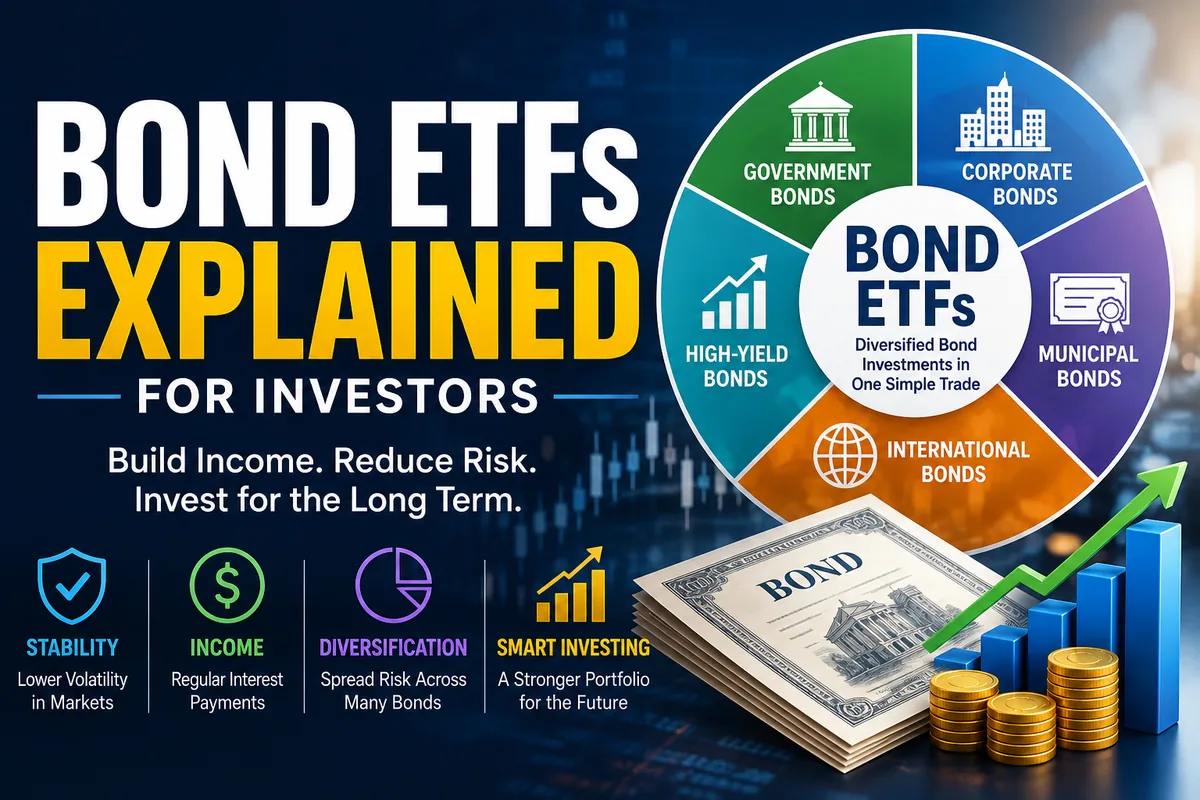
Introduction: Bond ETFs Explained
Investing can feel confusing when you first encounter terms such as bonds, bond yields, coupons, duration, interest rates, fixed income, credit quality, and Bond ETFs. Stocks represent ownership in companies, while bonds generally represent lending money to a government, corporation, or other issuer. Understanding this difference is the first step toward understanding how fixed-income investments work.
Bond ETFs Explained in simple terms means learning how exchange-traded funds package many individual bonds into one investment that can be bought and sold on a stock exchange. Instead of purchasing and managing dozens or hundreds of individual bonds yourself, a Bond ETF can provide exposure to a diversified portfolio of bonds through a single fund.
Bond ETFs can be useful for investors seeking income, diversification, portfolio stability, or exposure to specific parts of the bond market. However, they are not risk-free. Their prices can decline when interest rates rise, credit conditions deteriorate, inflation remains high, or investors become concerned about the underlying bonds.
In this complete guide, you will learn:
- What bonds are and how they work
- What Bond ETFs are
- Important bond terminology
- How Bond ETFs generate income
- Different types of Bond ETFs
- Why interest rates affect bond prices
- How duration affects Bond ETF volatility
- Bond ETF risks
- Bond ETFs versus individual bonds
- Bond ETFs versus stock ETFs
- Retirement and income strategies
- Real-world examples and case studies
- How to evaluate a Bond ETF before investing
- Common mistakes beginners should avoid
By the end, you should have a much clearer understanding of how Bond ETFs fit into a diversified investment portfolio.
What Is a Bond?
A bond is essentially a loan that an investor provides to an issuer.
When you purchase a bond, you are lending money to an organization such as:
- A government
- A corporation
- A municipality
- A financial institution
In exchange, the issuer generally agrees to pay interest according to the bond’s terms and return the principal at maturity.
For example, suppose a company issues a $1,000 bond with a 5% annual coupon and a 10-year maturity. If you purchase the bond at its face value and the issuer makes all required payments, you would generally receive $50 of annual coupon interest and receive the $1,000 principal when the bond matures.
However, a bond can trade at a price above or below its face value before maturity. This means the return an investor receives from buying a bond in the secondary market can differ from its original coupon rate.
Bonds are therefore not simply “fixed deposits.” Their market prices can change every trading day.
Simple Example of a Bond
Imagine that a government wants to raise $1 billion to finance infrastructure projects.
It could issue bonds to investors.
Suppose you purchase a $1,000 bond with:
- A 5% annual coupon
- A 10-year maturity
- A $1,000 face value
The 5% coupon means the bond is scheduled to pay $50 per year based on its $1,000 face value.
Over 10 years, you would receive $500 in coupon payments if the coupon payments remain unchanged and the issuer makes every payment. At maturity, the issuer would generally repay the $1,000 principal.
The important point is that the coupon rate and market yield are not always the same thing.
If the bond later trades for $900, an investor buying it at $900 could receive the same $50 annual coupon but would be paying less for those payments. Consequently, the investor’s yield based on the purchase price would be higher than 5%.
This relationship between bond prices and yields becomes extremely important when understanding Bond ETFs.
Important Bond Terms Explained
Understanding bond terminology makes Bond ETFs much easier to analyze.
1. Face Value (Par Value)
Face value, also called par value, is the amount the bond issuer promises to repay at maturity, subject to the bond’s terms and the issuer remaining able to meet its obligations.
A common example is a $1,000 bond.
The bond may trade for:
- $950
- $1,000
- $1,050
even though its face value remains $1,000.
2. Coupon Rate
The coupon rate is the stated annual interest rate applied to a bond’s face value.
For example:
- Face value = $1,000
- Coupon rate = 5%
Annual coupon interest:
$1,000 × 5% = $50
The coupon rate generally does not change for a traditional fixed-rate bond.
The bond’s market price, however, can change substantially.
3. Yield
Yield describes the income or return associated with a bond relative to its current market price or other calculation methodology.
For example, a $1,000 bond paying $50 annually has a 5% coupon rate. If its market price falls to $900, the $50 annual coupon represents a higher current yield relative to the $900 purchase price.
Bond ETF investors will encounter several yield measures, including distribution yield and SEC yield. These measurements are not necessarily interchangeable, so investors should understand exactly what a fund’s quoted yield represents.
4. Maturity
Maturity is the date when a bond reaches the end of its contractual term.
Examples include:
- 1-year bonds
- 3-year bonds
- 5-year bonds
- 10-year bonds
- 30-year bonds
Generally, longer-maturity bonds tend to have greater sensitivity to changes in interest rates, although the exact sensitivity depends on the bond’s duration and cash-flow characteristics.
5. Credit Rating
A credit rating attempts to measure the creditworthiness of a bond issuer or debt instrument.
Major credit-rating organizations include Moody’s, S&P Global Ratings, and Fitch Ratings.
Higher-quality bonds generally have lower perceived default risk and often offer lower yields. Lower-rated bonds generally need to offer higher yields to compensate investors for taking additional credit risk.
What Is a Bond ETF?
ETF stands for Exchange-Traded Fund.
A Bond ETF is an investment fund that holds a portfolio of bonds and whose shares trade on an exchange during market hours.
Instead of purchasing one individual bond, an investor can purchase shares of a Bond ETF and gain exposure to many bonds through one investment.
The ETF may hold:
- Government bonds
- Corporate bonds
- Municipal bonds
- Mortgage-related bonds
- International bonds
- High-yield bonds
depending on its investment objective.
A Bond ETF therefore combines characteristics of traditional bonds and exchange-traded funds.
Like a bond fund, it provides exposure to a portfolio of fixed-income securities. Like a stock ETF, its shares can generally be bought and sold throughout the trading day.
Simple Definition
A Bond ETF is a basket of bonds packaged into an exchange-traded investment fund.
For example, imagine a Bond ETF that holds 1,000 different corporate bonds.
Instead of researching and purchasing hundreds of individual bonds, an investor could buy shares of the ETF and obtain diversified exposure to the fund’s portfolio.
This can make fixed-income investing easier for beginners.
However, buying one Bond ETF does not automatically eliminate risk. The risk depends on what the ETF owns.
A Treasury ETF and a high-yield corporate Bond ETF can have very different risk characteristics.
Example of a Bond ETF
Suppose a Bond ETF owns hundreds of bonds issued by companies with different maturities and credit ratings.
An investor purchasing $10,000 of the ETF does not directly own a specific bond worth $10,000. Instead, the investor owns ETF shares representing a proportional interest in the fund.
The ETF’s value changes as:
- The underlying bond prices change
- Interest rates change
- Credit conditions change
- The fund receives interest income
- Investors buy or sell ETF shares
This diversification can reduce the impact of problems at any single issuer, although it cannot eliminate overall market risk.
Why Bond ETFs Became Popular
Traditional bond investing can require research into individual issuers, maturities, coupons, credit ratings, and market prices.
Bond ETFs simplify this process.
Major advantages can include:
- Diversification
- Lower entry barriers
- Intraday trading
- Portfolio transparency
- Professional portfolio management
- Access to specific bond-market segments
- Potentially low operating costs
Another important benefit is flexibility.
An investor may choose a short-duration Treasury ETF, an investment-grade corporate Bond ETF, or a high-yield ETF depending on the portfolio’s objective.
However, investors should always review the fund’s expense ratio, holdings, duration, credit quality, yield characteristics, and strategy before investing.
How Bond ETFs Work
A Bond ETF collects capital from investors and uses that capital to hold bonds according to its stated investment strategy.
The fund may track a bond index or use an active management strategy.
As bonds inside the portfolio pay interest, the fund receives that income. After accounting for expenses and fund operations, distributions may be paid to shareholders according to the fund’s schedule.
The market price of the ETF can change throughout the trading day.
It is also important to distinguish the ETF’s market price from its net asset value (NAV).
NAV represents the value of the fund’s underlying assets after liabilities. The ETF’s market price can trade slightly above or below NAV because of supply, demand, liquidity, and market conditions.
Bond ETF Income
Many Bond ETFs distribute income monthly, although distribution schedules vary by fund.
The income generally comes from interest generated by the bonds held by the fund.
Suppose an investor has $10,000 invested in a Bond ETF and the fund’s annualized income rate is approximately 4%.
A simplified illustration would be:
$10,000 × 4% = $400 per year
That would be approximately $33.33 per month if the income were perfectly consistent.
In reality, distributions can vary. A quoted yield is not a guaranteed future return, and investors should distinguish between income distributions and total return.
Total return can include:
- Income distributions
- Changes in ETF share price
This distinction is particularly important for retirees who depend on investment income.
Example
Imagine two Bond ETFs.
ETF A produces a 3.5% income rate and has relatively short-duration government bonds.
ETF B produces a 7% yield but invests primarily in lower-rated corporate debt.
At first glance, ETF B may look more attractive because it generates more income.
However, the higher yield exists partly because investors are being compensated for greater risk.
If the economy enters a recession and weaker companies experience financial problems, ETF B may experience larger price declines.
The lesson is simple: do not evaluate a Bond ETF by yield alone.
How Bond ETF Yields Are Calculated
Understanding bond yields is essential for fixed income investing because a fund’s advertised yield does not always equal the income an investor will receive or the return the investor will earn.
A bond ETF can report several yield measures. Investors should check the fund provider’s definition and calculation date before comparing funds.
Coupon Rate vs. Current Yield
The coupon rate is the stated annual interest on a bond relative to its face value. Current yield compares the bond’s annual coupon payments with its current market price.
For example, a bond with a $1,000 face value and a 5% annual coupon pays $50 per year. If its market price falls to $900, its current yield is approximately 5.56%, calculated as $50 divided by $900.
This calculation is a simple bond example, not a forecast of a bond ETF’s return. It excludes the effect of maturity, reinvestment, expenses, and possible default.
Distribution Yield vs. SEC Yield
Distribution yield generally estimates income distributions relative to a fund’s share price using the fund provider’s stated methodology. Depending on the methodology, it may reflect a recent distribution that is not representative of future payments.
SEC yield is a standardized measure used by many US bond funds. It estimates the income generated by a portfolio over a specified period, after fund expenses, using a prescribed calculation. It is useful for comparing many US bond funds, but it is not a guarantee of future distributions or total return.
Yield to maturity estimates the annualized return implied by a bond’s current price and expected cash flows if held to maturity and if the relevant assumptions hold. A traditional bond ETF, however, generally holds and replaces securities over time, so an investor’s actual ETF return can differ from the portfolio’s quoted yield to maturity.
How Investors Should Compare Bond ETF Yields
Before choosing a fund, compare its yield measure, duration, credit quality, expense ratio, and holdings. Check whether the yield is current and whether it includes the effects of fund expenses.
A high-yield corporate bond ETF should not be compared with a short-term Treasury ETF on yield alone. The corporate fund may expose investors to greater default risk and larger losses during periods of economic stress.
The key lesson is that bond yields help investors evaluate income potential, but yield is only one part of the total-return and risk analysis.
Types of Bonds Inside Bond ETFs
Different Bond ETFs invest in different categories of fixed-income securities.
1. Government Bond ETFs
Government Bond ETFs invest primarily in government-issued debt.
Examples include:
- U.S. Treasury bonds
- UK government bonds
- Indian government securities
- Other sovereign debt
Government Bond ETFs can be used by investors seeking relatively high credit quality, although the risk level depends on the country, maturity, inflation environment, currency, and specific securities held.
Characteristics
Potential advantages include:
- Lower default risk for highly creditworthy sovereign issuers
- Portfolio diversification
- Regular interest income
- Potential defensive characteristics in certain economic environments
A major disadvantage is that government bonds can still decline in market value when interest rates rise.
Real Example
Suppose an investor owns a long-duration government Bond ETF.
Interest rates rise significantly.
Newly issued bonds now offer higher yields. Existing bonds with lower yields become less attractive, causing their market prices to decline.
The ETF’s price can therefore fall even though the government has not defaulted.
2. Corporate Bond ETFs
Corporate Bond ETFs invest in debt issued by companies.
Companies issue bonds to finance:
- Expansion
- Acquisitions
- Capital expenditures
- Refinancing
- General business operations
Corporate bonds usually offer higher yields than comparable government bonds because investors take additional credit risk.
Advantages
Potential advantages include:
- Higher income potential
- Diversification across many companies
- Access to corporate debt without buying individual bonds
Risks
Corporate Bond ETFs are exposed to credit risk.
If economic conditions deteriorate, companies with weaker balance sheets may have greater difficulty meeting their obligations.
Credit spreads can also widen during periods of financial stress, causing corporate bond prices to fall.
Case Study: Corporate Bonds During Recession
Imagine an investor owns a diversified corporate Bond ETF before a recession.
During the recession:
- Corporate profits decline
- Default concerns increase
- Credit spreads widen
- Investors become more defensive
The ETF could decline even if some of the individual companies eventually recover.
At the same time, high-quality government bonds may perform differently.
This illustrates why the words “bond” and “safe” should never automatically be treated as synonyms.
3. Municipal Bond ETFs
Municipal Bond ETFs invest in debt issued by states, cities, counties, and other public entities.
The money may finance:
- Schools
- Roads
- Public transportation
- Water systems
- Infrastructure projects
In the United States, certain municipal bond income may receive favorable tax treatment depending on the investor’s circumstances and the specific bond.
Investors should always consider their own tax situation before choosing municipal bonds.
4. High-Yield Bond ETFs
High-Yield Bond ETFs invest in bonds issued by companies or entities with lower credit ratings.
They are commonly called junk bond ETFs.
Because these bonds have greater credit risk, they generally offer higher yields than higher-quality bonds.
Why Higher Yield?
Investors demand additional compensation when taking additional risk.
For example:
A high-quality government bond might offer a relatively low yield, while a lower-rated corporate bond might offer a much higher yield.
The additional yield is compensation for risks such as:
- Default
- Credit deterioration
- Economic recession
- Greater price volatility
Risks of High-Yield Bond ETFs
High-yield funds can experience substantial price declines during economic downturns.
They may behave more like risk assets than traditional high-quality government bonds.
This makes them unsuitable as a direct substitute for cash or guaranteed savings.
Example
Suppose:
- Government bond yield = 3%
- High-yield bond ETF yield = 8%
The 8% yield does not mean the investor receives a free additional 5%.
The market is pricing additional risk into the higher yield.
5. International Bond ETFs
International Bond ETFs invest in bonds issued outside an investor’s domestic market.
They can provide exposure to:
- European bonds
- Japanese bonds
- Emerging-market bonds
- Other international debt markets
Benefits
Potential benefits include:
- Global diversification
- Exposure to different interest-rate environments
- Geographic diversification
- Additional income opportunities
Risks
International investing introduces additional risks.
These can include:
- Currency fluctuations
- Political uncertainty
- Different monetary policies
- Foreign economic conditions
- Different regulatory environments
Currency movements can either increase or reduce an investor’s return.
Understanding Interest Rates and Bond ETFs
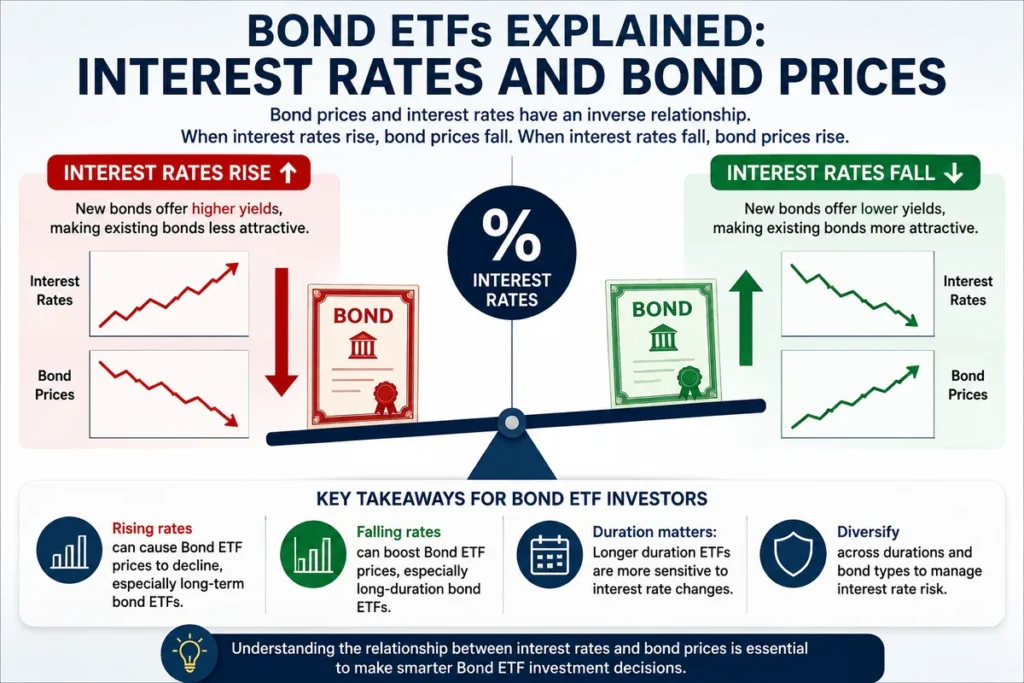
Interest rates are one of the most important factors affecting Bond ETF prices.
A traditional fixed-rate bond generally becomes less attractive when newly issued bonds offer significantly higher rates.
As a result, existing bond prices generally need to adjust.
Relationship Between Rates and Bonds
The basic relationship is:
- When market interest rates rise, existing fixed-rate bond prices generally fall.
- When market interest rates fall, existing fixed-rate bond prices generally rise.
The relationship is not perfectly identical for every bond or ETF, but it is a fundamental principle of fixed-income investing.
Why Does This Happen?
Suppose you own a bond paying $30 per year.
Now imagine that new bonds with similar risk begin paying $50 per year.
An investor would generally prefer the newer bond.
To make the older $30 bond competitive, its market price may fall.
The coupon has not necessarily changed. The market price changes instead.
Example
Imagine:
Old bond:
- Face value = $1,000
- Coupon = 3%
- Annual coupon = $30
New comparable bond:
- Face value = $1,000
- Coupon = 5%
- Annual coupon = $50
The old bond’s price may need to decline so that a buyer receives a more competitive market yield.
This is one of the most important concepts for anyone investing in Bond ETFs.
Bond ETF Impact
Because Bond ETFs own many bonds, changes in interest rates can affect the entire portfolio.
A short-duration ETF may experience relatively small price movements when rates change.
A long-duration ETF may experience much larger movements.
This is why investors should examine duration before investing.
Duration Explained
Duration is a measure of a bond or bond portfolio’s sensitivity to changes in interest rates.
In general:
Higher duration = greater interest-rate sensitivity.
Lower duration = lower interest-rate sensitivity.
For example, imagine two Bond ETFs.
ETF A has a duration of approximately 2 years.
ETF B has a duration of approximately 10 years.
If interest rates rise substantially, ETF B would generally be expected to experience a larger price decline than ETF A, all else being equal.
Duration is therefore an important risk-management tool.
It can help investors understand how strongly a Bond ETF’s price may react to changes in market yields.
Example
Suppose a long-duration Bond ETF has a duration of approximately 10 years.
As a simplified illustration, a 1-percentage-point increase in yields could correspond to roughly a 10% decline in price before considering other factors.
This is only an approximation, not a guarantee. Actual results depend on convexity, cash flows, yield-curve movements, portfolio composition, and other factors.
Case Study: Interest Rate Hikes
During periods when central banks rapidly increase interest rates, existing bonds can experience significant price declines.
Consider an investor who believed bonds could never lose money.
They purchase a long-duration Bond ETF expecting stability.
Then interest rates rise rapidly.
The ETF’s underlying bonds lose market value, causing the ETF share price to fall.
The investor has not necessarily suffered a permanent loss if the fund’s underlying bonds remain solvent and market conditions eventually change, but the investor can still experience substantial temporary or permanent losses depending on when they sell and the securities held.
The lesson is that Bond ETFs can decline in value even when they hold high-quality bonds.
Bond ETF vs Individual Bonds
Many beginners ask whether they should buy individual bonds or Bond ETFs.
Individual bonds offer a defined maturity date and specific contractual terms.
Bond ETFs provide diversification and easier trading.
| Feature | Individual Bonds | Bond ETFs |
|---|---|---|
| Diversification | Usually lower | Usually higher |
| Liquidity | Can vary | Generally easy to trade |
| Minimum investment | Can be higher | Often accessible with small amounts |
| Trading simplicity | Requires research | Generally simpler |
| Maturity date | Specific | Usually no single maturity |
| Management | Self-managed | Managed according to fund strategy |
Important Difference
An individual bond has a maturity date.
If you hold an individual bond until maturity and the issuer fulfills its obligations, you generally receive the stated principal.
A traditional Bond ETF generally does not have one final maturity date.
The fund continuously holds, buys, sells, or replaces bonds according to its strategy.
This means Bond ETFs can maintain relatively consistent duration or maturity exposure instead of simply reaching one final maturity date.
Bond ETF Risks Explained
Bond ETFs are not risk-free.
Understanding the risks before investing is essential.
1. Interest Rate Risk
Interest-rate risk is the possibility that changes in market interest rates will reduce the value of existing bonds.
Long-duration Bond ETFs generally have greater interest-rate sensitivity than short-duration ETFs.
2. Credit Risk
Credit risk is the possibility that an issuer cannot make required interest or principal payments.
Credit risk is generally more important for corporate, high-yield, and certain emerging-market bond funds than for highly creditworthy government securities.
3. Inflation Risk
Inflation reduces the purchasing power of future income.
Suppose a Bond ETF generates a 4% nominal return while inflation is 6%.
A simplified real-return calculation would be approximately: 4% – 6% = -2%
The actual real return calculation is slightly different, but the example demonstrates the problem.
4. Liquidity Risk
Liquidity refers to how easily an investment can be bought or sold without causing a significant price impact.
Bond markets can become less liquid during periods of financial stress.
The ETF itself may continue trading, but the underlying bonds may become harder or more expensive to trade.
5. Currency Risk
International Bond ETFs may expose investors to foreign currencies.
If the foreign currency declines against the investor’s home currency, it can reduce the investor’s return. Bond ETF investors may pay more than the fund’s midpoint value when buying and receive less when selling because of the bid-ask spread. The SEC’s ETF investor bulletin explains how ETF trading prices and net asset value can differ.
Why Investors Use Bond ETFs
Despite their risks, Bond ETFs can serve several important portfolio functions.
1. Passive Income
Bond ETFs can distribute interest income.
This can be useful for:
- Retirees
- Income-focused investors
- Conservative investors
- Investors building diversified portfolios
However, distributions are not guaranteed and can change over time.
2. Portfolio Stability
Bonds can reduce portfolio volatility when combined with stocks.
Example
Consider two hypothetical portfolios.
Portfolio A:
- 100% stocks
Portfolio B:
- 70% stocks
- 30% bonds
During a major stock-market decline, Portfolio B may experience a smaller overall decline if its bond allocation holds up better than stocks.
This does not happen in every market environment.
3. Diversification
Diversification means spreading investments across different assets, issuers, sectors, and risk factors.
A Bond ETF may hold hundreds or thousands of securities.
If one company experiences financial difficulties, its impact on the entire diversified fund may be limited.
4. Capital Preservation
High-quality, short-duration government Bond ETFs can be used by investors seeking relatively lower-risk fixed-income exposure.
However, capital preservation is not guaranteed.
Even high-quality Bond ETFs can decline in market value.
Bond ETFs vs Stock ETFs
| Feature | Bond ETFs | Stock ETFs |
|---|---|---|
| Main purpose | Income and diversification | Long-term growth |
| Risk level | Varies; often lower than stocks | Generally higher |
| Volatility | Often lower | Often higher |
| Potential return | Generally moderate | Generally higher long-term potential |
| Income | Interest distributions | Dividends and other distributions |
| Recession behavior | Depends on bond type | Often more volatile |
The two types of ETFs can complement each other.
Stocks can provide long-term growth potential, while bonds can provide income and diversification.
Should Young Investors Buy Bond ETFs?
There is no universal allocation that is appropriate for every investor.
Young investors often have a longer investment horizon and may therefore tolerate greater stock-market volatility.
However, a small bond allocation can still provide diversification and help investors remain disciplined during market downturns.
The appropriate allocation depends on:
- Risk tolerance
- Investment horizon
- Financial goals
- Income needs
- Emergency savings
- Overall financial situation
Example Portfolio by Age
Age 25
A hypothetical aggressive investor might choose a portfolio with a high stock allocation and a smaller Bond ETF allocation.
For example:
- 90% stocks
- 10% bonds
This is only an illustration, not a recommendation.
Age 45
An investor with a medium-to-long time horizon might use a more balanced allocation.
Example:
- 70% stocks
- 30% bonds
Age 65
An investor approaching or living in retirement may prioritize income and stability more heavily.
A hypothetical allocation might be:
- 40% stocks
- 60% bonds
Age alone should not determine asset allocation. Spending needs, other income sources, risk tolerance, and financial objectives also matter.
The 60/40 Portfolio
The 60/40 portfolio is a well-known asset-allocation concept consisting of approximately:
- 60% stocks
- 40% bonds
The idea is to combine growth-oriented assets with relatively defensive fixed-income assets.
During strong stock markets, the stock portion can drive growth.
During periods of stock-market weakness, the bond allocation may provide diversification.
The strategy is not guaranteed to outperform, and stocks and bonds can sometimes decline together.
Bond ETF Expense Ratio Explained
The expense ratio is the annual operating cost charged by a fund, expressed as a percentage of assets.
Suppose:
- Investment = $10,000
- Expense ratio = 0.10%
A simplified annual cost would be:
$10,000 × 0.10% = $10
The fee is generally reflected in the fund’s returns rather than being separately billed to the investor.
Lower costs can help investors retain more of their investment returns over long periods, assuming other factors are comparable.
Example
Consider two similar Bond ETFs.
ETF A:
- Expense ratio = 0.10%
ETF B:
- Expense ratio = 0.50%
If their underlying investments and performance were otherwise identical, ETF A would leave more of the return with investors.
Fees should therefore be considered alongside duration, credit quality, yield, liquidity, and investment strategy.
Bond ETF Taxation: What Investors Should Know
Taxes can affect the amount of income an investor keeps from a bond ETF. The treatment depends on the country of tax residence, the type of bonds held, the investor’s account, and the character of the fund’s distributions.
Interest Income and Capital Gains
Bond ETF distributions may include income generated by the fund’s holdings. An investor may also realize a capital gain or loss when selling ETF shares for more or less than their adjusted purchase cost. Some funds may distribute capital gains generated when they sell portfolio assets.
These categories are not necessarily taxed in the same way. Investors should review their annual tax statements and the fund’s official tax information rather than assuming that every distribution receives the same treatment.
US Investors: Treasury and Municipal Bond Considerations
For US taxpayers, interest on US Treasury securities is generally subject to federal income tax but exempt from state and local income taxes. The Internal Revenue Service explains the general rules for interest income in its Topic 403: Interest Received. A fund holding Treasury securities may distribute income with different tax characteristics from a fund holding corporate bonds.
Certain municipal-bond income may qualify for favorable federal tax treatment, but the treatment depends on the bonds, the fund’s distributions, and the investor’s circumstances. Some income may be subject to special rules, including alternative minimum tax considerations.
Investors should also consult the fund’s official annual tax information and IRS Publication 550 where relevant. The tax treatment of a bond ETF distribution depends on its source and the investor’s circumstances. A fund holding Treasuries can distribute income with different tax characteristics from a fund holding corporate bonds.
Certain municipal-bond income may qualify for favorable federal tax treatment, but the treatment depends on the bonds, the fund’s distributions, and the investor’s circumstances. Some income can be subject to special rules, including alternative minimum tax considerations.
Investors can consult the IRS guidance on interest received and IRS Publication 550 for further details.
International Investors: Check Local Rules
Tax treatment differs across countries. Investors in the United Kingdom, Canada, Australia, India, and other jurisdictions should check their local rules on foreign fund distributions, capital gains, withholding taxes, currency conversion, and any applicable tax-account arrangements.
Do not assume that US municipal-bond tax benefits automatically apply to a non-US investor.
Compare After-Tax Outcomes
When evaluating two bond ETFs, consider the expected income, expense ratio, credit quality, duration, and the tax treatment applicable to your own circumstances. A fund with a higher quoted yield may not provide the higher after-tax outcome.
Tax rules change and individual circumstances vary. This section is educational, not tax advice; investors should consult current official guidance or a qualified tax professional before making tax-sensitive decisions.
Active vs Passive Bond ETFs
Bond ETFs can use either passive or active investment approaches.
Passive Bond ETFs
Passive Bond ETFs generally attempt to track an index.
Advantages can include:
- Lower costs
- Transparent methodology
- Predictable portfolio rules
- Broad market exposure
The fund does not necessarily try to outperform the market through individual security selection.
Active Bond ETFs
Active Bond ETFs give portfolio managers greater flexibility to select securities.
Managers may consider:
- Credit quality
- Interest rates
- Economic conditions
- Duration
- Yield spreads
- Individual issuers
Potential advantages include flexibility and the possibility of outperforming a benchmark.
Potential disadvantages include higher costs, manager risk, and the possibility of underperformance.
Investment Grade vs Junk Bonds
Investment Grade
Investment-grade bonds have relatively strong credit ratings according to recognized rating methodologies.
They generally carry lower expected credit risk than lower-rated debt.
The trade-off is often lower yields.
Junk Bonds
Junk bonds are lower-rated bonds with greater credit risk.
They usually offer higher yields to compensate investors for accepting that additional risk.
Real-World Example
During a strong economy, investors may become more comfortable taking credit risk, potentially supporting high-yield bonds.
During a recession, investors may become more concerned about defaults.
Credit spreads can widen, causing high-yield Bond ETFs to fall.
Therefore, high-yield Bond ETFs should not automatically be considered a conservative alternative to stock ETFs.
Inflation-Protected Bond ETFs
Inflation-protected Bond ETFs invest in securities designed to provide some protection against inflation.
One well-known example in the United States is Treasury Inflation-Protected Securities, commonly called TIPS.
TIPS are structured so that their principal value adjusts with inflation according to government rules.
Inflation-protected funds can therefore play a role in portfolios where purchasing-power risk is an important concern.
They are not a guarantee against every form of inflation-related loss.
Bond ETF Strategies
Different investors use Bond ETFs for different purposes.
1. Income Strategy
The goal is to generate regular investment income.
Investors may focus on Bond ETFs with attractive distribution characteristics while still considering credit quality and duration.
2. Safety Strategy
The goal is to reduce risk.
Investors may focus on:
- High-quality government bonds
- Short-duration bonds
- Investment-grade securities
The objective is generally stability rather than maximum yield.
3. Diversification Strategy
The goal is to combine different asset classes.
An investor may hold:
- Domestic stocks
- International stocks
- Government Bond ETFs
- Corporate Bond ETFs
The combination can create a more diversified portfolio.
4. Interest Rate Strategy
Some investors adjust bond duration based on their expectations for interest rates.
For example, an investor concerned about rising rates may prefer shorter-duration bonds.
An investor expecting falling rates may consider longer-duration exposure.
Trying to predict interest rates consistently is difficult, so this approach carries additional timing risk.
Best Bond ETF Strategies During Inflation
Inflation can reduce the purchasing power of fixed interest payments. It can also influence central-bank policy, market yields, and the prices of existing bonds. The most appropriate bond ETF strategy therefore depends on whether the investor needs current income, short-term stability, or longer-term inflation protection.
Consider Shorter-Duration Exposure
Short-duration bond ETFs generally have less sensitivity to interest-rate changes than longer-duration funds, all else being equal. This can be useful when an investor is concerned that market yields may rise further.
However, shorter duration does not eliminate inflation risk. If the income earned on the investment fails to keep pace with inflation, purchasing power can still decline. Short-duration funds also may offer less price appreciation than longer-duration funds if yields fall.
Understand Inflation-Protected Securities
US Treasury Inflation-Protected Securities (TIPS) adjust their principal according to changes in the Consumer Price Index under Treasury rules. ETFs that hold TIPS provide access to a portfolio of these securities without requiring the investor to buy individual issues.
TIPS funds can still decline in market value. Their prices respond to real interest rates, inflation expectations, duration, and market conditions. Inflation protection at the individual-security level does not mean a TIPS ETF’s share price will always rise when reported inflation increases.
Avoid Relying on One Inflation Forecast
Investors should be cautious about moving their entire fixed-income allocation based on a single inflation report or interest-rate prediction. A diversified approach can spread exposure across different maturities and credit categories while keeping the portfolio aligned with its intended risk level.
Review the fund’s duration, credit quality, inflation linkage, costs, and role in the overall portfolio. The goal is to manage inflation-related risks rather than to assume that one fund will outperform in every inflationary environment.
Laddering vs. Bond ETF Investing
A bond ladder and a traditional bond ETF solve related but different investment problems.
How a Bond Ladder Works
A bond ladder holds individual bonds with different maturity dates. When a bond matures, the investor receives its principal if the issuer meets its obligations. The investor can then use the proceeds or reinvest them in a new bond at the prevailing market yield.
A ladder can help spread reinvestment dates over time. However, it still carries credit, inflation, and interest-rate risks, and selling an individual bond before maturity may result in a loss.
How a Traditional Bond ETF Differs
A traditional bond ETF generally maintains exposure to a portfolio rather than allowing the whole investment to mature on one specified date. The fund buys and sells bonds according to its mandate, so the investor normally does not receive a fixed principal repayment date for the ETF shares.
Bond ETFs may offer diversification and convenient exchange trading. Individual-bond ladders may offer more control over specific maturity dates and cash-flow timing, but they can require more research and may involve transaction costs or minimum purchase sizes.
Which Approach May Fit Different Goals?
An investor who needs cash for a known expense at a specific future date may value the maturity schedule of suitable individual bonds, provided the credit risk and cash-flow timing are understood. An investor seeking diversified, ongoing fixed-income exposure may prefer a bond ETF.
Defined-maturity or target-maturity bond ETFs are another category to investigate. These funds have a stated target year and are designed to wind down around that time, subject to their terms; they are not the same as a guarantee of principal.
The decision should be based on cash-flow needs, diversification, costs, taxes, and risk tolerance not on the assumption that one structure is always safer.
Ladder Strategy Explained
A bond ladder spreads investments across different maturity dates.
For example:
- 1-year bonds
- 3-year bonds
- 5-year bonds
- 10-year bonds
As shorter bonds mature, the investor can reinvest the proceeds.
The objective is to reduce the risk of having all investments mature at the same time.
A traditional Bond ETF is different because it generally does not have one fixed maturity date.
Investors who want a specific maturity schedule should understand the difference between traditional Bond ETFs and defined-maturity or target-maturity bond funds.
Illustrative Hypothetical Example: Retired Investor
Consider John, a hypothetical 68-year-old investor with $500,000 invested.
His primary objectives are:
- Generate income
- Reduce portfolio volatility
- Maintain purchasing power
- Avoid excessive portfolio risk
Suppose his portfolio includes stocks and Bond ETFs.
During a stock-market decline, the bond portion may help reduce the overall portfolio decline, depending on the type of bonds held and market conditions.
The Bond ETF distributions may also provide income that can help fund living expenses.
However, John still needs to consider inflation, taxes, withdrawal rates, healthcare expenses, and the possibility that bonds and stocks could both decline.
The lesson is that Bond ETFs can be one component of a retirement plan, rather than a complete retirement strategy by themselves.
Illustrative Hypothetical Example: Young Investor
Sarah is 28 and has several decades before retirement.
She wants long-term growth but dislikes seeing her portfolio fall sharply during market crashes.
She chooses a hypothetical allocation of:
- 90% stock ETFs
- 10% Bond ETFs
The Bond ETF allocation is not primarily intended to maximize returns.
Instead, it provides diversification and may make the overall portfolio easier for Sarah to manage emotionally.
If the stock market falls substantially, the smaller bond allocation may provide some stability.
The important lesson is that the “right” Bond ETF allocation depends on the individual investor rather than age alone.
Bond ETF Performance During Crashes
Bond ETFs can behave differently during market crashes.
High-quality government bonds may benefit when investors seek safety and interest rates decline.
However, corporate and high-yield Bond ETFs can fall alongside stocks when investors become concerned about economic growth and defaults.
During an inflation shock, both stocks and traditional bonds can also decline.
Therefore, investors should never assume that every Bond ETF will automatically rise whenever stocks fall.
Important Lesson
The word “bond” does not mean “guaranteed.”
A Bond ETF can lose value.
The size of the potential decline depends on factors such as:
- Duration
- Credit quality
- Interest rates
- Inflation
- Liquidity
- Currency exposure
- Economic conditions
Bond ETFs During Recessions: Historical Lessons
Bond ETFs do not all react the same way during a recession. The outcome depends on whether investors are worried mainly about economic growth and corporate defaults, inflation and rising interest rates, or a combination of these risks.
Historical Case Study 1: The 2020 COVID-19 Market Shock
During the early stages of the COVID-19 pandemic in February and March 2020, financial markets experienced severe volatility. Treasury yields fell, corporate-bond spreads widened, and trading conditions deteriorated in several markets. The Federal Reserve’s June 2020 Monetary Policy Report documents these developments and the financial-market strains that followed the outbreak.
For bond ETF investors, this episode illustrates why a fund’s market price, liquidity and underlying bond-market conditions matter during periods of stress. The experience of one bond ETF, however, depends on its holdings, duration, credit quality and trading conditions.
Historical Case Study 2: The 2022 Bond-Market Sell-Off
In 2022, persistent inflation and expectations of tighter monetary policy contributed to a sharp increase in Treasury yields and corporate bond yields. The Federal Reserve’s June 2022 Monetary Policy Report documents the rise in Treasury yields across maturities, tighter financial conditions and increases in corporate bond yields.
This episode illustrates a key risk for bond ETF investors: when market interest rates rise, the prices of existing bonds generally fall, all else being equal. The effect on an individual ETF depends on its duration, credit quality and holdings. A fund’s actual return also depends on income received and changes in its market price.
What This Means for Recession Planning
Rather than trying to predict exactly when a recession will begin, investors can evaluate their bond allocation before market conditions deteriorate.
- High-quality government bonds: May provide diversification in some growth shocks, but can decline when inflation or yields rise.
- Investment-grade corporate bonds: Add corporate credit exposure, which can become more costly during financial stress.
- High-yield bond ETFs: May suffer from widening credit spreads and greater default concerns.
- Short-duration bond ETFs: Generally have less interest-rate sensitivity, but they are not immune to losses.
- International bond ETFs: Add currency and country-specific risks unless exposures are appropriately hedged.
Sources for further reading: the Federal Reserve’s 2020 Monetary Policy Report and 2022 Monetary Policy Report.
Common Beginner Mistakes
1. Ignoring Interest Rates
Investors sometimes purchase long-duration Bond ETFs because they appear safe without understanding their interest-rate sensitivity.
Understanding duration can help prevent this mistake.
2. Chasing High Yield
A high yield can be attractive, but it usually comes with additional risk.
Investors should ask:
- Why is the yield high?
- What is the credit quality?
- How long is the duration?
- How volatile has the fund been?
- What securities does it own?
3. No Diversification
Putting an entire fixed-income allocation into one risky bond category can create unnecessary concentration.
Diversification across issuers, sectors, and maturities can help manage some risks.
4. Panic Selling
Bond ETFs trade throughout the day, so their prices can fluctuate.
Investors who sell during temporary market declines may turn paper losses into permanent losses.
A better approach is to understand the investment objective and risk before purchasing.
How to Evaluate a Bond ETF
Before investing, investors should examine several characteristics.
1. Yield
Look at the fund’s stated yield and understand how it is calculated. Do not assume the quoted yield represents a guaranteed future return.
2. Duration
Duration helps estimate sensitivity to changes in interest rates. A higher duration generally means greater interest-rate sensitivity.
3. Credit Quality
Review whether the fund invests in:
- Government securities
- Investment-grade corporate bonds
- High-yield bonds
- Emerging-market debt
Credit quality can significantly affect risk.
4. Expense Ratio
Compare the fund’s operating costs with similar Bond ETFs. A lower expense ratio can be beneficial when funds are otherwise comparable.
5. Holdings
Always examine what the ETF actually owns.
Two funds with similar names can have significantly different:
- Maturities
- Credit ratings
- Countries
- Sectors
- Durations
- Yield characteristics
Reading the fund’s official holdings and prospectus can help investors understand what they are purchasing.
Real-World Comparison: Four Bond ETFs
The following comparison shows how bond ETFs can differ in interest-rate sensitivity, credit exposure, costs, and yield. The examples are four U.S.-listed iShares ETFs covering short-term Treasury bonds, intermediate-term Treasury bonds, investment-grade corporate bonds, and high-yield corporate bonds.
Bond ETF Comparison Table
| ETF | Bond exposure | Effective duration | 30-day SEC yield | Expense ratio |
|---|---|---|---|---|
| SHY | Short-term U.S. Treasuries | 1.82 years | 4.66% | 0.15% |
| IEF | Intermediate-term U.S. Treasuries | 6.85 years | 5.02% | 0.15% |
| LQD | Investment-grade corporate bonds | 7.51 years | 6.01% | 0.14% |
| HYG | High-yield corporate bonds | 3.20 years | 7.32% | 0.49% |
Data source and date note: Data checked on October 19, 2026, using the official iShares fund pages linked above. Yield and effective-duration figures have individual reporting dates, which are noted in the accompanying source details. Expense ratios are taken from the fund providers’ published information. These figures can change; check the latest fund pages before making investment decisions.
The 30-day SEC yield is a standardized measure of recent fund income after expenses, not a guaranteed return. Effective duration estimates sensitivity to interest-rate changes. Corporate bond funds also carry credit risk, and high-yield bonds generally have greater credit risk than investment-grade bonds or U.S. Treasury securities.
How to Interpret the Comparison
SHY — Short-term Treasury exposure: Its relatively short duration indicates lower sensitivity to interest-rate changes than the longer-duration Treasury and investment-grade corporate funds in this comparison. It still has market risk, and its income can change as its holdings mature and are replaced.
IEF — Intermediate-term Treasury exposure: Its longer duration means its price is generally more sensitive to changes in interest rates than SHY’s. U.S. Treasury credit exposure differs from corporate credit exposure, but Treasury ETFs can still lose value when yields rise.
LQD — Investment-grade corporate bonds: This fund adds corporate credit exposure while maintaining a relatively long duration. Its returns can be affected by both changes in Treasury yields and changes in the additional yield investors demand for corporate credit risk.
HYG — High-yield corporate bonds: Its higher quoted SEC yield comes with greater exposure to below-investment-grade issuers, including default and credit-spread risks. A higher yield is not a guarantee of a higher total return.
Popular Bond ETF Categories
Major Bond ETF categories include:
- Treasury ETFs
- Corporate Bond ETFs
- Investment-grade Bond ETFs
- High-yield Bond ETFs
- Municipal Bond ETFs
- International Bond ETFs
- Emerging-market Bond ETFs
- Inflation-protected Bond ETFs
- Short-duration Bond ETFs
- Intermediate-duration Bond ETFs
- Long-duration Bond ETFs
Each category serves a different purpose.
There is no universally “best” Bond ETF because the appropriate fund depends on an investor’s objective, risk tolerance, time horizon, tax situation, and overall portfolio.
Why Bond ETFs Matter in Retirement
Retirement investors often have different priorities from younger investors.
During the accumulation stage, an investor may focus heavily on growth.
During retirement, the investor may need to balance:
- Income
- Capital preservation
- Inflation protection
- Liquidity
- Longevity risk
- Portfolio growth
Bond ETFs can help provide diversification and income, but they should be selected carefully.
For example, a retiree who needs money within a few years may prefer relatively short-duration, high-quality fixed-income investments rather than taking substantial high-yield or long-duration risk.
The correct choice depends on the investor’s complete financial plan.
Psychological Benefits of Bonds
Investment decisions are not purely mathematical.
Large portfolio declines can cause investors to panic.
A diversified bond allocation may help some investors remain invested during stock-market volatility.
For example, an investor with a 100% stock portfolio may experience a large decline and become uncomfortable enough to sell.
An investor with a diversified portfolio containing stocks and bonds may experience a smaller overall decline and find it easier to stay committed to the strategy.
This psychological benefit can be important because investor behavior can have a major impact on long-term results.
Bond ETFs During Inflation
Inflation can create a difficult environment for traditional fixed-rate bonds.
When consumer prices rise rapidly, fixed interest payments may lose purchasing power.
For example, receiving $400 of annual interest sounds attractive until inflation significantly reduces what that $400 can purchase.
Investors may therefore consider:
- Short-duration bonds
- Inflation-protected securities
- Diversified asset allocations
- Different bond maturities
Inflation does not affect every Bond ETF in exactly the same way.
Are Bond ETFs Safe?
Bond ETFs can be relatively conservative or relatively aggressive depending on what they hold.
A short-duration government Bond ETF and a high-yield emerging-market Bond ETF should not be treated as equivalent investments.
Before purchasing a Bond ETF, consider:
- Bond type
- Credit quality
- Duration
- Yield
- Currency exposure
- Expense ratio
- Liquidity
- Investment objective
Bond ETFs are therefore better described as risk-managed investment tools, not risk-free investments.
Future of Bond ETFs
Bond ETFs have become an important part of modern investing because they make fixed-income markets more accessible.
Investors can use them for:
- Income
- Diversification
- Retirement planning
- Portfolio construction
- Interest-rate exposure
- Inflation protection
As passive investing and exchange-traded products continue developing, investors have access to increasingly specialized fixed-income strategies.
However, greater choice also means investors need to understand what they are buying.
A fund’s name alone does not tell you its complete risk profile.
2026 Bond Market Outlook: Scenarios, Risks, and What to Watch
The bond market outlook for 2026 depends on inflation, economic growth, central-bank policy, government borrowing, and investors’ demand for bonds. These factors can affect Treasury yields, corporate credit spreads, bond ETF prices, and the income available to new investors.
U.S. Treasury Yields and the Bond ETF Outlook
Treasury yields change daily, so investors should check the observation date before using a yield figure to assess the bond market. For example, the U.S. Department of the Treasury reported a 10-year Treasury par yield of 5.09% on October 16, 2026. This is a dated market reference, not a forecast or a guaranteed return from a bond ETF. See the U.S. Treasury’s daily Treasury yield curve data.
For bond ETF investors, changes in Treasury yields can affect bond prices, but the impact depends on the fund’s duration, credit exposure, and portfolio composition. A Treasury yield should not be confused with a bond ETF’s distribution yield or SEC yield.
U.S. Inflation and Bond ETFs
According to the U.S. Bureau of Labor Statistics, the Consumer Price Index for All Urban Consumers (CPI-U) rose 3.7% over the 12 months ending September 2026. On a seasonally adjusted basis, the index increased 0.6% in September 2026. These figures measure different periods and should not be treated as interchangeable. See the official September 2026 CPI release from the U.S. Bureau of Labor Statistics.
Inflation can reduce the purchasing power of fixed interest payments and bond principal. However, the effect on a bond ETF depends on its holdings, duration, inflation expectations, and changes in market interest rates. Inflation data alone cannot predict the future performance of a bond ETF.
What Bond ETF Investors Should Monitor
Investors following the 2026 bond market can monitor:
- Official inflation and employment releases.
- Federal Reserve policy statements and economic projections.
- Treasury yields across short-, intermediate-, and long-term maturities.
- Credit spreads and changes in corporate credit quality.
- Fund duration, yield measures, expense ratios, and portfolio holdings.
- ETF bid–ask spreads and premiums or discounts to net asset value.
The purpose of monitoring these indicators is to understand risk, not to predict every market move. Investors should avoid building a portfolio around one interest-rate forecast. The right fixed-income allocation depends on the investment horizon, cash-flow needs, risk tolerance, and the role bonds play in a diversified portfolio.
This outlook is educational and reflects information available at the time of writing. It is not a guarantee of future bond-market performance. Update this section whenever the cited data or outlook materially changes.
Technology and Bond ETFs
Modern investment platforms have made it easier for investors to research and trade Bond ETFs.
Investors can generally:
- Compare funds
- Review holdings
- Examine historical performance
- Monitor yields
- Check expense ratios
- Buy and sell ETF shares
- Reinvest distributions
This accessibility has made fixed-income investing more convenient for individual investors.
However, easy access should not replace careful research.
Investors should read the fund’s official documentation and understand its strategy before investing.
Frequently Asked Questions About Bond ETFs
Are Bond ETFs safe?
Bond ETFs can be less volatile than many stock investments, but they are not risk-free. Their risk depends on interest rates, duration, credit quality, inflation, liquidity, and the underlying securities.
Can Bond ETFs lose money?
Yes. Bond ETF prices can fall when interest rates rise, credit conditions deteriorate, inflation increases, or market liquidity weakens.
How do Bond ETFs make money?
Bond ETFs generally receive interest from the bonds they hold. Investors can potentially earn income distributions and may also experience gains or losses from changes in the ETF’s market price.
Do Bond ETFs pay monthly income?
Many Bond ETFs distribute income monthly, but not every fund follows the same schedule. Distribution amounts can also change.
What happens to Bond ETFs when interest rates rise?
Bond prices generally fall when market interest rates rise. Therefore, Bond ETFs holding fixed-rate bonds can decline in price, with longer-duration funds generally being more sensitive.
Are Bond ETFs good for retirement?
Bond ETFs can be useful in retirement portfolios for diversification and income, but the appropriate fund depends on the investor’s risk tolerance, spending needs, time horizon, tax situation, and overall portfolio.
What is the difference between a Bond ETF and an individual bond?
An individual bond has a specific maturity date and contractual terms. A traditional Bond ETF holds a portfolio of bonds and generally continues buying and selling securities, so it usually does not have one final maturity date.
Final Thoughts
Bond ETFs are an important tool for investors seeking income, diversification, and portfolio stability.
A Bond ETF allows investors to obtain exposure to a portfolio of bonds without having to purchase every individual bond themselves.
The most important concepts to understand are:
- Bond prices and interest rates generally move in opposite directions
- Duration measures interest-rate sensitivity
- Higher yields often come with higher risk
- Credit quality affects risk
- Inflation can reduce real purchasing power
- Bond ETFs can lose money
- Individual bonds and Bond ETFs have different characteristics
- Yield should never be the only factor used to evaluate a fund
For retirement investors, Bond ETFs can potentially provide income and diversification. For younger investors, they may provide portfolio balance and help reduce overall volatility.
The appropriate allocation depends on each investor’s financial goals, risk tolerance, investment horizon, income requirements, tax situation, and broader portfolio.
The key lesson is simple: Bond ETFs are not automatically safe simply because they invest in bonds. Understanding the underlying securities, duration, credit quality, yield, costs, and economic environment is essential.
With that knowledge, investors can make more informed decisions about whether and how Bond ETFs fit into their long-term investment strategy.
This article is for educational purposes only and should not be considered personalized investment, tax, or financial advice. Investments can lose value, including principal. Past performance does not guarantee future results.