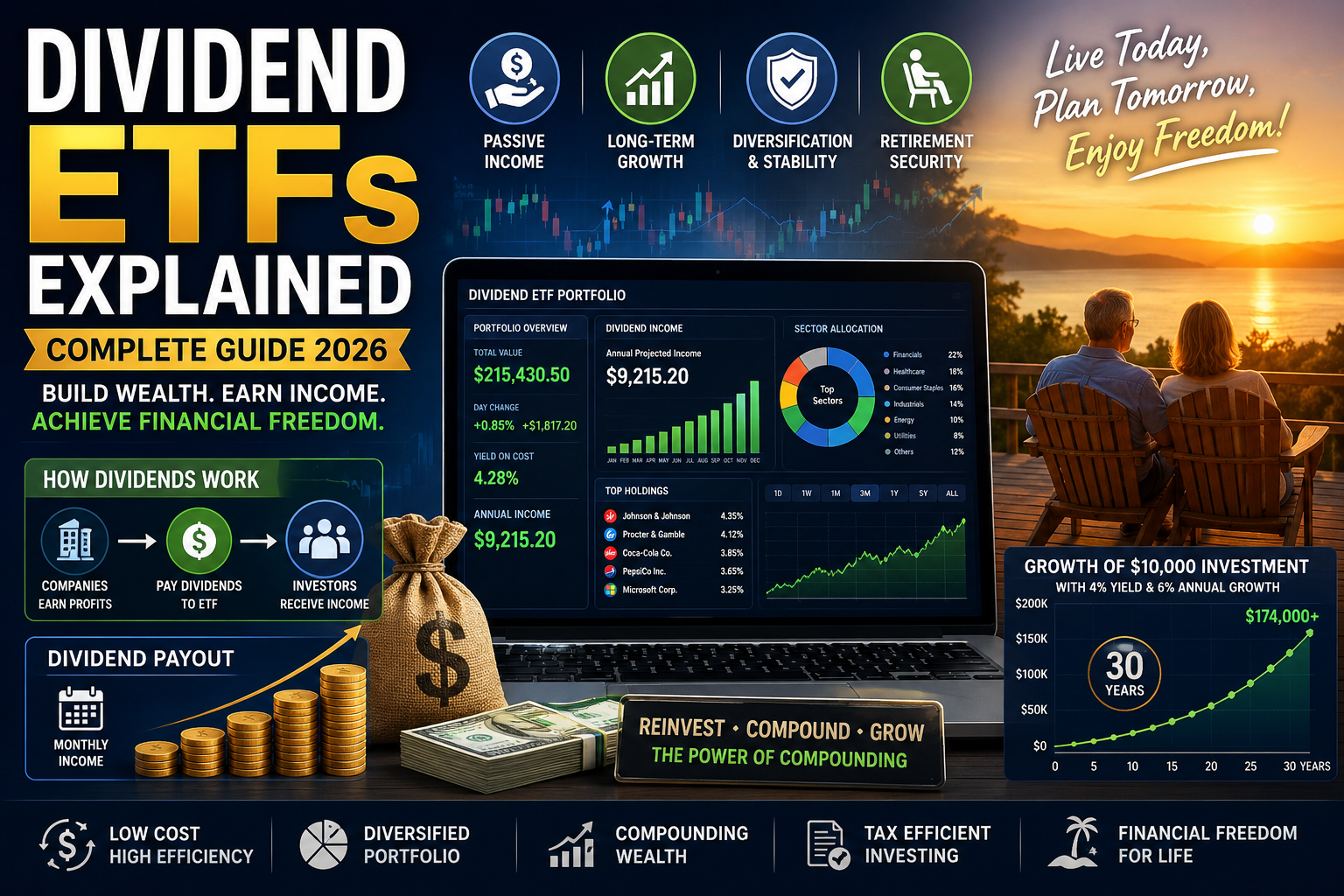
Dividend ETFs Explained (2026 Complete Beginner-to-Advanced Guide)
Dividend investing has become one of the most popular wealth-building strategies in the world. Millions of investors—especially in countries like the United States, Canada, the United Kingdom, and Australia—use dividend-focused investments to generate passive income, build retirement wealth, and reduce portfolio volatility.
But many investors still ask important questions:
- What exactly is a dividend?
- What is a Dividend ETF?
- How do Dividend ETFs work?
- Are Dividend ETFs safe?
- Can you live off dividends?
- Which Dividend ETFs are best for long-term investing?
- What are the risks of chasing high yields?
This complete guide explains Dividend ETFs from beginner to advanced level using simple language, financial terms, case studies, and real-world examples.
What Is a Dividend?
A dividend is a portion of a company’s profit paid to shareholders.
When a company earns money, it can generally do four things:
- Reinvest into the business
- Pay debt
- Buy back shares
- Pay dividends to investors
If you own shares of a company that pays dividends, you receive cash payments regularly.
Example:
Suppose you own 100 shares of a company.
- Dividend per share = $2 annually
- Shares owned = 100
Annual dividend income:
[
100 \times 2 = 200
]
You receive $200 per year.
Why Companies Pay Dividends
Companies usually pay dividends when:
- They generate stable profits
- They have mature business models
- Growth opportunities are limited
- They want to attract long-term investors
Examples of dividend-paying sectors:
- Banks
- Utilities
- Consumer staples
- Telecom companies
- Energy companies
- Healthcare companies
What Is a Dividend ETF?
A Dividend ETF (Exchange-Traded Fund) is a basket of dividend-paying stocks packaged into one investment fund.
Instead of buying individual dividend stocks separately, investors can buy one Dividend ETF that holds hundreds of companies.
Think of it like this:
| Investment Type | Meaning |
|---|---|
| Single Stock | One company |
| Dividend ETF | Collection of dividend-paying companies |
Exchange-traded funds pool investors’ money to hold a portfolio of assets, and their shares trade on exchanges throughout the trading day. For more detail on ETF structure, pricing and investor considerations, see the SEC’s Investor.gov guide to exchange-traded funds (ETFs).
What Does ETF Mean?
ETF stands for:
Exchange-Traded Fund
An ETF is:
- Traded on stock exchanges like stocks
- Diversified
- Professionally managed
- Usually low-cost
ETFs combine features of:
- Mutual funds
- Individual stocks
You can buy or sell ETFs during market hours.
How Dividend ETFs Work
A dividend ETF holds a portfolio of dividend-paying companies selected according to the fund’s investment strategy. When those companies pay dividends, the fund receives the payments and may distribute income to shareholders according to its distribution policy.
The process generally works as follows:
- The ETF holds shares in dividend-paying companies.
- Those companies pay dividends to the fund.
- The fund collects the dividend payments.
- The fund distributes income to shareholders according to its schedule and policy.
The amount and timing of distributions can vary. Dividend payments are not guaranteed, and investors can lose money if the ETF’s market value declines.
Simple Example of a Dividend ETF
These companies illustrate how a dividend-focused ETF might hold shares in several businesses rather than relying on a single company.
The fund collects dividends from its underlying holdings and distributes income according to its own policy. The amount an investor receives depends on the fund’s holdings, the dividends those companies pay, fund expenses and the number of ETF shares owned.
Holding multiple companies can reduce dependence on any one company, but it does not eliminate market risk or guarantee lower losses.
Suppose a Dividend ETF owns:
| Company | Dividend Yield |
|---|---|
| Coca-Cola | 3% |
| PepsiCo | 2.8% |
| Johnson & Johnson | 3.1% |
| Procter & Gamble | 2.5% |
The ETF combines income from all these companies.
Instead of researching every company individually, investors buy one ETF.
This creates:
- Diversification
- Convenience
- Lower risk
What Is Dividend Yield?
Dividend yield measures dividend income relative to investment price.
Formula:
\text{Dividend Yield} = \frac{\text{Annual Dividend}}{\text{Stock Price}} \times 100
Example:
- Stock price = $100
- Annual dividend = $4
Dividend yield:
[
\frac{4}{100} \times 100 = 4%
]
A 4% dividend yield means you earn $4 annually for every $100 invested.
When evaluating an ETF, do not rely on its yield alone. Review the fund’s investment objective, holdings, expenses, risks and prospectus before investing. The SEC’s ETF Investor Bulletin explains key factors investors should consider when evaluating an ETF.
Investors can also use FINRA’s investor education resources to learn more about investment products, risk and due diligence before making investment decisions.
Why Investors Love Dividend ETFs
Dividend ETFs are popular because they offer:
1. Passive Income
Investors receive regular cash payments.
This can help:
- Retirees
- Early retirees
- Passive income seekers
2. Diversification
One ETF may hold:
- 50 companies
- 100 companies
- 500 companies
This reduces single-company risk. To understand how ETFs and index funds differ and how they can help investors diversify, read our guide to ETFs and index funds.
3. Lower Volatility
Dividend-paying companies may have established businesses, but dividend payments do not guarantee lower volatility. Some dividend-focused ETFs may experience smaller declines than particular market benchmarks during certain periods, while others may fall just as much or more. Results depend on the fund’s holdings, sector exposure, valuation and market conditions.
4. Long-Term Compounding
Reinvested dividends can massively grow wealth over decades.
This is one of the most powerful concepts in investing.
The Power of Dividend Reinvestment
Illustrative Dividend-Reinvestment Calculation
Suppose an investor invests $10,000 in an investment that earns an assumed annual total return of 10% for 30 years. This hypothetical calculation assumes that all investment returns are reinvested and that the annual return remains constant.
Using the compound-growth formula, the estimated future value is approximately $174,494 before taxes and investment fees.
This is a mathematical illustration, not a prediction of actual ETF performance. Real investment returns fluctuate, distributions can change, and fees and taxes may reduce the amount an investor accumulates.
Calculation assumptions:
- Initial investment: $10,000
- Assumed annual total return: 10%
- Investment period: 30 years
- Reinvestment: All returns remain invested
- Contributions: No additional contributions
- Fees and taxes: Excluded
Formula: Future value = Initial investment × (1 + annual return)^number of years
A total return already includes both investment income and changes in investment value. Therefore, do not add a dividend yield to a total-return assumption that already includes dividends.
Types of Dividend ETFs
Dividend ETFs are not all the same.
There are several categories.
1. High Dividend Yield ETFs
These focus on companies paying very high dividends.
Examples may include:
- Energy firms
- Telecom companies
- REITs
- Utilities
Pros:
- High income
Cons:
- Higher risk
- Dividend cuts possible
2. Dividend Growth ETFs
These invest in companies that consistently increase dividends yearly.
Example characteristics:
- Strong balance sheets
- Stable profits
- Long histories of dividend growth
These are often considered higher-quality investments.
3. International Dividend ETFs
These invest outside the investor’s home country.
Benefits:
- Geographic diversification
- Currency diversification
Risks:
- Currency fluctuations
- Political risk
4. REIT Dividend ETFs
These focus on Real Estate Investment Trusts.
REITs must distribute most profits as dividends.
Benefits:
- High income potential
Risks:
- Sensitive to interest rates
5. Covered Call Dividend ETFs
These use options strategies to generate extra income.
They often produce very high yields.
Risks:
- Limited upside growth
- More complex strategies
For a real-world example, the Vanguard Dividend Appreciation ETF (VIG) seeks to track an index of companies with a record of increasing dividends over time. Its strategy illustrates the difference between focusing on dividend growth and simply selecting stocks with the highest current yields. Review Vanguard’s fund page for its latest holdings, expenses, distribution information and risks. This is an educational example, not an investment recommendation.
Important Dividend Terms Explained
Dividend Payout Ratio
This measures how much profit a company pays as dividends.
Formula:
\text{Payout Ratio} = \frac{\text{Dividends}}{\text{Net Income}} \times 100
Example:
- Company earns $1 billion
- Pays $400 million dividends
Payout ratio:
40%
Lower payout ratios are generally safer.
Ex-Dividend Date
The cutoff date to qualify for a dividend.
If you buy after the ex-dividend date, you usually won’t receive the next payment.
Dividend Aristocrats
These are companies that increased dividends for at least 25 consecutive years.
They are often viewed as financially strong.
Examples historically include:
- Coca-Cola
- Johnson & Johnson
- Procter & Gamble
Dividend Kings
Companies increasing dividends for 50+ consecutive years.
Very rare and respected.
Yield Trap
A yield trap happens when a dividend yield looks attractive but is actually dangerous.
Example:
- Stock falls heavily
- Yield rises artificially
- Company may cut dividend soon
High yield does NOT always mean good investment.
How Dividend ETFs Make Money
Dividend ETF returns come from two sources:
| Source | Meaning |
|---|---|
| Dividends | Cash income |
| Capital Appreciation | ETF price growth |
Dividend ETFs can generate returns through cash distributions and changes in the market value of their shares.
Total return measures the investment’s overall performance over a period, including distributions and price changes. For a simplified calculation that excludes additional cash flows:
Total return = (Ending value − Beginning value + Distributions) ÷ Beginning value × 100
This calculation assumes distributions are measured over the same period and does not account for taxes or transaction costs. If distributions are reinvested, the calculation must account for that reinvestment.
Many beginners focus only on yield and ignore total return. Understanding fund expenses is also important because fees reduce the returns investors keep. Learn how expense ratios impact your 20-year returns.
Example: High Yield vs Growth
Investor A:
- 9% yield
- 0% growth
Investor B:
- 3% yield
- 10% growth
Over decades, Investor B may build far more wealth.
This is why dividend growth investing is powerful.
Case Study: Dividend Reinvestment Over 25 Years
Illustrative Example: Spending vs. Reinvesting Investment Returns Over 25 Years
Consider two hypothetical investors who each start with $50,000 and earn an assumed annual total return of 6% over 25 years.
Investor 1 — Takes Distributions as Cash
The investor withdraws investment distributions rather than reinvesting them. The portfolio’s ending value cannot be calculated from the 6% total-return assumption alone because the timing and amount of distributions and the remaining portfolio returns must also be specified.
Investor 2 — Reinvests All Returns
The investor reinvests all investment returns and makes no additional contributions. Assuming a constant 6% annual total return, the estimated portfolio value after 25 years would be approximately $214,594 before fees and taxes.
Calculation: $50,000 × (1.06)^25 ≈ $214,594.
This is a hypothetical compound-growth calculation, not an observed investment result. Actual returns vary from year to year, and fees, taxes, withdrawals and changing distributions can affect the final portfolio value.
Reinvesting distributions can increase the number of shares an investor owns and support compounding. However, the outcome depends on the investment’s total return, distribution policy, costs and market performance. A fair comparison between spending and reinvesting distributions must use consistent return assumptions and account for cash withdrawn.
Are Dividend ETFs Safe?
Dividend ETFs can reduce company-specific risk by spreading investments across multiple holdings. However, diversification does not eliminate market losses, and a fund concentrated in particular sectors may remain exposed to significant industry-specific risks. Dividend ETFs are not automatically safer than other equity investments.
- Risks of Dividend ETFs
- Market Risk
- Interest Rate Risk
- Dividend Cuts
- Sector Concentration Risk
Risks of Dividend ETFs
Dividend payments do not eliminate investment risk, and past distributions or performance do not guarantee future results. Before investing, review the fund’s prospectus, fees, holdings and principal risks. The SEC’s ETF Investor Bulletin provides further guidance on evaluating ETFs.
1. Market Risk
Dividend ETFs can fall during bear markets.
Example:
- 2008 Financial Crisis
- 2020 COVID crash
2. Interest Rate Risk
When interest rates rise:
- Bonds become more attractive
- Dividend stocks may fall
Utilities and REITs are especially sensitive.
3. Dividend Cuts
Companies can reduce or eliminate dividends during difficult periods.
This happened widely during:
- COVID pandemic
- Banking crises
- Energy crashes
4. Sector Concentration Risk
Some Dividend ETFs heavily focus on:
- Banks
- Energy
- Utilities
Too much concentration increases risk.
Dividend ETFs vs Growth ETFs
Table A: Dividend ETF vs Growth ETF
| Feature | Dividend ETF | Growth ETF |
| Main objective | Focuses on dividend-paying companies or dividend-related strategies | Focuses on companies expected to grow earnings or share prices |
| Cash distributions | May distribute dividends or other income | May distribute dividends, but income is not necessarily the main objective |
| Selection strategy | May screen for dividend yield, growth, consistency or quality | May screen for growth, earnings, revenue or other growth-related measures |
| Potential return | Distributions plus changes in share price | Changes in share price plus any distributions |
| Main risks | Market losses, dividend cuts, sector concentration and valuation risk | Market losses, high valuations, business risk and concentration risk |
| Best evaluated by | Strategy, holdings, distribution history, fees and total return | Strategy, holdings, growth assumptions, fees and total return |
Dividend ETFs vs Bonds
Table B: Dividend ETF vs Bonds
| Feature | Dividend ETF | Bond investment |
| What it holds | Shares in companies selected by the fund’s strategy | Debt securities issued by governments, companies or other borrowers |
| Potential income | Dividends or other fund distributions, which may change | Interest payments, subject to the bond’s terms and issuer’s ability to pay |
| Capital risk | Share prices can fall significantly | Bond prices can fall; issuers may also default |
| Income certainty | Dividends are generally not guaranteed | Contractual interest is specified for many bonds, but payment is not risk-free |
| Interest-rate sensitivity | Depends on the ETF’s underlying holdings and market conditions | Bond prices are generally sensitive to changes in interest rates |
| How to compare | Distribution policy, holdings, fees, total return and risk | Yield to maturity, duration, credit quality, maturity and fees |
Investors comparing income-producing investments can also learn more about bond fund structure, interest-rate sensitivity and credit risk in our guide to bond ETFs explained.
Taxation of Dividend ETFs
Taxes depend on country and account type.
In countries like the U.S.:
Qualified dividends may receive lower tax rates.
In retirement accounts like:
- 401(k)
- IRA
- Roth IRA
tax treatment differs significantly.
Always understand local tax laws.
Monthly vs Quarterly Dividend ETFs
Some ETFs pay:
- Monthly
- Quarterly
Monthly dividends are popular among retirees because they mimic salary income.
However, payment frequency alone should NOT determine investment quality.
Best Characteristics of Strong Dividend ETFs
Investors often look for:
Low Expense Ratio
Lower fees improve long-term returns.
Strong Diversification
Avoid over-concentration.
Stable Dividend History
Consistency matters.
Dividend Growth
Dividend growth may help offset inflation over time, but increases are not guaranteed and may not keep pace with rising prices. Investors should assess inflation-adjusted total returns and the sustainability of distributions.
High-Quality Holdings
Companies with:
- Strong cash flow
- Durable businesses
- Stable earnings
Common Mistakes Beginners Make
1. Chasing Extremely High Yield
A 15% yield often signals danger.
Very high yields can mean:
- Financial distress
- Unsustainable payouts
2. Ignoring Total Return
Income alone does not build maximum wealth.
Growth matters too.
3. Lack of Diversification
Owning only one sector increases risk.
4. Panic Selling During Crashes
Dividend investing works best long term.
Market crashes are normal.
5. Not Reinvesting Early
Reinvestment is strongest during early accumulation years.
Real-World Example: Retiree Portfolio
Illustrative Retirement-Income Example
Suppose a retiree has a $500,000 portfolio invested in a dividend-focused ETF with an assumed annual distribution rate of 4%.
At that assumed rate, the portfolio would distribute approximately $20,000 over a year, before taxes. This is a mathematical illustration, not a prediction of what a particular ETF will pay.
The actual distributions may vary, and the portfolio’s market value can rise or fall. A 4% distribution rate also does not mean the investment earns a 4% total return: the distribution may be accompanied by a decline in the ETF’s share price.
A retirement-income plan should consider essential living expenses, other income sources, taxes, inflation, healthcare costs, investment time horizon and the possibility of market losses. Depending on individual circumstances, a combination of dividends, interest and planned asset sales may be more suitable than relying on dividends alone.
Calculation: $500,000 × 4% = $20,000 per year, before taxes.
The 4% rate is an assumption, not the actual yield of an unnamed fund.
Dividend ETF Strategy by Age
| Age Group | Possible Focus |
|---|---|
| 20s | Growth + Dividend Growth |
| 30s | Balanced Growth & Income |
| 40s | Increasing Income Exposure |
| 50s | Stability & Dividend Reliability |
| 60+ | Income & Capital Preservation |
Psychological Benefits of Dividend Investing
Many investors prefer dividends because:
- Cash flow feels tangible
- Less emotional stress
- Easier to stay invested
- Encourages long-term mindset
Receiving dividends during market crashes can reduce panic.
Can You Live Off Dividend ETFs?
Yes, but it depends on:
- Portfolio size
- Lifestyle expenses
- Yield
- Taxes
- Inflation
Whether dividend ETFs can cover living expenses depends on the amount invested, the distributions received, taxes, inflation and the investor’s spending needs.
Illustrative calculation
Suppose annual expenses are $50,000 and an investor assumes a 4% annual distribution rate.
Required portfolio at that assumed rate:
$50,000 ÷ 0.04 = $1,250,000
This calculation suggests a portfolio of $1.25 million would distribute $50,000 a year at an assumed 4% rate, before taxes.
This is a mathematical illustration, not a guarantee of income. Actual ETF distributions can change, and the portfolio’s market value can rise or fall. A 4% distribution rate is also not the same as a 4% total return.
Investors should consider other income sources, spending flexibility and the risk of relying too heavily on dividend distributions.
For a broader view of retirement planning, including long-term investment goals and income needs, read our guide to retirement investing.
Dividend ETFs During Inflation
Inflation reduces the purchasing power of investment income. Dividend-growing companies may increase their distributions over time, but their ability to do so depends on business performance, profitability, cash flow and other factors.
Dividend growth is not guaranteed, and distributions may fail to keep pace with inflation. Investors should evaluate inflation-adjusted total returns, distribution growth, fees, taxes and the sustainability of income rather than assuming dividend ETFs automatically protect purchasing power.
Case Study: 2008 Financial Crisis
Case Study: The 2008–2009 Financial Crisis and Dividend Cuts
The global financial crisis demonstrated that dividends are not guaranteed, even when companies have paid them for many years.
Research examining dividend suspensions found that 135 firms announced dividend suspensions during the 18-month period from January 2008 through June 2009: 81 in 2008 and 54 in 2009. The research identifies the global financial crisis as one of the two notable periods of elevated dividend-suspension activity in its dataset. Read the research on dividend suspensions.
The broader lesson for dividend ETF investors is that a fund’s distributions depend on the dividends and other income generated by its underlying holdings, along with the fund’s own distribution policy. If companies reduce or suspend their dividends, an ETF focused on those companies may experience lower income distributions. Its market price can also fall during a financial crisis.
What investors should learn
- A long record of dividend payments does not guarantee that a company will continue paying them.
- A high dividend yield can reflect a falling share price or concerns about the sustainability of the dividend.
- An ETF’s diversification does not eliminate market risk or protect every holding from dividend cuts.
- Investors should review sector concentration, company fundamentals, dividend sustainability and the fund’s distribution history rather than relying only on its current yield.
This historical episode does not prove that all dividend ETFs will underperform during a crisis. The outcome depends on the fund’s selection methodology, holdings, sector exposures and the period being measured.
Case Study: COVID-19 Crash
Case Study: COVID-19 and Dividend Reductions in 2020
The COVID-19 shock showed why dividend investors must distinguish between receiving income and preserving the value of their investment.
According to S&P Dow Jones Indices’ review of S&P 500 dividend announcements, by the end of June 2020, companies in the index had announced 62 dividend decreases during the second quarter, including 41 suspensions. The same review reported that first-half announced dividend increases totalled $14.9 billion while announced cuts totalled $42.5 billion, resulting in a net reduction of $27.6 billion in announced dividends. These figures describe the index-level announcements covered in that review, not the distributions of every dividend ETF. Read the S&P Dow Jones Indices review.
The Federal Reserve also announced temporary restrictions on dividend payments by large banks in June 2020 as part of its response to economic uncertainty and its effort to preserve bank capital. Read the Federal Reserve’s statement.
What this means for dividend ETF investors
A dividend-focused ETF can distribute less income when companies in its portfolio cut or suspend their payments. At the same time, the ETF’s share price can decline as financial markets reprice economic and business risks.
The experience also shows why investors should not assume that a dividend-growth strategy, a high-yield strategy and a broad-market strategy will respond identically to the same crisis. Index methodology, sector exposure and the underlying companies can materially affect results.
The COVID-19 experience is a reminder to evaluate both income sustainability and total return. Neither a high yield nor a history of dividend growth guarantees stable distributions or protection from market losses.
Should Beginners Buy Dividend ETFs?
For many beginners, Dividend ETFs can be excellent investments because they provide:
- Diversification
- Simplicity
- Passive income
- Lower emotional volatility
However, beginners should still learn:
- Risk management
- Asset allocation
- Tax implications
- Long-term investing principles
How to Evaluate a Dividend ETF
Before investing, investors often review:
| Metric | Why It Matters |
|---|---|
| Dividend Yield | Income level |
| Expense Ratio | Cost efficiency |
| Holdings | Portfolio quality |
| Sector Allocation | Diversification |
| Dividend Growth | Inflation protection |
| Historical Performance | Long-term consistency |
Important Investing Principle
A higher yield does NOT automatically mean better investment.
Sometimes:
- Lower-yield
- Higher-quality
- Faster-growing
companies produce better long-term results.
Total Return Investing
Professional investors focus heavily on:
Total Return
Evaluating total return helps investors compare the overall performance of an investment rather than focusing only on its dividend yield.
A fund with a high distribution rate may still deliver a poor result if its market value declines significantly. Investors should assess distributions, price changes, fees, taxes and their investment time horizon when evaluating performance.
Dividend ETFs for Retirement
Dividend ETFs may be one component of a retirement portfolio, but their suitability depends on an investor’s income needs, time horizon, risk tolerance and other financial resources.
A retirement portfolio may combine different types of investments, such as:
- Dividend ETFs: Potential cash distributions from dividend-paying companies.
- Bond ETFs: Potential interest-related income, with interest-rate and credit risks.
- Broad-market or growth ETFs: Exposure to companies that may contribute to long-term capital growth.
The appropriate mix varies by investor. Dividend income is not guaranteed, and a portfolio concentrated in dividend-paying stocks may still experience substantial losses.
Retirement planning should consider total return, inflation, taxes, liquidity needs and the possibility of selling investments to meet expenses. Dividend income alone does not determine whether a retirement plan is sustainable.
Do Dividend ETFs Reduce Risk?
Dividend ETFs can provide diversification by holding shares in multiple companies, but diversification does not eliminate the risk of losses. A fund concentrated in particular sectors, such as financials, utilities or real estate, can remain vulnerable to industry-specific problems.
Dividend-paying companies are not necessarily safer than companies that reinvest earnings instead of paying dividends. Risk depends on factors such as business fundamentals, debt, valuation, profitability, sector exposure and the ETF’s investment methodology.
Can Dividend ETFs Protect Against Inflation?
Dividend income may grow over time when the underlying companies increase their distributions, but this is not guaranteed. Inflation can reduce the purchasing power of a fixed or declining income stream, and dividend increases may not keep pace with rising prices.
Investors should assess inflation-adjusted total returns, distribution growth, fees and taxes over an appropriate period rather than assuming that dividend ETFs automatically provide inflation protection.
Frequently Asked Questions About Dividend ETFs
What are Dividend ETFs?
Dividend ETFs are exchange-traded funds that invest primarily in companies that pay dividends. Instead of purchasing individual dividend stocks, investors can buy shares of one ETF that holds a diversified group of dividend-paying companies.
How do Dividend ETFs make money?
Dividend ETFs can generate returns from two main sources: dividend income paid by the underlying companies and capital appreciation when the ETF’s share price increases.
Are Dividend ETFs good for beginners?
Dividend ETFs can be suitable for beginners because they provide diversification through a single investment. However, investors should understand the ETF’s holdings, fees, strategy, risks, and investment objectives before investing.
Can Dividend ETFs lose money?
Yes. Dividend ETFs are investments in the stock market, so their prices can decline. Even an ETF with a strong dividend history can lose value during market downturns.
Do Dividend ETFs pay dividends every month?
Not necessarily. Dividend ETFs may distribute income monthly, quarterly, semiannually, or on another schedule depending on the fund. Investors should check the individual ETF’s distribution schedule.
What is a good dividend yield for an ETF?
There is no single dividend yield that is considered good for every investor. A higher yield can mean greater income, but it can also indicate higher risk. Investors should consider dividend sustainability, portfolio quality, growth, fees, and total return rather than yield alone.
Are high-yield Dividend ETFs risky?
They can be. A very high yield may result from a risky investment strategy, declining share prices, concentrated sectors, or potentially unsustainable distributions. Investors should investigate why an ETF has a high yield before investing.
What is the difference between a Dividend ETF and a dividend stock?
A dividend stock represents ownership in one company, while a Dividend ETF generally holds a collection of dividend-paying companies. An ETF can therefore provide greater diversification than owning a single dividend stock.
Are Dividend ETFs better than individual dividend stocks?
Neither is automatically better. Individual stocks can provide greater control, while Dividend ETFs can make diversification easier and reduce the impact of problems at one company.
Should I reinvest Dividend ETF dividends?
Investors who are focused on long-term wealth accumulation may consider reinvesting dividends. Reinvestment allows distributions to purchase additional ETF shares, potentially increasing future income and compounding returns.
What is dividend reinvestment?
Dividend reinvestment means using dividend distributions to purchase additional shares instead of taking the income as cash. Over long periods, this can increase the number of shares generating future dividends.
What is dividend yield?
Dividend yield measures annual dividend income relative to the investment’s current price. It is commonly expressed as a percentage and helps investors compare income levels among investments.
What is a dividend payout ratio?
The dividend payout ratio measures the portion of a company’s earnings that is distributed to shareholders as dividends. Investors often examine it when evaluating whether a company’s dividend may be sustainable.
What is a dividend yield trap?
A dividend yield trap occurs when an investment appears attractive because its dividend yield is unusually high, but the high yield may be caused by a falling share price or financial problems. The company or fund may subsequently reduce its distribution.
Do Dividend ETFs grow in value?
They can. Dividend ETFs can appreciate when the underlying holdings increase in value. However, price appreciation is not guaranteed, and dividend income does not prevent an ETF’s market price from falling.
Can Dividend ETFs provide passive income?
Yes. Dividend ETFs can provide investment income through distributions from their underlying holdings. The amount of income can vary, and investors should not assume that distributions will remain constant.
Can I live off Dividend ETF income?
Potentially, but it depends on your portfolio size, spending requirements, dividend yield, taxes, inflation, and the sustainability of the ETF’s distributions. A larger portfolio generally provides more potential income at the same yield.
Are Dividend ETFs good for retirement?
Dividend ETFs can be one component of a retirement portfolio. Retirees should consider income needs, diversification, volatility, taxes, inflation, and capital preservation rather than relying exclusively on dividends.
Are Dividend ETFs safer than individual stocks?
Diversification can reduce the risk associated with one company failing or cutting its dividend, but Dividend ETFs are still exposed to stock-market risk. They are not risk-free investments.
Do Dividend ETFs pay guaranteed income?
No. Dividend distributions are not guaranteed in the same way that a contractual payment might be. Companies can reduce or eliminate dividends, and ETF distributions can change over time.
What happens to Dividend ETFs during a market crash?
Dividend ETFs can decline significantly during a market crash. Some underlying companies may also reduce dividends. However, diversified ETFs can spread company-specific risk across many holdings.
How do interest rates affect Dividend ETFs?
Higher interest rates can make bonds and other interest-bearing investments relatively more attractive. Rate changes can therefore affect dividend-focused stocks and ETFs, particularly sectors such as utilities and REITs.
What is the difference between Dividend ETFs and Growth ETFs?
Dividend ETFs generally emphasize companies that distribute income to shareholders, while Growth ETFs generally emphasize companies expected to grow earnings or revenue rapidly. Some ETFs can combine both characteristics.
Should young investors buy Dividend ETFs?
Young investors may use Dividend ETFs as part of a diversified portfolio, but their investment decisions should reflect their time horizon, risk tolerance, financial goals, and overall asset allocation. A younger investor does not necessarily need to prioritize current income.
Are Dividend ETFs affected by inflation?
Yes. Inflation can reduce the purchasing power of investment income. Dividend-growing companies may have greater ability to increase distributions over time, but dividend growth is not guaranteed.
What are the main risks of Dividend ETFs?
Major risks include market risk, dividend reductions, interest-rate risk, sector concentration, economic downturns, and the possibility that an ETF’s strategy does not perform as expected.
What should I look for when choosing a Dividend ETF?
Consider the ETF’s investment strategy, holdings, expense ratio, diversification, dividend history, distribution policy, sector exposure, performance history, and risk characteristics.
Does a higher Dividend ETF yield mean higher returns?
No. Yield and total return are different concepts. An ETF can have a high distribution yield while experiencing weak price performance. Investors should evaluate total return rather than focusing exclusively on yield.
What is total return in Dividend ETF investing?
Total return combines the change in an investment’s value with income received from the investment. For dividend-focused investing, both dividend income and capital appreciation are important.
How often should I review my Dividend ETF portfolio?
There is no universal schedule, but long-term investors can periodically review their ETF’s holdings, strategy, fees, diversification, distributions, and whether it still fits their financial goals.
Can Dividend ETFs diversify my portfolio?
Yes. A Dividend ETF can provide exposure to many companies through a single investment. However, investors should check the ETF’s sector and geographic exposure because some Dividend ETFs can still be concentrated.
Do Dividend ETFs have fees?
Yes. ETFs generally charge an expense ratio or other fund expenses. Even relatively small annual costs can affect long-term returns, making fees an important factor when comparing funds.
Can Dividend ETFs be used for passive income and growth?
Yes. Some Dividend ETFs provide both income and potential capital appreciation. The balance between income and growth depends on the ETF’s underlying holdings and investment strategy.
Final Thoughts
Dividend ETFs can provide exposure to dividend-paying companies and may generate cash distributions, but they are not guaranteed sources of income or protection against market losses.
Before investing, consider the fund’s holdings, distribution policy, expenses, sector exposure, tax treatment and potential for capital losses. Evaluate total return alongside dividend income, and avoid choosing a fund solely because it advertises a high yield.
Reinvesting distributions may support long-term compounding, while investors who need income should consider how distributions fit into their wider financial plan.
The key lesson: Focus on investment quality, diversification, sustainable expectations and long-term goals not dividend yield alone. Every investment carries risks, and the right approach depends on an investor’s circumstances.