Last Updated: September 1, 2026
Editorial Policy: The AJ Times is committed to providing clear, accurate, transparent, and research-driven information about personal finance, investing, financial markets, and wealth building.
We understand that financial information can influence important decisions. For that reason, we are committed to publishing content that is accurate, transparent, useful, understandable, and responsibly presented.
Our editorial standards are designed to help readers make better-informed financial decisions while recognizing that every individual’s financial circumstances, goals, risk tolerance, tax situation, and legal environment are different.
Important: The AJ Times provides educational and informational content. Our articles are not personalized financial, investment, tax, accounting, or legal advice. Readers should consider consulting a qualified professional before making financial decisions that could materially affect their finances.
1. Our Editorial Mission
Our Editorial Policy guides how The AJ Times researches, writes, reviews, publishes, and updates financial content.
The AJ Times focuses on helping readers understand financial concepts and make more informed decisions.
Our primary areas of coverage include:
- Personal finance
- Investing
- Stock market education
- ETFs and index funds
- Mutual funds
- Asset allocation
- Portfolio construction
- Retirement investing
- Dividend investing
- Value and growth investing
- Financial ratios and valuation
- Wealth building
- Passive income concepts
- Financial planning concepts
- Saving and budgeting
- Investment calculators and financial tools
- Market and economic concepts
Our goal is not to encourage readers to trade frequently or chase short-term market movements.
Instead, we emphasize financial education, long-term thinking, diversification, risk management, disciplined investing, and evidence-based decision-making.
2. Editorial Independence
The editorial content published by The AJ Times is intended to remain independent from advertisers, sponsors, affiliate partners, and other commercial relationships.
Our Editorial Policy is designed to protect the independence of our financial and investing content from commercial influence.
Commercial relationships do not determine:
- Which topics we cover
- Whether an article is published
- The conclusions presented in an article
- Our educational explanations
- The risks discussed
- Whether we identify limitations or disadvantages
- Whether we update or correct an article
We do not accept payment in exchange for a predetermined positive investment opinion.
If a company, financial product, platform, broker, fund, or service is discussed because of a commercial relationship, that relationship will be disclosed where appropriate.
Our editorial standards take priority over commercial interests.
Our Editorial Policy is designed to protect the independence of our financial and investing content from commercial influence.
3. How We Research Our Content
We aim to base financial content on reliable and relevant sources.
Our Editorial Policy emphasizes the use of reliable, relevant, and authoritative sources when researching financial topics.
Depending on the subject, our research may include:
- Government agencies
- Regulatory authorities
- Central banks
- Stock exchanges
- Official company filings
- Company investor-relations materials
- Fund-provider documentation
- Academic research
- Established financial institutions
- Reputable financial publications
- Official statistical databases
- Regulatory filings
- Primary-source documents
Examples of primary and authoritative sources may include organizations such as the U.S. Securities and Exchange Commission (SEC), Federal Reserve, Financial Conduct Authority (FCA), Bank of England, Statistics Canada, Australian Securities & Investments Commission (ASIC), Australian Bureau of Statistics, and other appropriate government or regulatory bodies.
We aim to use primary sources whenever practical, particularly when discussing regulations, financial statistics, company filings, investment products, or official policies.
4. Fact-Checking and Accuracy
We make reasonable efforts to ensure that published information is accurate at the time of publication or update.
Before publication, articles may be reviewed for:
- Numerical accuracy
- Definitions
- Calculations
- Investment terminology
- Source quality
- Claims and supporting evidence
- Dates
- Financial statistics
- Examples and assumptions
- Links and references
- Potentially misleading statements
For numerical examples, we aim to explain the assumptions used so readers can understand how the result was calculated.
However, financial information can change quickly.
Interest rates, market prices, tax rules, regulations, investment products, economic data, company information, and other financial conditions may change after an article is published.
For that reason, readers should verify time-sensitive information before making financial decisions.
5. Sources and References
Where appropriate, our articles include links to relevant sources so readers can independently review the underlying information.
We prefer authoritative sources when available.
For example, an article about a publicly traded company may reference:
- SEC filings
- Annual reports
- Quarterly reports
- Investor-relations materials
- Official company documents
An article concerning financial regulations may reference:
- Government agencies
- Financial regulators
- Official regulatory publications
- Statutory or legislative sources
An article concerning economic statistics may reference:
- Government statistical agencies
- Central banks
- Official economic databases
Sources may vary depending on the subject.
We do not consider the inclusion of a source to mean that The AJ Times endorses every position, product, or service mentioned by that source.
6. Author Standards
Articles published by The AJ Times are attributed to the appropriate author whenever possible.
Our Editorial Policy sets expectations for authors to provide accurate, balanced, transparent, and responsibly presented financial information.
Authors are expected to:
- Research topics carefully
- Use reliable sources
- Avoid intentionally misleading claims
- Distinguish facts from opinions
- Explain important assumptions
- Identify meaningful risks and limitations
- Avoid presenting speculation as certainty
- Disclose relevant conflicts of interest
- Update articles when material information changes
Author biographies may provide additional information about the writer’s background and areas of focus.
Readers can use our author pages to learn more about the people responsible for our content.
7. Financial and Investment Content
Financial content requires particular care because readers may use information from our website when making decisions involving money.
We therefore aim to avoid presenting investments as guaranteed opportunities.
We do not promise:
- Guaranteed investment returns
- Guaranteed profits
- Risk-free investments
- Guaranteed income
- Guaranteed retirement outcomes
- Guaranteed stock-market performance
Investment returns are uncertain, and losses are possible.
When discussing an investment strategy, asset, fund, stock, or financial concept, we aim to explain both potential benefits and relevant risks.
8. Risk Disclosure
Investing involves risk.
The value of investments can rise or fall, and investors may lose some or all of the money they invest.
Past performance does not guarantee future results.
Examples, projections, historical returns, hypothetical portfolios, and calculations shown on The AJ Times are intended for educational purposes unless explicitly stated otherwise.
Readers should consider factors such as:
- Investment horizon
- Risk tolerance
- Financial goals
- Liquidity needs
- Diversification
- Fees and expenses
- Taxes
- Inflation
- Market conditions
- Personal circumstances
before making an investment decision.
9. No Personalized Financial Advice
The AJ Times provides general educational information.
Our content is not intended to determine whether a particular investment is suitable for a specific individual.
We generally do not know a reader’s complete:
- Financial position
- Income
- Expenses
- Assets
- Liabilities
- Investment objectives
- Risk tolerance
- Tax circumstances
- Retirement needs
- Legal circumstances
Therefore, our content should not be interpreted as individualized financial advice.
Readers who require personalized guidance should consider consulting an appropriately qualified and regulated professional in their jurisdiction.
For additional information about the limitations and risks of our financial content, please see our Financial Disclaimer.
10. Country and Jurisdiction Differences
The AJ Times aims to serve an international English-speaking audience, including readers in major English-speaking and Tier-1 markets such as:
- United States
- United Kingdom
- Canada
- Australia
Financial rules differ significantly between countries.
Tax laws, retirement accounts, investment regulations, financial products, consumer protections, brokerage services, and reporting requirements may differ by jurisdiction.
Therefore, information applicable in one country may not apply to another.
When an article discusses country-specific information, we aim to identify the relevant jurisdiction clearly.
For additional information about the limitations and risks of our financial content, please see our Financial Disclaimer.
Readers should verify local rules with the appropriate government authority, regulator, financial institution, tax professional, or other qualified professional.
11. Affiliate Disclosure
Some articles on The AJ Times may contain affiliate links.
If a reader clicks an affiliate link and subsequently purchases a product or service, The AJ Times may receive a commission at no additional cost to the reader.
Affiliate relationships do not determine our editorial conclusions.
We aim to recommend or discuss products and services based on their relevance to the topic and potential usefulness to readers rather than solely on the availability or size of an affiliate commission.
Where an affiliate relationship could reasonably affect how a recommendation is evaluated, we aim to make the relationship clear.
Affiliate disclosures should be understandable and visible to readers rather than hidden in obscure locations.
For more information, please see our Affiliate Disclosure.
12. Advertising
The AJ Times may display advertising through third-party advertising networks.
Advertisements help support the operation, maintenance, research, and development of the website.
Advertising does not automatically constitute an editorial endorsement.
We aim to distinguish advertising from editorial content so readers can understand the difference between paid promotional material and independently produced editorial information.
Advertisers do not control our editorial conclusions.
13. Sponsored Content
If The AJ Times publishes sponsored or paid promotional content, we intend to identify it clearly.
Sponsored content should not be presented in a way that intentionally misleads readers into believing that paid promotional material is independent editorial reporting.
Where applicable, sponsored content may include labels such as:
- Sponsored
- Advertisement
- Paid Partnership
- Partner Content
The existence of a commercial relationship does not mean that The AJ Times guarantees the performance, safety, profitability, or suitability of a product or service.
14. Product and Financial-Service Reviews
When reviewing or comparing financial products, investment platforms, financial tools, or related services, we may consider factors such as:
- Fees
- Features
- Accessibility
- Usability
- Investment options
- Account functionality
- Transparency
- Availability
- Educational resources
- Potential advantages
- Potential disadvantages
- Relevant risks
The criteria may vary depending on the type of product being evaluated.
We do not guarantee that a product or service will remain available, maintain the same pricing, or be suitable for every reader.
Readers should review current terms, fees, eligibility requirements, and regulatory information directly with the provider before opening an account or purchasing a product.
15. Use of AI and Technology
The AJ Times may use technology and artificial intelligence tools as part of the content-production and research workflow.
AI-assisted tools may be used for tasks such as:
- Brainstorming
- Outlining
- Drafting
- Summarization
- Editing
- Formatting
- Research assistance
- Identifying potential topics
- Improving readability
However, AI-generated information is not automatically considered accurate.
AI tools can produce incorrect, outdated, incomplete, or misleading information.
For financial content, important claims, calculations, statistics, definitions, and factual information should therefore be reviewed and verified before publication whenever reasonably possible.
AI is used as a productivity and research-support tool, not as a substitute for editorial responsibility.
The final published content remains subject to our editorial standards.
Our Editorial Policy requires AI-assisted financial content to remain subject to appropriate editorial review and verification.
16. Originality and Plagiarism
The AJ Times aims to publish original editorial content.
We do not intentionally copy or reproduce another publisher’s work without appropriate permission, attribution, or lawful basis.
When information from another source is used, we aim to summarize, analyze, or explain the information in our own words and provide appropriate attribution or links where necessary.
We respect intellectual-property rights.
If you believe that material on The AJ Times improperly reproduces copyrighted content, please contact us so that we can investigate the matter.
17. Corrections Policy
We believe transparency is important when mistakes occur.
Our Editorial Policy requires us to address material factual errors and update information when reasonably practical.
Corrections may involve:
- Correcting factual inaccuracies
- Updating outdated information
- Correcting calculations
- Clarifying ambiguous statements
- Replacing broken or outdated sources
- Updating financial statistics
- Adding additional context
Material updates may be reflected through an Updated or Last Updated date.
We do not believe that publishing an article makes it permanently correct. Financial information changes, and responsible publishing requires ongoing review.
18. Reader Corrections and Feedback
Readers are encouraged to contact us if they identify:
- A factual error
- An outdated statistic
- An incorrect calculation
- A broken source
- An unclear explanation
- A misleading statement
- A potentially outdated financial rule
- Another significant editorial issue
When contacting us, please provide:
- The article URL
- The specific statement or section
- What you believe is incorrect
- A reliable source supporting the correction, if available
Our editorial team will review the information and determine whether a correction or update is appropriate.
19. Updating Older Articles
Financial information can become outdated quickly.
We may periodically review older articles to determine whether they require updates.
Updates may include:
- New market information
- Updated statistics
- New regulations
- Changes in tax rules
- Updated investment-product information
- Updated examples
- New research
- Improved explanations
- New sources
- Broken-link replacement
- Corrections
When a substantial update is made, we aim to display an updated date.
An updated date does not necessarily mean that every sentence of an article was rewritten. It indicates that the article has been reviewed or materially updated according to our editorial process.
Our Editorial Policy supports periodic review of older financial content when material information changes.
20. Editorial Review Process
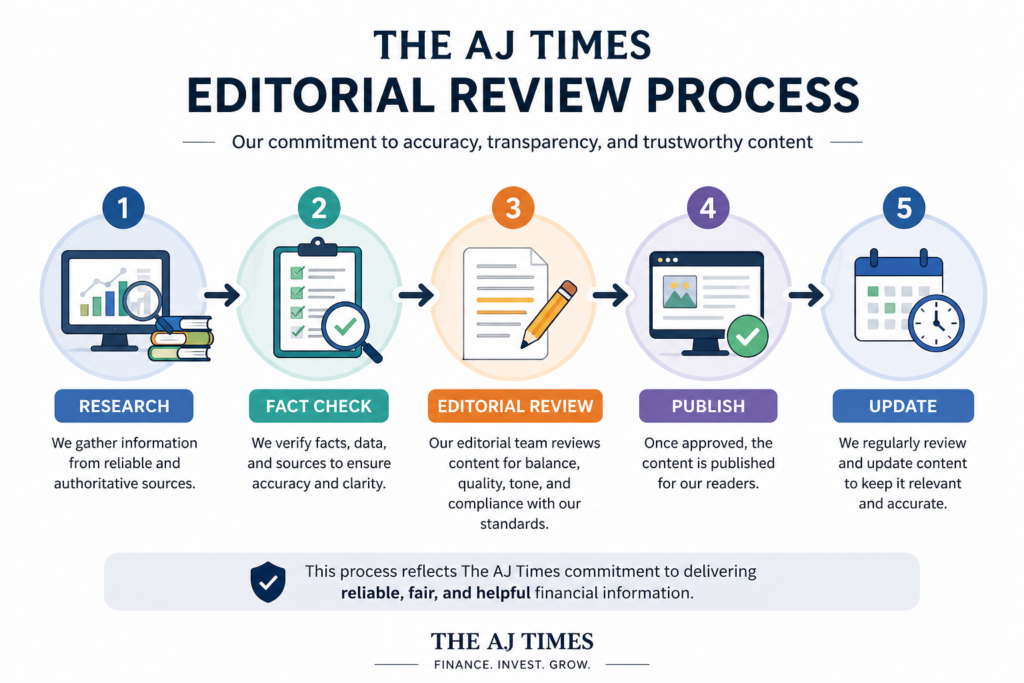
Our general editorial workflow may include the following stages:
Step 1 — Topic Selection
We select topics based on reader needs, financial education value, search demand, relevance, and current developments.
Step 2 — Research
The writer researches the subject using relevant and credible sources.
Step 3 — Drafting
The article is written with an emphasis on clarity, accuracy, useful examples, and practical explanations.
Step 4 — Verification
Important facts, figures, calculations, terminology, and claims are reviewed where reasonably possible.
Step 5 — Editorial Review
The article may be reviewed for:
- Accuracy
- Clarity
- Structure
- Sources
- Financial-risk language
- Disclosure requirements
- Potentially misleading statements
- Reader usefulness
Step 6 — Publication
The article is published with appropriate metadata, including the publication date and, when applicable, updated date.
Step 7 — Ongoing Updates
Articles may be reviewed and updated when material information changes.
21. Headlines and Titles
We aim to write headlines that accurately represent the content of an article.
We avoid intentionally misleading headlines designed solely to generate clicks.
A headline should not promise a result that the article cannot reasonably support.
For example, we avoid presenting uncertain investment outcomes as guaranteed results.
22. Use of Examples and Case Studies
The AJ Times may use hypothetical examples and case studies to explain financial concepts.
Unless specifically identified otherwise, examples are illustrative rather than predictions.
For example, an article discussing compound interest may show how a hypothetical investment could grow under a particular assumed return.
Such examples do not guarantee that an actual investor will achieve the same result.
Actual results can differ substantially because of:
- Market performance
- Fees
- Taxes
- Inflation
- Timing
- Contributions
- Withdrawals
- Investment selection
- Individual circumstances
23. Market Forecasts and Predictions
Financial markets are inherently uncertain.
When discussing potential future market conditions, we aim to distinguish:
- Historical facts
- Current information
- Analyst expectations
- Hypothetical scenarios
- Our educational analysis
- Predictions or forecasts
Forecasts should not be interpreted as guarantees.
No person or publication can reliably predict every future movement in financial markets.
24. Conflicts of Interest
Editorial contributors should disclose relevant conflicts of interest when they could reasonably affect the credibility or interpretation of the content.
Potential conflicts may include:
- Financial relationships
- Sponsorships
- Affiliate relationships
- Employment relationships
- Ownership interests
- Compensation arrangements
Where relevant, disclosures will be provided so readers can evaluate the information appropriately.
25. Editorial vs. Financial Promotion
The AJ Times distinguishes educational editorial content from promotional material.
An article may explain an investment strategy without recommending that every reader use that strategy.
Likewise, discussing a company, stock, ETF, fund, broker, or financial product does not necessarily constitute an endorsement.
Readers should evaluate investments independently and consider their own circumstances.
26. Responsible Financial Communication
We aim to avoid language that encourages irresponsible financial behavior.
We do not intentionally promote:
- Guaranteed wealth
- Get-rich-quick schemes
- Unrealistic investment returns
- Excessive speculation
- Unnecessary trading
- Misleading financial claims
- Guaranteed passive income
- Guaranteed retirement outcomes
We believe good financial education should help readers understand both opportunity and risk.
27. Transparency About Limitations
No financial education website can provide a complete answer for every investor.
Our content may have limitations because:
- Financial markets change
- Regulations change
- Data can be revised
- Financial products change
- Tax rules vary by jurisdiction
- Individual circumstances differ
- Historical performance may not repeat
- Sources may later be updated
Where appropriate, we aim to identify these limitations rather than presenting information with unjustified certainty.
28. What The AJ Times Does Not Do
Unless explicitly stated otherwise, The AJ Times does not:
- Manage readers’ investment portfolios
- Execute trades
- Hold itself out as a reader’s personal financial adviser
- Guarantee investment returns
- Guarantee profits
- Guarantee future market performance
- Provide individualized tax advice
- Provide individualized legal advice
- Determine whether a financial product is suitable for a particular person
Our primary role is financial education and information.
29. Commitment to Readers
Our readers are at the center of our editorial standards.
We aim to provide information that is:
Accurate — We strive to verify important claims and calculations.
Clear — We explain financial terminology in understandable language.
Useful — We focus on practical financial education.
Transparent — We disclose relevant commercial relationships.
Independent — Commercial relationships should not determine editorial conclusions.
Responsible — We explain investment risks and limitations.
Current — We update content when material information changes.
Reader-focused — We aim to help readers understand financial decisions rather than simply encourage transactions.
30. Contact Us About Editorial Issues
If you believe an article contains a significant factual error, outdated information, misleading statement, incorrect calculation, or other editorial issue, please contact us through our Contact Us page.
Questions or concerns about our Editorial Policy can also be raised through the appropriate contact channels.
When reporting an issue, please include the article URL and explain the specific issue so our editorial team can investigate it efficiently.
Contact: The AJ Times Editorial Team
Website: The AJ Times
31. Related Policies
For additional information, please review our:
- About Us
- Author / Meet the Author
- Affiliate Disclosure
- Financial Disclaimer
- Privacy Policy
- Terms of Service
- Contact Us
These policies work together to provide readers with greater transparency about how The AJ Times operates.
Our Editorial Policy works alongside our Financial Disclaimer, Affiliate Disclosure, Privacy Policy, and Terms of Service.
Our Editorial Promise
At The AJ Times, we believe financial education should be clear, honest, practical, and responsible.
This Editorial Policy reflects our commitment to maintaining high standards for financial research, accuracy, transparency, and responsible communication.
We will continue working to improve the quality of our research, strengthen our editorial standards, update our content as financial information changes, and communicate both opportunities and risks clearly.
Our goal is not simply to publish more financial content.
Our goal is to publish financial content that readers can understand, evaluate, and use responsibly.
The AJ Times Editorial Team
Last reviewed: September 1, 2026