Active vs Passive Investing: What the Data Really Says
Active vs Passive Investing is one of the most important debates in modern finance. Investors constantly ask whether they should try to beat the market through active strategies or simply track the market using passive index funds.
Investing is one of the most critical financial activities for individuals, institutions, and governments. At its core, investing means allocating money today in hopes of receiving more money in the future. But how that money is invested has a profound impact on long-term outcomes. Two major approaches dominate the investment world:
🔹 Active Investing
🔹 Passive Investing
This article will define each approach, explain how they work, compare them using real data, and explore the strengths, weaknesses, and practical implications of each. We will also use case studies, charts, and historical examples to show what the data really says about both.
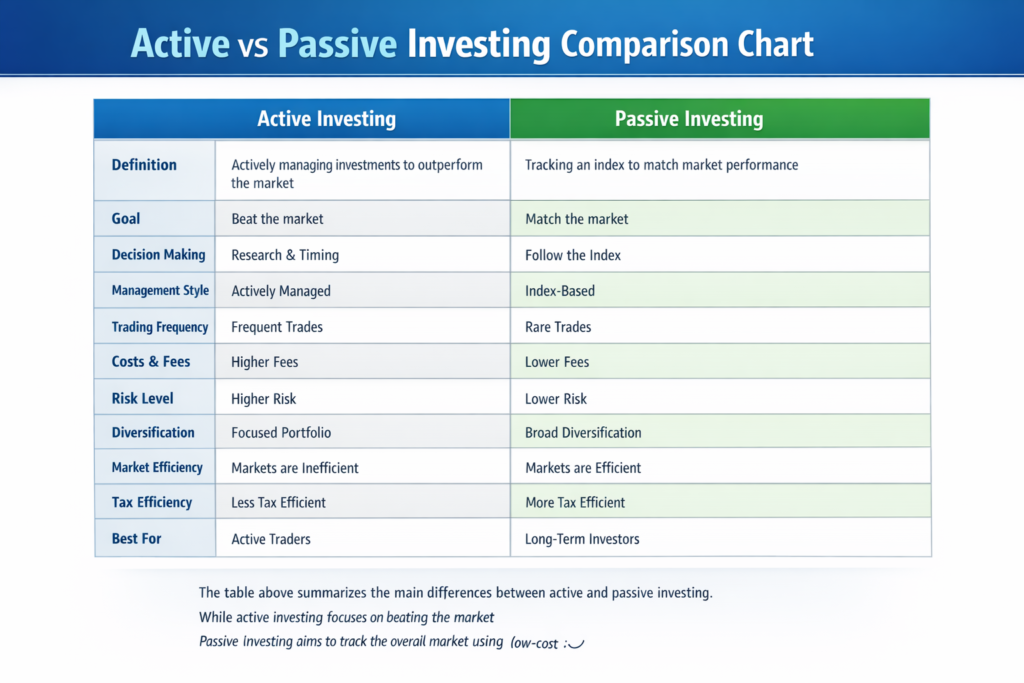
Active vs Passive Investing Comparison Chart
| Feature | Active Investing | Passive Investing |
|---|---|---|
| Definition | Investment strategy where investors or fund managers actively buy and sell securities to outperform the market. | Investment strategy that aims to match market performance by tracking a benchmark index. |
| Goal | Beat the market or benchmark index. | Match the market’s performance. |
| Decision Making | Based on research, analysis, and market timing. | Based on predefined rules of an index. |
| Management Style | Actively managed by portfolio managers and analysts. | Automatically follows an index with minimal intervention. |
| Trading Frequency | High – frequent buying and selling. | Low – very few changes to the portfolio. |
| Costs and Fees | Higher management fees and trading costs. | Lower fees due to minimal management. |
| Risk Level | Potentially higher risk due to concentrated positions. | Generally lower risk due to diversification. |
| Diversification | May hold fewer securities depending on strategy. | Usually highly diversified across many companies. |
| Market Efficiency Belief | Believes markets are inefficient and mispriced opportunities exist. | Believes markets are mostly efficient. |
| Typical Investment Vehicles | Actively managed mutual funds, hedge funds, actively managed ETFs. | Index funds and Exchange-Traded Funds (ETFs). |
| Tax Efficiency | Often lower due to frequent trading. | Usually higher because turnover is low. |
| Time Commitment | Requires research and monitoring. | Minimal time required once invested. |
| Best For | Experienced investors seeking higher returns or tactical opportunities. | Long-term investors seeking low-cost diversified exposure. |
The table above summarizes the main differences between active and passive investing. While active investing focuses on beating the market through research and strategy, passive investing aims to track the overall market using low-cost index funds.
What Is Active vs Passive Investing?
Active vs Passive Investing refers to two different investment strategies used by investors to grow wealth. Active investing attempts to outperform the market by selecting individual stocks or timing market movements, while passive investing aims to match market performance by tracking an index such as the S&P 500.
Active vs Passive Investing comparison table
| Feature | Active Investing | Passive Investing |
|---|---|---|
| Goal | Beat the market | Match market returns |
| Strategy | Stock selection | Index tracking |
| Fees | Higher | Lower |
Active vs Passive Investing: Understanding the Core Difference
Active vs Passive Investing represents two fundamentally different strategies used by investors to build wealth. Active investing attempts to outperform the market through stock selection and timing, while passive investing aims to match market returns through index tracking.
1. What Is Active Investing?
Definition
Active investing is an investment approach where portfolio managers or individual investors buy and sell securities with the goal of outperforming a benchmark index (like the S&P 500). The idea is to beat the market by identifying mispriced stocks or timing market trends.
📌 Key Goal: Generate higher returns than a benchmark index.
How Active Investing Works – Explained
Active investors believe markets are inefficient. An inefficient market is one where security prices do not always reflect all available information. Active managers use research, analysis, market forecasting, and judgment to identify opportunities.
The tools of active investing include:
✔ Fundamental analysis
✔ Technical analysis
✔ Macro-economic projections
✔ Industry trends
✔ Company financials
✔ News catalysts
Active investing involves:
- Frequent trading
- Analyst teams
- Portfolio adjustments
- Risk and opportunity assessment
Types of Active Investing Strategies
There are several ways active investors try to outperform the market:
- Growth Investing
Focuses on companies with high growth potential (e.g., tech startups). - Value Investing
Investing in undervalued companies according to metrics like P/E ratio. - Quantitative Investing
Using mathematical models and algorithms to predict price movements. - Event-Driven Investing
Capitalizing on price moves caused by specific events (M&A, earnings reports).
Example of Active Investing in Practice
Suppose a fund manager believes a company like General Motors is undervalued due to short-term supply issues. They buy shares expecting that once supply normalizes, the price will rise.
Contrast that with buying a broad index fund that holds GM plus hundreds of other companies.
In active investing, every decision—what to buy, when to sell, how long to hold—is based on judgment and analysis, not a preset rule.
2. What Is Passive Investing?
Definition
Passive investing is an approach where investors buy securities designed to mimic the performance of a market index or benchmark. Instead of beating the market, passive investors aim to match market returns.
📌 Key Goal: Achieve returns that closely track the overall market.
How Passive Investing Works – Explained
Passive investing originated from the belief that markets are mostly efficient—meaning it is very difficult to consistently outperform them after trading costs and fees.
In passive investing:
✔ Investors buy a broad market index
✔ Holdings rarely change
✔ Trades are infrequent
✔ Fees are low
Common passive vehicles include:
- Index funds
- Exchange-Traded Funds (ETFs)
- Target-date funds
Example of Passive Investing in Practice
A simple example is buying shares in an S&P 500 index fund. You don’t pick individual companies. The fund automatically holds all 500 stocks in proportion to their market size.
So, if Apple, Microsoft, and Amazon are large companies, the fund holds more of them—without decision-making or trading based on judgment.
Active vs Passive Investing Explained (Video)
Example:
Active vs passive investing can sometimes be easier to understand through a visual explanation. The video below explains how index funds work, why passive investing has become popular, and how active managers attempt to outperform the market.
3. The Philosophical Divide: Efficient vs Inefficient Markets
Efficient Market Hypothesis (EMH)
Passive investors believe in the Efficient Market Hypothesis (EMH). EMH suggests:
All available information is reflected in asset prices
Therefore, it’s nearly impossible to consistently outperform the market.
Three forms of EMH:
- Weak Form Efficiency: Past prices cannot predict future prices.
- Semi-Strong Efficiency: All public information is already priced in.
- Strong Form Efficiency: Even insider information is priced in.
Passive investors assume at least semi-strong efficiency.
Active Investors Reject Full EMH
Active investors believe:
✔ Markets are sometimes irrational
✔ Mispricing happens
✔ Skilled managers can identify and exploit these mispricings
This disagreement lies at the heart of the active vs passive debate.
4. Active vs Passive Investing Performance: What the Data Shows
Now we reach the heart of the topic: What does the data say?
A. Active Funds vs Passive Benchmarks
Over the last several decades, multiple studies have compared:
📍 Active mutual funds
📍 Passive index funds
Key findings from major research:
1. SPIVA Reports
SPIVA (S&P Indices Versus Active) reports published by S&P Dow Jones Indices measure how many active funds outperform passive benchmark indexes over time.
Findings over 10, 15, and 20 years:
- A large majority of active funds underperform their benchmarks.
- Underperformance increases over longer periods.
- Only a small fraction of active managers consistently outperform.
🔹 For example: According to long-term research from S&P Dow Jones Indices SPIVA scorecards, less than 20% of active U.S. large-cap funds outperform the S&P 500 over a 15-year period.
🔹 The longer the time horizon, the fewer active managers outperform.
👉 This suggests consistency of outperformance is rare.
2. Morningstar Research
Research from Morningstar shows that:
✔ Even top-performing active managers often struggle to maintain their performance leadership over long periods.
✔ Many funds beat the market for a period but then fall behind.
This is called the “performance persistence problem.”
3. Active vs Passive Investing Fees Comparison
One of the biggest advantages of passive investing is low fees.
📌 Average expense ratios:
- Active funds: ~0.5% or more per year
- Passive index funds: ~0.05% or less per year
- compounding example
That difference may seem small, but over time it compounds.
Impact of Fees – A Simple Example
Suppose:
- Your portfolio returns 8% annually
- You pay 0.05% fees
versus
- 8% return
- 0.75% fees
After 30 years:
💡 The difference in ending value can be huge—hundreds of thousands of dollars—simply due to fees compounding.
This is known as fee drag—the negative effect of costs on returns.
5. Real-World Case Studies
Let’s look at real examples:
Case Study 1: S&P 500 Index vs Active Mutual Funds
📅 Time Period: 1995–2020
- S&P 500 Index returned ~9.8% annualized
- Median active large-cap fund returned ~8.2% annualized
Result:
Index investors ended up significantly richer due to better returns AND lower fees.
Case Study 2: Dot-Com Bubble (2000–2002)
During the crash:
👉 Some active managers outperformed by avoiding tech overvaluation.
✅ Active decision-making helped in this period.
But over the entire decade (2000–2009), the S&P 500 still beat many active peers due to recovery and broad diversification.
Case Study 3: 2008 Financial Crisis
Active managers who recognized credit risk in banks and financials did well.
✔ Active investors could adjust risk exposure.
But once again, long-term passive returns still outperformed most active funds.
6. Advantages of Active Investing
Despite data showing many active managers lag benchmarks, there are advantages:
A. Flexibility
Active managers can:
✔ Reduce exposure in a downturn
✔ Increase allocation to defensive sectors
✔ Capitalize on short-term opportunities
B. Risk Management
Passive index funds are fully invested at all times.
Active managers can:
✔ Hedge risk
✔ Exit positions
✔ Use cash holdings
This may reduce losses in certain conditions.
C. Markets with Inefficiencies
Active investing shines where:
✔ Markets are less transparent
✔ There is poor price discovery
✔ Liquidity is low
Examples:
- Small-cap stocks
- Emerging markets
- Corporate credit
In these areas, skilled analysts can find mispricings more easily than in large, highly liquid markets.
7. Advantages of Passive Investing
Passive investing has major strengths:
A. Low Cost
As explained earlier, passive funds cost much less.
Over decades, lower fees dramatically increase investor returns.
Studies from Morningstar also show that low-cost index funds tend to outperform most actively managed funds after fees.
B. Diversification
Index funds hold many stocks across sectors.
This reduces:
✔ Company-specific risk
✔ Sector concentration risk
Passive portfolios automatically rebalance.
C. No Need for Market Timing
Since passive investing simply tracks the market, there is:
✔ No decision-making stress
✔ No timing the market highs and lows
This can benefit emotional discipline.
D. Proven Long-Term Performance
Research shows:
💡 Over long time horizons, passive strategies outperform most active funds.
8. The Emotional Factor in Investing
One big reason passive investing works is behavioral:
Behavioral Biases in Active Investing
Active investors must constantly make decisions. This leads to:
✔ Overconfidence
✔ Loss aversion
✔ Herd behavior
✔ Emotional trading in downturns
These biases often hurt returns.
Passive Investing Reduces Bias
Because passive investing involves fewer choices:
✔ Investors are less likely to act emotionally
✔ You avoid frequent buying and selling
✔ You stay invested for the long term
This helps in avoiding bad timing decisions.
9. Portfolio Construction: Active, Passive, or Both?
Active vs Passive Investing Portfolio Strategy Diagram
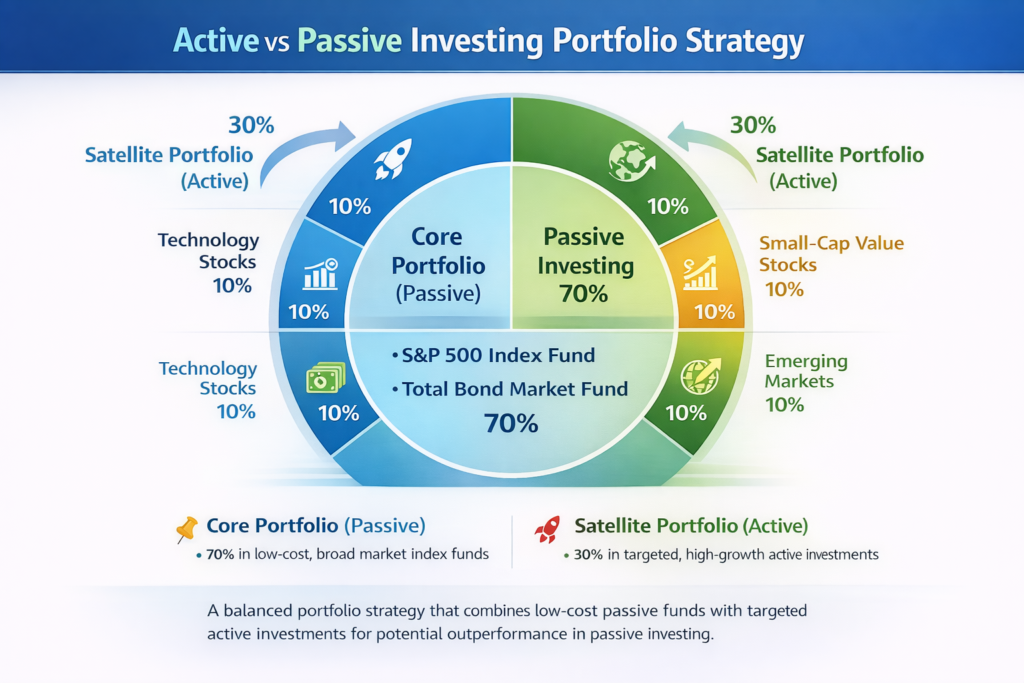
Investors don’t have to choose only one approach. Many use a hybrid approach.
Core-Satellite Strategy
📌 “Core” = Passive index holdings
📌 “Satellite” = Active positions
Example:
- 70% in S&P 500 index fund
- 30% in selected active strategies (technology, small cap, etc.)
This seeks:
✔ Market returns
✔ Potential for outperformance
Tactical Allocation
Some investors adjust allocation based on economic conditions.
- Increase bonds in recession
- Increase equities in growth
This is a blend of active risk management with passive diversification.
10. When Active Investing Works Best
Active investing tends to outperform more often in:
1. Less Efficient Markets
Smaller markets or sectors with poor information transparency.
Examples:
- Emerging markets
- Corporate credit markets
- Micro-cap companies
2. Volatile Periods
During high uncertainty, active managers with skill can adapt faster:
- Rise of tech or AI stocks
- Industry disruptions
- Geopolitical events
3. Short Time Horizons
Passive investing thrives over long horizons.
But in short windows (1–3 years), active decisions may add value.
11. When Passive Investing Works Best
Passive investing works best in:
✔ Efficient major markets
✔ Long time frames
✔ Low-cost disciplined approaches
Examples:
- S&P 500 investing
- Total stock market ETFs
- Broad international index funds
In these arenas, passive strategies often outperform most active funds after fees.
12. Myths in Active vs Passive Investing
Let’s debunk some myths:
❌ Myth 1: Passive Investing Means Higher Returns
Not always. Passive returns = market returns. They can suffer in downturns like any market decline.
❌ Myth 2: Active Investing Always Beats the Market
Data shows this is false over long periods.
❌ Myth 3: All Active Managers Are Bad
Some do outperform—but consistency is rare.
13. Costs, Taxes & Turnover
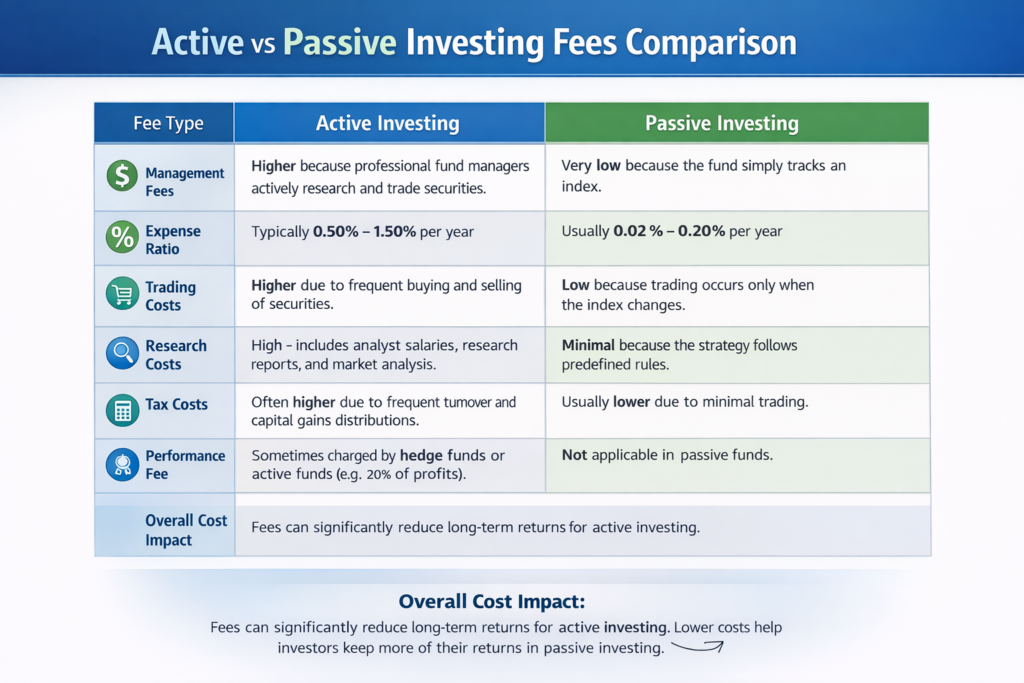
Active vs Passive Investing Fees Comparison
| Fee Type | Active Investing | Passive Investing |
|---|---|---|
| Management Fees | Higher because professional fund managers actively research and trade securities. | Very low because the fund simply tracks an index. |
| Expense Ratio | Typically 0.50% – 1.50% per year | Usually 0.02% – 0.20% per year |
| Trading Costs | Higher due to frequent buying and selling of securities. | Low because trading occurs only when the index changes. |
| Research Costs | High – includes analyst salaries, research reports, and market analysis. | Minimal because the strategy follows predefined rules. |
| Tax Costs | Often higher due to frequent turnover and capital gains distributions. | Usually lower due to minimal trading. |
| Performance Fee | Sometimes charged by hedge funds or active funds (e.g., 20% of profits). | Not applicable in passive funds. |
| Overall Cost Impact | Fees can significantly reduce long-term returns. | Lower costs help investors keep more of their returns. |
Simple Example: Impact of Fees Over Time
Suppose an investor invests $10,000 for 30 years.
| Scenario | Annual Return | Annual Fees | Final Value |
|---|---|---|---|
| Active Fund | 8% | 1% | ~$57,000 |
| Passive Index Fund | 8% | 0.05% | ~$93,000 |
Even though both investments earn the same market return, the higher fees dramatically reduce the final wealth.
Even though both investments generate the same 8% market return, higher fees significantly reduce long-term wealth. This example shows why many studies from institutions like Morningstar and S&P Dow Jones Indices emphasize that lower costs are one of the strongest predictors of better investment outcomes.
Costs
Active management fees are higher than passive.
Over decades, even a 0.5% difference can erode returns significantly.
Turnover
Active funds trade more frequently.
This leads to:
✔ Higher transaction costs
✔ Taxable gains (for taxable accounts)
Passive funds trade less, reducing tax drag.
14. What the Data Says: Summary
📌 MOST active funds fail to beat passive benchmarks over long periods.
📌 Fee differences account for much of the performance gap.
📌 Passive investing historically delivers competitive returns with low risk.
📌 Active strategies can add value in niche markets or short horizons.
📌 Diversified portfolios benefit from combining both approaches.
15. How to Choose What’s Best for You
Here are questions to ask yourself:
1. What is your time horizon?
- Long horizon → Passive performs well
- Short horizon → Active may offer opportunities
2. Are you comfortable with risk?
- Passive = steady, broad exposure
- Active = concentrated risk, higher volatility
3. What is your cost tolerance?
- Active = higher fees
- Passive = minimal fees
4. Do you want control or simplicity?
- Active offers control
- Passive offers simplicity
16. Active vs Passive Investing Strategy for Beginners
If you’re just starting out:
📌 Build a core portfolio of passive index funds:
- S&P 500 index
- Total international stock index
- Bond index fund
This gives broad diversification with low cost.
Only add active strategies if:
✔ You understand the strategy
✔ You can tolerate higher risk
✔ You compare fees vs expected performance
17. Practical Application: A Seasoned Investor
If you’re experienced:
✔ Combine passive core holdings with active satellite plays.
✔ Use tactical allocation based on macro conditions.
Example Portfolios:
| Strategy | Allocation |
|---|---|
| Passive Core (Stocks + Bonds) | 70% |
| Active Sector Picks | 20% |
| Cash or Tactical Positions | 10% |
18. Final Takeaways
Active and passive investing are not enemies—they are tools.
The real question is not whether one is always better than the other, but:
👉 Which approach fits your goals, timeline, risk tolerance, and financial psychology?
What the Data Really Says:
🔹 Passive investing delivers competitive long-term returns at low cost.
🔹 Most active managers fail to outperform after fees.
🔹 Skilled active investing can add value in specific markets or conditions.
🔹 A combined strategy often helps balance risk and opportunity.
19. Quick Comparison
| Feature | Active | Passive |
|---|---|---|
| Goal | Beat the market | Track the market |
| Fees | Higher | Lower |
| Flexibility | Yes | No |
| Turnover | High | Low |
| Long-Term Return | Less consistent | More consistent |
| Tax Efficiency | Lower | Higher |
Active vs Passive Investing FAQs
Conclusion
Both active and passive investing have a role in modern finance. Understanding the data, risks, costs, and your personal financial goals is the smartest way to build a successful investment journey.
📌 Passive investing often wins on cost and consistency.
📌 Active investing wins where markets are less efficient or in short-term tactical plays.