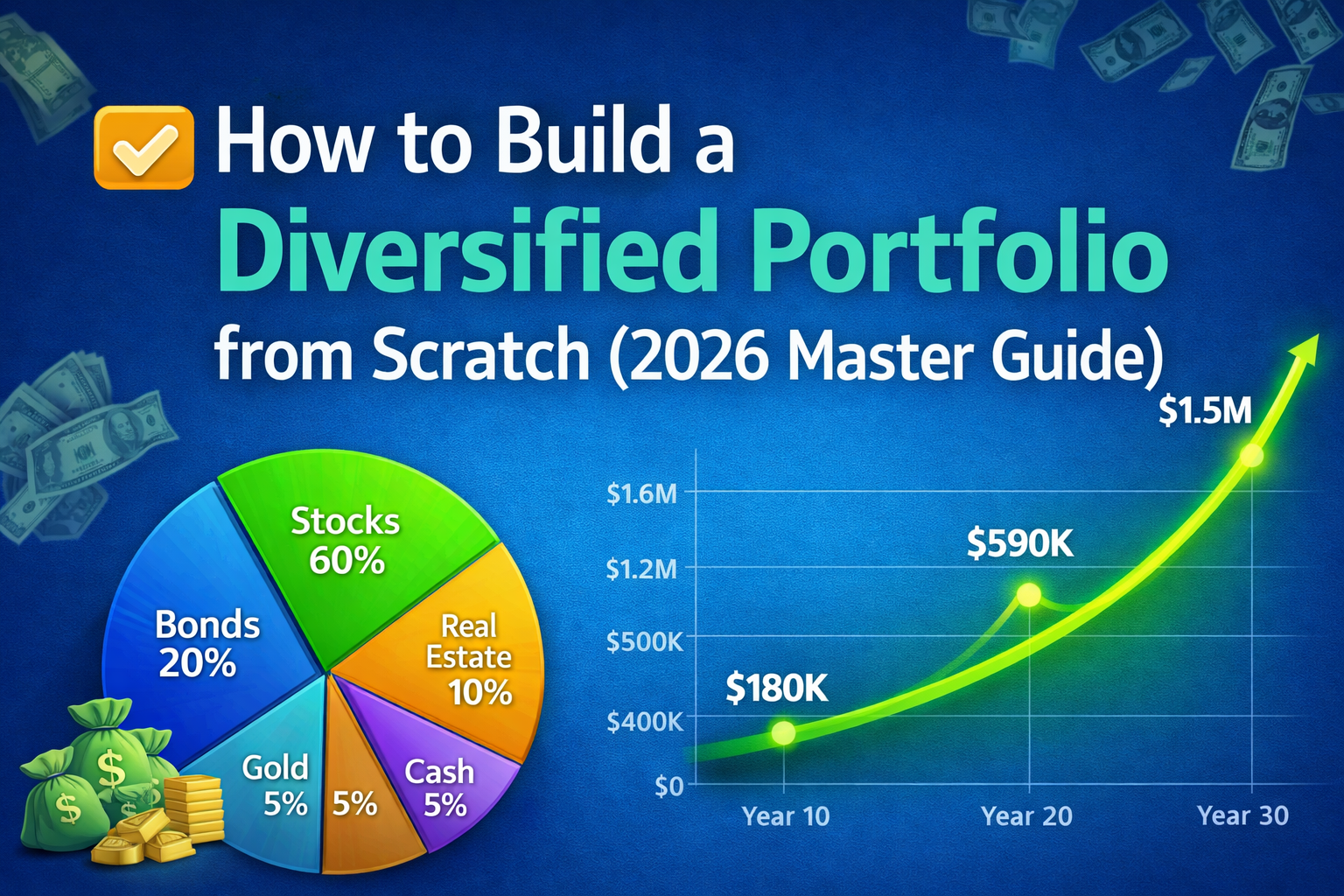
Diversified Portfolio Explained (Introduction)
Diversified portfolio strategy is the foundation of long-term wealth creation in modern financial markets.
Before investing even $1 in developed economies like the United States, United Kingdom, Canada, or Australia, understanding the core language of investing is critical. These markets are mature, highly regulated, and efficient, meaning returns are driven not by luck but by disciplined strategies like diversification.
A diversified portfolio is essentially a structured mix of different financial assets designed to reduce risk while maintaining consistent returns over time. According to Investopedia, diversification helps reduce overall portfolio risk by spreading investments across different asset classes.
If you’re new, read our complete guide on How to Start Investing with $1,000 to begin your journey.
Instead of relying on a single investment, you spread your money across multiple asset classes that behave differently under varying economic conditions. This ensures that when one asset under performs, another may perform well, balancing your overall returns.
This guide explains how to build a diversified portfolio step by step.
What is a Diversified Portfolio?
A portfolio is the complete set of all financial investments owned by an individual or institution. It includes stocks, bonds, real estate, commodities, and cash equivalents. The key idea is that these assets do not operate independently—they interact with each other to influence the overall performance of your wealth.
A portfolio is not just a random collection; it is a strategically designed system where each component plays a role. For example, stocks provide growth, bonds provide stability, and cash provides liquidity. Together, they create a balanced financial structure. A diversified portfolio ensures these assets work together efficiently.
Financial Assets Explained in Depth
A financial asset is anything that has monetary value and can generate returns. Each asset plays a role in a diversified portfolio strategy. Returns can come in two forms:
- Income (dividends, interest, rent)
- Capital appreciation (increase in value over time)
For example, owning shares of Apple Inc. gives you ownership in the company, and you benefit if the company grows. Similarly, investing in funds from Vanguard Group provides exposure to diversified markets.
Asset Class Comparison Table
| Asset Class | Return Potential | Risk Level | Liquidity | Role |
|---|---|---|---|---|
| Stocks | High | High | High | Growth |
| Bonds | Moderate | Low | Medium | Stability |
| Real Estate | Moderate | Medium | Low | Income + Hedge |
| Gold | Low | Medium | High | Protection |
| Cash | Very Low | Very Low | Very High | Liquidity |
This diversified portfolio example shows how combining assets balances risk and return.
Diversified Portfolio Allocation Chart
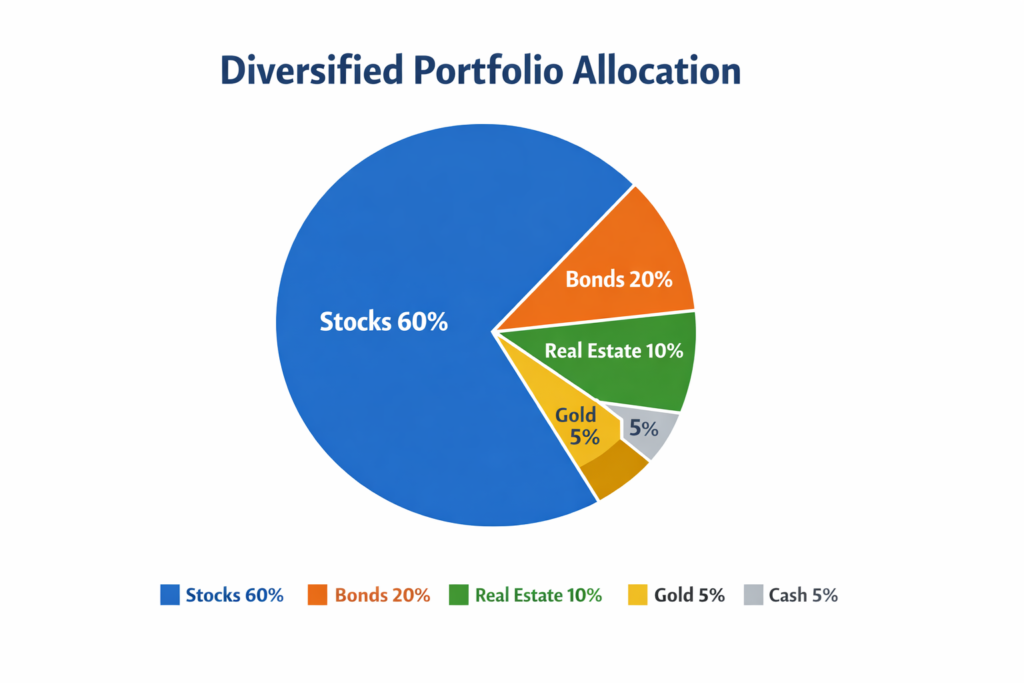
This is a typical diversified portfolio example used by investors in the United States and other developed markets.
Example Allocation Breakdown
| Asset Class | Allocation |
|---|---|
| Stocks | 60% |
| Bonds | 20% |
| Real Estate | 10% |
| Gold | 5% |
| Cash | 5% |
This diversified portfolio allocation chart shows how spreading investments across multiple asset classes reduces risk while maintaining long-term growth. Stocks provide growth, bonds add stability, real estate offers income and inflation protection, gold acts as a hedge during crises, and cash ensures liquidity. This balanced structure is ideal for investors in Tier-1 countries aiming for consistent returns.
Why a Diversified Portfolio is Important
A diversified portfolio is important because it reduces risk and protects investors from market volatility. Instead of relying on a single asset class, diversification spreads investments across multiple assets that behave differently in various economic conditions.
For example, when stock markets decline, assets like bonds or gold may perform better, helping to balance overall portfolio performance. This reduces the chances of large losses and provides more stable long-term returns.
A diversified portfolio also improves consistency. Investors in Tier-1 countries like the United States, United Kingdom, Canada, and Australia rely heavily on diversification to manage risk across global markets.
Historical Case Study: 2008 Crisis
The Global Financial Crisis is one of the most important examples of why diversification matters. During this period, global stock markets collapsed due to excessive risk-taking in the banking sector, particularly in mortgage-backed securities. Investors who were heavily invested in stocks saw their portfolios decline by nearly 50%.
However, diversified investors who held bonds and gold experienced significantly smaller losses because bonds performed positively and gold acted as a safe haven. This clearly demonstrates that diversification is not about maximizing returns—it is about minimizing losses during extreme events. The ability to survive market crashes is what ultimately leads to long-term wealth creation. A diversified portfolio performed significantly better during this crisis.
During the Global Financial Crisis:
| Asset | Performance |
|---|---|
| Stocks | -50% |
| Real Estate | -30% |
| Bonds | +5% to +10% |
Investor Comparison
| Investor | Strategy | Result |
|---|---|---|
| A | 100% Stocks | Lost 50% |
| B | Diversified | Lost ~20% |
Lesson: Diversification reduces damage
The Science Behind Diversification
What is Risk?
Risk = uncertainty of returns
Regulatory bodies like the U.S. Securities and Exchange Commission emphasize understanding risk before investing, as it directly impacts long-term financial outcomes.
Measured using:
- Standard deviation
- Beta
- Drawdowns
Types of Risk
Unsystematic Risk
- Company-specific
- Example: Bankruptcy of a company
Can be reduced with diversification
Systematic Risk
- Market-wide risk
- Example: recession
Cannot be avoided
What is Volatility?
Volatility measures how much an asset’s price fluctuates over time. It is a key indicator of risk. High volatility means prices change rapidly, while low volatility indicates stable price movement.
For example, stocks of high-growth companies can experience large swings in value within short periods, while government bonds tend to move slowly and predictably. Understanding volatility helps investors choose the right mix of assets based on their risk tolerance. A diversified portfolio helps reduce volatility by spreading risk.
Volatility Comparison
| Asset | Volatility | Behavior |
|---|---|---|
| Crypto | Very High | Extreme swings |
| Stocks | High | Growth + risk |
| REITs | Medium | Balanced |
| Bonds | Low | Stable |
| Cash | Very Low | No fluctuation |
Modern Portfolio Theory
Developed by Harry Markowitz, this theory suggests that investors can achieve optimal returns by combining assets that are not perfectly correlated. In simple terms, you should invest in assets that do not move in the same direction at the same time.
This concept is widely used by firms like BlackRock to design efficient portfolios for millions of investors globally.
Core Building Blocks of a Diversified Portfolio
Stocks
Stocks represent ownership in a company. When you buy shares, you become a partial owner and benefit from the company’s growth. Stocks are considered the most powerful wealth-building tool because they historically deliver higher returns compared to other asset classes. Learn more in our detailed comparison: Stocks vs ETFs vs Mutual Funds
For example, the S&P 500 has delivered an average return of around 10% annually over the long term. This makes stocks essential for long-term investors, especially in Tier-1 countries where markets are well-regulated.
Stocks = ownership in a company
Example:
- Buying Apple Inc. stock
Benefits:
- High growth
- Dividends
- Inflation beating
Long-Term Data:
| Period | Return |
|---|---|
| 1926–2023 | ~10% annually |
Case Study (USA)
John (Age 25):
- Invests $500/month
- 10% return
➡️ After 30 years:
≈ $1 million+
Bonds
Bonds are essentially loans that you give to governments or corporations. In return, you receive fixed interest payments. Bonds are less risky than stocks and act as a stabilizing component in a portfolio.
In developed economies, government bonds are considered one of the safest investments, making them ideal for conservative investors or those nearing retirement.
Benefits:
- Stable income
- Lower risk
- Protection in crashes
Real Estate
Real estate provides both income and capital appreciation. It is also an effective hedge against inflation. In countries like the United States and Canada, real estate markets have historically grown steadily over time.
Types:
- Residential
- Commercial
- REITs
Benefits:
- Rental income
- Appreciation
- Inflation hedge
Commodities
Commodities like gold act as a hedge during economic uncertainty. When markets crash or inflation rises, gold tends to perform well, making it a valuable component in a diversified portfolio.
Examples:
- Gold
- Oil
Role:
- Crisis protection
- Inflation hedge
Cash
Cash provides liquidity and safety. It allows investors to take advantage of opportunities during market downturns. Although it offers low returns, it plays a critical role in financial stability.
Role:
- Emergency fund
- Liquidity
- Opportunity investing
How to Build a Diversified Portfolio (Step-by-Step)
Step 1: Define Financial Goals
In the United States, investors benefit from tax-advantaged accounts like 401(k) and Roth IRA, which allow tax-deferred or tax-free growth. Similarly, in the United Kingdom, ISA accounts provide tax-free investment returns, making them ideal for building a diversified portfolio.
Tier-1 Examples
| Country | Goal |
|---|---|
| USA | 401(k), Roth IRA |
| UK | ISA |
| Canada | RRSP |
| Australia | Superannuation |
Step 2: Risk Tolerance
| Type | Strategy |
|---|---|
| Conservative | More bonds |
| Moderate | Balanced |
| Aggressive | More stocks |
Step 3: Asset Allocation
Portfolio Models
| Type | Stocks | Bonds | Others |
|---|---|---|---|
| Conservative | 40% | 50% | 10% |
| Moderate | 70% | 25% | 5% |
| Aggressive | 90% | 10% | 0% |
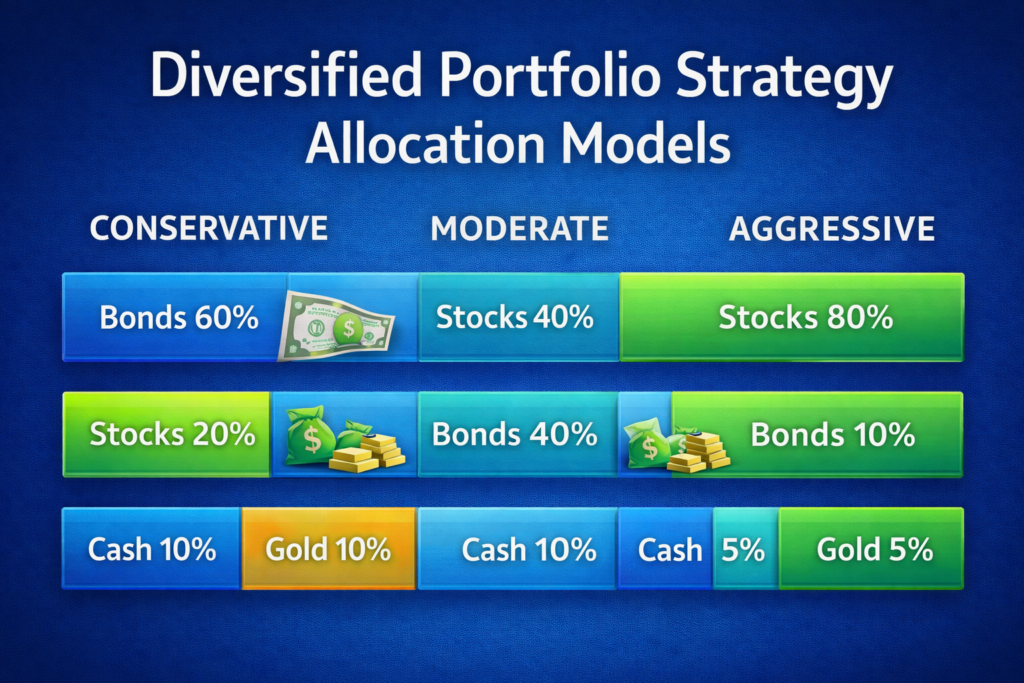
This portfolio allocation model illustrates how a diversified portfolio can be structured based on an investor’s risk tolerance. A conservative portfolio focuses more on bonds for stability, while a moderate portfolio balances stocks and bonds for growth and safety. An aggressive portfolio allocates a higher percentage to stocks to maximize long-term returns. Choosing the right allocation helps investors align their diversified portfolio strategy with their financial goals and risk capacity.
Diversified Portfolio Example (2026)
“This diversified portfolio example shows how a balanced allocation can reduce risk while maintaining growth.”
30-Year Diversified Portfolio Case Study
Over time, a diversified portfolio delivers more consistent returns. The power of diversification becomes more evident over long periods.
Consider two investors:
- Investor A invests only in technology stocks
- Investor B builds a diversified portfolio
During market downturns, Investor A experiences massive losses, sometimes up to 70%. Investor B, however, experiences smaller declines because other assets offset the losses.
Over 30 years, Investor B achieves more consistent growth and avoids catastrophic losses. This highlights an important principle: wealth is not just about growth—it is about survival.
Investor Comparison
| Investor | Strategy | Result |
|---|---|---|
| A | 100% Tech | -70% crash |
| B | Diversified | -25% crash |
Survival matters more than returns
Geographic Diversification
Geographic diversification involves investing across different countries and regions. This is important because economies do not grow at the same pace. A diversified portfolio includes global exposure to reduce country-specific risk.
For example, during the early 2000s, the United States experienced slow growth, while emerging markets delivered higher returns. By investing globally, investors can benefit from growth opportunities in different regions while reducing dependency on a single economy.
Example:
| Region | Performance |
|---|---|
| USA | Low (2000s) |
| Emerging Markets | High |
Sector Diversification
Sector diversification means spreading investments across different industries such as technology, healthcare, finance, and energy. Sector allocation is a key part of a diversified portfolio strategy.
For example:
- Technology may perform well during innovation cycles
- Healthcare remains stable during economic downturns
- Energy benefits from rising commodity prices
By diversifying across sectors, investors reduce the risk of being heavily impacted by downturns in a single industry.
Major Sectors
| Sector | Example |
|---|---|
| Tech | Apple |
| Healthcare | Pharma |
| Finance | Banks |
| Energy | Oil |
Avoid overconcentration
Index Fund Strategy for a Diversified Portfolio
Index funds are one of the simplest and most effective ways to build a diversified portfolio. Investment firms like Vanguard Group have popularized low-cost index investing for long-term wealth creation. These funds track market indices like the S&P 500, providing exposure to hundreds of companies in a single investment. Index funds make building a diversified portfolio simple and efficient.
The key advantages of index funds include low costs, broad diversification, and consistent performance. They are widely recommended for beginners and are commonly used in retirement accounts in Tier-1 countries.
Popular ETFs used in diversified portfolio strategies include the S&P 500 ETF (VOO), Total Market ETF (VTI), and International ETF (VXUS). These funds provide broad market exposure and are widely used by long-term investors in Tier-1 countries.
Best Diversified Portfolio Strategy for Beginners
“Index funds are the easiest way to build a diversified portfolio for beginners.”
Benefits:
| Feature | Advantage |
|---|---|
| Low cost | More returns |
| Passive | Easy |
| Diversified | Lower risk |
Rebalancing Your Diversified Portfolio
Rebalancing is the process of adjusting your portfolio to maintain your desired asset allocation. Over time, some assets may grow faster than others, causing your portfolio to drift from its original structure. Rebalancing maintains your diversified portfolio structure.
For example, if stocks outperform bonds, your portfolio may become riskier than intended. Rebalancing involves selling some stocks and buying bonds to restore balance. This ensures that your risk level remains aligned with your financial goals.
Example:
| Asset | Before | After |
|---|---|---|
| Stocks | 70% | 80% |
| Bonds | 30% | 20% |
Psychological Benefits
Diversification:
- Reduces panic
- Improves discipline
- Avoids emotional mistakes
Compounding Power in a Diversified Portfolio
Compounding is one of the most powerful concepts in investing. It refers to the process where your returns generate additional returns over time.
Growth Visualization
| Year | Value |
|---|---|
| 10 | $180K |
| 20 | $590K |
| 30 | $1.5M |
Compounding creates exponential growth because your investment grows not only on the original amount but also on the accumulated returns. This is why starting early is crucial for long-term wealth creation. A diversified portfolio benefits greatly from compounding over time. Also read: How Compounding Works in Long-Term Investing
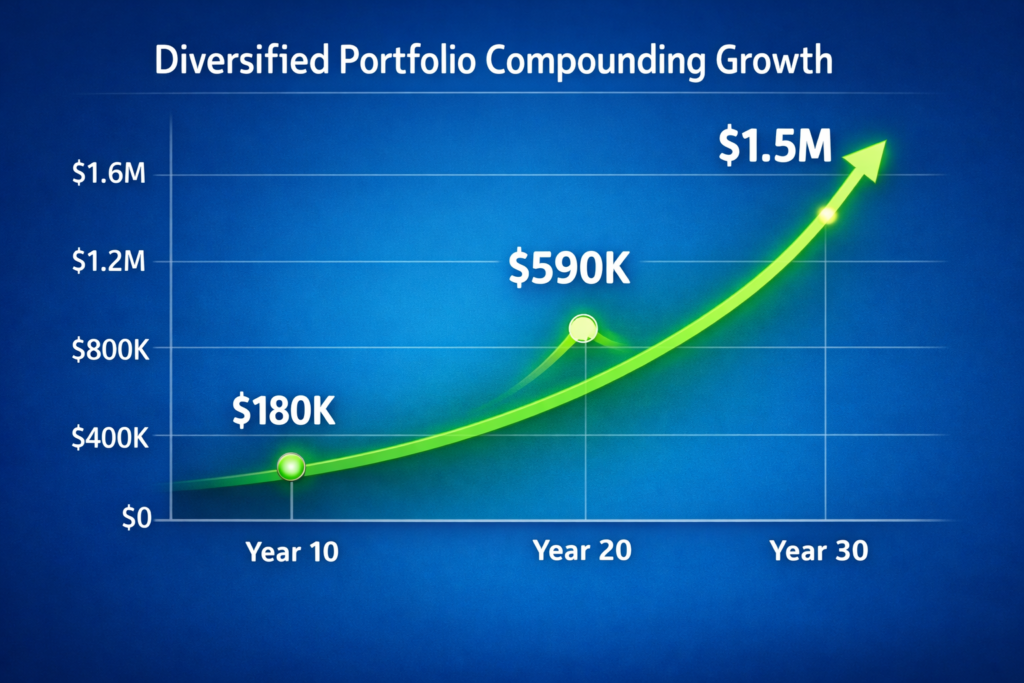
This compounding growth chart demonstrates how a diversified portfolio can generate exponential returns over time. In the early years, growth appears slow, but as returns begin to compound, the portfolio value accelerates significantly. By Year 10, the investment reaches $180K, grows to $590K by Year 20, and surpasses $1.5M by Year 30. This highlights the power of long-term investing, where consistency and patience play a crucial role in wealth creation.
Common Mistakes to Avoid
Many investors fail due to avoidable mistakes. One of the biggest mistakes is lack of diversification, which exposes them to unnecessary risk. Another common mistake is chasing market trends or hype, such as investing heavily in cryptocurrencies during peak periods without understanding the risks. Failing to build a diversified portfolio is one of the biggest mistakes.
Ignoring fees is another critical issue, as high fees can significantly reduce long-term returns. Additionally, failing to rebalance the portfolio can lead to increased risk over time. Avoiding these mistakes is essential for achieving consistent financial growth.
| Mistake | Result |
|---|---|
| No diversification | Huge losses |
| Chasing hype | Loss |
| Ignoring fees | Lower returns |
| No rebalancing | Risk increases |
Sample Diversified Portfolio (2026)
| Asset | Allocation |
|---|---|
| US Stocks | 50% |
| International | 20% |
| Bonds | 20% |
| REITs | 10% |
Wealth Formula Explained
A diversified portfolio combined with time and discipline creates wealth. The formula for building wealth can be summarized as:
Diversification + Time + Discipline + Compounding = Wealth
Diversification reduces risk, time allows investments to grow, discipline ensures consistency, and compounding accelerates growth. Together, these factors create a powerful system for long-term financial success.
Final Case Study
Two Investors
| Investor | Strategy | Result |
|---|---|---|
| A | Crypto only | -70% |
| B | Diversified | -15% |
Winner = diversified investor
Key Takeaways
✔ Diversification reduces risk
✔ Asset allocation matters more than stock picking
✔ Long-term investing wins
✔ Emotions destroy wealth
Final Truth
Wealth is built by:
- Discipline
- Patience
- Consistency
NOT by:
- Luck
- Timing
FAQs About Diversified Portfolio
Conclusion
A diversified portfolio is the most reliable way to build long-term wealth.”
Investors who stay disciplined and consistent can achieve financial independence.
Start building your diversified portfolio today to secure your financial future.
Investors who focus on diversification, maintain discipline, and stay invested for the long term are far more likely to achieve financial independence. Success in investing is not about timing the market—it is about time in the market.