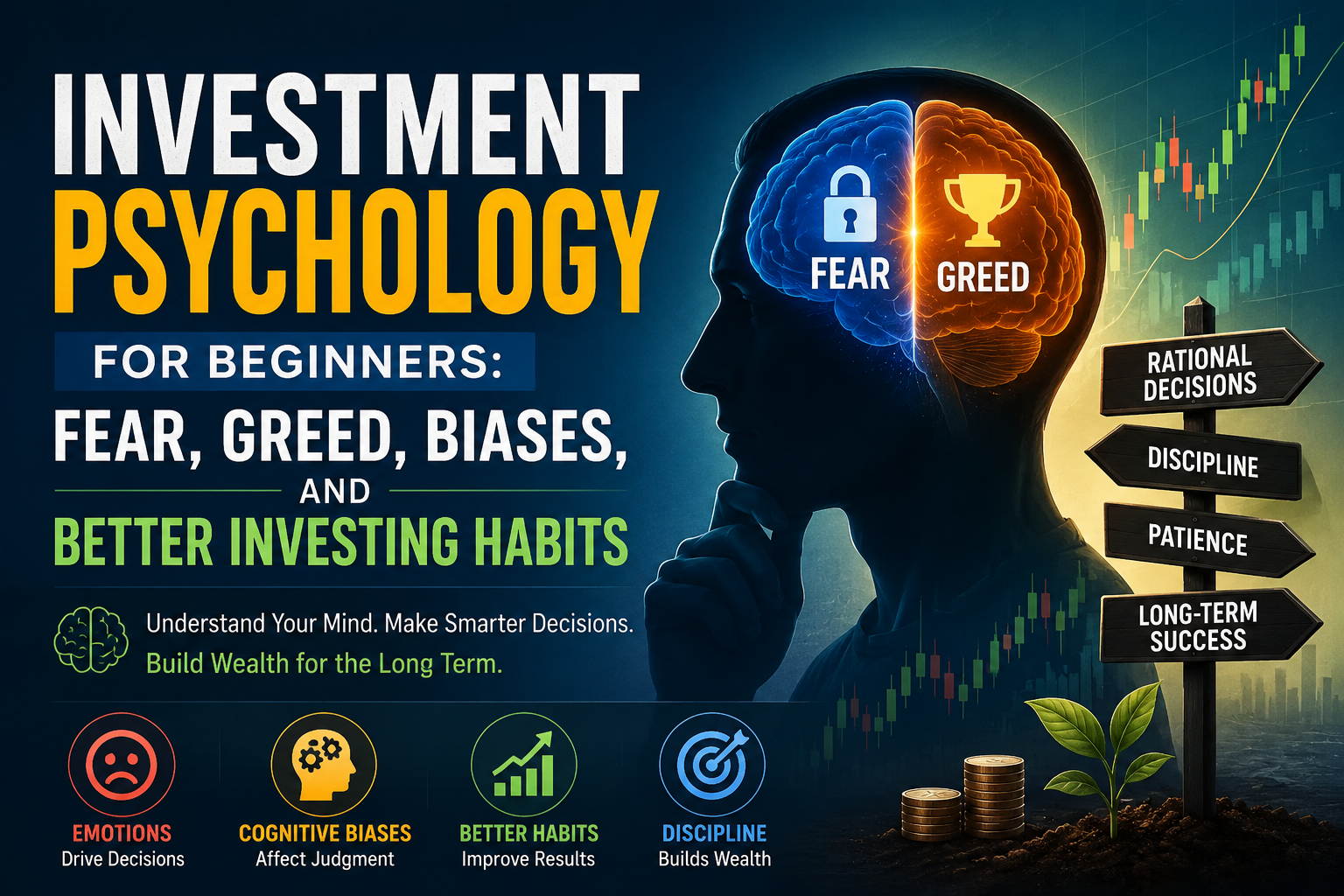
Investment Psychology for Beginners
If you are new to investing, you probably expect success to depend mostly on which stocks you pick, which ETF you buy, or when you enter the market. Those things matter but they are not the whole story. In many cases, the biggest factor shaping your long-term results is not the market itself. It is you.
That may sound harsh, but it is actually good news. Why? Because markets are uncertain and uncontrollable. Your behavior, however, can be improved. If you understand how your mind reacts to money, risk, headlines, gains, and losses, you can make better decisions, avoid costly mistakes, and stay invested long enough for compounding to work.
That is what investment psychology is about.
Investment psychology is the study of how thoughts, emotions, mental shortcuts, habits, and social influences affect the way people invest. It sits at the intersection of finance, psychology, and behavior. Traditional finance once assumed investors were rational, calm, and logical. Real life tells a different story. Investors panic in crashes, chase hot stocks at market tops, ignore their own plans, sell winners too early, hold losers too long, and confuse luck with skill. Even highly educated people do this. Even professionals do this.
A beginner who understands investment psychology gains a powerful advantage. You may not be able to predict the next recession, interest rate move, or AI stock rally. But you can learn to avoid emotional buying, panic selling, overtrading, and herd behavior. That alone can improve your odds of long-term success.
This guide explains investment psychology for beginners. We will cover what investment psychology means, why it matters, the most common emotional traps, the major behavioral biases that hurt returns, and practical systems you can use to become a calmer, more disciplined investor. You will also see real-world examples and case studies showing how investor behavior affects actual outcomes.
By the end, you should understand one of the most important truths in personal finance:
Successful investing is not only about finding the right investments. It is about building the right behavior.
1) What Is Investment Psychology?
Investment psychology refers to the way a person’s emotions, beliefs, mental habits, and cognitive biases influence investing decisions.
Let’s break that down.
Investment
An investment is something you put money into with the expectation that it will grow in value or produce income in the future. Examples include stocks, bonds, ETFs, mutual funds, real estate, and retirement accounts.
Psychology
Psychology is the study of the human mind and behavior—how people think, feel, decide, react, and form habits.
Investment Psychology
Put those two together, and investment psychology becomes the study of questions like:
- Why do investors panic when markets fall?
- Why do people buy after prices have already surged?
- Why do investors hold losing stocks hoping they “come back”?
- Why do some people take too much risk after a few wins?
- Why do headlines and social media affect portfolio decisions?
In simple terms:
Investment psychology is about how your mind affects your money decisions.
It includes both emotions and biases.
Emotions in investing
Emotions are feelings that influence decisions. In investing, the big ones are:
- Fear – “What if I lose everything?”
- Greed – “What if I miss a huge gain?”
- Hope – “Maybe this terrible stock will recover.”
- Regret – “I should have bought that earlier.”
- Pride – “I was right once, so I must be skilled.”
- Envy – “Everyone else is making money except me.”
Biases in investing
Biases are mental shortcuts or distortions in thinking. They are often automatic and invisible to us. Examples include:
- Loss aversion – losses feel more painful than gains feel rewarding
- Confirmation bias – looking only for information that supports what you already believe
- Overconfidence bias – believing you know more than you do
- Recency bias – assuming what happened recently will continue
- Herd mentality – following what everyone else is doing
These emotional reactions and biases can lead to poor decisions, even when the investor technically “knows better.”
2) Why Investment Psychology Matters More Than Beginners Think
When people first start investing, they often focus on the visible parts of investing:
- which broker to use
- which stock to buy
- whether to choose ETFs or mutual funds
- how much return they can earn
- whether the market is “too high”
Those are important questions. But a beginner can still fail with good investments if their behavior is poor.
Example: Same fund, different results
Imagine two investors both buy the same low-cost S&P 500 index fund.
Investor A
- invests every month automatically
- ignores short-term noise
- stays invested during crashes
- rebalances once a year
- keeps cash for emergencies so they don’t need to sell in panic
Investor B
- buys after seeing a rally
- stops investing when headlines turn negative
- sells after a 20% decline because they feel scared
- buys speculative stocks during hype cycles
- keeps checking the portfolio every day
Even though they owned the same market at one point, their long-term results may be very different. Why? Behavior.
Good investing is often boring
This is one of the hardest things for beginners to accept. Good investing often looks boring:
- consistent contributions
- broad diversification
- patience
- not reacting to every headline
- not chasing what is hot
- sticking to a plan when emotions are loud
But the brain hates boredom. It wants action, certainty, stories, excitement, and control. That is why investment psychology matters. It helps you understand the internal battle between what works in theory and what feels good in the moment.
3) The Link Between Behavioral Finance and Investing
To understand investment psychology, you should know the term behavioral finance.
What is behavioral finance?
Behavioral finance is the field that studies how psychological influences and human behavior affect financial decisions and market outcomes.
Traditional finance assumed investors are rational. Behavioral finance says:
- investors are emotional
- investors use shortcuts
- investors are influenced by context
- investors make predictable mistakes
- those mistakes affect prices, portfolios, and long-term returns
Behavioral finance helps explain why:
- bubbles happen
- panic selling happens
- investors underperform the funds they own
- people hold losers and sell winners too quickly
- trends become self-reinforcing
- speculation feels irresistible during booms
Key names in behavioral finance
If you want to understand the roots of investment psychology, a few names matter:
- Daniel Kahneman – psychologist and Nobel Prize winner whose work on decision-making changed economics
- Amos Tversky – collaborator with Kahneman on heuristics and biases
- Richard Thaler – behavioral economist known for applying psychology to economic behavior
- Benjamin Graham – not a behavioral scientist, but his “Mr. Market” concept is a classic lesson in emotional markets
Behavioral finance gives academic language to what investors have observed for decades:
People are not spreadsheets. They are emotional, social, biased decision-makers trying to make choices under uncertainty.
4) The Emotional Side of Investing: Fear, Greed, Hope, Regret, and FOMO
Investment psychology is easier to understand if we start with emotions. These feelings often drive the biggest mistakes.
4.1 Fear
Fear is one of the strongest emotions in investing. It shows up when:
- markets fall sharply
- your portfolio is down 10%, 20%, or 30%
- layoffs or recession fears dominate the news
- you worry that a temporary decline will become permanent loss
Fear can be useful if it stops reckless behavior. But in investing, fear often becomes destructive when it pushes people to sell quality assets during downturns.
Example
An investor buys a diversified index fund. The market drops 25% during a recession. They panic, sell everything, and move to cash. Six months later, the market rebounds. They miss the recovery.
Fear did not protect them. It locked in damage.
4.2 Greed
Greed appears when markets rise and investors want more, faster. It can lead to:
- overexposure to risky assets
- buying speculative stocks with no plan
- using leverage without understanding it
- ignoring valuation and fundamentals
- believing “this time is different”
Greed often disguises itself as ambition, confidence, or “high conviction.”
Example
A beginner sees friends doubling money in AI or crypto-related names. Instead of sticking to their diversified plan, they move half their portfolio into a handful of momentum stocks near the peak.
4.3 Hope
Hope sounds positive, but in investing it can become dangerous when it replaces analysis.
Healthy hope:
- “Over the long term, diversified markets may reward patient investors.”
Unhealthy hope:
- “This broken company will come back because I need it to.”
Hope becomes a trap when investors refuse to admit a thesis is wrong.
4.4 Regret
Regret has two faces in investing:
Regret from action
“I should never have bought that stock.”
Regret from inaction
“I should have invested when prices were lower.”
“I should have bought Nvidia years ago.”
“I should have started in my 20s.”
Regret often leads to bad follow-up decisions:
- revenge investing
- rushing into the next hot asset
- abandoning a good plan out of frustration
4.5 FOMO (Fear of Missing Out)
FOMO is one of the defining emotions of modern investing. It is amplified by:
- social media screenshots
- influencer content
- memes and online communities
- constant access to markets
- stories of overnight wealth
FOMO says:
- “Everyone is making money except me.”
- “If I don’t buy now, I’ll miss the opportunity forever.”
- “This stock is up 80%, so it must keep going.”
FOMO is especially dangerous because it often causes people to buy after the easy gains have already happened.
5) The Most Common Psychological Biases in Investing
Now let’s move from emotions to cognitive biases—the mental shortcuts that distort judgment.
5.1 Loss Aversion
Loss aversion means losses feel more painful than gains feel pleasurable.
If you gain $1,000, you feel good. If you lose $1,000, you usually feel much worse than the pleasure of the gain. The pain is often stronger.
How it hurts investors
Loss aversion can cause people to:
- avoid investing altogether because they fear short-term losses
- sell after declines to stop the emotional pain
- refuse to rebalance into falling assets
- hold losing positions too long because selling makes the loss “real”
Beginner example
A new investor sees their portfolio fall 12%. Instead of viewing it as normal volatility, they interpret it as failure and stop investing for two years.
5.2 Overconfidence Bias
Overconfidence bias is the tendency to overestimate your knowledge, skill, forecasting ability, or control.
This often happens after a few successful trades. A rising market makes many people feel smarter than they really are.
Signs of overconfidence
- “I can beat the market consistently.”
- “I know this company better than Wall Street.”
- “Diversification is for average investors.”
- “I don’t need a plan—I can just react.”
Why it is dangerous
Overconfidence can lead to:
- concentrated bets
- excessive trading
- ignoring risk management
- dismissing uncertainty
- underestimating how much luck helped past gains
5.3 Confirmation Bias
Confirmation bias means looking for information that supports what you already believe while ignoring evidence that challenges you.
Example
You buy a stock and then spend weeks reading only bullish posts, watching only positive videos, and dismissing all criticism as “fear.”
Why it matters
Confirmation bias turns investing into a search for emotional comfort instead of truth.
A good investor asks:
- What could make me wrong?
- What is the bear case?
- What evidence would change my mind?
5.4 Recency Bias
Recency bias is the tendency to overweight recent events and assume they will continue.
In bull markets
- “Stocks have been rising for months, so they’ll keep rising.”
In bear markets
- “Markets keep falling, so I should stay out until things feel safe.”
Recency bias makes investors extrapolate the present into the future. It causes buying high and selling low.
5.5 Herd Mentality
Herd mentality means following the crowd rather than thinking independently.
Humans are social creatures. If everyone around you is doing something, it feels safer to join. In markets, this can be dangerous.
Examples
- buying meme stocks because everyone online is excited
- piling into housing or tech because “everyone is making money”
- selling during a crash because everyone else is panicking
The crowd can sometimes be right. But herd behavior is risky when it replaces analysis.
5.6 Anchoring Bias
Anchoring happens when you become attached to a reference point—often a past price.
Example
You buy a stock at $100. It falls to $60. You refuse to sell because you are anchored to the $100 purchase price and keep saying, “I’ll sell when it gets back to break-even.”
The market does not care what price you paid. But your brain does.
5.7 Disposition Effect
The disposition effect is the tendency to:
- sell winners too early
- hold losers too long
Why? Because taking a profit feels good, while realizing a loss feels painful.
This can create a harmful pattern:
- good assets are sold before compounding can work
- bad assets stay in the portfolio because of emotional attachment
5.8 Availability Bias
Availability bias means judging probability based on whatever examples come easily to mind.
If the news is full of recession fears, crashes, or bankruptcies, investors may overestimate how likely disaster is. If social media is full of “10x stock” stories, investors may overestimate how easy it is to get rich quickly.
5.9 Hindsight Bias
Hindsight bias is believing that past events were predictable after they already happened.
Example:
- “It was obvious that AI stocks would rally.”
- “It was obvious the market would bounce.”
This bias can make beginners overconfident because they confuse clarity after the fact with skill beforehand.
5.10 Endowment Effect
The endowment effect means people assign more value to something simply because they own it.
In investing, this can lead to emotional attachment to a stock:
- “I’ve held it for years, so it must be special.”
- “I know it better than outsiders do.”
- “I can’t sell now—it’s part of my story.”
6) Why Beginners Are Especially Vulnerable to Emotional Investing
Investment psychology affects everyone, but beginners are often more exposed because they have less experience with market volatility.
6.1 No emotional memory of market cycles
If you have never lived through a 30%–50% market drawdown, it is easy to think you can handle one. But your emotional reaction during an actual crash may surprise you.
6.2 Limited framework for volatility
Beginners often interpret volatility as danger rather than normal market behavior. A 15% decline may feel catastrophic if you do not know that drawdowns are common.
6.3 Social media pressure
New investors often learn from YouTube, Reddit, TikTok, X, Discord, and online communities. These spaces can be useful—but they also reward speed, excitement, and certainty rather than patience and nuance.
6.4 Lack of written process
Beginners often invest without a formal plan:
- no asset allocation target
- no rules for rebalancing
- no criteria for buying or selling
- no emergency fund
- no risk limits
Without a system, emotions fill the gap.
6.5 Confusing activity with progress
Beginners often think more action means better investing:
- checking prices constantly
- switching funds
- reacting to every headline
- “optimizing” every week
In reality, unnecessary activity often hurts returns.
7) How Market Cycles Trigger Psychological Mistakes
Markets do not just move prices. They trigger emotions in predictable waves.
Stage 1: Early optimism
Investors feel cautious but interested. Good news starts to build. Confidence returns.
Stage 2: Excitement
Prices rise, headlines improve, and more people join. Investors begin to feel rewarded.
Stage 3: Euphoria
This is the dangerous phase. People believe:
- easy gains are normal
- risk does not matter
- valuation does not matter
- “this time is different”
Speculation increases. FOMO explodes.
Stage 4: Anxiety
The market starts wobbling. Investors tell themselves it is temporary.
Stage 5: Denial
Losses grow, but many refuse to act or rethink their assumptions.
Stage 6: Fear and panic
Selling accelerates. Investors focus on preserving what is left.
Stage 7: Capitulation
Some investors sell near the bottom because the pain becomes unbearable.
Stage 8: Despair and numbness
People swear off investing. This is often when future returns improve, but emotionally exhausted investors do not want to participate.
Understanding this emotional cycle helps you recognize when your brain is reacting to the environment rather than following a plan.
8) Case Studies: How Investor Psychology Shapes Real Results
Below are practical case studies showing how investment psychology affects outcomes.
Case Study 1: The 2020 Crash and Panic Selling
Situation
In early 2020, global markets fell sharply during the COVID shock. Many investors saw their portfolios drop at terrifying speed.
Investor A: Panic response
- sold index funds after a major decline
- moved to cash “until things stabilize”
- waited for certainty before re-entering
- missed much of the rebound
Investor B: Plan-based response
- continued monthly contributions
- rebalanced back into equities
- kept emergency cash separate from investments
- stayed invested through volatility
Psychology lesson
Fear is strongest near market lows, not highs. Investors who wait for emotional comfort often re-enter after prices have already recovered.
Case Study 2: The Meme Stock FOMO Investor
Situation
A beginner sees viral posts about a stock soaring hundreds of percent. Social media is full of “diamond hands” memes and screenshots of gains.
What happens
- they buy after the price has already surged
- they invest money meant for long-term goals
- they treat a speculation like an investment
- the stock collapses
- they refuse to sell because the community says to “hold”
Psychology lesson
FOMO, herd mentality, and confirmation bias often work together. The investor stops asking, “What is this worth?” and starts asking, “How do I avoid missing out?”
Case Study 3: The Overconfident Bull Market Winner
Situation
A new investor starts during a strong bull market and earns excellent returns.
What happens
- they assume the gains came from skill rather than market conditions
- they increase position sizes
- they stop diversifying
- they begin trading options or concentrated tech bets
- a market reversal exposes how fragile the strategy was
Psychology lesson
A rising market can hide mistakes. Overconfidence grows fastest when investors mistake a favorable environment for personal genius.
Case Study 4: The Loss-Averse Retiree Saver
Situation
A middle-aged investor wants to start investing for retirement but is afraid of losing money.
What happens
- they keep nearly everything in cash for years
- inflation quietly erodes purchasing power
- they avoid short-term volatility but sacrifice long-term growth
- they later realize the bigger risk was not investing enough
Psychology lesson
Loss aversion does not only cause panic selling. It can also cause under-investing, which is a quieter but serious long-term mistake.
Case Study 5: The “Break-Even” Stock Holder
Situation
An investor buys a company at $80. It falls to $40.
What happens
- instead of reassessing the business, they keep saying:
“I’ll sell once it gets back to $80.” - the stock remains weak for years
- better opportunities are ignored
- the decision becomes emotional rather than rational
Psychology lesson
Anchoring to your purchase price is dangerous. The right question is not “Can I get back to break-even?” The right question is “If I had fresh cash today, would I buy this asset now?”
Case Study 6: The Index Investor Who Keeps Interrupting Compounding
Situation
An investor believes in low-cost index funds, but keeps reacting to headlines.
What happens
- invests during good months
- pauses contributions when the market looks scary
- sells part of the portfolio during a correction
- buys back later at higher prices
Psychology lesson
You can own the right assets and still get the wrong result if your behavior constantly interrupts compounding.
Case Study 7: The Couple With Different Risk Tolerance
Situation
One spouse is aggressive and optimistic. The other is cautious and hates losses.
What happens
- portfolio decisions become emotional arguments
- during downturns, the more cautious spouse pushes to sell
- the more aggressive spouse doubles down recklessly
- there is no shared plan or risk framework
Psychology lesson
Investment psychology is not only individual. Household dynamics, communication, and shared goals also shape financial behavior.
9) The Cost of Bad Investor Behavior
Poor investor behavior can cost money in several ways.
9.1 Buying high and selling low
This is the classic behavior gap. Investors add money after strong performance and pull money after declines.
9.2 Missing recovery periods
Some of the market’s best days happen close to the worst days. Investors who sell during panic may miss a major rebound.
9.3 Overtrading
Too much buying and selling can create:
- bad timing
- more taxes in taxable accounts
- more fees or spreads
- more stress
- lower focus on long-term goals
9.4 Concentration risk
Overconfidence can lead investors to put too much money in one stock, sector, theme, or country.
9.5 Under-diversification
Emotionally attached investors often think:
- “I know this company.”
- “This sector is the future.”
- “Why own boring funds?”
That can leave a portfolio fragile.
9.6 Holding cash too long
Fear can prevent beginners from investing at all. Cash has a role, but excessive long-term cash can reduce real wealth if inflation outpaces returns.
10) How to Build a Strong Investor Mindset
A strong investor mindset does not mean never feeling fear. It means having a system that keeps fear, greed, and bias from controlling your decisions.
10.1 Think in decades, not days
The stock market is noisy in the short term and productive in the long term. A long time horizon changes how you interpret volatility.
Short-term mindset
- “My portfolio is down this week.”
- “Should I sell before it gets worse?”
Long-term mindset
- “I am buying productive assets for goals 10, 20, or 30 years away.”
10.2 Accept uncertainty
No one knows exactly what the market will do next month. Investing becomes easier when you stop demanding certainty.
You do not need certainty to invest successfully.
You need:
- diversification
- time
- discipline
- reasonable expectations
10.3 Focus on process, not prediction
A healthy process matters more than perfect forecasts.
Examples of process goals:
- invest a fixed amount every month
- keep emergency savings separate
- maintain target asset allocation
- rebalance annually
- avoid concentrated bets beyond a set limit
10.4 Separate market volatility from personal failure
If your diversified portfolio falls during a market correction, that does not automatically mean you made a mistake. Markets are volatile. That is part of the price of earning long-term returns.
10.5 Learn to be “approximately right” instead of “perfect”
Many beginners freeze because they want the perfect stock, perfect ETF, perfect entry point, and perfect timing.
Perfectionism often leads to procrastination or impulsive switching. A good-enough plan followed consistently usually beats a perfect plan followed inconsistently.
11) Practical Rules to Control Emotions While Investing
This is where investment psychology becomes useful. You need tools, not just theory.
Rule 1: Automate your investing
Set up automatic contributions into your retirement account, brokerage account, or index funds.
Why it works:
- reduces the temptation to “wait for the right time”
- lowers decision fatigue
- builds consistency
- turns investing into a habit rather than a debate
Rule 2: Use a written investment policy statement
A simple written document can be one of the best defenses against emotional behavior.
Your investment policy statement can include:
- your goals
- your time horizon
- your target asset allocation
- what you are allowed to invest in
- what you will do during a market crash
- when you will rebalance
- when you are allowed to sell
Example:
“I invest 20% of my income monthly into diversified global stock and bond funds. I rebalance once a year or if allocations drift by more than 5%. I do not sell because of headlines or market fear.”
Rule 3: Limit portfolio checking
Checking your portfolio multiple times a day increases emotional stress and the urge to act.
A beginner investing for long-term goals may do better checking:
- monthly
- quarterly
- or only during scheduled review dates
Rule 4: Build an emergency fund
One reason people panic-sell is that they need cash. An emergency fund reduces the chance that a market decline turns into a forced sale.
Rule 5: Pre-decide your response to market crashes
Write your crash plan before the crash.
For example:
- if the market falls 10%, continue normal investing
- if it falls 20%, rebalance
- if it falls 30%+, do not stop contributions unless income is affected
- review goals, not headlines
Rule 6: Diversify enough to sleep at night
The “best” portfolio on paper is not the best portfolio if it makes you panic. A slightly more conservative portfolio that you can stick with may outperform a more aggressive one you abandon in a crisis.
Rule 7: Avoid making major decisions during emotional spikes
If you feel euphoric or terrified, wait. Create a rule:
- no buy or sell decision above a certain size without a 24-hour or 72-hour cooling-off period
Rule 8: Have a rebalancing rule
Rebalancing forces you to do something psychologically difficult but valuable:
- trim what has run up
- add to what has fallen
This can reduce emotional drift and maintain your risk level.
Rule 9: Stop treating social media as investment research
Use social media for idea generation at most—not as your decision engine.
Rule 10: Measure progress by savings rate and discipline, not short-term returns
Beginners often obsess over monthly performance. In the early years, the most important drivers are often:
- how much you save
- whether you stay invested
- whether you avoid destructive mistakes
12) Portfolio Design for Psychological Comfort
The best portfolio is not just mathematically efficient. It should also be behaviorally durable—a portfolio you can stick with during good and bad markets.
12.1 Match risk to your real tolerance, not your fantasy tolerance
Many investors think they can handle risk until they see real losses. Be honest.
Ask:
- How would I feel if my portfolio fell 20%?
- What about 35%?
- Would I keep investing?
- Would I lose sleep?
12.2 Use core-satellite thinking carefully
A beginner-friendly structure may look like:
Core (80%–95%)
- broad index funds
- diversified ETFs
- retirement funds
- global equity/bond exposure
Satellite (5%–20%)
- individual stocks
- thematic bets
- speculative ideas
This structure allows curiosity without risking your entire financial future.
12.3 Keep your portfolio simple
Complex portfolios can create false sophistication and emotional confusion. Simplicity often improves discipline.
13) Long-Term Investing Psychology vs Trading Psychology
Not all market participants operate the same way.
Long-term investing psychology
A long-term investor focuses on:
- goals
- asset allocation
- savings rate
- diversification
- time horizon
- patience
The key psychological skill is staying consistent.
Trading psychology
A trader focuses on:
- shorter time frames
- entry and exit discipline
- risk management
- position sizing
- emotional control under fast feedback
The key psychological skill is strict execution.
Many beginners think they are “investing” when they are actually doing random short-term speculation. That confusion creates trouble.
Ask yourself:
- Am I building wealth over years?
- Or am I chasing fast price moves without a repeatable edge?
14) Social Media, News, and the Attention Trap
Modern investing is not just about markets. It is also about information overload.
Why attention is dangerous
Financial content platforms are often designed to maximize:
- clicks
- urgency
- outrage
- certainty
- emotional reaction
That is the opposite of what good investing usually requires.
Common attention traps
- “This stock will 10x”
- “You must buy before Monday”
- “The crash is here”
- “Retire rich with this one ETF”
- “Only fools hold cash”
- “Only fools buy stocks now”
These messages are built to trigger action, not wisdom.
How to protect yourself
- choose a few high-quality information sources
- reduce doom-scrolling
- schedule portfolio reviews
- unfollow hype-driven accounts
- remember that content creators are often rewarded for attention, not your outcomes
15) How to Create a Personal Investment Behavior Plan
Here is a simple framework beginners can use.
Step 1: Define your goal
Examples:
- retirement in 25 years
- home down payment in 7 years
- financial independence
- child education fund
Step 2: Define your time horizon
Your timeline affects your risk capacity and emotional strategy.
Step 3: Define your target allocation
Example:
- 80% global stock index funds
- 20% bonds/cash equivalents
Step 4: Define your contribution system
Example:
- invest on the 1st of every month automatically
Step 5: Define your behavior rules
Example rules:
- I will not sell because of social media or headlines
- I will not buy any single stock above 5% of my portfolio
- I will wait 48 hours before making non-planned changes
- I will rebalance every January
Step 6: Define your “panic checklist”
Before selling anything, ask:
- Has my goal changed?
- Has my time horizon changed?
- Has the investment thesis broken?
- Or am I just uncomfortable?
Step 7: Review annually, not emotionally
Make changes on a schedule, not in a panic.
16) Beginner Checklist: Signs Your Emotions Are Controlling Your Portfolio
You may be investing emotionally if:
- you check your portfolio multiple times a day
- you feel compelled to act after every market move
- you buy because a stock is trending online
- you sell because a red screen makes you anxious
- you cannot explain why you own something
- you keep changing your strategy every few months
- you regret not getting rich quickly and start taking bigger risks
- you compare your portfolio constantly to strangers online
- you have no written plan
- you invest based on headlines instead of goals
If several of those feel familiar, that does not mean you are doomed. It means you are normal—and that your process needs strengthening.
17) Frequently Asked Questions About Investment Psychology for Beginners
What is investment psychology in simple words?
Investment psychology is how your emotions, habits, and mental biases affect the way you invest. It explains why people panic-sell, chase hot stocks, or ignore their long-term plan.
Why is investment psychology important for beginners?
Beginners often have limited experience with market volatility, which makes them more likely to react emotionally. Learning investment psychology helps you avoid common mistakes like panic selling, FOMO buying, and overtrading.
What is the biggest emotional mistake investors make?
One of the biggest mistakes is buying after excitement and selling after fear—in other words, buying high and selling low because emotions take over.
What is loss aversion in investing?
Loss aversion means losses feel more painful than gains feel good. This can make investors avoid risk entirely, panic during downturns, or hold losing investments too long because they do not want to “lock in” a loss.
Can emotions really reduce investment returns?
Yes. Emotional decisions can lead to bad timing, overtrading, under-diversification, and missed recoveries. Even good investments can produce poor personal results if behavior is undisciplined.
How can beginners control investing emotions?
Helpful strategies include:
- automating contributions
- creating a written investment plan
- diversifying properly
- keeping an emergency fund
- limiting portfolio checks
- avoiding social-media-driven decisions
- rebalancing on a schedule
Is it normal to feel scared when the market falls?
Yes. Fear during market declines is normal. The goal is not to eliminate emotion—it is to stop emotion from controlling your decisions.
Should beginners invest in individual stocks or index funds?
That depends on goals, knowledge, risk tolerance, and interest level. For many beginners, diversified index funds are a strong foundation because they reduce single-stock risk and simplify decision-making.
What is behavioral finance?
Behavioral finance is the study of how psychology affects financial decisions and markets. It helps explain why investors often behave irrationally.
How often should I check my portfolio?
If you are investing for long-term goals, daily checking is often counterproductive. Monthly, quarterly, or scheduled reviews may be healthier.
18) Final Thoughts: The Investor You Become Matters as Much as the Investments You Buy
When beginners think about investing, they often ask:
- What stock should I buy?
- Which ETF is best?
- Is now a good time to invest?
- How do I maximize returns?
Those are reasonable questions. But there is another question that may matter just as much:
What kind of investor am I becoming?
Are you becoming the kind of investor who:
- panics during volatility?
- chases hype?
- checks prices obsessively?
- abandons plans when emotions rise?
Or are you becoming the kind of investor who:
- saves consistently
- accepts uncertainty
- uses a written process
- diversifies intelligently
- stays patient through market cycles
- learns from mistakes without overreacting?
Investment psychology for beginners is not a side topic. It is one of the foundations of successful investing.
You do not need to predict the market perfectly.
You do not need to pick the next superstar stock.
You do not need to eliminate fear forever.
But you do need to build systems that protect you from your own worst impulses.
Because in investing, the market is not always the biggest challenge.
Sometimes the biggest challenge is the voice in your own head telling you to do the exact wrong thing at the exact wrong time.
The good news is that this can be improved. With awareness, structure, patience, and discipline, you can become a better investor—not by becoming emotionless, but by learning how to act wisely even when emotions are loud.
And that is one of the most valuable investment skills you will ever build.
Bonus: Quick Summary for Beginners
If you remember only 10 things from this article, remember these:
- Investment psychology is how your mind affects your money decisions.
- Fear and greed are normal, but acting on them blindly is costly.
- Loss aversion, overconfidence, confirmation bias, and herd mentality are common traps.
- The biggest mistake is often buying from excitement and selling from fear.
- A good portfolio is one you can actually stick with.
- Automating contributions reduces emotional mistakes.
- A written investment plan is one of the best psychological tools.
- Checking your portfolio too often increases stress and impulsive behavior.
- Long-term investing rewards patience more than constant action.
- Your behavior can matter as much as your investment choices.