Introduction
Planning for retirement is one of the most important financial decisions you’ll ever make, and understanding the 401(k) vs IRA comparison is a crucial step toward building long-term wealth. Both retirement accounts offer valuable tax advantages, but they differ in contribution limits, employer benefits, investment flexibility, and tax treatment. Knowing how these accounts work together can help you create a more efficient retirement strategy.
One of the most common questions investors ask is:
Should I max my 401(k) first, or should I contribute to an IRA?
The answer depends on several factors, including:
- Whether your employer offers matching contributions
- Your current income and tax bracket
- Your eligibility for a Roth IRA
- Your investment goals
- Your expected retirement timeline
Making the right decision today can have a meaningful impact on your retirement savings over time through consistent investing, tax-efficient planning, and the power of compound growth.
In this comprehensive guide, you’ll learn:
- What a 401(k) retirement plan is
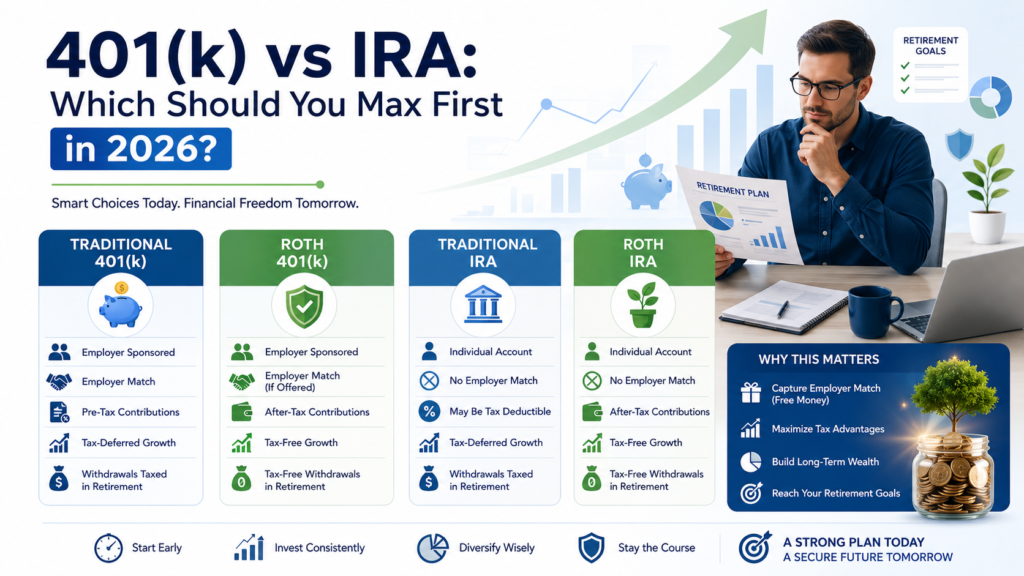
- How Traditional and Roth 401(k) accounts work
- What an IRA is and how Traditional and Roth IRAs differ
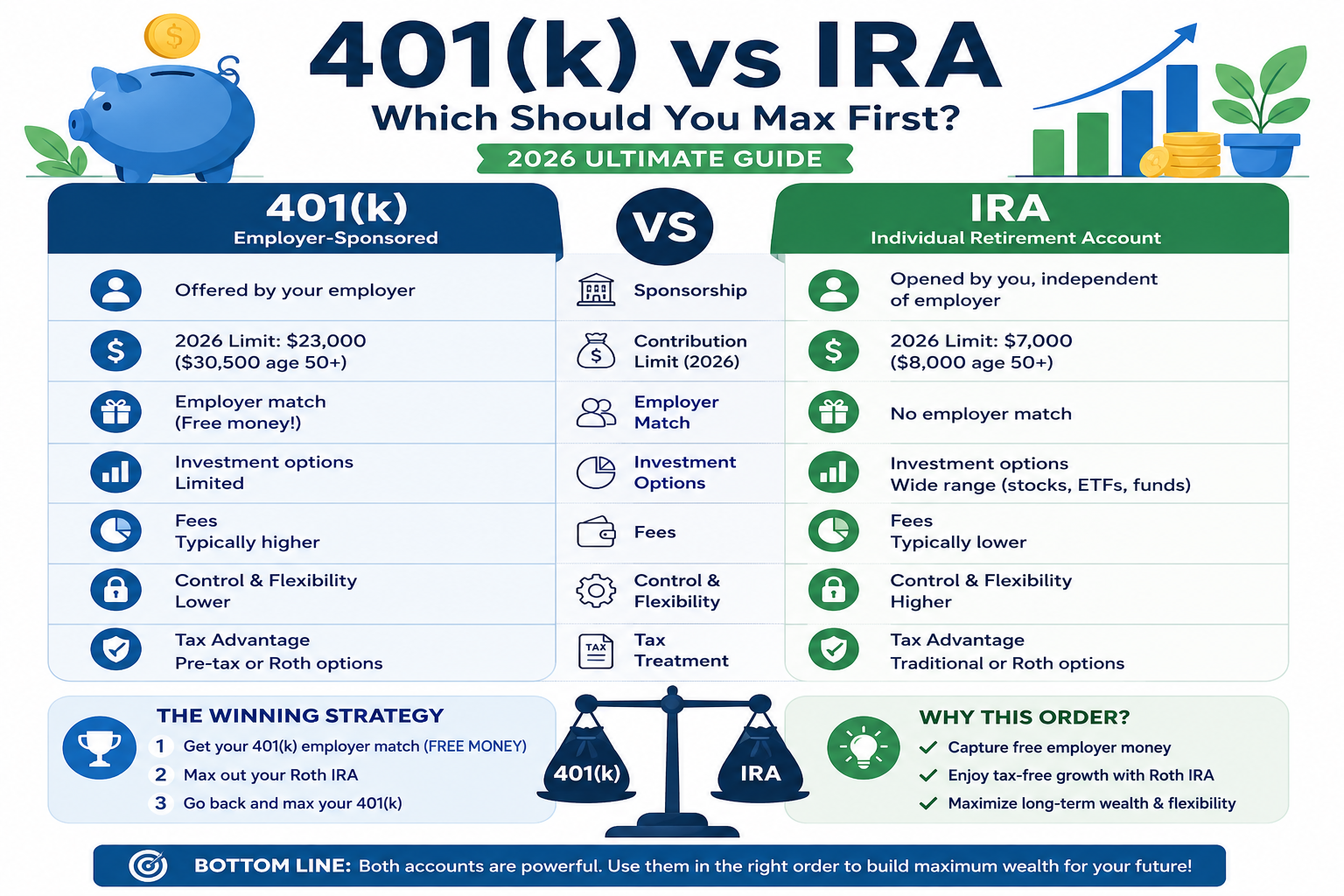
- The key differences between a 401(k) and an IRA
- Which account you should prioritize first
- How employer matching works
- Current contribution limits
- Tax advantages and withdrawal rules
- Real-world examples and case studies
- Common retirement investing mistakes to avoid
- Advanced strategies for higher-income investors
- Frequently asked questions and practical retirement planning tips
Whether you’re opening your first retirement account or reviewing an existing investment strategy, this guide will help you understand the strengths of both account types and make more informed retirement planning decisions.
What Is a 401(k)?
A 401(k) is an employer-sponsored retirement savings plan available primarily in the United States. It allows employees to contribute a portion of their salary into a retirement investment account before or after taxes, depending on the type of 401(k) selected.
The account is named after Section 401(k) of the U.S. Internal Revenue Code, which established the rules governing these retirement plans.
Unlike a regular savings account, money inside a 401(k) is typically invested in assets such as:
- Mutual funds
- Index funds
- Target-date retirement funds
- Bond funds
- Company stock (if offered)
These investments have the potential to grow over many years through market appreciation and reinvested earnings.
Why Is a 401(k) Important?
A 401(k) is designed to help individuals build financial security after they stop working. Since many people cannot rely solely on government retirement benefits, contributing consistently to a retirement account is an essential part of long-term financial planning.
Some of the biggest benefits include:
- Tax advantages
- Automatic payroll deductions
- Employer matching contributions
- Long-term compound growth
- Higher annual contribution limits than many other retirement accounts
For many workers, a 401(k) becomes the foundation of their retirement portfolio.
How Does a 401(k) Work?
When you enroll in your employer’s retirement plan, you choose a percentage or dollar amount from each paycheck to contribute.
For example:
- Annual salary: $80,000
- Contribution rate: 10%
- Annual contribution: $8,000
Instead of receiving the full salary in your paycheck, the selected amount is automatically deposited into your retirement account and invested according to your chosen investment options.
This automatic investing approach helps build wealth consistently without requiring manual monthly transfers.
Traditional 401(k) vs Roth 401(k)
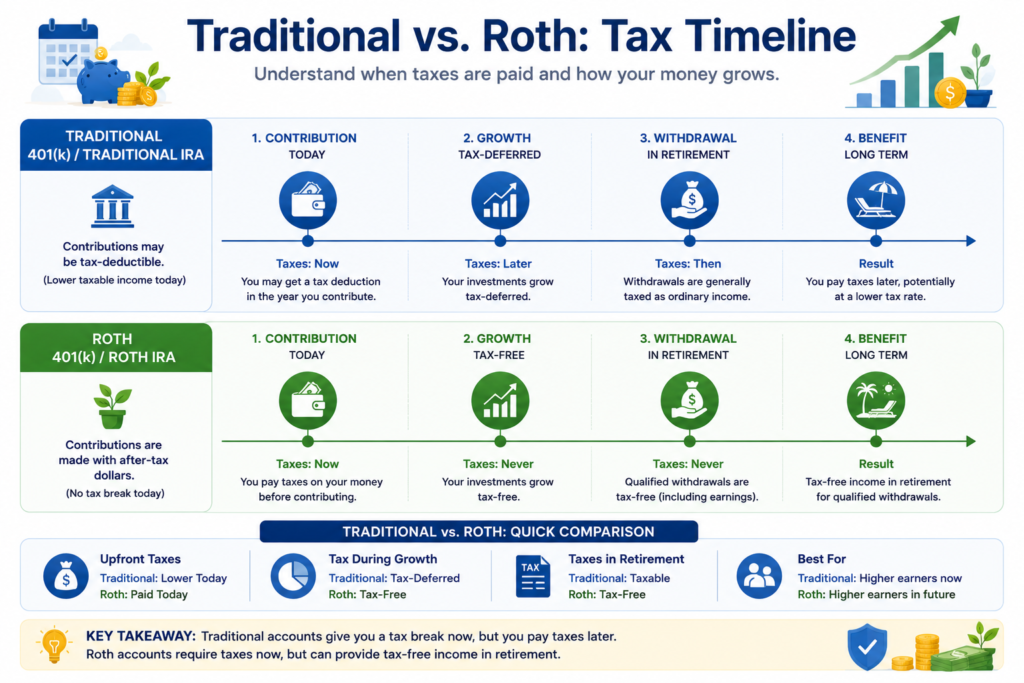
One of the most important decisions you’ll make is choosing between a Traditional 401(k) and a Roth 401(k).
Although both help you save for retirement, their tax treatment is very different.
Traditional 401(k)
A Traditional 401(k) allows you to contribute pre-tax dollars.
This means your contributions reduce your taxable income in the current year.
Example
Suppose your annual salary is $100,000, and you contribute $15,000 to your Traditional 401(k).
Your taxable income for that year may be reduced to approximately $85,000 (subject to applicable tax rules and deductions).
This can lower your current tax bill while allowing your investments to grow on a tax-deferred basis.
Advantages
- Immediate tax savings
- Lower taxable income today
- Tax-deferred investment growth
- Suitable for individuals in higher tax brackets
Disadvantages
- Withdrawals in retirement are generally taxed as ordinary income.
- Required minimum distribution (RMD) rules may apply depending on current law.
Roth 401(k)
A Roth 401(k) works differently.
Contributions are made using after-tax income, meaning you pay taxes before the money enters the account.
The major advantage is that qualified withdrawals during retirement are generally tax-free.
Example
Salary: $100,000
Contribution: $15,000
You still pay income tax on the full $100,000 this year, but future qualified withdrawals—including investment earnings—can be withdrawn without federal income tax if IRS requirements are met.
Advantages
- Tax-free qualified retirement withdrawals
- Excellent for younger investors expecting higher future income
- No concern about future tax increases on qualified distributions
Disadvantages
- No immediate tax deduction
- Slightly lower take-home pay today
Traditional vs Roth 401(k): Quick Comparison
| Feature | Traditional 401(k) | Roth 401(k) |
|---|---|---|
| Contributions | Pre-tax | After-tax |
| Current Tax Benefit | Yes | No |
| Retirement Withdrawals | Taxable | Generally tax-free (qualified) |
| Best For | Higher current tax brackets | Lower current tax brackets or long investment horizons |
2026 Contribution Limits
Annual contribution limits are adjusted periodically to account for inflation.
For 2026, assume the following approximate limits (verify the latest IRS figures before filing or planning):
| Age | Annual Contribution |
|---|---|
| Under 50 | Approximately $23,000 |
| Age 50+ | Approximately $30,500 (including catch-up contributions) |
Higher contribution limits allow workers to invest significantly more for retirement than many other account types.
Official IRS contribution limits and catch-up contribution rules are updated annually. Always verify the latest limits before making contributions.
Understanding Employer Matching
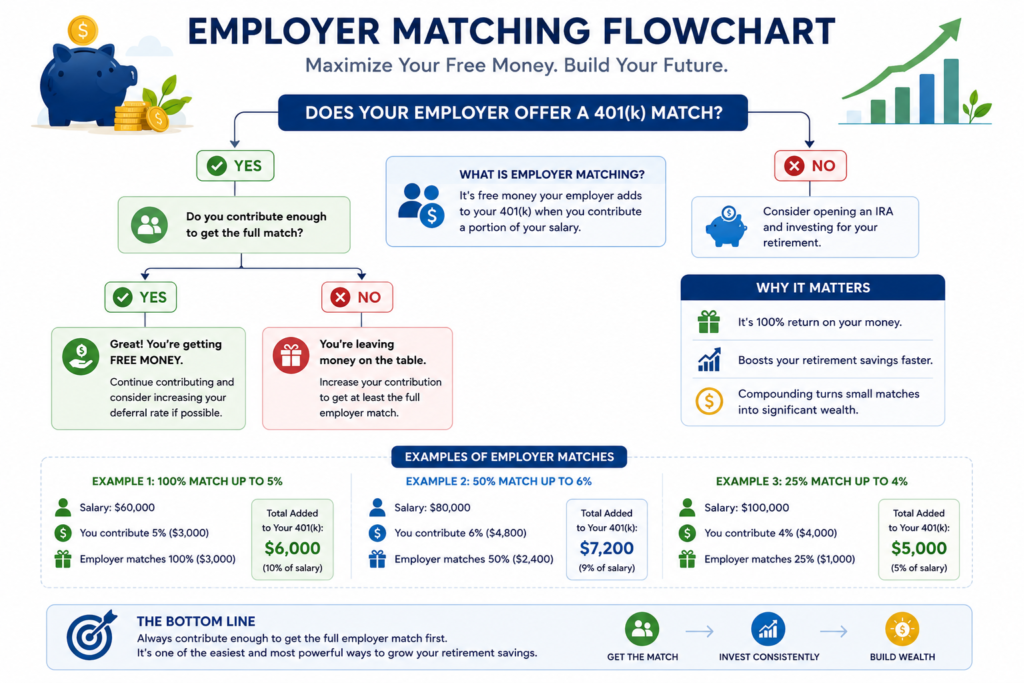
One of the biggest reasons financial professionals recommend contributing to a 401(k) is the possibility of receiving an employer match.
An employer match is additional money your employer contributes to your retirement account based on your own contributions.
Think of it as an employment benefit rather than part of your salary.
Example 1
Annual salary: $80,000
Employer policy: Matches 100% of the first 5% of salary.
Your contribution: 5% = $4,000
Employer contribution: $4,000
Total invested: $8,000
Without investing an extra dollar yourself, you’ve effectively doubled your contribution through your employer’s matching program.
Example 2
Employer matches 50% of the first 6%.
Salary: $70,000
Your contribution: 6% = $4,200
Employer contribution: 50% × $4,200 = $2,100
Total annual retirement investment: $6,300
Over 30 years, those matching contributions can compound into a substantial portion of your retirement savings.
Learn more about employer-sponsored retirement plans from the U.S. Department of Labor.
Why Employer Matching Matters
Employer matching is often described as “free money” because it’s compensation you receive only if you participate in the retirement plan.
If your employer offers a match and you don’t contribute enough to receive it, you’re effectively leaving part of your compensation unclaimed.
For this reason, many financial planners recommend contributing at least enough to receive the full employer match before considering other retirement investment priorities.
Pros of a 401(k)
A 401(k) offers several important advantages for long-term investors.
1. Employer Contributions
Employer matching can significantly increase your retirement savings without requiring additional personal investment.
2. Tax Advantages
Traditional and Roth options provide flexibility based on your tax strategy.
3. Automatic Investing
Payroll deductions help maintain disciplined, consistent investing.
4. Higher Contribution Limits
Compared with many retirement accounts, a 401(k) generally allows larger annual contributions.
5. Compound Growth Potential
Investment returns can generate additional returns over decades, making early contributions especially valuable.
Cons of a 401(k)
Although highly beneficial, a 401(k) isn’t perfect.
Limited Investment Choices
Most plans offer a curated selection of investment funds rather than the entire investment market.
Plan Fees
Administrative fees and investment expense ratios vary by employer and plan provider.
Early Withdrawal Penalties
Taking money out before retirement age may trigger taxes and penalties unless an exception applies.
Employer Dependence
Investment choices and plan quality depend on your employer’s retirement program.
Beginner Example
Consider Emily, a 25-year-old software engineer earning $75,000 annually.
Her employer matches 100% of contributions up to 5% of salary.
Emily contributes:
- 5% of salary = $3,750
Employer contributes: $3,750
Total invested in the first year: $7,500
If Emily increases her contributions over time and earns an average annual return of 8% over several decades, her retirement portfolio could grow substantially due to consistent investing and compounding.
Key Financial Terms Explained
Before comparing 401(k) vs IRA, it’s helpful to understand these common retirement investing terms:
| Term | Meaning |
|---|---|
| Contribution | Money you deposit into a retirement account. |
| Employer Match | Additional retirement contribution made by your employer based on your own contributions. |
| Tax-Deferred | Taxes on investment growth are postponed until withdrawal. |
| After-Tax Contribution | Money invested after income taxes have already been paid. |
| Pre-Tax Contribution | Money invested before income taxes are deducted. |
| Compound Growth | Investment earnings generate additional earnings over time. |
| Diversification | Spreading investments across multiple asset types to reduce risk. |
| Target-Date Fund | A fund that automatically adjusts its asset allocation as retirement approaches. |
What Is an IRA?
An Individual Retirement Account (IRA) is a personal retirement savings account that you open and manage yourself. Unlike a 401(k), which is provided by an employer, an IRA is available through banks, brokerage firms, credit unions, and investment companies.
The purpose of an IRA is to encourage individuals to save for retirement by offering tax advantages that help investments grow more efficiently over time.
Inside an IRA, you can invest in a wide range of assets, including:
- Individual stocks
- Exchange-Traded Funds (ETFs)
- Index funds
- Mutual funds
- Bonds
- Certificates of Deposit (CDs)
- Treasury securities
- Certain alternative investments (depending on the provider)
Because IRAs generally offer more investment choices than many employer-sponsored plans, investors often use them to build a diversified retirement portfolio.
Why Is an IRA Important?
An IRA complements other retirement accounts by providing additional opportunities to save and invest.
Some key benefits include:
- Tax-advantaged investing
- Greater investment flexibility
- Potentially lower fees than some employer plans
- Ability to choose your own financial institution
- Long-term compound growth
If your employer does not offer a retirement plan, an IRA can also serve as your primary retirement savings account.
Types of IRA
There are two primary types of IRAs:
- Traditional IRA
- Roth IRA
Although both accounts are designed for retirement, they differ mainly in how and when taxes are paid.
Traditional IRA
A Traditional IRA allows eligible individuals to make contributions that may be tax-deductible, depending on income, filing status, and whether they participate in an employer-sponsored retirement plan.
The money inside the account grows on a tax-deferred basis.
This means:
- You may receive a tax benefit today.
- Investments can grow without annual taxes on gains.
- Withdrawals during retirement are generally taxed as ordinary income.
Example
Suppose Sarah earns $70,000 annually.
She contributes $6,500 to a Traditional IRA.
If she qualifies for a deductible contribution, her taxable income may be reduced, lowering her current tax bill.
Over the next 30 years, her investments continue growing without annual taxes on capital gains or dividends inside the account.
When Sarah retires and withdraws the money, those withdrawals are generally subject to income tax.
Advantages of a Traditional IRA
- Possible tax deduction today
- Tax-deferred investment growth
- Flexible investment choices
- Suitable for investors expecting a lower tax rate in retirement
Disadvantages
- Withdrawals are generally taxable.
- Required Minimum Distribution (RMD) rules may apply depending on current law.
- Deductibility may be limited by income and workplace retirement plan participation.
Roth IRA
A Roth IRA is funded with after-tax dollars, meaning you pay income tax before making contributions.
In return, qualified withdrawals during retirement—including investment earnings—are generally tax-free.
This makes the Roth IRA particularly attractive for younger investors or those who expect to be in a higher tax bracket later in life.
Example
Michael earns $60,000 annually.
He contributes $7,000 to a Roth IRA.
Although he receives no immediate tax deduction, his investments grow over several decades.
At retirement, if the account meets IRS requirements for qualified distributions, he can generally withdraw both contributions and earnings without paying federal income tax.
Advantages of a Roth IRA
- Tax-free qualified withdrawals
- No tax on qualified investment growth
- Greater flexibility for retirement planning
- Contributions (not earnings) can generally be withdrawn at any time without tax or penalty, subject to IRS rules
Disadvantages
- No upfront tax deduction
- Income limits may restrict direct contributions
- Lower annual contribution limits than many employer retirement plans
Traditional IRA vs. Roth IRA
| Feature | Traditional IRA | Roth IRA |
|---|---|---|
| Contributions | May be tax-deductible | After-tax |
| Current Tax Benefit | Possible | None |
| Investment Growth | Tax-deferred | Tax-free (qualified) |
| Retirement Withdrawals | Generally taxable | Generally tax-free |
| Income Restrictions | Deduction limits may apply | Direct contribution limits apply |
| Best For | Higher current tax bracket | Lower current tax bracket or long-term growth |
Eligibility and Income Limits
One of the biggest differences in the 401(k) vs IRA discussion is eligibility.
Almost anyone with earned income can generally contribute to a Traditional IRA, although tax deductions may be limited depending on income and participation in an employer retirement plan.
A Roth IRA, however, has income limits that determine whether you can contribute directly.
Because these limits are adjusted periodically by the IRS, always verify the latest figures before making contributions.
Roth IRA income eligibility limits are published annually by the IRS.
Example
Suppose David earns $210,000 annually.
His income may exceed the limit for direct Roth IRA contributions.
In this situation, he may consider a Backdoor Roth IRA, a strategy in which an investor contributes to a Traditional IRA and then converts eligible funds to a Roth IRA while carefully considering the applicable tax consequences.
Because tax rules can be complex, many investors consult a qualified tax professional before using this strategy.
Contribution Limits
Contribution limits are generally lower for IRAs than for 401(k) plans.
Approximate annual limits for 2026 are:
| Age | IRA Contribution Limit* |
|---|---|
| Under 50 | Approximately $7,000 |
| Age 50 and older | Approximately $8,000 (including catch-up contributions) |
*Always confirm the latest IRS limits, as they may change annually.
Investment Options in an IRA
One reason many investors prefer IRAs is the broad selection of investment opportunities.
Depending on your provider, you may invest in:
- U.S. stocks
- International stocks
- Index funds
- ETFs
- Bond funds
- Dividend funds
- Treasury securities
- Real estate investment trusts (REITs)
- Money market funds
This flexibility allows investors to customize a portfolio based on their goals, risk tolerance, and investment timeline.
Retirement Account Fees Comparison
| Fee Type | Typical 401(k) | Typical IRA |
|---|---|---|
| Administrative Fees | Sometimes charged by plan | Usually none |
| Expense Ratios | Depends on employer plan | Depends on selected investments |
| Trading Fees | Rare | Broker dependent |
| Account Maintenance | Employer plan dependent | Often $0 at many brokers |
| Investment Choice | Limited | Broad |
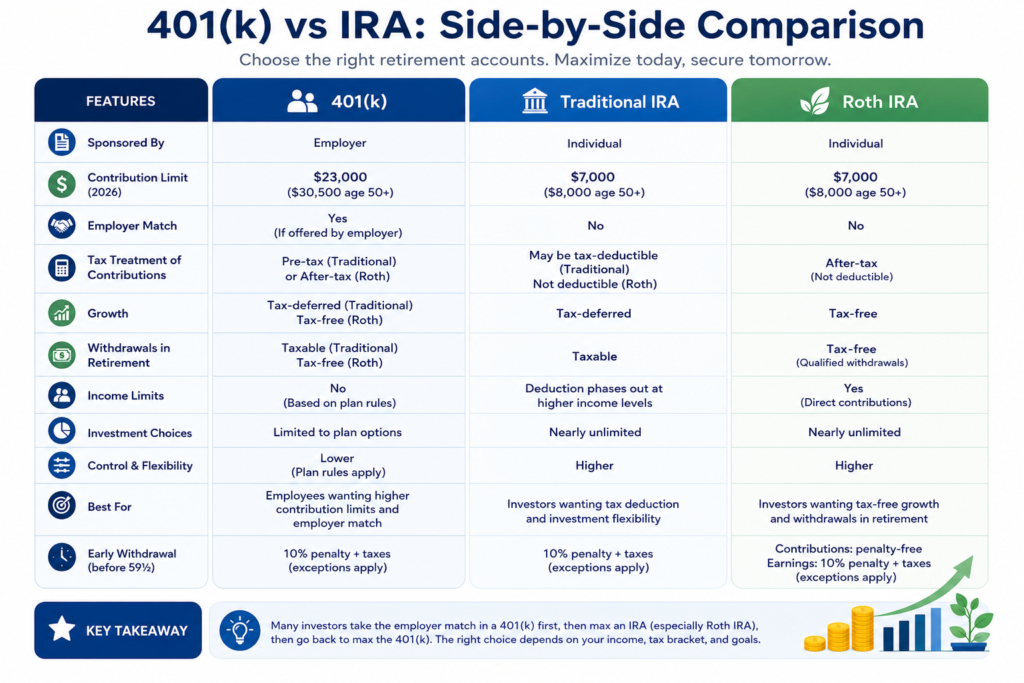
401(k) vs. IRA Comparison Table
The following table highlights the major differences between a 401(k) vs IRA.
| Feature | 401(k) | IRA |
|---|---|---|
| Sponsored By | Employer | Individual |
| Opened Through | Employer | Brokerage, bank, or financial institution |
| Employer Match | Usually available | Not available |
| Annual Contribution Limit | Higher | Lower |
| Investment Choices | Limited to plan options | Broad selection |
| Tax Advantages | Yes | Yes |
| Payroll Contributions | Automatic | Manual or automatic transfers |
| Control Over Investments | Moderate | High |
| Best For | Employees with workplace plans | Anyone eligible to contribute |
Understanding Tax Treatment
Taxes are one of the most important considerations when choosing between retirement accounts.
Understanding how each account is taxed can help you build a more efficient retirement strategy.
Traditional Accounts
Examples:
- Traditional 401(k)
- Traditional IRA
Characteristics:
- Contributions may reduce taxable income (if eligible)
- Investments grow tax-deferred
- Withdrawals during retirement are generally taxable
This approach may benefit investors who expect to be in a lower tax bracket after retirement.
Roth Accounts
Examples:
- Roth IRA
- Roth 401(k)
Characteristics:
- Contributions are made with after-tax income
- No immediate tax deduction
- Qualified withdrawals are generally tax-free
This strategy can be attractive for younger investors with many years of potential investment growth ahead of them.
Example 1: Early Career Professional
Emily is 26 years old and earns $55,000 annually.
She expects her salary to increase significantly over the next 20 years.
She decides to contribute to a Roth IRA because she is currently in a relatively low tax bracket.
If her investments grow substantially, qualified withdrawals during retirement can generally be made tax-free, potentially reducing her lifetime tax burden.
Example 2: High-Income Professional
James is 45 years old and earns $180,000 annually.
He wants to reduce his current taxable income.
He contributes heavily to a Traditional 401(k) because those contributions may lower his taxable income today.
He also contributes to an IRA if eligible, creating a diversified retirement strategy across multiple account types.
Example 3: Self-Employed Consultant
Olivia operates her own consulting business.
Because she doesn’t have access to an employer-sponsored retirement plan, she opens an IRA to begin building retirement savings.
She invests monthly in low-cost index funds and ETFs, taking advantage of automatic investing and long-term compounding.
Key Takeaways
When comparing 401(k) vs IRA, remember that these accounts are not competitors—they are often complementary tools that can work together.
A 401(k) may provide higher contribution limits and valuable employer matching, while an IRA offers broader investment choices, greater flexibility, and additional tax-planning opportunities.
The best choice depends on factors such as your income, employment situation, tax bracket, and retirement goals.
401(k) vs IRA Decision Matrix
| Situation | Best Choice | Why |
|---|---|---|
| Employer offers full match | 401(k) | Capture employer contributions first |
| No employer retirement plan | IRA | Greater investment flexibility |
| High current tax bracket | Traditional 401(k) | Potential current tax savings |
| Young investor | Roth IRA | Potential tax-free qualified withdrawals |
| High-income investor | 401(k) + Backdoor Roth (where appropriate) | Maximize tax-advantaged retirement savings |
| Near retirement | Traditional 401(k) | Higher contribution limits and catch-up contributions |
Which Should You Max First?
For most employees, the recommended order is:
- Contribute enough to your 401(k) to receive the full employer match.
- Max your Roth IRA (if eligible) or Traditional IRA, depending on your tax situation.
- Return to your 401(k) and contribute up to the annual limit if your budget allows.
- Consider a taxable brokerage account or other retirement strategies after maximizing tax-advantaged accounts.
This approach helps you capture employer contributions while also benefiting from the flexibility and tax advantages of an IRA.
Step-by-Step Retirement Investing Strategy
Step 1: Capture the Full Employer Match
Employer matching is often the highest guaranteed return available to an employee.
Example
Annual salary: $90,000
Employer match: 100% of the first 5%
You contribute: $4,500
Employer contributes: $4,500
Total invested: $9,000
Failing to contribute enough to receive the full match means leaving part of your compensation behind.
Step 2: Max Your IRA
Once you’ve secured the employer match, consider contributing to an IRA.
Why?
- More investment choices
- Lower investment expenses in many cases
- Greater control over your portfolio
- Potential tax-free qualified withdrawals with a Roth IRA
Many investors build diversified portfolios using broad-market index funds and ETFs inside their IRA.
Step 3: Increase Your 401(k) Contributions
After maximizing your IRA contribution, direct additional retirement savings back into your 401(k).
This allows you to:
- Increase tax-advantaged savings
- Reduce taxable income (Traditional 401(k))
- Build a larger retirement portfolio
Step 4: Invest Additional Savings
If you’ve reached the annual limits for both accounts, consider:
- Taxable brokerage accounts
- Health Savings Accounts (HSAs), if eligible
- 529 education plans (for education goals)
- Emergency savings
Diversifying savings across account types can improve flexibility later in life.
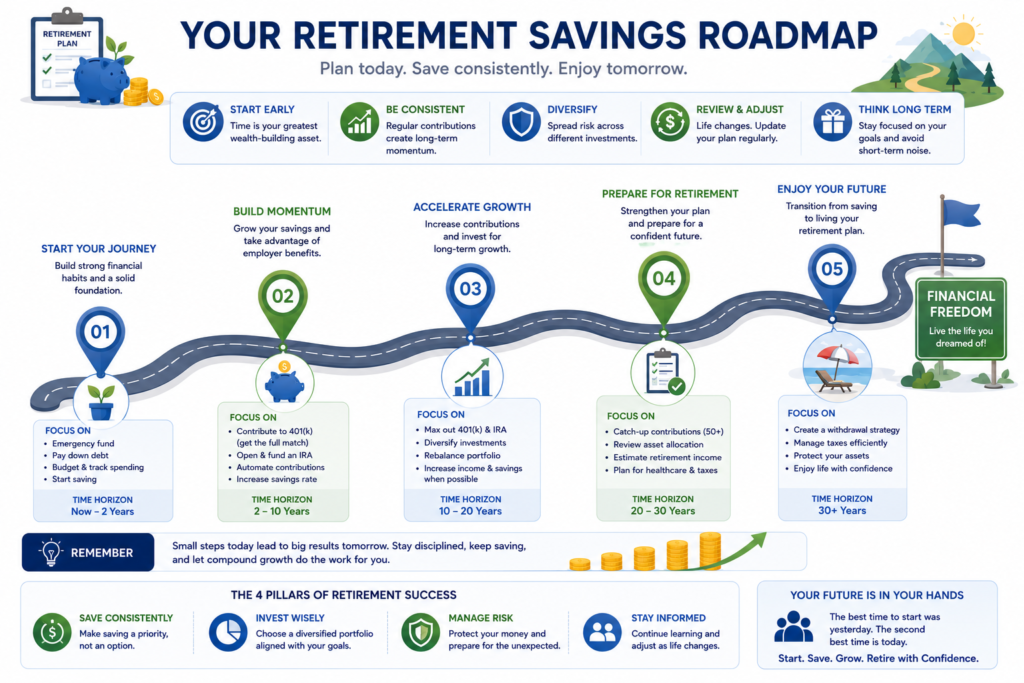
Why This Strategy Works
This sequence combines the strongest features of each account.
| Priority | Benefit |
|---|---|
| Employer Match | Immediate return on contributions |
| IRA | Investment flexibility and tax planning |
| 401(k) | Higher annual contribution limits |
| Taxable Investing | Additional long-term wealth building |
Real-World Case Studies
Case Study 1: Recent College Graduate
Investor: Emily
Age: 24
Salary: $58,000
Employer Match: 100% up to 4%
Emily contributes 4% to receive the full employer match.
She then contributes monthly to a Roth IRA invested in low-cost index funds.
Because Emily is in a relatively low tax bracket today, she prefers paying taxes now in exchange for potentially tax-free qualified retirement withdrawals later.
Lesson: Younger investors often benefit from combining employer matching with long-term Roth growth.
Case Study 2: Mid-Career Professional
Investor: Michael
Age: 38
Salary: $120,000
Michael contributes enough to receive his employer’s match.
Afterward, he maximizes his IRA contribution before increasing his 401(k) savings.
His portfolio now includes:
- U.S. stock index funds
- International equity funds
- Bond funds
By using both account types, Michael improves diversification while taking advantage of multiple tax benefits.
Case Study 3: High-Income Executive
Investor: Lisa
Age: 46
Salary: $240,000
Lisa cannot make a direct Roth IRA contribution because of income limits.
Her strategy includes:
- Maximizing her Traditional 401(k)
- Using a Backdoor Roth IRA (where appropriate)
- Continuing long-term diversified investing
This approach allows her to continue building retirement assets while working within IRS contribution rules.
Case Study 4: Self-Employed Consultant
Investor: Daniel
Age: 35
Without an employer-sponsored retirement plan, Daniel opens an IRA and contributes consistently every month.
He invests primarily in:
- Total U.S. Stock Market ETF
- International ETF
- Bond Index Fund
Automatic monthly investing helps him build retirement wealth despite not receiving employer matching.
Case Study 5: Couple Planning Early Retirement
Investors: Sarah and James
Combined income: $180,000
Strategy:
- Each contributes enough to receive employer matching.
- Both maximize their IRAs.
- Additional retirement savings go into their workplace retirement plans.
Over several decades, this coordinated strategy creates multiple sources of retirement income while improving tax diversification.
The Power of Compound Growth
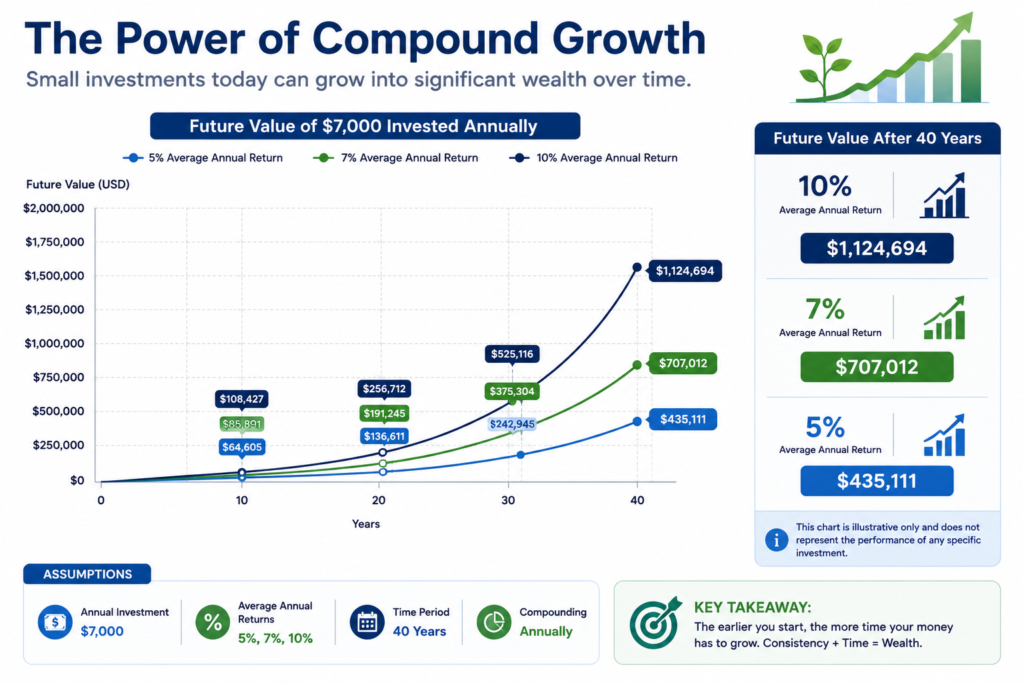
One of the greatest advantages of starting early is compound growth.
Compound growth means your investment earnings generate additional earnings over time.
The longer investments remain invested, the greater the potential impact of compounding.
genui{“finance_accounting_operations_learning_block”:{“type_id”:”COMPOUND_INTEREST”,”content”:”FV=PMT((1+r)^n-1)/r”}}
Example
Annual contribution: $7,000
Average annual return: 8%
Investment period: 30 years
Approximate future value: Around $790,000–$860,000, depending on contribution timing and market performance.
Now imagine increasing annual retirement contributions or investing for 40 years instead of 30.
The difference can be substantial because compound growth accelerates over longer periods.
Example: Starting Early vs. Starting Late
| Investor | Starting Age | Annual Investment | Years Invested |
|---|---|---|---|
| Emma | 25 | $7,000 | 40 |
| David | 35 | $7,000 | 30 |
Although both invest the same amount annually, Emma’s additional decade of compounding gives her significantly greater long-term growth potential.
This demonstrates why time in the market is often more valuable than trying to perfectly time the market.
Common Mistakes to Avoid
Mistake 1: Ignoring Employer Matching
Many employees postpone retirement investing because they believe they can “catch up later.”
Doing so may mean permanently missing employer contributions that cannot be recovered.
Mistake 2: Waiting Too Long to Start
Every year of delay reduces the time available for compound growth.
Even modest contributions made consistently over decades can grow into substantial retirement savings.
Mistake 3: Investing Without Diversification
Placing all retirement savings into one company stock or one sector increases concentration risk.
Diversification across asset classes and geographic regions may help reduce portfolio volatility.
Mistake 4: Choosing Investments Without Understanding Risk
Retirement investing should align with:
- Investment horizon
- Risk tolerance
- Retirement goals
- Financial situation
A portfolio suitable for a 25-year-old may not be appropriate for someone nearing retirement.
Mistake 5: Frequently Changing Investment Strategy
Constantly buying and selling investments based on short-term market movements can undermine a long-term retirement plan.
Successful retirement investing often relies on consistency, disciplined contributions, and periodic portfolio reviews.
Advanced Retirement Strategies
As income grows, some investors explore additional strategies to maximize tax-advantaged retirement savings.
Backdoor Roth IRA
A Backdoor Roth IRA is a strategy that may be available to individuals whose income exceeds the limit for direct Roth IRA contributions.
The basic process generally involves:
- Contributing to a Traditional IRA.
- Converting eligible funds to a Roth IRA.
- Paying any applicable taxes on the conversion.
Because the tax implications can be complex, consulting a qualified tax professional before implementing this strategy is advisable.
Mega Backdoor Roth
Some employer retirement plans permit after-tax 401(k) contributions and in-plan Roth conversions or rollovers.
When available, this strategy—often called the Mega Backdoor Roth—may allow high-income savers to move significantly larger amounts into Roth accounts than a standard Roth IRA contribution allows.
However:
- Not every employer plan offers this feature.
- IRS rules and plan-specific provisions vary.
- Professional tax advice is often recommended before using it.
Decision Framework: Should You Max Your 401(k) or IRA First?
Use the following framework to determine the most appropriate strategy for your financial situation.
Step 1: Does Your Employer Offer a Matching Contribution?
Yes
→ Contribute enough to your 401(k) to receive the full employer match.
Employer matching is one of the few opportunities to receive additional retirement savings simply by participating in your workplace plan.
No
→ Consider starting with an IRA, where you may have more investment choices and flexibility.
Step 2: Do You Qualify for a Roth IRA?
If your income falls within the IRS eligibility limits for direct Roth IRA contributions, many younger investors choose to maximize a Roth IRA after receiving their employer match because of the potential for tax-free qualified withdrawals in retirement.
If your income exceeds the limit, you may consider alternatives such as a Traditional IRA or, where appropriate, a Backdoor Roth IRA strategy after consulting a tax professional.
Step 3: Evaluate Your Current Tax Bracket
Your current income tax rate can influence whether a Traditional or Roth account is more beneficial.
You may prefer a Traditional account if:
- You’re currently in a relatively high tax bracket.
- You expect a lower tax rate during retirement.
- You want to reduce your taxable income today.
You may prefer a Roth account if:
- You’re early in your career.
- You expect higher earnings in the future.
- You value tax-free qualified retirement withdrawals.
Step 4: Review Your Investment Options
Compare your employer-sponsored retirement plan with investment choices available through an IRA.
Questions to ask:
- Does my 401(k) offer low-cost index funds?
- Are expense ratios competitive?
- Do I have sufficient diversification?
- Can I build a portfolio aligned with my goals?
If your workplace plan has limited investment choices or relatively high fees, an IRA may provide additional flexibility.
Step 5: Stay Consistent
The best retirement strategy is one that you can maintain consistently over many years.
Rather than trying to predict short-term market movements, focus on:
- Investing regularly
- Increasing contributions when income rises
- Maintaining an appropriate asset allocation
- Reviewing your portfolio periodically
Retirement Strategy by Age
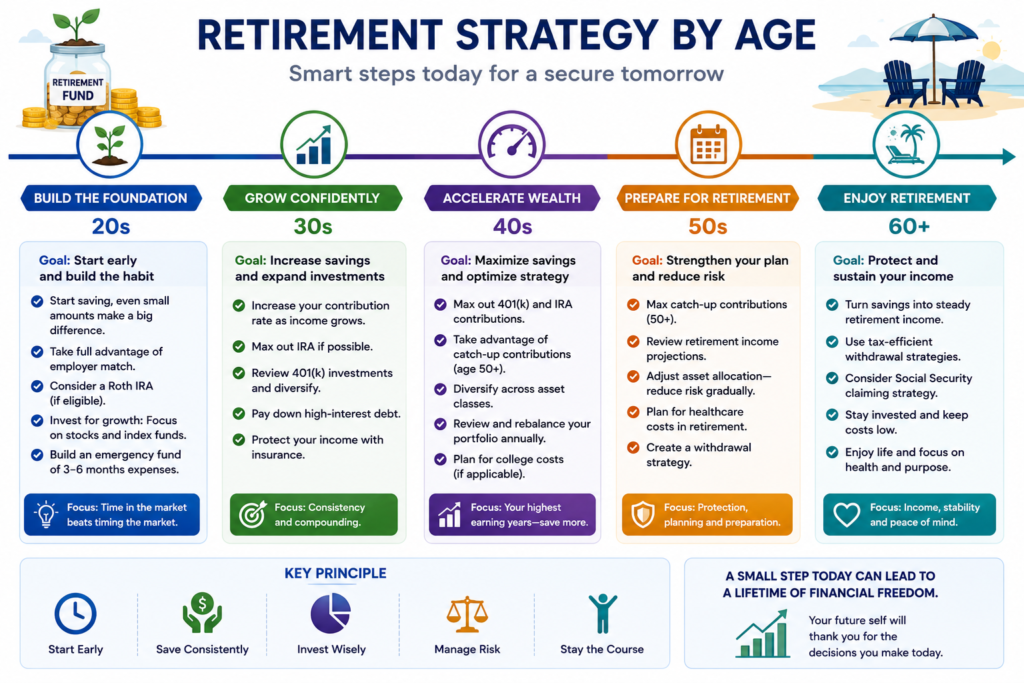
Retirement planning evolves throughout your career. Your priorities at age 25 differ from those at age 55.
Ages 20–29: Build the Habit
Primary goals:
- Start investing as early as possible.
- Capture the full employer match.
- Consider a Roth IRA if eligible.
- Invest primarily in diversified stock funds if appropriate for your risk tolerance and long time horizon.
Even modest contributions made consistently during your twenties may benefit from decades of compound growth.
Ages 30–39: Increase Contributions
Career advancement often brings higher income.
This is an excellent time to:
- Increase your savings rate.
- Maximize IRA contributions if possible.
- Work toward contributing more to your 401(k).
- Review beneficiary designations and retirement goals.
Ages 40–49: Accelerate Retirement Savings
As retirement approaches, many investors focus on:
- Increasing annual retirement contributions.
- Reviewing portfolio diversification.
- Reducing unnecessary debt.
- Planning for healthcare and future income needs.
This decade is often critical because earnings are frequently at their highest.
Ages 50–59: Take Advantage of Catch-Up Contributions
Many retirement plans allow additional catch-up contributions beginning at age 50, subject to IRS rules.
These extra contributions can help investors strengthen retirement savings during their highest earning years.
Review:
- Retirement income projections
- Tax planning
- Investment risk
- Withdrawal strategies
Age 60 and Beyond
As retirement gets closer:
- Evaluate your expected retirement expenses.
- Review Social Security claiming strategies (where applicable).
- Build a sustainable withdrawal plan.
- Maintain an appropriate balance between growth and stability.
Retirement planning becomes less about accumulation and more about preserving wealth while generating reliable income.
2026 Retirement Trends and Statistics
While retirement outcomes vary by household and market conditions, several broad trends continue to shape retirement planning in 2026:
- Many workers continue to rely on employer-sponsored retirement plans as their primary retirement savings vehicle.
- Automatic enrollment and automatic contribution increases are becoming more common in workplace retirement plans.
- Low-cost index funds and ETFs remain widely used by long-term retirement investors.
- Longer life expectancies have increased the importance of saving enough to support retirement that may last 20–30 years or more.
- Younger investors continue to show strong interest in Roth retirement accounts because of their potential tax-free qualified withdrawals.
- Financial professionals increasingly emphasize diversification, low investment costs, and consistent contributions over attempting to time the market.
These trends reinforce the importance of beginning retirement planning early and reviewing your strategy regularly.
Expert Insights
Although every investor’s circumstances are different, many financial planners consistently emphasize several core principles.
Start Early
Beginning retirement investing early provides more time for compound growth to work.
Even small monthly contributions may become meaningful over several decades.
Capture Employer Matching
If your employer offers matching contributions, many advisors recommend contributing enough to receive the full match before considering other priorities.
Keep Investment Costs Low
Expense ratios and management fees can affect long-term returns.
Many investors favor broadly diversified, low-cost investment funds for retirement portfolios.
Diversify Your Portfolio
Rather than concentrating investments in a single company or sector, diversification can help reduce portfolio risk over time.
A diversified portfolio may include:
- U.S. stocks
- International stocks
- Bonds
- Cash equivalents (depending on goals and risk tolerance)
Review Your Plan Annually
Retirement planning is not a one-time decision.
Consider reviewing:
- Contribution levels
- Asset allocation
- Investment performance
- Retirement goals
- Tax strategy
at least once each year or after major life events.
Additional retirement investing education is available from:
Withdrawal Rules Table
| Account | General Withdrawal Age | Taxes | Early Withdrawal Considerations |
|---|---|---|---|
| Traditional 401(k) | Generally 59½ | Usually taxable | Taxes and penalties may apply before eligible age unless an exception applies |
| Roth 401(k) | Qualified distribution rules apply | Generally tax-free if qualified | Rules vary depending on contribution and earnings |
| Traditional IRA | Generally 59½ | Usually taxable | Taxes and penalties may apply before eligible age unless an exception applies |
| Roth IRA | Contributions generally accessible under IRS rules; earnings subject to qualified distribution rules | Depends on withdrawal type | Depends on circumstances and IRS rules |
Frequently Asked Questions (FAQs)
1. Is a 401(k) better than an IRA?
Not necessarily. A 401(k) and an IRA serve different purposes. Many investors benefit from using both accounts together.
2. Should I contribute to both a 401(k) and an IRA?
If your budget allows and you are eligible, contributing to both can increase tax-advantaged retirement savings and improve investment flexibility.
3. Should I always take the employer match first?
For many employees, contributing enough to receive the full employer match is a common first step because it increases retirement savings without requiring additional personal funds.
4. Can I have both a Traditional IRA and a Roth IRA?
Yes, although annual contribution limits generally apply across your IRA contributions, and eligibility rules vary.
5. Which account has better investment choices?
IRAs typically offer broader investment options because you can choose your own brokerage or financial institution.
6. What happens if I exceed contribution limits?
Excess contributions may result in taxes or penalties if not corrected according to IRS rules. Review current IRS guidance or consult a tax professional if this occurs.
7. Is a Roth IRA suitable for young investors?
Many younger investors consider a Roth IRA attractive because they may currently be in lower tax brackets and have decades for investments to grow before retirement.
8. Can I change investments inside my retirement account?
Yes. Most retirement accounts allow investors to change investment allocations, subject to the rules and options available within the plan.
9. How often should I review my retirement portfolio?
Many financial professionals recommend reviewing retirement investments at least annually and after major life changes such as marriage, career changes, or retirement.
10. Is it too late to start investing at age 40 or 50?
No. While starting earlier generally provides more time for compound growth, investing consistently later in life can still significantly improve retirement preparedness.
11. Can I contribute to both a 401(k) and an IRA in the same year?
Yes. Many eligible investors contribute to both accounts in the same tax year. Keep in mind that each account has its own contribution rules and limits, so always verify the latest IRS guidance.
12. Which account is better for beginners?
For many employees, a practical starting point is contributing enough to receive the full employer match in a 401(k). If additional savings are available, an IRA can provide broader investment choices and additional tax-planning flexibility.
13. What if my employer doesn’t offer a 401(k)?
If you don’t have access to a workplace retirement plan, opening an IRA can be an excellent way to begin saving for retirement. Self-employed individuals may also wish to explore other retirement plans designed for business owners, such as SEP IRAs or Solo 401(k)s.
14. Can I change from a Traditional IRA to a Roth IRA later?
Yes. A Roth conversion may be possible, but converting pre-tax assets to a Roth account can create a taxable event. Review the tax implications carefully or consult a qualified tax advisor before proceeding.
15. What investments should I hold inside my retirement account?
Many long-term investors use diversified portfolios that may include:
- Broad-market index funds
- ETFs
- Bond funds
- International equity funds
- Target-date retirement funds
The appropriate mix depends on your goals, investment horizon, and risk tolerance.
16. What happens if I leave my employer?
Depending on your circumstances and plan rules, you may be able to:
- Leave assets in the existing plan (if permitted)
- Roll the account into an IRA
- Roll the account into a new employer’s retirement plan
Before making a decision, compare fees, investment options, and tax considerations. Review official rollover guidance before transferring retirement assets.
17. Should married couples use the same retirement strategy?
Not always. Each spouse’s income, employer benefits, retirement timeline, and tax situation should be considered. Coordinating contributions across both households can improve overall retirement planning.
18. How much should I save for retirement?
There is no universal amount that fits everyone. A common guideline is to save a meaningful percentage of income consistently while increasing contributions as earnings grow. Your retirement needs will depend on your lifestyle, expected retirement age, healthcare costs, and other financial goals.
19. How often should I rebalance my retirement portfolio?
Many investors review and rebalance their portfolios annually or when allocations drift significantly from their target. Rebalancing helps maintain your intended level of investment risk.
20. Can I retire comfortably using only a 401(k)?
For some individuals, a well-funded 401(k) may provide a significant portion of retirement income. However, many retirees benefit from multiple income sources, such as IRAs, taxable investments, pensions (if available), and Social Security (where applicable).
Printable Retirement Investing Checklist
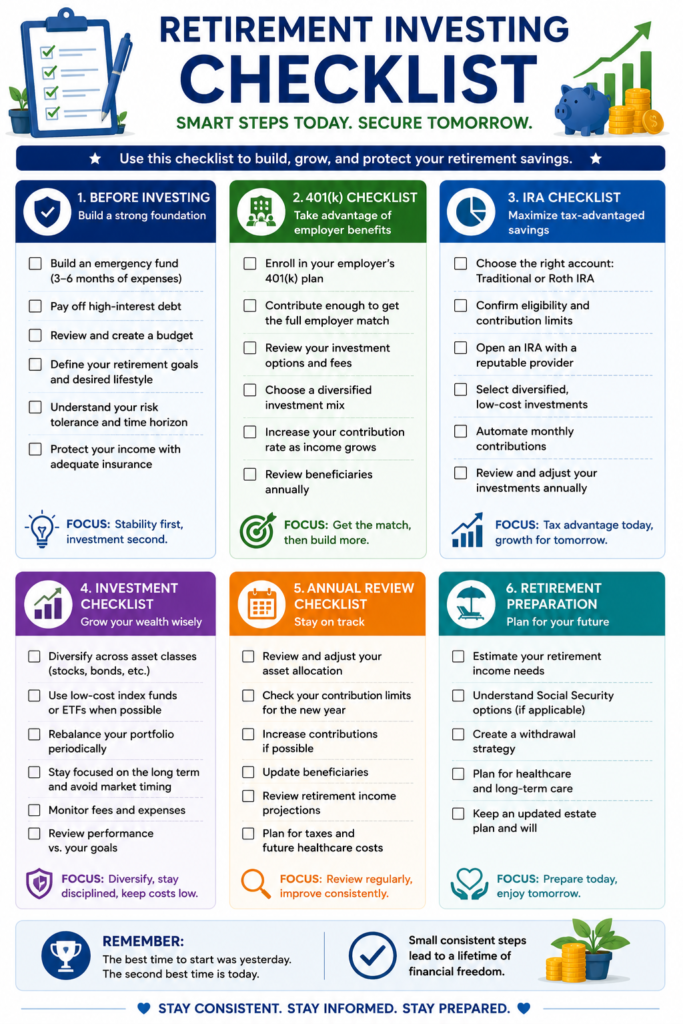
Use this checklist to review your retirement strategy.
Before Investing
☐ Build an emergency fund.
☐ Pay off high-interest debt where appropriate.
☐ Define your retirement goals.
☐ Understand your investment time horizon.
401(k)
☐ Enroll in your employer’s retirement plan.
☐ Contribute enough to receive the full employer match.
☐ Review investment options.
☐ Increase contributions as your income grows.
IRA
☐ Determine whether a Traditional or Roth IRA best fits your tax situation.
☐ Confirm eligibility and contribution limits.
☐ Choose diversified investments.
☐ Automate monthly contributions if possible.
Annual Review
☐ Review your asset allocation.
☐ Rebalance if needed.
☐ Update beneficiaries.
☐ Check contribution limits for the new tax year.
☐ Review retirement goals and projected income.
Conclusion
Choosing between a 401(k) and an IRA is not about selecting a single “winner.” Instead, it’s about understanding how each account fits into your overall retirement strategy.
For many employees, a practical approach is:
- Contribute enough to your 401(k) to receive the full employer match.
- Maximize your IRA if eligible and appropriate for your tax situation.
- Increase your 401(k) contributions toward the annual limit.
- Continue investing consistently and review your plan regularly.
Remember that retirement planning is a long-term process. Market conditions, tax laws, contribution limits, and personal circumstances can change over time. Periodically reviewing your strategy and seeking professional advice when needed can help keep your retirement plan aligned with your goals.
The most important step is not finding the “perfect” account. It is developing a disciplined investing habit, staying diversified, keeping investment costs reasonable, and remaining focused on your long-term objectives.
Final Editorial Note
Before publishing, verify all 2026 contribution limits, income thresholds, and tax rules against the latest official IRS guidance or another authoritative source, as retirement account rules may be updated annually. This helps keep the article accurate and compliant with current regulations.