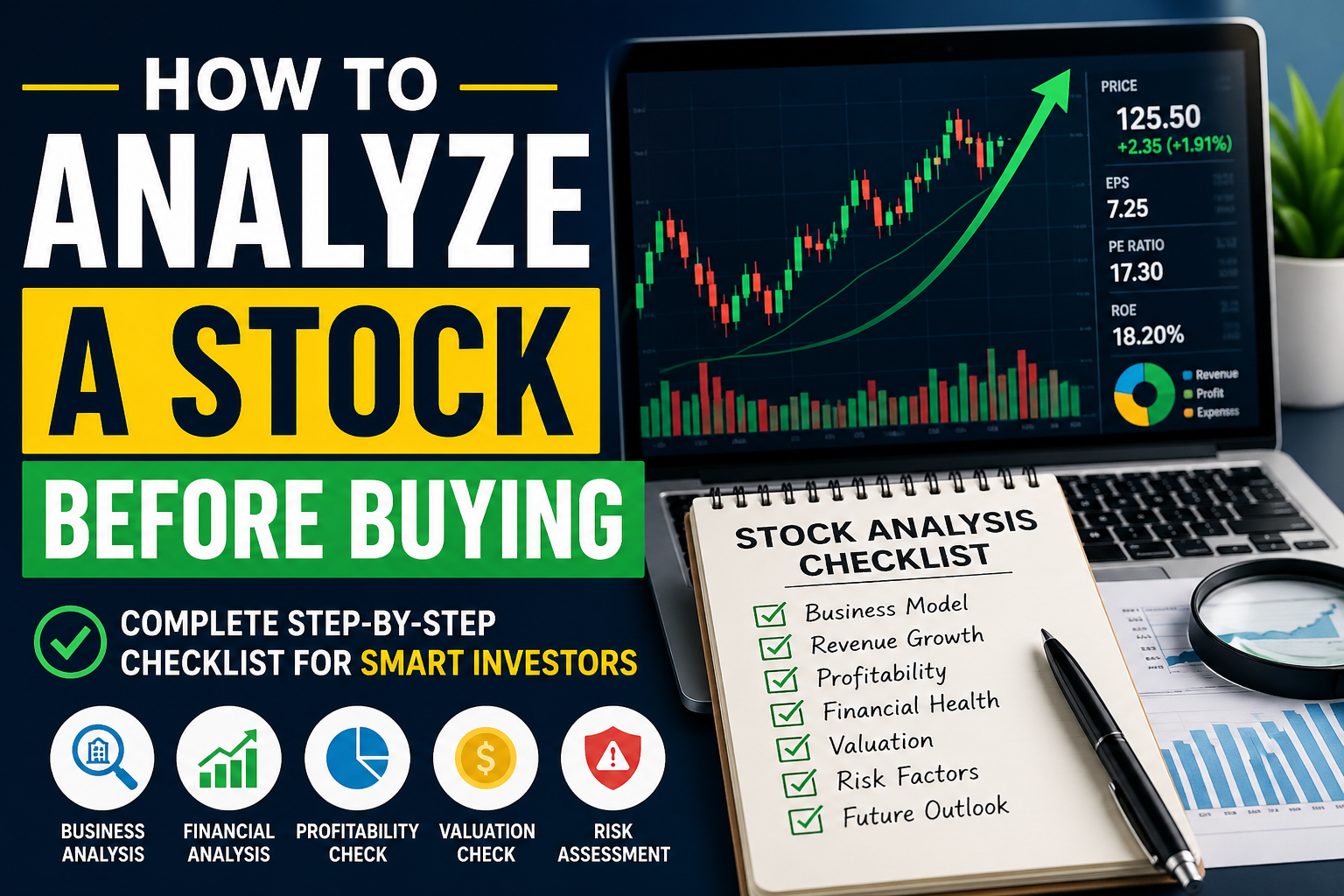
What Does “Analyze a Stock” Actually Mean?
How to analyze a stock before buying is one of the most important skills every investor must learn. This complete guide will walk you through a step-by-step fundamental checklist to evaluate any stock before investing.
Let’s break this down.
- Analyze = To examine something carefully and systematically.
- Stock = A share of ownership in a publicly traded company.
- Before Buying = Prior to investing your money.
- Fundamental = Based on business fundamentals (revenues, profits, assets, growth).
- Checklist = A structured step-by-step evaluation framework.
So:
Fundamental Stock Analysis = Studying a company’s financial health, business model, competitive position, and valuation to decide if it is worth buying.
This is different from technical analysis, which studies price charts.
Why Fundamental Analysis Matters
When you buy a stock, you’re buying part ownership of a real business.
If the business grows profits → stock price rises long-term.
If the business deteriorates → stock falls long-term.
As Warren Buffett says:
“Price is what you pay. Value is what you get.”
Fundamental analysis helps you determine value.
The Complete Fundamental Checklist
1️⃣ Understand the Business Model (How to Analyze a Stock Before Buying)
🔹 What Is a Business Model?
A business model explains how a company operates. It shows how the company creates and delivers value. It also explains how the business earns profit. Without understanding this, you cannot judge whether a company is sustainable or risky.
Understanding the business model is the first step in how to analyze a stock before buying, because it reveals how the company generates revenue.
A business model explains:
🔹 How the Company Makes Money
This refers to the core way a company generates income from its operations. It could be through selling products, offering services, subscriptions, commissions, or advertising. A clear and scalable earning method is a sign of a strong business.
🔹 Who Pays Them
Every business has a target customer segment—individuals, businesses, or governments. Knowing who pays helps you understand demand stability and pricing power. For example, enterprise customers usually bring more predictable revenue than individual buyers.
🔹 What They Sell
Companies sell either tangible products (like phones, cars) or intangible services (like software, subscriptions). Understanding the offering helps you evaluate demand, competition, and differentiation in the market.
🔹 Their Cost Structure
Cost structure includes all expenses required to run the business—production, salaries, marketing, logistics, etc. A company with controlled costs and efficient operations usually maintains better profit margins.
Example: Apple Inc.




Revenue Sources:
🔹 iPhones
iPhones are Apple’s primary revenue driver, contributing a major portion of total sales. These are high-margin premium products with strong global demand. Frequent upgrades and brand loyalty keep sales consistent.
🔹 MacBooks
MacBooks generate revenue from laptops targeted at professionals and students. Though smaller than iPhone revenue, they strengthen Apple’s ecosystem. High pricing leads to strong profit margins.
🔹 Services (App Store, iCloud)
Apple earns recurring income through services like App Store commissions and iCloud subscriptions. This segment is highly profitable because it has low operating costs. It ensures steady and predictable cash flow.
🔹 Wearables
Products like AirPods and Apple Watch fall under wearables. These complement Apple’s ecosystem and increase customer dependency. They also add an additional revenue stream with strong growth potential.
Apple earns money from:
🔹 Hardware Sales
Apple earns large revenue by selling physical products like iPhones, Macs, and iPads. These are one-time purchases but generate high profit margins. Hardware also acts as an entry point into Apple’s ecosystem.
🔹 Subscription Services
Recurring services like Apple Music and iCloud provide continuous revenue. This reduces dependency on one-time product sales. Subscription models improve long-term financial stability.
🔹 Ecosystem Lock-in
Apple’s ecosystem connects devices and services seamlessly, making it hard for users to switch. This increases customer retention and lifetime value. It acts as a powerful competitive advantage.
✅ Checklist Questions
🔹 What Product/Service Do They Sell?
Understanding the core offering helps you evaluate demand and relevance in the market. If the product solves a real problem, the business has long-term potential. Weak or outdated products signal risk.
🔹 Is Demand Growing?
A growing demand indicates future revenue expansion. You can check industry trends and company sales growth. Declining demand may lead to falling stock prices.
🔹 Who Are Competitors?
Competitors affect pricing power and market share. Strong competition can reduce profits and growth. A company with weak competition usually has better margins.
🔹 Is Revenue Recurring or One-Time?
Recurring revenue (subscriptions) provides stability and predictability. One-time sales depend heavily on continuous customer acquisition. Recurring models are generally preferred by investors.
📊 Case Study: Good vs Bad Business Model
✅ Strong Model: Microsoft
Microsoft shifted from selling one-time software licenses to subscription-based services. This created consistent monthly income and reduced revenue volatility. It transformed the company into a stable, high-growth business.
🔹 Recurring Subscriptions (Office 365)
Customers pay monthly or yearly fees instead of buying once. This ensures predictable and continuous revenue. It also increases customer lifetime value.
🔹 Cloud Services (Azure)
Azure provides cloud infrastructure to businesses on a pay-as-you-use model. This is highly scalable and growing rapidly. It has become one of Microsoft’s biggest revenue drivers.
🔹 Predictable Cash Flow
Recurring revenue allows better financial planning and stability. Investors prefer companies with steady income streams. It reduces risk during economic downturns.
❌ Weak Model: WeWork
WeWork’s business model had structural flaws in cost and revenue mismatch. It created high risk despite rapid expansion. The company struggled to sustain operations.
🔹 Long-Term Lease Obligations
WeWork rented office spaces on long-term contracts. These fixed costs remained even if demand dropped. This increased financial pressure.
🔹 Short-Term Customer Contracts
Customers could leave anytime with short-term agreements. This made revenue unpredictable. It created a mismatch between income and expenses.
🔹 Cash Burn
WeWork spent more money than it earned to grow fast. Continuous losses led to financial instability. Eventually, investor confidence collapsed.
🔹 Result: Financial Collapse
The flawed model led to massive losses and valuation crash. The company failed to sustain its operations long-term. This highlights why business model analysis is critical before investing.
2️⃣ Revenue Analysis – How to Analyze a Stock Before Buying
🔹 What Is Revenue?
Revenue is the total income a company earns from its business activities before any expenses are deducted. It shows how much demand exists for the company’s products or services. Higher revenue generally indicates stronger business activity. You can check real-time data on Yahoo Finance.
Revenue analysis is a core part of fundamental stock analysis, as it shows whether the company is growing or declining.
🔹 Revenue = Total Money Earned from Sales Before Expenses
This means all money coming in from selling goods or services, without subtracting costs like salaries, rent, or taxes. It reflects the company’s ability to generate sales. Profit is calculated only after expenses are deducted from revenue.
🔹 Also Called: Top Line
Revenue is called the top line because it appears at the top of the income statement. It represents the starting point of financial performance. Investors track top-line growth to measure business expansion.
🔹 Also Called: Sales
“Sales” is another common term for revenue, especially in product-based companies. It simply refers to the value of goods or services sold. Strong sales growth usually signals increasing customer demand.
Key Revenue Metrics
🔹 1. Revenue Growth Rate
Revenue growth rate measures how fast a company’s sales are increasing over time. It helps investors understand whether the business is expanding or slowing down. Consistent growth is a strong positive signal.
🔹 Formula
(CurrentRevenue–PreviousRevenue)/PreviousRevenue
This formula calculates the percentage increase or decrease in revenue. It allows easy comparison across different time periods. A positive number means growth, while negative indicates decline.
🔹 If Revenue Grows Consistently → Healthy Demand
Steady revenue growth shows that customers continue to buy the company’s products or services. It indicates strong market demand and business scalability. Companies with consistent growth are often favored by investors.
Example
For example, Amazon’s revenue growth shows strong demand.


🔹 Amazon Revenue Growth (2005 → 2023)
Amazon’s revenue grew from around $8 billion in 2005 to over $500 billion in 2023. This massive increase shows long-term business expansion. It reflects strong demand across e-commerce, cloud, and services.
🔹 Compounded Revenue Growth → Stock Exploded
As Amazon’s revenue kept growing year after year, investor confidence increased. This led to a significant rise in its stock price over time. Consistent growth is one of the main drivers of long-term stock returns.
Warning Signs in Revenue
- Declining revenue
- One-time spikes
- Revenue dependent on one customer
Revenue trends are a crucial part of how to analyze a stock before buying effectively.
3️⃣ Profitability Analysis – How to Analyze a Stock Before Buying
🔹 Revenue Without Profit = Vanity
A company can show high revenue but still lose money if expenses are too high. This is why revenue alone doesn’t guarantee success. True financial strength comes from generating consistent profits.
Profitability is essential when learning how to evaluate a stock, because strong profits indicate a sustainable business. However, revenue alone does not guarantee profits.
📊 Key Profit Metrics
🔹 1. Gross Profit
Gross profit = Revenue – Cost of Goods Sold (COGS).
It shows how much money remains after covering direct production costs. This helps measure how efficiently a company produces its goods or services.
🔹 Measures Production Efficiency
If gross profit is high, the company is producing at a lower cost relative to its selling price. This indicates strong pricing power or cost control. Low gross profit may signal inefficiency or heavy competition.
🔹 2. Operating Profit
Operating profit is what remains after subtracting operating expenses like salaries, rent, and marketing. It reflects how well the core business is managed. A strong operating profit means the company runs efficiently.
🔹 3. Net Profit
Net profit is the final earnings after all expenses, including taxes and interest, are deducted. It represents the actual profit available to shareholders. This is the most important measure of profitability.
📈 Profit Margins
🔹 Margin = Profit / Revenue
Profit margin shows how much profit is generated from each rupee of revenue. It helps compare efficiency across companies. Higher margins indicate better cost control and pricing strength.
🔹 Higher Margin = More Efficient Business
Companies with high margins keep more profit from their sales. This gives them more flexibility to reinvest, grow, or survive downturns. Low-margin businesses are more vulnerable to rising costs.
Profitability is one of the most important factors in how to analyze a stock before buying.
Example: High Margin Business – Visa




🔹 Visa Doesn’t Lend Money
Visa does not provide loans or take credit risk like banks. Instead, it acts as a payment network connecting buyers and sellers. This reduces financial risk significantly.
🔹 It Processes Payments
Visa earns fees every time a transaction is processed through its network. This model is scalable because more transactions mean more revenue without major cost increases. It benefits from global digital payment growth.
🔹 Result: High Margins
Since Visa has low operating costs compared to revenue, its profit margins are very high. This makes it one of the most efficient business models. High margins attract long-term investors.
🔹 Low Capital Requirements
Visa doesn’t need heavy investment in factories or inventory. Its infrastructure is mostly digital. This allows it to generate large profits with relatively low capital investment.
🔹 Massive Profitability
Due to high margins and low costs, Visa generates strong and consistent profits. This leads to high return on investment. It is considered a high-quality business.
Case Study 2: Revenue vs Profit Trap – Uber




🔹 Uber Grew Revenue Rapidly
Uber expanded globally and increased its revenue quickly. It gained a large customer base and market share. On the surface, this looked like strong growth.
🔹 But for Years → No Profits
Despite high revenue, Uber spent heavily on incentives, marketing, and expansion. Costs exceeded earnings, leading to continuous losses. This showed weak profitability.
🔹 Lesson: Growth Alone Isn’t Enough
A company cannot survive long-term on growth without profits. Investors eventually demand profitability. Sustainable businesses must balance growth with earnings.
🔹 Profitability Matters
Profitable companies generate real value for shareholders. They can reinvest, pay dividends, and survive downturns. Profitability is a key indicator of long-term success.
4️⃣ Financial Statements – How to Analyze a Stock Before Buying
Financial statements are the backbone of fundamental analysis. They help you understand a company’s financial health, performance, and stability. You can verify company filings directly from U.S. Securities and Exchange Commission.
In addition, the cash flow statement shows real liquidity. There are three core financial statements every investor must analyze.
📄 1. Income Statement
🔹 What It Shows
The income statement displays a company’s revenue, expenses, and net income over a specific period. It tracks how much money the company earned and how much it spent. This helps evaluate overall business performance.
🔹 Revenue
Revenue is the total income generated from business operations. It reflects demand for the company’s products or services. Higher and growing revenue usually indicates a healthy business.
🔹 Expenses
Expenses include all costs required to run the business, such as salaries, rent, marketing, and production. Managing expenses efficiently is key to profitability. High expenses can reduce overall earnings.
🔹 Net Income
Net income is the final profit after deducting all expenses, taxes, and interest. It shows how much the company actually earns. Positive and consistent net income is a strong sign of financial health.
🔹 Key Question: Is the Company Profitable?
The income statement answers whether the company is making a profit or a loss. Investors use it to assess earnings performance. A profitable company is generally more sustainable long-term.
If you’re serious about investing, mastering how to analyze a stock before buying is essential for long-term success.
📊 2. Balance Sheet
🔹 What It Shows
The balance sheet provides a snapshot of a company’s financial position at a specific point in time. It lists what the company owns and what it owes. It helps evaluate financial stability.
🔹 Assets
Assets are everything the company owns, such as cash, buildings, inventory, and equipment. These resources are used to generate future income. Strong asset base indicates financial strength.
🔹 Liabilities
Liabilities are the company’s obligations, like loans, debts, and unpaid bills. High liabilities increase financial risk. A company must manage its liabilities carefully to avoid trouble.
🔹 Equity
Equity represents the ownership value of shareholders in the company. It is calculated as Assets minus Liabilities. Higher equity means stronger financial health and investor confidence.
🔹 Assets = What Company Owns
This includes both physical and financial resources controlled by the company. These assets help generate revenue. More productive assets lead to better growth opportunities.
🔹 Liabilities = What Company Owes
These are financial obligations the company must repay in the future. Excessive liabilities can strain cash flow. Balanced debt levels are important for stability.
🔹 Equity = Shareholder Ownership
Equity shows the portion of the company owned by investors. It reflects retained earnings and invested capital. Growing equity signals value creation for shareholders.
💰 3. Cash Flow Statement
🔹 Most Important for Serious Investors
The cash flow statement tracks actual cash movement in and out of the business. It provides a clearer picture than profits alone. Investors rely on it to verify financial strength. Cash flow analysis is one of the most important steps in how to analyze a stock before buying, since it reflects real financial strength.
🔹 Cash from Operations
This shows cash generated from core business activities. Positive operating cash flow indicates a healthy and sustainable business. It means the company can fund itself without external help.
🔹 Cash from Investing
This includes money spent on or earned from investments like assets, equipment, or acquisitions. High investment may indicate growth. However, excessive spending can strain finances.
🔹 Cash from Financing
This reflects cash raised from or paid to investors and lenders. It includes loans, stock issuance, or dividends. It shows how the company funds its operations.
🔹 Profits Can Be Manipulated
Companies can use accounting techniques to inflate profits on paper. This may mislead investors about actual performance. That’s why relying only on net income can be risky.
🔹 Cash Is Harder to Fake
Cash flow reflects real money movement, which is difficult to manipulate. Strong cash flow confirms genuine business performance. It is one of the most reliable indicators of financial health.
⚠️ Case Study: Enron
🔹 Reported Profits
Enron showed strong profits in its financial statements. On paper, it looked like a successful and growing company. This attracted many investors.
🔹 But Cash Flow Was Weak
Despite reported profits, Enron’s actual cash flow was poor. This indicated underlying financial problems. The business was not generating real cash.
🔹 Collapsed in Accounting Fraud
Enron used accounting tricks to hide debt and inflate earnings. Eventually, the truth came out, and the company collapsed. Investors lost billions.
🔹 Lesson: Always Check Cash Flow
Never rely only on profits when analyzing a company. Always verify whether the business generates real cash. Strong cash flow is a key sign of a trustworthy company.
5️⃣ Competitive Advantage (Economic Moat)
The idea of an economic moat was popularized by Warren Buffett. It refers to a company’s ability to protect its profits and market position from competitors over the long term.
🔹 What Is a Moat?
A moat is a sustainable competitive advantage that keeps rivals away, just like a moat protects a castle. It allows a company to maintain high profits and market share. Strong moats lead to long-term business stability and growth. A strong competitive moat is a key factor in any stock analysis checklist, as it protects long-term profits.
🛡️ Types of Economic Moats
🔹 Brand Power
Brand power means strong recognition and trust among customers. People prefer well-known brands even at higher prices. This allows companies to charge premium pricing and maintain loyal customers.
🔹 Network Effects
A network effect occurs when a product becomes more valuable as more people use it. This creates a strong barrier for new competitors. Examples include social media platforms or payment networks.
🔹 Cost Advantages
Companies with cost advantages can produce goods or services cheaper than competitors. This allows them to offer lower prices or earn higher margins. It becomes difficult for competitors to match their pricing.
🔹 Switching Costs
Switching cost is the difficulty or expense a customer faces when changing to another product or service. High switching costs keep customers locked in. This ensures stable and recurring revenue.
🔹 Patents
Patents give a company exclusive rights to produce or sell a product. This prevents competitors from copying innovations. It provides a temporary monopoly and strong profit potential.
Example: Coca-Cola




Why strong moat?
🔹 Global Brand Recognition
Coca-Cola is one of the most recognized brands worldwide. Customers trust and prefer it over generic alternatives. This strong branding allows the company to maintain consistent sales globally.
🔹 Distribution Network
Coca-Cola has an extensive global distribution system reaching millions of stores. Its products are available almost everywhere. This wide reach creates a major barrier for new competitors.
🔹 Customer Loyalty
Many customers repeatedly choose Coca-Cola due to habit and emotional connection. This loyalty ensures stable demand over time. It reduces the impact of competition on sales.
6️⃣ Management Quality
In investing, you are not just buying a business—you are trusting the people running it. Strong management can grow an average company, while poor management can destroy even a great business.
🔹 You Invest in People
Management makes key decisions about strategy, growth, and finances. Their vision and execution directly impact company performance. That’s why investors closely evaluate leadership before investing.
📋 What to Check in Management
🔹 CEO Track Record
The CEO’s past performance shows their ability to lead and deliver results. A strong track record indicates good decision-making and execution skills. Frequent failures or instability can be a red flag.
🔹 Capital Allocation
Capital allocation means how management uses company money—whether for growth, dividends, or investments. Good leaders invest in high-return opportunities. Poor allocation can waste resources and reduce shareholder value.
🔹 Insider Ownership
Insider ownership refers to how much company stock is held by executives and directors. High ownership aligns management’s interests with shareholders. It shows confidence in the company’s future.
🔹 Past Performance
Analyzing past financial and strategic decisions helps evaluate management quality. Consistent growth, profitability, and smart expansions indicate strong leadership. Poor past decisions may signal future risks.
🌟 Example: Satya Nadella
🔹 Transformed Microsoft
Satya Nadella took over Microsoft during a period of stagnation. He shifted the company’s direction and modernized its strategy. This led to a major turnaround in performance.
🔹 Focus on Cloud
He prioritized cloud computing, especially Azure, as a key growth driver. This aligned Microsoft with future technology trends. Cloud services became a major revenue source.
🔹 Improved Culture
Nadella transformed Microsoft’s internal culture to be more innovative and collaborative. This boosted employee productivity and innovation. A strong culture supports long-term success.
🔹 Boosted Shareholder Value
Under his leadership, Microsoft’s revenue, profits, and market value increased significantly. Investors gained strong returns over time. This shows the impact of effective management.
🔹 Stock Multiplied
Microsoft’s stock price grew कई times during Nadella’s tenure. This reflects improved business fundamentals and investor confidence. Strong leadership often leads to long-term stock growth.
7️⃣ Debt Analysis
Debt is a powerful tool in business—it can help companies grow faster, but if misused, it can also destroy them. Understanding how much debt a company has is critical before investing.
Debt evaluation is critical in fundamental stock analysis, because excessive debt can destroy a company. Therefore, high debt increases financial risk.
🔹 Debt Can Accelerate Growth
Companies use borrowed money to expand operations, invest in new projects, or acquire other businesses. If managed well, debt can increase returns and boost growth. It allows companies to scale faster than using only internal funds.
🔹 But Too Much = Danger
Excessive debt increases financial pressure due to interest and repayment obligations. If revenue drops, the company may struggle to meet these payments. High debt can lead to financial distress or even bankruptcy.
📊 Key Ratios to Analyze Debt
🔹 Debt-to-Equity Ratio
This ratio compares total debt to shareholder equity. It shows how much the company relies on borrowing versus its own funds. A high ratio means higher risk, while a lower ratio indicates safer financial structure.
🔹 Interest Coverage Ratio
This measures how easily a company can pay interest on its debt using its earnings. It is calculated as operating profit divided by interest expense. A higher ratio means the company can comfortably handle its debt payments.
🔹 High Debt + Falling Profits = Bankruptcy Risk
When a company has high debt and its profits start declining, it becomes difficult to repay loans. This creates serious financial stress. In extreme cases, it can lead to bankruptcy or business collapse.
⚠️ Case Study: Lehman Brothers
🔹 Excessive Leverage
Lehman Brothers used very high levels of borrowed money to amplify returns. This increased both potential profits and risks. The company became heavily dependent on debt.
🔹 Collapsed in 2008 Crisis
During the financial crisis, asset values dropped and profits declined. Lehman could not meet its debt obligations. This led to one of the biggest financial collapses in history.
🔹 Lesson
Always check how much debt a company has and whether it can manage it. Balanced debt is healthy, but excessive leverage is risky. Strong companies maintain control over their borrowings.
8️⃣ Growth Potential – How to Analyze a Stock Before Buying
Growth potential tells you how much a company can expand in the future. Investors pay higher prices for businesses that can grow faster and capture larger markets over time.
🔹 What to Look At
Evaluating growth potential requires analyzing both the company and the industry it operates in. Strong growth drivers increase future revenue and profits. Weak growth limits long-term returns.
📈 Key Factors to Analyze
🔹 Industry Growth
Industry growth shows whether the overall market is expanding or shrinking. A growing industry creates more opportunities for companies to increase sales. Companies in declining industries often struggle to grow.
🔹 Total Addressable Market (TAM)
TAM represents the total possible revenue opportunity if a company captures 100% of its market. A large TAM means more room for expansion. Small TAM limits long-term growth potential. Growth potential plays a major role in how to analyze a stock before buying, as future expansion drives stock returns.
🔹 Innovation Pipeline
Innovation pipeline refers to new products, services, or technologies under development. Continuous innovation helps companies stay competitive and grow. Lack of innovation can lead to stagnation.
Example: Tesla




Investors bet on:
🔹 EV Adoption Growth
Tesla benefits from the global shift toward electric vehicles. As more consumers adopt EVs, demand for Tesla’s products increases. This provides strong long-term growth potential.
🔹 Energy Storage
Tesla is expanding into energy storage solutions like batteries and solar systems. This opens additional revenue streams beyond cars. Diversification supports future growth.
🔹 Autonomous Driving
Tesla is investing in self-driving technology, which could transform transportation. If successful, it can create new business models and revenue sources. This adds significant upside potential.
🔹 High Growth Expectation → High Valuation
Investors expect Tesla to grow rapidly in the future, so they are willing to pay a premium price. This leads to high stock valuations compared to traditional companies. However, if growth slows, the stock may fall sharply.
9️⃣ Valuation Checklist (How to Analyze a Stock Before Buying)
Valuation helps you decide whether a stock is worth its current price. Even the best companies can give poor returns if you buy them at too high a valuation.
🔹 Even Great Companies Can Be Bad Investments if Overpriced
A strong business does not always mean a good investment. If the stock price is too high compared to its earnings, future returns may be low. Buying at the right price is crucial for long-term success.
📊 Key Valuation Ratios
🔹 1. P/E Ratio (Price-to-Earnings)
The P/E ratio is calculated as Price ÷ Earnings per share (EPS). It shows how much investors are willing to pay for each unit of profit. It is one of the most commonly used valuation metrics. Understanding valuation is a critical step in how to analyze a stock before buying, as it determines whether a stock is overpriced or undervalued.
For example, high P/E ratios reflect growth expectations.
🔹 High P/E = Growth Expectations
A high P/E ratio indicates that investors expect strong future growth. They are willing to pay a premium for potential earnings expansion. However, if growth does not meet expectations, the stock may fall.
🔹 2. PEG Ratio
PEG ratio is calculated as P/E divided by the company’s growth rate. It adjusts valuation based on expected growth. This gives a more balanced view than P/E alone.
🔹 PEG ≈ 1 = Fair Value
A PEG ratio close to 1 suggests the stock is fairly valued relative to its growth. A PEG below 1 may indicate undervaluation, while above 1 could signal overvaluation. It helps compare companies with different growth rates.
🔹 3. Price-to-Book (P/B Ratio)
The P/B ratio compares the company’s market value to its book value (net assets). It shows how much investors are paying for the company’s assets. Useful for asset-heavy industries like banking.
🔹 Market Value vs Book Value
Market value is the current stock price multiplied by total shares. Book value is the net worth of the company (assets minus liabilities). A higher P/B means investors expect strong future returns.
Example
Nvidia




🔹 High P/E Justified by Growth:
Nvidia often trades at a high P/E ratio due to strong future expectations. Investors believe the company will grow earnings rapidly. This justifies paying a premium price.
🔹 Explosive AI Demand
Nvidia benefits from massive demand for AI chips and data centers. This creates strong revenue growth opportunities. The AI boom is a major driver of its valuation.
🔹 Strong Margins
Nvidia maintains high profit margins due to its advanced technology and pricing power. High margins increase profitability and investor confidence. This supports higher valuation multiples.
🔹 Revenue Acceleration
The company has shown rapid growth in revenue over recent years. Accelerating sales strengthen future earnings potential. This is a key reason investors value it highly.
🔹 But Valuation Risk Exists
If growth slows or expectations are not met, the stock price can decline sharply. High valuation increases downside risk. Investors must balance growth potential with price paid.
🔟 Risk Analysis
Risk analysis helps you identify what could negatively impact a company’s performance and stock price. Even strong businesses face uncertainties, so understanding risks is essential before investing. However, external risks can impact even strong companies.
🔹 Always Ask: What Could Go Wrong?
Every investment has potential downsides that must be evaluated. This question forces you to think critically about weaknesses and threats. Identifying risks early helps you avoid major losses.
⚠️ Key Risk Factors to Analyze
🔹 Regulatory Risk
Regulatory risk arises from changes in government laws, rules, or policies. New regulations can increase costs, restrict operations, or reduce profits. Industries like banking, pharma, and tech are highly affected.
🔹 Economic Slowdown
During economic downturns, consumer spending and business activity decline. This reduces company revenue and profits. Cyclical industries like real estate and automobiles are especially vulnerable.
🔹 Competition
Strong competition can reduce market share and force companies to lower prices. This directly impacts profit margins. Companies without a strong competitive advantage may struggle to survive.
🔹 Technological Disruption
New technologies can make existing products or services obsolete. Companies that fail to innovate may lose relevance quickly. Continuous innovation is necessary to stay competitive in fast-changing industries.
Final Case Study: Putting It All Together
Let’s pretend you’re analyzing Apple.
- Business Model → Strong ecosystem.
- Revenue Growth → Consistent.
- Profit Margins → High.
- Cash Flow → Strong.
- Moat → Brand + ecosystem.
- Debt → Manageable.
- Management → Proven.
- Valuation → Depends on entry price.
Conclusion:
If valuation reasonable → strong candidate.
🔎 The Ultimate 15-Point Fundamental Checklist
Before buying ANY stock:
✅ Understand business
✅ Revenue growing?
✅ Profits consistent?
✅ Strong margins?
✅ Positive cash flow?
✅ Low debt?
✅ Competitive moat?
✅ Good management?
✅ Industry growing?
✅ Fair valuation?
✅ Risks understood?
✅ Insider ownership?
✅ No accounting red flags?
✅ Sustainable advantage?
✅ Long-term thesis clear?
📥 Download Free Stock Analysis Checklist PDF
Want a quick and practical way to apply everything you learned?
Download our free stock analysis checklist PDF to evaluate any company step-by-step.
🏆 Final Wisdom
Stocks follow earnings long-term.
Short term = noise.
Long term = business performance.
As Warren Buffett teaches:
“Buy wonderful companies at fair prices.”
In conclusion, learning how to analyze a stock before buying can help you avoid bad investments and build long-term wealth.
Improve Credit Score Fast (Legally & Safely) – 2026 Ultimate Guide
The 50/30/20 Rule Explained (2026): Powerful Guide to Master Your Money