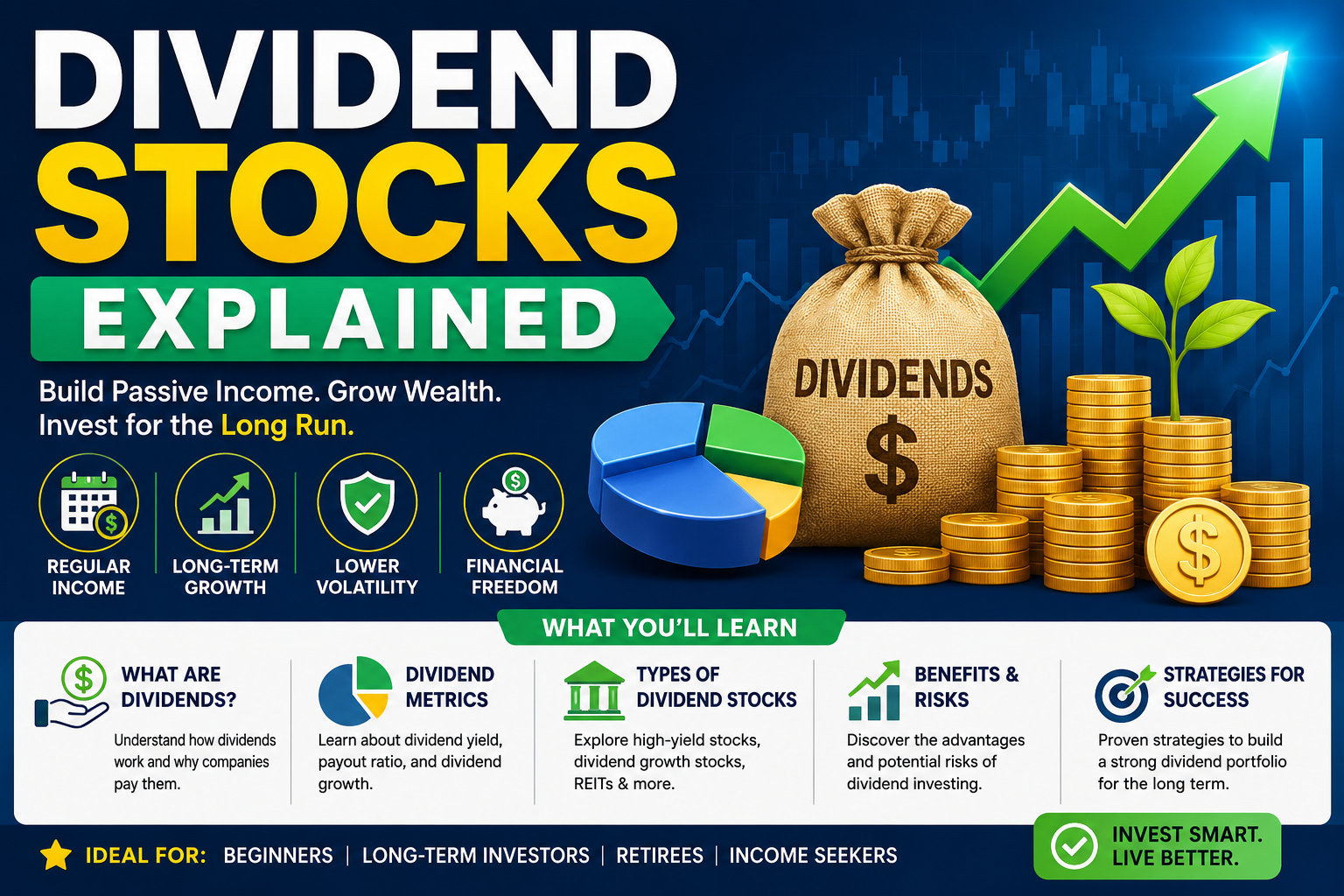
Dividend Stocks Explained
Dividend Stocks Explained: Dividend stocks are among the most popular investments for long-term wealth creation and passive income. Investors in the United States, Canada, the United Kingdom, and Australia often rely on dividend stocks to generate regular cash flow while growing their portfolios over time.
Dividend stocks are among the most popular investments in countries like the United States, Canada, United Kingdom, and Australia because they can provide:
- Regular income
- Long-term wealth growth
- Protection during market downturns
- Passive cash flow during retirement
- Portfolio stability
For many investors, dividend investing is the foundation of financial independence.
Some of the world’s largest companies — like Apple, Johnson & Johnson, Coca-Cola, Procter & Gamble, and Royal Bank of Canada — have rewarded shareholders with dividends for decades.
What Is a Dividend?
A dividend is a portion of a company’s profits that is paid to shareholders.
When a company earns money, management has several choices:
- Reinvest profits into the business
- Pay down debt
- Buy back shares
- Keep cash reserves
- Pay dividends to investors
When a company chooses to distribute part of its profits to shareholders, that payment is called a dividend.
Simple Example of a Dividend
Imagine a company earns:
- $10 billion in annual profit
- It decides to distribute $4 billion to shareholders
- The remaining $6 billion stays in the business
That $4 billion gets divided among shareholders based on how many shares they own.
If you own:
- 100 shares
- Dividend = $2 per share annually
You receive:
- 100 × $2 = $200 per year
This income arrives whether the stock price rises or falls.
What Is a Dividend Stock?
A dividend stock is a stock that regularly pays dividends to shareholders.
These companies are usually:
- Mature businesses
- Financially stable
- Profitable
- Cash-flow positive
- Industry leaders
Dividend stocks are common in industries such as:
- Banking
- Utilities
- Consumer staples
- Telecommunications
- Energy
- Healthcare
- Real estate
How Dividend Stocks Work
When you buy shares of a dividend-paying company:
- You become a partial owner
- The company may pay you cash distributions
- Payments are usually quarterly
- You continue receiving dividends as long as you own shares
For example:
Suppose you buy:
- 50 shares at $100 each
- Total investment = $5,000
- Annual dividend = $4 per share
Annual dividend income:
50 × $4 = $200
Quarterly payments:
$200 ÷ 4 = $50 every quarter
Important Dividend Terms Explained
1. Dividend Yield
Dividend yield measures how much income a stock pays relative to its price.
Formula:
Dividend\ Yield = \frac{Annual\ Dividend\ Per\ Share}{Stock\ Price} \times 100
Example:
- Stock price = $100
- Annual dividend = $4
Yield:
4 ÷ 100 × 100 = 4%
What Yield Means
If you invest:
- $10,000
- Dividend yield = 4%
You may receive approximately:
- $400 annually
assuming the dividend stays unchanged.
2. Dividend Payout Ratio
The payout ratio shows how much profit a company distributes as dividends.
Formula:
Payout\ Ratio = \frac{Dividends}{Net\ Income} \times 100
Example:
- Company earnings = $10 billion
- Dividends paid = $4 billion
Payout ratio:
40%
Why It Matters
A lower payout ratio often means:
- Safer dividends
- More room for growth
- Better financial flexibility
Very high payout ratios can signal danger.
3. Dividend Growth
Some companies increase dividends every year.
Example:
| Year | Dividend |
|---|---|
| 2021 | $1.00 |
| 2022 | $1.10 |
| 2023 | $1.25 |
| 2024 | $1.40 |
This is called dividend growth investing.
Over time, rising dividends can significantly increase passive income.
Why Investors Love Dividend Stocks
1. Passive Income
Dividend stocks can provide recurring cash flow without selling investments.
This is especially attractive for:
- Retirees
- FIRE investors
- Long-term wealth builders
- Conservative investors
2. Compounding Through Reinvestment
Many investors reinvest dividends to buy more shares.
This creates:
- More shares
- Larger future dividends
- Faster compounding
This process is one of the most powerful wealth-building strategies.
3. Lower Volatility
Dividend-paying companies are often more stable than speculative growth companies.
These businesses usually have:
- Predictable earnings
- Established brands
- Strong cash flow
- Global operations
During bear markets, dividend stocks sometimes decline less than high-growth stocks.
4. Inflation Protection
Companies with growing dividends may help investors keep pace with inflation.
If your dividends rise faster than inflation, your purchasing power improves.
Types of Dividend Stocks
1. Blue-Chip Dividend Stocks
These are large, established companies with strong reputations.
Examples include:
- Microsoft
- PepsiCo
- McDonald’s
Characteristics:
- Reliable profits
- Global operations
- Consistent dividends
2. Dividend Aristocrats
Dividend Aristocrats are companies that have increased dividends for at least 25 consecutive years.
Examples:
- Coca-Cola
- 3M
- Colgate-Palmolive
These companies are considered elite dividend payers.
3. High-Yield Dividend Stocks
These stocks offer unusually high dividend yields.
Examples often come from:
- Telecom
- Energy
- REITs
- Utilities
However, extremely high yields can sometimes indicate financial problems.
4. REIT Dividend Stocks
REIT stands for:
- Real Estate Investment Trust
REITs own income-producing real estate.
Examples:
- Apartment buildings
- Shopping centers
- Warehouses
- Data centers
REITs are legally required in many countries to distribute most profits as dividends.
Dividend Reinvestment Plans (DRIPs)
A DRIP automatically reinvests dividends into additional shares.
Example:
- You receive $100 dividend
- Instead of cash, broker buys more stock
Benefits:
- Automatic compounding
- No emotional investing
- Long-term wealth acceleration
Many brokers in Tier-1 countries offer free DRIPs.
The Power of Compounding
Albert Einstein supposedly called compounding the “eighth wonder of the world.”
Dividend reinvestment can dramatically increase wealth.
Example:
Initial investment = $10,000
- Dividend yield = 4%
- Annual stock growth = 7%
- Total annual return ≈ 11%
After 30 years:
Your portfolio could potentially exceed:
- $200,000+
without adding additional money.
Dividend Yield Trap Explained
A yield trap occurs when a stock’s yield looks attractive because the share price collapsed.
Example:
- Stock price falls from $100 to $40
- Dividend remains temporarily unchanged
- Yield jumps from 4% to 10%
This may signal:
- Financial distress
- Falling profits
- Unsustainable dividends
Many inexperienced investors chase yield without evaluating risk.
Safe vs Unsafe Dividends
Signs of Safe Dividends
Strong Free Cash Flow
The company consistently generates cash.
Moderate Payout Ratio
Usually below 60% for many industries.
Stable Earnings
Profits remain predictable over time.
Long Dividend History
Companies with decades of uninterrupted dividends often prioritize shareholders.
Signs of Unsafe Dividends
Excessive Debt
Debt burdens can threaten dividends.
Falling Revenue
Shrinking sales weaken cash flow.
Very High Yields
Extremely high yields may signal risk.
Dividend Cuts
A dividend reduction often hurts investor confidence.
Dividend Investing Strategies
1. Income Investing
Goal:
Generate immediate cash flow.
Common among retirees.
Focus:
- High-yield stocks
- REITs
- Utilities
- Telecom companies
2. Dividend Growth Investing
Goal:
Increase future income over time.
Focus:
- Companies growing dividends annually
- Lower starting yields
- Strong earnings growth
Popular with younger investors.
3. Total Return Investing
Focuses on:
- Dividends
- Capital appreciation
- Long-term growth
This balanced approach is widely used in retirement portfolios.
Case Study: Coca-Cola Dividend Investing
Coca-Cola is one of the most famous dividend stocks in history.
Why investors like it:
- Global brand recognition
- Stable demand
- Massive cash flow
- Long dividend history
The company has increased dividends for decades.
Imagine an investor bought shares in 1995 and reinvested dividends.
Over time:
- Shares multiplied
- Dividend income increased substantially
- Portfolio value compounded significantly
This demonstrates long-term dividend investing power.
Case Study: Bank Dividend Stocks in Canada
Canadian banks are popular dividend investments.
Examples include:
- Toronto-Dominion Bank
- Bank of Montreal
- Royal Bank of Canada
Why investors like them:
- Oligopoly-style banking system
- Stable profits
- Strong regulation
- Consistent dividends
Many Canadian retirees use bank dividends for income.
Case Study: Australian Dividend Culture
Australia has one of the world’s strongest dividend cultures.
Major dividend sectors include:
- Mining
- Banking
- Telecommunications
Popular companies include:
- BHP
- Commonwealth Bank
Australia’s franking credit system also makes dividends tax-efficient for some investors.
Dividend Stocks vs Growth Stocks
| Feature | Dividend Stocks | Growth Stocks |
|---|---|---|
| Income | High | Low or none |
| Stability | Usually higher | Usually lower |
| Volatility | Lower | Higher |
| Reinvestment | Slower expansion | Aggressive expansion |
| Investor Type | Income-focused | Growth-focused |
Growth companies often reinvest profits instead of paying dividends.
Examples:
- Amazon
- Tesla
Dividend companies prioritize shareholder income.
Taxes on Dividends
Dividend taxation differs across countries.
United States
Qualified dividends often receive favorable tax rates.
Canada
Eligible dividends may receive dividend tax credits.
United Kingdom
Dividend allowances apply up to certain thresholds.
Australia
Franking credits can reduce double taxation.
Tax laws change regularly, so investors often consult professionals.
Dividend ETFs Explained
Instead of buying individual stocks, investors can buy dividend ETFs.
ETF means:
- Exchange-Traded Fund
These funds hold many dividend-paying companies.
Examples include funds focused on:
- High yield
- Dividend growth
- International dividends
- U.S. dividend aristocrats
Benefits:
- Diversification
- Simplicity
- Lower company-specific risk
Risks of Dividend Stocks
Dividend stocks are not risk-free.
1. Dividend Cuts
Companies can reduce or eliminate dividends.
2. Interest Rate Risk
When interest rates rise:
- Bonds become more attractive
- Dividend stocks may decline
3. Slow Growth
Some dividend companies grow slowly.
4. Sector Concentration
Dividend portfolios can become overly concentrated in:
- Utilities
- Banks
- Energy
Diversification remains important.
How to Analyze Dividend Stocks
Step 1: Check Dividend Yield
Avoid blindly chasing very high yields.
Step 2: Examine Payout Ratio
Look for sustainable payouts.
Step 3: Analyze Earnings Growth
Healthy companies usually grow profits over time.
Step 4: Review Debt Levels
Too much debt increases risk.
Step 5: Study Dividend History
Consistency matters.
Example of Dividend Portfolio Allocation
A balanced dividend portfolio might include:
| Sector | Allocation |
|---|---|
| Healthcare | 20% |
| Consumer Staples | 20% |
| Financials | 20% |
| Utilities | 15% |
| Energy | 10% |
| REITs | 10% |
| Cash | 5% |
This diversification helps reduce risk.
Dividend Investing for Retirement
Dividend investing is extremely popular among retirees because it may provide:
- Predictable income
- Lower volatility
- Reduced need to sell assets
Example:
Portfolio value = $1 million
Dividend yield = 4%
Potential annual income:
1{,}000{,}000 \times 0.04 = 40{,}000
Potential income:
- $40,000 annually
without selling shares.
Common Dividend Investing Mistakes
Chasing Yield
High yield does not always mean safety.
Ignoring Valuation
Even great companies can become overpriced.
Lack of Diversification
Owning only one sector increases risk.
Panic Selling
Dividend investing often requires patience.
Dividend Stocks During Market Crashes
During recessions:
- Some dividends get cut
- Strong companies often survive
- Quality businesses may continue paying dividends
Investors who reinvest during downturns may benefit from lower prices and larger future gains.
Building a Dividend Portfolio Step-by-Step
Step 1: Define Goals
Do you want:
- Income?
- Growth?
- Retirement cash flow?
Step 2: Choose Strategy
Options include:
- High yield
- Dividend growth
- ETFs
- Hybrid approach
Step 3: Diversify
Spread investments across industries and countries.
Step 4: Reinvest Dividends
Compounding accelerates wealth creation.
Step 5: Review Annually
Monitor:
- Dividend safety
- Earnings
- Valuation
- Portfolio balance
Psychological Benefits of Dividend Investing
Many investors enjoy receiving cash payments because it creates:
- Emotional stability
- Confidence during volatility
- Reduced temptation to trade frequently
Dividend investing often encourages long-term thinking.
Final Thoughts
Dividend stocks are one of the most powerful tools for long-term wealth creation.
They combine:
- Passive income
- Compounding
- Stability
- Potential growth
For investors in Tier-1 countries like the United States, Canada, United Kingdom, and Australia, dividend investing remains a core strategy for:
- Retirement planning
- Financial independence
- Wealth preservation
- Long-term portfolio growth
The most successful dividend investors usually focus on:
- Quality companies
- Long time horizons
- Sustainable dividends
- Diversification
- Consistent reinvestment
Over decades, even modest dividends can compound into substantial wealth.