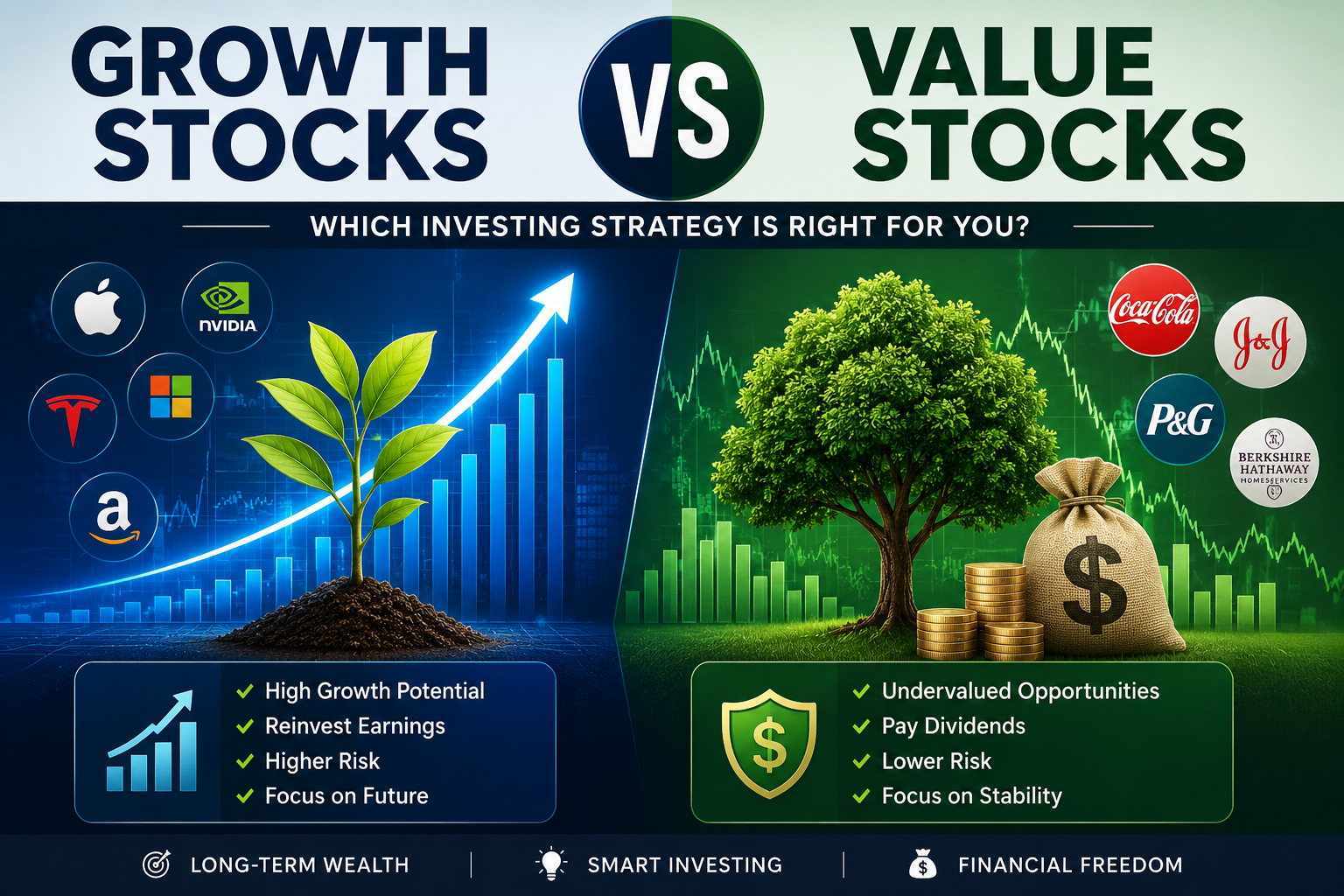
Growth Stocks vs Value Stocks
Growth Stocks vs Value Stocks is one of the most important comparisons every investor should understand before building a stock portfolio. Whether you are investing in the United States, Canada, the United Kingdom, or Australia, understanding the difference between growth and value investing can significantly impact your long-term returns.
Investing in stocks is one of the most powerful ways to build long-term wealth. But once investors enter the stock market, they quickly discover that not all stocks behave the same way. Some companies grow rapidly and reinvest profits to expand even faster. Others are mature businesses trading at lower prices relative to their earnings and assets.
These two major categories are known as growth stocks and value stocks.
Understanding the difference between them is essential for investors in Tier-1 countries such as the United States, United Kingdom, Canada, and Australia because retirement planning, tax-efficient investing, portfolio management, and wealth creation strategies often depend on choosing the right balance between growth and value investments.
Famous investors have built fortunes using these strategies:
- Warren Buffett became famous through value investing.
- Peter Lynch invested heavily in growth opportunities.
- Benjamin Graham created the foundation of value investing principles.
- Cathie Wood became known for aggressive growth investing.
Both strategies can create wealth, but they work differently, perform differently during economic cycles, and attract different types of investors.
What Is a Stock?
Before comparing growth and value stocks, we must understand the meaning of a stock.
A stock represents ownership in a company.
When you buy shares of a company like Apple or Microsoft, you become a partial owner of that business.
Companies issue stocks to:
- Raise money
- Expand operations
- Build new products
- Hire employees
- Invest in innovation
Investors buy stocks because they expect:
- Capital appreciation (share price growth)
- Dividends (cash payments)
- Long-term wealth creation
What Are Growth Stocks?
A growth stock is a company expected to grow revenue, earnings, and market share faster than the overall market.
These companies usually:
- Reinvest profits instead of paying dividends
- Focus on expansion
- Operate in fast-growing industries
- Trade at higher valuations
Growth investors believe the company’s future earnings potential justifies paying a premium price today.
Characteristics of Growth Stocks
1. High Revenue Growth
Growth companies often increase sales rapidly.
Example:
- A software company growing revenue from $1 billion to $2 billion within 3 years.
Common growth sectors:
- Artificial intelligence
- Cloud computing
- Biotechnology
- Electric vehicles
- Fintech
Examples include:
- NVIDIA
- Tesla
- Amazon
2. High Valuation Ratios
Growth stocks often appear “expensive.”
Investors commonly analyze:
- P/E Ratio (Price-to-Earnings)
- P/S Ratio (Price-to-Sales)
- PEG Ratio (Price/Earnings-to-Growth)
P/E Ratio Formula
P/E\ Ratio = \frac{Share\ Price}{Earnings\ Per\ Share}
If a company earns $5 per share and trades at $150:
[
P/E = \frac{150}{5} = 30
]
A P/E of 30 means investors are willing to pay 30 times current earnings because they expect future growth.
3. Low or No Dividends
Growth companies usually reinvest profits into:
- Research and development
- Expansion
- Marketing
- Acquisitions
For example:
- Meta Platforms historically reinvested profits rather than paying large dividends.
4. Higher Risk and Volatility
Growth stocks can rise dramatically but also fall sharply.
Reasons:
- High investor expectations
- Sensitivity to interest rates
- Dependence on future profits
A growth company missing earnings estimates may drop 20–30% in one day.
What Are Value Stocks?
A value stock is a company trading below what investors believe is its intrinsic or fair value.
These companies are often:
- Mature businesses
- Stable earners
- Dividend payers
- Temporarily undervalued
Value investors search for bargains in the market.
Characteristics of Value Stocks
1. Lower Valuation Ratios
Value stocks often trade at lower:
- P/E ratios
- Price-to-book ratios
- Price-to-cash-flow ratios
Investors believe the market is underpricing the company.
2. Stable Earnings
Value companies usually generate predictable cash flow.
Examples:
- Banks
- Consumer goods companies
- Insurance firms
- Energy companies
Examples include:
- Coca-Cola
- Johnson & Johnson
- Procter & Gamble
3. Dividend Payments
Many value companies distribute profits to shareholders.
Dividend Yield Formula
Dividend\ Yield = \frac{Annual\ Dividend\ Per\ Share}{Share\ Price}
If a company pays:
- $4 annual dividend
- Stock price = $100
[
Dividend\ Yield = \frac{4}{100} = 4%
]
Dividend income is important for:
- Retirees
- Passive income investors
- Conservative portfolios
4. Lower Volatility
Value stocks usually fluctuate less because:
- Earnings are stable
- Businesses are established
- Investors rely on dividends
Growth Stocks vs Value Stocks: Core Differences
| Feature | Growth Stocks | Value Stocks |
|---|---|---|
| Goal | Rapid expansion | Undervalued opportunity |
| Dividend | Usually low | Often high |
| Risk | Higher | Lower |
| Volatility | High | Moderate |
| Valuation | Expensive | Cheap |
| Investor Focus | Future growth | Current value |
| Common Sectors | Tech, AI, biotech | Banking, utilities |
| Earnings | Reinvested | Distributed |
| Market Sensitivity | High | Moderate |
Understanding Intrinsic Value
Intrinsic value means the “true worth” of a company.
Value investors compare:
- Market price
- Actual business value
If intrinsic value is higher than market price, the stock may be undervalued.
Margin of Safety
Value investing heavily uses the concept of a margin of safety.
This means buying stocks significantly below estimated intrinsic value.
Example:
- Estimated intrinsic value = $100
- Current market price = $70
Margin of safety:
Margin\ of\ Safety = \frac{Intrinsic\ Value – Market\ Price}{Intrinsic\ Value}
[
= \frac{100-70}{100} = 30%
]
This reduces downside risk.
Why Growth Stocks Become Expensive
Growth stocks attract investors because:
- Future profits may explode
- Innovation creates excitement
- Market leadership potential exists
Investors pay premiums for:
- Future earnings
- Market dominance
- Technological leadership
Example:
Amazon traded at extremely high valuations for years because investors expected massive future expansion.
Why Value Stocks Become Cheap
Value stocks may decline because:
- Negative news
- Economic downturns
- Industry pessimism
- Temporary earnings weakness
Sometimes the market overreacts.
Value investors attempt to identify situations where fear creates opportunity.
Growth Investing Strategy
Growth investors prioritize:
- Revenue growth
- Innovation
- Scalability
- Competitive advantage
They often ignore:
- High valuation
- Low dividends
- Short-term volatility
The goal is long-term capital appreciation.
Value Investing Strategy
Value investors prioritize:
- Financial strength
- Undervaluation
- Stable cash flow
- Margin of safety
They prefer:
- Reasonable prices
- Dividend income
- Lower downside risk
Economic Cycles and Performance
Growth and value stocks perform differently depending on economic conditions.
Growth Stocks During Low Interest Rates
Growth stocks often outperform when:
- Interest rates are low
- Money is cheap
- Investors seek higher returns
This happened after the 2008 financial crisis and during the 2020 pandemic recovery.
Technology companies surged because investors focused on future earnings.
Value Stocks During Inflation
Value stocks often outperform during:
- Inflation
- Rising interest rates
- Economic recovery
Why?
Because:
- Banks earn more from higher rates
- Energy companies benefit from commodity prices
- Mature businesses generate stable cash flow
Case Study 1: Growth Investing Success
NVIDIA
Background
NVIDIA started as a graphics chip company but became a leader in:
- Gaming
- Artificial intelligence
- Data centers
Growth Characteristics
- Rapid revenue expansion
- High valuation
- Strong innovation
- Reinvestment strategy
Result
Investors who bought shares years earlier experienced extraordinary returns.
Lesson
Growth stocks can create massive wealth when companies dominate emerging industries.
Case Study 2: Value Investing Success
Coca-Cola
Background
Coca-Cola is a mature global brand with stable cash flow.
Value Characteristics
- Dividend payments
- Strong brand loyalty
- Predictable earnings
- Lower volatility
Result
Long-term investors benefited from:
- Dividend income
- Steady appreciation
- Defensive stability
Lesson
Value investing may generate slower but more stable wealth accumulation.
Case Study 3: When Growth Fails
Dot-Com Bubble (2000)
During the late 1990s:
- Internet stocks surged
- Investors ignored valuations
- Speculation exploded
Many companies had:
- No profits
- Weak business models
- Massive valuations
When the bubble burst:
- Technology stocks collapsed
- Investors lost billions
Lesson
Even excellent growth stories can become dangerous if prices become irrational.
Case Study 4: Value Trap
Sometimes cheap stocks remain cheap for a reason.
This is called a value trap.
Example:
A company may appear undervalued because:
- Business model is failing
- Industry is shrinking
- Debt is excessive
Buying purely because a stock looks cheap can be risky.
Key Financial Ratios Explained
1. Price-to-Earnings Ratio (P/E)
Measures how expensive a stock is relative to earnings.
P/E\ Ratio = \frac{Market\ Price\ Per\ Share}{Earnings\ Per\ Share}
Higher P/E:
- Usually growth stock
Lower P/E:
- Usually value stock
2. Price-to-Book Ratio (P/B)
Measures stock price relative to company assets.
P/B\ Ratio = \frac{Market\ Price\ Per\ Share}{Book\ Value\ Per\ Share}
Lower P/B may indicate undervaluation.
3. PEG Ratio
Compares valuation to growth.
PEG\ Ratio = \frac{P/E\ Ratio}{Earnings\ Growth\ Rate}
PEG below 1 may indicate reasonable valuation relative to growth.
Sector Differences
Growth Sectors
- Technology
- Artificial intelligence
- Software
- Renewable energy
- Biotechnology
Examples:
- Alphabet
- Shopify
Value Sectors
- Utilities
- Consumer staples
- Financials
- Healthcare
- Energy
Examples:
- ExxonMobil
- Pfizer
Dividends vs Capital Gains
Growth investors usually prioritize:
- Capital gains
Value investors often prioritize:
- Dividend income
- Stability
Example Portfolio Comparison
Growth Portfolio
| Company | Allocation |
|---|---|
| NVIDIA | 30% |
| Tesla | 25% |
| Amazon | 25% |
| Shopify | 20% |
Characteristics:
- High volatility
- High upside potential
- Lower dividends
Value Portfolio
| Company | Allocation |
|---|---|
| Coca-Cola | 25% |
| Johnson & Johnson | 25% |
| Procter & Gamble | 25% |
| Pfizer | 25% |
Characteristics:
- Dividend income
- Lower risk
- Slower growth
Which Strategy Is Better?
There is no universal answer.
The best strategy depends on:
- Age
- Income
- Risk tolerance
- Financial goals
- Time horizon
Growth Stocks for Younger Investors
Young investors often prefer growth because:
- Long time horizon
- Ability to handle volatility
- Higher wealth-building potential
Example:
A 25-year-old investor saving for retirement may prioritize aggressive growth.
Value Stocks for Retirees
Retirees often prefer value because:
- Dividend income
- Lower volatility
- Capital preservation
Example:
A retiree may depend on dividend payments for living expenses.
Blended Strategy
Many professional investors combine both growth and value stocks.
Benefits:
- Diversification
- Balanced risk
- Exposure to multiple market conditions
Example:
- 60% growth
- 40% value
This approach reduces dependence on one market style.
Growth vs Value Performance History
Historically:
- Growth dominates during innovation booms
- Value dominates during inflationary periods
Market leadership rotates over time.
This is why diversification matters.
Psychological Differences Between Investors
Growth investors often:
- Accept volatility
- Focus on future potential
- Take aggressive risks
Value investors often:
- Seek bargains
- Focus on downside protection
- Prefer patience
Common Mistakes in Growth Investing
1. Chasing Hype
Investors sometimes buy:
- Trending stocks
- Overvalued companies
- Speculative narratives
2. Ignoring Valuation
Even excellent companies can become overpriced.
A great company is not always a great investment at any price.
3. Emotional Investing
Growth stocks can rise and crash rapidly.
Fear and greed cause poor decisions.
Common Mistakes in Value Investing
1. Buying Value Traps
Cheap stocks may stay cheap.
2. Ignoring Industry Decline
Some industries face permanent disruption.
Example:
Traditional retail struggled because of e-commerce growth.
3. Over-Diversification
Owning too many mediocre companies reduces returns.
ETFs for Growth and Value Investing
Investors often use ETFs (Exchange-Traded Funds).
Growth ETFs:
- Technology-focused
- Innovation-focused
Value ETFs:
- Dividend-focused
- Defensive sectors
Examples include:
- VUG
- VTV
Tax Considerations in Tier-1 Countries
Investors in:
- USA
- UK
- Canada
- Australia
must consider:
- Capital gains tax
- Dividend taxation
- Retirement account benefits
Growth stocks:
- Often generate lower immediate taxes because profits are reinvested.
Value stocks:
- May create taxable dividend income annually.
Tax-efficient accounts:
- 401(k)
- IRA
- ISA
- TFSA
- Superannuation
can improve after-tax returns.
Inflation and Interest Rates
Growth stocks are more sensitive to:
- Rising interest rates
Why?
Because future earnings become less valuable when discount rates rise.
Value stocks tend to perform better during:
- Inflationary environments
- Economic recovery periods
Risk Management
Investors should:
- Diversify
- Avoid emotional trading
- Rebalance portfolios
- Focus on long-term goals
How Professionals Analyze Stocks
Professional investors evaluate:
- Revenue growth
- Profit margins
- Debt levels
- Competitive advantage
- Management quality
- Industry trends
They do not rely on one ratio alone.
Long-Term Investing Perspective
Both growth and value investing can build wealth over decades.
The key drivers are:
- Discipline
- Patience
- Diversification
- Consistency
Final Comparison
| Factor | Growth Stocks | Value Stocks |
|---|---|---|
| Main Objective | Capital appreciation | Undervalued opportunity |
| Typical Investor | Aggressive | Conservative |
| Dividend Yield | Low | Higher |
| Volatility | High | Lower |
| Time Horizon | Long-term | Medium/long-term |
| Economic Strength | Innovation booms | Inflationary periods |
| Risk Level | Higher | Moderate |
| Potential Reward | Very high | Stable and consistent |
Conclusion
Growth stocks and value stocks represent two different philosophies of investing.
Growth investing focuses on:
- Innovation
- Expansion
- Future earnings potential
Value investing focuses on:
- Undervaluation
- Stability
- Margin of safety
Neither strategy is always superior.
Some of the world’s greatest investors succeeded with growth investing, while others built fortunes through value investing. The most effective approach for many investors is often a balanced portfolio containing both styles.
A young investor seeking aggressive wealth creation may lean toward growth stocks, while retirees or conservative investors may prefer value stocks for income and stability.
The most important lesson is that successful investing is not about chasing trends. It is about understanding:
- Business fundamentals
- Risk tolerance
- Time horizon
- Portfolio diversification
- Long-term discipline
Investors who consistently apply these principles are more likely to build sustainable wealth over time.