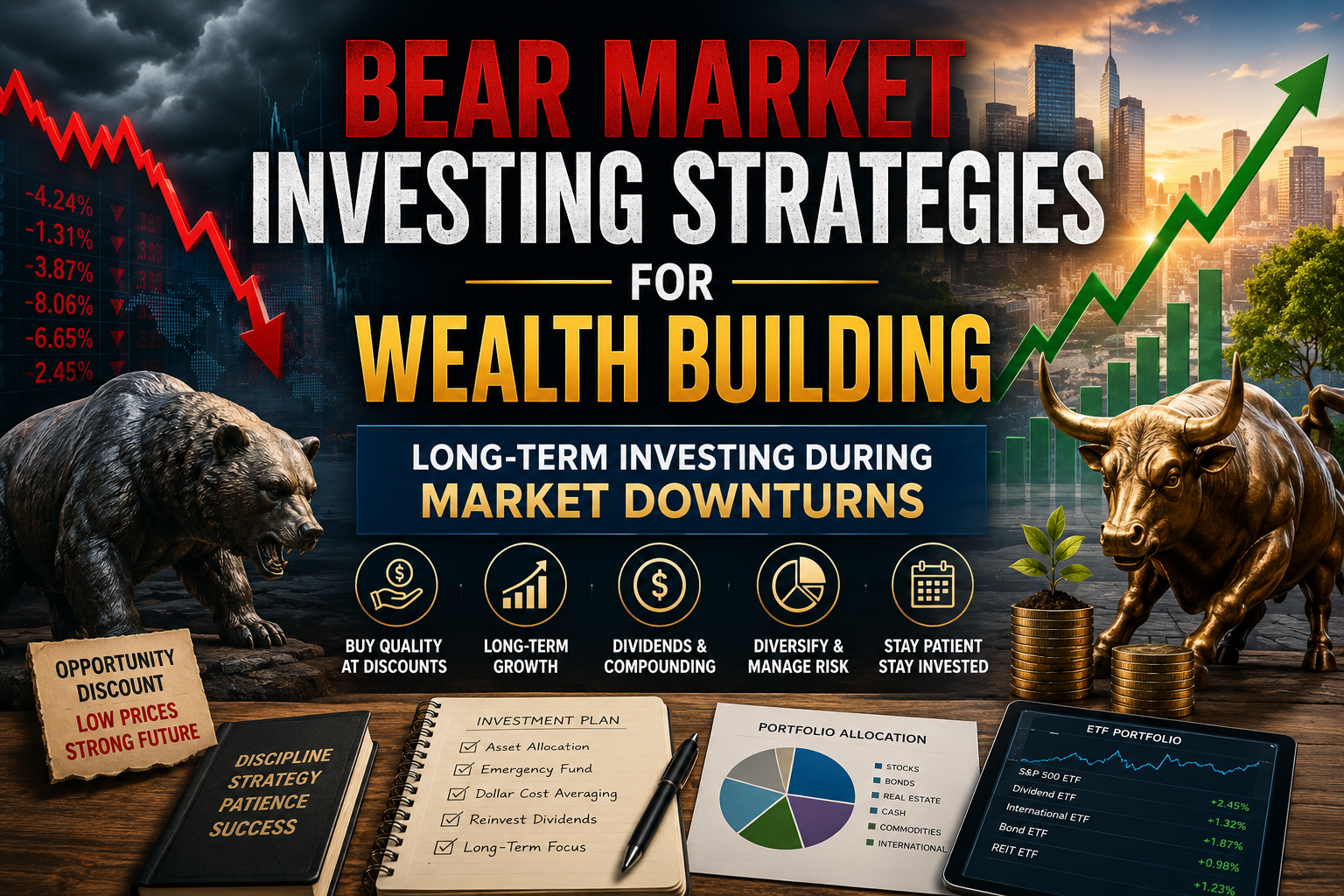
Bear Market Investing Strategies for Wealth Building
Bear Market Investing Strategies can help long-term investors navigate periods of falling stock prices, elevated volatility, economic uncertainty, and negative investor sentiment. Rather than treating every market decline as a reason to panic, disciplined investors can use appropriate asset allocation, diversification, dollar-cost averaging, rebalancing, and valuation analysis to pursue long-term wealth-building goals.
Many investors fear bear markets. Headlines become negative, stock prices decline, portfolios shrink, and uncertainty dominates financial news. However, history shows that some of the world’s greatest wealth-building opportunities have emerged during bear markets.
Understanding Bear Market Investing Strategies can help investors transform periods of fear into opportunities for long-term financial growth. Instead of viewing market declines as disasters, experienced investors often see them as opportunities to purchase quality assets at discounted prices.
The reality is simple: wealth is frequently built during bear markets but recognized during bull markets.
This comprehensive guide explains everything you need to know about bear market investing, including definitions, strategies, historical examples, case studies, risk management techniques, portfolio allocation methods, and proven approaches used by successful investors.
What Is a Bear Market?
A bear market is a period when financial markets decline by at least 20% from recent highs and remain depressed for an extended period.
Definition
A bear market occurs when investor confidence weakens, economic concerns increase, and asset prices fall significantly.
Key Characteristics
- Stock prices fall 20% or more
- Investor sentiment becomes pessimistic
- Economic growth slows
- Corporate earnings decline
- Unemployment may rise
- Market volatility increases
Why Is It Called a Bear Market?
The term originates from how a bear attacks.
A bear swipes its paws downward.
Similarly, stock prices move downward during a bear market.
In contrast, a bull attacks by thrusting its horns upward, representing rising markets.
Understanding Wealth Building During Bear Markets
Many beginner investors assume wealth is created when markets rise.
In reality, wealth is often created when investors purchase valuable assets at discounted prices during market downturns.
Consider a simple example.
Scenario A
Investor buys shares at:
$100 per share
Scenario B
Investor buys identical shares during a bear market at:
$60 per share
If both stocks eventually recover to $120:
Investor A gains 20%.
Investor B gains 100%.
This illustrates why bear markets can become powerful wealth-building periods.
Historical Evidence: Bear Markets Eventually End
Throughout history, markets have recovered from every major downturn.
The Great Depression (1929)
The stock market fell nearly 90%.
Investors who remained invested and continued buying quality companies eventually benefited from decades of growth.
Dot-Com Crash (2000–2002)
Technology stocks collapsed.
Many investors panicked and sold.
Those who invested in strong companies eventually experienced substantial gains during future technology booms.
Global Financial Crisis (2008)
The market lost more than 50%.
Investors who continued investing through the crisis enjoyed one of the strongest bull markets in history afterward.
COVID-19 Market Crash (2020)
Markets fell rapidly.
Fear dominated headlines.
However, recovery occurred faster than many expected, rewarding disciplined investors.
Why Investors Make Mistakes During Bear Markets
Understanding investor psychology is essential.
Fear
Investors fear additional losses.
Panic Selling
People often sell after prices have already declined.
Emotional Decisions
Emotion replaces logic.
Herd Mentality
Investors follow crowds rather than fundamentals.
Short-Term Thinking
Focus shifts from long-term wealth creation to short-term market movements.
These psychological biases frequently destroy wealth.
Strategy 1: Continue Investing Consistently
One of the most effective bear market investing strategies is maintaining regular investments.
This approach is called:
Dollar-Cost Averaging (DCA)
Dollar-cost averaging means investing a fixed amount at regular intervals regardless of market conditions.
Example
Monthly investment:
$1,000
When prices fall:
- More shares purchased
When prices rise:
- Fewer shares purchased
Over time, average costs decline.
Benefits of Dollar-Cost Averaging
Removes Emotion
No need to predict market bottoms.
Builds Discipline
Investing becomes automatic.
Reduces Timing Risk
Avoids trying to perfectly time markets.
Encourages Long-Term Thinking
Focus remains on wealth accumulation.
Case Study 1: Sarah’s Bear Market Investment Plan
Sarah invested:
$500 monthly
During the 2008 financial crisis.
Friends stopped investing.
Sarah continued.
Over several years:
- Average purchase prices declined
- Recovery boosted returns
- Portfolio value significantly increased
Her success came from consistency rather than market prediction.
Strategy 2: Buy High-Quality Companies
Bear markets often punish both strong and weak companies.
This creates opportunities.
What Is a High-Quality Company?
Characteristics include:
Strong Balance Sheet
Low debt levels.
Consistent Profits
Reliable earnings growth.
Competitive Advantage
Difficult for competitors to replicate.
Strong Management
Effective leadership team.
Positive Cash Flow
Business generates surplus cash.
Examples of Quality Businesses
Historically, companies with strong brands and durable business models have often survived market downturns better than weaker competitors.
Characteristics include:
- Global brand recognition
- Diverse revenue streams
- Strong financial reserves
- Long operating history
Strategy 3: Focus on Long-Term Investing
Successful wealth builders think in decades, not months.
Long-Term Investment Horizon
A long-term horizon means:
- 10 years
- 20 years
- 30 years
or more.
Temporary bear markets become less significant when viewed over decades.
Warren Buffett’s Perspective
Warren Buffett has repeatedly emphasized that investors should view market declines as opportunities rather than threats.
His famous philosophy centers on buying quality businesses when prices become attractive.
Strategy 4: Rebalance Your Portfolio
Portfolio rebalancing restores target asset allocation.
Example
Target Allocation:
- 70% stocks
- 30% bonds
Bear Market Result:
- 55% stocks
- 45% bonds
Rebalancing involves purchasing stocks and reducing bonds to restore the original allocation.
This process naturally encourages buying low.
Strategy 5: Build Cash Reserves Before Bear Markets
Cash provides flexibility.
Investors with emergency funds can avoid selling investments during downturns.
Recommended Emergency Fund
Generally:
3–12 months of living expenses.
Benefits include:
- Financial security
- Reduced stress
- Ability to invest during downturns
- Avoidance of forced asset sales
Strategy 6: Invest in Index Funds
Many investors struggle to identify winning stocks.
Index funds provide broad diversification.
What Is an Index Fund?
An index fund tracks a market index.
Examples include:
- S&P 500
- NASDAQ Composite
- FTSE 100
Advantages
Low Cost
Lower management fees.
Diversification
Exposure to hundreds of companies.
Simplicity
Easy to understand.
Historical Performance
Broad market indexes have historically recovered from bear markets.
Strategy 7: Invest in Dividend Stocks
Dividend-paying companies may provide income during difficult markets.
What Is a Dividend?
A dividend is a payment made by a company to shareholders.
Benefits
- Passive income
- Reinvestment opportunities
- Reduced reliance on price appreciation
- Potential inflation protection
Case Study 2: Dividend Reinvestment During a Bear Market
James owned dividend stocks during a downturn.
Instead of spending dividends, he reinvested them.
As prices fell:
- Dividends purchased more shares
- Share count increased
- Recovery produced larger gains
This demonstrates the power of compounding.
Strategy 8: Take Advantage of Market Discounts
Bear markets create discounts.
Imagine a luxury store offering products at 40% off.
Customers become excited.
Yet investors often become fearful when stocks are discounted.
This contradiction creates opportunities.
Value Investing During Bear Markets
Value investing focuses on purchasing assets below intrinsic value.
Key metrics include:
Price-to-Earnings Ratio (P/E)
Measures valuation relative to earnings.
Price-to-Book Ratio (P/B)
Compares price to company assets.
Free Cash Flow
Indicates financial strength.
Case Study 3: Buying During the 2008 Crisis
Michael purchased diversified index funds during the financial crisis.
Markets declined further after his purchases.
Instead of selling:
He continued investing.
Ten years later:
Portfolio growth substantially exceeded initial investment.
His advantage was patience.
The Power of Compounding During Bear Markets
Albert Einstein reportedly referred to compounding as one of the most powerful forces in finance.
Compounding occurs when returns generate additional returns.
Example
Investment:
$10,000
Annual Return:
10%
Year 1:
$11,000
Year 2:
$12,100
Year 3:
$13,310
Growth accelerates over time.
Bear markets often improve future compounding potential because assets are purchased at lower prices.
Common Mistakes to Avoid
Panic Selling
Locks in losses.
Market Timing
Extremely difficult.
Following Headlines
Media often amplifies fear.
Ignoring Diversification
Concentrated positions increase risk.
Excessive Trading
Creates costs and emotional stress.
Case Study 4: The Investor Who Sold Too Early
During a market crash, Robert sold his entire portfolio.
Markets recovered within the following years.
He remained in cash.
Result:
He missed substantial gains.
His mistake was reacting emotionally rather than strategically.
Advanced Bear Market Investing Strategies
Strategy 9: Tax-Loss Harvesting
Tax-loss harvesting is one of the most powerful yet underutilized wealth-building strategies during bear markets.
Definition
Tax-loss harvesting involves selling investments at a loss to offset taxable capital gains.
Example
Suppose:
- Capital Gains = $20,000
- Capital Losses = $10,000
Taxable Gain:
$20,000 − $10,000 = $10,000
Result:
Lower tax liability.
Many professional investors use tax-loss harvesting during market downturns to improve after-tax returns.
Benefits
- Reduces taxes
- Improves portfolio efficiency
- Creates reinvestment opportunities
- Enhances long-term wealth accumulation
Strategy 10: Increase Retirement Contributions
Bear markets create opportunities to purchase retirement assets at lower prices.
Retirement Accounts
Examples include:
- 401(k)
- IRA
- Roth IRA
- Pension-linked investments
- Employer-sponsored retirement plans
When markets decline, every contribution buys more shares.
Long-term investors often benefit substantially when markets eventually recover.
Strategy 11: Focus on Dividend Reinvestment
Many investors spend dividends.
Wealth builders frequently reinvest them.
Why It Works
During market declines:
- Prices are lower
- Dividends buy more shares
- Recovery produces larger gains
This creates a compounding effect.
Strategy 12: Buy Defensive Stocks
Defensive stocks often perform better during economic downturns.
Defensive Sectors
- Healthcare
- Utilities
- Consumer Staples
- Essential Services
Consumers still buy food, electricity, medicine, and household necessities during recessions.
As a result, these companies may experience more stable earnings.
Strategy 13: Invest in Quality ETFs
Exchange-Traded Funds (ETFs) provide diversification and simplicity.
Popular ETF Categories
- Broad Market ETFs
- Dividend ETFs
- Value ETFs
- International ETFs
- Bond ETFs
During bear markets, ETFs can reduce company-specific risk while maintaining market exposure.
Strategy 14: Maintain Asset Diversification
Diversification spreads risk across multiple asset classes.
Asset Classes
- Stocks
- Bonds
- Real Estate
- Cash
- Commodities
- International Investments
Diversification reduces the impact of a severe decline in any single asset class.
Strategy 15: Build Cash for Future Opportunities
Cash is often called “dry powder.”
Investors holding cash can:
- Buy discounted assets
- Avoid forced selling
- Maintain flexibility
A cash reserve provides optionality during periods of market stress.
Strategy 16: Focus on Value Investing
Value investors search for companies trading below intrinsic value.
Key Metrics
- Price-to-Earnings Ratio (P/E)
- Price-to-Book Ratio (P/B)
- Free Cash Flow
- Dividend Yield
Bear markets frequently create opportunities for value investors.
Strategy 17: Global Diversification
Many investors concentrate entirely on domestic markets.
Global diversification provides exposure to:
- Europe
- Asia-Pacific
- North America
- Emerging Markets
Economic recoveries occur at different times around the world.
Strategy 18: Reinvest Market Fear into Opportunity
The greatest investment opportunities often appear when investor sentiment becomes extremely negative.
Historically, excessive fear has often preceded significant long-term market recoveries.
Successful investors focus on fundamentals rather than headlines.
Sector-by-Sector Analysis During Bear Markets
Technology Sector
Characteristics:
- Higher growth potential
- Greater volatility
- Larger drawdowns
Technology stocks often fall sharply during bear markets but may lead recoveries.
Healthcare Sector
Characteristics:
- Defensive
- Consistent demand
- Stable earnings
People require healthcare regardless of economic conditions.
Consumer Staples Sector
Examples:
- Food products
- Household goods
- Personal care items
These businesses typically maintain demand during recessions.
Utilities Sector
Examples:
- Electricity
- Water
- Natural Gas
Utilities often generate predictable revenue.
Financial Sector
Banks and financial institutions may face pressure during economic downturns.
However, strong financial firms can recover significantly during expansions.
Energy Sector
Energy stocks may experience large fluctuations due to:
- Oil prices
- Geopolitical events
- Economic growth
Investors should understand sector-specific risks.
Real Estate Sector
Real estate investment trusts (REITs) can provide:
- Income
- Diversification
- Inflation protection
However, rising interest rates may affect valuations.
ETFs for Bear Markets
Many investors prefer ETFs because they provide diversification and low costs.
Broad Market ETFs
Track major indexes.
Benefits:
- Diversification
- Low expenses
- Long-term growth potential
Dividend ETFs
Focus on companies paying dividends.
Advantages:
- Income generation
- Potential stability
- Reinvestment opportunities
Value ETFs
Target undervalued companies.
These ETFs often become attractive during market declines.
Bond ETFs
Bond ETFs may reduce portfolio volatility.
Benefits:
- Income
- Diversification
- Lower risk compared to equities
International ETFs
Provide global diversification and reduce home-country concentration risk.
Retirement Investing During Bear Markets
Bear markets can be advantageous for retirement investors.
Younger Investors
Time Horizon: 20–40 years
Advantages:
- More recovery time
- More accumulation opportunities
- Greater compounding potential
Mid-Career Investors
Objectives:
- Continue contributions
- Rebalance portfolios
- Maintain diversification
Avoid emotional decisions.
Near-Retirees
Focus on:
- Risk management
- Income generation
- Cash reserves
Asset allocation becomes increasingly important.
Asset Allocation Models
Conservative Portfolio
- 30% Stocks
- 60% Bonds
- 10% Cash
Suitable for investors prioritizing capital preservation.
Moderate Portfolio
- 60% Stocks
- 30% Bonds
- 10% Cash
Balances growth and stability.
Aggressive Portfolio
- 80% Stocks
- 15% Bonds
- 5% Cash
Suitable for investors with longer time horizons.
Historical Bear Market Statistics
Great Depression (1929)
Approximate Market Decline: -89%
Recovery required many years.
Dot-Com Crash (2000–2002)
Approximate NASDAQ Decline: -78%
Technology stocks suffered severe losses.
Global Financial Crisis (2008)
Approximate S&P 500 Decline: -57%
One of the largest modern bear markets.
COVID-19 Crash (2020)
Approximate Decline: -34%
One of the fastest bear markets and recoveries.
Expert Quotes
Warren Buffett
“Be fearful when others are greedy and greedy when others are fearful.”
Lesson: Bear markets create opportunities.
Benjamin Graham
“The investor’s chief problem—and even his worst enemy—is likely to be himself.”
Lesson: Emotional discipline matters.
Peter Lynch
“The real key to making money in stocks is not to get scared out of them.”
Lesson: Patience is essential.
Additional Case Studies
Case Study 5: Young Professional During COVID-19
Age: 28
Strategy: Continued monthly investing.
Result: Purchased shares at depressed prices and benefited from recovery.
Case Study 6: Dividend Investor
Focused on: Dividend-paying companies.
Outcome: Dividend reinvestment accelerated portfolio growth.
Case Study 7: ETF Investor
Invested exclusively in broad-market ETFs.
Benefits:
- Simplicity
- Diversification
- Lower fees
Case Study 8: Retirement Saver
Continued 401(k) contributions throughout market decline.
Result: Acquired significantly more shares at lower prices.
Case Study 9: Value Investor
Purchased high-quality companies trading below historical valuations.
Outcome: Strong long-term returns after recovery.
Case Study 10: Disciplined Rebalancer
Rebalanced annually during bear markets.
Result: Consistently bought undervalued assets.
Wealth Building Lessons from Every Bear Market
History repeatedly demonstrates:
- Bear markets are temporary.
- Diversification matters.
- Emotional investing destroys wealth.
- Consistent investing often wins.
- Quality assets recover.
- Time in the market beats timing the market.
- Compounding rewards patience.
Key Takeaways
Bear markets are uncomfortable but often create exceptional wealth-building opportunities.
The most successful investors generally:
- Continue investing
- Focus on quality assets
- Diversify portfolios
- Rebalance regularly
- Maintain emergency funds
- Think long term
- Avoid emotional decisions
Rather than fearing market downturns, investors who understand Bear Market Investing Strategies can use them as opportunities to accumulate assets, strengthen portfolios, and build long-term wealth.
Frequently Asked Questions
What is a bear market?
A bear market is generally defined as a decline of 20% or more from a recent market high, typically accompanied by weaker investor sentiment and increased market uncertainty.
Should I stop investing during a bear market?
Not necessarily. Investors with a suitable long-term plan may continue making regular investments during a bear market. Continuing contributions can allow investors to purchase more shares when prices are lower, although investment decisions should match their risk tolerance, financial situation, and time horizon.
Are bear markets good for wealth building?
Bear markets can create potential wealth-building opportunities because high-quality stocks, ETFs, and other investments may become available at lower valuations. However, lower prices do not guarantee future gains, and some investments may continue declining or may never recover.
How long do bear markets last?
There is no fixed duration. Some bear markets have lasted only a few months, while others have continued for several years. The length and severity depend on factors such as economic conditions, corporate earnings, interest rates, financial crises, and investor confidence.
What is the safest strategy during a bear market?
There is no completely risk-free investment strategy. However, maintaining appropriate diversification, keeping an emergency fund, avoiding excessive leverage, controlling portfolio risk, and following a long-term investment plan can help investors manage bear-market volatility.
Is dollar-cost averaging effective during a bear market?
Dollar-cost averaging involves investing a predetermined amount at regular intervals regardless of short-term market movements. During a bear market, this approach can result in purchasing more shares when prices are lower. However, it does not guarantee profits or prevent losses.
Are ETFs suitable for bear-market investing?
ETFs can be useful because many provide diversification across companies, sectors, bonds, or markets. Broad-market and diversified ETFs can reduce company-specific risk, but an ETF can still decline substantially during a bear market.
Should I buy stocks when the market crashes?
A market decline can create opportunities, but investors should evaluate the underlying investment rather than assuming every falling stock is a bargain. Financial strength, valuation, earnings, debt, competitive advantages, and long-term business prospects should be considered.
How should beginners invest during a bear market?
Beginners should generally prioritize financial stability before increasing investment risk. Building an emergency fund, paying attention to high-interest debt, choosing an appropriate asset allocation, diversifying investments, and following a consistent long-term strategy can be more important than trying to predict the market bottom.
Should I rebalance my portfolio during a bear market?
Rebalancing can help restore a portfolio to its intended asset allocation after market movements cause it to drift. For example, if stocks fall significantly and the portfolio becomes more heavily weighted toward bonds, an investor following a predetermined rebalancing plan may purchase stocks to return to the target allocation.
How can I protect my retirement portfolio during a bear market?
Retirement investors should consider their age, withdrawal needs, investment horizon, income sources, and risk tolerance. Maintaining an appropriate mix of stocks, bonds, cash, and other assets can help manage volatility. Investors close to retirement may also need to consider sequence-of-returns risk and maintain sufficient liquid assets for near-term expenses.
Can dividend investing help during a bear market?
Dividend-paying investments can provide income while markets are declining, but dividends are not guaranteed. Companies can reduce or eliminate dividends when financial conditions deteriorate. Investors should therefore evaluate dividend sustainability, cash flow, debt, and the underlying company’s financial health rather than focusing only on dividend yield.
What should investors avoid during a bear market?
Investors should be cautious about panic selling, excessive leverage, trying to predict the exact market bottom, concentrating too much money in a single investment, and making decisions based solely on short-term financial headlines. A written investment plan can help reduce emotional decisions.
Can a bear market create opportunities for long-term investors?
Yes. Significant market declines can create opportunities to accumulate diversified, fundamentally sound investments at lower prices. The potential benefit comes from having a sufficiently long time horizon and the ability to tolerate further declines while waiting for a recovery.