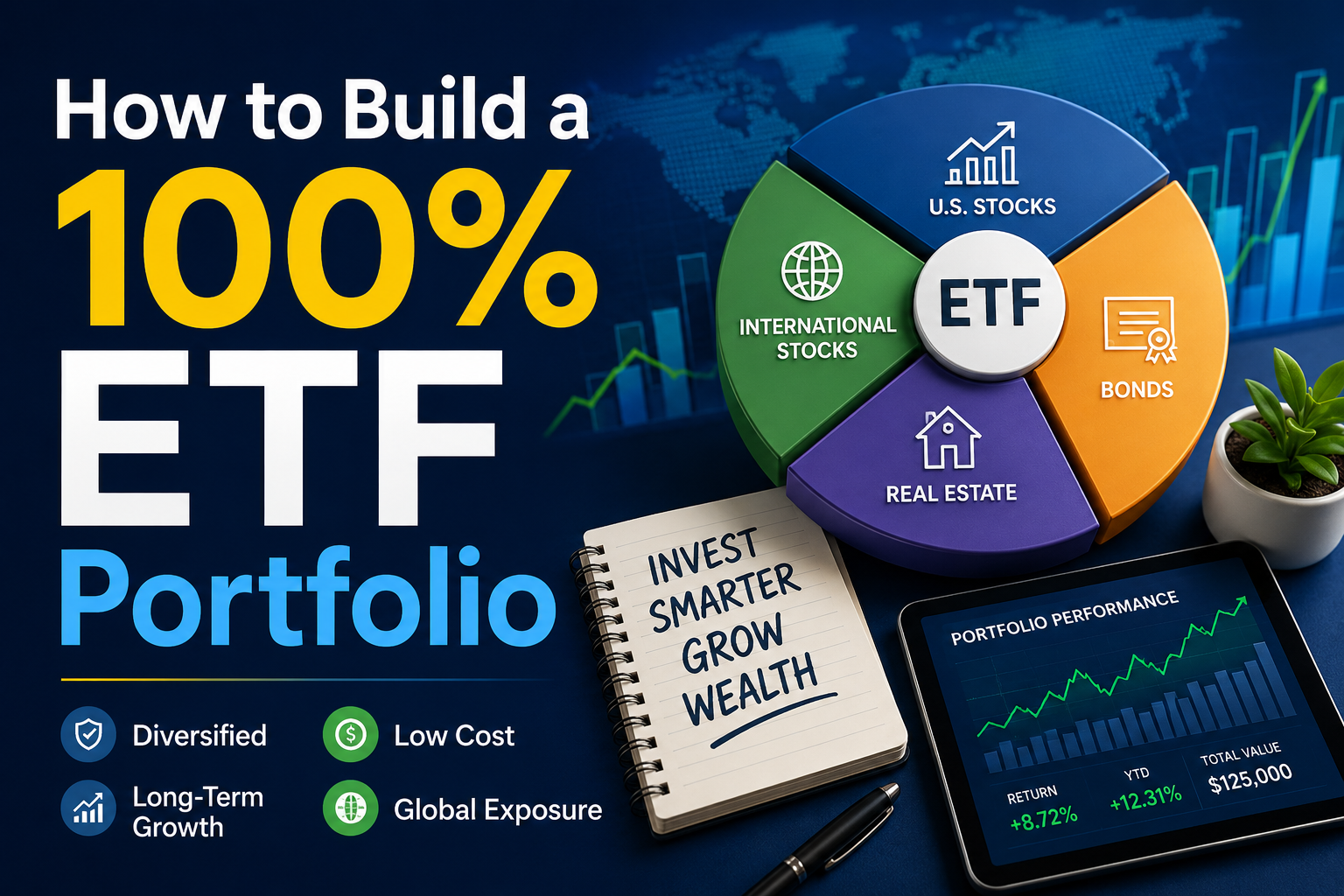
How to Build a 100% ETF Portfolio (2026 Complete Beginner-to-Advanced Guide)
How to Build a 100% ETF Portfolio is one of the most searched investing topics among beginners and long-term investors. A well-constructed ETF portfolio can provide diversification, lower costs, passive income opportunities, and long-term wealth creation without requiring investors to pick individual stocks.
Building wealth in modern investing no longer requires picking individual stocks, analyzing complicated balance sheets, or constantly watching the market every day.
Today, millions of investors build their entire portfolio using only ETFs.
A 100% ETF portfolio means your entire investment strategy is built using Exchange-Traded Funds (ETFs) instead of individual stocks, bonds, mutual funds, or other securities.
This approach has become one of the most popular investing methods in countries like the United States, Canada, the United Kingdom, and Australia because it offers:
- Diversification
- Simplicity
- Lower risk
- Lower fees
- Passive investing
- Long-term growth
- Tax efficiency
- Easy retirement planning
Even billionaire investors and financial advisors frequently recommend ETF investing for ordinary investors.
In this complete guide, you’ll learn:
- What ETFs are
- Why ETF-only portfolios are popular
- How diversification works
- How to choose ETFs
- Asset allocation strategies
- Risk management
- Retirement ETF portfolios
- International diversification
- Dividend ETF strategies
- Real-life portfolio examples
- Mistakes to avoid
- Case studies and investing scenarios
What Is an ETF?
An ETF (Exchange-Traded Fund) is an investment fund that holds a collection of assets.
These assets may include:
- Stocks
- Bonds
- Commodities
- Real estate
- International securities
- Government debt
- Gold
- Multiple asset classes together
Instead of buying one stock, an ETF allows you to buy hundreds or even thousands of investments in a single purchase.
For example:
An S&P 500 ETF may contain shares of:
- Apple
- Microsoft
- Amazon
- NVIDIA
- Meta Platforms
When you buy one ETF share, you indirectly own small portions of all these companies.
That is why ETFs are considered one of the easiest ways to diversify.
Why Investors Build a 100% ETF Portfolio
A fully ETF-based portfolio solves many problems faced by ordinary investors.
1. Simplicity
Instead of researching 50 individual stocks, you may only need:
- One U.S. stock ETF
- One international ETF
- One bond ETF
That alone can create a globally diversified portfolio.
2. Diversification
Diversification means spreading investments across many assets to reduce risk.
The idea is simple:
If one company performs poorly, your entire portfolio should not collapse.
A broad ETF spreads risk automatically.
For example:
A total market ETF may hold:
- Large-cap stocks
- Mid-cap stocks
- Small-cap stocks
- Growth companies
- Value companies
This reduces dependence on one business.
3. Lower Fees
Many actively managed mutual funds charge:
- 1%
- 2%
- Sometimes even higher annual fees
Most passive ETFs charge very low expense ratios.
Some major ETFs charge less than 0.05% annually.
Over 30 years, lower fees can save investors hundreds of thousands of dollars.
Understanding Expense Ratios
An expense ratio is the annual fee charged by the ETF provider.
Example:
If you invest $10,000 into an ETF with a 0.03% expense ratio:
Annual cost:
[
10,000 \times 0.0003 = 3
]
You pay approximately $3 yearly.
This is dramatically cheaper than many traditional investment products.
The Core Philosophy Behind ETF Investing
ETF investing is usually based on passive investing.
Passive investing means:
Instead of trying to “beat the market,” investors attempt to match market performance over long periods.
This philosophy became popular because:
- Most active fund managers fail to beat the market consistently
- Market timing is extremely difficult
- Long-term investing usually outperforms emotional trading
Types of ETFs Used in a 100% ETF Portfolio
Understanding ETF categories is essential.
1. Total Market ETFs
These ETFs track an entire stock market.
Example exposure:
- Large companies
- Mid-sized companies
- Small companies
Benefits:
- Maximum diversification
- Simplicity
- Broad market exposure
Example categories:
- U.S. Total Market ETFs
- Global Total Market ETFs
2. S&P 500 ETFs
These track the 500 largest publicly traded U.S. companies.
Advantages:
- Historically strong long-term returns
- Exposure to leading corporations
- Low costs
Disadvantage:
- Less exposure to smaller companies
3. International ETFs
These invest outside your home country.
They may include:
- Europe
- Japan
- China
- India
- Emerging markets
- Canada
- Australia
International diversification reduces dependence on one economy.
4. Bond ETFs
Bond ETFs invest in debt instruments.
Types include:
- Government bonds
- Treasury bonds
- Corporate bonds
- International bonds
Purpose:
- Stability
- Income generation
- Reduced volatility
Older investors often allocate more to bond ETFs.
5. Dividend ETFs
Dividend ETFs focus on companies paying regular dividends.
Benefits:
- Passive income
- Potentially lower volatility
- Retirement income strategy
These ETFs are popular among retirees.
6. Sector ETFs
These focus on specific industries:
- Technology
- Healthcare
- Energy
- Financials
- Real estate
Sector ETFs increase concentration risk but may offer growth opportunities.
7. Real Estate ETFs
These invest in REITs (Real Estate Investment Trusts).
Benefits:
- Real estate exposure
- Dividend income
- Diversification
The Building Blocks of a 100% ETF Portfolio
Most ETF portfolios combine multiple asset classes.
A basic structure may look like:
| Asset Class | Example Allocation |
|---|---|
| U.S. Stocks | 50% |
| International Stocks | 30% |
| Bonds | 15% |
| Real Estate | 5% |
This is called asset allocation.
What Is Asset Allocation?
Asset allocation means dividing investments among different asset categories.
It is one of the most important concepts in investing.
Research shows asset allocation often influences returns more than stock selection.
Why Asset Allocation Matters
Different assets behave differently.
Example:
During a stock market crash:
- Stocks may fall sharply
- Bonds may remain stable
- Gold may rise
- International markets may behave differently
Diversification helps reduce emotional panic.
Risk Tolerance Explained
Risk tolerance means how much volatility an investor can emotionally and financially handle.
Three common profiles:
| Investor Type | Risk Level |
|---|---|
| Conservative | Low |
| Moderate | Medium |
| Aggressive | High |
Conservative ETF Portfolio Example
Suitable for:
- Retirees
- Low-risk investors
- Income-focused investors
Example allocation:
| ETF Category | Allocation |
|---|---|
| Stock ETFs | 40% |
| Bond ETFs | 50% |
| REIT ETFs | 10% |
Goal:
- Stability
- Lower volatility
- Consistent income
Moderate ETF Portfolio Example
Suitable for:
- Long-term investors
- Balanced growth seekers
Example:
| ETF Category | Allocation |
|---|---|
| U.S. Stocks | 45% |
| International Stocks | 25% |
| Bonds | 25% |
| REITs | 5% |
This balances growth and stability.
Aggressive ETF Portfolio Example
Suitable for:
- Younger investors
- Long investment horizon
- High risk tolerance
Example:
| ETF Category | Allocation |
|---|---|
| U.S. Stocks | 60% |
| International Stocks | 30% |
| Emerging Markets | 10% |
No bonds.
Higher volatility but potentially higher long-term returns.
The Power of Compounding
Compounding is the process where investment returns generate additional returns over time.
Albert Einstein allegedly called compound interest the “eighth wonder of the world.”
Example:
Initial investment: $10,000
Annual return: 10%
After one year:
[
10,000 \times 1.10 = 11,000
]
After two years:
[
11,000 \times 1.10 = 12,100
]
This snowball effect becomes powerful over decades.
genui{“math_block_widget_always_prefetch_v2”:{“content”:”A=P\left(1+r\right)^t”}}
Case Study: Two ETF Investors
Investor A
- Starts investing at age 25
- Invests $500 monthly
- Average annual return: 8%
By age 65:
Potential portfolio value may exceed $1.7 million.
Investor B
- Starts at age 40
- Invests same amount
- Same return
By age 65:
Portfolio may be less than half of Investor A.
Lesson:
Time matters more than perfection.
The Importance of Dollar-Cost Averaging
Dollar-cost averaging means investing consistently regardless of market conditions.
Example:
You invest:
- $500 every month
- Whether the market rises or falls
Benefits:
- Reduces emotional investing
- Avoids timing mistakes
- Encourages discipline
This is one of the most effective ETF investing strategies.
What Is Rebalancing?
Over time, portfolio allocations change because investments grow at different rates.
Example:
Original allocation:
- Stocks: 60%
- Bonds: 40%
After a stock market rally:
- Stocks become 75%
- Bonds become 25%
Rebalancing restores original targets.
Why Rebalancing Is Important
It helps:
- Control risk
- Maintain discipline
- Prevent overexposure
- Reduce emotional decisions
Many investors rebalance:
- Quarterly
- Semiannually
- Annually
One-ETF Portfolio Strategy
Some investors use a single all-in-one ETF.
These ETFs automatically contain:
- U.S. stocks
- International stocks
- Bonds
Benefits:
- Extremely simple
- Automatic diversification
- Automatic rebalancing
Drawback:
- Less customization
Three-Fund Portfolio Strategy
This is one of the most famous ETF strategies.
Typical structure:
| Fund Type | Purpose |
|---|---|
| U.S. Total Market ETF | Domestic growth |
| International ETF | Global diversification |
| Bond ETF | Stability |
This strategy is widely respected among passive investors.
Understanding Market Capitalization
Companies are categorized by size.
Large-Cap
Very large companies.
Examples:
- Amazon
- Alphabet
Usually more stable.
Mid-Cap
Medium-sized companies.
Potential balance between growth and stability.
Small-Cap
Smaller businesses with higher growth potential.
Usually more volatile.
Growth vs Value ETFs
Growth ETFs
Focus on fast-growing companies.
Examples:
- Technology
- Artificial intelligence
- Innovation companies
Higher risk and higher potential growth.
Value ETFs
Focus on undervalued companies.
Often include:
- Banks
- Energy firms
- Industrial companies
Potentially lower volatility.
International Diversification Matters
Many investors make the mistake of investing only in their home country.
But no country dominates forever.
International ETFs provide exposure to:
- Different economies
- Different currencies
- Emerging growth markets
This can reduce concentration risk.
Emerging Market ETFs
Emerging markets include developing economies such as:
- India
- Brazil
- Indonesia
Potential benefits:
- Faster economic growth
- Younger populations
- Expanding middle class
Risks:
- Political instability
- Currency fluctuations
- Higher volatility
Understanding ETF Risks
ETFs are diversified, but they are not risk-free.
Risks include:
- Market crashes
- Inflation
- Interest rate risk
- Currency risk
- Recession
- Sector concentration
Investors must understand that all investing involves uncertainty.
Example: The 2008 Financial Crisis
During the global financial crisis:
- Stock ETFs declined sharply
- Many investors panicked
- Some sold at major losses
However, investors who stayed invested generally recovered over time.
Lesson:
Long-term discipline matters.
Emotional Investing: The Biggest Enemy
Many investors fail not because of bad investments but because of bad behavior.
Common mistakes:
- Panic selling
- Buying during hype
- Chasing trends
- Constant portfolio changes
ETF investing works best with patience.
Dividend Reinvestment Strategy
Many ETF investors automatically reinvest dividends.
This means:
Instead of taking cash payouts, dividends buy additional ETF shares.
Benefits:
- Accelerated compounding
- Faster portfolio growth
Tax Efficiency of ETFs
ETFs are often more tax-efficient than mutual funds because of their structure.
Potential benefits:
- Lower capital gains distributions
- Reduced turnover
- Better long-term efficiency
Tax rules differ by country.
Retirement ETF Portfolios
ETFs are commonly used in retirement accounts such as:
- 401(k)
- IRA
- Roth IRA
- ISA
- Superannuation accounts
Why?
Because retirement investing benefits from:
- Long-term compounding
- Diversification
- Lower fees
Case Study: Retirement ETF Strategy
Sarah (Age 30)
Portfolio:
| ETF Type | Allocation |
|---|---|
| U.S. Stocks | 70% |
| International | 20% |
| Bonds | 10% |
She contributes monthly for 35 years.
Because of compounding, even moderate returns may create substantial retirement wealth.
Understanding ETF Liquidity
Liquidity means how easily investments can be bought or sold.
Large ETFs generally have:
- High trading volume
- Smaller bid-ask spreads
- Better pricing efficiency
Popular ETFs are usually highly liquid.
Expense Ratio vs Performance
Some investors chase high-performing ETFs without checking fees.
Example:
| ETF | Annual Return | Expense Ratio |
|---|---|---|
| ETF A | 9% | 0.03% |
| ETF B | 9% | 1.25% |
Over decades, ETF A may outperform because lower fees preserve returns.
Smart Beta ETFs
These ETFs follow alternative strategies rather than simple market weighting.
Examples:
- Low volatility
- Momentum
- Quality factor
- Value factor
They attempt to improve returns or reduce risk.
The Role of Bonds in ETF Portfolios
Bonds reduce portfolio volatility.
They may provide:
- Income
- Stability
- Capital preservation
Younger investors often hold fewer bonds.
Older investors typically increase bond allocation.
Age-Based ETF Allocation Rule
A traditional rule:
[
\text{Bond Allocation} = \text{Your Age}
]
Example:
Age 40:
- 40% bonds
- 60% stocks
This rule is flexible, not mandatory.
\text{Bond Allocation} = \text{Age}
Should You Add Gold ETFs?
Some investors include gold ETFs for:
- Inflation protection
- Crisis hedging
- Diversification
But gold does not produce earnings or dividends.
Therefore, allocations are usually small.
Common Mistakes in ETF Investing
1. Overcomplicating
Owning 25 ETFs is not always better than owning 3.
Too many ETFs may create overlap.
2. Chasing Performance
Investors often buy recent winners near market tops.
Past performance does not guarantee future results.
3. Ignoring Fees
High costs reduce long-term wealth.
4. Panic Selling
Selling during crashes locks in losses.
5. Lack of Diversification
Concentrating only in one sector increases risk.
Real-World Example: Technology Concentration Risk
Many investors heavily overweight technology because of companies like:
- NVIDIA
- Tesla
- Microsoft
Technology can outperform for years.
But sector crashes can also happen.
Balanced portfolios reduce this risk.
How Much Should You Invest Monthly?
A common budgeting framework:
| Income Percentage | Purpose |
|---|---|
| 50% | Needs |
| 30% | Wants |
| 20% | Savings & Investing |
Even small consistent investing matters.
Example:
- $100 monthly invested for decades may grow substantially.
Case Study: Beginner ETF Investor
Rahul (Age 24)
Income: ₹50,000 monthly
Investment plan:
| ETF Type | Allocation |
|---|---|
| Indian Index ETF | 50% |
| U.S. ETF | 30% |
| Gold ETF | 10% |
| Bond ETF | 10% |
He uses SIP-style monthly investing.
Benefits:
- Diversification
- International exposure
- Long-term growth potential
Case Study: Near Retirement Investor
Michael (Age 58)
Goals:
- Income
- Lower volatility
- Capital preservation
Portfolio:
| ETF Type | Allocation |
|---|---|
| Dividend ETFs | 35% |
| Bond ETFs | 45% |
| International ETFs | 10% |
| REIT ETFs | 10% |
This strategy prioritizes stability over aggressive growth.
Should You Pick Individual Stocks Too?
Some investors combine:
- ETFs
- Individual stocks
But many experts believe most investors are better served primarily through ETFs because:
- Lower risk
- Better diversification
- Less emotional stress
ETF Portfolio for Different Goals
Wealth Building
Focus:
- Growth ETFs
- Total market ETFs
- Long-term compounding
Retirement Income
Focus:
- Dividend ETFs
- Bond ETFs
- REIT ETFs
Capital Preservation
Focus:
- Bonds
- Treasury ETFs
- Conservative allocations
The Psychology of Long-Term Investing
Successful ETF investing is often less about intelligence and more about behavior.
Winning habits include:
- Patience
- Consistency
- Discipline
- Long-term thinking
- Avoiding emotional decisions
The Future of ETF Investing
ETFs continue growing globally because investors value:
- Transparency
- Lower costs
- Simplicity
- Accessibility
Today, ETFs cover almost every asset class imaginable.
Final Thoughts
A 100% ETF portfolio can be one of the simplest and most effective ways to build long-term wealth.
It offers:
- Diversification
- Lower fees
- Simplicity
- Global exposure
- Tax efficiency
- Long-term growth potential
But success still depends on:
- Asset allocation
- Discipline
- Patience
- Consistent investing
- Emotional control
The most important lesson is this:
You do not need to predict markets perfectly to become a successful investor.
For many people, a diversified ETF portfolio held consistently for decades may outperform complicated strategies driven by emotion and constant trading.
That is why ETF investing has become one of the dominant wealth-building strategies of modern investing.
3-Fund Portfolio Strategy: Simple Proven Way to Build $1M Wealth (2026 Guide)