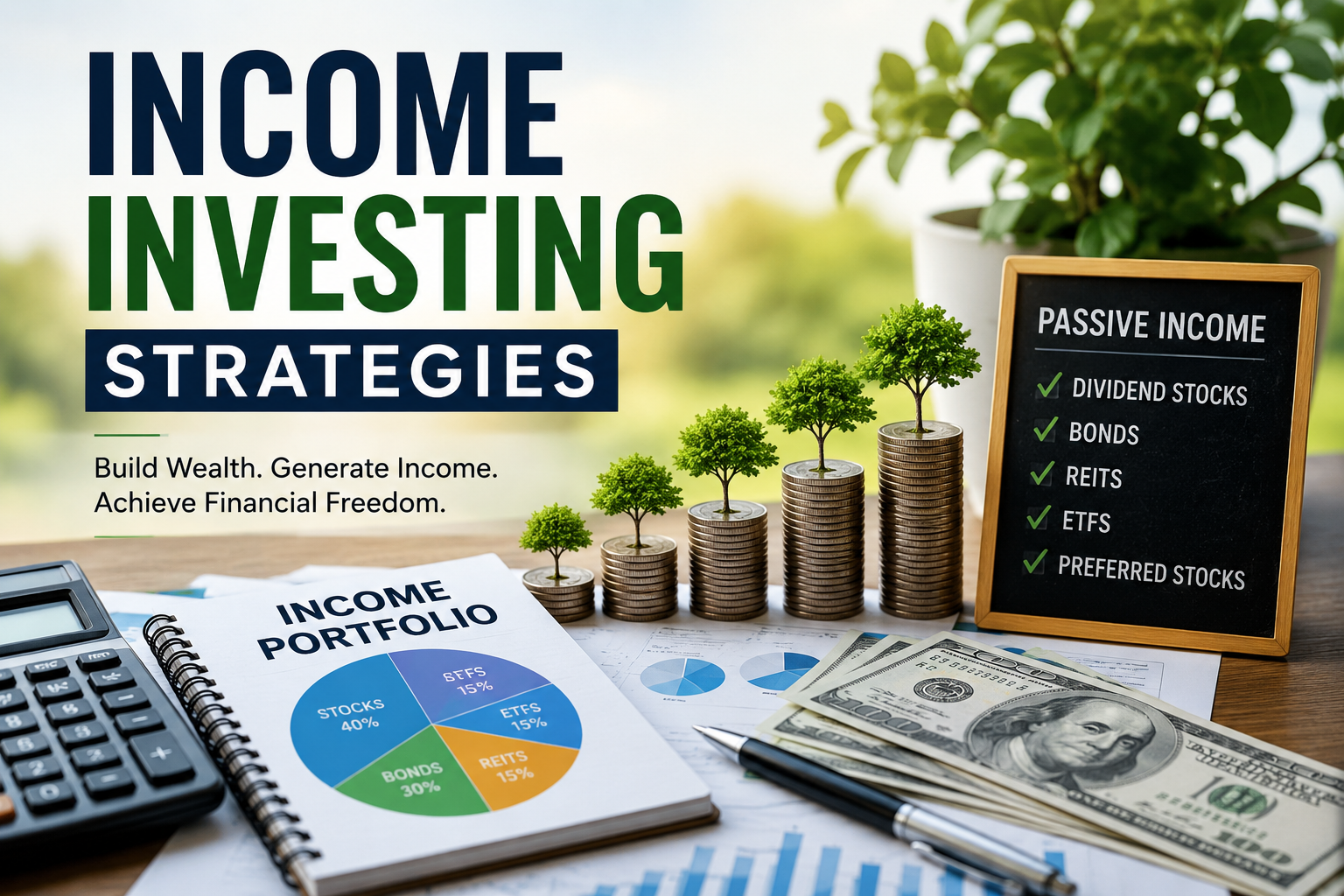
Income Investing Strategies: How to Build Reliable Cash Flow From Investments
Income Investing Strategies are among the most effective ways to build reliable passive income while growing long-term wealth. Whether you’re planning for retirement, creating a second income stream, or achieving financial independence, understanding the right income investing strategy can help generate consistent cash flow through dividend stocks, bonds, REITs, ETFs, and other income-producing assets.
Income investing is one of the most practical and psychologically rewarding ways to invest. Instead of focusing only on buy low and sell high, income investors build portfolios designed to generate cash flow regularly—monthly, quarterly, semiannually, or annually—through dividends, bond interest, rental income via real estate funds, and other distributions.
For many investors, that income serves a specific purpose:
- paying living expenses in retirement,
- supplementing salary,
- funding children’s education,
- building a “second paycheck,”
- or simply reducing the need to sell investments during market downturns.
But income investing is often misunderstood. Many people assume it means “buy the highest-yield stock you can find.” That is one of the fastest ways to make mistakes.
A strong income investing strategy is not about chasing yield. It is about combining cash flow, quality, diversification, risk control, tax efficiency, inflation protection, and sustainability into one portfolio framework.
This guide explains income investing strategies in depth, from the ground up. You’ll learn:
- what income investing really means,
- how dividends, bonds, REITs, and income ETFs work,
- how to build a monthly or quarterly income portfolio,
- how to avoid yield traps,
- how to think about taxes and inflation,
- and how different types of investors can use income strategies in real life.
Whether you’re a beginner building your first dividend ETF portfolio or a retiree trying to design a sustainable withdrawal plan, this guide will help you understand how income investing works and how to use it intelligently.
1) What Is Income Investing?
Income investing is an investment strategy focused on owning assets that pay cash to the investor on a regular basis. Instead of relying mainly on future price appreciation, the investor seeks a portfolio that produces current income.
That income can come from:
- Dividends from stocks
- Interest payments from bonds and fixed-income securities
- Distributions from REITs (Real Estate Investment Trusts)
- Payouts from certain ETFs, mutual funds, preferred stocks, or covered-call funds
- Rental-income exposure through real estate vehicles
Simple definition
Income investing = building a portfolio that pays you cash while you own it.
This is different from a pure growth strategy, where the main goal is for the asset price to rise over time.
Example
Suppose Investor A buys a growth stock that pays no dividend. The hope is that the stock price rises from $100 to $180 over several years.
Investor B buys a diversified income portfolio that yields 4.5% annually. On a $500,000 portfolio, that could generate about $22,500 per year in cash distributions before taxes.
Both investors may grow wealth over time, but Investor B is emphasizing cash flow today, not just wealth later.
2) Why Investors Use Income Investing Strategies
Income investing appeals to investors for several reasons.
A. It creates cash flow without requiring asset sales
If you depend on your portfolio for spending money, selling shares during a market crash can be painful. Income-producing investments can reduce the need to sell assets at bad prices.
B. It can support retirement spending
Many retirees want their portfolio to generate part of their living expenses through dividends and interest. Income investing can provide a framework for that.
C. It can reduce emotional stress
Receiving cash from your portfolio can make investing feel more tangible. Some investors stay disciplined more easily when they see regular income.
D. It can complement growth investing
Income and growth are not opposites. Many strong income portfolios still grow over time through dividend increases, reinvestment, and capital appreciation.
E. It may help during weak markets
When price returns are modest, dividends and interest can represent a larger share of total return. Research from Hartford Funds and S&P Dow Jones has shown that dividends have historically contributed a meaningful portion of long-term equity returns.
3) The Building Blocks of Income Investing
Income investing usually draws from five major asset categories:
- Dividend-paying stocks
- Bonds and fixed income
- REITs and real estate income vehicles
- Income ETFs / mutual funds
- Specialized income securities such as preferred stocks or covered-call funds
Let’s break each one down.
4) Dividend Investing Strategies
Dividend investing is one of the most popular income investing approaches. A dividend is a cash payment made by a company to shareholders, usually from profits or accumulated earnings.
Key dividend terms
Dividend yield
The annual dividend per share divided by the share price.
Example:
If a stock pays $4 per year and the stock price is $100, the dividend yield is:
$4 ÷ $100 = 4%
Dividend payout ratio
The percentage of earnings paid out as dividends.
If a company earns $5 per share and pays $2 per share in dividends, the payout ratio is 40%.
Dividend growth
How much the dividend increases over time.
A company paying $1.00 per share this year and $1.10 next year has grown its dividend by 10%.
Ex-dividend date
The date you must own the stock before in order to receive the upcoming dividend.
Qualified dividend
In the U.S., some dividends qualify for lower tax rates if specific rules are met. IRS rules distinguish between ordinary and qualified dividends.
5) Three Core Dividend Income Strategies
Strategy 1: High-Quality Dividend Growth Investing
This strategy focuses on companies that:
- have strong balance sheets,
- produce consistent cash flow,
- and regularly raise dividends over time.
Examples often include:
- consumer staples
- healthcare giants
- utilities
- mature industrial firms
- selected financial companies
Why this strategy works
A company that raises its dividend consistently may offer:
- rising income over time,
- inflation protection,
- and often stronger business quality than companies paying unsustainably high yields.
Best for
- long-term investors
- retirement savers
- investors who want income and portfolio growth
Main risk
Yield may be lower today than riskier income stocks.
Strategy 2: High-Yield Dividend Investing
This approach targets stocks with above-average dividend yields, such as 5%, 6%, or even higher.
Examples may include:
- telecom companies
- pipeline companies
- utilities
- tobacco companies
- certain energy infrastructure businesses
- high-yield equity funds
Why investors like it
- Higher immediate income
- Useful for investors who need cash now rather than 20 years later
The problem
High yield is not always a gift. Sometimes it is a warning sign.
A stock’s yield rises when:
- the dividend increases, or
- the stock price falls.
If a stock drops from $100 to $50 while keeping the same $4 dividend, the yield jumps from 4% to 8%. That looks attractive—but maybe the market expects the dividend to be cut.
Best use
High-yield stocks can be part of an income strategy, but only after reviewing:
- payout ratio
- debt levels
- free cash flow
- earnings stability
- sector risk
- dividend history
Strategy 3: Dividend ETF Investing
Instead of picking individual stocks, many investors buy dividend-focused ETFs.
Dividend ETFs can target:
- broad dividend-paying stocks
- high-yield stocks
- dividend growth stocks
- international dividend stocks
- preferred shares
- covered-call income strategies
Benefits
- diversification
- simplicity
- lower company-specific risk
- easier rebalancing
- no need to analyze every stock
Drawbacks
- less control over holdings
- fund fees
- may include stocks you don’t love
- income level can fluctuate depending on index design
6) Why Dividends Matter in Total Return
One of the most important ideas in income investing is this:
Income is not separate from total return. It is part of total return.
Total return = price appreciation + dividends/interest/distributions
Historical data often shows dividends contributing a substantial share of long-term equity returns. S&P Dow Jones notes that dividends have historically represented a meaningful portion of S&P 500 total return over long periods, while Hartford Funds’ research highlights how reinvested dividends have played a major role in compounding outcomes.
This matters because investors sometimes think dividends are “extra money.” They are not magic. When a company pays a dividend, cash leaves the business and goes to shareholders. But dividends can still be incredibly valuable because they:
- provide spendable income,
- impose discipline on management,
- and, when reinvested, accelerate compounding.
7) Bond Income Strategies
If dividend stocks are the “equity income” side of income investing, bonds are the “fixed income” side.
A bond is essentially a loan made by an investor to a government, municipality, or company. In exchange, the borrower typically pays interest and returns the principal at maturity.
Bond terms every income investor should know
Face value (par value)
The amount the bond repays at maturity, usually $1,000 per bond.
Coupon
The interest rate paid by the bond issuer.
Yield
The return you earn based on the bond’s price and cash flows.
Maturity
The date the bond principal is repaid.
Duration
A measure of interest-rate sensitivity. Longer duration generally means greater sensitivity to rate changes.
Credit risk
The risk that the issuer can’t pay interest or repay principal.
Investment-grade bond
A bond issued by a borrower with relatively strong credit quality.
High-yield bond
A lower-rated bond that pays more yield but carries more default risk.
8) Major Bond Income Strategies
Strategy 1: Buy a Bond Fund or Bond ETF
This is the easiest path for many investors.
A bond fund may hold:
- U.S. Treasuries
- investment-grade corporate bonds
- municipal bonds
- mortgage-backed securities
- international bonds
- high-yield bonds
Pros
- instant diversification
- easy to buy and sell
- professional management or index-based structure
- low minimums
Cons
- you don’t control maturity dates of individual bonds
- income can change as portfolio holdings change
- fund prices fluctuate with interest rates
Strategy 2: Build a Bond Ladder
A bond ladder means buying bonds with staggered maturity dates—for example, one bond maturing in each year from 2027 through 2032.
Example
You invest $60,000 in six bonds:
- $10,000 matures in 2027
- $10,000 in 2028
- $10,000 in 2029
- $10,000 in 2030
- $10,000 in 2031
- $10,000 in 2032
As each bond matures, you can:
- spend the money, or
- reinvest it into a new long-term bond.
Why investors like ladders
Bond ladders can help with:
- predictable cash flow,
- reducing the need to guess interest-rate moves,
- smoothing reinvestment risk,
- and matching future spending needs.
Fidelity, Schwab, and Vanguard all describe bond ladders as a way to manage cash flow and interest-rate risk through staggered maturities.
Best for
- retirees
- conservative investors
- investors funding future liabilities (tuition, retirement spending, home purchase)
Strategy 3: Treasury Income Strategy
U.S. Treasury securities are backed by the U.S. government and are often used by income investors who prioritize safety over yield.
Treasury options include:
- Treasury bills (short-term)
- Treasury notes (medium-term)
- Treasury bonds (long-term)
- TIPS (inflation-protected securities)
Best for
- capital preservation
- low credit risk
- short- to intermediate-term income needs
- emergency reserve tiers beyond cash
Strategy 4: Municipal Bond Income Strategy
Municipal bonds are issued by states, cities, and local governments. In the U.S., interest from many municipal bonds may be exempt from federal income tax, and sometimes state tax as well, depending on the investor’s location and the bond.
Why this matters
A lower nominal yield on a municipal bond can still be attractive if the after-tax income is better than a taxable alternative.
Best for
- higher-income taxable investors
- investors in high tax brackets
- investors seeking tax-efficient income
9) REIT Income Strategies
A REIT (Real Estate Investment Trust) is a company that owns, operates, or finances income-producing real estate and distributes a large share of its taxable income to shareholders.
REITs can invest in:
- apartments
- industrial warehouses
- office buildings
- shopping centers
- healthcare facilities
- cell towers
- data centers
- self-storage properties
- hotels
Why REITs are popular with income investors
- They often pay above-average yields
- They provide exposure to real estate without directly buying property
- They can diversify an income portfolio
- Some REIT sectors have inflation-linked revenue characteristics
Nareit data has shown that listed REITs remain a meaningful income-producing segment of public markets, though results vary heavily by property type and rate environment.
REIT risks
REITs are not “bond substitutes.” They are equities and can be volatile. Their risks include:
- interest-rate sensitivity
- recession risk
- tenant weakness
- property sector disruption
- refinancing risk
- dividend cuts during property stress
Example
A warehouse REIT serving e-commerce logistics may have different risks and growth drivers than an office REIT dealing with remote-work pressure.
10) Income ETFs and Fund-Based Income Portfolios
Many investors don’t want to select individual dividend stocks, individual bonds, and individual REITs. That’s where income ETFs and mutual funds come in.
Common categories of income funds
Dividend growth ETFs
Focus on companies with histories of increasing dividends.
High-dividend ETFs
Focus on higher-yielding stocks.
Bond ETFs
Provide exposure to Treasuries, corporates, munis, high yield, or multi-sector bonds.
REIT ETFs
Own baskets of listed REITs.
Preferred stock ETFs
Focus on preferred shares that typically offer higher yields than common stocks.
Multi-asset income funds
Blend stocks, bonds, and other income assets.
Covered-call ETFs
Use options to generate additional cash flow, often at the cost of capping upside.
11) Income Investing Strategy Framework: 7 Proven Approaches
Below are seven practical income investing strategies, from conservative to more aggressive.
Strategy A: The Dividend Growth Core Strategy
Goal
Build rising income over time while preserving long-term growth potential.
Typical holdings
- dividend growth ETF
- broad market ETF
- selected high-quality dividend stocks
- small bond allocation for stability
Who it fits
- younger investors
- mid-career savers
- investors who don’t need maximum income right now
Advantages
- lower risk of dividend cuts than pure high-yield portfolios
- better inflation protection
- more total-return potential
Drawback
Current yield may be moderate rather than high.
Strategy B: The Balanced Income Portfolio
Goal
Blend stocks and bonds for a middle-ground approach between income and stability.
Sample mix
- 35% dividend stocks / dividend ETFs
- 35% bond funds or ladders
- 15% REITs
- 10% cash or short Treasuries
- 5% preferred shares or other income tools
Who it fits
- pre-retirees
- moderate-risk investors
- investors seeking smoother income and lower volatility than an all-stock income portfolio
Strategy C: The Bond Ladder Retirement Income Strategy
Goal
Create scheduled cash flow for the next 5–10 years while reducing interest-rate timing risk.
Typical structure
- 1–10 year ladder of Treasuries, CDs, munis, or investment-grade corporates
- equity dividend sleeve for inflation and growth
- cash reserve for near-term spending
Why it works
You can match maturing bonds to known spending needs while allowing the equity side to keep compounding.
Strategy D: The Tax-Aware Income Strategy
Goal
Maximize after-tax income rather than pre-tax yield.
Tactics
- hold municipal bonds in taxable accounts when appropriate
- keep tax-inefficient bond funds in retirement accounts
- use qualified-dividend-producing holdings where suitable
- avoid unnecessary turnover
Why it matters
A 5% taxable yield is not always better than a 4% tax-advantaged yield.
Strategy E: The REIT + Dividend Blend
Goal
Boost income by combining corporate dividends with real estate distributions.
Example mix
- 50% dividend stock ETF
- 25% REIT ETF
- 25% bond ETF
Benefit
Can produce a higher portfolio yield than dividend stocks alone.
Risk
REITs can be cyclical and rate-sensitive.
Strategy F: The High-Yield Satellite Strategy
Goal
Use a small allocation to boost total portfolio income without making the entire portfolio fragile.
Example
Core portfolio:
- dividend growth ETF
- intermediate bond ETF
- Treasury ladder
Satellite sleeve:
- 5%–15% in higher-yielding REITs, preferreds, or carefully chosen income funds
Why this is better than “all high yield”
It keeps the portfolio from depending entirely on the riskiest income sources.
Strategy G: The Total Return + Withdrawal Strategy
This is an important concept.
Some investors think “income investing” must mean only buying investments that directly pay enough cash to cover spending. But another valid strategy is:
- build a diversified total-return portfolio,
- collect dividends and interest,
- then sell a small amount of assets only when needed.
This is often called a total return retirement strategy, and for some investors it may be better than obsessing over high yield.
Income investing and total return investing are not enemies. In practice, many smart portfolios combine both.
12) How to Evaluate an Income Investment
Before buying any income asset, ask these questions:
1. What is the yield?
Yield tells you the income rate, but not the safety or quality.
2. Is the income sustainable?
For stocks, review:
- earnings
- free cash flow
- payout ratio
- debt
- dividend history
For bonds, review:
- credit rating
- issuer health
- maturity
- yield to maturity
For REITs, review:
- funds from operations (FFO)
- occupancy
- debt maturity schedule
- sector health
3. What risks am I taking to earn this yield?
A 9% yield may come with:
- leverage risk
- credit risk
- dividend-cut risk
- interest-rate sensitivity
- sector concentration
4. How is the income taxed?
A lower-yield investment with better tax treatment can outperform after taxes.
5. Does this fit my goal?
An investor needing reliable near-term retirement cash flow should not evaluate an income asset the same way a 30-year-old accumulator would.
13) The Yield Trap: The Biggest Income Investing Mistake
A yield trap happens when an investment looks attractive because the yield is very high, but the high yield is a symptom of underlying weakness.
Example of a yield trap
A company pays a $4 annual dividend.
- At $100 share price → 4% yield
- At $50 share price → 8% yield
The investor sees 8% and buys. But the price fell because:
- earnings collapsed,
- debt surged,
- or management is likely to cut the dividend.
Then the company cuts the dividend from $4 to $1.
Now:
- income drops sharply,
- share price may fall again,
- and the investor loses both cash flow and capital.
Warning signs of a yield trap
- payout ratio consistently too high
- earnings decline
- debt rising rapidly
- cash flow weaker than reported profits
- dividend not covered by free cash flow
- management issuing optimistic language while business deteriorates
- yield far above peers without clear reason
14) Income Investing and Inflation
One of the biggest dangers in retirement is not just low returns—it’s inflation.
If your portfolio yields 4% but inflation averages 3%, your real spending power is barely growing. If your income is fixed and never rises, inflation can quietly destroy purchasing power.
Inflation-friendly income assets may include:
- dividend growth stocks
- selected REITs with rent escalators
- TIPS
- businesses with pricing power
- some infrastructure assets
Inflation-vulnerable income assets may include:
- long-duration fixed-rate bonds
- annuity-like cash flows with no inflation adjustment
- overly concentrated utility or preferred-stock portfolios with limited growth
A strong income portfolio should not only pay you today—it should help preserve your spending power tomorrow.
15) How Taxes Affect Income Investing
Taxes can dramatically change real income.
U.S. tax basics for income investors
Qualified dividends
Some dividends are taxed at lower capital-gains-style rates if requirements are met. IRS Publication 550 and Topic 404 explain the rules, including holding-period requirements.
Ordinary dividends
Some dividends do not qualify for lower rates and are taxed as ordinary income.
Bond interest
Bond interest is usually taxable as ordinary income unless it comes from tax-exempt municipal bonds.
Capital gains rates
The IRS publishes annual capital-gains tax thresholds, which matter for qualified dividends and sales of appreciated assets.
Why this matters
Two portfolios can both yield 5%, but the after-tax result may be very different depending on:
- asset location,
- account type,
- tax bracket,
- and whether income is qualified, ordinary, or tax-exempt.
16) Account Placement: Where to Hold Income Investments
This is called asset location.
Taxable account may be suitable for:
- qualified dividend stocks
- municipal bonds (for some high-income investors)
- broad equity ETFs with low turnover
Tax-deferred or retirement account may be suitable for:
- taxable bond funds
- REIT funds
- high-turnover income funds
- preferred share funds depending on tax profile
The goal is not just “what should I own?” but also “where should I own it?”
17) How to Build an Income Portfolio Step by Step
Here is a practical framework.
Step 1: Define the purpose of the income
Ask:
- Is this income for retirement spending?
- Is it supplemental cash flow?
- Is it a future income stream I won’t use for 10 years?
- Is it a conservative parking place for capital?
The purpose changes the portfolio design.
Step 2: Estimate required annual cash flow
Example:
You need $24,000 per year from investments.
If your portfolio yields 4%, you’d need about:
$24,000 ÷ 0.04 = $600,000
That doesn’t mean you must force a 4% yield. It simply gives you a planning baseline.
Step 3: Decide how much stability vs growth you need
Higher stability:
More Treasuries, high-quality bonds, short-duration instruments, cash reserves
Higher growth and inflation protection:
More dividend growth stocks, equity ETFs, REITs
Step 4: Build a core-satellite structure
Example core
- 35% dividend growth ETF
- 30% high-quality bond ETF or ladder
- 15% Treasury/TIPS sleeve
- 10% REIT ETF
- 10% cash / short-duration / preferreds / other income assets
Satellite ideas
- individual dividend stocks
- municipal bond fund
- covered-call ETF
- international dividend ETF
Step 5: Diversify income sources
Don’t rely on one stock, one REIT, or one bond issuer. Diversify across:
- sectors
- asset classes
- geographies
- maturities
- tax treatments
Step 6: Reinvest or spend intentionally
If you don’t need the income yet, automatic reinvestment can be powerful.
If you do need the income, route dividends and interest to cash rather than reinvesting.
Step 7: Review sustainability annually
Check:
- dividend cuts or increases
- bond maturities
- duration risk
- yield changes
- sector concentration
- inflation impact
- tax changes
18) Case Studies: 8 Income Investing Scenarios
Below are practical examples showing how income strategies differ depending on goals.
Case Study 1: The 30-Year-Old Accumulator
Profile
- Age: 30
- Goal: build passive income for the future
- No need for current spending
- High time horizon, moderate risk tolerance
Strategy
- 60% broad market equity ETF
- 20% dividend growth ETF
- 10% REIT ETF
- 10% bond ETF / Treasury fund
Why this works
This investor should not sacrifice long-term growth just to maximize yield today. The portfolio still includes income assets, but the main goal is to grow future income through compounding and dividend growth.
Lesson
Young investors often benefit more from income growth than from high current yield.
Case Study 2: The 45-Year-Old Professional Seeking a “Second Paycheck”
Profile
- Age: 45
- Stable salary
- Wants $1,000 per month in supplemental portfolio income over time
- Moderate risk tolerance
Strategy
- 35% dividend ETF
- 20% dividend growth stocks
- 25% bond ETF
- 10% REIT ETF
- 10% short Treasuries / cash reserve
Implementation logic
This investor doesn’t need to force immediate maximum yield. Instead, the portfolio can grow toward a future monthly income target while staying diversified.
Lesson
Income investing doesn’t have to be all-or-nothing. It can be built gradually.
Case Study 3: The 62-Year-Old Pre-Retiree Building a Bond Ladder
Profile
- Retirement in 3 years
- Wants spending stability in early retirement
- Nervous about sequence-of-returns risk
Strategy
- 40% dividend stock ETF
- 35% 1–7 year bond ladder
- 15% Treasury/TIPS sleeve
- 10% REIT fund
Why the ladder matters
The bond ladder is intended to fund near-term retirement withdrawals, reducing the need to sell stocks during a market decline.
Lesson
Income investing can be about cash-flow planning, not just yield chasing.
Case Study 4: The Retired Couple Needing $40,000 per Year From Portfolio Income
Profile
- Social Security covers part of expenses
- Portfolio must provide additional $40,000 annually
- Taxable + IRA accounts
Strategy
- Taxable account: municipal bond fund + dividend ETF
- IRA: taxable bond fund + REIT fund
- Cash reserve covering 1 year of withdrawals
Why this works
This structure considers asset location, not just asset selection. Tax-aware placement may improve after-tax income.
Lesson
For retirees, after-tax cash flow can matter more than headline yield.
Case Study 5: The High-Yield Chaser Who Bought a Yield Trap
Profile
- Bought several 9%–12% yielding stocks
- Focused only on current income
- Ignored balance-sheet risk
Outcome
- One company cuts dividend by 70%
- Another suspends dividend entirely
- Share prices fall sharply
Lesson
A 10% yield is not automatically better than a 4% yield. Sustainability beats headline yield.
Case Study 6: The Conservative Investor Using Treasuries and Dividend Growth
Profile
- Age 55
- Low risk tolerance
- Wants moderate income and strong capital preservation
Strategy
- 45% short/intermediate Treasuries
- 30% dividend growth ETF
- 10% TIPS
- 10% high-quality corporate bond ETF
- 5% REIT ETF
Why it works
This investor accepts a lower yield in exchange for higher safety and lower drawdown risk.
Lesson
The right income strategy is not the one with the highest yield. It is the one you can stick with.
Case Study 7: The Tax-Bracket-Aware Municipal Bond Investor
Profile
- High-income U.S. taxpayer
- Wants stable income in taxable brokerage account
- Less interested in equity volatility
Strategy
- municipal bond fund in taxable account
- dividend growth ETF for inflation protection
- REITs and taxable bonds mostly inside retirement accounts
Lesson
For some investors, tax-equivalent yield matters more than nominal yield.
Case Study 8: The Hybrid Total Return + Income Investor
Profile
- Portfolio: $1.5 million
- Wants flexibility rather than maximum portfolio yield
- Comfortable selling small portions when needed
Strategy
- 50% global equities
- 25% dividend-focused equities
- 20% bond ladder
- 5% cash
Spending approach
Use dividends and interest first, then top up spending by selling appreciated assets when needed.
Lesson
Income investing does not have to mean forcing the entire portfolio into high-payout securities.
19) Monthly vs Quarterly Income Investing
Many investors want monthly income, but not all income assets pay monthly.
Common payout patterns
- Many U.S. dividend stocks: quarterly
- Many bonds: semiannual coupon payments
- Some ETFs and REITs: monthly
- Some funds: quarterly or monthly depending on structure
How to create smoother monthly cash flow
You can:
- hold multiple assets with different payment schedules,
- use a bond ladder with staggered coupon months,
- combine monthly-paying funds with quarterly dividend assets,
- or simply let income accumulate in cash and withdraw monthly.
Don’t force a bad investment just because it pays monthly.
20) Income Investing vs Growth Investing
This is one of the most misunderstood debates in investing.
Growth investing
Focuses more on capital appreciation.
Income investing
Focuses more on cash flow generation.
Reality
Most investors need both.
A retiree may want:
- enough income for current spending,
- enough growth to fight inflation,
- and enough stability to survive downturns.
That often leads to a blended strategy, not a pure one.
21) Common Mistakes Income Investors Make
Mistake 1: Chasing the highest yield
High yield can hide serious risk.
Mistake 2: Ignoring inflation
A fixed income stream that never grows may lose purchasing power.
Mistake 3: Owning too many “bond substitutes”
Utilities, REITs, and preferreds all react differently to rates and economic conditions. Don’t assume they’re interchangeable.
Mistake 4: Underestimating tax drag
A 6% taxable yield is not always superior to a 4.5% tax-advantaged one.
Mistake 5: Using only one income source
A portfolio built entirely around one sector—like REITs, MLPs, or junk bonds—can become fragile.
Mistake 6: Forgetting total return
A portfolio that pays 8% but loses 20% of principal is not automatically superior to a 4% yield portfolio with better long-term resilience.
Mistake 7: Failing to review dividend safety
A dividend history matters, but so do present-day fundamentals.
22) Practical Income Portfolio Templates
Below are educational examples only—not personal financial advice.
Portfolio Template 1: Conservative Income
- 35% Treasuries / government bonds
- 25% investment-grade bond ETF
- 20% dividend growth ETF
- 10% TIPS
- 10% REIT ETF
Goal: preserve capital, moderate income, inflation defense
Portfolio Template 2: Balanced Retirement Income
- 30% dividend ETF
- 25% bond ladder
- 20% broad equity ETF
- 15% Treasury/TIPS sleeve
- 10% REIT ETF
Goal: income plus long-term purchasing-power protection
Portfolio Template 3: Higher-Income Portfolio
- 25% dividend ETF
- 20% high-quality dividend stocks
- 20% bond ETF
- 15% REIT ETF
- 10% preferred shares
- 10% short-term Treasuries / cash
Goal: higher cash yield with moderate-to-elevated risk
23) Expert Perspective: Why Quality Matters More Than Yield Alone
Many professional firms emphasize that income investing should start with portfolio design and risk management, not just payout size.
- Dividend research from S&P Dow Jones and Hartford Funds has highlighted the long-term role of dividends in total return and the relative appeal of companies with sustainable dividend policies.
- Bond ladder guidance from Fidelity, Schwab, and Vanguard emphasizes cash-flow planning, maturity diversification, and reinvestment flexibility rather than trying to perfectly predict interest rates.
- REIT industry data shows that real estate income can be attractive, but property-sector health, debt structure, and balance-sheet quality matter enormously.
The common thread is clear:
Sustainable income usually comes from quality, diversification, and discipline—not from chasing the biggest headline yield.
24) Frequently Asked Questions (FAQs)
1. What is the best income investing strategy for beginners?
For many beginners, a simple diversified mix of:
- a dividend growth ETF,
- a broad bond ETF,
- and a REIT ETF or broad equity ETF
can be easier and safer than picking only individual high-yield stocks.
2. Is income investing good for retirement?
Yes, income investing can be very useful in retirement because it may provide regular cash flow. But the best retirement portfolio usually balances income, growth, inflation protection, and tax efficiency.
3. How much yield is “safe”?
There is no universal safe number. A 3% yield can be unsafe if the company is failing, and a 6% yield can be safe if the cash flow is strong and stable. Safety depends on fundamentals, not just the yield percentage.
4. Are dividend stocks safer than growth stocks?
Not automatically. Some dividend-paying companies are very stable, but others are not. Dividend stocks still carry market risk and business risk.
5. Are bonds better than dividend stocks for income?
Bonds generally offer more contractual cash flow, while dividend stocks offer more growth potential and inflation protection. Many investors use both.
6. What is a bond ladder?
A bond ladder is a portfolio of bonds with staggered maturity dates designed to create more predictable cash flow and reduce interest-rate timing risk.
7. Are REITs good for income investing?
They can be. REITs often offer attractive income, but they also come with sector, debt, and rate risks. They should usually be one part of a diversified income portfolio rather than the whole portfolio.
8. Is income investing the same as passive income?
Income investing can be a source of passive income, but “passive income” is a broad term. Income investing specifically refers to building a portfolio that generates cash distributions.
9. Should I reinvest dividends?
If you don’t need the income right now, reinvesting dividends can be powerful for compounding. If you need the cash for spending, taking the income directly may be more appropriate.
10. What’s better: high yield or dividend growth?
It depends on your goal. If you need income now, yield matters. If you want a stronger long-term inflation-resistant income stream, dividend growth may be more important.
25) Final Thoughts: The Best Income Investing Strategy Is the One That Matches Your Goal
Income investing is not one strategy. It is a family of strategies built around the same question:
How can I make my portfolio produce dependable cash flow without taking reckless risk?
For some investors, the answer will be:
- dividend growth stocks,
- bond ladders,
- REIT exposure,
- and a modest yield today with strong growth tomorrow.
For others—especially retirees—it may mean:
- a carefully structured bond sleeve,
- tax-aware dividend holdings,
- cash reserves,
- and a portfolio designed to fund spending with as little stress as possible.
The most important lesson is this:
Good income investing is not about maximizing yield.
It is about optimizing reliable income, capital preservation, inflation resilience, tax efficiency, and long-term sustainability.
If you remember only one rule from this guide, make it this one:
Don’t ask, “What pays the most?”
Ask, “What can keep paying me through good markets, bad markets, inflation, and time?”
That is the foundation of a real income investing strategy.
Quick Recap
A strong income investing plan usually includes:
- Clear goals for what the income is for
- Diversification across dividends, bonds, and possibly REITs
- Quality screening instead of yield chasing
- Inflation awareness so your income can grow over time
- Tax planning to maximize after-tax cash flow
- Periodic reviews of payout safety, bond maturities, and asset allocation
Done well, income investing can turn a portfolio from a pile of assets into a working financial engine—one that not only grows wealth, but also helps fund life.