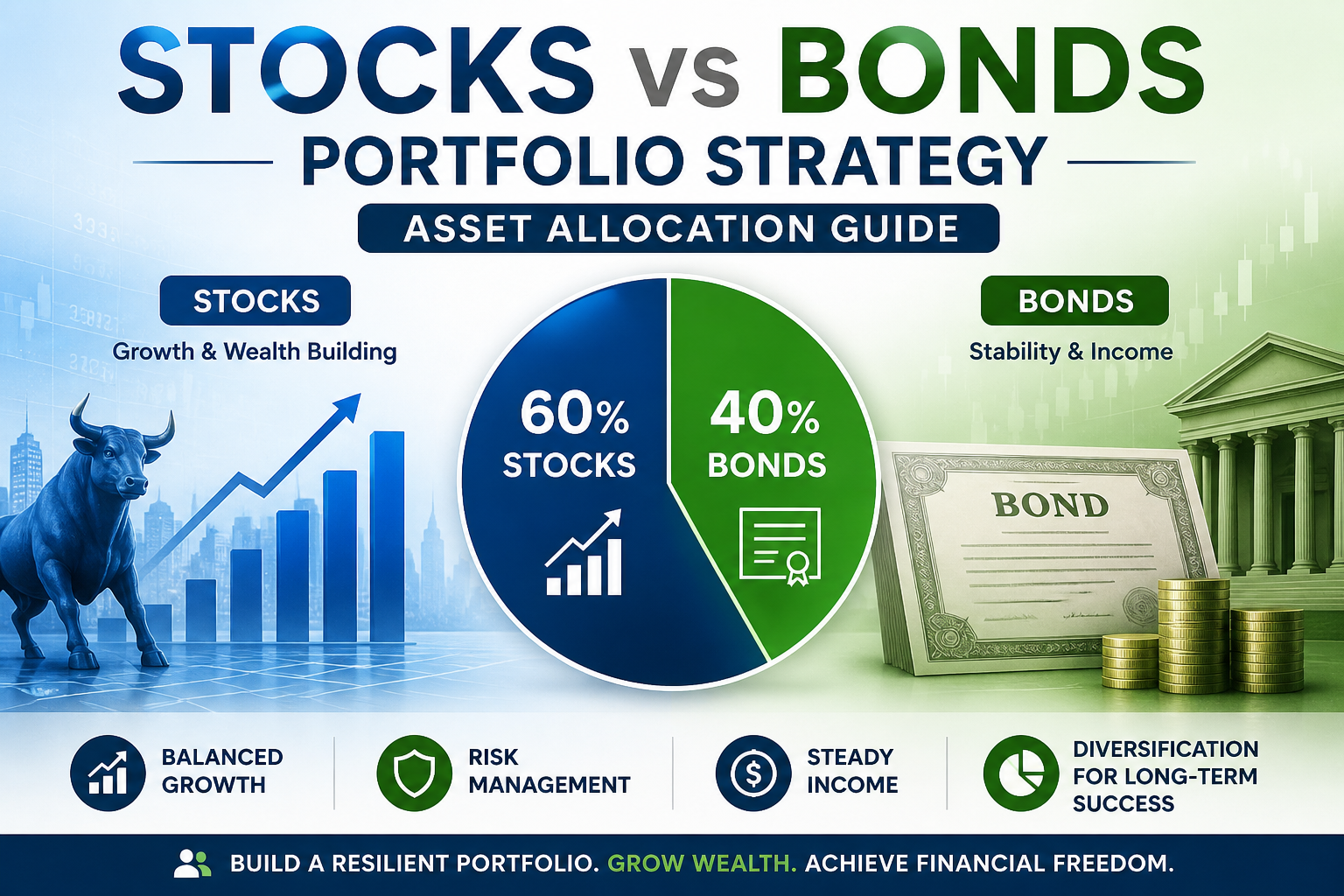
Stocks vs Bonds Portfolio Strategy
Stocks vs Bonds Portfolio Strategy is one of the most important concepts in investing because it helps investors balance growth, income, and risk. Whether you are saving for retirement, building long-term wealth, or protecting your portfolio during market downturns, understanding how stocks and bonds work together can significantly improve investment outcomes.
Building wealth is not just about picking “good investments.” It is about creating the right balance between growth, income, stability, and risk management. For investors in Tier-1 countries such as the United States, United Kingdom, Canada, and Australia, one of the most important long-term investing decisions is determining the right mix between stocks and bonds.
This balance is known as a portfolio strategy.
A portfolio strategy determines:
- How much risk you take
- How much return you may earn
- How stable your investments remain during market crashes
- How quickly you can retire
- How safely you can withdraw money in retirement
Many beginner investors think investing is simply buying popular companies or index funds. In reality, professional investors focus heavily on asset allocation — the percentage of money invested in different asset classes such as stocks, bonds, cash, and real estate.
Historically, the difference between successful investors and struggling investors often comes down to:
- discipline,
- diversification,
- and portfolio construction.
This guide explains everything in detail:
- What stocks are
- What bonds are
- How they work together
- Portfolio allocation models
- Risk tolerance
- Retirement portfolio strategies
- Case studies
- Real-world examples
- Common mistakes
- Tax considerations
- Rebalancing methods
- Age-based portfolio allocation
What Are Stocks?
A stock represents ownership in a company.
When you buy a stock, you own a small piece of that business.
For example:
- If you buy shares of Apple, you become a partial owner of Apple.
- If Apple grows profits, expands globally, and increases revenue, the stock price may rise.
- Some companies also distribute profits to shareholders through dividends.
Key Terms Explained
1. Share
A unit of ownership in a company.
Example:
- Buying 10 shares of Apple means you own 10 units of Apple stock.
2. Dividend
A payment companies distribute to shareholders from profits.
Example:
- A company may pay $2 per share annually.
3. Capital Appreciation
Increase in stock value over time.
Example:
- Buying a stock at $100 and selling at $150 creates a $50 capital gain.
4. Volatility
The degree of price movement.
Stocks are considered volatile because prices can rise or fall rapidly.
5. Equity
Another word for ownership in a company.
Why Investors Buy Stocks
Investors buy stocks primarily for:
- Long-term growth
- Inflation protection
- Wealth creation
- Retirement investing
- Dividend income
Historically, stocks have produced higher long-term returns than bonds or cash.
For example:
- The S&P 500 has historically returned around 8–10% annually over long periods.
This is why younger investors often allocate more money toward stocks.
What Are Bonds?
A bond is essentially a loan.
When you buy a bond:
- You lend money to a government or corporation.
- In return, they pay you interest.
- At maturity, they return your principal investment.
Example
Suppose you buy a $1,000 government bond paying 4% interest.
You receive:
- $40 annually in interest
- Your $1,000 back at maturity
Unlike stocks, bonds do not represent ownership.
Types of Bonds
1. Government Bonds
Issued by governments.
Examples:
- US Treasury Bonds
- UK Gilts
- Canadian Government Bonds
- Australian Government Bonds
These are generally considered safer.
2. Corporate Bonds
Issued by companies.
Examples:
- Bonds from Microsoft
- Bonds from Tesla
Corporate bonds typically offer higher yields but more risk.
3. Municipal Bonds
Issued by local governments.
Popular in the USA because many municipal bonds provide tax advantages.
4. High-Yield Bonds
Also called “junk bonds.”
These offer higher interest rates because they involve higher default risk.
Important Bond Terms
1. Coupon Rate
The interest rate paid by the bond.
Example:
- A 5% coupon bond pays $50 annually on a $1,000 bond.
2. Yield
The actual return earned based on current bond price.
3. Maturity
The date when the bond principal is repaid.
Examples:
- 2-year bond
- 10-year bond
- 30-year bond
4. Credit Rating
Measures the issuer’s ability to repay debt.
Ratings are assigned by agencies like:
- Moody’s
- Standard & Poor’s
Stocks vs Bonds: Core Differences
| Feature | Stocks | Bonds |
|---|---|---|
| Ownership | Yes | No |
| Risk | Higher | Lower |
| Return Potential | Higher | Moderate |
| Income | Dividends | Interest |
| Volatility | High | Lower |
| Inflation Protection | Better | Weaker |
| Stability | Lower | Higher |
| Long-Term Growth | Strong | Limited |
Why Portfolio Balance Matters
A portfolio with:
- 100% stocks may grow faster but experience massive crashes.
- 100% bonds may feel safer but fail to beat inflation.
The goal is balance.
Stocks provide:
- growth,
- wealth creation,
- inflation protection.
Bonds provide:
- stability,
- income,
- downside protection.
Together, they create a diversified portfolio.
Understanding Risk Tolerance
Risk tolerance means your ability to emotionally and financially handle market declines.
Aggressive Investor
Comfortable with:
- market crashes,
- high volatility,
- long-term investing.
Typical allocation:
- 80–100% stocks
Moderate Investor
Wants balance between growth and stability.
Typical allocation:
- 60% stocks
- 40% bonds
Conservative Investor
Prioritizes capital preservation.
Typical allocation:
- 30–50% stocks
- 50–70% bonds
The Classic 60/40 Portfolio
The most famous investment strategy is the 60/40 portfolio.
Allocation:
- 60% stocks
- 40% bonds
This strategy became popular because it balances:
- growth,
- income,
- risk reduction.
Historically:
- Stocks drive long-term growth.
- Bonds cushion downturns.
Example of a 60/40 Portfolio
Suppose an investor has:
- $100,000
Allocation:
- $60,000 in stock index funds
- $40,000 in bond funds
Possible stock allocation:
- US Total Market Index
- International Equity ETF
Possible bond allocation:
- Government bond ETF
- Investment-grade corporate bond ETF
Why Bonds Help During Crashes
During stock market crashes:
- investors often move money into safer assets,
- bond prices may rise,
- bond income continues.
This reduces portfolio volatility.
Case Study: 2008 Financial Crisis
The Global Financial Crisis was one of the worst market crashes in history.
100% Stock Portfolio
Many portfolios fell:
- 40–50%
Investors panicked and sold.
Balanced 60/40 Portfolio
Losses were significantly smaller.
Why?
- Bonds stabilized the portfolio.
Investors who stayed invested recovered faster.
Case Study: Young Investor in the USA
Investor Profile
Name: Michael
Age: 28
Country: USA
Income: $95,000 annually
Goals:
- Retirement at 60
- Long investment horizon
- High risk tolerance
Portfolio Strategy
Michael chooses:
- 90% stocks
- 10% bonds
Why?
- He has over 30 years before retirement.
- Short-term volatility matters less.
- Long-term growth matters more.
Potential Outcome
If the market averages:
- 8% annual returns,
his retirement portfolio could grow substantially due to:
- compound interest,
- long-term investing,
- consistent contributions.
Compound Interest Explained
Compound interest means:
- your returns generate additional returns.
Example:
- $10,000 invested at 8%
- grows to:
- $10,800 after year one
- future growth occurs on the new total.
This creates exponential growth over decades.
genui{“math_block_widget_always_prefetch_v2”:{“content”:”A=P\left(1+\frac{r}{n}\right)^{nt}”}}
Where:
- (A) = future value
- (P) = principal
- (r) = annual interest rate
- (n) = number of compounding periods
- (t) = time in years
Case Study: Near-Retirement Investor
Investor Profile
Name: Sarah
Age: 58
Country: Canada
Goals:
- Retire in 7 years
- Preserve wealth
- Reduce volatility
Portfolio Strategy
Sarah chooses:
- 45% stocks
- 55% bonds
Why?
- Large stock crashes near retirement can be dangerous.
- Bonds provide stability and income.
Sequence of Returns Risk
One major retirement danger is:
Sequence Risk
This occurs when:
- markets crash early in retirement,
- withdrawals continue,
- portfolio recovery becomes difficult.
Bonds help reduce this risk.
Age-Based Portfolio Allocation
A traditional rule:
“100 Minus Your Age”
Example:
- Age 30:
- 70% stocks
- 30% bonds
- Age 60:
- 40% stocks
- 60% bonds
Modern investors sometimes use:
- 110 minus age
- 120 minus age
because people live longer today.
Portfolio Models by Age
| Age | Stocks | Bonds |
|---|---|---|
| 20s | 90% | 10% |
| 30s | 80% | 20% |
| 40s | 70% | 30% |
| 50s | 60% | 40% |
| 60s | 45% | 55% |
| 70+ | 30% | 70% |
These are guidelines, not strict rules.
Types of Stock Investments
1. Individual Stocks
Buying shares of specific companies.
Examples:
- NVIDIA
- Amazon
Higher potential return but higher risk.
2. Index Funds
Funds tracking market indexes.
Examples:
- S&P 500
- Total market index funds
Lower fees and broad diversification.
3. ETFs
Exchange-Traded Funds.
Trade like stocks while offering diversification.
Examples:
- Bond ETFs
- International ETFs
- Dividend ETFs
Types of Bond Investments
1. Bond ETFs
Easy diversification across many bonds.
2. Treasury Bonds
Backed by governments.
3. Inflation-Protected Bonds
Examples include:
- TIPS in the USA
These adjust for inflation.
Inflation and Portfolio Strategy
Inflation reduces purchasing power.
Example:
- $100 today may buy less in 20 years.
Stocks generally outperform inflation better than bonds.
This is why younger investors emphasize stocks.
Interest Rates and Bonds
Bond prices and interest rates have an inverse relationship.
When:
- interest rates rise,
- existing bond prices usually fall.
Why?
- newer bonds offer higher yields,
- older bonds become less attractive.
Diversification Explained
Diversification means spreading investments across:
- sectors,
- countries,
- asset classes.
Purpose:
- reduce risk,
- avoid dependence on one investment.
International Diversification
Many investors include:
- US stocks,
- international developed markets,
- emerging markets.
Benefits:
- broader exposure,
- reduced country-specific risk.
Example of a Globally Diversified Portfolio
Stocks
- 50% US stocks
- 20% international developed
- 10% emerging markets
Bonds
- 20% government bonds
Rebalancing a Portfolio
Over time:
- stocks may outperform bonds,
- allocations drift.
Example:
- 60/40 becomes 75/25.
Rebalancing restores original targets.
Example of Rebalancing
Initial:
- $60,000 stocks
- $40,000 bonds
After strong stock growth:
- stocks become $80,000
- bonds remain $40,000
New allocation:
- 67/33
Investor sells some stocks and buys bonds.
Purpose:
- maintain risk level.
Emotional Investing Problems
One of the biggest investing mistakes is emotional behavior.
Common mistakes:
- panic selling,
- chasing hot stocks,
- timing the market,
- abandoning strategy.
Case Study: Pandemic Crash
During the COVID-19 pandemic market crash:
- many investors sold at the bottom,
- missed the recovery.
Disciplined investors who maintained diversified portfolios often recovered successfully.
Dollar-Cost Averaging
Dollar-cost averaging means investing consistently over time.
Example:
- investing $500 monthly regardless of market conditions.
Benefits:
- reduces emotional investing,
- smooths purchase prices,
- builds discipline.
Tax-Efficient Portfolio Strategy
Taxes matter greatly in Tier-1 countries.
Tax-Advantaged Accounts
USA
- 401(k)
- Roth IRA
- Traditional IRA
UK
- ISA
- SIPP
Canada
- TFSA
- RRSP
Australia
- Superannuation
These accounts provide:
- tax deferral,
- tax-free growth,
- retirement benefits.
Asset Location Strategy
Not just asset allocation — asset location matters too.
Example:
- bonds in tax-advantaged accounts,
- stocks in taxable accounts.
Why?
- bond income may be taxed heavily.
Withdrawal Strategy in Retirement
Retirees often:
- withdraw from bonds during stock crashes,
- allow stocks time to recover.
This helps protect portfolios.
The Role of Cash
Some investors also hold cash.
Benefits:
- emergency liquidity,
- psychological comfort,
- reduced volatility.
Problem:
- cash often loses value to inflation over long periods.
Are Bonds Still Worth It?
Some younger investors argue:
- “I don’t need bonds.”
This became popular during years of:
- low interest rates,
- strong stock returns.
However, bonds still provide:
- diversification,
- stability,
- income,
- psychological support during crashes.
Modern Portfolio Theory
Developed by Harry Markowitz, Modern Portfolio Theory explains:
- combining assets with different behaviors can improve risk-adjusted returns.
The idea:
- diversification reduces overall portfolio risk.
Risk vs Return Relationship
Higher returns usually require higher risk.
Examples:
- Stocks = higher expected returns + higher volatility
- Bonds = lower expected returns + lower volatility
Every investor must find their own balance.
Behavioral Finance
Behavioral finance studies:
- emotional investing decisions.
Many investors:
- buy high,
- sell low,
- follow market hype.
A proper portfolio strategy helps reduce emotional mistakes.
Common Portfolio Mistakes
1. Too Aggressive Near Retirement
Large crashes can delay retirement.
2. Too Conservative When Young
Excessive bonds may reduce long-term growth.
3. Lack of Diversification
Owning only a few stocks increases risk.
4. Market Timing
Trying to predict crashes usually fails.
5. Ignoring Fees
High expense ratios reduce long-term returns.
ETF Portfolio Example
Aggressive Growth Portfolio
- 90% stock ETFs
- 10% bond ETFs
Best for:
- younger investors,
- long-term horizons.
Balanced Portfolio
- 60% stock ETFs
- 40% bond ETFs
Best for:
- moderate investors.
Conservative Portfolio
- 40% stock ETFs
- 60% bond ETFs
Best for:
- retirees,
- wealth preservation.
Case Study: Couple Planning Retirement
Investors
James and Emily
Age: 45
Country: Australia
Goals:
- retire at 65,
- stable retirement income.
Strategy
Portfolio:
- 70% global stocks
- 30% bonds
Additional actions:
- monthly investing,
- annual rebalancing,
- superannuation contributions.
Result
Over 20 years:
- portfolio compounds steadily,
- volatility stays manageable,
- retirement confidence improves.
The Psychology of Staying Invested
The best portfolio is not necessarily the one with:
- highest theoretical return.
It is the portfolio you can stick with during:
- recessions,
- crashes,
- bear markets,
- inflation periods.
Consistency matters more than perfection.
Should You Choose Stocks or Bonds?
The answer is:
both.
The real question is:
“What percentage should you allocate to each?”
That depends on:
- age,
- income,
- retirement timeline,
- emotional tolerance,
- financial goals,
- job stability,
- withdrawal needs.
Example Portfolio Allocations
| Investor Type | Stocks | Bonds |
|---|---|---|
| Aggressive | 90% | 10% |
| Growth | 80% | 20% |
| Balanced | 60% | 40% |
| Conservative | 40% | 60% |
| Retiree Income | 30% | 70% |
Final Thoughts
A successful stocks vs bonds portfolio strategy is not about predicting the market.
It is about:
- discipline,
- diversification,
- long-term consistency,
- managing emotions,
- aligning investments with goals.
Stocks provide:
- growth,
- inflation protection,
- wealth creation.
Bonds provide:
- stability,
- income,
- protection during volatility.
Together, they form the foundation of modern investing.
For most investors in Tier-1 countries, a diversified portfolio using:
- low-cost index funds,
- ETFs,
- retirement accounts,
- periodic rebalancing,
- and long-term discipline
can create substantial wealth over decades.
The most important lesson is this:
Time in the market usually matters more than timing the market.
Investors who:
- stay invested,
- rebalance regularly,
- ignore short-term noise,
- and maintain a diversified stock-bond allocation
are historically far more likely to achieve long-term financial success.