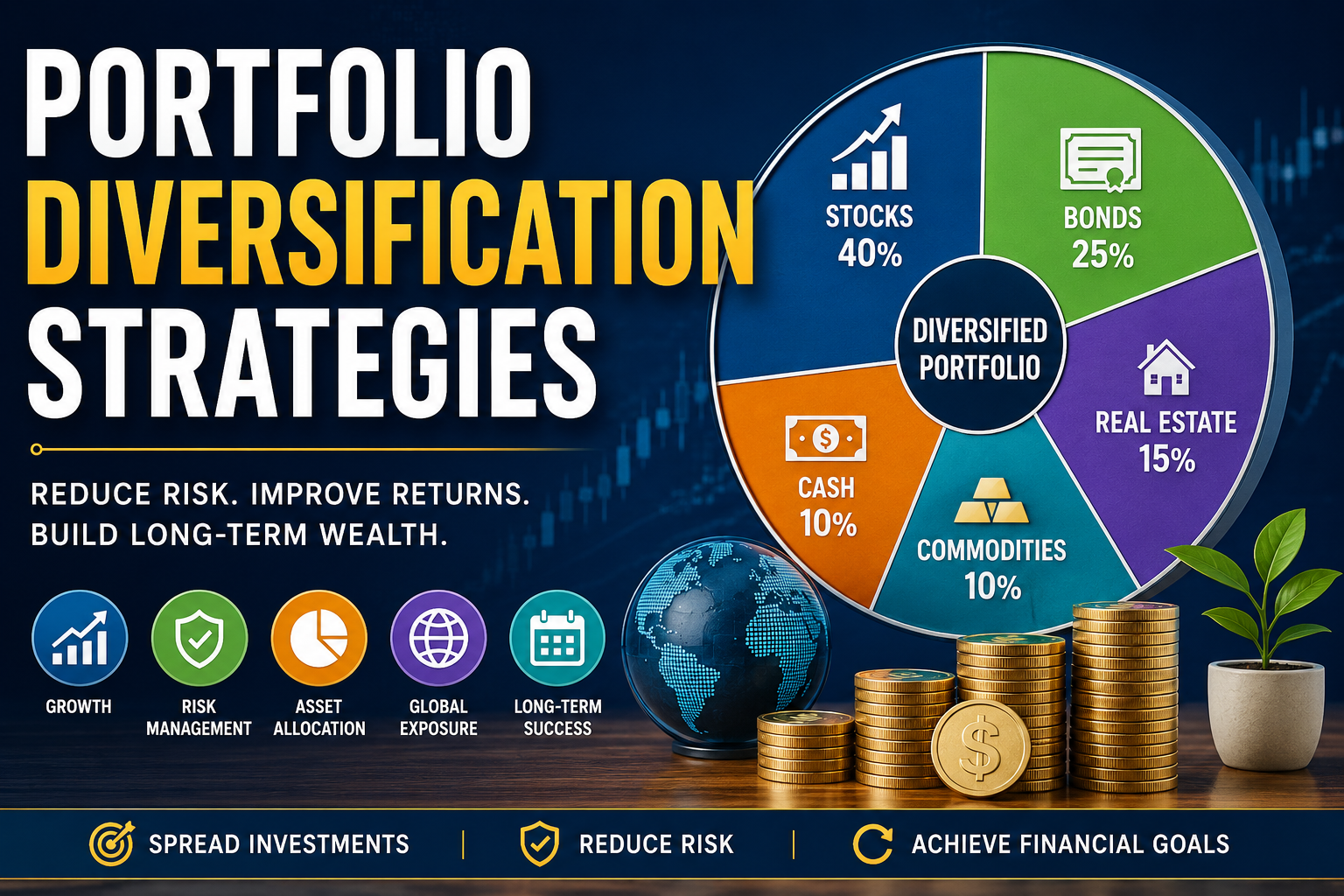
Portfolio Diversification Strategies
Introduction
Portfolio Diversification Strategies are among the most effective methods investors use to reduce risk, protect wealth, and achieve consistent long-term returns. Whether you invest in stocks, bonds, ETFs, real estate, or international markets, diversification helps create a balanced portfolio capable of withstanding market volatility.
Portfolio diversification is one of the most important concepts in investing. It is often called the “golden rule” of risk management because it helps investors reduce losses while still allowing their money to grow over time. In simple words, diversification means spreading investments across different assets, industries, countries, and investment types instead of putting all your money into one place.
The famous saying, “Don’t put all your eggs in one basket,” perfectly explains diversification. If one basket falls, all the eggs break. But if the eggs are spread across multiple baskets, the damage is smaller. The same principle applies to investing.
For investors in Tier-1 countries like the United States, United Kingdom, Canada, and Australia, diversification is especially important because financial markets are deeply connected to global economic events, interest rates, inflation, technology changes, and geopolitical risks. A diversified portfolio helps investors survive market crashes, recessions, inflationary periods, and economic uncertainty.
This article explains portfolio diversification strategies in detail, including terms, concepts, examples, case studies, and practical strategies used by professional investors.
What Is a Portfolio?
A portfolio is a collection of financial investments owned by an investor.
A portfolio can include:
- Stocks
- Bonds
- ETFs
- Mutual funds
- Real estate
- Commodities
- Cash
- Cryptocurrencies
- International investments
For example:
A U.S. investor may own:
- 40% U.S. stocks
- 20% international stocks
- 20% bonds
- 10% real estate
- 10% cash
All these investments together form the investor’s portfolio.
What Is Diversification?
Diversification means spreading investments across different assets to reduce risk.
The main goal is:
- Reduce losses
- Improve stability
- Smooth long-term returns
- Protect wealth during market crashes
Diversification does NOT guarantee profits or eliminate risk entirely. However, it reduces the impact of any single investment failing.
Why Diversification Matters
Markets are unpredictable.
Different investments perform differently under different economic conditions.
For example:
| Economic Condition | Best Performing Assets |
|---|---|
| High inflation | Commodities, energy stocks |
| Recession | Bonds, defensive stocks |
| Economic growth | Growth stocks |
| High interest rates | Cash, short-term bonds |
| Global crisis | Gold, government bonds |
A diversified portfolio balances these situations.
Key Investment Terms Explained
1. Asset Allocation
Asset allocation means dividing investments among different asset classes.
Common asset classes include:
- Stocks
- Bonds
- Real estate
- Cash
- Commodities
Asset allocation is one of the biggest drivers of portfolio performance.
2. Risk
Risk means the possibility of losing money.
Types of investment risk include:
- Market risk
- Inflation risk
- Interest rate risk
- Currency risk
- Credit risk
Diversification helps reduce many of these risks.
3. Volatility
Volatility measures how much prices move up and down.
Highly volatile investments:
- Technology stocks
- Cryptocurrencies
Less volatile investments:
- Government bonds
- Treasury bills
Diversification reduces portfolio volatility.
4. Correlation
Correlation measures how investments move relative to each other.
Positive Correlation
Assets move together.
Example:
Two tech stocks rising and falling together.
Negative Correlation
Assets move opposite each other.
Example:
Stocks falling while bonds rise.
Good diversification uses assets with low or negative correlation.
Types of Diversification
1. Asset Class Diversification
This is the most basic diversification strategy.
Invest across multiple asset classes:
- Stocks
- Bonds
- Real estate
- Commodities
- Cash
Example
| Asset Class | Allocation |
|---|---|
| Stocks | 60% |
| Bonds | 25% |
| Real Estate | 10% |
| Cash | 5% |
This reduces dependence on one asset class.
2. Stock Diversification
Diversify within stocks themselves.
Diversify By:
- Industry
- Company size
- Geography
- Growth vs value
- Dividend vs non-dividend
Industry Diversification
Avoid investing only in one sector.
Example
Bad diversification:
- 100% technology stocks
Good diversification:
- Technology
- Healthcare
- Financials
- Energy
- Consumer goods
Sector Definitions
Technology Sector
Companies involved in:
- Software
- Artificial intelligence
- Cloud computing
- Semiconductors
Examples include companies like:
- Apple
- Microsoft
- NVIDIA
Healthcare Sector
Includes:
- Pharmaceutical companies
- Medical devices
- Healthcare providers
Healthcare tends to be more defensive during recessions.
Financial Sector
Includes:
- Banks
- Insurance companies
- Investment firms
These often benefit from rising interest rates.
3. Geographic Diversification
Invest across multiple countries and regions.
Why Important?
Different economies grow at different rates.
Example:
- U.S. stocks may fall
- Asian markets may rise
- European markets may remain stable
Example Geographic Allocation
| Region | Allocation |
|---|---|
| United States | 50% |
| Europe | 20% |
| Asia-Pacific | 20% |
| Emerging Markets | 10% |
4. Market Capitalization Diversification
Market capitalization means company size.
Types
Large-Cap Stocks
Large established companies.
Examples:
- Amazon
- Alphabet
Lower risk compared to smaller companies.
Mid-Cap Stocks
Medium-sized companies with growth potential.
Small-Cap Stocks
Smaller businesses with higher growth potential but higher risk.
A diversified portfolio includes all three.
5. Time Diversification
Time diversification means investing consistently over long periods.
This strategy reduces the impact of market timing mistakes.
Dollar-Cost Averaging (DCA)
Investing fixed amounts regularly regardless of market conditions.
Example:
Invest:
- $500 monthly into index funds
Benefits:
- Reduces emotional investing
- Lowers timing risk
- Builds long-term discipline
6. Bond Diversification
Many investors ignore bond diversification.
But bonds also carry risks.
Types of Bonds
Government Bonds
Issued by governments.
Examples:
- U.S. Treasury bonds
- UK Gilts
- Canadian government bonds
Usually lower risk.
Corporate Bonds
Issued by companies.
Higher yield but higher risk.
Municipal Bonds
Issued by local governments.
Often tax-efficient in the United States.
7. Real Estate Diversification
Real estate can provide:
- Rental income
- Inflation protection
- Diversification from stocks
Investors may use:
- REITs (Real Estate Investment Trusts)
- Rental properties
- Commercial real estate funds
8. Commodity Diversification
Commodities include:
- Gold
- Oil
- Silver
- Agriculture products
Gold is commonly used as a hedge during uncertainty.
Modern Portfolio Theory (MPT)
E(R_p)=\sum_{i=1}^{n} w_i E(R_i)
Modern Portfolio Theory was developed by Harry Markowitz.
The theory says investors can maximize returns while minimizing risk through diversification.
Core Idea
A portfolio should combine assets that do not move together.
Efficient Frontier
The Efficient Frontier represents portfolios that provide:
- Maximum return for a given risk
OR - Minimum risk for a given return
Professional portfolio managers use this concept extensively.
Systematic vs Unsystematic Risk
Systematic Risk
Market-wide risk affecting all investments.
Examples:
- Recession
- Inflation
- Interest rates
- War
Cannot be eliminated through diversification.
Unsystematic Risk
Company-specific risk.
Examples:
- Fraud
- Bad management
- Product failure
Can be reduced through diversification.
Diversification Strategies for Different Ages
Investors in Their 20s
Goals:
- Growth
- Long-term wealth creation
Possible allocation:
- 80–90% stocks
- 10–20% bonds
Higher risk tolerance due to long time horizon.
Investors in Their 30s
Goals:
- Family planning
- Home ownership
- Retirement savings
Balanced diversification becomes more important.
Investors in Their 40s
Goals:
- Wealth preservation
- Retirement preparation
More balanced approach:
- Stocks
- Bonds
- Real estate
Investors in Their 50s and 60s
Goals:
- Capital preservation
- Income generation
Higher allocation toward:
- Bonds
- Dividend stocks
- Cash reserves
Diversification Through ETFs
ETFs (Exchange-Traded Funds) are among the easiest ways to diversify.
Benefits
- Low fees
- Broad market exposure
- Instant diversification
- Easy trading
Popular ETF Categories
| ETF Type | Purpose |
|---|---|
| S&P 500 ETF | Large U.S. companies |
| International ETF | Foreign exposure |
| Bond ETF | Income and stability |
| REIT ETF | Real estate exposure |
| Commodity ETF | Inflation protection |
Case Study: The 2008 Financial Crisis
The 2008 financial crisis showed why diversification matters.
Investor A
Portfolio:
- 100% bank stocks
Result:
- Lost over 70%
Investor B
Portfolio:
- 50% diversified stocks
- 30% bonds
- 10% gold
- 10% cash
Result:
- Smaller losses
- Faster recovery
Diversification reduced damage significantly.
Case Study: COVID-19 Market Crash (2020)
During the pandemic:
- Airlines collapsed
- Hospitality crashed
- Technology stocks surged
Investors heavily concentrated in travel industries suffered severe losses.
Diversified investors recovered faster because technology and healthcare investments performed strongly.
Case Study: Inflation Shock (2022)
In 2022:
- Interest rates increased sharply
- Growth stocks declined
- Energy stocks and commodities surged
Diversified portfolios containing:
- Energy
- Commodities
- Value stocks
performed better than tech-only portfolios.
Home Country Bias
Many investors invest mostly in their home country.
Example:
- Americans buying only U.S. stocks
- Canadians buying only Canadian banks
This creates concentration risk.
Global diversification reduces dependence on one economy.
Common Diversification Mistakes
1. Over-Diversification
Owning too many investments can reduce returns.
Example:
- Owning 100 similar ETFs
This creates unnecessary complexity.
2. Fake Diversification
Owning multiple investments that behave similarly.
Example:
- 10 technology ETFs
Looks diversified but actually highly concentrated.
3. Ignoring Correlation
Many investors buy assets that move together.
True diversification requires low-correlation assets.
4. Chasing Trends
Investing heavily in popular sectors.
Examples:
- Dot-com bubble
- Meme stocks
- Crypto mania
Trend concentration increases risk.
The 60/40 Portfolio
One classic diversification strategy is the 60/40 portfolio.
Allocation:
- 60% stocks
- 40% bonds
Purpose:
- Growth plus stability
This strategy has historically been popular among retirement investors.
Diversification and Retirement Planning
Retirement investors need balance between:
- Growth
- Income
- Stability
- Inflation protection
Diversification helps achieve all four goals.
Diversification for High-Net-Worth Investors
Wealthy investors often diversify across:
- Public stocks
- Private equity
- Hedge funds
- Venture capital
- Real estate
- International assets
The goal is preserving wealth across generations.
Behavioral Finance and Diversification
Human emotions affect investing.
Common emotional mistakes:
- Fear during crashes
- Greed during bull markets
- Panic selling
- FOMO (Fear Of Missing Out)
Diversification helps investors stay emotionally stable because portfolio swings are smaller.
Tax-Efficient Diversification
Tax-efficient investing is important in Tier-1 countries.
Strategies include:
- Tax-loss harvesting
- Holding long-term investments
- Using retirement accounts
- Municipal bonds
- Asset location strategies
Retirement Accounts by Country
United States
Common retirement accounts:
- 401(k)
- Roth IRA
- Traditional IRA
United Kingdom
- ISA (Individual Savings Account)
- SIPP (Self-Invested Personal Pension)
Canada
- TFSA
- RRSP
Australia
- Superannuation accounts
These accounts help investors diversify while reducing taxes.
Rebalancing a Portfolio
Over time, allocations change.
Example:
Original:
- 60% stocks
- 40% bonds
After stock market rally:
- 75% stocks
- 25% bonds
Rebalancing restores target allocation.
Why Rebalancing Matters
Benefits:
- Maintains risk level
- Prevents concentration
- Encourages discipline
Most investors rebalance:
- Quarterly
- Semi-annually
- Annually
Tactical vs Strategic Diversification
Strategic Diversification
Long-term consistent allocation.
Example:
- 70% stocks
- 30% bonds forever
Tactical Diversification
Temporary adjustments based on market conditions.
Example:
- Increasing cash during recession fears
Professional investors often combine both.
The Role of Cash in Diversification
Cash provides:
- Liquidity
- Stability
- Emergency protection
Too much cash reduces growth due to inflation.
Balance is important.
International Diversification Risks
Global investing also carries risks:
- Currency fluctuations
- Political instability
- Different regulations
However, benefits often outweigh risks over long periods.
ESG Diversification
ESG means:
- Environmental
- Social
- Governance
Many modern investors diversify into ESG funds to align investments with values.
Technology and Diversification
Modern investing platforms make diversification easier through:
- Robo-advisors
- Fractional investing
- Automated rebalancing
- Global ETFs
Examples include:
- Vanguard
- BlackRock
- Fidelity Investments
Example of a Diversified Portfolio
Moderate-Risk Investor
| Asset Type | Allocation |
|---|---|
| U.S. Stocks | 35% |
| International Stocks | 20% |
| Bonds | 25% |
| Real Estate | 10% |
| Gold | 5% |
| Cash | 5% |
This portfolio aims to balance:
- Growth
- Stability
- Inflation protection
Advanced Diversification Strategies
Professional investors may use:
- Options
- Futures
- Hedge funds
- Alternative assets
- Private equity
These strategies are more complex and often higher risk.
Diversification During Recession
During recessions, investors often shift toward:
- Defensive stocks
- Government bonds
- Gold
- Cash
Defensive sectors include:
- Healthcare
- Utilities
- Consumer staples
Diversification vs Concentration
Some famous investors prefer concentrated investing.
For example:
Warren Buffett has said diversification may protect against ignorance.
However, most retail investors benefit more from diversification because they lack inside knowledge and institutional research capabilities.
Pros of Diversification
1. Lower Risk
Reduces losses from single investments.
2. More Stable Returns
Portfolio performance becomes smoother.
3. Emotional Comfort
Lower volatility helps investors stay invested.
4. Better Long-Term Survival
Avoiding catastrophic losses is critical.
Cons of Diversification
1. Lower Maximum Returns
A highly diversified portfolio may underperform concentrated winners.
2. Complexity
Managing many assets can be difficult.
3. Potential Over-Diversification
Too many investments dilute performance.
Real-World Example
Example 1: Concentrated Investor
An investor places:
- 100% into one technology stock
Possible outcomes:
- Massive gains
OR - Massive losses
Example 2: Diversified Investor
Portfolio includes:
- Technology
- Healthcare
- Bonds
- International stocks
- Real estate
Returns may be steadier over time.
Diversification and Inflation
Inflation reduces purchasing power.
Assets often used for inflation protection:
- Real estate
- Commodities
- Dividend stocks
- Treasury Inflation-Protected Securities (TIPS)
Portfolio Diversification Checklist
A good diversified portfolio usually includes:
✅ Multiple industries
✅ Multiple countries
✅ Different asset classes
✅ Large and small companies
✅ Growth and value investments
✅ Short-term and long-term assets
✅ Periodic rebalancing
Final Thoughts
Portfolio diversification is not about avoiding risk completely. It is about managing risk intelligently.
The future is uncertain:
- Markets crash
- Economies change
- Industries evolve
- Interest rates move
- Inflation rises and falls
Diversification helps investors survive uncertainty while still participating in long-term wealth creation.
For investors in Tier-1 countries such as the United States, United Kingdom, Canada, and Australia, diversification is one of the most powerful long-term investing strategies available.
A well-diversified portfolio can:
- Reduce stress
- Protect wealth
- Improve consistency
- Support retirement goals
- Increase financial stability
The most successful investors understand an important truth:
You do not need to predict the future perfectly to build wealth.
You simply need a disciplined, diversified strategy that can survive many possible futures.