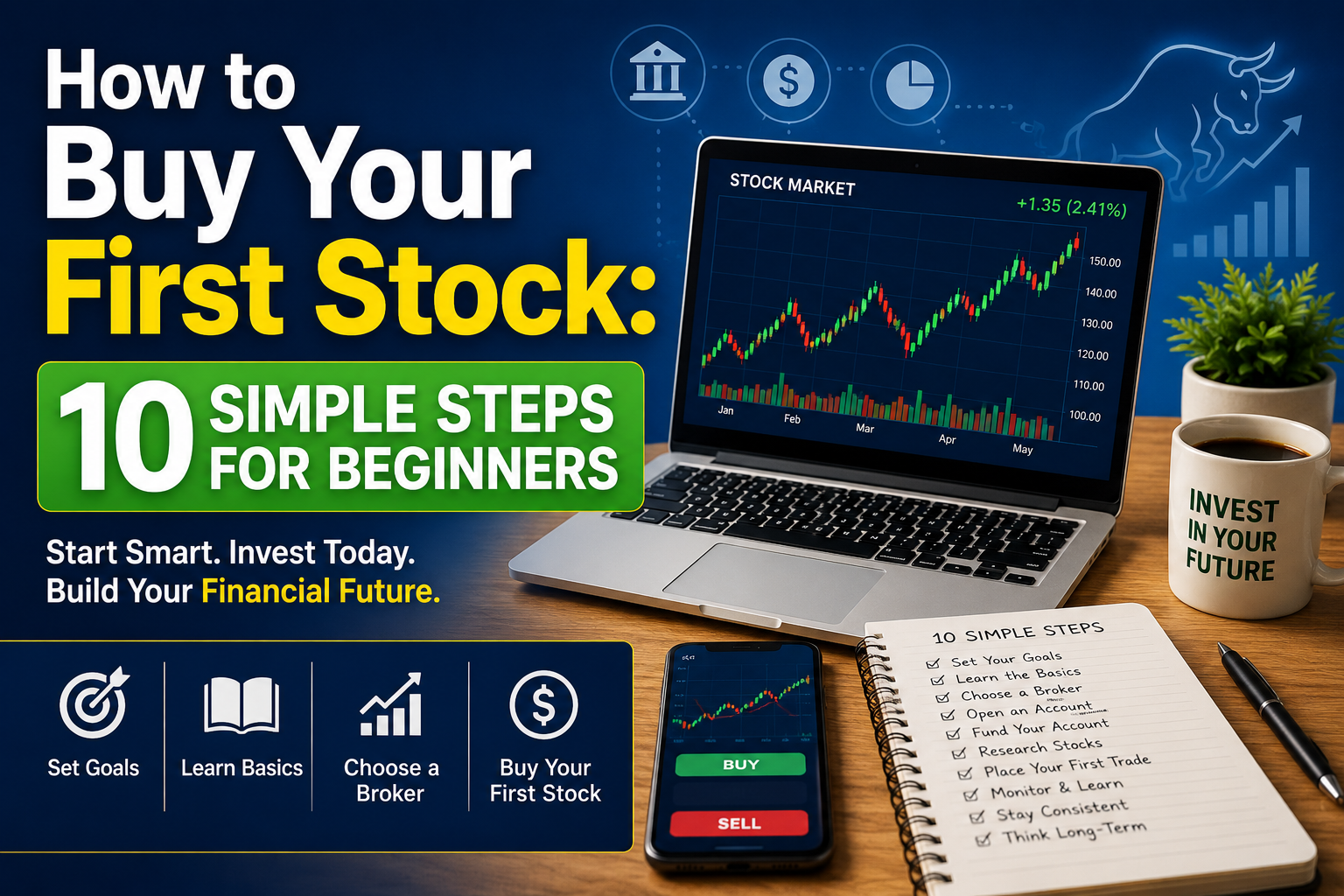
How to Buy Your First Stock
Introduction
Learning how to buy your first stock is one of the most important financial milestones in your life. For beginners in Tier-1 countries such as the United States, Canada, the United Kingdom, and Australia, investing in the stock market is one of the most powerful ways to build long-term wealth, achieve financial independence, and beat inflation.
However, most beginners hesitate because the stock market looks complex, risky, and technical. Terms like brokerage account, dividends, market orders, ETFs, and P/E ratio can feel overwhelming at first.
This guide simplifies everything step-by-step. You will learn how to buy your first stock, how the market works, how to avoid mistakes, and how professionals think when investing.
By the end of this guide, you will have a complete roadmap to confidently place your first investment.
What Is a Stock?
A stock represents ownership in a company.
When you buy a stock, you become a shareholder, meaning you own a small part of that business.
For example:
If a company has 1 million shares and you own 100 shares, you own a tiny percentage of the company.
Companies issue stocks to raise money for:
- Expansion
- Research
- Hiring employees
- Building factories
- Paying debt
- Launching products
In return, investors hope the company grows and becomes more valuable over time.
Understanding Shares
A share is a single unit of ownership in a company.
Example:
If Apple Inc. stock trades at $200 per share and you buy 5 shares:
- Investment = $1,000
- You own 5 shares of Apple
If the stock rises to $250:
- Your investment becomes $1,250
- Profit = $250
💰 Why People Learn How to Buy Their First Stock
People invest in stocks for 5 main reasons:
1. Wealth Creation
Stocks grow over time and build long-term wealth.
2. Passive Income
Some companies pay dividends regularly.
3. Inflation Protection
Stocks grow faster than inflation in most long-term periods.
4. Retirement Planning
Investing early helps build retirement funds.
5. Financial Freedom
Stocks can generate long-term passive income streams.
Why Do People Buy Stocks?
People buy stocks for several reasons:
1. Capital Appreciation
This means the stock price increases over time.
Example:
- Buy at $50
- Sell at $80
- Gain = $30 per share
2. Dividend Income
Some companies distribute profits to shareholders through dividends.
Example:
The Coca-Cola Company pays dividends regularly.
If you own 100 shares and the dividend is $2 annually:
- You receive $200 yearly
3. Wealth Building
Historically, stocks have outperformed many other investments over long periods.
Examples include:
- Savings accounts
- Bonds
- Gold
- Cash holdings
What Is the Stock Market?
The stock market is a marketplace where investors buy and sell shares.
Major stock exchanges include:
- New York Stock Exchange
- NASDAQ
- London Stock Exchange
- Toronto Stock Exchange
- Australian Securities Exchange
How Stocks Make Money
Stocks move based on:
- Company profits
- Economic conditions
- Interest rates
- Investor sentiment
- Industry growth
- News events
If investors believe a company will grow, demand for the stock rises.
Higher demand usually increases price.
🏦 Why Learn How to Buy Your First Stock?
People invest in stocks for:
- Wealth creation
- Retirement planning
- Passive income
- Inflation protection
- Financial independence
Step-by-Step Guide to Buying Your First Stock
Step 1: Define Your Financial Goals
Before buying anything, ask yourself:
Why am I investing?
Common goals include:
- Retirement
- Buying a house
- Passive income
- Wealth accumulation
- Beating inflation
- Financial independence
Your goal determines:
- Risk tolerance
- Time horizon
- Investment strategy
Understanding Time Horizon
A time horizon is how long you plan to keep your money invested.
Examples:
| Goal | Time Horizon |
|---|---|
| Vacation | 1 year |
| House down payment | 5 years |
| Retirement | 30 years |
Longer time horizons generally allow investors to take more risk.
Step 2: Build an Emergency Fund First
Before investing:
Financial advisors typically recommend:
- 3–6 months of expenses saved in cash
Why?
Because stocks are volatile.
You should not be forced to sell investments during emergencies.
Step 3: Understand Risk Tolerance
Risk tolerance means your emotional and financial ability to handle losses.
There are three main investor types:
Conservative Investor
Prefers safety.
Usually invests more in:
- Bonds
- Dividend stocks
- Stable companies
Moderate Investor
Balances growth and safety.
Uses diversified portfolios.
Aggressive Investor
Accepts larger short-term losses for higher long-term growth.
Often invests in:
- Growth stocks
- Technology companies
- Emerging industries
Step 4: Choose a Brokerage Account
A brokerage account allows you to buy and sell stocks.
A brokerage acts as the middleman between you and the stock market.
Popular brokers in Tier-1 countries include:
United States
Canada
United Kingdom
Australia
What to Look for in a Broker
Low Fees
Some brokers charge:
- Trading commissions
- Withdrawal fees
- Currency conversion fees
Many modern brokers offer commission-free trading.
User-Friendly Platform
Beginners benefit from:
- Easy dashboards
- Educational resources
- Mobile apps
Fractional Shares
Fractional investing lets you buy part of a stock.
Example:
Instead of buying one $1,000 share, you can invest $50.
This is useful for expensive stocks like:
- NVIDIA Corporation
- Amazon.com, Inc.
Step 5: Open and Fund Your Account
Typical requirements include:
- Government ID
- Tax information
- Bank account connection
Funding methods:
- Bank transfer
- Wire transfer
- Debit card
- PayPal (some brokers)
Step 6: Learn Stock Market Terms
Market Capitalization
Market cap = total company value.
Formula:
\text{Market Capitalization} = \text{Share Price} \times \text{Total Shares Outstanding}
Example:
- Share price = $100
- Shares outstanding = 1 billion
- Market cap = $100 billion
Large-Cap Stocks
Usually stable, established companies.
Examples:
- Microsoft Corporation
- Johnson & Johnson
Growth Stocks
Companies expected to grow rapidly.
Examples:
- AI companies
- Cloud computing firms
- Technology startups
Growth stocks may deliver high returns but can be volatile.
Dividend Stocks
Companies paying regular dividends.
Often popular among retirees and income investors.
Blue-Chip Stocks
Large, financially stable companies with strong reputations.
Examples:
- McDonald’s Corporation
- Visa Inc.
ETF (Exchange-Traded Fund)
An ETF is a basket of investments.
Instead of buying one stock, you buy many companies at once.
Example:
Vanguard Group ETFs may include hundreds of stocks.
ETFs help reduce risk through diversification.
Step 7: Research Your First Stock
Beginners should avoid buying stocks based purely on hype.
Research should include:
- Revenue growth
- Profitability
- Debt
- Competitive advantage
- Industry trends
- Leadership quality
Important Financial Terms
Revenue
Total money generated from sales.
Profit
Money left after expenses.
Earnings Per Share (EPS)
Measures company profitability per share.
Formula:
EPS = \frac{\text{Net Income}}{\text{Outstanding Shares}}
Price-to-Earnings Ratio (P/E Ratio)
Shows how expensive a stock is relative to earnings.
Formula:
P/E = \frac{\text{Share Price}}{\text{Earnings Per Share}}
High P/E may indicate:
- High growth expectations
- Overvaluation
Dividend Yield
Measures dividend income relative to stock price.
Formula:
\text{Dividend Yield} = \frac{\text{Annual Dividend}}{\text{Stock Price}}
Step 8: Decide How Much to Invest
Never invest money needed for:
- Rent
- Bills
- Emergencies
Many beginners start with:
- $100
- $500
- $1,000
Consistency matters more than starting amount.
Dollar-Cost Averaging
This strategy means investing fixed amounts regularly.
Example:
- Invest $200 every month
- Buy during highs and lows
Benefits:
- Reduces emotional investing
- Builds long-term discipline
Step 9: Place Your First Trade
You search for the company ticker.
Examples:
- Apple = AAPL
- Microsoft = MSFT
- Tesla = TSLA
Then choose:
Market Order
Buys immediately at current market price.
Limit Order
Buys only at your chosen price.
Example:
- Current price = $100
- Your limit = $95
- Order executes only if stock reaches $95
Step 10: Monitor but Don’t Panic
Stocks fluctuate daily.
Short-term declines are normal.
New investors often make mistakes by:
- Panic selling
- Watching prices constantly
- Chasing trends
Long-term investing requires patience.
Case Study 1: Buying Apple Stock
Imagine Sarah, a 25-year-old teacher in the United States.
She invests:
- $500 into Apple Inc.
Apple grows due to:
- iPhone sales
- Services revenue
- Brand loyalty
Over 10 years:
- Stock appreciates significantly
- Dividends reinvest
- Investment compounds
This demonstrates long-term growth investing.
Understanding Compounding
Compounding means earning returns on previous returns.
Example:
- Invest $1,000
- Earn 10%
- Value becomes $1,100
Next year:
- 10% earned on $1,100
- Not just original $1,000
Over decades, compounding becomes powerful.
Formula:
Where:
- A = future value
- P = principal
- r = interest rate
- n = compounding periods
- t = time
Example:
If you invest $1,000 at 10% annual return for 5 years, compounding increases your returns significantly.
Case Study 2: Panic Selling During a Crash
During the 2020 market crash:
Many investors sold stocks in fear.
However, long-term investors who stayed invested often recovered and gained as markets rebounded.
Lesson:
Emotions can damage investment performance.
Diversification Explained
Diversification means spreading investments across different assets.
Instead of buying one stock:
You may own:
- Technology
- Healthcare
- Consumer goods
- Energy
- International stocks
Benefits include reduced risk.
Example of a Beginner Portfolio
| Asset | Allocation |
|---|---|
| US Stock ETF | 50% |
| International ETF | 20% |
| Dividend Stocks | 15% |
| Bonds | 15% |
This provides balance and diversification.
Common Beginner Mistakes
1. Investing Without Research
Buying based on social media hype can be dangerous.
2. Trying to Get Rich Quickly
Successful investing usually requires years, not weeks.
3. Ignoring Fees
High fees reduce long-term returns.
4. Lack of Diversification
Owning only one stock increases risk.
5. Emotional Decisions
Fear and greed often lead to poor timing.
Understanding Taxes
Taxes vary by country.
Common investment taxes include:
- Capital gains tax
- Dividend tax
- Withholding tax
Examples of tax-advantaged accounts:
United States
- 401(k)
- Roth IRA
Canada
- TFSA
- RRSP
United Kingdom
- ISA
Australia
- Superannuation
These accounts can reduce taxes significantly.
Active Investing vs Passive Investing
Active Investing
Trying to outperform the market through stock picking.
Requires:
- Research
- Analysis
- Time
Passive Investing
Investing in ETFs or index funds that track the market.
Popular among long-term investors.
What Is an Index Fund?
An index fund tracks a market index.
Examples:
- S&P 500
- NASDAQ-100
Benefits:
- Diversification
- Low cost
- Simplicity
Psychological Challenges of Investing
Investing is not only financial.
It is emotional.
Common emotions include:
- Fear
- Greed
- FOMO (Fear of Missing Out)
- Regret
Successful investors manage emotions effectively.
Warren Buffett’s Philosophy
Warren Buffett emphasizes:
- Long-term thinking
- Quality businesses
- Patience
- Discipline
One famous principle:
“Be fearful when others are greedy and greedy when others are fearful.”
Growth Investing vs Value Investing
Growth Investing
Focuses on companies growing rapidly.
Examples:
- AI
- Technology
- Cloud computing
Value Investing
Looks for undervalued companies trading below intrinsic value.
Often associated with:
Benjamin Graham
Income Investing
Focuses on dividend-producing assets.
Popular among retirees.
ESG Investing
ESG stands for:
- Environmental
- Social
- Governance
Investors evaluate companies based on ethical and sustainability standards.
How Inflation Affects Investing
Inflation reduces purchasing power.
Example:
If inflation is 3% yearly:
- $100 today buys less in future years.
Stocks historically help combat inflation through growth.
Reinvesting Dividends
Instead of taking cash dividends:
You can automatically buy more shares.
Benefits:
- Faster compounding
- Higher future income
- Long-term growth
Understanding Volatility
Volatility means price fluctuations.
Example:
A stock moving:
- +5%
- -4%
- +7%
within days is volatile.
Higher volatility means higher uncertainty.
How Professionals Evaluate Stocks
Institutional investors analyze:
- Financial statements
- Competitive advantages
- Industry positioning
- Cash flow
- Management quality
What Is a Moat?
A moat is a competitive advantage protecting a company.
Examples include:
- Strong brand
- Patents
- Network effects
- High switching costs
Example:
Visa Inc. benefits from massive payment networks.
Long-Term Investing Mindset
The stock market rewards:
- Patience
- Discipline
- Consistency
It often punishes:
- Emotional reactions
- Speculation
- Short-term gambling
Example: Monthly Investing Strategy
Suppose John invests:
- $300 monthly
- Average annual return = 8%
- Time = 30 years
Potential result:
Hundreds of thousands of dollars through compounding and consistency.
Should Beginners Buy Individual Stocks or ETFs?
For most beginners:
ETFs are usually safer because they provide instant diversification.
However:
Buying a few high-quality individual stocks can also help investors learn market behavior.
Signs of a Strong Beginner Stock
Characteristics may include:
- Profitable business
- Strong brand
- Low debt
- Consistent revenue growth
- Global presence
- Reliable leadership
Examples often discussed by beginners include:
- Microsoft Corporation
- Apple Inc.
- Costco Wholesale Corporation
Final Beginner Checklist
Before buying your first stock:
✅ Emergency fund built
✅ Debt manageable
✅ Long-term mindset
✅ Brokerage account opened
✅ Research completed
✅ Diversified approach planned
✅ Emotional expectations realistic
Final Thoughts
Buying your first stock is more than a financial transaction.
It is the beginning of understanding:
- Ownership
- Wealth creation
- Economic growth
- Long-term financial planning
The most successful investors are not necessarily the smartest.
They are usually the most disciplined.
A beginner who invests consistently, diversifies wisely, controls emotions, and thinks long term often performs better than someone constantly chasing market trends.
Your first investment may feel small today, but over decades, disciplined investing combined with compounding can transform financial futures dramatically.
The key is starting wisely, staying patient, and continuing to learn.