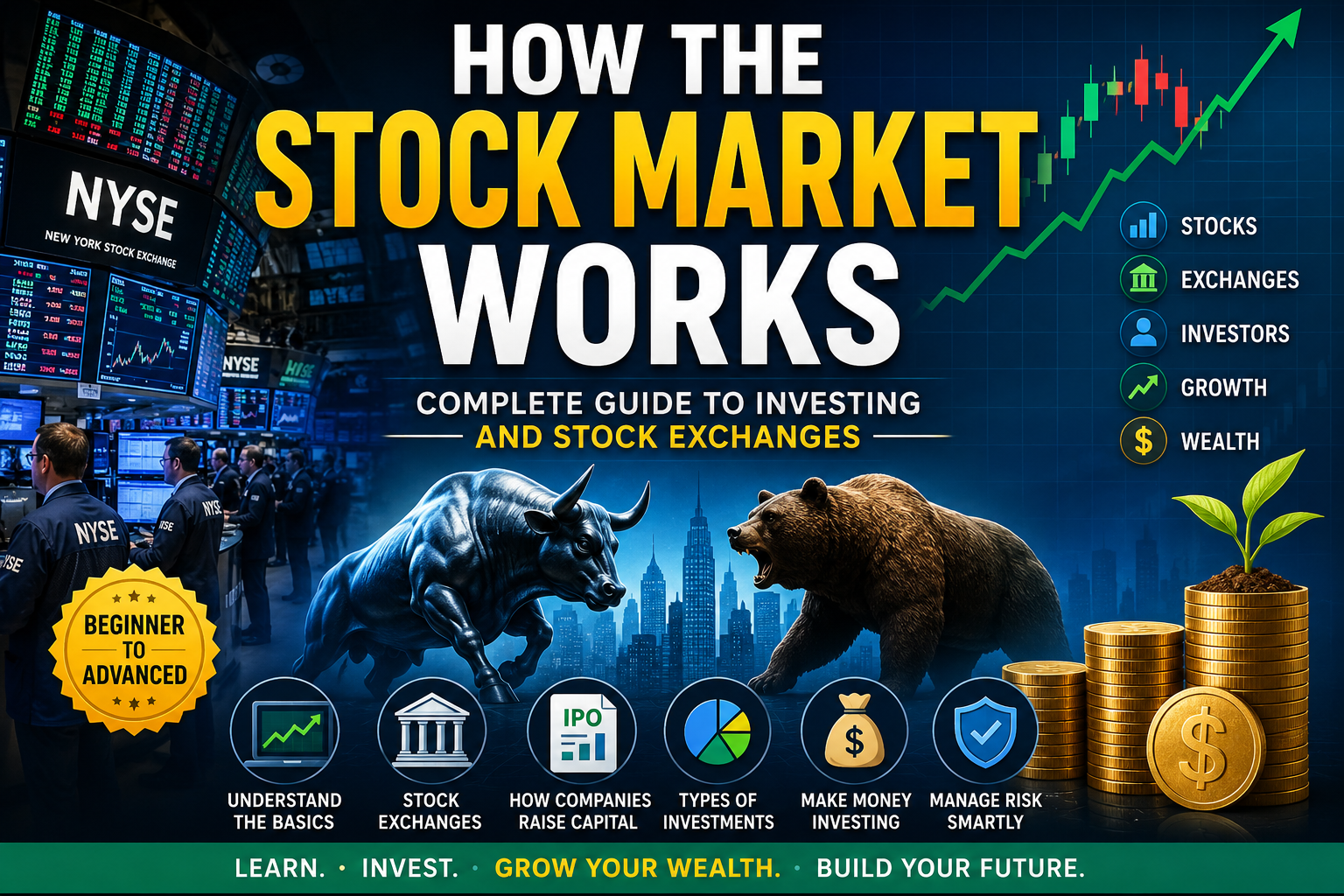
How the Stock Market Works
How the Stock Market Works is one of the most important concepts every investor should understand before investing in stocks, ETFs, mutual funds, or retirement accounts. Understanding how the stock market works helps individuals build wealth, achieve financial goals, and make informed investment decisions.
The stock market is one of the most important financial systems in the modern world. It helps businesses raise money, allows investors to build wealth, supports economic growth, and creates opportunities for retirement planning and long-term investing. In Tier-1 countries such as the United States, United Kingdom, Canada, and Australia, the stock market plays a major role in personal finance and national economies.
When people hear terms like “Wall Street,” “shares,” “stocks,” “bull market,” or “NASDAQ,” they are talking about parts of the stock market ecosystem. Understanding how the stock market works is essential for investors, business owners, students, and anyone interested in financial independence.
What Is the Stock Market?
The stock market is a marketplace where investors buy and sell ownership shares of publicly traded companies.
A “stock” represents partial ownership in a company. If you own a stock, you own a small piece of that business.
For example:
- If a company has 1 million shares outstanding
- And you own 1,000 shares
- You own 0.1% of the company
Companies sell shares to raise capital for expansion, operations, research, acquisitions, and innovation.
Investors buy those shares hoping the company grows and the stock price increases over time.
Understanding the Word “Stock”
A stock is also called:
- Equity
- Share
- Security
These terms are often used interchangeably.
Example
If you buy shares of Apple Inc., you become a shareholder of the company.
That means:
- You participate in the company’s growth
- You may receive dividends
- Your investment value can rise or fall
Why Companies Need the Stock Market
Businesses need money to grow.
Instead of borrowing only from banks, companies can raise money from the public by issuing shares.
This process is called:
Initial Public Offering (IPO)
An IPO is when a private company becomes publicly traded.
Example
When Facebook went public in 2012, it sold shares to investors and raised billions of dollars.
The company used this money for:
- Expansion
- Technology development
- Hiring
- Acquisitions
Investors who bought early shares benefited as the company grew over time.
Primary Market vs Secondary Market
The stock market has two major parts.
1. Primary Market
This is where new shares are created and sold.
Example:
- IPOs
- New share offerings
Money goes directly to the company.
2. Secondary Market
This is where investors trade shares with each other.
Examples:
- New York Stock Exchange
- NASDAQ
- London Stock Exchange
Money does not go to the company here. It goes between investors.
How Stock Exchanges Work
A stock exchange is a regulated marketplace where securities are traded.
Think of it as an auction system.
Buyers place bids.
Sellers place asking prices.
When prices match, a trade happens.
Major Stock Exchanges in Tier-1 Countries
United States
- New York Stock Exchange
- NASDAQ
United Kingdom
- London Stock Exchange
Canada
- Toronto Stock Exchange
Australia
- Australian Securities Exchange
What Happens When You Buy a Stock?
Suppose you buy one share of Tesla.
The process works like this:
- You place an order through a broker
- The broker sends the order to the exchange
- The exchange finds a seller
- The transaction executes
- Ownership transfers to you electronically
Today, most transactions happen in milliseconds through computerized trading systems.
What Is a Stock Broker?
A broker is a licensed intermediary that allows investors to buy and sell securities.
Popular brokers in Tier-1 countries include:
- Charles Schwab
- Fidelity Investments
- Robinhood
- Interactive Brokers
Brokers provide:
- Trading platforms
- Research tools
- Retirement accounts
- Portfolio tracking
- Investment education
Understanding Stock Prices
Stock prices constantly change because of:
- Supply and demand
- Company earnings
- Economic conditions
- Interest rates
- Investor sentiment
- News events
- Geopolitical events
If more people want to buy a stock than sell it, the price rises.
If more people want to sell than buy, the price falls.
Market Capitalization Explained
Market capitalization (“market cap”) measures company size.
Formula:
\text{Market Capitalization} = \text{Share Price} \times \text{Shares Outstanding}
Example
If a company has:
- Share price = $100
- Shares outstanding = 1 billion
Then:
- Market cap = $100 billion
Types of Stocks
1. Common Stock
Most investors buy common stock.
Benefits:
- Voting rights
- Potential capital appreciation
- Dividends
Risks:
- Higher volatility
2. Preferred Stock
Preferred shareholders receive priority dividends.
Benefits:
- Stable income
- Lower volatility
Risks:
- Less growth potential
What Are Dividends?
Dividends are payments companies distribute to shareholders from profits.
Example:
- A company pays $2 dividend annually per share
- You own 100 shares
- You receive $200 annually
Dividend investing is popular in Tier-1 retirement portfolios.
What Is Capital Gain?
Capital gain occurs when you sell a stock for more than you paid.
Example
- Buy stock at $50
- Sell at $80
- Profit = $30 capital gain
What Causes Stocks to Rise?
Stocks generally rise because of:
- Revenue growth
- Profit growth
- Innovation
- Strong leadership
- Economic expansion
- Investor confidence
Case Study: Apple
Apple Inc. became one of the world’s most valuable companies because of:
- iPhone success
- Strong ecosystem
- Consistent profitability
- Brand loyalty
- Services expansion
Investors who bought Apple shares in the early 2000s experienced enormous long-term returns.
What Causes Stocks to Fall?
Stocks may decline because of:
- Recessions
- Poor earnings
- Rising interest rates
- Inflation
- Scandals
- Competition
- Weak consumer demand
Bull Market vs Bear Market
Bull Market
A bull market means prices are rising.
Characteristics:
- Economic growth
- Strong investor confidence
- Rising employment
- Higher spending
Example:
The long US bull market after the 2008 financial crisis.
Bear Market
A bear market means prices fall significantly.
Usually:
- Decline of 20% or more
- Fear and uncertainty
- Economic slowdown
Example:
The 2020 COVID-19 market crash.
Understanding Stock Indexes
An index tracks a group of stocks.
Indexes help measure overall market performance.
Major Indexes
United States
- S&P 500
- Dow Jones Industrial Average
- NASDAQ Composite
United Kingdom
- FTSE 100
Canada
- S&P/TSX Composite Index
Australia
- S&P/ASX 200
Example of How an Index Works
If the S&P 500 rises 10%:
- The average large US company performed well
- Many retirement portfolios also likely increased
Indexes are important because many funds track them.
What Are ETFs?
ETF stands for Exchange-Traded Fund.
An ETF is a basket of investments traded like a stock.
Example:
An S&P 500 ETF owns shares in hundreds of companies.
Benefits:
- Diversification
- Lower fees
- Easy investing
- Reduced risk
Popular ETFs include those tracking:
- US market
- Technology sector
- International stocks
- Bonds
What Is Diversification?
Diversification means spreading investments across multiple assets.
Goal:
Reduce risk.
Instead of buying only one stock, investors may own:
- Technology stocks
- Healthcare stocks
- International stocks
- Bonds
- Real estate funds
Risk and Reward in the Stock Market
Higher potential returns usually come with higher risk.
Growth stocks may rise rapidly but also crash sharply.
Bonds are usually more stable but offer lower returns.
Volatility Explained
Volatility means how much prices move.
High volatility:
- Bigger gains possible
- Bigger losses possible
Low volatility:
- More stable
- Slower growth
Long-Term Investing
Historically, the stock market has rewarded long-term investors.
Short-term movements are unpredictable.
But over decades, markets generally trend upward because economies grow.
Case Study: S&P 500 Long-Term Growth
The S&P 500 has historically generated strong long-term returns over many decades despite recessions, wars, inflation, and financial crises.
An investor regularly contributing to an index fund over 30 years often accumulates significant wealth through:
- Compound growth
- Reinvested dividends
- Market appreciation
Compound Interest and Investing
Compound growth is one of the most powerful concepts in finance.
genui{“math_block_widget_always_prefetch_v2”:{“content”:”A = P\left(1+\frac{r}{n}\right)^{nt}”}}
Where:
- A = future value
- P = principal
- r = annual return
- n = compounding frequency
- t = time
Example of Compounding
If you invest:
- $10,000
- Average annual return = 8%
- Time = 30 years
The investment can grow dramatically because returns generate additional returns.
This is why retirement investing starts early in Tier-1 countries.
Institutional Investors
Large organizations dominate stock markets.
Examples include:
- Pension funds
- Hedge funds
- Insurance companies
- Mutual funds
These institutions manage trillions of dollars.
Retail Investors
Retail investors are individual investors.
Technology has made investing accessible through mobile apps and online brokers.
Millions of people now invest independently.
What Is a Mutual Fund?
A mutual fund pools money from many investors.
Professional managers invest that money into stocks or bonds.
Benefits:
- Professional management
- Diversification
- Simplicity
Disadvantages:
- Higher fees than ETFs
Understanding Interest Rates
Interest rates strongly affect stock markets.
When rates rise:
- Borrowing becomes expensive
- Corporate profits may slow
- Stocks often decline
When rates fall:
- Businesses borrow more
- Consumers spend more
- Stocks may rise
Role of Central Banks
Central banks influence markets through monetary policy.
Examples:
- Federal Reserve
- Bank of England
- Bank of Canada
- Reserve Bank of Australia
Their decisions affect:
- Inflation
- Interest rates
- Employment
- Market confidence
Market Sectors
The stock market includes many sectors.
Examples:
- Technology
- Healthcare
- Energy
- Financials
- Consumer goods
- Utilities
Different sectors perform differently depending on economic conditions.
Growth Stocks vs Value Stocks
Growth Stocks
Companies expected to grow rapidly.
Examples:
- Tech companies
- AI companies
Higher risk and higher valuation.
Value Stocks
Companies trading below perceived value.
Usually:
- Stable businesses
- Lower valuations
- Dividend-paying firms
Defensive Stocks
Defensive stocks perform relatively well during recessions.
Examples:
- Food companies
- Utility providers
- Healthcare firms
People continue buying essentials even during economic downturns.
Cyclical Stocks
Cyclical companies depend heavily on economic conditions.
Examples:
- Airlines
- Hotels
- Luxury brands
- Automobile manufacturers
Case Study: COVID-19 Market Crash
During the 2020 pandemic:
- Airlines collapsed
- Hotels suffered
- Technology companies surged
Remote work accelerated growth for:
- Cloud computing
- E-commerce
- Digital communication
Companies like Amazon benefited significantly.
This demonstrated how economic trends affect sectors differently.
What Is Insider Trading?
Insider trading involves trading stocks using non-public information.
Illegal insider trading is prohibited because it creates unfair advantages.
Regulators monitor suspicious trading activity.
Stock Market Regulation
Stock markets are heavily regulated.
Regulators protect investors from:
- Fraud
- Manipulation
- Insider trading
Examples:
- U.S. Securities and Exchange Commission
- Financial Conduct Authority
High-Frequency Trading (HFT)
HFT uses algorithms and supercomputers to trade rapidly.
Trades occur within milliseconds.
Advantages:
- Market liquidity
- Faster execution
Criticism:
- Market instability
- Unequal advantages
Behavioral Finance
Markets are influenced by human psychology.
Common emotions:
- Fear
- Greed
- Panic
- Overconfidence
These emotions can create:
- Bubbles
- Crashes
- Irrational valuations
Case Study: Dot-Com Bubble
In the late 1990s:
- Internet stocks skyrocketed
- Investors ignored fundamentals
- Speculation exploded
Eventually:
- Many tech stocks crashed
- Investors lost billions
Lesson:
Speculation without profitability can be dangerous.
What Is Market Liquidity?
Liquidity means how easily assets can be bought or sold.
Highly liquid stocks:
- Large companies
- Heavy trading volume
Low liquidity:
- Harder to trade
- Bigger price swings
Order Types in Trading
Market Order
Buy or sell immediately at current market price.
Limit Order
Buy or sell only at a specified price.
Stop-Loss Order
Automatically sells a stock at a predetermined price to reduce losses.
What Is Short Selling?
Short selling profits from declining stock prices.
Process:
- Borrow shares
- Sell shares
- Repurchase later at lower price
- Return borrowed shares
Risk:
Losses can be unlimited if stock prices rise sharply.
Margin Trading
Margin trading means borrowing money from a broker to buy stocks.
Benefits:
- Larger positions
Risks:
- Amplified losses
Market Efficiency
The Efficient Market Hypothesis suggests stock prices reflect available information quickly.
Meaning:
Consistently beating the market is difficult.
This is one reason passive investing became popular.
Passive Investing
Passive investing means tracking market indexes rather than actively picking stocks.
Popular because:
- Lower fees
- Simplicity
- Strong historical performance
Active Investing
Active investors attempt to outperform the market through research and timing.
Challenges:
- Higher costs
- Difficult consistency
- Emotional mistakes
Retirement Investing in Tier-1 Countries
Stock markets are central to retirement systems.
Examples:
United States
- 401(k)
- IRA
United Kingdom
- ISA
- Workplace pensions
Canada
- RRSP
- TFSA
Australia
- Superannuation
These systems often invest heavily in stocks for long-term growth.
Inflation and the Stock Market
Inflation reduces purchasing power.
Stocks can help protect against inflation because companies may:
- Raise prices
- Increase revenues
- Grow earnings over time
Economic Indicators That Affect Markets
Important indicators include:
- GDP growth
- Inflation
- Employment
- Consumer spending
- Interest rates
- Corporate earnings
Markets react quickly to economic data releases.
Why the Stock Market Matters
The stock market supports:
- Economic growth
- Business expansion
- Innovation
- Retirement savings
- Wealth creation
Without stock markets:
- Companies would struggle to raise capital
- Economic development would slow
- Investment opportunities would shrink
Common Beginner Mistakes
1. Emotional Investing
Buying during excitement and selling during panic.
2. Lack of Diversification
Owning only one or two stocks.
3. Trying to Time the Market
Predicting short-term market movements consistently is extremely difficult.
4. Ignoring Fees
High investment fees reduce long-term returns.
Smart Investing Principles
Successful long-term investors often focus on:
- Diversification
- Patience
- Consistency
- Low costs
- Long-term thinking
- Risk management
Final Case Study: Warren Buffett
Warren Buffett is considered one of the greatest investors in history.
His principles include:
- Buying quality businesses
- Long-term investing
- Avoiding speculation
- Understanding company fundamentals
- Patience and discipline
Buffett’s success demonstrates the power of long-term compounding and rational investing.
Conclusion
The stock market is a complex but powerful financial system that connects businesses and investors. It allows companies to raise capital while giving individuals opportunities to build wealth over time.
Understanding how the stock market works involves learning about:
- Stocks
- Exchanges
- Brokers
- Indexes
- Risk
- Diversification
- Interest rates
- Investor psychology
- Economic cycles
In Tier-1 countries such as the United States, United Kingdom, Canada, and Australia, the stock market plays a major role in retirement planning, economic growth, and wealth creation.
Although markets can be volatile in the short term, history shows that disciplined long-term investing, diversification, and financial education are among the most effective ways to participate successfully in the stock market.