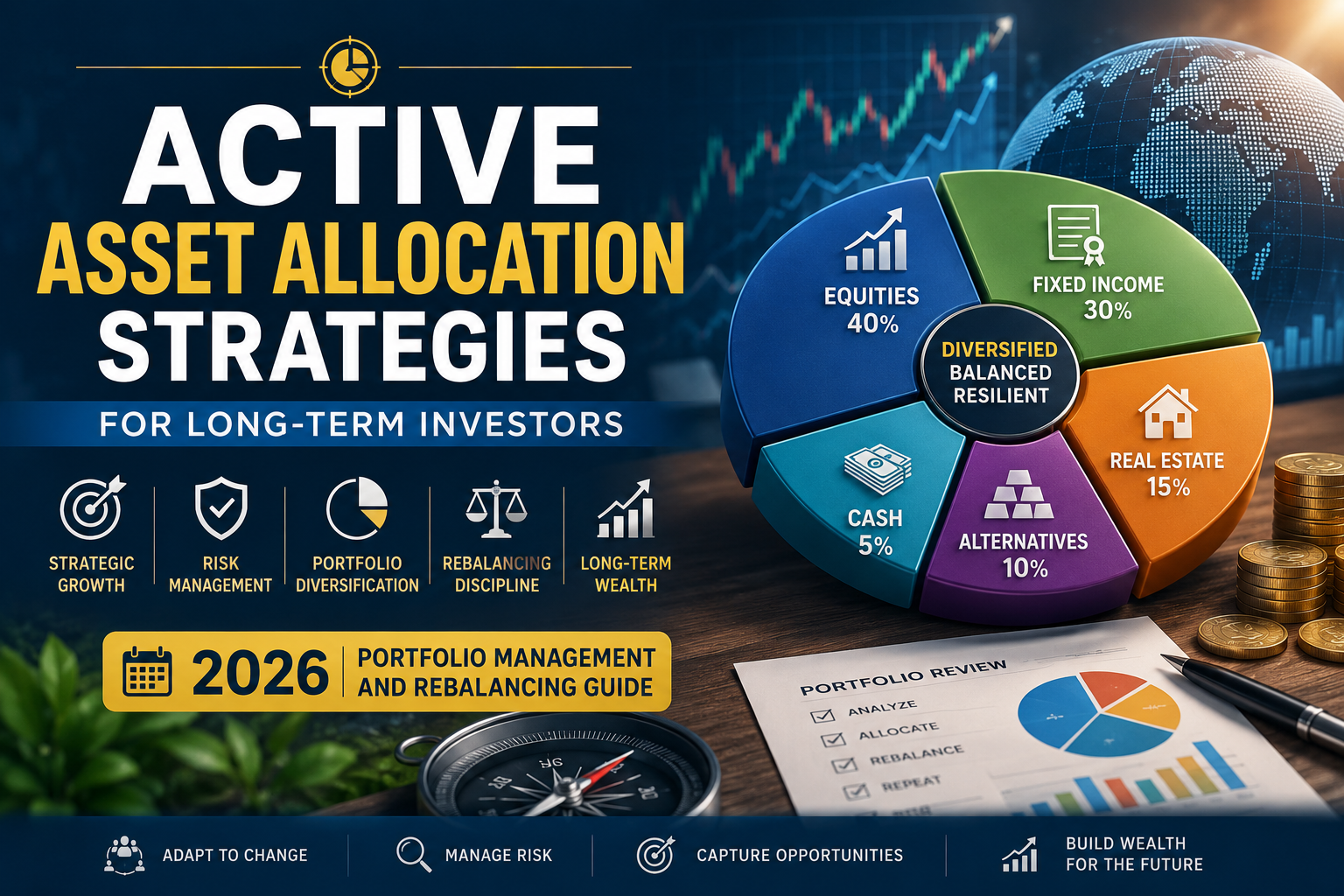
Active Asset Allocation Strategies: Complete Guide for Long-Term Investors (2026)
Introduction
Successful investing is not just about picking winning stocks. Research from leading financial institutions consistently shows that asset allocation—how you divide your money among different investments—has a major impact on long-term portfolio performance.
Many investors spend countless hours searching for the next big stock, yet overlook the most important factor in wealth building: creating and managing an effective asset allocation strategy.
This is where Active Asset Allocation becomes valuable.
Unlike passive allocation approaches that maintain fixed investment percentages over time, active allocation allows investors to adjust their portfolios based on changing market conditions, economic trends, valuations, interest rates, inflation, and risk levels.
For long-term investors, active asset allocation can help:
- Improve risk-adjusted returns
- Reduce portfolio volatility
- Protect capital during downturns
- Take advantage of market opportunities
- Enhance wealth accumulation over decades
This comprehensive guide explains everything investors need to know about active asset allocation strategies, including tactical allocation, strategic allocation, portfolio construction, risk management, rebalancing techniques, historical examples, expert insights, and real-world case studies.
What Is Asset Allocation?
Asset allocation is the process of dividing investments among different asset classes.
An asset class is a category of investments that share similar characteristics.
Common asset classes include:
Stocks (Equities)
Stocks represent ownership in companies.
Examples:
- Apple
- Microsoft
- Nvidia
- Amazon
Benefits:
- High growth potential
- Inflation protection
- Long-term wealth creation
Risks:
- High volatility
- Market downturns
Bonds (Fixed Income)
Bonds are loans made to governments or corporations.
Examples:
- U.S. Treasury Bonds
- Corporate Bonds
- Municipal Bonds
Benefits:
- Stability
- Predictable income
- Lower volatility
Risks:
- Interest rate risk
- Inflation risk
Real Estate
Investments in property or real estate funds.
Examples:
- REITs
- Commercial property
- Residential property
Benefits:
- Income generation
- Inflation hedge
Risks:
- Liquidity constraints
- Market cycles
Commodities
Physical resources.
Examples:
- Gold
- Silver
- Oil
- Natural Gas
Benefits:
- Inflation protection
- Diversification
Risks:
- Price volatility
Cash
Cash and cash equivalents.
Examples:
- Savings accounts
- Money market funds
- Treasury bills
Benefits:
- Safety
- Liquidity
Risks:
- Inflation erosion
What Is Active Asset Allocation?
Active asset allocation is an investment strategy where portfolio weights are adjusted periodically based on market conditions and future expectations.
Instead of maintaining fixed percentages, investors actively change allocations.
Example:
Initial Portfolio:
- Stocks: 60%
- Bonds: 30%
- Cash: 10%
During a recession forecast:
- Stocks: 40%
- Bonds: 45%
- Cash: 15%
The goal is to:
- Reduce downside risk
- Capture opportunities
- Improve returns
Why Asset Allocation Matters More Than Stock Picking
Many investors assume stock selection drives performance.
However, studies from institutional investing have repeatedly shown that asset allocation explains a significant portion of portfolio return variability.
Reasons include:
Diversification
Different assets behave differently.
Example:
During stock market crashes:
- Stocks may decline 30%
- Bonds may rise
- Gold may outperform
Diversification smooths returns.
Risk Control
Asset allocation determines portfolio risk more than individual investments.
Example:
A portfolio with:
- 90% stocks
- 10% bonds
Will be much riskier than:
- 50% stocks
- 50% bonds
Regardless of stock selection.
Behavioral Protection
Proper allocation helps investors avoid emotional decisions.
During crashes:
- Fear causes panic selling
- Greed causes excessive buying
Balanced portfolios reduce emotional investing.
Active vs Passive Asset Allocation
| Feature | Active Allocation | Passive Allocation |
|---|---|---|
| Market Timing | Yes | No |
| Flexibility | High | Low |
| Rebalancing | Frequent | Periodic |
| Management Effort | High | Low |
| Potential Returns | Higher | Market Returns |
| Costs | Higher | Lower |
Strategic Asset Allocation
Strategic Asset Allocation is the long-term framework of a portfolio.
Investors determine target allocations based on:
- Goals
- Risk tolerance
- Time horizon
Example:
A 35-year-old investor:
- Stocks: 70%
- Bonds: 20%
- Real Estate: 10%
These allocations remain relatively stable for decades.
Benefits of Strategic Allocation
Simplicity
Easy to manage.
Lower Costs
Fewer trades.
Reduced Emotional Decisions
Maintains discipline.
Long-Term Focus
Avoids short-term speculation.
Tactical Asset Allocation
Tactical Asset Allocation (TAA) is an active investing strategy that temporarily shifts portfolio allocations.
The goal is to exploit market opportunities.
Example:
Normal Portfolio:
- Stocks 60%
- Bonds 30%
- Cash 10%
Expected recession:
- Stocks 45%
- Bonds 40%
- Cash 15%
After recovery:
- Return to original allocation.
Tactical Allocation Indicators
Investors often use:
Interest Rates
Higher rates can pressure stocks.
Inflation
Rising inflation may favor commodities.
Economic Growth
Strong growth benefits equities.
Valuation Metrics
Examples:
- P/E Ratio
- CAPE Ratio
Market Momentum
Strong trends may continue.
Dynamic Asset Allocation
Dynamic allocation continuously adjusts exposure based on market changes.
Unlike tactical allocation, dynamic strategies often use quantitative models.
Example:
If volatility increases:
- Stocks reduced automatically.
If volatility decreases:
- Stocks increased.
Core Principles of Active Asset Allocation
1. Diversification
Never rely on one asset class.
Example:
Instead of:
- 100% stocks
Use:
- Stocks
- Bonds
- REITs
- Gold
- Cash
2. Risk Management
Protecting capital is essential.
Warren Buffett famously said:
Rule No.1: Never lose money.
While losses are unavoidable, risk management reduces severe damage.
3. Discipline
Successful investors follow a process.
Avoid:
- Panic selling
- FOMO buying
4. Long-Term Thinking
Wealth is built over decades.
Asset allocation should support long-term objectives.
Risk Management in Active Asset Allocation
Risk management is the foundation of successful investing.
Market Risk
The risk of overall market declines.
Example:
During the 2008 financial crisis, global equities fell dramatically.
Diversified portfolios performed better.
Interest Rate Risk
Bond prices generally fall when rates rise.
Inflation Risk
Inflation reduces purchasing power.
Assets that may help:
- Stocks
- Real Estate
- Commodities
Liquidity Risk
Some assets are difficult to sell quickly.
Examples:
- Real estate
- private investments
Portfolio Examples
Conservative Portfolio
Suitable for retirees.
- Stocks 30%
- Bonds 50%
- REITs 10%
- Cash 10%
Moderate Portfolio
Suitable for balanced investors.
- Stocks 60%
- Bonds 25%
- REITs 10%
- Cash 5%
Aggressive Portfolio
Suitable for younger investors.
- Stocks 80%
- Bonds 10%
- REITs 5%
- Cash 5%
Case Study 1: The 2008 Financial Crisis
Investor A:
- 100% Stocks
Loss:
Approximately 50%.
Investor B:
- Stocks 60%
- Bonds 30%
- Cash 10%
Losses significantly lower.
Lesson:
Diversification reduces drawdowns.
Case Study 2: COVID-19 Market Crash (2020)
Markets fell rapidly.
Active allocators increased cash before peak uncertainty and redeployed capital during recovery.
Result:
Improved risk-adjusted returns.
Case Study 3: Rising Inflation (2022)
Traditional stock and bond portfolios struggled.
Investors with:
- Energy exposure
- Commodities
- Inflation-protected assets
Outperformed.
Case Study 4: Young Professional Investor
Age: 30
Portfolio:
- Stocks 85%
- Bonds 10%
- Cash 5%
Long horizon allowed greater equity exposure.
After 25 years:
Potential wealth significantly exceeded conservative allocations.
Case Study 5: Near Retirement Investor
Age: 60
Portfolio shifted from:
- 80% stocks
To:
- 50% stocks
- 40% bonds
- 10% cash
Reduced retirement risk.
Case Study 6: Tech Bubble (2000)
Many investors concentrated in technology stocks.
When the bubble burst:
NASDAQ lost approximately 78%.
Diversified portfolios recovered faster.
Key lesson:
Concentration creates significant risk.
Advanced Active Asset Allocation Strategies
Sector Rotation
Moving capital between sectors.
Examples:
- Technology
- Healthcare
- Financials
- Energy
Depending on economic conditions.
Global Allocation
Invest beyond domestic markets.
Examples:
- United States
- Canada
- United Kingdom
- Australia
- Europe
- Japan
Benefits:
- Diversification
- Additional growth opportunities
Valuation-Based Allocation
Increase exposure to undervalued markets.
Reduce exposure to overvalued markets.
Momentum Allocation
Invest in strong-performing assets.
Based on the principle that trends often persist.
Risk Parity
Allocate risk equally rather than allocating capital equally.
Used by institutional investors.
Portfolio Rebalancing Methods
Rebalancing restores target allocations.
Calendar Rebalancing
Example:
- Quarterly
- Semiannually
- Annually
Most common method.
Threshold Rebalancing
Rebalance when allocation deviates by a set percentage.
Example:
Target Stocks = 60%
Actual = 70%
Rebalance.
Hybrid Rebalancing
Combines:
- Time intervals
- Allocation thresholds
Often considered best practice.
Rebalancing Example
Original:
- Stocks 60%
- Bonds 40%
After Bull Market:
- Stocks 75%
- Bonds 25%
Rebalance by:
- Selling stocks
- Buying bonds
Benefits:
- Controls risk
- Locks in gains
Common Asset Allocation Mistakes
Chasing Performance
Buying recent winners often leads to poor timing.
Ignoring Risk Tolerance
Aggressive portfolios can cause panic during downturns.
Lack of Diversification
Too much concentration increases risk.
Overtrading
Excessive adjustments increase costs.
Failure to Rebalance
Portfolios drift away from target allocations.
Expert Quotes
Warren Buffett
Diversification is protection against ignorance.
Benjamin Graham
The investor’s chief problem—and even his worst enemy—is likely to be himself.
Ray Dalio
The Holy Grail of investing is diversification.
John Bogle
Asset allocation is one of the most important decisions investors make.
Statistics Every Investor Should Know
- Bear markets occur regularly throughout investing history.
- Diversified portfolios historically experience lower volatility.
- Investors who remain invested long-term generally outperform market timers.
- Rebalanced portfolios often maintain more consistent risk levels than unmanaged portfolios.
- Equity markets have historically delivered stronger long-term returns than cash and many fixed-income assets, though with higher volatility.
Building Your Own Active Asset Allocation Plan
Step 1:
Define financial goals.
Examples:
- Retirement
- Wealth building
- Income generation
Step 2:
Assess risk tolerance.
Step 3:
Determine strategic allocation.
Step 4:
Establish tactical adjustment rules.
Step 5:
Create rebalancing schedule.
Step 6:
Review annually.
Frequently Asked Questions (FAQs)
What is active asset allocation?
An investment strategy that adjusts portfolio allocations based on market conditions, economic forecasts, valuations, and risk assessments.
Is active asset allocation better than passive allocation?
Neither is universally superior. Active allocation offers flexibility and risk management opportunities, while passive allocation provides simplicity and lower costs.
How often should portfolios be rebalanced?
Many investors rebalance quarterly, semiannually, or annually. Threshold-based methods are also popular.
Can beginners use active asset allocation?
Yes, but beginners should start with simple allocation models and avoid excessive trading.
What percentage should be in stocks?
The answer depends on age, goals, time horizon, income needs, and risk tolerance.
Should retirees use active allocation?
Many retirees benefit from active risk management because preserving capital becomes increasingly important.
Final Thoughts
Active Asset Allocation Strategies represent one of the most powerful tools available to long-term investors. While stock selection often receives the most attention, portfolio construction, diversification, risk management, tactical adjustments, and disciplined rebalancing frequently have a greater impact on long-term wealth creation.
By combining a solid strategic allocation framework with carefully executed tactical adjustments, investors can potentially improve returns, reduce volatility, protect capital during market downturns, and maintain a portfolio aligned with their long-term goals.
The most successful investors are rarely those who predict every market move correctly. Instead, they build resilient portfolios, manage risk intelligently, rebalance consistently, and stay committed to a disciplined investment process through every market cycle. This is the foundation of sustainable wealth building in 2026 and beyond.