Introduction
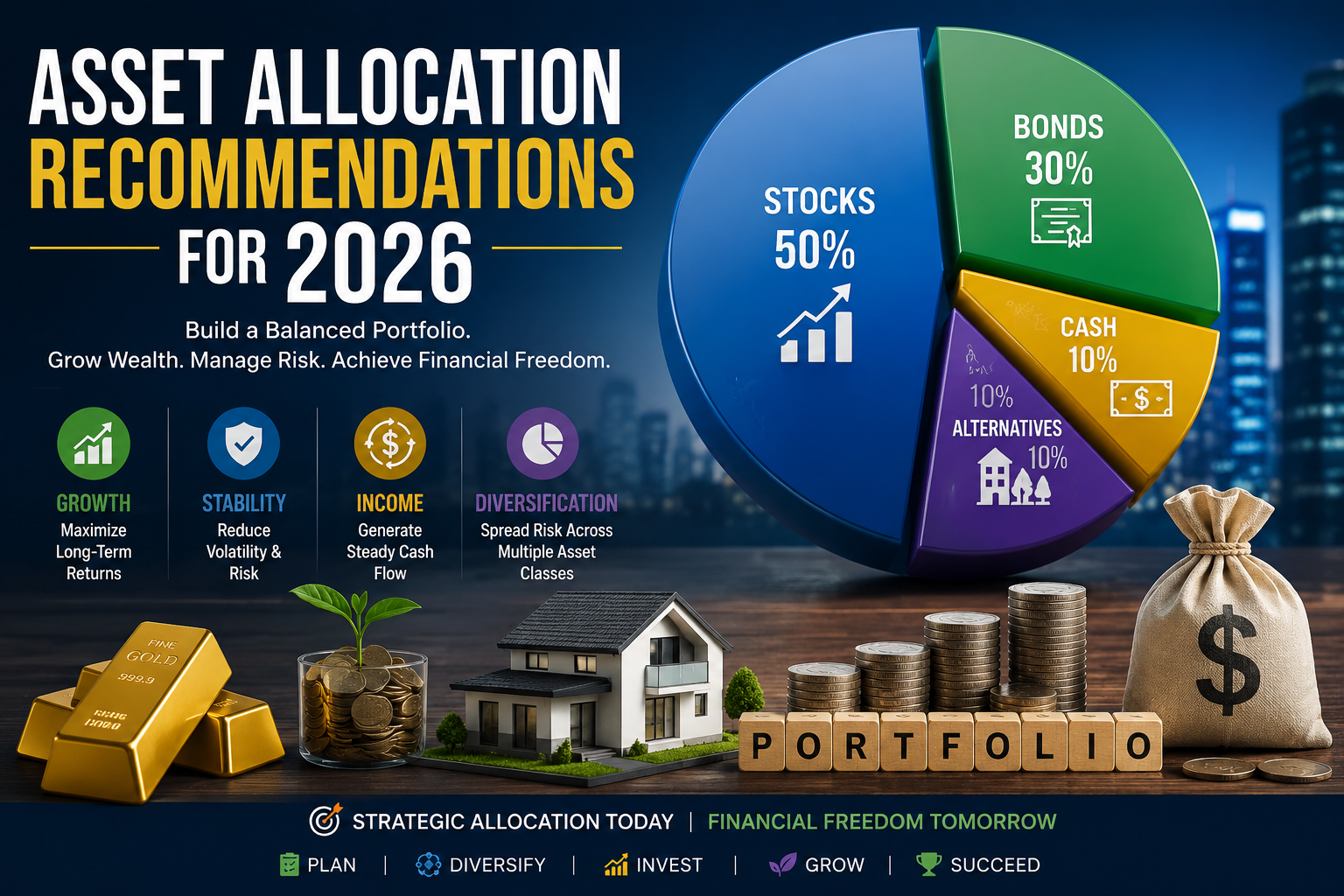
Asset Allocation Recommendations for 2026 are becoming increasingly important as investors navigate inflation, interest rates, economic uncertainty, and rapidly evolving financial markets. A well-diversified portfolio allocation strategy can help investors balance risk and reward while pursuing long-term wealth creation.
Successful investing is not simply about finding the next winning stock or predicting market movements. Research from leading institutions such as the Vanguard Group, BlackRock, and Morningstar consistently shows that asset allocation is one of the most important drivers of long-term portfolio performance.
Investors often focus heavily on stock selection while ignoring the broader question:
How should investment capital be divided among stocks, bonds, cash, and alternative assets?
This process is known as asset allocation.
As global markets enter 2026, investors face:
- Higher interest rates than the previous decade
- Ongoing inflation concerns
- Geopolitical uncertainty
- AI-driven technological transformation
- Evolving retirement planning needs
- Greater access to alternative investments
Because of these factors, portfolio allocation decisions may matter more than ever.
This guide explains:
- What asset allocation means
- Why it matters
- Asset classes explained
- Portfolio allocation models
- Recommended allocations for different risk levels
- Real-world case studies
- Historical statistics
- Expert insights
- Common mistakes
- Rebalancing strategies
- Frequently asked questions
By the end, you’ll understand how to build a diversified portfolio designed for long-term wealth creation.
What Is Asset Allocation?
Asset allocation is the process of dividing investment capital among different asset classes.
The objective is balancing:
- Risk
- Return
- Liquidity
- Volatility
- Investment goals
Instead of investing 100% into one asset type, investors spread money across multiple categories.
Example:
$100,000 portfolio:
- Stocks = 60%
- Bonds = 25%
- Cash = 10%
- Alternatives = 5%
This reduces concentration risk while improving portfolio resilience.
The Four Asset Classes in a 2026 Portfolio
Before creating an allocation strategy, investors must understand the major asset classes.
1. Stocks (Equities)
Stocks represent ownership in a company.
When investors buy shares, they become partial owners.
Examples:
- Apple Inc.
- Microsoft Corporation
- NVIDIA Corporation
- Amazon.com Inc.
Benefits
- High growth potential
- Dividend income
- Inflation protection
- Long-term wealth creation
Risks
- Market crashes
- Volatility
- Economic recessions
Historically, U.S. stocks have returned approximately 9–10% annually over long periods.
2. Bonds (Fixed Income)
Bonds are loans made to governments or corporations.
Examples:
- U.S. Treasury Bonds
- Corporate Bonds
- Municipal Bonds
Benefits
- Income generation
- Lower volatility
- Capital preservation
Risks
- Interest rate risk
- Inflation risk
- Credit risk
Bonds often perform differently than stocks, helping reduce portfolio volatility.
3. Cash and Cash Equivalents
Cash includes:
- Savings accounts
- Money market funds
- Treasury bills
Benefits
- Stability
- Liquidity
- Emergency access
Risks
- Inflation erosion
- Lower long-term returns
Cash provides flexibility during market downturns.
4. Alternative Investments
Alternative assets include investments outside traditional stocks and bonds.
Examples:
Real Estate
Commercial property
Residential rentals
REITs
Commodities
- Gold
- Silver
- Oil
- Agriculture
Private Equity
Investments in private businesses.
Infrastructure
Roads, airports, utilities.
Hedge Funds
Actively managed investment strategies.
Benefits include diversification and potential inflation protection.
Why Asset Allocation Matters
Many investors wrongly believe stock picking determines investment success.
Studies suggest asset allocation has historically explained a significant portion of long-term portfolio outcomes.
Benefits:
Risk Reduction
Different assets react differently to economic events.
Diversification
Smoother Returns
Diversification reduces volatility.
Better Behavioral Control
Less panic during downturns.
Improved Long-Term Performance
Balanced portfolios often outperform emotionally managed portfolios.
The Four Core Portfolio Building Blocks
Think of a portfolio like a house.
Foundation: Cash
Provides stability.
Walls: Bonds
Reduce risk.
Structure: Stocks
Drive growth.
Roof: Alternatives
Provide diversification.
A strong portfolio typically contains all four.
2026 Economic Outlook for Investors
Several economic conditions are relevant when investors review their asset allocation in 2026. These conditions do not automatically determine what an investor should buy or sell, but they can affect the risks and opportunities associated with different asset classes.
Inflation
Inflation remains an important consideration because rising prices can reduce the purchasing power of cash and fixed income. Investors should consider their required real return—the return remaining after inflation—when evaluating long-term portfolio goals.
Interest Rates
As of July 29, 2026, the Federal Reserve maintained the federal funds target range at 3.50%–3.75%. The Federal Reserve also stated that inflation remained elevated relative to its 2% longer-run goal and that economic uncertainty remained elevated.
For investors, interest-rate conditions can affect bonds, cash yields, borrowing costs, and equity valuations. The appropriate response depends on the investor’s objectives and time horizon rather than on a simple prediction about the next rate move.
Economic Growth
The Federal Reserve reported in July 2026 that economic activity was expanding at a solid pace, while also noting elevated uncertainty. Investors should therefore consider both growth potential and downside risk when reviewing portfolio allocations.
Artificial Intelligence
AI and related capital investment are important considerations for investors because technological developments can affect productivity, business models, capital spending, and valuations. However, investors should avoid assuming that every AI-related company or sector will outperform.
Geopolitical Uncertainty
Geopolitical developments can affect energy prices, inflation, economic activity, and financial markets. The Federal Reserve specifically noted elevated uncertainty partly related to conflict in the Middle East in its July 2026 statement.
Retirement and Demographic Trends
Longer retirement periods can increase the importance of balancing growth, income, liquidity, and longevity risk. Retirement investors should consider how long their portfolio needs to support withdrawals rather than relying solely on age-based allocation rules.
Global Diversification
International diversification can reduce dependence on a single country’s economy or market. However, international investments introduce additional currency, political, regulatory, and market risks that investors should understand before investing.
The 2026 environment reinforces the importance of matching asset allocation to goals, time horizon, risk tolerance, and liquidity needs rather than attempting to predict short-term market movements.
12 Asset Allocation Strategies for 2026
The following strategies illustrate different ways investors can divide a portfolio among stocks, bonds, cash, and other assets. There is no single allocation that is appropriate for everyone. The right mix depends on factors such as investment horizon, financial goals, risk tolerance, income needs, and ability to withstand losses.
1. Conservative Asset Allocation
A conservative allocation emphasizes capital preservation, income, and lower portfolio volatility rather than maximum growth. A typical example might hold a larger share of bonds and cash while maintaining some stock exposure.
Example: 30% stocks, 50% bonds, 15% cash, and 5% alternatives.
May suit: Investors with shorter time horizons, retirees, or investors with lower risk tolerance.
Main benefit: Greater emphasis on stability and income.
Main risk: Lower long-term growth potential and purchasing-power risk from inflation.
2026 consideration: Investors should still evaluate inflation, interest rates, and their need for portfolio income before choosing a conservative allocation.
2. Moderate Asset Allocation
A moderate allocation balances growth and stability by combining a substantial stock allocation with bonds, cash, and potentially a small allocation to alternatives.
Example: 60% stocks, 25% bonds, 10% cash, and 5% alternatives.
May suit: Long-term investors seeking a balance between growth and risk management.
Main benefit: A diversified mix can provide growth potential while reducing reliance on equities alone.
Main risk: The portfolio can still experience significant losses during stock-market declines.
2026 consideration: A moderate allocation may be useful for investors who want meaningful equity exposure without adopting an aggressive portfolio.
3. Growth Asset Allocation
A growth allocation places greater emphasis on stocks because the primary objective is long-term capital appreciation.
Example: 80% stocks, 10% bonds, 5% cash, and 5% alternatives.
May suit: Investors with long investment horizons and higher risk tolerance.
Main benefit: Greater potential for long-term capital growth.
Main risk: Higher volatility and larger potential short-term losses.
2026 consideration: Investors should avoid increasing equity exposure simply because a particular sector or market has recently performed well.
4. Aggressive Growth Allocation
An aggressive growth allocation prioritizes long-term growth and accepts substantial short-term volatility.
Example: 85% stocks, 5% bonds, 5% cash, and 5% alternatives.
May suit: Investors with long time horizons and a high ability and willingness to tolerate market declines.
Main benefit: High exposure to long-term growth assets.
Main risk: Large drawdowns can occur, and investors may be tempted to sell during market declines.
2026 consideration: A high equity allocation should be based on the investor’s long-term plan rather than short-term market expectations.
5. Retirement-Focused Allocation
A retirement-focused allocation considers both growth and the need to protect assets as withdrawals approach or begin. The allocation may gradually become more conservative as the investor approaches the period when portfolio withdrawals are expected.
May suit: Investors approaching retirement or already withdrawing portfolio income.
Main benefit: Balances growth needs with capital-preservation and income considerations.
Main risk: Becoming too conservative too early can increase longevity and inflation risks.
2026 consideration: Investors should consider retirement horizon, expected withdrawals, Social Security or other income sources, inflation, and healthcare costs when determining the allocation.
6. Income-Focused Allocation
An income-focused allocation emphasizes assets that can generate interest, dividends, or other cash flows while retaining enough growth exposure to support long-term purchasing power.
May suit: Retirees and investors who need portfolio income.
Main benefit: Can provide a structured source of portfolio cash flow.
Main risk: High-yield investments can involve greater credit, interest-rate, market, or liquidity risk.
2026 consideration: Investors should evaluate total return rather than selecting investments solely because they advertise high yields.
7. Inflation-Resistant Allocation
An inflation-resistant allocation seeks to reduce the effect of rising prices on purchasing power by combining traditional assets with investments that may respond differently to inflation.
Possible components can include equities, inflation-sensitive bonds, real assets, and a measured allocation to commodities or real estate.
May suit: Investors concerned about purchasing-power risk.
Main benefit: Provides exposure to assets that may behave differently during inflationary periods.
Main risk: Inflation-sensitive assets can still decline and may introduce additional volatility.
2026 consideration: Inflation protection should complement, rather than replace, a diversified long-term allocation.
8. Global Diversification Allocation
A global allocation spreads equity and fixed-income exposure across multiple countries and regions rather than relying entirely on one domestic market.
May suit: Long-term investors seeking geographic diversification.
Main benefit: Reduces dependence on the economic and market performance of a single country.
Main risk: International investments can involve currency, political, regulatory, and market risks.
2026 consideration: Investors should consider international exposure as part of their overall diversification strategy rather than attempting to predict which country will outperform.
9. 60/40 Portfolio Allocation
The traditional 60/40 approach allocates approximately 60% to stocks and 40% to bonds. It is designed to combine long-term equity growth with the diversification and income characteristics of bonds.
May suit: Investors seeking a relatively simple balanced framework.
Main benefit: Easy to understand and maintain.
Main risk: A 60/40 allocation is not risk-free, and both stocks and bonds can decline under certain market conditions.
2026 consideration: Investors should treat 60/40 as a starting framework rather than a universal recommendation.
10. Cash-Reserve Allocation
A cash-reserve strategy maintains a deliberate cash or cash-equivalent allocation to support liquidity, near-term spending, emergencies, or planned investment opportunities.
May suit: Investors with near-term financial needs or those who require greater liquidity.
Main benefit: Provides stability and readily accessible funds.
Main risk: Excessive cash can reduce long-term growth and purchasing-power potential.
2026 consideration: The appropriate cash allocation should be based primarily on financial needs and time horizon rather than attempting to predict the next market decline.
11. Alternative-Asset Allocation
An alternative-asset allocation adds investments outside traditional stocks and bonds, such as real estate, commodities, infrastructure, or other alternatives.
May suit: Investors who understand the additional risks and want another source of diversification.
Main benefit: Some alternatives may have different return drivers from traditional stocks and bonds.
Main risk: Alternatives can involve higher fees, lower liquidity, complexity, leverage, or valuation uncertainty.
2026 consideration: Alternatives should generally be considered as part of a broader portfolio rather than as a replacement for diversified stocks and bonds.
12. Goal-Based Asset Allocation
Goal-based allocation organizes investments around specific financial objectives rather than using one allocation for the entire portfolio.
For example, an investor could use a more conservative allocation for a near-term home purchase and a more growth-oriented allocation for a retirement goal several decades away.
May suit: Investors with multiple financial goals and different time horizons.
Main benefit: Connects investment risk with the timing and importance of each financial goal.
Main risk: Managing several portfolios or “buckets” can become unnecessarily complicated.
2026 consideration: Review each goal’s time horizon, required return, liquidity needs, and ability to absorb losses before selecting an allocation.
Recommended Asset Allocation Models for 2026
Important: The allocations below are illustrative examples for educational purposes, not personalized investment advice. The appropriate asset allocation depends on factors such as your financial goals, investment time horizon, risk tolerance, risk capacity, income needs, liquidity requirements, and tax situation. Consider your individual circumstances before making investment decisions.
portfolio table
| Investor Profile | Stocks | Bonds | Cash | Alternatives | Total |
|---|---|---|---|---|---|
| Conservative | 30% | 50% | 15% | 5% | 100% |
| Moderate | 60% | 25% | 10% | 5% | 100% |
| Growth | 80% | 10% | 5% | 5% | 100% |
| Aggressive Growth | 85% | 5% | 5% | 5% | 100% |
Conservative Portfolio
Goal:
Capital preservation.
Allocation:
- Stocks: 30%
- Bonds: 50%
- Cash: 15%
- Alternatives: 5%
Suitable for:
- Retirees
- Income-focused investors
Moderate Portfolio
Goal:
Balanced growth.
Allocation:
- Stocks: 60%
- Bonds: 25%
- Cash: 10%
- Alternatives: 5%
Suitable for:
- Long-term investors
- Retirement savers
Growth Portfolio
Goal:
Maximum long-term appreciation.
Allocation:
- Stocks: 80%
- Bonds: 10%
- Cash: 5%
- Alternatives: 5%
Suitable for:
- Younger investors
- High risk tolerance
Aggressive Growth Portfolio
Allocation:
- 85% Stocks
- 5% Bonds
- 5% Cash
- 5% Alternatives
- Total: 100%
Who it may suit: Investors with long investment horizons and a high tolerance and capacity for market volatility.
Primary objective: Long-term capital growth.
Main advantage: High exposure to growth-oriented assets while maintaining modest allocations to bonds, cash, and alternatives for diversification.
Main risk: This portfolio can experience substantial losses during major stock-market declines.
2026 consideration: Investors should choose an aggressive allocation based on their long-term goals and ability to withstand losses rather than attempting to predict which market sectors will perform best in 2026.
Strategic vs. Tactical Allocation in 2026
Strategic Allocation
Strategic asset allocation establishes long-term target percentages for major asset classes and is generally maintained through different market conditions. For example, an investor might establish a 60% stock, 30% bond, and 10% cash target and periodically rebalance toward those targets.
Tactical Allocation
Tactical allocation makes temporary changes to the target mix based on an investor’s assessment of market conditions. Because tactical decisions require investors to make judgments about markets, they can increase complexity and the risk of making incorrect timing decisions.
Asset Allocation by Investor Type
Age can be one factor in asset allocation, but it should not be used as a standalone formula. Investors should also consider investment horizon, financial goals, income needs, risk tolerance, risk capacity, and expected withdrawals.
Young Investors
Middle-Age Investors
Investors Near Retirement
Retirees
Income-Focused Investors
High-Risk-Tolerance Investors
Example Portfolios for 2026
Case Study 1: The Retired Investor
Investor:
Age 68
Portfolio:
$1 million
Allocation:
- 35% stocks
- 50% bonds
- 10% cash
- 5% alternatives
Result:
Maintained income while reducing volatility during market corrections.
Case Study 2: Young Professional
Age:
28
Investment Horizon:
35 years
Allocation:
- 85% stocks
- 10% alternatives
- 5% cash
Outcome:
Higher short-term volatility but significantly greater long-term growth potential.
Case Study 3: Near Retirement Investor
Age:
58
Allocation:
- 55% stocks
- 30% bonds
- 10% cash
- 5% alternatives
Benefit:
Balanced growth while protecting retirement capital.
Case Study 4: Inflation Protection Portfolio
Allocation:
- 50% stocks
- 20% bonds
- 15% real estate
- 10% commodities
- 5% cash
Outcome:
Improved resilience during inflationary environments.
Case Study 5: Global Diversification Strategy
Allocation:
- U.S. stocks: 40%
- International stocks: 25%
- Bonds: 25%
- Alternatives: 10%
Result:
Reduced dependence on one economy.
Historical Risk and Return Trade-Offs
Then explain qualitatively:
- Equity-heavy portfolios generally have greater volatility and higher long-term growth potential.
- Bond-heavy portfolios generally have lower equity-market exposure but can still experience losses.
- Cash has high liquidity but can lose purchasing power to inflation.
- Diversification can reduce concentration risk but does not eliminate losses.
How to Build a 2026 Asset Allocation
seven-step process:
- Define goals
- Assess risk tolerance
- Choose allocation
- Select investments
- Diversify globally
- Rebalance
- Stay invested
How to Rebalance Your Portfolio in 2026
Annual Rebalancing
Threshold Rebalancing
When to Rebalance
Tax Considerations
Common Asset Allocation Mistakes
Chasing 2026 Market Winners
Buying last year’s winners.
Ignoring Diversification
Holding too much of one asset.
Emotional Investing
Panic selling during downturns.
Never Rebalancing
Allowing portfolio drift.
Holding Excessive Cash
Missing growth opportunities.
Panic selling
Overconcentrating in AI/technology
Ignoring international markets
Taking more risk than necessary
Stocks vs Bonds vs Cash vs Alternatives
| Asset | Growth | Income | Stability |
|---|---|---|---|
| Stocks | High | Medium | Low |
| Bonds | Medium | High | Medium |
| Cash | Low | Low | High |
| Alternatives | Medium-High | Medium | Medium |
Building Your Own Portfolio
Step 1:
Define goals.
Step 2:
Assess risk tolerance.
Step 3:
Choose allocation.
Step 4:
Select investments.
Step 5:
Diversify globally.
Step 6:
Rebalance regularly.
Step 7:
Stay invested.
Future Trends Affecting Asset Allocation
Artificial Intelligence
Transforming productivity and earnings.
Digital Assets
Growing institutional interest.
Longevity
Longer retirement periods.
Automation
Lower investment costs.
Globalization
Broader investment opportunities.
Key Evidence and Investor Considerations
- Asset allocation should reflect an investor’s time horizon, financial goals, and risk tolerance rather than a one-size-fits-all formula.
- Diversification across asset categories and within those categories can help reduce concentration risk.
- Portfolio weights can drift as different investments produce different returns, which is why investors may periodically rebalance.
- Rebalancing can be performed by selling overweight assets, buying underweight assets, or directing new contributions toward underweight categories.
- Rebalancing decisions should also consider transaction costs and potential tax consequences.
- A long-term allocation should be reviewed when an investor’s financial goals, time horizon, or risk tolerance materially changes.
Sources: U.S. Securities and Exchange Commission and Investor.gov educational guidance on asset allocation, diversification, and rebalancing.
Frequently Asked Questions (FAQs)
What is the best asset allocation for 2026?
There is no universal allocation. A 60/25/10/5 portfolio (stocks, bonds, cash, alternatives) is often appropriate for moderate investors.
How much cash should investors hold?
Typically 5–15% depending on goals and market conditions.
Are bonds attractive again?
Higher yields have improved the attractiveness of fixed-income investments.
Should alternative investments be included?
Many investors benefit from a modest allocation (5–15%) to alternatives for diversification.
How often should portfolios be rebalanced?
Most investors review annually or when allocations drift significantly.
Final Thoughts
Asset allocation remains one of the most important investment decisions investors make. While stock selection and market timing receive the most attention, long-term success often comes from maintaining a disciplined allocation among stocks, bonds, cash, and alternative assets.
For 2026, a diversified portfolio that balances growth opportunities, income generation, liquidity, and risk management is likely to remain the foundation of successful wealth building. Investors who align asset allocation with their goals, risk tolerance, and investment horizon can improve the probability of achieving long-term financial success while reducing the emotional challenges that often derail investment plans.