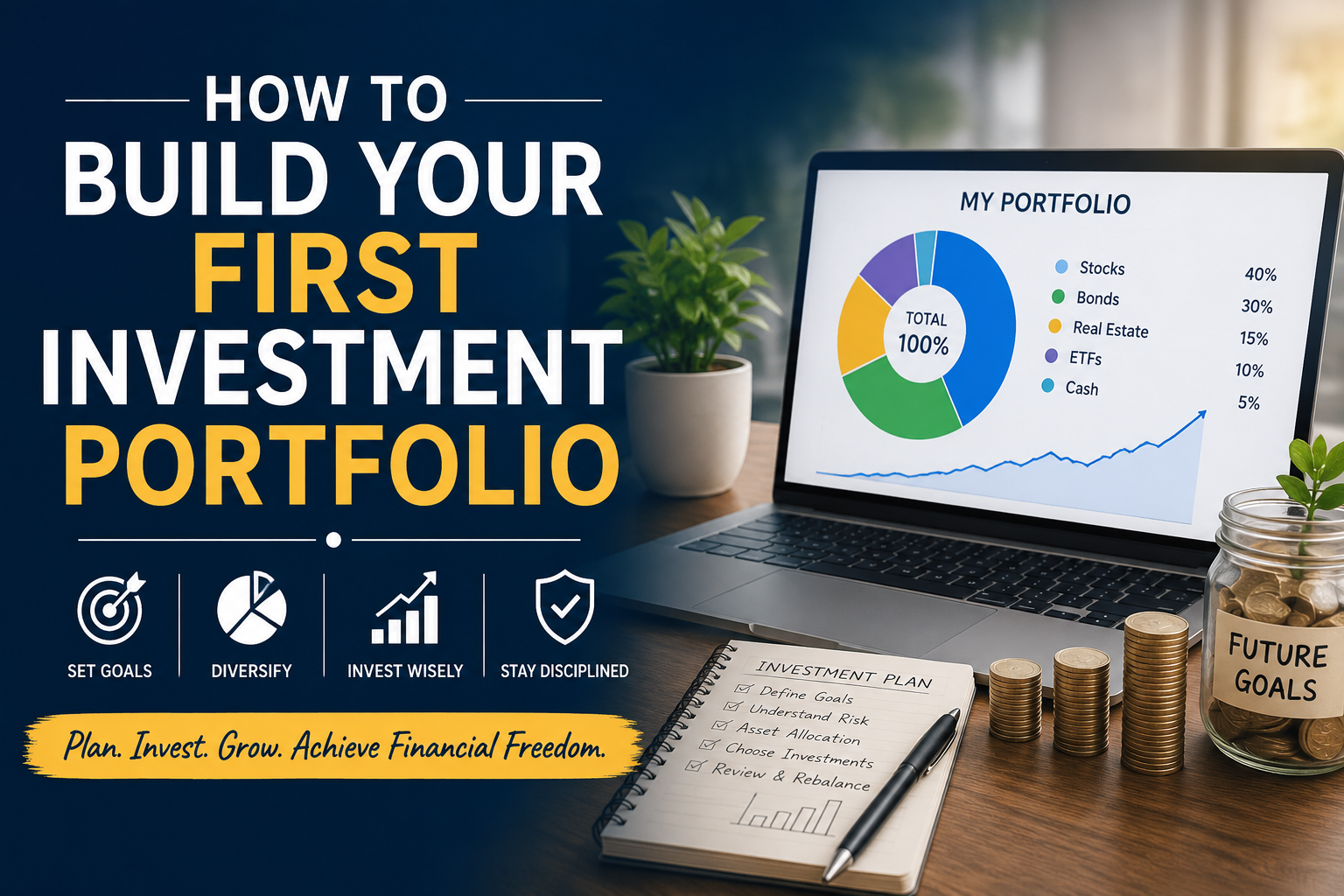
How to Build Your First Investment Portfolio
Building your first investment portfolio can feel intimidating. You open a brokerage app, see thousands of stocks, ETFs, mutual funds, bonds, and retirement products, and suddenly one simple goal—“I want to start investing”—turns into a hundred questions.
- Should you buy individual stocks or index funds?
- How much should go into stocks versus bonds?
- What does diversification actually mean?
- How do you know if your portfolio is too risky—or not risky enough?
- What if you start at the wrong time and the market falls the next week?
These are normal questions, and nearly every investor asks them at the beginning.
The good news is this: building your first investment portfolio does not require predicting the market, choosing the next winning stock, or being a finance expert. In fact, the strongest beginner portfolios are often the simplest. A good first portfolio is not about complexity. It is about clarity, structure, diversification, cost control, and discipline.
At its core, a portfolio is simply a collection of investments you own. Those investments work together toward one purpose: helping you reach your financial goals while balancing growth, risk, liquidity, taxes, and time horizon.
If you’re a beginner in a Tier 1 country such as the United States, United Kingdom, Canada, or Australia, this guide will walk you through the full process of building your first portfolio from scratch. We’ll cover the language of investing, the logic behind asset allocation, how to choose investments, how much to invest, how to rebalance, common mistakes to avoid, and how real people build starter portfolios in practice.
By the end, you should understand not just what to buy, but why it belongs in your portfolio.
1) What Is an Investment Portfolio?
An investment portfolio is the full collection of assets you own for financial growth, income, preservation, or a combination of all three.
Your portfolio may include:
- Stocks (ownership in companies)
- Bonds (loans to governments or companies)
- ETFs (exchange-traded funds)
- Mutual funds
- Cash or cash equivalents
- REITs (real estate investment trusts)
- Target-date funds
- In some cases, alternatives such as commodities or private investments
Think of your portfolio as a financial container. Inside that container are the investments you choose. The job of a portfolio is not simply to “make money.” Its job is to help you reach a specific outcome, such as:
- retirement
- a home deposit
- long-term wealth building
- children’s education funding
- financial independence
- passive income later in life
A portfolio is not just a list of random investments. A real portfolio has a structure. That structure is usually built around:
- goals
- time horizon
- risk tolerance
- asset allocation
- diversification
- cost efficiency
- tax efficiency
That is what separates “buying a few stocks” from building an investment portfolio.
2) Why Building a Portfolio Matters
A lot of beginners start investing in a fragmented way. They buy a stock because it is trending. Then an ETF because someone on YouTube recommended it. Then a tech stock. Then a dividend stock. Then maybe a crypto asset. After a few months, they own several investments—but they do not actually know what their portfolio is supposed to do.
That is the problem a portfolio solves.
A portfolio gives your money direction.
Instead of asking:
“What should I buy next?”
you start asking:
“What role does this investment play in my plan?”
That shift is huge.
A well-built portfolio helps you:
1. Match your money to your goals
If you need money in 2 years for a home deposit, you should not invest it the same way as money meant for retirement in 30 years.
2. Control risk instead of guessing
You cannot eliminate market risk, but you can decide how much volatility you are willing and able to accept.
3. Diversify instead of concentrating
A portfolio prevents you from betting your financial future on one stock, one sector, or one country.
4. Stay disciplined during market volatility
When the market drops, a written portfolio strategy helps you avoid panic-selling.
5. Measure progress
A portfolio gives you benchmarks, target allocations, and a framework for reviewing your progress over time.
3) Before You Invest: The 6 Foundations You Must Set First
Before building your first portfolio, make sure you have the financial basics in place. Investing is powerful, but investing without a foundation can backfire if you are forced to sell during an emergency.
Foundation 1: Build an emergency fund
An emergency fund is cash set aside for unexpected expenses such as:
- job loss
- medical bills
- urgent travel
- car repairs
- home repairs
A common starting target is 3 to 6 months of essential expenses, though this varies by job stability, family size, and risk tolerance.
Foundation 2: Pay down toxic high-interest debt
If you have credit card debt at very high interest rates, paying that down is often a higher-priority “guaranteed return” than investing aggressively.
Foundation 3: Know your monthly cash flow
You need to know:
- how much you earn
- how much you spend
- how much you can invest consistently
Foundation 4: Clarify your short-, medium-, and long-term goals
Your investment portfolio should serve real goals—not vague motivation.
Foundation 5: Understand your employer retirement benefits
In countries like the U.S., U.K., Canada, and Australia, workplace retirement plans and tax-advantaged accounts can dramatically improve long-term outcomes.
Foundation 6: Separate investing from speculation
If you want to “try” a few speculative ideas, keep them in a small satellite bucket. Your core portfolio should be built for long-term compounding, not entertainment.
4) Investment Terms Every Beginner Should Understand
If you are building your first portfolio, you need to understand the language. Here are the most important terms explained in plain English.
Asset
An asset is anything you own that has value. In investing, assets include stocks, bonds, funds, and cash.
Asset Class
An asset class is a category of investments that behave similarly.
Main asset classes include:
- Equities / Stocks
- Fixed income / Bonds
- Cash / cash equivalents
- Real assets such as property-related investments or commodities
Equity / Stock
A stock (also called an equity) represents partial ownership in a company. If you own shares of a business, you participate in its growth and risks.
Example: If you buy shares of a global index ETF, that ETF may own small pieces of hundreds or thousands of companies.
Bond
A bond is a loan you make to a government or company. In exchange, the issuer pays interest and eventually returns your principal at maturity.
Bonds are often used for:
- stability
- income
- lowering portfolio volatility
- capital preservation compared with stocks
ETF (Exchange-Traded Fund)
An ETF is a fund that holds a basket of investments and trades on a stock exchange like a stock.
An ETF may hold:
- the entire U.S. stock market
- the S&P 500
- global stocks
- government bonds
- dividend-paying companies
- a blend of multiple assets
For beginners, ETFs are often one of the easiest ways to build diversified portfolios.
Mutual Fund
A mutual fund pools money from many investors and invests according to a stated objective. Many retirement accounts use mutual funds.
Index Fund
An index fund is a fund designed to track an index such as:
- S&P 500
- FTSE All-World
- MSCI World
- TSX index benchmarks
- ASX-related benchmarks
Index funds aim to match market performance rather than beat it through active stock picking.
Diversification
Diversification means spreading your money across different investments so that one weak investment does not destroy your entire portfolio.
You can diversify by:
- asset class
- sector
- company size
- geography
- investment style
- maturity/duration (for bonds)
Asset Allocation
Asset allocation is how you divide your portfolio among major asset classes.
Example:
- 80% stocks
- 20% bonds
or
- 60% stocks
- 30% bonds
- 10% cash
Asset allocation is one of the most important decisions in portfolio construction because it shapes both your potential return and your volatility.
Risk Tolerance
Risk tolerance is your emotional ability to handle market ups and downs without making destructive decisions.
Risk Capacity
Risk capacity is your practical ability to take risk based on your financial situation. A 24-year-old with stable income and a 30-year time horizon usually has higher risk capacity than someone retiring in 3 years.
Volatility
Volatility refers to how much an investment price moves up and down. Stocks are generally more volatile than bonds or cash.
Rebalancing
Rebalancing means bringing your portfolio back to its target allocation after market movements change the percentages.
Example:
If your target is 80% stocks / 20% bonds, but a strong stock rally pushes it to 88% stocks / 12% bonds, you may rebalance back toward your target.
Expense Ratio
An expense ratio is the annual fee charged by a fund as a percentage of assets invested.
Example:
- A 0.05% expense ratio means $5 per year for every $10,000 invested.
- A 1.00% expense ratio means $100 per year for every $10,000 invested.
Over decades, fees matter enormously.
Dividend
A dividend is a payment some companies make to shareholders from profits.
Yield
Yield usually refers to income produced by an investment, often expressed as a percentage.
Capital Gain
A capital gain is the profit you make when you sell an investment for more than you paid.
Dollar-Cost Averaging
Dollar-cost averaging (DCA) means investing a fixed amount on a regular schedule—such as monthly—regardless of whether markets are up or down.
5) Step 1: Define Your Investment Goal
Before choosing investments, answer one question:
“What is this portfolio for?”
That question matters because different goals require different portfolio designs.
Common beginner goals
- Retirement in 20–40 years
- House deposit in 5–7 years
- Building wealth over the long term
- Passive income in the future
- Education funding for children
- A “freedom fund” for career flexibility
Your goal determines:
- how much risk you should take
- how much liquidity you need
- whether stocks or bonds should dominate
- what account type to use
- how often you’ll add money
Example
Goal A: Retirement in 30 years
A long horizon often allows a higher stock allocation.
Goal B: House deposit in 3 years
This money usually needs more stability and less equity risk.
Goal C: Child university fund in 12 years
A blended portfolio may make sense, gradually becoming more conservative over time.
Rule: Never build a portfolio without naming the goal first.
6) Step 2: Know Your Time Horizon
Your time horizon is how long you expect to keep the money invested before needing it.
Why time horizon matters
Stocks can be excellent long-term investments, but they can also fall sharply in the short term. If you need your money soon, you may not have time to recover from a market drop.
General framework
Short-term horizon: 0–3 years
Money needed soon usually belongs in safer vehicles such as:
- high-yield savings
- short-duration fixed income
- cash equivalents
- low-volatility holdings
Medium-term horizon: 3–10 years
You may use a mixed portfolio depending on flexibility and risk tolerance.
Long-term horizon: 10+ years
Longer horizons generally support greater stock exposure because you have more time to ride out volatility.
7) Step 3: Understand Risk Tolerance and Risk Capacity
A beginner mistake is assuming risk is just about courage. It is not. You need to assess both:
A) Risk tolerance = emotional comfort
How would you feel if your portfolio dropped 20% in a bear market?
Would you:
- keep investing calmly?
- feel nervous but stay invested?
- panic and sell everything?
B) Risk capacity = financial ability
How much risk can your life situation realistically support?
Questions to ask:
- How stable is your income?
- Do you have dependents?
- Do you have an emergency fund?
- When will you need this money?
- Do you have other savings?
Why both matter
A person may have high risk capacity but low emotional tolerance. Another may be comfortable with risk but actually cannot afford major losses because they need the money soon.
The right portfolio is where your goals, timeline, emotional tolerance, and financial reality overlap.
8) Step 4: Choose Your Asset Allocation
This is one of the most important parts of building your first investment portfolio.
What is asset allocation?
Asset allocation is the split of your portfolio across major asset classes.
Example:
- 90% stocks / 10% bonds
- 80% stocks / 20% bonds
- 60% stocks / 40% bonds
- 40% stocks / 60% bonds
Why asset allocation matters so much
Asset allocation drives:
- expected return
- expected volatility
- drawdown severity
- income profile
- how comfortable you feel during market stress
A more stock-heavy portfolio generally offers higher long-term growth potential but also bigger short-term swings. A more bond-heavy portfolio generally offers more stability but usually lower long-term growth.
Investor education resources from FINRA and Vanguard consistently emphasize that beginners should align their allocation with goals, time horizon, and risk tolerance, and use diversification and periodic rebalancing to manage risk rather than relying on hot tips or concentration bets.
9) Three Simple Beginner Allocation Models
These are not universal rules, but they are useful starting frameworks.
1. Aggressive growth portfolio
Example allocation: 80% stocks / 20% bonds
Best suited for:
- younger investors
- long time horizons
- retirement-focused portfolios
- investors who can tolerate volatility
Pros
- higher long-term growth potential
- stronger inflation-fighting power
- easier to compound over decades
Cons
- can fall sharply in bear markets
- emotionally harder to hold during downturns
2. Moderate balanced portfolio
Example allocation: 60% stocks / 40% bonds
Best suited for:
- investors who want growth but also stability
- medium to long-term goals
- beginners who know they dislike large drawdowns
Pros
- smoother ride than an all-stock portfolio
- still provides meaningful growth potential
- psychologically easier for many investors
Cons
- lower expected long-term return than a stock-heavy portfolio
- may feel too conservative for very young investors with long horizons
3. Conservative portfolio
Example allocation: 40% stocks / 60% bonds
Best suited for:
- short-to-medium time horizons
- lower risk tolerance
- investors nearing the need date for the money
Pros
- lower volatility
- greater emphasis on preservation and income
Cons
- lower long-term growth
- may struggle to outpace inflation over very long periods
10) Step 5: Pick the Right Investment Account Type
Your account type matters because it affects taxes, flexibility, contribution limits, and sometimes employer benefits.
Below is a broad Tier 1 overview. Rules vary by country and account provider, so always confirm current tax rules locally.
11) Portfolio Accounts in Tier 1 Countries
United States
Common account types include:
- 401(k) / workplace retirement plans
- Traditional IRA
- Roth IRA
- Taxable brokerage account
- 529 plans for education
Typical beginner priority order in the U.S.
- Capture employer 401(k) match if available
- Consider tax-advantaged retirement accounts
- Use a taxable brokerage account for additional long-term investing
Employer retirement plans are a major gateway to investing in the U.S. Fund-industry research shows that retirement plans remain one of the most common entry points for mutual fund ownership and long-term investing.
United Kingdom
Common account types include:
- Workplace pension
- Stocks & Shares ISA
- Self-Invested Personal Pension (SIPP)
- General Investment Account
Canada
Common account types include:
- RRSP
- TFSA
- FHSA for first-home savings
- Non-registered investment account
Australia
Common account types include:
- Superannuation
- Brokerage / investment account
- Additional structures depending on income, family, and tax planning
12) A Simple Account-Selection Principle
When possible, use the best tax wrapper available for your goal.
Example:
- Retirement goal → prioritize retirement accounts where appropriate
- Flexible long-term wealth outside retirement → taxable brokerage / general investment account / TFSA / ISA equivalent depending on country
- House goal → consider the specific local tax-advantaged home-saving account if available
A portfolio is not only about what you invest in. It is also about where you hold those investments.
13) Step 6: Choose Your Investments
Now we reach the question beginners usually ask first—but it should come after goals, time horizon, risk, and account selection.
What should actually go inside a beginner portfolio?
For most first-time investors, the simplest approach is to build a portfolio using broad, diversified, low-cost funds rather than trying to select many individual stocks.
That usually means using a mix of:
- Domestic stock market index fund / ETF
- International stock market index fund / ETF
- Bond fund / ETF
- Optional: one-fund solution such as a target-date fund or all-in-one balanced ETF/fund
14) The 4 Building Blocks of a Beginner Portfolio
Building Block 1: Domestic equity fund
This gives exposure to companies in your home market or primary market of focus.
Examples conceptually:
- Total U.S. market fund
- S&P 500 fund
- U.K. equity index fund
- Canadian broad-market fund
- Australian broad-market fund
Building Block 2: International equity fund
This gives exposure outside your domestic market.
Why it matters:
- reduces home-country concentration
- broadens diversification
- gives access to different sectors, economies, and currencies
Building Block 3: Bond fund
A bond allocation helps moderate volatility and may provide stability or income depending on the type of bond fund used.
Common beginner options:
- total bond market fund
- high-quality government bond fund
- investment-grade bond fund
- short-duration bond fund for more stability
Building Block 4: Cash / short-term reserve (optional for certain goals)
If part of your goal is near-term or if you want psychological stability, keeping some money in cash or near-cash can be reasonable.
15) The Simplest Portfolio Structures for Beginners
Option A: One-fund portfolio
Use a single target-date fund or all-in-one asset allocation fund.
Best for:
- absolute beginners
- hands-off investors
- people who want automatic rebalancing
- retirement investors who prefer simplicity
Pros
- instant diversification
- automatic rebalancing
- no need to manage multiple holdings
- easy to automate
Cons
- less customization
- tax placement may be less flexible in taxable accounts
- you don’t control every asset split
Option B: Two-fund portfolio
Example:
- 80% global stock fund
- 20% bond fund
Very simple, very effective.
Option C: Three-fund portfolio
A classic beginner-friendly structure:
- Domestic stock index fund
- International stock index fund
- Bond index fund
This is one of the most practical ways to build a first portfolio because it gives you control without unnecessary complexity.
Option D: Four-fund portfolio
A more customized version may include:
- domestic stock fund
- international developed markets fund
- emerging markets fund
- bond fund
This adds complexity but can be useful if you want more precision.
16) Example Beginner Portfolio Models
Below are educational examples only—not personalized financial advice.
Portfolio Model 1: 90/10 Beginner Growth Portfolio
For a long time horizon and high risk tolerance.
- 55% domestic stock index fund
- 35% international stock index fund
- 10% total bond fund
Who it may suit
- age 20s to 30s
- retirement 25+ years away
- steady income
- comfortable with volatility
Portfolio Model 2: 80/20 Long-Term Portfolio
- 50% domestic stock index fund
- 30% international stock index fund
- 20% bond fund
Who it may suit
- beginner investors who want strong growth but some downside ballast
- long-term wealth builders
- people who know 100% stocks would feel too aggressive
Portfolio Model 3: 60/40 Balanced Portfolio
- 35% domestic stock index fund
- 25% international stock index fund
- 40% bond fund
Who it may suit
- medium-to-long-term investors
- those who prioritize stability
- people with lower risk tolerance
Portfolio Model 4: Home Goal in 5–7 Years
- 30% global stock fund
- 50% short/intermediate high-quality bond fund
- 20% cash or short-term savings
Who it may suit
- investors saving for a house deposit
- people who need partial growth but cannot afford a deep market drawdown close to the goal date
17) How Much of Your Stock Allocation Should Be International?
There is no single perfect number, but a beginner should at least understand the reason for international exposure.
Why add international stocks?
Because relying only on your home country creates concentration risk.
Example:
- A U.S.-only investor is heavily exposed to one market and one currency system.
- A U.K.-only investor is concentrated in a smaller market.
- A Canadian investor can become overexposed to financials, energy, and domestic economic conditions.
- An Australian investor can become concentrated in financials and mining-related sectors.
International exposure helps diversify:
- sectors
- economic cycles
- valuations
- currency exposure
- political/regulatory environments
A practical beginner approach is to hold both domestic and international equities rather than choosing one exclusively.
18) ETFs vs Mutual Funds vs Individual Stocks
ETFs
Best for:
- most modern DIY beginners
- tax-efficient investing in some jurisdictions
- broad diversification
- low costs
- intraday trading flexibility
Pros
- easy to buy
- diversified
- low-cost options widely available
- good for automated portfolios in many brokerages
Cons
- trading flexibility can tempt overtrading
- beginners may buy too many overlapping ETFs
Mutual Funds
Best for:
- retirement accounts
- automated contributions
- employer plans
- investors who prefer simplicity
Pros
- easy automation
- broad access in retirement accounts
- often excellent for long-term investing
Cons
- some active funds have higher fees
- tax efficiency may differ from ETFs depending on country/account
Individual Stocks
Best for:
- experienced investors
- investors who enjoy company analysis
- satellite positions, not necessarily the whole beginner portfolio
Pros
- direct ownership
- possibility of outperforming
- educational if position sizes are small
Cons
- company-specific risk
- easy to become concentrated
- emotionally harder to manage
- much more research required
Best beginner rule
If you want individual stocks, consider keeping them as a small satellite sleeve—for example 5% to 10% of the portfolio—while the core remains diversified index funds.
19) How Much Money Do You Need to Start Investing?
A common beginner myth is that you need thousands of dollars to build a portfolio. In reality, many investors can start with far less, especially if their broker allows:
- fractional shares
- automatic recurring ETF/fund purchases
- low minimum contributions
Better question than “How much do I need?”
Ask:
“How much can I invest consistently every month for the next 5–20 years?”
Consistency often matters more than starting size.
Example
- Starting with $200 per month and increasing contributions over time can be far more powerful than waiting years to “save up enough” to begin.
20) How to Fund Your Portfolio: Lump Sum vs Monthly Investing
There are two common ways to start:
Lump-sum investing
You invest a larger amount all at once.
Good when:
- you already have cash set aside for long-term investing
- your emergency fund is already built
- you are psychologically comfortable entering the market immediately
Dollar-cost averaging (monthly investing)
You invest a fixed amount on a regular schedule.
Good when:
- you are investing from salary income
- you are nervous about market timing
- you want a repeatable system
- you’re building the portfolio gradually
For beginners, monthly automated investing is often ideal because it removes decision fatigue and helps build discipline.
21) How to Build Your First Portfolio Step by Step
Let’s turn all of this into a clear process.
Step-by-Step Portfolio Blueprint
Step 1: Define the goal
Example:
“I’m building a retirement portfolio for 30+ years.”
Step 2: Decide the account
Example:
- retirement account
- ISA / TFSA / brokerage / super-linked investing route depending on country
Step 3: Choose your target asset allocation
Example:
- 80% stocks / 20% bonds
Step 4: Split the stock portion
Example:
- 50% domestic stocks
- 30% international stocks
Step 5: Select actual funds
Example structure:
- domestic broad-market ETF/fund
- international broad-market ETF/fund
- total bond ETF/fund
Step 6: Set a contribution plan
Example:
- invest $500 on the 1st of every month
Step 7: Turn on automation
Automate:
- transfers from bank
- recurring investments if possible
- dividend reinvestment if appropriate
Step 8: Write your portfolio policy in one page
Include:
- goal
- target allocation
- monthly contribution
- rebalance rule
- speculative allocation cap if any
Step 9: Review once or twice a year
Not daily. Not every time headlines turn negative.
Step 10: Rebalance when needed
Bring allocations back to target if they drift materially.
22) How Rebalancing Works
Rebalancing is one of the most important portfolio maintenance habits.
Why portfolios drift
Suppose you start with:
- 80% stocks
- 20% bonds
If stocks perform much better than bonds for two years, your portfolio might become:
- 88% stocks
- 12% bonds
You are now taking more risk than you originally planned.
Rebalancing means restoring your target
You might:
- sell some stocks and buy bonds, or
- direct new contributions toward bonds until the allocation normalizes
Investor education guidance from FINRA and Vanguard consistently treats rebalancing as a core discipline because market moves naturally pull portfolios away from their intended risk profile over time.
Common rebalancing approaches
1. Calendar rebalancing
Review every 6 or 12 months.
2. Threshold rebalancing
Rebalance when an allocation drifts by a chosen amount, such as 5 percentage points.
3. Contribution-based rebalancing
Use new money to buy whichever asset class is below target.
For taxable accounts, rebalancing may create tax consequences, so contribution-based rebalancing can sometimes be more efficient.
23) Why Costs Matter So Much
A 1% annual fee may not sound large, but over decades it can consume a huge share of your gains.
Example concept
Two investors earn the same gross market return, but:
- Investor A pays 0.05% in fund costs
- Investor B pays 1.00% in fund costs
Over 20–30 years, the compounding drag can become massive.
That is why beginner portfolios often emphasize low-cost broad index funds rather than expensive, complex products unless there is a clear reason otherwise.
Fund-industry research continues to show that investors care deeply about diversification and fees when selecting mutual funds, and expense ratios across many fund categories have trended lower over time—good news for long-term investors.
24) Tax Considerations for Tier 1 Investors
Taxes can materially affect your portfolio’s long-term returns, so your investment strategy should consider tax location, tax efficiency, and withdrawal rules.
A) Use tax-advantaged accounts where appropriate
Examples include:
- 401(k), IRA, Roth IRA in the U.S.
- ISA and pension structures in the U.K.
- TFSA / RRSP / FHSA in Canada
- Superannuation in Australia
B) Understand taxable vs tax-sheltered accounts
In a taxable account, you may owe taxes on:
- dividends
- interest
- realized capital gains
C) Consider asset location
Sometimes investors place more tax-inefficient assets in tax-advantaged accounts and more tax-efficient equity index funds in taxable accounts. This can become more relevant as your portfolio grows.
D) Don’t let taxes dominate everything
Tax efficiency matters, but your portfolio still needs to fit your goals and risk profile first.
25) Common Beginner Portfolio Mistakes
Mistake 1: Starting without a goal
A portfolio without a goal becomes random.
Mistake 2: Taking too much risk because of social media
If your portfolio is built from trending ideas rather than your time horizon and risk profile, you’re speculating, not planning.
Mistake 3: Owning too many overlapping funds
Beginners often buy:
- an S&P 500 ETF
- a U.S. total market ETF
- a large-cap growth ETF
- a tech ETF
- a dividend ETF
- another “quality” ETF
This can create the illusion of diversification while still leaving you highly concentrated in the same companies.
Mistake 4: Ignoring bonds or stability assets when they actually fit the goal
Not every portfolio should be 100% stocks.
Mistake 5: Panic-selling in downturns
The portfolio you can stick with is better than the “perfect” portfolio you abandon during a bear market.
Mistake 6: Checking the portfolio too often
If you look at your account 20 times a day, volatility feels larger than it is.
Mistake 7: Chasing performance
Buying what just went up often leads to buying high and selling low.
Mistake 8: Paying high fees without realizing it
Fees are one of the few things you can control.
Mistake 9: Mixing investing money with emergency cash
If an emergency forces you to sell in a bad market, your portfolio strategy breaks down.
Mistake 10: No written investment plan
A one-page portfolio policy can prevent emotional decisions later.
26) 6 Real-World Case Studies: First Portfolio Examples
Below are simplified educational case studies showing how different people might build their first portfolio.
Case Study 1: Emma, 26, U.S., Retirement Investor
Situation
- Salary: $72,000
- Emergency fund: 5 months
- Goal: retirement in 35 years
- Risk tolerance: high but not extreme
- Employer offers 401(k) match
Portfolio strategy
- Contribute enough to get full 401(k) match
- Use low-cost diversified retirement funds
- Target allocation: 90% stocks / 10% bonds
- Stock allocation split between U.S. and international equity funds
Example structure
- 55% U.S. total market index fund
- 35% international equity fund
- 10% bond fund
Why this works
Emma has:
- long time horizon
- stable employment
- emergency savings
- ability to handle volatility
Her biggest risk is not market volatility. It is failing to invest enough early.
Case Study 2: Oliver, 34, U.K., House Deposit in 6 Years
Situation
- Goal: build a house deposit
- Time horizon: 6 years
- Risk tolerance: moderate
- Wants growth, but cannot risk a 40% drawdown close to purchase time
Portfolio strategy
This is not a retirement portfolio, so it should be more conservative.
Example structure
- 35% global stock fund
- 45% bond fund
- 20% cash / short-term savings
Why this works
Oliver still wants some inflation-beating growth, but a large stock allocation could derail the house goal if markets fall right before he needs the money.
Case Study 3: Sophia, 29, Canada, Beginner With Limited Knowledge
Situation
- Wants to start investing but feels overwhelmed
- Can invest CAD 400 per month
- Goal: long-term wealth and retirement
- Prefers a hands-off system
Portfolio strategy
Use a one-fund solution in a tax-advantaged account where appropriate.
Example structure
- A single globally diversified all-in-one balanced or growth ETF/fund depending on risk profile
Why this works
Sophia’s biggest problem is not investment theory—it is decision paralysis. Simplicity increases the chance that she stays consistent.
Case Study 4: Noah, 41, Australia, Late Starter
Situation
- Has focused on mortgage and family expenses
- Wants to accelerate long-term investing
- Moderate risk tolerance
- Has superannuation plus separate brokerage investing
Portfolio strategy
- Keep retirement assets broadly diversified
- Build an additional long-term portfolio outside super
- Use a balanced allocation
Example structure
- 45% domestic broad equity
- 25% international equity
- 25% bonds
- 5% cash / optional REIT exposure
Why this works
Noah is not “too late.” He simply needs a portfolio that he can fund aggressively and stick with consistently.
Case Study 5: Ava, 24, U.S., Wants Some Individual Stocks Too
Situation
- New investor
- Loves researching companies
- Also wants a sensible long-term plan
- Risk tolerance: high
- Concern: may overconcentrate in tech
Portfolio strategy
Use a core-satellite approach.
Example structure
- 85% core diversified index portfolio
- 50% U.S. total market
- 25% international
- 10% bonds
- 15% “satellite” for individual stock ideas
Why this works
Ava gets the educational and emotional satisfaction of stock picking without putting the entire portfolio at risk.
Case Study 6: James and Mia, 37 and 35, U.K., Family Wealth Portfolio
Situation
- Two incomes
- One child
- Long-term goals: retirement + future education costs
- Prefer moderate risk
- Need both growth and structure
Portfolio strategy
Split goals into separate buckets:
- retirement portfolio
- child education / medium-term fund
- emergency reserve in cash
Example retirement structure
- 70% equities
- 30% bonds
Example education fund structure
- 50% equities
- 35% bonds
- 15% cash
Why this works
Their mistake would be mixing all goals into one pot. Separate buckets create clearer risk management.
27) Portfolio Templates by Goal
A) First Retirement Portfolio (Long Horizon)
Possible range: 80–100% stocks depending on risk tolerance
Simple structure:
- domestic broad stock fund
- international broad stock fund
- optional bond allocation
B) Wealth-Building Portfolio Outside Retirement
Possible range: 70–90% stocks, 10–30% bonds depending on flexibility and goals
C) House Deposit Portfolio (3–7 Years)
Likely more conservative:
- lower stock allocation
- higher bond / short-duration fixed-income allocation
- cash reserve
D) Financial Independence Portfolio
Often still growth-oriented in accumulation years, but may include a thoughtful bond allocation and cash buffer depending on withdrawal timeline.
28) What Statistics and Research Tell Beginners
A beginner does not need to memorize endless market statistics, but a few facts are useful because they reinforce good portfolio behavior.
1. Investing is mainstream, not niche
In the U.S., regulated funds and mutual funds are widely held by households, and ownership has expanded over time across middle-income families. Industry data reported 76.0 million U.S. households owned U.S.-registered investment companies in 2025, and 72.7 million households owned mutual funds.
2. Retirement plans are a major investing gateway
A large share of mutual fund–owning households hold funds inside employer-sponsored retirement plans, which shows why workplace plans are often the best first investing platform for beginners.
3. Diversification and low cost matter to investors
Recent ICI research found that mutual fund investors place heavy emphasis on diversification, investment objective, risk level, and fees/expenses when selecting funds.
4. Asset allocation and rebalancing are not “advanced” topics—they are beginner essentials
Investor education guidance from FINRA and Vanguard consistently highlights:
- align investments with goals
- diversify across asset classes
- rebalance periodically
- avoid concentration risk
- choose a portfolio appropriate for time horizon and risk tolerance
5. Long-term investing works best when behavior is stable
Recent reporting on Vanguard retirement-plan behavior found most participants did not make frequent trades even during volatility, reinforcing a powerful lesson: staying invested and using diversified managed options can help investors avoid self-sabotage.
29) Expert Principles That Matter More Than Finding “The Best Stock”
You do not need a celebrity investor quote to build a strong first portfolio. What matters is the set of principles that many experienced investors, fiduciary planners, and evidence-based portfolio builders agree on.
Principle 1: Start with goals, not products
Products come after planning.
Principle 2: Diversification is a risk-management tool, not a return guarantee
Diversification does not eliminate losses. It reduces the chance that one mistake destroys the whole portfolio.
Principle 3: Your behavior is part of your portfolio
A mathematically strong portfolio that causes you to panic-sell is not the right portfolio for you.
Principle 4: Costs compound too
Low fees leave more of the return in your pocket.
Principle 5: Simplicity beats complexity for beginners
A three-fund portfolio held for 20 years can outperform a chaotic collection of trendy trades.
Principle 6: Rebalancing is discipline in action
It keeps your portfolio aligned with the risk level you originally chose.
Principle 7: The first portfolio is not permanent
You are allowed to improve your portfolio as your life changes and your knowledge grows.
30) A Beginner Portfolio Checklist
Use this checklist before funding your first portfolio.
Portfolio Setup Checklist
- I know the exact goal of this portfolio
- I know the time horizon
- I have an emergency fund or a plan to complete one
- I understand my risk tolerance
- I chose the right account type for the goal
- I chose a target asset allocation
- I selected diversified low-cost investments
- I know how much I will invest monthly
- I have a rebalancing rule
- I know how often I will review the portfolio
- I understand that downturns are normal
31) Example of a One-Page Portfolio Policy Statement
You do not need a formal 20-page investment policy. A one-page version is enough.
Sample
Goal: Retirement in 30+ years
Account: Retirement account + brokerage overflow
Monthly contribution: $600
Target allocation: 80% equities / 20% bonds
Equity split: 50% domestic / 30% international
Bond split: 20% total bond market
Rebalance rule: Review every January and July; rebalance if any asset class drifts by 5 percentage points
Speculative cap: No more than 10% of portfolio in individual stocks
Emergency fund: Maintain 6 months of expenses outside the portfolio
Behavior rule: No selling based on headlines alone
This kind of document is simple, but it can save you from emotional decisions later.
32) Frequently Asked Questions
1. What is the best first investment portfolio for a beginner?
For many beginners, the best first portfolio is a simple diversified portfolio of low-cost index funds or ETFs, often built around domestic stocks, international stocks, and bonds. A one-fund target-date or all-in-one fund can also be excellent for beginners who want simplicity.
2. Should I invest in stocks or ETFs first?
If you are a beginner, broad ETFs or index funds are often a better starting point than building a portfolio entirely from individual stocks. They provide instant diversification and reduce company-specific risk.
3. How many investments should be in my first portfolio?
There is no magic number. A beginner can build an excellent portfolio with:
- 1 fund
- 2 funds
- or 3 funds
You do not need 20 holdings to be diversified if your funds already hold hundreds or thousands of securities.
4. Is 100% stocks too risky?
It depends on your time horizon, risk tolerance, and financial situation. For some young long-term investors, 100% equities may be reasonable. For others, even 10%–20% in bonds can make the portfolio easier to hold during downturns.
5. How often should I rebalance my portfolio?
A common beginner approach is every 6 to 12 months, or when allocations drift materially from target.
6. Should I wait for a market crash before investing?
Trying to perfectly time the market is difficult and often harmful. Many beginners are better served by starting now with a clear allocation and investing consistently over time.
7. How much should I invest each month?
Invest an amount that is sustainable and repeatable after covering essentials, debt priorities, and emergency savings. The “best” amount is one you can keep contributing through market ups and downs.
8. Can I build a portfolio with $100 or $200 per month?
Yes. Many investors begin with modest monthly contributions and grow their portfolio through consistency and increasing contributions over time.
9. Do I need bonds in my first portfolio?
Not always, but bonds can help reduce volatility and improve portfolio stability. Whether you need them depends on your goal, timeline, and tolerance for market swings.
10. What is the biggest mistake beginners make?
One of the biggest mistakes is buying investments before creating a portfolio plan. Another is panic-selling when markets fall.
33) Final Thoughts: Your First Portfolio Does Not Need to Be Perfect
One of the most damaging beliefs in investing is the idea that you must build the perfect portfolio before you begin.
You do not.
Your first portfolio needs to do only a few things well:
- Match your goal
- Fit your time horizon
- Be diversified
- Keep costs reasonable
- Be simple enough that you can stick with it
- Allow regular contributions and periodic rebalancing
That’s it.
The best first portfolio is not the one that looks impressive on social media. It is the one that keeps you invested for years, then decades.
A portfolio built on broad diversification, appropriate asset allocation, tax awareness, and disciplined contributions may look boring on the surface—but boring is often exactly what works in long-term investing.
If you are just starting, don’t focus on building a portfolio that will impress strangers. Focus on building one that will quietly support your future self.
Start with a goal. Choose a simple allocation. Fund it consistently. Rebalance occasionally. Ignore noise. Let time do the heavy lifting.
That is how first portfolios turn into lifelong wealth-building systems.