1) What Is an ETF? Everything Beginners Need to Know
If you’re learning how to invest, one of the first terms you’ll encounter is ETF. You’ll see it in retirement accounts, investing apps, financial news, YouTube videos, and portfolio recommendations. Advisors often suggest ETFs to beginners. Long-term investors use them to build diversified portfolios. Even experienced traders use them for tactical exposure to specific sectors, countries, commodities, and investment themes.
So, what is an ETF?
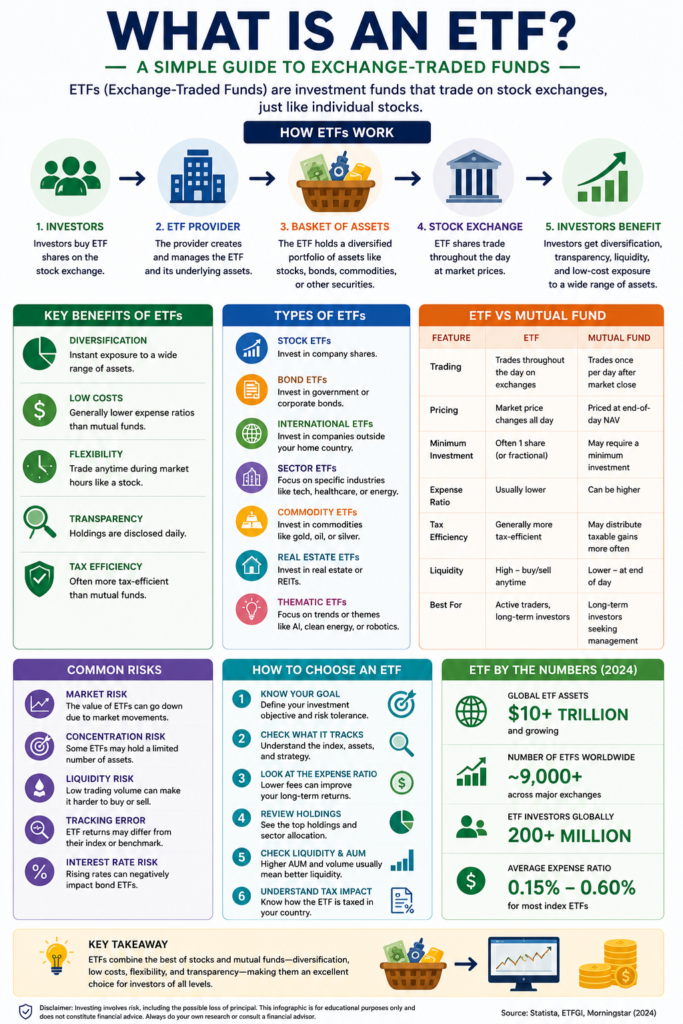
An ETF, or Exchange-Traded Fund, is an investment fund that holds a collection of assets—such as stocks, bonds, commodities, or other securities—and trades on a stock exchange just like a regular stock. Instead of buying one company at a time, an ETF allows you to buy many investments in one purchase.
That single sentence is the foundation, but to really understand ETFs, you need to unpack every part of it:
- What does exchange-traded mean?
- What exactly is a fund?
- How is an ETF different from a stock?
- Why do ETFs often cost less than many traditional funds?
- Are ETFs safe?
- How do dividends, taxes, and fees work?
- Which ETFs do beginners typically use?
- When should you use ETFs instead of individual stocks?
This guide answers all of those questions. It’s designed as a pillar article for beginners and intermediate investors in Tier-1 markets such as the United States, Canada, the United Kingdom, and Australia, where ETFs are widely available through brokerage accounts, retirement plans, and robo-advisors.
By the end of this guide, you’ll understand:
- What an ETF is
- How ETFs work behind the scenes
- Why ETFs are popular for long-term investing
- What types of ETFs exist
- How ETF fees, liquidity, and taxes work
- The biggest ETF risks to avoid
- How to choose your first ETF
- How real investors use ETFs in different life situations
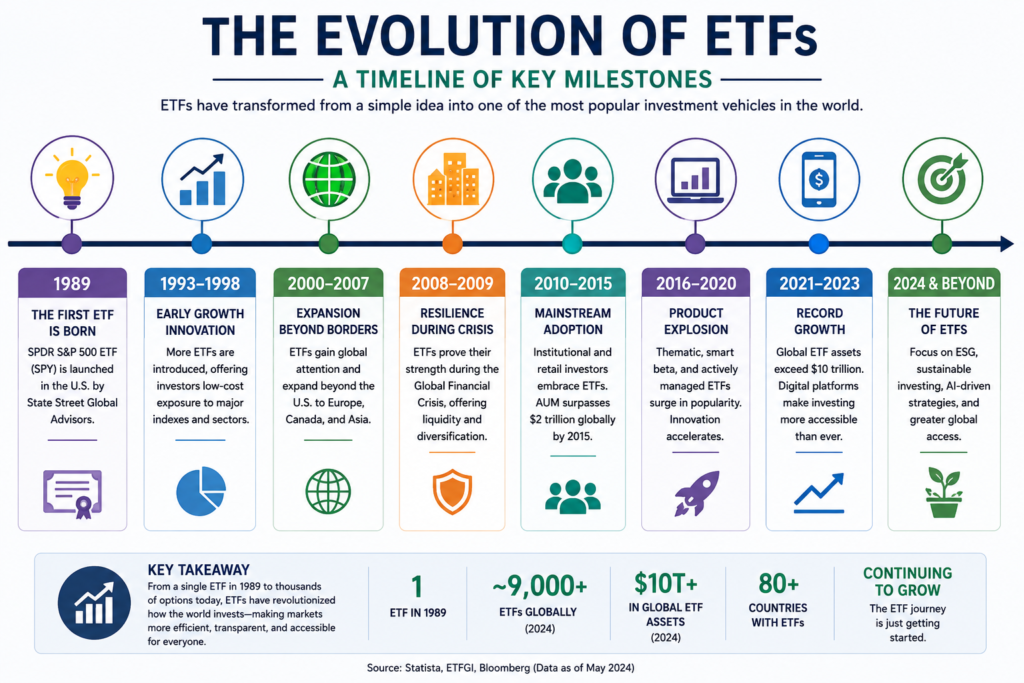
This guide is part of our comprehensive ETFs & Index Funds hub, where you’ll learn everything about ETFs, index funds, diversification, and long-term investing.
An Exchange-Traded Fund (ETF) is an investment fund that trades on a stock exchange. For an official definition, see the SEC’s ETF investor guide.
2) What Is an ETF?
An ETF (Exchange-Traded Fund) is a basket of investments packaged into a single fund that trades on a stock exchange.
Think of an ETF as a container. Inside that container may be:
- 500 large U.S. companies
- thousands of global stocks
- government bonds
- corporate bonds
- gold
- dividend-paying companies
- technology stocks
- healthcare companies
- emerging-market shares
- real estate securities
- a mix of many asset classes
When you buy one share of an ETF, you’re buying a slice of that container and therefore getting exposure to everything inside it.
Simple ETF Example
Imagine you want to invest in the largest 500 U.S. companies. You could try to buy shares in all 500 companies one by one—but that would be slow, expensive, and difficult to manage.
Instead, you could buy an ETF that tracks the S&P 500. With one purchase, you gain exposure to companies such as Apple, Microsoft, Amazon, Alphabet, and hundreds more.
That is the core appeal of ETFs:
One investment can give you instant diversification.
3) ETF Meaning: Breaking Down the Term
To fully understand ETFs, let’s break the phrase Exchange-Traded Fund into its parts.
Exchange
An exchange is a marketplace where investments are bought and sold.
Examples include:
- New York Stock Exchange (NYSE)
- Nasdaq
- London Stock Exchange (LSE)
- Toronto Stock Exchange (TSX)
- Australian Securities Exchange (ASX)
When an ETF is listed on an exchange, investors can buy and sell it during market hours.
Traded
Traded means the ETF can be bought or sold in the market throughout the day, just like a stock.
This matters because mutual funds usually trade only once per day after the market closes, while ETFs can be traded whenever the market is open.
Fund
A fund is a pooled investment vehicle. It collects money from many investors and uses that money to buy a portfolio of assets.
So when we combine the three words:
An Exchange-Traded Fund is a pooled investment vehicle that holds multiple assets and can be bought and sold on a stock exchange throughout the trading day.
4) How ETFs Work
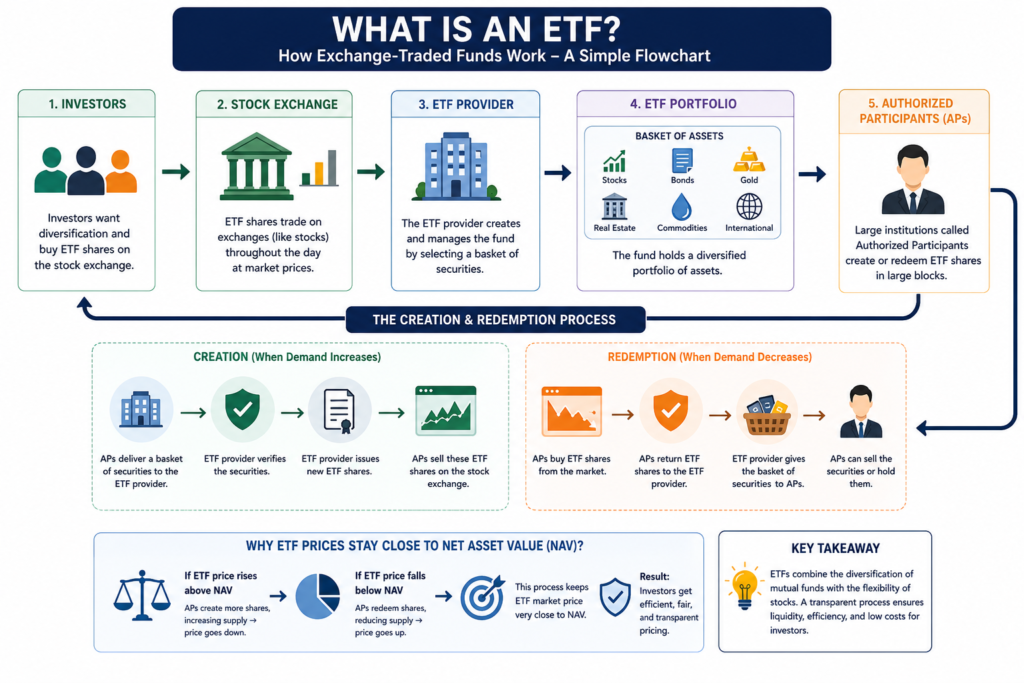
At the investor level, ETFs are simple: you open a brokerage account, type the ticker symbol, and buy shares.
Behind the scenes, however, ETFs have a structure that helps keep their market price close to the value of the assets they hold.
The Two Layers of an ETF
1. The Portfolio Layer
The ETF owns a portfolio of investments according to its strategy.
For example:
- A U.S. total market ETF may own thousands of U.S. stocks.
- A bond ETF may hold government and corporate bonds.
- A gold ETF may hold physical gold or gold-related exposure.
2. The Trading Layer
ETF shares trade on an exchange between buyers and sellers.
So there are two values you should know:
- Market Price: the price investors pay on the stock exchange
- NAV (Net Asset Value): the value of the ETF’s underlying holdings per share
Ideally, these two numbers stay close together.
How ETF Prices Stay in Line: The Creation/Redemption Process
One of the most important ETF concepts is the creation/redemption mechanism.
Large financial institutions called authorized participants (APs) can create new ETF shares or redeem existing ones by exchanging baskets of securities with the ETF issuer.
Why this matters
If an ETF’s market price rises too far above the value of its holdings:
- APs can buy the underlying securities
- exchange them for ETF shares
- sell those ETF shares in the market
- profit from the difference
This tends to push the ETF price back toward fair value.
If the ETF trades below the value of its holdings:
- APs can buy ETF shares
- redeem them for the underlying securities
- profit from the pricing gap
This tends to pull the ETF price back up.
This mechanism is one reason ETFs are considered efficient vehicles.
For additional educational information about ETF trading and investor protections, see FINRA’s ETF guide.
5) ETF vs Stock: What’s the Difference?
Many beginners ask: If ETFs trade like stocks, are they basically the same thing?
Not exactly.
A Stock Represents One Company
When you buy a stock, you’re buying ownership in one business.
Example:
- If you buy Apple stock, your return depends largely on Apple’s performance.
- If Apple disappoints, your investment can fall sharply.
An ETF Represents a Basket
When you buy an ETF, you’re usually buying many companies or securities at once.
Example:
- If you buy an S&P 500 ETF, you’re not betting on one company. You’re buying exposure to 500 large U.S. companies.
Key Difference
- Stock = concentrated risk
- ETF = diversified exposure
That doesn’t mean ETFs can’t lose value—they absolutely can—but the risk is usually spread across many holdings instead of tied to one business.
Stock vs ETF Comparison
| Feature | ETF | Individual Stock |
|---|---|---|
| Number of Holdings | Many investments | One company |
| Diversification | High | Low |
| Risk | Spread across holdings | Company-specific |
| Research Required | Moderate | High |
| Volatility | Usually lower than a single stock | Can be much higher |
| Suitable For | Most long-term investors | Investors comfortable analyzing companies |
6) ETF vs Mutual Fund: Which Is Better?
This is one of the most common investing questions.
ETF vs Mutual Fund Comparison
| Feature | ETF | Mutual Fund |
|---|---|---|
| Full Form | Exchange-Traded Fund | Mutual Fund |
| Trading | Trades throughout the day on stock exchanges | Trades once daily after market close |
| Pricing | Market price changes throughout the day | End-of-day Net Asset Value (NAV) |
| Minimum Investment | Often one share or fractional shares | May require a minimum investment |
| Expense Ratio | Usually lower for passive ETFs | Can be higher, especially for actively managed funds |
| Tax Efficiency | Generally more tax-efficient (varies by country) | May distribute taxable capital gains more often |
| Liquidity | Can be bought or sold during market hours | Redeemed at end-of-day NAV |
| Best For | Long-term investors and traders | Long-term investors seeking professional management |
Similarities
Both ETFs and mutual funds:
- pool investor money
- own a basket of investments
- can track an index or follow an active strategy
- offer diversification
Differences
1. Trading
- ETF: trades throughout the day like a stock
- Mutual fund: bought or sold at the end-of-day NAV
2. Minimum Investment
- ETF: often just the price of one share, or even fractional shares
- Mutual fund: may require a minimum investment
3. Tax Efficiency
In many markets—especially the U.S.—ETFs can be more tax-efficient than traditional mutual funds because of the creation/redemption process.
4. Cost
Many ETFs are extremely low-cost, especially passive index ETFs.
5. Simplicity of Automation
Mutual funds are often easier for automatic fixed-dollar contributions inside certain retirement accounts, although many brokers now allow recurring ETF purchases too.
7) Which Is Better?
There’s no universal winner. But for many modern retail investors, ETFs are attractive because they combine:
- diversification
- low fees
- trading flexibility
- tax efficiency
- broad availability
8) Why ETFs Became So Popular
ETFs have grown from a niche product into one of the most important investment vehicles in the world.
Global ETF assets reached roughly $19.85 trillion at the end of 2025, according to ETFGI, after record annual inflows. Industry data providers and market researchers also show the ETF market has expanded dramatically over the past two decades.
Why investors love ETFs
1. Instant Diversification
Instead of researching and buying dozens or hundreds of securities, one ETF can provide broad exposure.
2. Low Costs
Many broad-market ETFs charge very low expense ratios. That fee advantage compounds over time.
3. Simplicity
ETFs make it easy to build a portfolio using a few core building blocks.
4. Accessibility
You can buy ETFs through many brokers, retirement platforms, and investing apps.
5. Transparency
Many ETFs disclose holdings regularly, so investors can see what they own.
6. Flexibility
There are ETFs for stocks, bonds, dividends, international markets, sectors, inflation protection, commodities, and more.
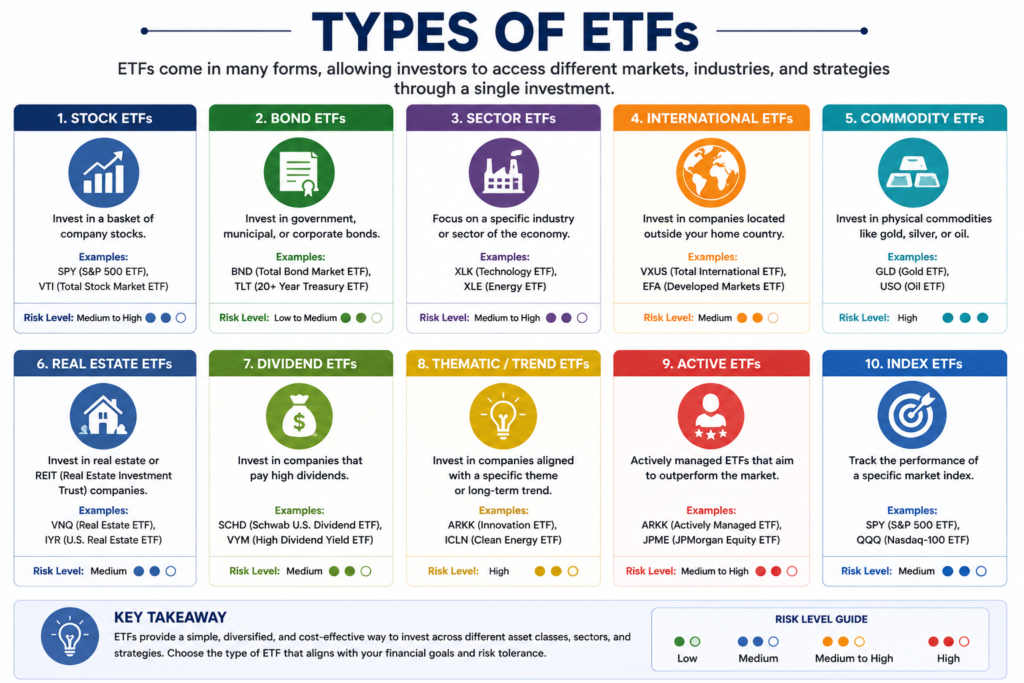
9) Types of ETFs
The word “ETF” is broad. There isn’t just one type of ETF. There are many categories, each with a different purpose.
9.1 Stock ETFs
These ETFs invest in equities (stocks). They are the most common type.
Examples:
- Total U.S. stock market ETFs
- S&P 500 ETFs
- international stock ETFs
- small-cap ETFs
- dividend ETFs
- sector ETFs
9.2 Bond ETFs
These ETFs hold fixed-income securities such as:
- U.S. Treasury bonds
- corporate bonds
- municipal bonds
- international bonds
- inflation-linked bonds
Bond ETFs are often used for:
- income
- stability
- portfolio diversification
- retirement planning
9.3 Index ETFs
An index ETF tracks a market index.
Examples:
- S&P 500
- Nasdaq-100
- FTSE 100
- MSCI World
- Russell 2000
These are usually passive ETFs, meaning they aim to match an index rather than beat it.
9.4 Sector ETFs
These focus on a specific part of the economy:
- technology
- healthcare
- energy
- financials
- industrials
- consumer staples
Useful for investors who want targeted exposure—but they’re more concentrated than total-market ETFs.
9.5 International ETFs
These invest outside the investor’s home country.
Sub-types include:
- developed markets ETFs
- emerging markets ETFs
- region-specific ETFs
- single-country ETFs
International ETFs can improve geographic diversification.
9.6 Dividend ETFs
These focus on companies that pay dividends or have histories of dividend growth.
Popular among:
- income-focused investors
- retirees
- long-term dividend investors
9.7 Commodity ETFs
These provide exposure to assets such as:
- gold
- silver
- oil
- agriculture commodities
Commodity ETFs can behave differently from stock ETFs and may be used for diversification or inflation hedging.
9.8 Real Estate ETFs
These typically invest in REITs or real estate-related securities.
9.9 Thematic ETFs
These focus on a trend or theme such as:
- artificial intelligence
- cybersecurity
- clean energy
- robotics
- blockchain
- space technology
These can be exciting, but they often carry higher risk, narrower diversification, and sometimes higher fees.
9.10 Active ETFs
Unlike passive index ETFs, active ETFs are managed by portfolio managers trying to outperform a benchmark or deliver a specific strategy.
Investors looking for additional educational material about ETF categories can explore the resources available from BlackRock iShares.
| ETF Type | What It Invests In | Risk Level | Best For |
|---|---|---|---|
| Stock ETF | Company shares | Medium to High | Long-term growth |
| Bond ETF | Government and corporate bonds | Low to Medium | Income and stability |
| Dividend ETF | Dividend-paying companies | Medium | Passive income |
| International ETF | Global stocks | Medium | Geographic diversification |
| Sector ETF | One industry (e.g., Technology, Healthcare) | Medium to High | Targeted investing |
| Commodity ETF | Gold, Silver, Oil, etc. | High | Diversification and inflation hedge |
| Real Estate ETF | REITs and property-related securities | Medium | Real estate exposure |
| Thematic ETF | AI, Robotics, Clean Energy, etc. | High | Long-term growth themes |
| Active ETF | Professionally managed portfolio | Medium to High | Active investment strategies |
| Index ETF | Tracks a market index | Medium | Passive investing |
10) The Main Benefits of ETFs
ETFs became popular for a reason. For many investors, they solve several common investing problems at once.
Benefit #1: Diversification
Diversification means spreading your money across multiple investments so that one failure doesn’t destroy your portfolio.
A single stock can collapse because of:
- bad earnings
- fraud
- debt problems
- management mistakes
- regulation
- competition
A broad ETF spreads your exposure across many companies or bonds, reducing company-specific risk.
Benefit #2: Lower Costs
One of the biggest long-term advantages of ETFs is cost control.
Many broad-market ETFs have very low expense ratios. For example, some large U.S. index ETFs charge only a few basis points annually. Reuters recently reported that Vanguard’s S&P 500 ETF (VOO), which became the first ETF to exceed $1 trillion in assets, charges a 0.03% expense ratio.
Many ETF providers also publish educational resources explaining long-term investing and index strategies. The Vanguard Education Center offers beginner-friendly articles on investing fundamentals.
Why low fees matter
Fees reduce returns every single year. A small fee difference may look harmless, but over 20–30 years it can cost investors tens of thousands of dollars.
Benefit #3: Simplicity
Instead of choosing 25 stocks, many investors can start with:
- one total-market ETF
- one international ETF
- one bond ETF
That can be enough for a complete beginner portfolio.
Benefit #4: Transparency
Most index ETFs clearly state:
- what index they track
- their holdings
- expense ratio
- historical performance
- risk profile
Benefit #5: Flexibility
ETFs can be used for:
- long-term investing
- retirement investing
- income portfolios
- tactical sector exposure
- rebalancing
- tax-loss harvesting in some jurisdictions
Benefit #6: Broad Market Access
ETFs allow ordinary investors to access parts of the market that used to be more difficult to buy efficiently:
- international stocks
- bond ladders
- commodities
- real estate baskets
- factor strategies
- entire sectors
11) The Risks of ETFs
ETFs are useful, but they are not risk-free. A beginner guide that only talks about benefits would be incomplete.
Risk #1: Market Risk
If the overall market falls, a stock ETF can fall too.
Example:
- If you own an S&P 500 ETF and the U.S. stock market drops 20%, your ETF can also decline significantly.
Risk #2: Concentration Risk
Not all ETFs are diversified equally.
A total-market ETF may hold thousands of stocks.
A niche thematic ETF might hold only 25–40 companies in one narrow theme.
If you buy a very narrow ETF, you may be taking much more risk than you realize.
Risk #3: Sector Risk
A technology ETF may soar in a bull market but underperform badly during a tech downturn.
Risk #4: Liquidity Risk
Some ETFs trade with wide bid-ask spreads or low volume. That can make buying and selling more expensive.
Risk #5: Tracking Error
An ETF may not perfectly match the index it tracks because of:
- fees
- sampling methods
- cash drag
- rebalancing frictions
- withholding taxes in international markets
Risk #6: Interest Rate Risk in Bond ETFs
Bond ETF prices can fall when interest rates rise.
Risk #7: Complexity Risk
Some ETFs are not beginner products. Examples include:
- leveraged ETFs
- inverse ETFs
- complex derivatives-based products
- highly thematic speculative ETFs
These can behave very differently from plain index ETFs.
Risk #8: Behavioral Risk
ETFs are easy to trade, and that convenience can tempt investors to:
- panic sell during crashes
- chase performance
- overtrade
- buy too many overlapping funds
The ETF itself may be fine; the problem can be the investor’s behavior.
ETF Risk Comparison
| Risk | Description | Who Is Most Affected? |
|---|---|---|
| Market Risk | Entire market declines | All investors |
| Sector Risk | One industry performs poorly | Sector ETF investors |
| Concentration Risk | Too much exposure to a few holdings | Thematic and narrow ETF investors |
| Interest Rate Risk | Rising rates reduce bond prices | Bond ETF investors |
| Currency Risk | Exchange-rate fluctuations affect returns | International ETF investors |
| Liquidity Risk | Difficult to trade without affecting price | Low-volume ETF investors |
| Tracking Error | ETF performance differs from its benchmark | Index ETF investors |
| Behavioral Risk | Emotional buying and selling decisions | All investors |
12) ETF Fees, Costs, and Expense Ratios
What Is an Expense Ratio?
The expense ratio is the annual fee a fund charges, expressed as a percentage of your investment.
Example:
- If an ETF has a 0.10% expense ratio, you pay $10 per year for every $10,000 invested.
This fee is not usually billed to you as a separate invoice. It’s taken from fund assets and reflected in performance over time.
Why Expense Ratios Matter
The lower your costs, the more of your return you keep.
Example
Investor A invests $100,000 in an ETF charging 0.03%
Investor B invests $100,000 in a fund charging 1.00%
If both funds earn the same gross return, Investor A keeps far more over decades because fees compound against Investor B.
ETF Cost Checklist
When evaluating an ETF, don’t look only at the expense ratio. Also consider:
- Bid-ask spread
- tracking error
- broker commissions (if any)
- tax drag
- currency conversion costs for international investors
- premium/discount to NAV
- securities lending practices in some funds
ETF Fee Comparison
| Cost Type | What It Means | Can Investors Reduce It? |
|---|---|---|
| Expense Ratio | Annual management fee | Yes, by choosing lower-cost funds |
| Brokerage Commission | Fee charged by some brokers | Often avoidable with commission-free brokers |
| Bid-Ask Spread | Difference between buying and selling prices | Lower in highly liquid ETFs |
| Currency Conversion Fee | Cost when investing in foreign currencies | Depends on broker and account |
| Tax Costs | Taxes on dividends and capital gains | Depends on country and account type |
13) ETF Liquidity, Bid-Ask Spread, and Trading Volume
This is one of the most misunderstood ETF topics.
Liquidity
Liquidity refers to how easily you can buy or sell an investment without significantly affecting its price.
Bid-Ask Spread
- Bid = the highest price a buyer is willing to pay
- Ask = the lowest price a seller is willing to accept
The difference is the spread.
A tighter spread usually means lower trading friction.
Trading Volume
Higher volume often signals easier trading, but ETF liquidity is also influenced by the liquidity of the underlying securities.
Why it matters
If you’re buying a large position in a niche ETF with a wide spread, your transaction cost can be meaningfully higher.
For long-term investors making small periodic purchases in broad, liquid ETFs, this is usually less of a problem.
14) ETF Dividends and Taxes
Dividends
Some ETFs hold dividend-paying stocks or interest-paying bonds. Those payments may be passed through to investors.
Depending on the ETF, distributions may be:
- monthly
- quarterly
- semi-annually
- annually
What can you do with dividends?
Typically, investors either:
- Take the cash, or
- Reinvest it to buy more shares
Reinvesting can accelerate compounding.
Taxes
Tax treatment depends on:
- your country
- account type
- the ETF’s domicile
- whether distributions are qualified, ordinary, interest-based, or capital gains
- whether you sell at a profit
ETF Tax Comparison
| Tax Topic | ETF | Notes |
|---|---|---|
| Dividend Tax | May apply | Depends on country and account type |
| Capital Gains Tax | Usually applies when shares are sold for a profit | Rules vary by jurisdiction |
| Tax Efficiency | Often high | Particularly for many U.S.-listed ETFs |
| Retirement Accounts | Often tax-advantaged | Depends on local retirement account rules |
| Withholding Tax | May apply to international investments | Depends on tax treaties and fund domicile |
In the U.S.
ETFs are often considered tax-efficient relative to many mutual funds because the creation/redemption mechanism can reduce taxable capital gain distributions.
In the UK, Canada, Australia, and Europe
Tax treatment varies significantly. Some investors need to consider:
- withholding tax
- foreign-domiciled fund rules
- capital gains treatment
- tax-sheltered accounts
- reporting rules
Because taxes are jurisdiction-specific, investors should verify the rules that apply to their residence and account type.
15) Passive ETFs vs Active ETFs
Passive ETFs
A passive ETF tracks an index.
Examples:
- S&P 500 ETF
- total stock market ETF
- global bond index ETF
Goal:
Match market performance, minus fees.
Advantages:
- low cost
- transparency
- simplicity
- historically strong long-term case for broad indexing
Active ETFs
An active ETF is managed by professionals who select securities based on a strategy rather than simply tracking an index.
Goal:
Outperform a benchmark, manage risk differently, or pursue a specialized outcome.
Possible advantages:
- professional judgment
- tactical flexibility
- downside management in some strategies
Possible disadvantages:
- higher fees
- manager risk
- inconsistent performance
Actively managed ETFs have also grown rapidly. ETFGI reported that actively managed ETF assets globally reached $1.73 trillion by September 2025, highlighting strong investor demand for the format.
16) How Beginners Can Use ETFs to Build a Portfolio
For many people, ETFs are the easiest way to build a sensible long-term portfolio without becoming a full-time stock analyst.
Example of a simple beginner ETF portfolio
A beginner could build around three broad components:
1. U.S. or domestic stock ETF
Provides growth exposure to large sections of the stock market.
2. International stock ETF
Adds diversification outside the home market.
3. Bond ETF
Adds stability and can reduce portfolio volatility.
The exact mix depends on:
- age
- time horizon
- risk tolerance
- income stability
- goals
- retirement timeline
Example Allocation
A long-term investor in their 30s might use:
- 70% stock ETFs
- 20% international ETFs
- 10% bond ETFs
A retiree might prefer a more conservative mix.
This is not a universal recommendation—it’s simply an example of how ETFs can be combined as building blocks.
17) How to Choose an ETF
Not all ETFs are equally useful. Here’s a framework for evaluating one.
Step 1: Know Your Goal
Ask:
- Do I want broad long-term growth?
- Do I want income?
- Do I want bond exposure?
- Do I want international diversification?
- Am I speculating on a theme?
Your goal should determine the ETF—not the other way around.
Step 2: Check What It Tracks
Read the ETF description and index methodology.
Questions to ask:
- Is it broad or narrow?
- How many holdings does it have?
- What sectors dominate?
- Which countries are included?
- Is it market-cap weighted, equal-weighted, dividend-weighted, or something else?
Step 3: Look at the Expense Ratio
All else equal, lower cost is usually better for long-term passive exposure.
Step 4: Review Holdings
Some ETFs sound diversified but are actually concentrated in a few names.
Step 5: Review AUM and Liquidity
Larger, more established ETFs often have:
- tighter spreads
- stronger liquidity
- lower closure risk
Step 6: Understand Tax Structure
Especially important for cross-border investors.
Step 7: Avoid Buying What You Don’t Understand
If you cannot explain how the ETF makes money, what it holds, and why you own it, pause.
Before investing, compare an ETF’s holdings, fees, and historical performance using independent research platforms such as Morningstar.
18) ETF Mistakes Beginners Make
Mistake 1: Owning Too Many Overlapping ETFs
A beginner may think five ETFs means five different strategies—but those funds may all hold the same mega-cap U.S. stocks.
Mistake 2: Chasing Last Year’s Winners
Buying a hot ETF after a massive rally often leads to poor entry points.
Mistake 3: Ignoring Fees
A high-fee niche ETF has to overcome its own costs before it benefits you.
Mistake 4: Confusing “ETF” With “Safe”
An ETF is just a wrapper. The risk depends on what’s inside.
A Treasury bond ETF and a leveraged biotech ETF are both ETFs—but they are not remotely the same risk.
Mistake 5: Trading Too Often
ETFs are excellent long-term tools. Many investors reduce their success by using them like lottery tickets.
Mistake 6: Buying a Thematic ETF Instead of a Core ETF
Core ETFs should usually come first. Thematic ETFs, if used at all, are generally satellites—not the foundation.
Mistake 7: Ignoring Asset Allocation
Even the “best ETF” won’t fix a bad portfolio structure.
19) 7 Detailed ETF Case Studies
Case Study 1: The Beginner Who Wanted “One Good Investment”
Profile: Sarah, 28, first-time investor in the U.S.
Goal: Start investing for retirement with minimal complexity
Problem: She felt overwhelmed by stock picking.
What she considered
Sarah initially wanted to buy shares in five famous companies:
- Apple
- Amazon
- Nvidia
- Tesla
- Microsoft
That felt logical because she knew the brands. But this approach had issues:
- concentration risk
- no exposure to other sectors
- no small- or mid-cap companies
- no international diversification
ETF solution
Instead of buying five stocks, Sarah chose a broad market ETF as her portfolio core.
Outcome
- She got instant diversification.
- She reduced company-specific risk.
- She simplified her investing decisions.
- She created a repeatable monthly investing habit.
Lesson
ETFs are often most powerful when they remove decision overload.
Case Study 2: The Investor Who Paid Too Much in Fees
Profile: Daniel, 41, UK investor
Goal: Long-term wealth building in an ISA/SIPP-style framework
Problem: He owned several actively managed funds with fees near 1%+.
Daniel compared his portfolio against low-cost ETF alternatives and realized a major part of his underperformance came from fees.
What changed
He replaced several expensive funds with low-cost index ETFs covering:
- domestic equities
- global equities
- bonds
Why it mattered
Even if performance were similar before fees, the cost savings improved expected long-term compounding.
Lesson
Investors often focus on return but underestimate how powerful cost control is.
Case Study 3: The Retiree Seeking Income
Profile: Linda, 64, Canada
Goal: Generate income without managing dozens of stocks
Problem: She wanted dividends and bond income, but didn’t want to build a complex portfolio from scratch.
ETF solution
Linda used a mix of:
- dividend equity ETFs
- broad bond ETFs
- a small allocation to broad-market equity ETFs for growth
Result
She created a portfolio that was easier to manage, more diversified than a hand-picked dividend stock basket, and better aligned with retirement cash-flow needs.
Lesson
ETFs are useful not only for growth investors, but also for income-focused retirees.
Case Study 4: The Overconfident Thematic Investor
Profile: Marcus, 32, Australia
Goal: Capture explosive growth in AI and clean energy
Problem: He built almost his entire portfolio around thematic ETFs.
What went wrong
His ETFs were heavily concentrated in a narrow set of high-valuation companies. When sentiment reversed, the portfolio fell much harder than the broad market.
What he changed
He rebuilt the portfolio with:
- a broad market ETF core
- an international ETF
- a smaller thematic allocation capped at a modest percentage
Lesson
Thematic ETFs can be interesting, but they are often satellites, not a full portfolio.
Case Study 5: The Investor Who Didn’t Understand Bond ETFs
Profile: Priya, 47, U.S.-based professional
Goal: Add “safe” investments to reduce volatility
Problem: She assumed all bond ETFs would hold their value.
What happened
Interest rates rose sharply. Her long-duration bond ETF declined more than expected.
What she learned
Bond ETFs carry risks too, including:
- duration risk
- credit risk
- inflation risk
Portfolio fix
She diversified across different bond durations and understood that “lower risk” does not mean “no risk.”
Lesson
ETF structure does not eliminate the risks of the underlying asset class.
Case Study 6: The Tax-Aware High Earner
Profile: Michael, 38, U.S.
Goal: Build a taxable portfolio efficiently
Problem: He wanted a low-maintenance, tax-conscious strategy.
ETF approach
He used broad index ETFs in his taxable brokerage account and prioritized:
- low turnover
- tax efficiency
- low expense ratios
Why ETFs helped
Compared with some traditional funds, ETFs offered a more tax-friendly structure for his goals.
Lesson
For taxable investors, after-tax returns matter as much as headline returns.
Case Study 7: The Investor Who Needed a Global Portfolio
Profile: Emma, 35, UK
Goal: Avoid home-country bias
Problem: Her portfolio was too concentrated in domestic stocks.
ETF solution
She used:
- a global developed-market ETF
- an emerging-markets ETF
- a domestic bond ETF
Result
Her portfolio gained exposure to companies and economies outside her home market.
Lesson
ETFs make global diversification far easier than buying foreign securities individually.
20) ETF Statistics and Industry Trends
The ETF market has become one of the defining trends in modern investing.
Key ETF statistics
1. Global ETF assets are enormous and still growing
ETFGI reported that global ETF assets reached a record $19.85 trillion at the end of 2025, with record annual net inflows of $2.37 trillion.
2. ETF growth has accelerated over the last two decades
LSEG Lipper’s 2025 global ETF review showed industry assets rising from roughly $14.1 trillion at the end of 2024 to $18.7 trillion by the end of 2025, driven by both market performance and new inflows.
3. Broad, low-cost equity ETFs continue to dominate
LSEG reported that equity ETFs held the majority of global ETF assets in 2025, far ahead of bond ETFs and other categories.
4. Actively managed ETFs are growing fast
Actively managed ETF assets globally reached $1.73 trillion by September 2025, showing that investors increasingly want active strategies in ETF format.
5. The biggest ETFs are now massive
Reuters reported in June 2026 that Vanguard S&P 500 ETF (VOO) became the first ETF ever to surpass $1 trillion in assets, a major milestone that reflects the scale and popularity of low-cost index investing.
6. ETF choice keeps expanding
Kiplinger reported that the number of U.S.-listed ETFs has surged past 5,100, with a record number of new ETF launches between early 2025 and April 2026.
What these trends tell us
- Investors increasingly prefer low-cost, flexible investment wrappers.
- Broad-market ETFs remain the core of long-term portfolios.
- Active ETFs are becoming a bigger part of the market.
- ETF choice is growing—but so is complexity, which means beginners need to be more selective.
21) Expert Quotes About ETF Investing
John C. Bogle (founder of Vanguard)
While Bogle was most closely associated with index mutual funds rather than ETFs specifically, his philosophy transformed ETF investing. His core message was simple:
“In investing, you get what you don’t pay for.”
This quote captures one of the biggest advantages of broad, low-cost ETFs: minimizing unnecessary fees so more of the return stays with the investor.
Warren Buffett
Buffett has repeatedly endorsed low-cost index investing for most people. His broader philosophy supports the idea that ordinary investors often do better with diversified, low-cost market exposure than with constant stock picking.
Modern ETF industry takeaway
The most enduring ETF lesson is not “buy the hottest fund.” It’s this:
Use low-cost, diversified investment vehicles to stay invested for the long term.
22) ETF FAQs
1. What is an ETF in simple words?
An ETF is a fund that holds a basket of investments—such as stocks or bonds—and trades on a stock exchange like a stock.
2. Are ETFs good for beginners?
Yes, many ETFs are excellent for beginners because they offer diversification, simplicity, and low costs. Broad-market index ETFs are often the most beginner-friendly.
3. Can ETFs lose money?
Yes. An ETF’s value depends on the assets it holds. Stock ETFs can fall in market downturns, and bond ETFs can also decline.
4. Is an ETF safer than a stock?
A broad ETF is usually less risky than owning a single stock because it spreads risk across many holdings. But “safer” does not mean risk-free.
5. Do ETFs pay dividends?
Many do. Dividend stock ETFs and bond ETFs often distribute income to investors.
6. What’s the difference between an ETF and a mutual fund?
ETFs trade throughout the day on exchanges, while mutual funds usually transact once per day at end-of-day NAV. ETFs are often more tax-efficient and may have lower fees.
7. How much money do I need to start investing in ETFs?
Often just the price of one share—or less if your broker offers fractional shares.
8. Are ETFs passive or active?
Both exist. Many ETFs are passive index trackers, but active ETFs are also growing rapidly.
9. Are ETFs good for retirement investing?
Yes. Many retirement portfolios use broad stock ETFs and bond ETFs as core building blocks.
10. What is the best ETF for beginners?
There is no single “best” ETF for everyone. Beginners often start with broad, low-cost ETFs such as total-market, S&P 500, international, or bond index ETFs depending on their goals and risk tolerance.
11. Can I build a full portfolio using only ETFs?
Absolutely. Many investors build entire portfolios using only a handful of diversified ETFs.
12. Do all ETFs have low fees?
No. Broad passive ETFs often have low fees, but niche thematic and active ETFs may charge more.
13. Are ETF returns guaranteed?
No. ETF returns are not guaranteed unless the fund structure explicitly offers some protected outcome, which is a specialized category and not the norm.
14. What is tracking error?
Tracking error is the difference between an ETF’s performance and the performance of the index it aims to track.
15. Should I trade ETFs frequently?
Most long-term investors use ETFs as buy-and-hold vehicles rather than short-term trading tools.
23) Final Thoughts: Are ETFs a Good Investment?
For many investors, yes—ETFs are one of the best investing tools ever created.
They combine several powerful advantages in one package:
- diversification
- simplicity
- low cost
- flexibility
- broad market access
- easy portfolio building
- tax efficiency in many cases
That doesn’t mean every ETF is automatically good. A broad, low-cost total-market ETF is very different from a leveraged oil ETF, a narrow AI theme ETF, or a complex options strategy ETF.
The smartest way to think about ETFs is this:
ETFs are a wrapper, not a guarantee
The wrapper may be efficient, but the quality of the investment still depends on:
- what the ETF owns
- how concentrated it is
- how much it costs
- how it fits your goals
- how you behave as an investor
For beginners, the most practical starting point is usually not to search for the “perfect” ETF. It’s to understand the role ETFs can play in a long-term, diversified, low-cost portfolio.
If you can learn that one lesson early, you’ll be ahead of a huge number of investors.
Key Takeaways
- An ETF is an Exchange-Traded Fund—a fund that holds a basket of assets and trades on a stock exchange.
- ETFs can hold stocks, bonds, commodities, real estate securities, and more.
- They are popular because they offer diversification, low costs, transparency, and simplicity.
- Many ETFs are passive index funds, but active ETFs also exist.
- ETFs still carry risks such as market risk, concentration risk, liquidity risk, and tracking error.
- Broad, low-cost ETFs are often a strong starting point for beginners.
- The best ETF is not the trendiest one—it’s the one that fits your goal, time horizon, risk tolerance, and overall portfolio.
Author Note / Disclaimer
This article is for educational purposes only and should not be considered personalized financial advice. Investing involves risk, including possible loss of principal. Tax treatment, product availability, and ETF rules vary by country, broker, and account type.