Introduction
Index investing has become one of the most popular passive investing strategies because it allows investors to build a diversified investment portfolio by tracking a stock market index. Whether you choose an S&P 500 index fund or a total market index fund, understanding how index funds work is the first step toward long-term investing success.
What Is an Index Fund?
An index fund is a low-cost investment fund that tracks a market index, providing diversified exposure to many securities without active stock selection. Instead of trying to outperform the market, index funds aim to match the performance of indexes such as the S&P 500 or Total Stock Market Index.
Key Takeaways
- An index fund tracks a stock market index instead of trying to beat it.
- Index funds offer broad diversification across many companies.
- Most index funds have low expense ratios compared to actively managed funds.
- Passive investing helps reduce costs and emotional decision-making.
- Index funds are popular for retirement and long-term investing.
- Beginners can start with S&P 500, Total Market, or Global Index Funds.
What Is an Index Fund?
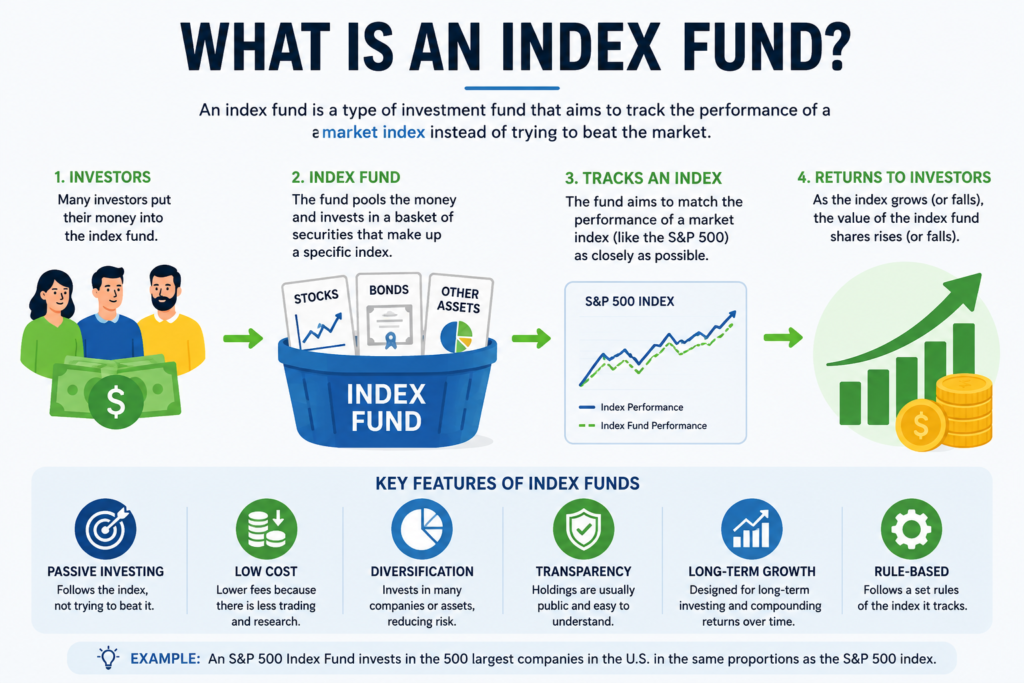
An index fund is a type of investment fund—usually a mutual fund or exchange-traded fund (ETF)—that aims to track the performance of a market index instead of trying to beat it.
In simple words:
- A traditional actively managed fund tries to pick winning investments.
- An index fund tries to copy a market index as closely as possible.
For example:
- An index fund tracking the S&P 500 buys shares in companies that are part of the S&P 500.
- A total-market index fund may hold thousands of stocks to mirror the overall market.
- A bond index fund may track a basket of government or corporate bonds.
So when someone asks, “What is an index fund?”, the shortest answer is:
An index fund is a low-cost investment fund designed to follow a market index rather than relying on a manager to pick stocks or time the market.
This sounds simple, but it is one of the most important ideas in modern investing. New to ETFs and index investing? Read our complete ETFs & Index Funds Guide to understand the different types of index funds, ETFs, their benefits, risks, and how to choose the right investment.
Why Index Funds Matter
Index funds changed investing because they made it possible for ordinary people to invest in entire markets at very low cost.
Instead of researching 50 different companies, reading annual reports, guessing future winners, and paying high management fees, an investor can buy one index fund and instantly own a diversified slice of the market.
Did You Know?
Many retirement portfolios in the U.S., UK, Canada, and Australia use index funds because they combine diversification, low costs, and long-term growth potential in a single investment.
That matters because long-term investing success is often driven by a few powerful principles:
- Diversification
- Low fees
- Consistency
- Patience
- Time in the market instead of timing the market
Index funds are built around those principles.
They are often recommended for:
- Beginners
- Busy professionals
- Retirement investors
- People who don’t want to pick stocks
- Long-term wealth builders
- Parents investing for children
- People building a pension, IRA, ISA, 401(k), RRSP, TFSA, or superannuation portfolio
Index Fund Meaning: Breaking Down
Let’s unpack the phrase “index fund”.
What Is an “Index” in Investing?
An index is a list or benchmark that measures the performance of a group of investments.
Think of an index as a scoreboard for part of the market.
Examples:
- S&P 500 → tracks around 500 large U.S. companies
- FTSE 100 → tracks 100 large companies listed in the UK
- NASDAQ-100 → tracks 100 large non-financial companies listed on Nasdaq
- MSCI World Index → tracks developed-market stocks globally
- Russell 2000 → tracks smaller U.S. companies
- Nikkei 225 → tracks major Japanese stocks
An index itself is not a product you buy directly. It’s a benchmark or measuring stick. A fund is created to follow that benchmark. Investor.gov describes index funds as mutual funds or ETFs that seek to track the returns of a market index rather than choosing securities one by one.
Example
Imagine a “Top 500 Largest U.S. Companies” list. If those 500 companies rise 10% overall, the index rises. If they fall 8%, the index falls.
The index fund’s job is to mirror that movement as closely as possible.
What Is a “Fund”?
A fund is a pooled investment vehicle. Many investors put money into the same pot, and the fund uses that money to buy assets such as:
- stocks
- bonds
- cash equivalents
- other securities
So instead of buying each stock individually, you buy shares of the fund, and the fund holds the investments on your behalf.
What Makes an Index Fund Different From Other Funds?
The difference is the strategy.
Active Fund
An active fund is run by a manager or team trying to:
- beat the market
- pick undervalued companies
- avoid weak sectors
- trade based on research and forecasts
Index Fund
An index fund doesn’t try to outsmart the market. It simply says:
“We will follow the index.”
If the index contains 500 stocks, the fund may buy those 500 stocks in similar proportions.
That’s why index funds are often called passive funds or part of passive investing.
What Is Passive Investing?
Passive investing means investing with the goal of matching market performance, not beating it.
It is called “passive” because the fund is not constantly making aggressive buy/sell decisions. Instead, it follows a rules-based benchmark.
Passive does not mean careless. It means:
- fewer trades
- lower research costs
- lower turnover
- lower fees
- more predictable structure
How Does an Index Fund Work?
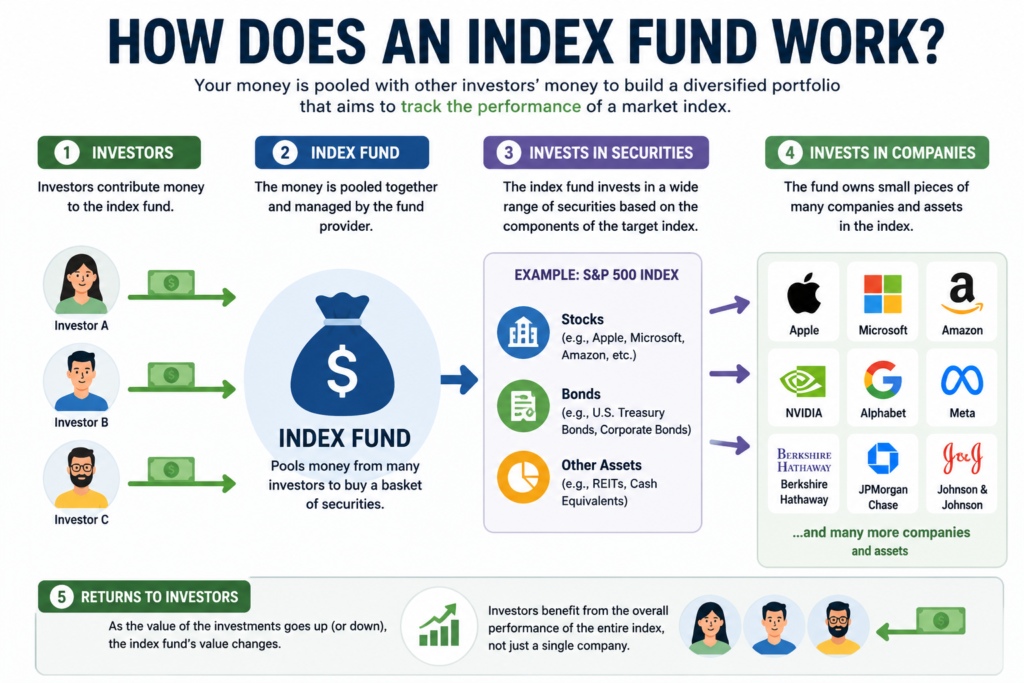
An index fund works by trying to replicate the performance of an index. It can do that in a few different ways.
1) Full Replication
The fund buys all the securities in the index in roughly the same weight.
Example:
If an S&P 500 index fund uses full replication, it may hold all or nearly all the companies in the S&P 500.
2) Sampling
If the index is huge—say a global bond index with thousands of securities—the fund may hold a representative sample rather than every single asset.
3) Synthetic Replication
In some markets, certain funds use derivatives or swap structures to mimic index returns. This is more common in some institutional or specialized products and requires extra understanding of counterparty risk and structure.
Investor.gov notes that some index funds invest in all the securities in the benchmark, while others use sampling.
Example: How an S&P 500 Index Fund Works
Suppose the S&P 500 index contains companies such as:
- Apple
- Microsoft
- Amazon
- Nvidia
- Alphabet
- Berkshire Hathaway
- Meta
- ExxonMobil
- JPMorgan Chase
- Johnson & Johnson
An S&P 500 index fund buys these and the rest of the index holdings according to their weight in the index.
If Apple represents 6% of the index, then about 6% of the fund may be invested in Apple.
When the index changes, the fund adjusts.
What Is “Weighting” in an Index Fund?
Weighting means how much of the index is allocated to each company or asset.
The most common approach is market-cap weighting.
What Is Market Capitalization?
Market capitalization (or market cap) is the total market value of a company’s shares.
Formula:
Market Cap = Share Price × Number of Shares Outstanding
Example:
If a company has:
- 1 billion shares
- each share worth $100
Then the market cap = $100 billion
Large companies get larger weights in market-cap-weighted indexes.
Example of Market-Cap Weighting
Imagine an index with only 3 companies:
- Company A = $600 billion
- Company B = $300 billion
- Company C = $100 billion
Total market value = $1 trillion
Index weights:
- Company A = 60%
- Company B = 30%
- Company C = 10%
If you invest $1,000 in an index fund tracking this index, roughly:
- $600 goes to Company A
- $300 to Company B
- $100 to Company C
Common Types of Index Funds
Index funds come in many forms. The word “index fund” does not mean only one thing.
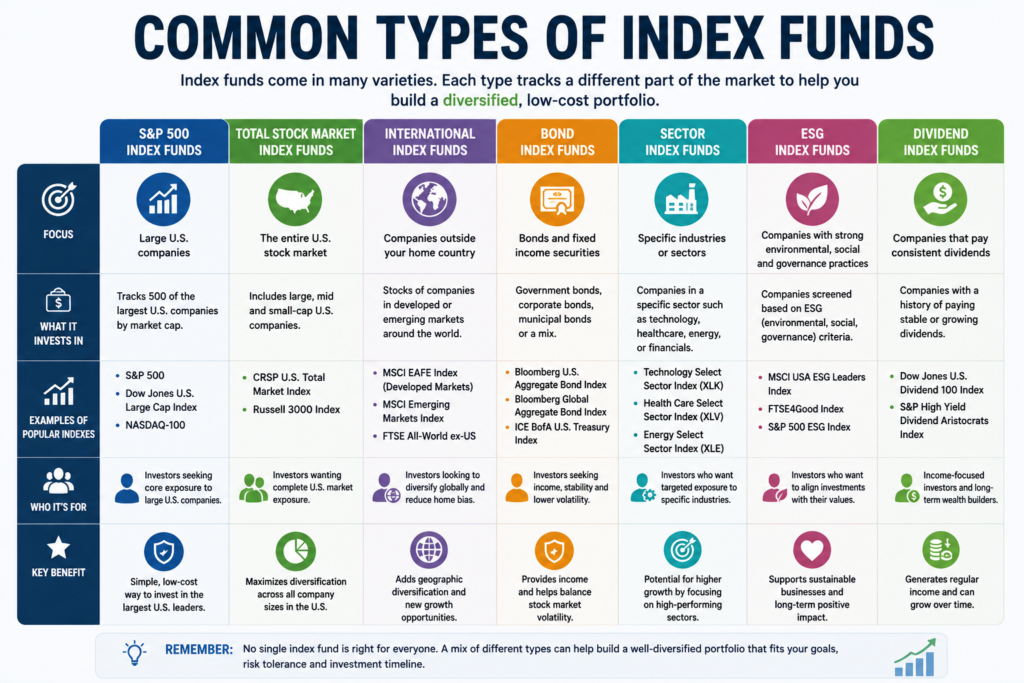
1) S&P 500 Index Funds
These track the S&P 500, one of the most famous stock indexes in the world.
What they give you:
- exposure to large U.S. companies
- a core long-term equity holding
- broad but not total-market diversification
Good for:
- retirement investors
- beginner portfolios
- long-term wealth building
2) Total Stock Market Index Funds
These aim to hold the entire stock market, not just the largest companies.
In the U.S., this may include:
- large-cap stocks
- mid-cap stocks
- small-cap stocks
Benefit:
More complete market coverage than just the S&P 500.
3) International Index Funds
These invest in stocks outside your home country.
Examples:
- developed international markets
- emerging markets
- global ex-U.S. indexes
- world indexes
Why use them?
Because your home country may not be the best-performing market every year. International diversification reduces concentration risk.
4) Global Index Funds
These invest across many countries, sometimes including the investor’s home market and sometimes excluding it depending on the fund design.
5) Bond Index Funds
These track bond markets, such as:
- U.S. Treasury bonds
- investment-grade corporate bonds
- aggregate bond indexes
- global bond indexes
Why use them?
Bonds may provide:
- income
- lower volatility than stocks
- portfolio balance
- capital preservation relative to equities
6) Sector Index Funds
These focus on one part of the market:
- technology
- healthcare
- energy
- financials
- real estate
- consumer staples
These are less diversified than total-market funds and are usually used as satellite positions, not the whole portfolio.
7) Dividend Index Funds
These track indexes built around dividend-paying companies.
8) ESG Index Funds
These track indexes using environmental, social, and governance screens.
9) Small-Cap and Mid-Cap Index Funds
These target smaller or medium-sized companies rather than large-cap giants.
10) Target-Date and Fund-of-Funds Structures Using Index Funds
Some retirement products hold multiple underlying index funds in one package and automatically rebalance over time.
Why Are Index Funds So Popular?
Index funds are popular because they solve several common investing problems at once.
They are usually low cost
They are easy to understand
They offer instant diversification
They remove stock-picking pressure
They are tax-efficient in many cases
They reduce emotional decision-making
They often outperform many active funds after fees over long periods
S&P Dow Jones’ SPIVA scorecards continue to show that a large share of active managers underperform benchmark indexes over long periods. In the U.S. scorecard data shown by SPIVA, 89.93% of large-cap U.S. funds underperformed the S&P Global 500 over 15 years as of year-end 2025.
That statistic doesn’t mean active management is impossible. It means the hurdle is high—and fees make it even harder.
The Core Benefits of Index Funds
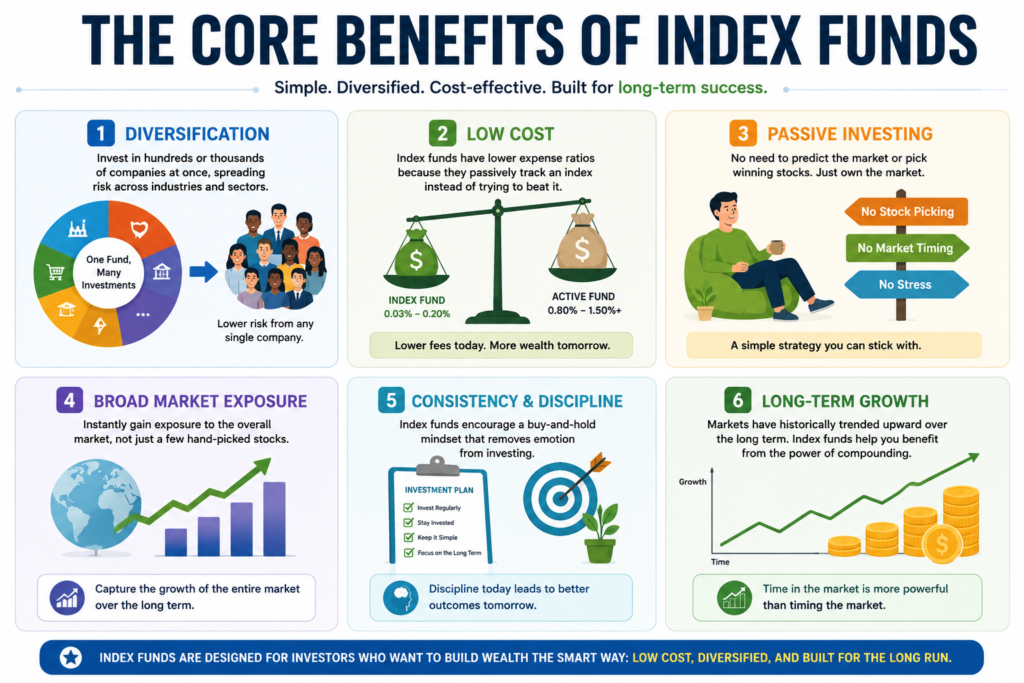
Pros & Cons Table
| Pros | Cons |
|---|---|
| Low expense ratios | Cannot outperform the market index |
| Broad diversification | Market downturns affect returns |
| Passive investing | Limited flexibility |
| Simple for beginners | Still subject to investment risk |
| Suitable for long-term investing | May become concentrated in large companies |
| Easy portfolio management | Returns follow the index |
1) Diversification
Diversification means spreading your money across many investments so that the failure of one company or sector doesn’t destroy your portfolio.
Example:
If you buy only one stock and it falls 70%, your portfolio suffers badly.
If you own 500 companies through an index fund, one company collapsing may hurt much less.
Why diversification matters:
- lowers company-specific risk
- reduces dependence on a single management team
- makes outcomes less extreme
- creates a smoother long-term investing experience
2) Low Cost
This is one of the biggest advantages.
Every fund charges something. The annual operating cost is usually expressed as an expense ratio.
What Is an Expense Ratio?
An expense ratio is the percentage of fund assets charged each year to cover fund expenses.
Example:
- Expense ratio = 0.05%
- Investment = $10,000
- Approx annual fund cost = $5
Compare that with an active fund charging 1.00%:
- $10,000 investment
- Approx annual cost = $100 per year
That difference compounds over decades.
The SEC’s investor bulletin explains that fees and expenses reduce your investment returns and that funds disclose these costs in prospectus fee tables.
3) Simplicity
Many people do not want to:
- analyze financial statements
- compare 100 active funds
- predict interest rates
- guess which sector will outperform next year
Index funds turn investing into a repeatable process.
4) Broad Market Exposure
Instead of betting on one or two companies, you buy a slice of an entire market.
5) Lower Turnover
Because index funds follow a benchmark, they usually trade less than active funds. That can help reduce transaction costs and, in some markets and account types, improve tax efficiency.
6) Reduced Emotional Investing
Index investing supports rules over emotions.
Investors often damage returns by:
- panic selling during crashes
- chasing hot stocks
- buying after a surge
- abandoning plans after one bad year
A simple index-fund strategy can reduce those temptations.
The Drawbacks of Index Funds
Index funds are powerful, but they are not magic. They also have limitations.
1) You Will Never Beat the Index You Track
If your fund tracks the S&P 500, you should expect to earn roughly the S&P 500 return minus fees and tracking differences. That means you will not outperform the benchmark by design.
2) You Accept Market Downturns
If the market falls, your index fund falls too. An S&P 500 index fund does not protect you from a bear market just because it is “passive.”
3) Market-Cap Weighting Can Concentrate You in Big Winners
Market-cap indexes often become heavily weighted toward the biggest companies. That can be good when mega-cap companies are performing well, but it also means you may become concentrated in a small group of firms.
4) You Own Good Companies and Bad Companies Together
An index fund doesn’t ask:
- Is this stock overvalued?
- Is management weak?
- Is debt too high?
If the company is in the index, the fund usually owns it.
5) Some Indexes Are Better Than Others
Not all indexes are equal.
A good index fund still depends on:
- the quality of the index
- the fund’s fee
- tracking efficiency
- liquidity
- tax structure
- how securities are selected and weighted
Morningstar points out that the details of index construction matter, and modern indexes are often better built for investor use than older benchmark designs.
6) Passive Doesn’t Mean Risk-Free
Index funds still carry:
- market risk
- interest-rate risk (for bond funds)
- currency risk (for international funds)
- sector concentration risk
- valuation risk
- inflation risk
- sequence-of-returns risk for retirees drawing income
Index Funds vs Mutual Funds: Are They the Same?
This is a very common beginner question.
Short answer:
An index fund can be a mutual fund, but not every mutual fund is an index fund.
Mutual fund
A legal structure / investment vehicle
ETF
Another legal structure / investment vehicle
Index fund
A strategy that can exist inside either structure
So you can have:
- an index mutual fund
- an index ETF
- an active mutual fund
- an active ETF
Index Fund vs ETF
People often confuse “index fund” and “ETF.”
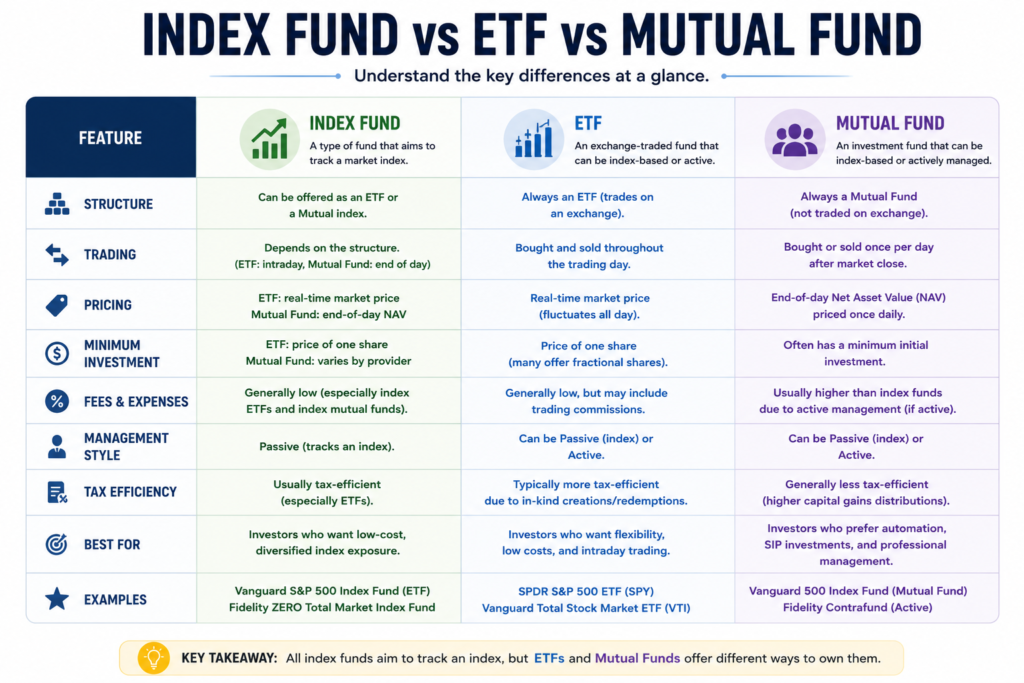
Comparison Table
| Feature | Index Fund | ETF | Mutual Fund | Individual Stocks |
|---|---|---|---|---|
| Diversification | High | High | Medium–High | Low |
| Management Style | Passive | Passive/Active | Active/Passive | Self-managed |
| Expense Ratio | Low | Low | Usually Higher | None (but trading costs may apply) |
| Risk | Moderate | Moderate | Moderate | High |
| Trading | End-of-day (mutual fund structure) | Intraday | End-of-day | Intraday |
| Best For | Long-term investors | Flexible investing | Active management | Experienced investors |
Index fund
A fund that tracks an index
ETF (Exchange-Traded Fund)
A fund that trades on an exchange like a stock
So an ETF can be:
- an index ETF
- an active ETF
A mutual fund can also be:
- an index mutual fund
- an active mutual fund
Main Differences Between Index Mutual Funds and Index ETFs
1) Trading Method
- ETF: bought and sold during the trading day like a stock
- Mutual fund: usually priced once per day at net asset value (NAV)
2) Minimum Investment
- ETFs may allow purchase of one share or fractional shares depending on platform
- Mutual funds may have minimum initial investments depending on provider
3) Tax Efficiency
In some countries and account structures, ETFs may have structural tax advantages. This depends heavily on jurisdiction and account type.
4) Automation
Mutual funds may be easier for automated contributions on some platforms, while many brokerages now allow automated ETF investing too.
What Is Tracking Error?
Tracking error is how closely the fund follows its benchmark.
If the index returns 10.0% and the fund returns 9.8%, the difference may come from:
- fees
- cash drag
- trading costs
- replication method
- rebalancing friction
- securities lending effects
- withholding taxes in international funds
A good index fund aims for low tracking error.
What Is Rebalancing?
Rebalancing means adjusting holdings to keep the fund aligned with the index.
Example:
If one company grows a lot and now represents a bigger share of the index, the fund may need to buy more of it. If another company is removed from the index, the fund may sell it.
Indexes themselves also rebalance periodically.
The Hidden Power of Low Fees
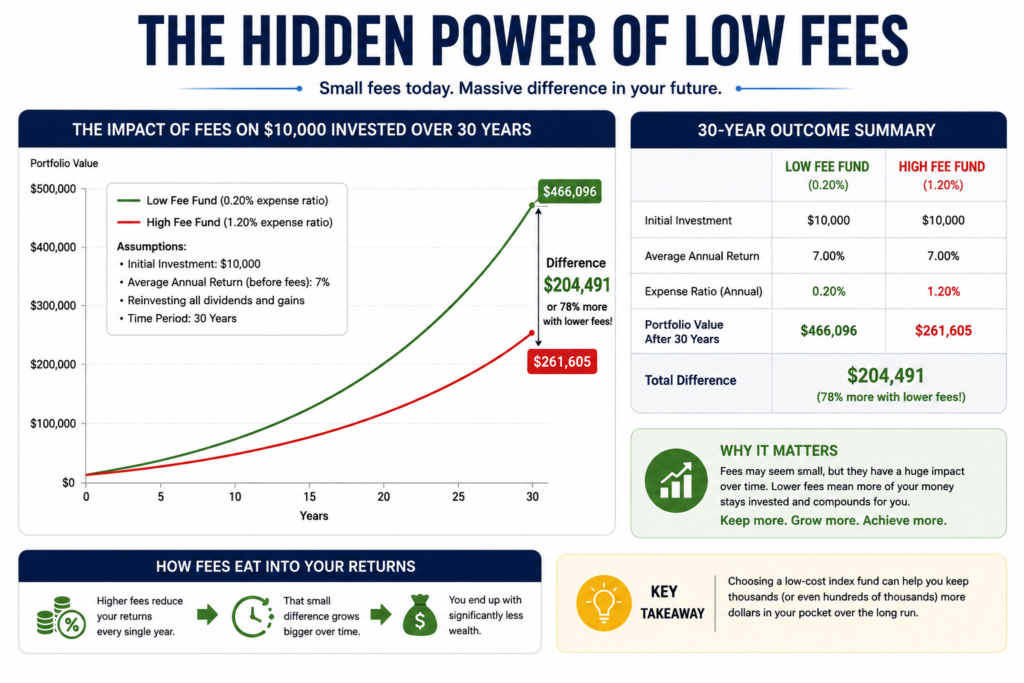
Low fees sound boring, but they are one of the most important predictors of long-term investor outcomes.
Expert Tip
Even a small difference in expense ratios can significantly affect your wealth over decades due to compound growth. Choosing a low-cost index fund can help you keep more of your investment returns.
Let’s compare two investors.
Investor A: Active Fund
- $10,000 initial investment
- 8% gross annual return
- 1.00% fee
- net return ≈ 7%
Investor B: Index Fund
- $10,000 initial investment
- 8% gross annual return
- 0.05% fee
- net return ≈ 7.95%
Over 30 years, that difference becomes very large.
Because fees are charged every year, they compound in reverse—they drag on your wealth.
The SEC explicitly warns that higher costs require stronger performance just to end up with the same investor return as a lower-cost fund.
Case Studies
Case Study 1: The Fee Drag Problem
Scenario
Emma and Daniel each invest $500 per month for 30 years.
Emma
- invests in a low-cost index fund
- annual return before fees = 8%
- expense ratio = 0.05%
Daniel
- invests in a higher-fee active fund
- annual return before fees = 8%
- expense ratio = 1.00%
If both earn the same gross market return, Emma keeps far more of it.
Lesson
A 1% fee difference may look tiny, but over decades it can cost tens or even hundreds of thousands of dollars depending on contributions and returns.
Case Study 2: Trying to Beat the Market vs Owning the Market
Scenario
Mark decides to build wealth for retirement.
Path A: Active stock picking
He buys:
- a few tech stocks
- a biotech stock
- a mining stock
- some “hot tips” from social media
Path B: Index investing
He buys:
- a total-market index fund
- a bond index fund
- rebalances once a year
After 15 years, Path B may not have exciting stories, but it often produces a more stable outcome with less stress, fewer mistakes, and lower fees.
Lesson
The goal is not entertainment. The goal is wealth accumulation with a sensible risk-adjusted process.
Case Study 3: The Retirement Saver in the U.S.
Investor
Sarah, age 32, lives in the U.S. and contributes to:
- 401(k)
- Roth IRA
- taxable brokerage account
Her index-fund strategy
- 60% U.S. total stock market index fund
- 20% international stock index fund
- 20% U.S. bond index fund
Why it works
- diversified across geographies and asset classes
- low-cost
- easy to automate
- easy to rebalance
- no need to predict next year’s winners
Lesson
Index funds work especially well when combined with tax-advantaged retirement accounts and automated monthly investing.
Case Study 4: A UK Investor Using Index Funds in an ISA
Investor
James, 40, invests through a Stocks and Shares ISA.
His goal
Retire at 60 with a globally diversified portfolio.
Strategy
- 70% global developed-market index fund
- 10% emerging markets index fund
- 20% global bond index fund
Why it fits
- tax shelter from the ISA wrapper
- broad diversification
- simple maintenance
- no pressure to choose individual UK shares
Lesson
Index funds are not only a U.S. story. They work globally and fit many account structures.
Case Study 5: A Canadian Couple Saving for Financial Independence
Investors
Mia and Oliver, both 35, contribute to:
- TFSA
- RRSP
- taxable investing account
Their portfolio
- Canadian equity index fund
- U.S. equity index fund
- international equity index fund
- bond index fund
Benefit
They avoid concentrating only in Canada’s market and instead spread risk across countries and sectors.
Lesson
Home-country bias can be reduced through global index investing.
Case Study 6: An Australian Superannuation Investor
Investor
Liam, 29, reviews the investment options inside his superannuation account.
He notices:
- actively managed options with higher fees
- indexed options with much lower fees
He chooses a low-cost indexed diversified option because he has a long time horizon and wants to minimize fees.
Lesson
Index investing can be useful even when you don’t build the portfolio manually. It can be used through pension wrappers, retirement accounts, and workplace plans.
Why Many Investors Choose Index Funds Instead of Active Funds
This is one of the central debates in investing.
Active investing says:
“Skilled managers can beat the market.”
Index investing says:
“Maybe a few can, but identifying them in advance—after fees and taxes—is very difficult, so buying the market is often the better bet.”
SPIVA’s data is one reason this debate keeps leaning toward passive investing for many everyday investors. The scorecards show that over long periods, most active funds fail to beat their benchmark indexes after costs. In the U.S., SPIVA’s year-end 2025 data showed 85.59% of large-cap funds underperformed the S&P 500 over 10 years, and 89.93% underperformed over 15 years.
Expert Perspective: Why Cost and Simplicity Matter
One of the most famous voices in this space was John C. Bogle, who helped popularize the idea that ordinary investors should keep costs low and own the market rather than constantly trying to outguess it.
The broader logic is simple:
- markets are highly competitive
- professional investors already analyze everything
- after fees, taxes, and trading costs, beating the benchmark consistently is hard
- low-cost ownership of the market is a rational default
That logic remains a core reason index funds continue to attract massive inflows. In June 2026, Reuters reported that Vanguard’s S&P 500 ETF became the first ETF to exceed $1 trillion in assets, a milestone that highlights the scale and popularity of low-cost index investing.
How to Choose a Good Index Fund
Not all index funds are equally attractive. When evaluating one, look at the following.
1) The Index It Tracks
Ask:
- What benchmark does it follow?
- Is it broad-market or narrow?
- Does it use market-cap weighting, equal weighting, factor screens, or something else?
- Does it fit the role you want in your portfolio?
2) Expense Ratio
Lower is generally better—assuming the fund is well-run and tracks a sensible benchmark.
3) Tracking Difference / Tracking Error
How closely has the fund matched the index after fees?
4) Fund Size and Liquidity
Larger, established funds often have operational advantages, tighter bid-ask spreads in ETF form, and stronger economies of scale.
5) Tax Structure
Important in taxable accounts.
6) Provider Reputation
Well-known providers often compete aggressively on fees and operational quality.
Examples of major firms in the index-fund world include:
- Vanguard
- BlackRock
- State Street Global Advisors
- Fidelity Investments
- Charles Schwab
7) Fund Structure: ETF or Mutual Fund
Choose the structure that fits:
- your account
- your contribution method
- tax situation
- platform features
- investing habits
The Most Common Indexes Beginners Should Know
U.S. Equity
- S&P 500
- Russell 2000
- total U.S. market indexes
Global / International
- MSCI World Index
- MSCI Emerging Markets Index
- FTSE global indexes
UK
- FTSE 100
- FTSE All-Share
Bonds
- aggregate bond indexes
- government bond indexes
- global bond benchmarks
What Return Can You Expect From an Index Fund?
This depends entirely on:
- the index
- valuation at purchase
- holding period
- interest rates
- inflation
- market cycles
- whether it’s stocks or bonds
- your country and currency exposure
Important rule:
Index funds do not create returns out of thin air. They pass through market returns minus costs.
If stock markets perform strongly, equity index funds may perform strongly.
If markets crash, they may crash too.
Better question than “What return will I get?”
Ask:
- What index does this fund track?
- What is my time horizon?
- Can I tolerate volatility?
- Am I diversified?
- What role does this fund play in my plan?
Index Funds and Market Crashes
A beginner mistake is assuming “index fund” means “safe.”
That is not correct.
An equity index fund can fall sharply in a bear market.
For example, a broad stock index fund can decline when:
- recession fears rise
- earnings fall
- interest rates increase
- valuations compress
- geopolitical shocks hit markets
The advantage of an index fund in a crash is not that it avoids the crash. The advantage is that:
- it is diversified
- it is rules-based
- it often has low fees
- it makes it easier to stay invested if it fits your risk tolerance
Index Funds for Beginners: A Simple Portfolio Example
If someone is just starting, they often do not need 12 different funds.
A very simple long-term portfolio could look like:
Example 3-Fund Style Portfolio
- U.S. total stock market index fund
- International stock index fund
- Bond index fund
This kind of structure is popular because it gives:
- domestic equity exposure
- international diversification
- fixed-income stability
The percentages depend on age, risk tolerance, time horizon, and goals.
Example Asset Allocation by Risk Profile
Aggressive (long horizon, high risk tolerance)
- 90% stocks
- 10% bonds
Moderate
- 70% stocks
- 30% bonds
Conservative
- 50% stocks
- 50% bonds
This is not personalized advice; it’s an illustration of how index funds can be used as building blocks.
Dollar-Cost Averaging and Index Funds
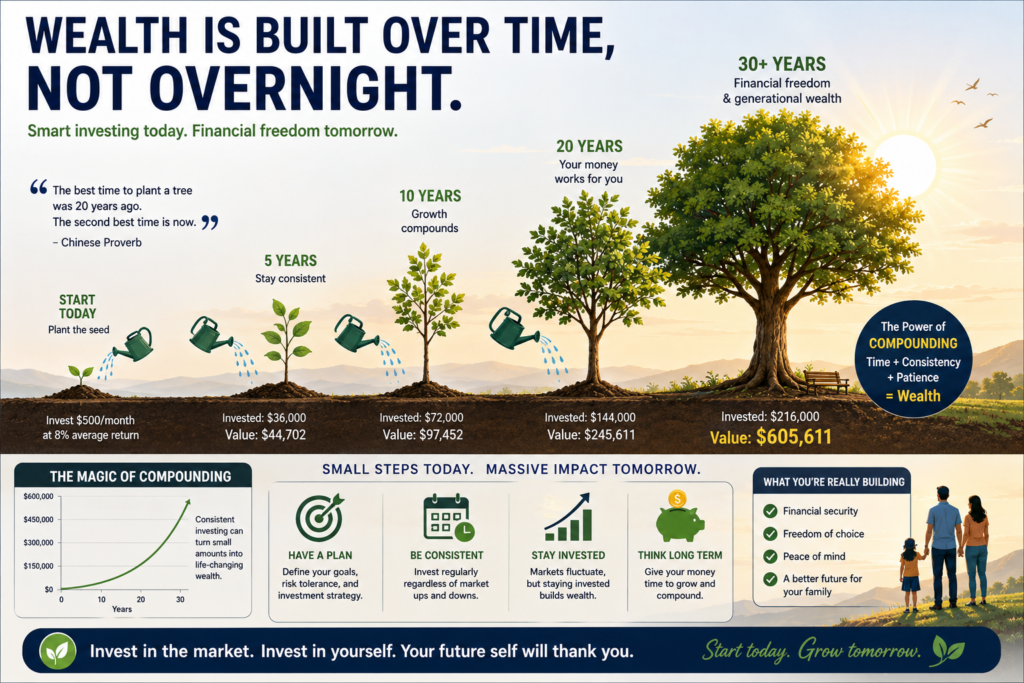
Dollar-cost averaging (DCA) means investing a fixed amount at regular intervals.
Example:
- $500 every month into an index fund
Why people use it:
- automates discipline
- reduces decision stress
- avoids trying to guess the “perfect” day to invest
- fits salary-based saving habits
It does not guarantee gains or eliminate risk, but it can be behaviorally powerful.
Index Funds vs Stock Picking
Let’s compare.
Stock Picking
You choose individual companies yourself.
Pros
- possibility of beating the market
- intellectually interesting
- concentrated conviction bets possible
Cons
- high research burden
- easier to make emotional mistakes
- less diversification
- greater company-specific risk
- harder to maintain discipline
Index Funds
You buy the market or a segment of it.
Pros
- diversified
- low-cost
- low-maintenance
- evidence-based
- easier to automate
- often hard for active alternatives to beat after fees
Cons
- no chance of outperforming the tracked index
- market downturns still hurt
- can feel boring
For most beginners, boring is often an advantage.
Common Misconceptions About Index Funds
Myth 1: Index Funds Are Risk-Free
False. They are investments, not savings accounts.
Myth 2: Index Funds Always Go Up
False. They can fall significantly in bear markets.
Myth 3: All Index Funds Are the Same
False. Different funds track different indexes, sectors, countries, and asset classes.
Myth 4: Passive Investing Means “Do Nothing and Never Review”
False. You still need:
- an asset allocation
- periodic rebalancing
- tax awareness
- a plan tied to your goals
Myth 5: If Active Funds Sometimes Beat the Market, Index Funds Are Pointless
False. The key question is not whether some active funds can outperform. The real question is whether you can reliably identify them in advance, stick with them, and still come out ahead after fees and taxes.
When Index Funds May Be a Strong Choice
Index funds are often a strong fit if you:
- are new to investing
- want a retirement portfolio
- prefer low-cost investing
- don’t want to research individual stocks
- value diversification
- want a rules-based strategy
- want to automate monthly investing
- are investing for 10+ years
- want a core portfolio holding
When Index Funds May Not Be the Only Solution
You might need more than a basic stock index fund if:
- you need near-term capital preservation
- your portfolio needs bonds, cash, or liability matching
- you’re drawing retirement income now
- you need tax-specific strategies
- you want targeted exposure to a sector, factor, or region
- you have estate, trust, or business-account considerations
Index funds are building blocks—not the answer to every financial planning question.
The Role of Index Funds in Retirement Investing
Index funds are widely used in retirement plans because they align well with long-term compounding.
Why they fit retirement accounts:
- low ongoing cost
- broad diversification
- easy automation
- easy rebalancing
- scalable from small balances to large balances
Examples of retirement wrappers by country:
- U.S. → 401(k), IRA, Roth IRA
- UK → ISA, SIPP, workplace pension
- Canada → TFSA, RRSP
- Australia → superannuation
- Ireland / EU investors → pension wrappers, tax-advantaged plans depending on country
Index Funds and Taxes
Tax treatment depends heavily on:
- your country
- the type of account
- whether the fund distributes dividends/interest
- whether the fund is accumulating or distributing
- capital gains rules
- withholding taxes on international holdings
Examples of tax-sensitive issues:
- dividend taxation
- capital gains taxation
- tax-loss harvesting rules
- withholding tax on foreign dividends
- pension vs taxable account placement
This is why “best index fund” can differ between otherwise similar investors in different countries.
A Practical Beginner Checklist Before Buying an Index Fund
Before investing, ask:
1) What goal is this money for?
- retirement?
- house deposit?
- children’s education?
- financial independence?
2) What is my time horizon?
- 2 years?
- 10 years?
- 30 years?
3) Can I handle a 30%–50% market decline without panic selling?
4) Do I need stocks, bonds, or both?
5) Am I using the right account type for taxes?
6) What index does this fund track?
7) What is the expense ratio?
8) Does this fund overlap with what I already own?
9) Is my portfolio globally diversified enough?
10) What will I do during the next market crash?
If you cannot answer question 10, your investment plan may not be complete.
Advanced Case Studies
Below are additional scenarios to make the concept practical.
Case Study 7: The “Hot Stock” Trap vs Index Discipline
A new investor buys 5 trending stocks after seeing social media posts about AI, biotech, and crypto-adjacent companies. Another investor buys a broad index fund monthly for five years.
The stock picker experiences:
- huge volatility
- repeated urge to sell
- concentration risk
- tax complexity from frequent trades
The index investor experiences:
- market ups and downs
- but far simpler decision-making
- broader exposure to winners without needing to identify them in advance
Lesson
Index funds reduce the cost of being wrong.
Case Study 8: The High-Income Professional With No Time
A surgeon earns well but has no interest in reading earnings reports.
She chooses:
- one global stock index fund
- one bond index fund
- automatic monthly contributions
Lesson
For many professionals, the best portfolio is the one they will actually stick with.
Case Study 9: Parents Investing for a Child
Parents open an investment account earmarked for a child’s future education costs. Because the time horizon is 15 years, they choose a diversified low-cost index-fund portfolio rather than trying to guess which companies will dominate by then.
Lesson
Long horizons often favor diversified, low-cost compounding over tactical bets.
Case Study 10: The Investor Who Switched After Comparing Fees
A 45-year-old investor realizes their actively managed fund charges 1.2% per year while a comparable index fund charges 0.05%.
Even if performance before fees were identical, the difference in net return over 20 years could be substantial.
Lesson
Sometimes the biggest portfolio improvement is not a new stock idea—it’s a fee reduction.
Case Study 11: The Investor Who Needed More Than Just One Fund
A beginner bought only a U.S. stock index fund and assumed that was “fully diversified.” Later, they realized they had:
- no international exposure
- no bonds
- no cash reserve strategy
They adjusted to a fuller portfolio.
Lesson
An index fund can be excellent, but one index fund is not automatically a complete financial plan.
Statistics That Help Explain the Rise of Index Funds
Here are several useful data points and market observations for context:
1) Most active managers struggle to beat benchmarks over long periods
SPIVA’s year-end 2025 U.S. scorecard shows that 89.93% of U.S. large-cap funds underperformed the S&P Global 500 over 15 years.
2) Fees directly reduce investor returns
The SEC’s investor bulletin emphasizes that fees and expenses reduce the value of investment returns and that a higher-cost fund must perform better than a lower-cost one just to deliver the same investor result. (Investor.gov)
3) Index-fund scale keeps growing
Reuters reported in June 2026 that Vanguard’s S&P 500 ETF became the first ETF ever to exceed $1 trillion in assets, reflecting the extraordinary demand for low-cost passive exposure. (Reuters)
4) Index-fund design matters
Morningstar highlights that index construction has evolved, and modern index design choices can materially affect investor experience, diversification, and tracking quality. (Morningstar)
How Beginners in Tier-1 Countries Can Start With Index Funds
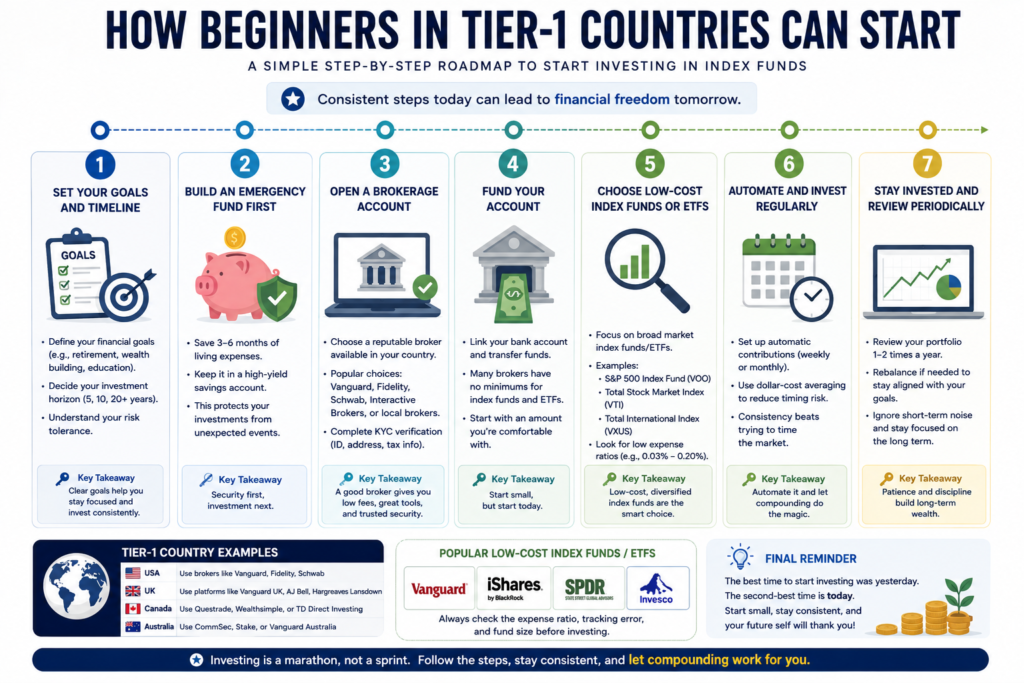
Below is a country-agnostic process that works well across major developed markets.
Step 1: Define the Goal
Examples:
- retirement at 60
- financial independence
- school fees in 15 years
- wealth accumulation over 25 years
Step 2: Choose the Right Account Wrapper First
This is often more important than people think.
U.S.
- 401(k)
- IRA / Roth IRA
- HSA if applicable
- taxable brokerage
UK
- Stocks and Shares ISA
- SIPP
- workplace pension
Canada
- TFSA
- RRSP
- FHSA if relevant
- taxable investing account
Australia
- superannuation
- personal brokerage accounts
Step 3: Choose Asset Allocation
How much in:
- stocks
- bonds
- cash reserve
Step 4: Choose the Index Funds
Typical building blocks:
- domestic total stock market index fund
- international stock index fund
- bond index fund
Step 5: Automate Contributions
Monthly automation is one of the most powerful habits in investing.
Step 6: Rebalance Periodically
For example:
- once per year
- or when allocations drift beyond a threshold
Step 7: Ignore Noise
This may be the hardest step.
Do not rebuild your entire portfolio because:
- one sector rallied
- a headline predicts recession
- a pundit says “cash is king”
- a friend doubled money on one stock
Sample Beginner Index Fund Portfolio Frameworks
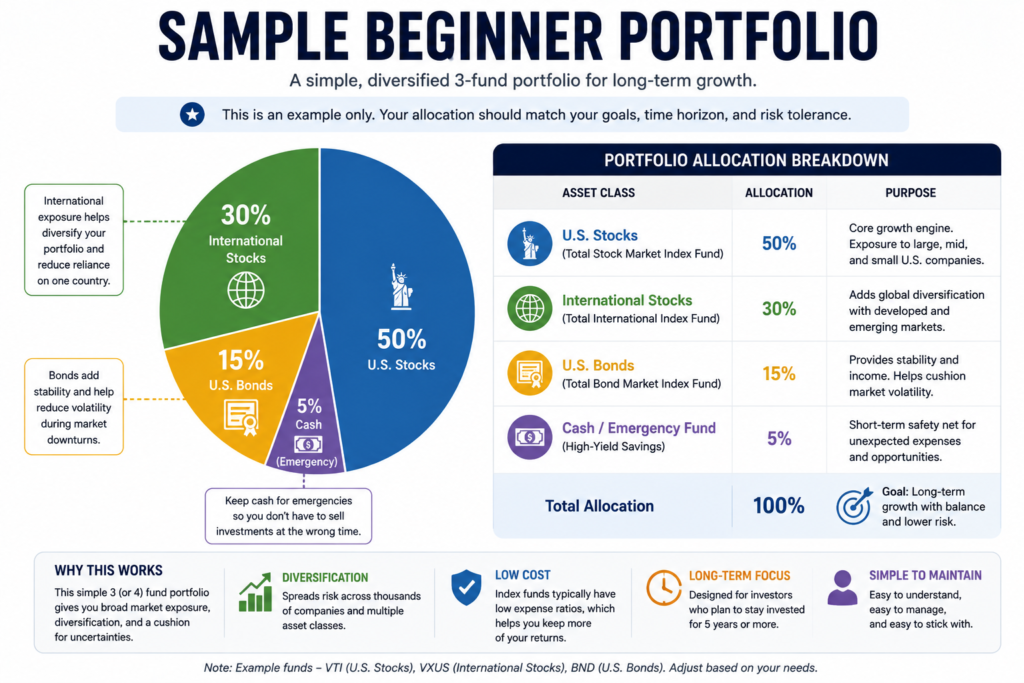
Portfolio A: Simple Growth Portfolio
- 80% global stock index fund
- 20% bond index fund
Portfolio B: U.S.-centric 3-fund approach
- 55% U.S. total market index fund
- 25% international index fund
- 20% bond index fund
Portfolio C: Younger investor, long horizon
- 90% stocks across domestic + international index funds
- 10% bonds or cash-like stability sleeve
These are educational examples only—not personal recommendations.
Risks You Must Understand Before Investing in Index Funds
Market Risk
The market can fall, and your fund will usually fall with it.
Inflation Risk
If your returns don’t outpace inflation, purchasing power erodes.
Interest Rate Risk
Bond index funds can fall when rates rise.
Currency Risk
International funds can be affected by exchange-rate movements.
Concentration Risk
A broad market-cap index may still become concentrated in a handful of mega-cap companies or sectors.
Sequence Risk
If you are withdrawing money in retirement during a market crash, timing of returns matters.
Behavior Risk
The biggest risk may be your own behavior—panic selling or abandoning the plan.
What Makes a Good Index Fund Investor?
Not intelligence.
Not market predictions.
Not perfect timing.
Usually the traits that matter most are:
- patience
- discipline
- realistic expectations
- consistency
- cost awareness
- emotional control
- willingness to stay invested through volatility
- understanding that boring can be profitable
Quick Summary
| Topic | Summary |
|---|---|
| Investment Style | Passive Investing |
| Risk Level | Moderate |
| Average Fees | Low |
| Diversification | High |
| Best For | Long-term Investors |
| Beginner Friendly | Yes |
Frequently Asked Questions (FAQs)
1) What is an index fund in simple words?
An index fund is an investment fund that aims to copy a market index—such as the S&P 500—rather than trying to beat it by picking stocks.
2) Is an index fund good for beginners?
Often yes. Index funds are popular with beginners because they are diversified, low-cost, and easy to hold long term.
3) Can you lose money in an index fund?
Yes. If the market falls, an index fund can lose value. It is not guaranteed or risk-free.
4) Are index funds better than individual stocks?
For many long-term investors, index funds are more practical because they offer diversification and reduce stock-specific risk. “Better” depends on goals, knowledge, time, and discipline.
5) Are index funds safe?
Safer than owning a single stock in terms of diversification, often yes. Safe in the sense of “no loss possible,” no.
6) Do index funds pay dividends?
Some do, depending on the stocks or bonds they hold. The income may be distributed or reinvested depending on the fund and share class.
7) What is the difference between an ETF and an index fund?
An ETF is a fund structure traded on an exchange. An index fund is a strategy. Many ETFs are index funds, but not all.
8) What is the minimum amount needed to invest in an index fund?
It depends on the provider and platform. Some ETFs can be bought with the price of one share or a fractional share; some mutual funds have minimums.
9) Can index funds make you rich?
They can help build substantial wealth over time through long-term compounding, especially when paired with regular contributions, low fees, and discipline. But they are not a get-rich-quick product.
10) Should I invest in one index fund or several?
That depends on whether one fund already gives broad exposure. Many investors use multiple funds to cover domestic stocks, international stocks, and bonds.
11) Are S&P 500 index funds enough?
They can be a strong core holding, but they do not include the full global market or a bond allocation. Whether they are “enough” depends on your portfolio design and goals.
12) What is the biggest advantage of an index fund?
For many investors, the biggest advantage is the combination of diversification + low fees + simplicity.
Final Verdict: What Is an Index Fund and Why Do So Many Investors Use One?
An index fund is one of the simplest and most effective tools ever created for long-term investing.
It allows you to:
- own a broad basket of investments
- keep costs low
- avoid the pressure of stock picking
- invest consistently
- stay aligned with long-term market growth
It is not exciting. It is not glamorous. It will not protect you from every market crash. It will not beat the index it tracks.
But for many investors, that is exactly the point.
Instead of trying to outsmart the market, index investing is about participating in the market—efficiently, patiently, and at low cost.
That’s why index funds are often used as the foundation of retirement portfolios, long-term wealth-building plans, and beginner investment strategies across the U.S., UK, Canada, Australia, and other developed markets.
If you remember only one sentence from this article, let it be this:
An index fund is a low-cost, diversified investment fund designed to track a market index, making it one of the simplest ways for ordinary investors to build long-term wealth.
Index funds are one of the easiest ways to build long-term wealth, but they’re only one part of a successful financial plan. Continue learning with our complete Wealth Building Guide, where you’ll discover investing strategies, portfolio management, retirement planning, and long-term financial growth.