Introduction
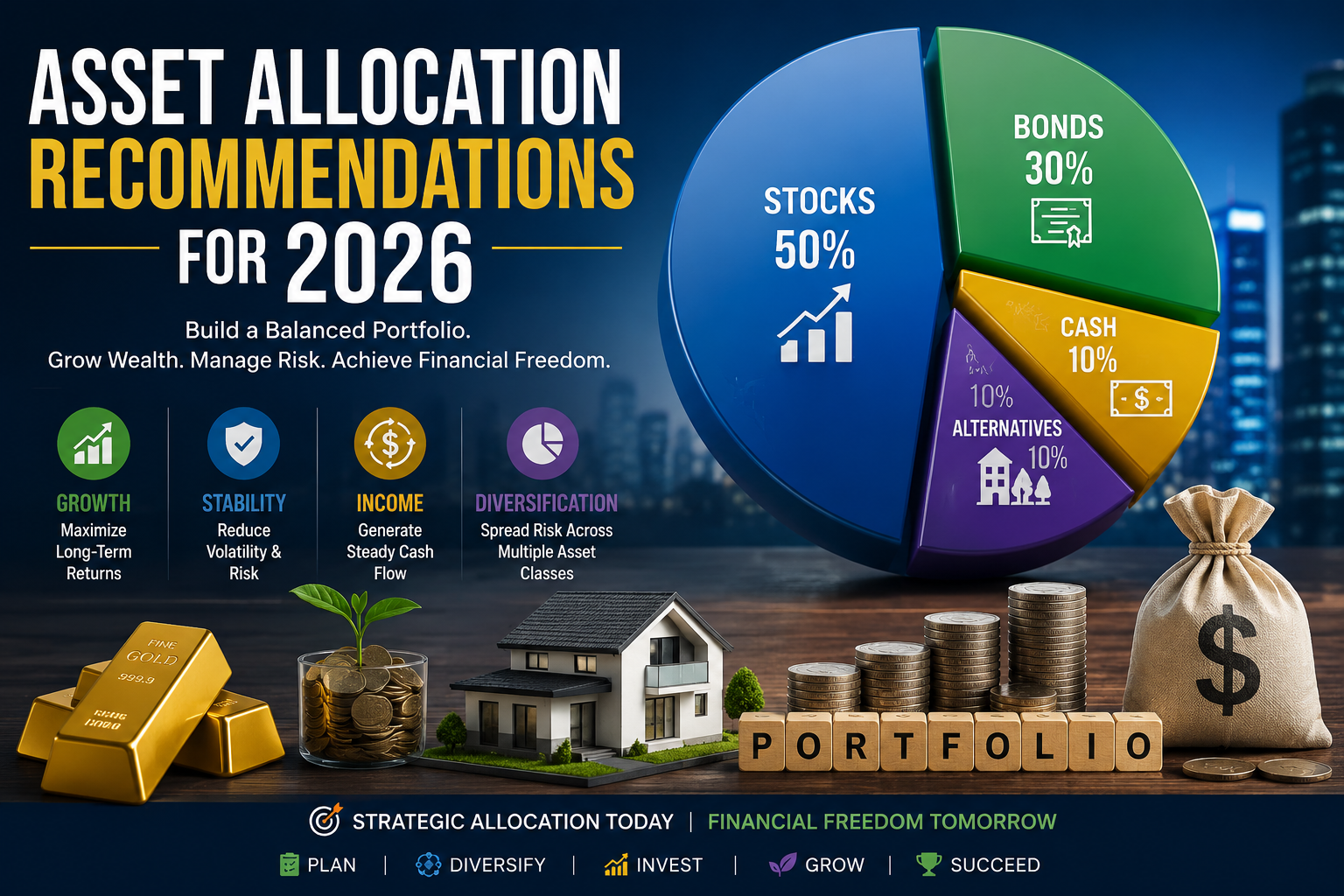
Asset Allocation Recommendations for 2026 are particularly important for investors navigating changing interest rates, inflation, economic uncertainty, technological developments, and evolving retirement needs. Choosing the right combination of stocks, bonds, cash, and alternative investments can help investors build portfolios that reflect their financial goals and ability to tolerate market losses.
Successful investing involves more than selecting individual stocks or identifying the next high-performing exchange-traded fund (ETF). Investors must also decide how much capital to allocate to different investment categories and how to adjust their portfolios as their circumstances change.
Investors who are new to financial markets should first understand the fundamentals of Start Investing, including investment goals, risk tolerance, diversification, and the importance of a long-term investment strategy.
For example, a young professional saving for retirement over 30 years may have different investment requirements from someone planning to withdraw money within three years.
The 2026 investment environment also deserves attention. On October 28, 2026, the Federal Reserve maintained its federal funds target range at 3.75%-4.00%, while reporting that inflation remained elevated and economic activity was expanding at a strong pace.
These conditions can influence bond yields, borrowing costs, cash returns, equity valuations, and investor expectations.
This comprehensive guide examines 12 practical asset allocation strategies, four illustrative portfolio models, real historical market examples, investor-specific considerations, and portfolio rebalancing methods.
The objective is to help investors understand how to construct a diversified portfolio rather than encourage them to chase short-term market predictions.
What Is Asset Allocation?
Asset allocation is the process of distributing investment capital among different asset classes, including stocks, bonds, cash equivalents, and potentially alternative investments. Understanding Portfolio Strategy can help investors determine how different investments work together to support financial objectives, manage risk, and maintain a suitable balance between growth and income.
An asset class is a category of investments that generally shares certain financial characteristics and risk factors.
The main purpose of asset allocation is to match investments with an investor’s financial goals, time horizon, liquidity requirements, and ability and willingness to accept losses.
Consider an investor with a portfolio worth $100,000.
An illustrative allocation might be:
| Asset class | Allocation | Investment value |
|---|---|---|
| Stocks | 60% | $60,000 |
| Bonds | 25% | $25,000 |
| Cash | 10% | $10,000 |
| Alternatives | 5% | $5,000 |
| Total | 100% | $100,000 |
This portfolio allocates most of its capital to equities while maintaining exposure to fixed income, liquid reserves, and alternative investments.
The allocation percentages are examples, not universal recommendations.
Investors can learn more from Investor.gov’s asset allocation and diversification guidance.
The Four Asset Classes in a 2026 Portfolio
Understanding the characteristics of each investment category helps investors select appropriate portfolio weights.
1. Stocks (Equities)
Stocks represent ownership in publicly traded companies. When investors purchase shares, they acquire an ownership interest in the underlying business. Investors should understand the fundamentals of the Stock Market, including how share prices, market capitalization, company earnings, and market conditions influence equity investments.
Examples include Apple, Microsoft, Amazon, and NVIDIA.
Stocks are commonly used to pursue long-term capital appreciation, although their prices can fluctuate considerably.
Benefits
- Long-term capital appreciation potential.
- Possible dividend income.
- Participation in business growth.
- Exposure to different industries and geographical markets.
- Potential protection against inflation over sufficiently long periods, although this is not guaranteed.
Risks
- Market volatility and substantial price declines.
- Company-specific business risks.
- Economic recession and changing consumer demand.
- High valuations and concentration in popular sectors.
- Currency risk when investing internationally.
For example, an investor holding only technology stocks may experience substantial losses if the technology sector underperforms.
A diversified equity allocation can instead include domestic and international companies across industries such as healthcare, consumer goods, financial services, industrials, and technology.
2. Bonds (Fixed Income)
Bonds are debt securities issued by governments, municipalities, and corporations. Bonds are an important component of many investment portfolio strategies because they can provide interest income and diversify exposure to equities, although their market values can fluctuate with interest rates and credit conditions.
When an investor purchases a conventional bond, the issuer generally agrees to pay interest according to specified terms and repay principal at maturity, subject to its ability to meet those obligations.
Important bond terminology includes:
- Face value: The principal amount a bond issuer promises to repay at maturity.
- Coupon rate: The stated annual interest rate based on face value.
- Yield: A measure of the income return relative to the bond’s market price.
- Maturity: The date when the principal is scheduled to be repaid.
- Credit risk: The possibility that an issuer fails to make promised payments.
- Duration: A measure of a bond’s sensitivity to changes in interest rates.
Benefits
- Potential interest income.
- Portfolio diversification.
- More predictable contractual cash flows for many conventional bonds.
- A potential source of stability compared with equities, depending on bond quality and market conditions.
Risks
- Interest-rate risk.
- Credit and default risk.
- Inflation risk.
- Liquidity risk.
- Reinvestment risk.
An important relationship is that existing conventional bond prices generally move in the opposite direction to market interest rates.
For example, if newly issued bonds offer higher yields, an older bond paying a lower coupon may become less attractive. Its market price may therefore decline.
3. Cash and Cash Equivalents
Cash and cash equivalents are highly liquid financial holdings used for immediate expenses, emergency reserves, and short-term financial objectives.
Examples include:
- Bank savings deposits.
- Money market funds.
- Treasury bills.
- Short-term government securities.
Benefits
- High liquidity.
- Lower price volatility for bank deposits and appropriately selected cash instruments.
- Access to funds for emergencies and planned expenses.
- Flexibility during market downturns.
Risks
- Inflation can reduce purchasing power.
- Long-term returns may be lower than those of growth-oriented investments.
- Deposit protection limits vary between countries and institutions.
- Money market funds are not identical to insured bank deposits.
For example, keeping money required for a house purchase within the next 12 months in highly volatile stocks could expose the investor to an unnecessary risk of having to sell after a market decline.
Cash reserves can help avoid that situation.
4. Alternative Investments
Alternative investments are assets outside traditional publicly traded stocks and conventional bonds.
They can include:
Real Estate
Real estate investments may include residential property, commercial buildings, infrastructure property, and publicly traded real estate investment trusts (REITs).
REITs allow investors to obtain exposure to income-producing property without necessarily purchasing an entire building.
Commodities
Commodities include physical resources such as gold, silver, oil, natural gas, and agricultural products.
Their prices can be affected by supply, demand, geopolitical events, currency movements, and economic growth.
Private Equity
Private equity involves investing in businesses that are not publicly traded or acquiring public companies to take them private.
These investments may have long holding periods, limited liquidity, and substantial minimum investment requirements.
Infrastructure
Infrastructure investments involve assets such as transportation networks, utilities, energy facilities, and communication systems.
Hedge Funds
Hedge funds use different investment strategies, sometimes involving leverage, derivatives, short selling, and less liquid assets.
Important: Alternative investments are not automatically safer or more diversified. Their fees, liquidity restrictions, complexity, valuation methods, and regulatory treatment should be examined carefully.
Why Asset Allocation Matters
Asset allocation influences how a portfolio responds to different market environments.
Risk Reduction
Holding different investment categories can reduce dependence on one source of returns. However, diversification does not eliminate market risk or guarantee that losses will be avoided.
Diversification
Diversification involves spreading investments across asset classes, industries, securities, and geographical markets.
For example, owning several technology stocks does not necessarily provide sufficient diversification because those companies may share similar market risks.
Smoother Returns
A portfolio containing stocks and high-quality bonds may experience a different return pattern from an entirely equity-based portfolio.
However, stocks and bonds can decline together, as demonstrated during some historical market periods.
Better Behavioral Control
A portfolio designed around an investor’s actual risk tolerance may make it easier to remain invested during market declines.
This matters because panic selling can turn temporary market losses into permanent investment losses.
Improved Long-Term Planning
An appropriate allocation connects investment decisions to specific financial objectives, including retirement, education, home purchases, and long-term wealth accumulation.
For further guidance, see Vanguard’s explanation of portfolio diversification.
The Four Core Portfolio Building Blocks
A useful way to understand a diversified portfolio is to consider the role each investment category plays.
Foundation: Cash
Cash provides liquidity for emergencies, short-term spending, and unexpected financial requirements.
Walls: Bonds
Bonds can contribute income and diversification, depending on credit quality, duration, and interest-rate conditions.
Structure: Stocks
Stocks generally provide the portfolio’s primary exposure to long-term business growth and capital appreciation.
Roof: Alternatives
Alternative investments may provide additional return sources or diversification, but they can also introduce higher costs and complexity.
These are educational analogies, not requirements that every investor must hold all four categories.
2026 Economic Outlook for Investors
Investors should consider economic conditions when reviewing their portfolios, but should not attempt to predict every market movement.
Inflation
Inflation measures the increase in the general price level of goods and services. Understanding Personal Finance principles, including budgeting, savings, inflation, and purchasing power, helps investors evaluate how rising living costs can affect their financial goals.
When inflation rises, the purchasing power of money decreases.
For example, if an investor has $10,000 in cash and annual inflation is 4%, the same amount of money would have purchasing power equivalent to approximately $9,615 in today’s prices after one year, assuming the cash earns no interest.
The formula for the inflation-adjusted value is:
Real purchasing power = Nominal amount ÷ (1 + inflation rate)
Therefore:
$10,000 ÷ 1.04 = $9,615.38
This illustrates why investors should consider purchasing-power risk when deciding how much long-term capital to hold in cash.
Interest Rates
On October 28, 2026, the Federal Reserve maintained the federal funds target range at 3.75%–4.00%.
Its statement also described inflation as elevated relative to the Federal Reserve’s 2% longer-run goal.
Interest rates influence borrowing costs, savings yields, bond valuations, and equity valuations.
For investors, higher interest rates can make newly issued fixed-income securities more attractive while potentially putting pressure on existing bond prices and the valuations of some growth companies.
However, the effect varies according to investment duration, credit quality, expected earnings, and market expectations.
Investors should remember that the federal funds rate is not the same as the yield available on every savings account, Treasury security, or corporate bond. Actual investment returns depend on maturity, credit quality, market conditions, and the financial institution or issuer.
Economic Growth
Economic growth can influence company earnings, employment, consumer demand, and investment opportunities.
Strong economic activity may support corporate revenue and profits, although the benefits are not distributed equally across industries.
Investors should avoid assuming that strong economic growth automatically translates into higher stock-market returns because market prices also reflect expectations and valuations.
Artificial Intelligence
Artificial intelligence is influencing business operations, software development, manufacturing, healthcare, and financial services.
AI-related investment may create opportunities, but companies can also face high capital expenditure, competition, regulatory challenges, and valuation risk.
Investors should avoid concentrating their entire equity allocation in a small group of technology companies simply because AI is receiving considerable attention.
Geopolitical Uncertainty
International conflicts, trade restrictions, supply-chain disruptions, and political developments can affect energy prices, currencies, inflation, and business confidence.
Geographical diversification can help reduce dependence on a single economy, although international investments introduce their own risks.
Retirement and Demographic Trends
Longer retirement periods can increase the importance of managing longevity risk.
Longevity risk is the possibility of outliving available financial resources.
Retirement portfolios may need to balance:
- Current income requirements.
- Long-term capital appreciation.
- Inflation protection.
- Healthcare expenses.
- Emergency liquidity.
- The possibility of living longer than expected.
Global Diversification
Investing across different countries can reduce dependence on one national economy. Investors can use diversified ETFs and Index Funds to obtain exposure to domestic markets, developed economies, and emerging markets without necessarily selecting individual international companies.
International investments may include developed markets and emerging markets.
Investors should consider currency fluctuations, political risks, differences in accounting standards, taxation, and market liquidity.
12 Asset Allocation Strategies for 2026
The following strategies illustrate different portfolio approaches. They are not mutually exclusive, and investors may combine several approaches according to their goals.
1. Conservative Asset Allocation
A conservative allocation emphasizes capital preservation, liquidity, and income.
Illustrative allocation: 30% stocks, 50% bonds, 15% cash, and 5% alternatives.
May suit: Investors with lower risk tolerance, shorter investment horizons, or significant near-term withdrawal requirements.
Main advantage: Lower exposure to equity-market fluctuations than an aggressive portfolio.
Main risk: Inflation may erode purchasing power, while bond prices can decline when interest rates rise.
2. Moderate Asset Allocation
A moderate allocation balances growth and income while maintaining exposure to different asset classes.
Illustrative allocation: 60% stocks, 25% bonds, 10% cash, and 5% alternatives.
May suit: Investors seeking a balance between capital appreciation and risk management.
Main advantage: Provides meaningful equity exposure while retaining fixed-income and liquid reserves.
Main risk: The portfolio can still experience significant losses during broad market declines.
3. Growth Asset Allocation
A growth allocation gives greater weight to equities to pursue long-term capital appreciation.
Illustrative allocation: 80% stocks, 10% bonds, 5% cash, and 5% alternatives.
May suit: Investors with long investment horizons and the financial capacity to tolerate substantial market declines.
Main advantage: Higher exposure to long-term equity growth potential.
Main risk: Larger short-term losses and greater portfolio volatility.
4. Aggressive Growth Allocation
An aggressive allocation prioritizes long-term capital growth and accepts substantial volatility.
Illustrative allocation: 85% stocks, 5% bonds, 5% cash, and 5% alternatives.
May suit: Investors with long horizons, stable financial circumstances, and a high ability and willingness to accept losses.
Main advantage: Significant exposure to equity-market growth.
Main risk: Severe market declines can produce substantial portfolio losses.
5. Retirement-Focused Allocation
Retirement-focused allocation considers the timing of withdrawals, income requirements, and the possibility of living for several decades after retirement. A comprehensive Retirement Investing strategy should consider withdrawal planning, retirement income sources, inflation, healthcare costs, and the need to maintain sufficient liquidity throughout retirement.
It may involve gradually adjusting equity and fixed-income exposure as retirement approaches.
However, becoming excessively conservative too early can expose investors to inflation and longevity risk.
May suit: Individuals approaching retirement and existing retirees.
Important consideration: Expected Social Security, pensions, other income sources, healthcare expenses, and withdrawal rates should be considered together.
6. Income-Focused Allocation
An income-focused strategy emphasizes investments that generate interest, dividends, or other cash flows.
Potential components include:
- Investment-grade bonds.
- Government securities.
- Dividend-paying equities.
- REITs.
- Other income-producing investments.
Investors should distinguish between income and total return.
Total return includes investment income and changes in market value.
A high dividend yield does not automatically mean a company is financially healthy. Dividends can be reduced or suspended.
7. Inflation-Resistant Allocation
An inflation-resistant portfolio seeks to reduce the effect of rising prices on long-term purchasing power.
Possible components include:
- Diversified equities.
- Treasury Inflation-Protected Securities (TIPS).
- Inflation-linked government bonds in other countries.
- Selected real estate investments.
- Carefully evaluated commodity exposure.
Inflation-linked bonds adjust certain payments or principal according to an inflation index, subject to their specific terms.
No asset provides perfect inflation protection under every market condition.
8. Global Diversification Allocation
A global allocation distributes investment exposure across domestic and international markets.
For example, an investor could hold domestic equities, developed-market international equities, emerging-market equities, and diversified bonds.
The purpose is to reduce dependence on a single country’s economic and financial performance.
However, international exposure may increase currency and political risks.
9. 60/40 Portfolio Allocation
A traditional 60/40 portfolio invests approximately 60% in stocks and 40% in bonds.
It combines equity-market growth potential with fixed-income exposure.
For example, a $100,000 portfolio could contain:
- $60,000 in diversified equities.
- $40,000 in diversified bonds.
This approach is relatively straightforward to manage, but it does not guarantee capital preservation.
The historical experience of 2022 demonstrated that stocks and bonds can both decline during the same period when inflation and rising interest rates affect both markets.
10. Cash-Reserve Allocation
A cash-reserve strategy maintains accessible funds for emergencies, near-term expenses, and planned withdrawals.
For example, someone saving for a house deposit due within 18 months may prioritize capital stability and liquidity over long-term equity growth for that specific goal.
Cash should be allocated according to actual financial requirements rather than a prediction that the stock market will decline.
11. Alternative-Asset Allocation
This strategy adds selected alternatives to a traditional portfolio.
Potential investments include real estate, commodities, infrastructure, and private equity.
Alternatives may provide different return sources, but investors should carefully assess liquidity, fees, leverage, regulation, and valuation transparency.
A modest allocation may be sufficient for investors who understand the additional risks. Some investors may reasonably choose not to hold alternatives at all.
12. Goal-Based Asset Allocation
Goal-based allocation organizes investments around individual financial objectives. Connecting investment decisions with long-term wealth building can help investors organize their savings around retirement, property purchases, education, and other financial milestones.
For example:
- Emergency savings: highly liquid, lower-volatility holdings.
- Home purchase in three years: capital-preservation-oriented investments.
- Retirement in 25 years: a potentially more growth-oriented diversified portfolio.
- Education expenses in five years: investments matched to the expected withdrawal date.
The benefit is that each investment allocation is connected to a specific financial requirement.
Recommended Asset Allocation Models for 2026
The following table provides four illustrative portfolio models for comparison.
These percentages are educational examples, not personalized recommendations.
| Investor profile | Stocks | Bonds | Cash | Alternatives | Total |
|---|---|---|---|---|---|
| Conservative | 30% | 50% | 15% | 5% | 100% |
| Moderate | 60% | 25% | 10% | 5% | 100% |
| Growth | 80% | 10% | 5% | 5% | 100% |
| Aggressive Growth | 85% | 5% | 5% | 5% | 100% |
portfolio table
For a portfolio valued at $100,000, the models translate into the following investment amounts.
Conservative Portfolio
- Stocks: $30,000.
- Bonds: $50,000.
- Cash: $15,000.
- Alternatives: $5,000.
Objective: Emphasize stability, liquidity, and income.
Moderate Portfolio
- Stocks: $60,000.
- Bonds: $25,000.
- Cash: $10,000.
- Alternatives: $5,000.
Objective: Balance growth potential and risk management.
Growth Portfolio
- Stocks: $80,000.
- Bonds: $10,000.
- Cash: $5,000.
- Alternatives: $5,000.
Objective: Pursue long-term capital appreciation while retaining some diversification.
Aggressive Growth Portfolio
- Stocks: $85,000.
- Bonds: $5,000.
- Cash: $5,000.
- Alternatives: $5,000.
Objective: Prioritize equity growth and accept substantial volatility.
An aggressive portfolio is not necessarily appropriate simply because an investor is young. Income stability, debt, emergency savings, investment knowledge, and emotional tolerance for losses also matter.
Strategic vs. Tactical Allocation in 2026
Strategic Allocation
Strategic asset allocation establishes long-term target percentages based on financial objectives and risk tolerance.
For example, an investor may establish a 60% stock and 40% bond allocation and periodically rebalance toward those targets.
The strategy focuses on maintaining a consistent long-term investment framework.
Tactical Allocation
Tactical asset allocation involves temporary changes to portfolio weights based on market assessments.
An investor might temporarily increase short-term government securities or reduce exposure to an asset class.
However, tactical allocation introduces market-timing risk and requires disciplined decision-making.
It should not become a justification for frequently changing investments in response to headlines.
Asset Allocation by Investor Type
Young Investors
Young investors with stable finances and long investment horizons may be able to tolerate greater equity exposure.
However, emergency savings, debt obligations, and near-term goals should be considered separately.
Middle-Age Investors
Middle-age investors may need to balance retirement savings, family expenses, education costs, and other financial obligations.
Their allocations should reflect the timing of each goal rather than age alone.
Investors Near Retirement
Investors approaching retirement should evaluate the amount of money they will need to withdraw, the stability of other income sources, and their ability to withstand a market downturn.
Retirees
Retirees often need to balance liquidity, income, capital preservation, and long-term growth.
A diversified portfolio may include equities for long-term purchasing power, bonds for income, and cash for near-term spending.
Income-Focused Investors
Investors seeking regular cash flows should examine interest payments, dividends, distribution policies, and the sustainability of income sources.
They should also consider total return and the possibility of capital losses.
High-Risk-Tolerance Investors
Investors with a high risk tolerance may choose higher equity exposure.
However, willingness to accept risk is different from financial capacity to absorb losses.
Both should be considered before selecting an aggressive allocation.
Example Portfolios for 2026
The following case studies use illustrative investor circumstances and transparent calculations. They are educational examples, not reports of actual named clients or guaranteed investment outcomes.
Case Study 1: The Retired Investor
Investor profile: Age 68, portfolio value $1 million.
Illustrative allocation:
- 35% stocks: $350,000.
- 50% bonds: $500,000.
- 10% cash: $100,000.
- 5% alternatives: $50,000.
This allocation emphasizes income and lower equity exposure while retaining growth potential.
If annual withdrawals are required, the investor should develop a withdrawal plan that considers pension income, Social Security eligibility, healthcare expenses, inflation, and tax treatment.
Case Study 2: Young Professional
Investor profile: Age 28, long-term retirement objective, 35-year investment horizon.
Illustrative allocation:
- 85% diversified stocks.
- 10% bonds.
- 5% cash.
The portfolio emphasizes long-term growth but can experience substantial market declines.
The investor should maintain emergency savings outside the long-term investment portfolio and avoid investing money needed for immediate expenses in volatile assets.
Case Study 3: Near-Retirement Investor
Investor profile: Age 58, expected retirement within seven years.
Illustrative allocation:
- 55% stocks.
- 30% bonds.
- 10% cash.
- 5% alternatives.
The portfolio balances continued growth potential with liquidity and fixed-income exposure.
A key concern is sequence-of-returns risk, which occurs when poor investment returns early in retirement coincide with withdrawals.
Case Study 4: Inflation Protection Portfolio
Investor profile: Long-term investor concerned about rising living costs.
Illustrative allocation:
- 50% stocks.
- 20% bonds.
- 15% real estate.
- 10% commodities.
- 5% cash.
This portfolio provides exposure to several investment categories that may respond differently to inflation.
However, commodities and real estate can be volatile, and inflation protection is not guaranteed.
Case Study 5: Global Diversification Strategy
Investor profile: Long-term investor seeking international exposure.
Illustrative allocation:
- 40% domestic stocks.
- 25% international stocks.
- 25% bonds.
- 10% alternatives.
This portfolio reduces dependence on a single equity market.
Currency fluctuations, international taxation, market liquidity, and political risks should still be evaluated.
Historical Risk and Return Trade-Offs
Historical market events demonstrate why asset allocation matters.
Case Study: The 2008 Global Financial Crisis
The 2008 financial crisis involved severe disruption in financial markets, falling equity prices, housing-market stress, and widespread credit problems.
Investors with concentrated equity portfolios faced substantial losses.
Diversified portfolios were not immune to declines, but exposure to different asset categories could change the overall experience depending on their holdings and market conditions.
The lesson is that investors should consider how their portfolios might behave during severe economic stress rather than evaluating investments only during rising markets.
Case Study: The 2020 COVID-19 Market Shock
The COVID-19 pandemic produced a rapid global economic shock and substantial financial-market volatility.
Equity markets experienced sharp declines before recovering as economic and policy conditions changed.
Investors who had a suitable long-term allocation and sufficient liquidity were generally better positioned to avoid selling long-term holdings solely to meet immediate spending needs.
The lesson is to distinguish short-term volatility from permanent changes in financial goals.
Case Study: The 2022 Stock and Bond Decline
In 2022, rising inflation and higher interest rates placed pressure on both equity and bond valuations.
This challenged the assumption that bonds always rise when stocks fall.
The experience demonstrated that diversification can reduce certain risks without eliminating all market losses.
How to Build a 2026 Asset Allocation
A practical allocation process involves seven steps.
Step 1: Define Financial Goals
Identify the purpose of each investment.
Examples include retirement, home ownership, education, and long-term wealth accumulation.
Step 2: Assess Risk Tolerance and Risk Capacity
Risk tolerance is your psychological willingness to accept investment losses.
Risk capacity is your financial ability to withstand those losses.
An investor may be comfortable with stock-market volatility but have limited financial capacity because of upcoming expenses.
Both factors matter.
Step 3: Choose an Appropriate Allocation
Compare the four illustrative models and evaluate which characteristics fit your objectives.
Do not select an aggressive allocation simply because it has greater potential returns.
Step 4: Select Investments
Choose diversified funds, ETFs, government securities, bonds, and other investments that provide the desired exposure.
Review fees, holdings, liquidity, tax treatment, and investment risks.
Step 5: Diversify Globally
Consider different countries, sectors, company sizes, and investment styles.
Avoid excessive concentration in one company, industry, or geographical market.
Step 6: Establish a Rebalancing Policy
Set a review schedule or allocation-drift thresholds.
A written policy can reduce emotional decision-making.
Step 7: Stay Disciplined
Review the portfolio when financial circumstances or investment objectives change.
Avoid constantly changing allocations in response to market headlines.
How to Rebalance Your Portfolio in 2026
Rebalancing means adjusting portfolio holdings to bring them closer to their intended target allocations.
Suppose an investor begins with:
- 60% stocks.
- 30% bonds.
- 10% cash.
After a period of strong equity-market performance, the stock allocation increases to 70%.
The portfolio may now carry more equity risk than originally intended.
Annual Rebalancing
Review the portfolio once a year and compare actual holdings with target percentages.
Threshold Rebalancing
Rebalance when an asset class moves beyond a predetermined tolerance.
For example, an investor with a 60% stock target might review the allocation if it moves below 55% or above 65%.
These are illustrative thresholds, not universal rules.
When to Rebalance
Consider rebalancing when:
- Portfolio weights drift significantly.
- Financial goals change.
- Retirement approaches.
- Withdrawal requirements change.
- Risk tolerance or financial capacity changes.
Tax Considerations
Selling investments can trigger taxable capital gains or losses, depending on the country’s tax rules and account type.
Investors may sometimes use new contributions or distributions to adjust portfolio weights without selling existing investments.
Review transaction costs and tax consequences before making changes.
For more information, see Investor.gov’s asset allocation and rebalancing guidance.
Common Asset Allocation Mistakes
Chasing 2026 Market Winners
Buying assets only because they recently performed well can lead to excessive valuations and poor timing decisions.
Ignoring Diversification
Holding multiple investments does not necessarily create diversification if they have similar underlying risks.
Emotional Investing
Panic selling during market declines can disrupt a long-term investment strategy.
Never Rebalancing
Allowing allocations to drift can gradually increase portfolio risk.
Holding Excessive Cash
Holding more cash than required for financial needs may reduce long-term growth potential and purchasing power.
Panic Selling
Selling long-term investments without considering the original financial plan can turn temporary declines into permanent losses.
Overconcentrating in AI/Technology
Investing too heavily in a popular sector can create significant concentration risk.
Ignoring International Markets
Excluding international investments may leave portfolios dependent on one country’s economic and financial performance.
Taking More Risk Than Necessary
An investor should not accept additional volatility without considering whether the potential return justifies the additional risk.
Stocks vs Bonds vs Cash vs Alternatives
| Asset class | Growth potential | Income potential | Liquidity | Main risks |
|---|---|---|---|---|
| Stocks | Generally higher over long horizons | Dividends | Usually high for listed stocks | Market and company risk |
| Bonds | Generally lower than equities | Interest | Varies by bond | Interest-rate and credit risk |
| Cash | Generally limited | Interest may be available | Generally high | Inflation and purchasing-power risk |
| Alternatives | Highly variable | Depends on investment | Often variable or limited | Complexity, valuation and liquidity risk |
No asset class is universally superior. Their suitability depends on the investor’s goals and circumstances.
Building Your Own Portfolio
Investors can use a simple mathematical formula to calculate the amount assigned to each asset category. Investors who want to develop their financial knowledge further can explore our Investment Market Guides for additional explanations of investment concepts, market terminology, and portfolio-related calculations.
Formula:
Investment amount = Total portfolio value × Asset allocation percentage
Consider a $50,000 portfolio with the following illustrative targets:
- Stocks: 60%.
- Bonds: 25%.
- Cash: 10%.
- Alternatives: 5%.
Calculations:
Stocks
$50,000 × 0.60 = $30,000
Bonds
$50,000 × 0.25 = $12,500
Cash
$50,000 × 0.10 = $5,000
Alternatives
$50,000 × 0.05 = $2,500
Total:
$30,000 + $12,500 + $5,000 + $2,500 = $50,000.
The portfolio is therefore fully allocated, with all four categories adding up to 100%.
Future Trends Affecting Asset Allocation
Artificial Intelligence
AI adoption may affect corporate productivity, investment spending, employment, and competitive advantages.
Investors should assess individual company fundamentals rather than assuming that all AI-related businesses will succeed.
Digital Assets
Digital assets, including cryptocurrencies, introduce additional volatility, custody, regulatory, and operational risks.
They are not necessary components of a diversified portfolio.
Longevity
Longer life expectancy increases the importance of retirement income planning and inflation-adjusted withdrawals.
Automation
Automation may reduce operating costs for some companies while disrupting existing business models and employment patterns.
Globalization
Changes in international trade, supply chains, and geopolitical relationships can influence investment opportunities and risk.
Key Evidence and Investor Considerations
Several important principles should guide portfolio decisions:
- Asset allocation should reflect investment goals, risk tolerance, risk capacity, and time horizon.
- Diversification should occur both between asset classes and within individual asset classes.
- Different asset classes can decline simultaneously.
- Historical returns do not guarantee future performance.
- Rebalancing can help maintain the intended portfolio risk.
- Transaction costs and tax consequences should be considered before selling investments.
- Cash requirements should be connected to actual spending and liquidity needs.
- Alternative investments can introduce additional complexity and may not be appropriate for every investor.
Authoritative educational resources:
- Investor.gov – Asset Allocation and Diversification
- Federal Reserve – October 28, 2026 FOMC Statement
- Vanguard – Portfolio Diversification
- SEBI Investor Education – Investment Considerations
Frequently Asked Questions (FAQs)
1. What are the best asset allocation recommendations for 2026?
There is no universally best allocation. A moderate investor might consider an illustrative mix of 60% stocks, 25% bonds, 10% cash, and 5% alternatives. The appropriate allocation depends on personal financial circumstances.
2. What is the ideal stock-to-bond ratio?
Common frameworks include 60/40, 80/20, and 40/60 stock-to-bond allocations. The appropriate ratio depends on investment horizon, financial goals, risk tolerance, and withdrawal requirements.
3. How much cash should investors hold in 2026?
Cash holdings should reflect emergency savings, upcoming expenses, and liquidity requirements. There is no universal percentage suitable for every investor.
4. Is a 60/40 portfolio still relevant in 2026?
Yes. The 60/40 framework remains a useful starting point for understanding the balance between equities and fixed income. However, it does not guarantee positive returns or protect against every market decline.
5. Should young investors hold more stocks?
Investors with long time horizons may have greater capacity to tolerate equity volatility. However, emergency reserves, income stability, debt, and financial obligations must also be considered.
6. What is the difference between strategic and tactical asset allocation?
Strategic allocation establishes long-term portfolio targets. Tactical allocation temporarily changes portfolio weights based on market assessments.
7. Are alternative investments necessary?
No. Alternative investments are optional. Investors should consider their fees, liquidity, complexity, and risks before including them.
8. How frequently should I rebalance my portfolio?
Many investors review their portfolios annually or use predetermined allocation-drift thresholds. The frequency should balance risk management against transaction costs and taxes.
9. What happens when stocks and bonds decline together?
A portfolio containing both can still experience losses. Investors should maintain realistic expectations about diversification and consider the quality, duration, and risk characteristics of their holdings.
10. How does inflation affect asset allocation?
Inflation reduces the purchasing power of money. Investors may consider a combination of equities, inflation-linked bonds, and selected real assets to manage long-term purchasing-power risk.
11. What is risk capacity?
Risk capacity is the financial ability to withstand investment losses without jeopardizing essential expenses or important financial goals. It differs from risk tolerance, which describes psychological comfort with risk.
12. How do I calculate asset allocation percentages?
Divide the value of an asset category by the total portfolio value and multiply by 100.
For example, $30,000 in stocks divided by a $50,000 portfolio equals 60%.
13. Should retirees invest in stocks?
Some retirees maintain equity exposure to support long-term growth and purchasing power. The appropriate amount depends on spending needs, other income, investment horizon, and risk capacity.
14. Does diversification guarantee against investment losses?
No. Diversification can reduce concentration risk, but broad market declines, economic shocks, and unexpected events can still cause losses.
15. Should I change my asset allocation whenever interest rates change?
Not necessarily. Interest rates are one consideration, but allocation decisions should primarily reflect long-term goals, time horizon, risk tolerance, and financial circumstances.
Final Thoughts
Asset Allocation Recommendations for 2026 should focus on building a portfolio that reflects individual financial goals rather than predicting which investment category will perform best next year.
Stocks can provide long-term growth potential, bonds can contribute income and diversification, cash provides liquidity, and selected alternative investments may offer additional exposure to different return sources.
The four illustrative portfolio models and 12 strategies in this guide provide starting points for comparing different approaches.
However, the right allocation is not determined by age, market headlines, or a single percentage formula. It depends on investment horizon, financial obligations, risk capacity, liquidity requirements, and the ability to remain disciplined during difficult market conditions.
A well-constructed portfolio should be diversified, reviewed periodically, and adjusted when financial circumstances or long-term objectives materially change.
The goal is not to find a perfect portfolio for 2026. It is to build an investment strategy that can support your financial goals through different market environments.
Financial Disclaimer: This article is for educational and informational purposes only. It does not constitute personalized investment, financial, legal, or tax advice. All portfolio allocations are illustrative examples and are not recommendations to buy or sell specific securities. Investments involve risks, including possible loss of principal. Consult a qualified financial professional and consider your individual circumstances before making investment decisions.