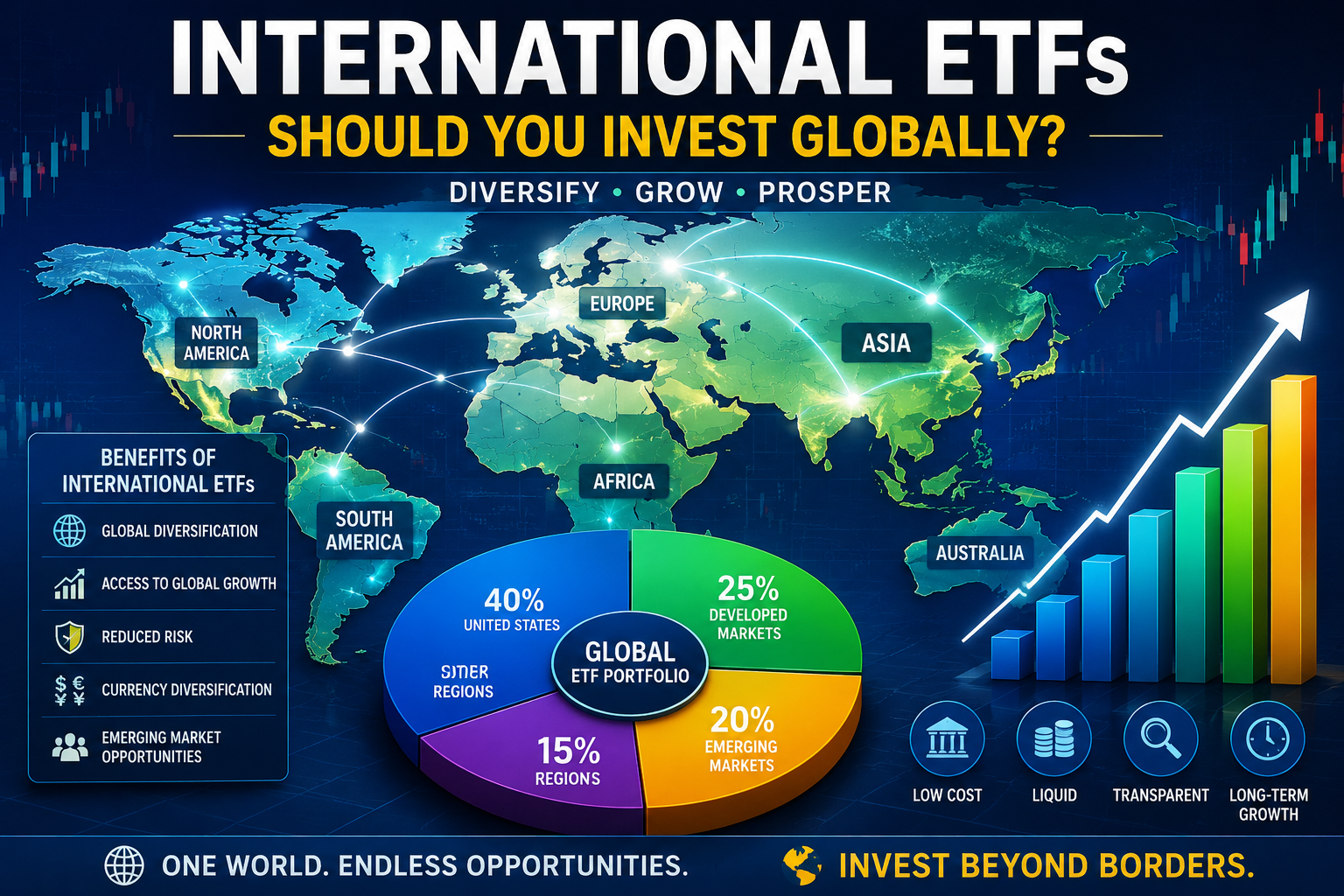
Global investing is no longer reserved for hedge funds, billionaires, or professional portfolio managers. Today, ordinary investors can buy shares of companies across the world using a simple investment product called an ETF.
But many investors still ask:
- Should I invest only in my home country?
- Is international investing risky?
- Are international ETFs worth it?
- What happens if the U.S. market underperforms?
- How much international exposure should a portfolio have?
These are important questions because the world economy is changing rapidly.
The United States still dominates global markets, but countries like India, China, Japan, Taiwan, Germany, Brazil, and South Korea continue to play massive roles in manufacturing, technology, energy, healthcare, and global trade.
International ETFs allow investors to participate in global growth without buying individual foreign stocks directly.
This guide explains everything in simple language — including terms, strategies, examples, risks, tax considerations, and real-world case studies.
What Is an ETF?
ETF stands for Exchange-Traded Fund.
An ETF is a basket of investments traded on a stock exchange just like a stock.
Instead of buying one company, an ETF lets you buy many investments together.
For example:
- One ETF may contain 500 U.S. companies
- Another ETF may contain Asian technology companies
- Another may track European markets
- Another may hold global stocks from 40+ countries
ETFs are popular because they provide:
- Diversification
- Low costs
- Easy investing
- Liquidity
- Transparency
What Is an International ETF?
An International ETF is an ETF that invests in companies outside your home country.
For example:
- A U.S. investor buying Japanese stocks through an ETF
- An Indian investor buying U.S. companies through an ETF
- A Canadian investor buying European stocks through an ETF
Instead of manually buying foreign shares, international ETFs package them into one simple investment.
Types of International ETFs
There are several categories of international ETFs.
Understanding them is critical before investing.
1. Developed Market ETFs
These invest in advanced economies.
Examples include:
- Japan
- Germany
- United Kingdom
- France
- Australia
- Canada
These economies usually have:
- Stable governments
- Mature financial systems
- Lower volatility
- Strong regulations
Example ETF Categories
- Europe ETFs
- Japan ETFs
- Pacific ETFs
- Developed Markets ETFs
2. Emerging Market ETFs
These invest in fast-growing economies.
Examples include:
- India
- China
- Brazil
- Indonesia
- Mexico
- Vietnam
Emerging markets often provide:
- Higher growth potential
- Younger populations
- Expanding middle class
- Industrial growth
But they also carry:
- Political risk
- Currency volatility
- Regulatory uncertainty
3. Global ETFs
Global ETFs invest in:
- U.S. companies
- International companies
- Emerging markets
They provide worldwide diversification in one fund.
4. Regional ETFs
Regional ETFs focus on a specific geographic area.
Examples:
- Asia ETFs
- Europe ETFs
- Latin America ETFs
- Middle East ETFs
5. Country-Specific ETFs
These ETFs invest in one country only.
Examples:
- India ETF
- China ETF
- Japan ETF
- Brazil ETF
Country ETFs can be useful when investors strongly believe in a specific economy.
Why Investors Use International ETFs
International ETFs solve a major problem:
Concentration risk.
Many investors unknowingly invest almost entirely in one country.
For example:
- Americans often hold mostly U.S. stocks
- Indians often hold mostly Indian stocks
- Japanese investors often hold Japanese assets
This creates home-country bias.
If your local market struggles for years, your wealth growth may slow dramatically.
International ETFs reduce this dependency.
What Is Home-Country Bias?
Home-country bias means investors prefer investments from their own country.
This happens because people feel:
- Familiarity
- Emotional comfort
- Better understanding
- National pride
But familiarity does not always equal better returns.
Historical Example: Japan’s Lost Decades
Japan’s stock market was once the largest in the world.
In 1989:
- Japanese stocks dominated global markets
- Real estate prices exploded
- Investors believed Japan would lead the world economy forever
Then the bubble burst.
The Japanese market struggled for decades afterward.
Investors who only held Japanese stocks experienced long periods of poor returns.
Global diversification could have reduced this damage.
Historical Example: U.S. Market Dominance
The U.S. stock market performed exceptionally well from 2010–2025.
Companies like:
- Apple
- Microsoft
- Nvidia
- Amazon
- Meta
drove enormous gains.
This caused many investors to believe international investing is unnecessary.
But market leadership changes over time.
Before 2010:
- Emerging markets often outperformed the U.S.
- International stocks had periods of stronger returns
No country leads forever.
Benefits of International ETFs
1. Diversification
Diversification means spreading investments across different assets.
International ETFs diversify across:
- Countries
- Economies
- Currencies
- Industries
- Political systems
This reduces dependence on one market.
2. Access to Global Growth
Some industries dominate outside the U.S.
Examples:
| Country | Industry Strength |
|---|---|
| Taiwan | Semiconductor manufacturing |
| India | IT services |
| Germany | Engineering |
| Switzerland | Pharmaceuticals |
| South Korea | Electronics |
| Brazil | Commodities |
International ETFs allow exposure to these sectors.
3. Currency Diversification
When investing internationally, you indirectly hold foreign currencies.
This can help if your home currency weakens.
Example:
If the U.S. dollar falls, foreign assets may rise in dollar value.
Currency Risk Explained
Currency risk means exchange rates affect returns.
Suppose:
- You invest $10,000 in European stocks
- European stocks rise 8%
- But the euro weakens 10% against the dollar
Your total return could become negative.
Currency movements matter significantly in international investing.
4. Reduced Portfolio Volatility
Different countries perform differently during economic cycles.
When one market falls:
- Another may rise
- Another may remain stable
This can smooth long-term returns.
5. Exposure to Emerging Markets
Emerging markets may grow faster because of:
- Population growth
- Urbanization
- Rising incomes
- Infrastructure development
- Digital adoption
Examples include:
- India’s technology expansion
- Vietnam manufacturing growth
- Indonesia consumer growth
Risks of International ETFs
Global investing is beneficial, but not risk-free.
1. Currency Risk
As explained earlier, exchange rate fluctuations can reduce returns.
This is one of the biggest international investing risks.
2. Political Risk
Governments can affect markets through:
- Regulations
- Tax policies
- Trade restrictions
- Nationalization
- Sanctions
Emerging markets especially face political uncertainty.
3. Economic Instability
Some countries may experience:
- Inflation
- Recession
- Banking crises
- Debt problems
These can hurt stock markets significantly.
4. Geopolitical Risk
International investing is affected by:
- Wars
- Trade conflicts
- Diplomatic tensions
- Supply chain disruptions
Example:
U.S.–China tensions impacted many global companies.
5. Different Accounting Standards
Financial reporting may differ between countries.
Some markets have:
- Less transparency
- Weaker regulations
- Corporate governance concerns
This increases investment uncertainty.
Developed Markets vs Emerging Markets
Understanding this difference is critical.
| Feature | Developed Markets | Emerging Markets |
|---|---|---|
| Stability | High | Medium/Low |
| Growth Potential | Moderate | High |
| Volatility | Lower | Higher |
| Regulation | Strong | Developing |
| Currency Stability | Higher | Lower |
| Risk | Lower | Higher |
Should Beginners Invest Internationally?
Yes — but gradually.
A beginner investor usually benefits from broad diversification instead of concentrated bets.
Global investing helps beginners:
- Reduce single-country risk
- Learn international market behavior
- Build balanced portfolios
However, beginners should avoid excessive complexity.
How Much International Exposure Should You Have?
There is no perfect answer.
Common approaches include:
| Strategy | International Allocation |
|---|---|
| Conservative | 10–20% |
| Balanced | 20–40% |
| Aggressive Global | 40–60% |
Many global market indexes currently allocate roughly 35–45% internationally.
Case Study: Two Investors
Investor A — Domestic Only
Portfolio:
- 100% U.S. stocks
Outcome:
- Strong gains during U.S. bull market
- Higher dependence on one economy
Investor B — Globally Diversified
Portfolio:
- 60% U.S.
- 25% Developed international
- 15% Emerging markets
Outcome:
- Slightly lower returns during U.S. dominance
- Better diversification
- Lower concentration risk
- Better protection if U.S. leadership weakens
Over decades, diversification often improves risk-adjusted returns.
What Is Risk-Adjusted Return?
Risk-adjusted return measures:
How much return you earned compared to the risk taken.
Two portfolios may earn the same return.
But if one experienced lower volatility, it produced better risk-adjusted performance.
Diversification aims to improve this balance.
International ETFs vs Individual Foreign Stocks
ETFs Advantages
- Instant diversification
- Lower research burden
- Lower company-specific risk
- Easier management
Individual Foreign Stocks Advantages
- Potentially higher returns
- More targeted investing
Most long-term investors prefer ETFs because simplicity often wins.
Tax Considerations of International ETFs
Taxes matter significantly.
Depending on your country, international ETFs may involve:
- Foreign withholding taxes
- Dividend taxes
- Capital gains taxes
- Estate taxes
- Currency conversion costs
What Is Foreign Withholding Tax?
Some countries automatically deduct tax from dividends before investors receive them.
Example:
A foreign company pays a dividend.
The government may withhold:
- 10%
- 15%
- 30%
before payment reaches investors.
Tax treaties sometimes reduce this amount.
Expense Ratio Explained
Every ETF charges a management fee called an expense ratio.
Example:
If an ETF charges 0.20% annually:
- Investing $10,000 costs about $20 yearly
Lower expense ratios help long-term returns compound faster.
Why Costs Matter
Small differences become huge over decades.
Example:
Two portfolios earn 8% annually.
But:
- Portfolio A costs 0.05%
- Portfolio B costs 1.00%
After 30 years, the lower-cost portfolio may end with dramatically more money.
Passive vs Active International ETFs
Passive ETFs
These track indexes.
Advantages:
- Lower fees
- Simplicity
- Consistency
Active ETFs
Managers select investments actively.
Advantages:
- Potential outperformance
- Tactical adjustments
Disadvantages:
- Higher costs
- Manager risk
- Often underperform long-term
Most evidence supports passive investing for long-term investors.
International ETFs and Retirement Investing
Global diversification is especially important for retirement portfolios.
Why?
Retirement investing spans:
- 20 years
- 30 years
- Sometimes 50+ years
No one knows which country will dominate decades from now.
International exposure reduces long-term uncertainty.
Sequence of Returns Risk
This refers to poor returns occurring early in retirement.
Global diversification may reduce the impact of prolonged underperformance in one country.
Should Young Investors Invest Globally?
Young investors usually have:
- Long time horizons
- Higher risk tolerance
- Greater ability to recover from volatility
This often makes international investing highly beneficial.
Should Retirees Invest Internationally?
Yes — but carefully.
Retirees may want:
- Lower volatility
- Stable income
- Currency protection
International exposure can still help, but allocations may be smaller.
Common International ETF Strategies
1. Total World Portfolio
This strategy owns the entire global stock market.
Advantages:
- Maximum diversification
- Simplicity
- Balanced exposure
2. U.S. + International Split
Example:
- 70% U.S.
- 30% International
This is extremely popular.
3. Developed + Emerging Split
Example:
- 80% Developed
- 20% Emerging
This balances stability and growth.
4. Regional Rotation Strategy
Some investors overweight regions they believe will outperform.
This requires more research and risk tolerance.
International Investing During Crises
Global diversification does not eliminate losses.
During global crises:
- Many markets fall together
Example:
During the 2008 financial crisis, worldwide markets declined sharply.
However, diversification still helps over long periods.
Correlation Explained
Correlation measures how investments move relative to each other.
- High correlation = move together
- Low correlation = move differently
International diversification works best when correlations are lower.
Why International Stocks Sometimes Underperform
There are periods when international markets lag because of:
- Strong U.S. dollar
- Faster U.S. innovation
- Economic weakness abroad
- Political instability
- Slower growth
This does not mean international investing is permanently bad.
Markets move in cycles.
Behavioral Mistakes Investors Make
1. Performance Chasing
Investors often buy whatever recently performed best.
This is dangerous.
2. Panic Selling
International markets can be volatile.
Selling during downturns locks in losses.
3. Overconcentration
Some investors put excessive money into one country or region.
Diversification matters globally too.
Real-World Example: Global Technology Exposure
Many investors think they already have international exposure through U.S. companies.
For example:
- Apple sells globally
- Microsoft operates internationally
- Coca-Cola earns revenue worldwide
This is partially true.
But owning international companies directly still provides different economic exposure.
What Is Market Capitalization?
Market capitalization means total company value.
Formula:
\text{Market Capitalization} = \text{Share Price} \times \text{Total Shares Outstanding}
Large-cap international companies dominate many ETFs.
Large-Cap vs Small-Cap International ETFs
Large-Cap ETFs
Invest in major global corporations.
Advantages:
- Stability
- Liquidity
- Lower risk
Small-Cap ETFs
Invest in smaller companies.
Advantages:
- Higher growth potential
Disadvantages:
- Higher volatility
Dividend International ETFs
Some investors prefer international dividend ETFs.
These focus on companies paying regular dividends.
Benefits may include:
- Income generation
- Mature companies
- Potential stability
But dividend investing also has risks.
ESG International ETFs
ESG stands for:
- Environmental
- Social
- Governance
These ETFs invest based on ethical or sustainability criteria.
Popularity has grown rapidly worldwide.
International Bond ETFs
Not all international ETFs hold stocks.
Some invest in:
- Government bonds
- Corporate bonds
- Emerging market debt
These may reduce volatility but introduce currency and interest-rate risks.
Currency-Hedged International ETFs
Some ETFs hedge currency risk.
This means they attempt to reduce exchange-rate fluctuations.
Advantages:
- More stable returns
Disadvantages:
- Higher costs
- Reduced diversification benefits
Should You Hedge Currency Risk?
There is no universal answer.
Long-term investors often avoid hedging because:
- Currency fluctuations may balance over time
- Hedging adds costs
But some retirees or conservative investors prefer hedged products.
Dollar-Cost Averaging Into International ETFs
Dollar-cost averaging means investing fixed amounts regularly.
Example:
- $500 monthly into international ETFs
Benefits include:
- Reduces emotional investing
- Smooths market timing risk
- Encourages discipline
Lump Sum vs Gradual Investing
Research often shows lump-sum investing wins statistically because markets generally rise over time.
However:
- Gradual investing reduces emotional stress
- Many investors prefer systematic investing
International ETFs in Recessions
Some international markets recover faster than others.
Global diversification may create more recovery opportunities after downturns.
Valuation Differences Matter
Countries trade at different valuation levels.
Example metrics:
- P/E ratio
- Price-to-book ratio
- Dividend yield
Sometimes international stocks appear cheaper than U.S. stocks.
What Is a P/E Ratio?
P/E ratio means Price-to-Earnings ratio.
Formula:
\text{P/E Ratio} = \frac{\text{Stock Price}}{\text{Earnings Per Share}}
A high P/E may suggest:
- High growth expectations
A low P/E may suggest:
- Lower expectations
- Potential undervaluation
- Higher risk
Common Myths About International ETFs
Myth 1: International Investing Is Too Risky
Reality:
All investing carries risk.
Diversification may actually reduce overall portfolio risk.
Myth 2: U.S. Companies Already Provide Enough Global Exposure
Partially true — but incomplete.
International companies behave differently economically and politically.
Myth 3: Emerging Markets Always Grow Faster
Economic growth does not always equal better stock returns.
Markets can already price in growth expectations.
Myth 4: International ETFs Are Too Complicated
Modern ETFs make global investing extremely simple.
Sample International Portfolio Allocations
Conservative Investor
- 80% Domestic
- 20% International
Balanced Investor
- 60% Domestic
- 30% Developed International
- 10% Emerging Markets
Aggressive Global Investor
- 40% Domestic
- 40% Developed International
- 20% Emerging Markets
What Long-Term Investors Should Remember
Global investing is not about predicting which country wins next year.
It is about:
- Reducing concentration risk
- Participating in worldwide growth
- Building resilient portfolios
- Preparing for uncertain futures
Final Verdict: Should You Invest Globally?
For most long-term investors, the answer is:
Yes — some level of international exposure is usually beneficial.
Why?
Because no country dominates forever.
International ETFs provide:
- Diversification
- Access to global innovation
- Currency diversification
- Exposure to emerging economies
- Reduced single-country dependence
However, international investing also introduces:
- Currency risk
- Political risk
- Volatility
- Tax complexity
The key is balance.
A thoughtful portfolio usually combines:
- Domestic investments
- Developed international markets
- Emerging markets
The exact allocation depends on:
- Age
- Risk tolerance
- Financial goals
- Investment timeline
- Retirement needs
Long-term investing success rarely comes from predicting one winning country.
Instead, it often comes from disciplined diversification, patience, low costs, and consistent investing across global markets.