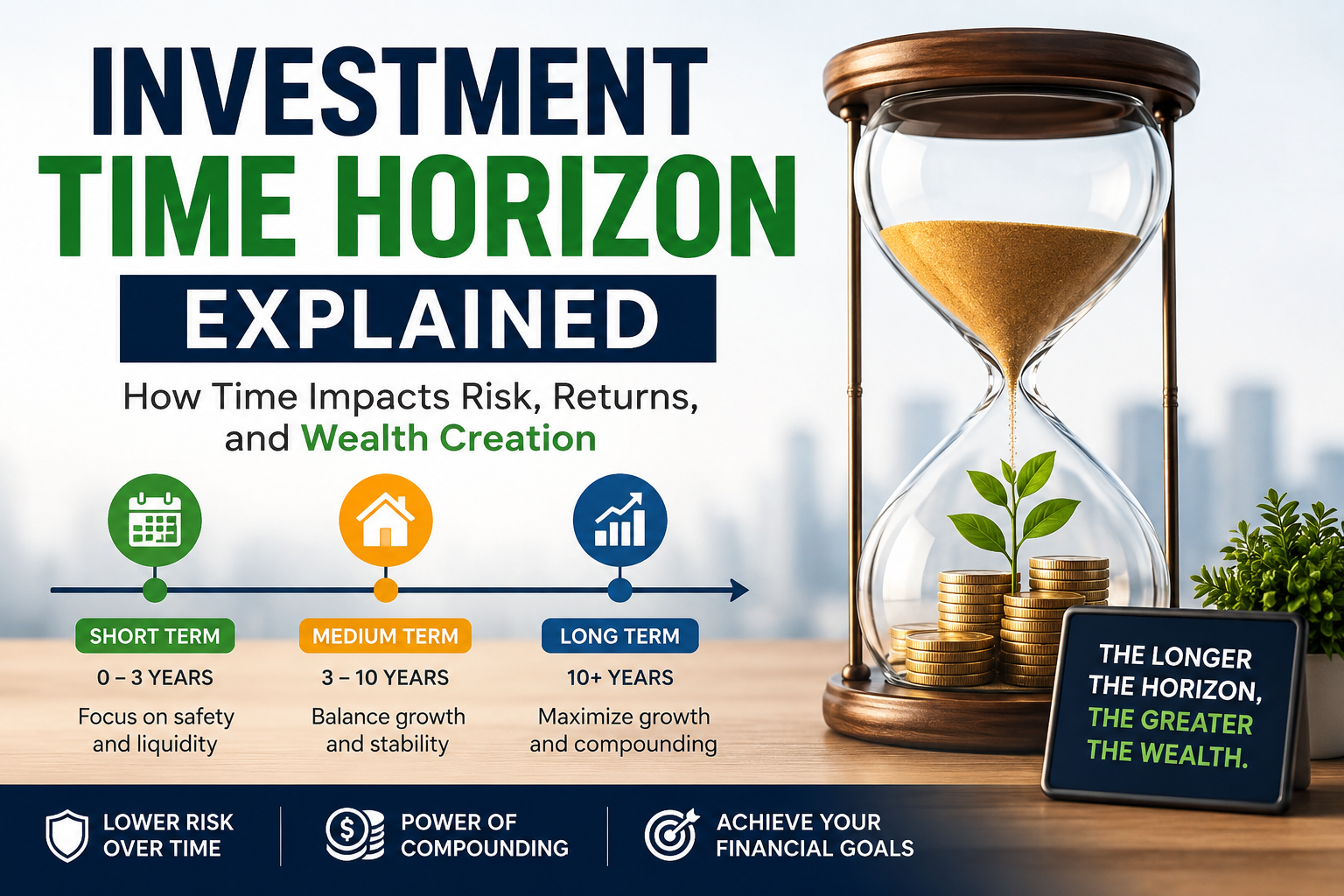
Introduction: Investment Time Horizon Explained
Investment Time Horizon Explained is an essential concept for anyone who wants to invest confidently, manage financial risk, and build long-term wealth. Your investment time horizon determines how long your money can remain invested before you need it for a specific financial goal. It influences your choice of stocks, bonds, exchange-traded funds (ETFs), cash savings, retirement accounts, and other investments.
For investors in the United States, United Kingdom, Canada, and Australia, understanding investment time horizons can help with retirement planning, home purchases, education expenses, and financial independence. However, having more time does not guarantee a profit, and even diversified investments can lose value.
This guide explains investment time horizons in simple language, defines important financial terms, examines historical market events, and provides practical examples for different financial goals. Understanding your investment time horizon helps you match investment choices to the date you need your money and the amount of risk you can reasonably accept.
What Is Investment Time Horizon Explained?
Investment Time Horizon Explained refers to the expected period between investing money and needing to withdraw it for a specific financial goal.
For example, someone saving for a home deposit in two years has a short investment horizon. Someone investing for retirement 30 years away has a long investment horizon.
The US Securities and Exchange Commission’s Investor.gov explains that an investing timeframe can range from months to years or decades. The appropriate investment mix depends partly on this timeframe and the investor’s ability and willingness to accept risk. Read the official explanation from Investor.gov.
How to Calculate Your Investment Time Horizon
The calculation is straightforward:
Investment time horizon = Goal date − Current date
Suppose an investor is 30 years old and plans to retire at 65.
- Current age: 30
- Target retirement age: 65
- Investment time horizon: 35 years
The investor has 35 years before retirement, although their retirement portfolio may need to provide income for another 20 to 30 years or longer.
This distinction matters: the time until you first need your money is not necessarily the same as the period over which you will use it.
Why Investment Time Horizon Matters
Your investment horizon helps determine how much market risk you can reasonably accept, how much liquidity you need, and when you should begin protecting money intended for spending.
Four factors are particularly important.
1. Risk tolerance
Risk tolerance is your willingness to endure investment losses and market fluctuations. A person who remains comfortable during a 20% market decline may have greater emotional risk tolerance than someone who would sell immediately.
However, emotional comfort is only one part of risk capacity. Your ability to recover financially from losses also matters.
2. Asset allocation
Asset allocation means dividing your portfolio among different asset classes, such as stocks, bonds, and cash. Learn more about building a suitable portfolio in our guide to portfolio strategy and asset allocation.
Stocks generally offer greater long-term growth potential but can experience substantial losses. High-quality short-term government securities and insured savings products may provide greater stability, although inflation and other risks remain.
For additional guidance, review Investor.gov’s explanation of asset allocation and diversification before deciding how to divide investments among different asset classes.
3. Liquidity
Liquidity describes how quickly an asset can be converted into spendable money without a substantial loss in value.
Cash in an accessible savings account is generally highly liquid. Property is less liquid because selling it can take time and involve transaction costs.
4. Financial goals
A portfolio intended to fund a house purchase in 18 months should not necessarily resemble a portfolio intended to fund retirement in 30 years. The same investor can need different strategies for different goals.
For another perspective on matching investments to specific goals, read Vanguard’s educational guide to investing goals.
Types of Investment Time Horizons
Investment horizons are commonly divided into short-term, medium-term, and long-term categories. These are practical guidelines, not universal regulatory definitions.
Short-Term Investment Horizon: 0–3 Years
A short-term horizon generally applies when money is needed within three years.
Typical goals include:
- Building an emergency fund
- Paying tuition or other near-term education expenses
- Buying a car
- Saving for a wedding or holiday
- Preparing a house deposit
Suitable investment considerations
For a short-term goal, preserving the money and ensuring that it is available on time may be more important than maximizing returns.
Potential options include:
- Insured bank savings accounts, subject to applicable deposit-protection rules
- Short-term government Treasury bills
- Eligible money market deposit accounts
- Fixed-term deposits or certificates of deposit whose maturity matches the goal
A money market mutual fund is not the same as an insured bank deposit. Its value and access arrangements depend on the product, and it may not be government-insured.
Example: If you need $20,000 for a home deposit in 12 months, a stock-market decline immediately before the purchase could force you to delay the transaction or sell investments at a loss. Keeping the required amount in suitable low-risk, liquid savings may better match the goal.
Medium-Term Investment Horizon: 3–10 Years
A medium-term horizon often applies to goals that are several years away but not decades away.
Examples include:
- A house deposit planned in six years
- University expenses beginning in eight years
- Starting a business
- Funding a planned career break
- Renovating a property
Balancing growth and stability
A medium-term investor may consider a combination of cash, high-quality bonds, and diversified stock funds. The appropriate mix depends on the exact spending date, the flexibility of the goal, financial circumstances, and ability to withstand losses.
For example, a hypothetical portfolio might begin with 40% diversified equities, 50% high-quality bonds, and 10% cash. These percentages are an illustration, not a recommendation for every investor.
If the money must be spent on a fixed date, the investor may gradually reduce exposure to volatile assets as that date approaches.
Long-Term Investment Horizon: 10 Years or More
A long-term horizon generally covers goals that are at least a decade away.
Examples include:
- Retirement
- Financial independence
- Long-term wealth accumulation
- Supporting future generations
- Saving for a child’s future expenses that are many years away
A long horizon can make it more practical to hold diversified equities because there may be more time to withstand market declines. However, a longer horizon does not eliminate the possibility of permanent losses.
Why diversification matters
Diversification means spreading investments across different securities, sectors, regions, or asset classes rather than depending on one investment.
A broad-market ETF may provide exposure to many companies through a single fund. Nevertheless, a narrowly focused ETF may remain concentrated in one industry, country, or investment theme.
Investors should examine a fund’s holdings, costs, risks, and investment objective rather than assuming every ETF is diversified. Read our guide to ETFs and index funds to understand how these funds differ and what to review before investing.
Investment Time Horizon and Risk: How They Work Together
Investment Time Horizon Explained also requires understanding how the time available before a withdrawal affects your ability to withstand market volatility. A longer horizon may provide more time to recover from a decline, but it does not guarantee recovery or eliminate investment risk.
A longer horizon can provide more time to recover from market declines, but it does not guarantee recovery. Individual companies can fail, sectors can underperform for long periods, and markets can experience extended downturns.
Three concepts help explain this relationship.
Market risk
Market risk is the possibility that investment prices decline because of economic conditions, interest rates, investor sentiment, geopolitical events, or other factors.
Inflation risk
Inflation risk is the possibility that rising prices reduce the purchasing power of your money.
For example, if your savings earn 2% in a year while inflation is 4%, the approximate real return before tax and fees is negative 2%.
A more precise calculation is:
Real return = (1 + nominal return) ÷ (1 + inflation rate) − 1
Sequence-of-returns risk
Sequence-of-returns risk refers to the effect that the order of investment returns can have when money is being withdrawn from a portfolio.
A large market decline early in retirement can be particularly damaging if the investor continues withdrawing money to cover living expenses. More units or shares may need to be sold when prices are depressed, leaving fewer assets available for a later recovery.
For this reason, retirement planning should consider both the time until retirement and the expected years of withdrawals afterward.
Understanding Compounding and Investment Time Horizon
Compounding occurs when investment returns remain invested and can generate further returns. Over time, returns may accumulate on both the original investment and earlier gains. Explore our guide to building long-term wealth to learn more about compounding, regular contributions, and investing discipline.
The compound-growth formula is:
A = P(1 + r/n)^(nt)
Where:
- A = future value
- P = initial principal
- r = annual nominal return expressed as a decimal
- n = number of compounding periods per year
- t = number of years
Example: How time affects investment growth
Suppose an investor puts $10,000 into an investment that earns a hypothetical 7% annual return, compounded annually, with no additional contributions.
- After 10 years: approximately $19,672
- After 20 years: approximately $38,697
- After 30 years: approximately $76,123
These are mathematical illustrations, not forecasts. Actual investment returns fluctuate, and fees, taxes, and inflation can reduce the final amount.
The lesson is not that investors will receive 7% every year. It is that time gives compounding more opportunities to work when returns remain invested.
You can explore different contribution amounts, rates of return, and timeframes using the Investor.gov compound interest calculator. Remember that calculated results are estimates, not guarantees of actual investment performance.
Seven Powerful Strategies for Managing Your Investment Time Horizon
Strategy 1: Match each investment to a specific goal
Write down what the money is for, how much you need, and when you expect to spend it. Separate your emergency reserve from your retirement portfolio and other long-term investments.
Strategy 2: Protect money needed soon
Avoid exposing essential near-term expenses to market volatility that could jeopardize the goal. Consider liquidity, deposit protection, maturity dates, and the possibility of early withdrawal penalties.
Strategy 3: Diversify long-term investments
Consider whether your portfolio is spread across appropriate asset classes, industries, companies, and geographic regions. Diversification can reduce concentration risk but cannot prevent all losses.
Strategy 4: Invest consistently when appropriate
Regular contributions can help build discipline and reduce the pressure to choose a single perfect entry point. Dollar-cost averaging involves investing a fixed amount at regular intervals regardless of market prices.
This approach does not guarantee a profit or prevent losses. It also differs from investing an existing lump sum immediately, which may produce a different result depending on subsequent market movements.
Strategy 5: Review fees and taxes
Investment fees reduce the amount of money that remains invested. Taxes can also affect net returns, depending on the account, asset, country, and investor’s circumstances.
Review fund expense ratios, trading charges, account fees, and applicable tax rules.
Strategy 6: Rebalance when your portfolio drifts
Rebalancing means bringing your portfolio back toward its intended asset allocation.
Suppose you begin with 60% stocks and 40% bonds. If stocks rise faster, the portfolio might become 70% stocks and 30% bonds. Rebalancing may involve selling part of the stock holdings or directing new contributions toward bonds.
Consider transaction costs and possible tax consequences before rebalancing.
Strategy 7: Reduce risk as a fixed goal approaches
If you need the entire portfolio for a house purchase in two years, you may not have sufficient time to wait through a prolonged market downturn. Gradually moving required funds into suitable lower-risk assets can help reduce the chance that a market decline disrupts the plan.
There is no single de-risking schedule suitable for every investor.
Real Historical Case Studies: What Market History Teaches Investors
Historical market events illustrate why an investment horizon matters. They do not establish what future returns will be.
Case Study 1: The 2007–2009 Global Financial Crisis
The Global Financial Crisis caused severe losses across many financial markets. The S&P 500 experienced a peak-to-trough decline of roughly 57% from October 2007 to March 2009 on a price-index basis.
Investors who needed to withdraw money during the downturn faced a different problem from investors who could continue holding diversified investments for many years.
The recovery also depended on when the investor bought, which securities were held, whether dividends were reinvested, and when withdrawals occurred.
Lesson: A long horizon can provide flexibility, but investors should not assume that every investment will recover. Diversification, suitable risk levels, and sufficient liquidity remain important.
Case Study 2: The COVID-19 Market Shock in 2020
The pandemic triggered a rapid market sell-off in early 2020. S&P Global reported that the S&P 500 fell 33.8% between February 19 and March 23, 2020, before rebounding sharply later that year. Read S&P Global’s historical analysis.
The rapid decline and rebound demonstrated how difficult it can be to predict market turning points. Investors who sold at depressed prices and waited to re-enter risked missing part of the recovery.
However, remaining invested is not always appropriate for money required immediately, and historical recovery patterns do not guarantee future results. If you are new to market movements, start with our guide to stock market basics.
Lesson: Investment strategy should reflect the goal and its deadline rather than short-term headlines alone.
Case Study 3: The Dot-Com Bubble and Concentration Risk
During the late 1990s, enthusiasm for internet and technology companies drove valuations to elevated levels. The subsequent collapse caused substantial losses in many technology-focused investments.
A long holding period did not protect every individual company or concentrated portfolio from lasting damage.
Lesson: Time alone is not a substitute for diversification. Broad exposure to different businesses and asset classes can help reduce dependence on a single sector or market theme.
Practical Investor Case Examples
The following are illustrative scenarios, not verified accounts of named individuals. They demonstrate how the same principles can apply to different goals.
Example 1: Sarah’s Two-Year House Deposit
Sarah lives in Canada and wants to accumulate CAD 60,000 for a home purchase in two years.
Her priorities are capital preservation and access to funds. She compares eligible savings accounts, GICs with appropriate maturity dates, and other suitable low-risk options.
She avoids relying on stock-market gains to reach the target because a market decline could occur shortly before closing.
Her final choice would depend on available rates, deposit-insurance eligibility, withdrawal conditions, taxes, and whether the purchase date is flexible.
Example 2: David’s Eight-Year Education Goal
David lives in Australia and plans to help fund his child’s university expenses in eight years.
He has a longer horizon than Sarah but still faces a fixed future expense. He considers a diversified mix of growth investments, high-quality fixed-income assets, and cash.
As university approaches, he reviews the amount needed for the first year and considers reducing the volatility of money that will soon be spent.
His strategy balances growth potential with the need to have funds available on time.
Example 3: Michael’s 35-Year Retirement Plan
Michael lives in the United States and is 30 years old. He expects to retire at 65, giving him a 35-year accumulation period. For more on preparing for retirement income and withdrawals, read our guide to retirement investing strategies.
He contributes regularly to eligible retirement accounts, considers diversified stock and bond funds, and reviews his investment allocation periodically.
He understands that a 35-year horizon does not mean his portfolio will rise every year. His plan also considers emergency savings, employer contributions where available, fees, tax treatment, and future retirement withdrawals.
As retirement approaches, he evaluates how much money he will need immediately and how much may remain invested throughout retirement.
Investment Time Horizon by Country: US, UK, Canada and Australia
Investment accounts and tax rules differ by jurisdiction. Account eligibility, contribution limits, withdrawal rules, and tax treatment can change, so investors should consult current official guidance.
United States
Common retirement and investment arrangements include 401(k) plans, Traditional IRAs, and Roth IRAs. Tax treatment depends on the account type and applicable rules.
United Kingdom
Investors may use Individual Savings Accounts (ISAs) or Self-Invested Personal Pensions (SIPPs), subject to eligibility and current rules. An ISA and a pension have different access and tax characteristics.
Canada
Tax-Free Savings Accounts (TFSAs) and Registered Retirement Savings Plans (RRSPs) are commonly used for saving and investing. Their contribution and withdrawal rules differ.
Australia
Superannuation is a major part of the Australian retirement system. Access is subject to preservation and other applicable rules, so it may not be suitable for a goal requiring unrestricted access to money.
In all four countries, the account wrapper and the underlying investment are separate considerations. A tax-advantaged account does not make a risky investment safe.
Common Investment Time Horizon Mistakes to Avoid
Mistake 1: Investing short-term savings aggressively
A market downturn could occur just before the money is needed.
Mistake 2: Assuming long-term investments cannot lose money
Stocks and other growth assets can experience severe declines and may not recover within your required timeframe.
Mistake 3: Ignoring inflation
A savings balance can increase while its purchasing power declines.
Mistake 4: Confusing risk tolerance with risk capacity
Being comfortable with risk does not mean you can afford a large loss. Your income, debts, emergency reserves, and spending obligations matter.
Mistake 5: Using one portfolio for every goal
Retirement, an emergency fund, and a near-term house deposit have different liquidity requirements and deadlines.
Mistake 6: Following market predictions instead of a plan
Repeatedly changing your portfolio in response to headlines can increase costs and lead to poorly timed decisions.
How to Create Your Own Investment Time Horizon Plan
Start by creating a separate plan for each important financial goal. A practical investment time horizon plan connects each financial goal to a target date, a required amount, an appropriate level of risk, and a strategy for accessing the money when needed.
Step 1: Define the goal. Write down what you are saving for.
Step 2: Set a target amount. Estimate how much money you will need, including likely inflation and relevant costs.
Step 3: Choose a target date. Identify when the money must be available and whether the date is flexible.
Step 4: Assess risk capacity. Consider whether you could delay the goal or recover financially if investments lost value. Budgeting, debt, and emergency savings also affect investing decisions; learn more in our guide to personal finance fundamentals.
Step 5: Choose suitable investments. Match the asset allocation, liquidity, and maturity dates to the goal.
Step 6: Review regularly. Revisit your plan after major life changes, shifts in income, or changes in the goal.
Step 7: Prepare for withdrawals. Decide how to move money from investments into spendable cash as the deadline approaches.
Frequently Asked Questions About Investment Time Horizon Explained
1. What is an investment time horizon?
It is the expected period between investing money and needing it to meet a financial goal. It can be measured in months, years, or decades.
2. What is a short-term investment horizon?
A short-term horizon generally means three years or less. Examples include an emergency reserve, an upcoming car purchase, or a home deposit needed soon.
3. What is a medium-term investment horizon?
A medium-term horizon commonly covers three to ten years. Education costs, home deposits, and planned career breaks may fall into this category.
4. What is a long-term investment horizon?
A long-term horizon usually means ten years or more. Retirement and long-term wealth accumulation are common examples.
5. Does a longer investment horizon guarantee higher returns?
No. More time can provide opportunities for compounding and recovery from market declines, but it cannot guarantee a profit or prevent permanent losses.
6. Which investments are suitable for a short-term goal?
Suitable choices may include eligible insured savings accounts, short-term government securities, and appropriately matched fixed-term deposits. The choice depends on liquidity needs, safety requirements, and local rules.
7. How does inflation affect my investment time horizon?
Inflation reduces the amount of goods and services your money can purchase. Long-term plans should consider whether the future value of savings will be sufficient after accounting for rising costs.
8. Should I change my portfolio as retirement approaches?
Many investors review and potentially reduce portfolio risk as retirement nears. However, retirement can last decades, so the portfolio may still need growth assets alongside stable assets.
9. What is the difference between time horizon and risk tolerance?
Time horizon is how long you have until you need the money. Risk tolerance is your willingness to accept uncertainty and losses. Both influence investment decisions, but they are not interchangeable.
10. Can I have multiple investment time horizons?
Yes. You may have a one-year emergency goal, a seven-year home goal, and a 30-year retirement goal simultaneously. Each goal should have an appropriate strategy.
11. How often should I review my investment time horizon?
Review it at least annually and after major life changes, such as changing jobs, having a child, buying a home, or bringing retirement forward. Review more frequently if your financial circumstances change materially.
12. Is dollar-cost averaging always better than investing a lump sum?
No. Regular investing can help manage the experience of market volatility and support consistent saving. Investing a lump sum sooner may produce higher returns in markets that rise, but can also expose the full amount to an immediate decline. The right approach depends on circumstances and risk tolerance.
13. Do ETFs eliminate investment risk?
No. ETFs are investment vehicles, not a guarantee of safety. Their risks depend on the underlying holdings, diversification, liquidity, leverage, costs, and investment strategy.
14. Should I keep retirement money entirely in cash?
Not necessarily. Cash can provide stability and liquidity, but excessive cash holdings may struggle to keep pace with inflation over long periods. Retirement planning must balance spending needs, growth, and risk.
15. How do I choose the right investment time horizon?
Start with the date you expect to need the money, the amount required, and how flexible the goal is. Then assess your financial ability to withstand losses and choose investments accordingly. If the decision is complex, consider qualified financial advice.
Conclusion: Make Time Work for Your Financial Goals
Investment Time Horizon Explained is more than a definition. It is a practical framework for matching investments to real financial needs.
Short-term goals generally require greater attention to capital preservation and liquidity. Medium-term goals require careful balancing of growth and stability. Long-term goals may allow more exposure to diversified growth assets, provided the investor can tolerate losses and does not need the money unexpectedly.
The most effective approach is to define your goals, understand your financial constraints, diversify appropriately, control costs, and review your plan as circumstances change.
Time can support wealth creation, but a suitable plan helps ensure your money is available when you need it.
Financial disclaimer: This article is for educational purposes only and does not constitute personalized financial, investment, legal, or tax advice. Investments can lose value. Consider your circumstances and consult a qualified professional when appropriate.