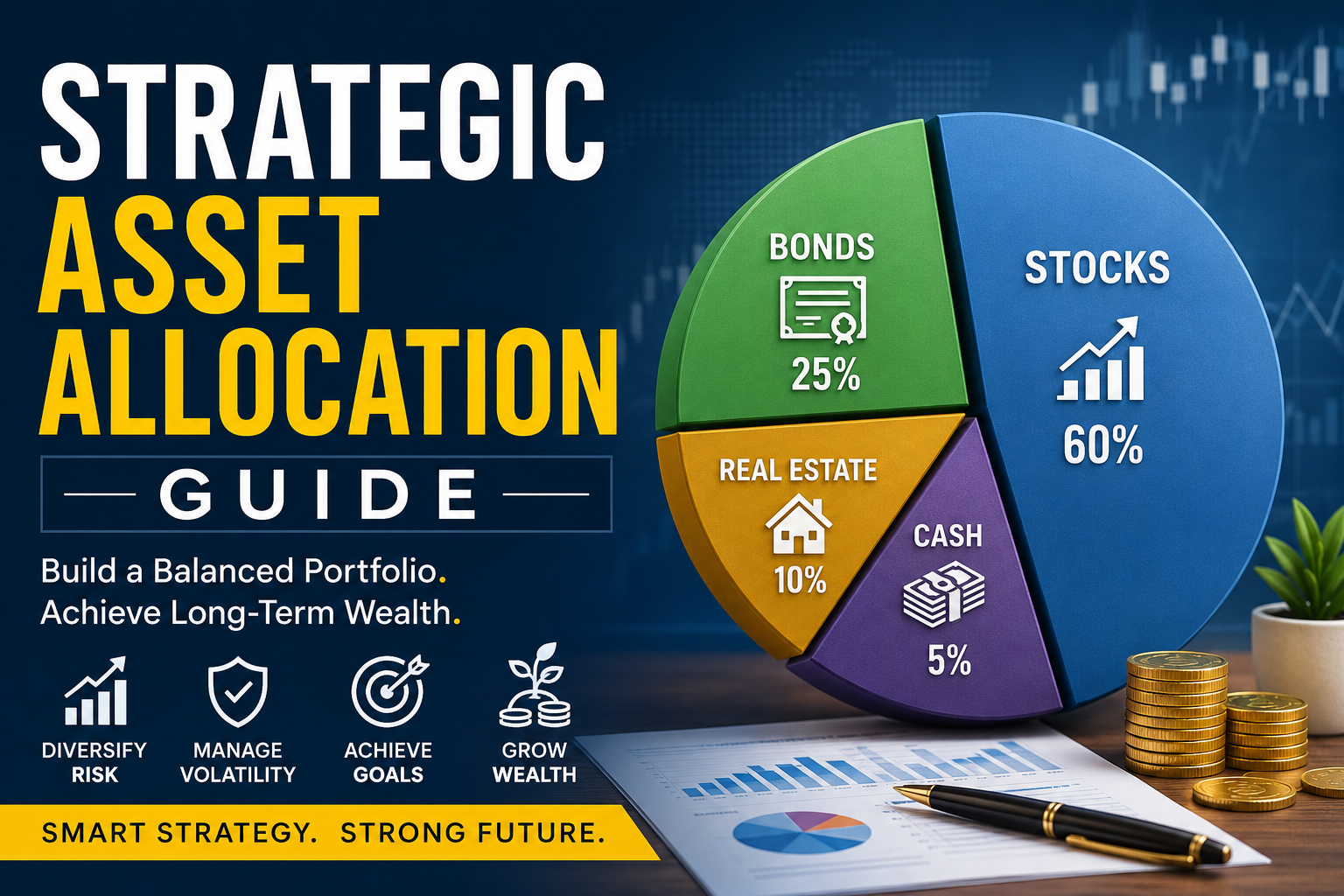
Strategic Asset Allocation Guide for Long-Term Wealth Building
Strategic asset allocation is one of the most important decisions investors make when building a long-term investment portfolio. It determines how money is divided among stocks, bonds, cash, real estate, and other investments to balance growth, income, liquidity, and risk.
Investors in the United States, United Kingdom, Canada, and Australia use asset allocation principles when planning for retirement, saving for major financial goals, and managing investment portfolios. However, selecting an appropriate allocation involves more than choosing percentages. Investors must consider their financial objectives, investment time horizon, ability to tolerate losses, income needs, and the relationship between different asset classes.
A well-designed strategic asset allocation plan provides a framework for making investment decisions during both rising and falling markets. It does not eliminate losses or guarantee profits. Instead, it helps investors manage risk, diversify their holdings, and avoid making impulsive changes based on short-term market movements.
This guide explains strategic asset allocation in simple language, examines real market events, and demonstrates how investors can develop a disciplined portfolio strategy.
What Is Strategic Asset Allocation?
Strategic asset allocation is a long-term investment approach in which an investor establishes target percentages for different asset classes based on financial goals, risk tolerance, and investment horizon.
For example, an investor with a portfolio worth $100,000 might choose the following illustrative allocation:
| Asset class | Target allocation | Initial investment |
|---|---|---|
| Stocks | 60% | $60,000 |
| Bonds | 30% | $30,000 |
| Cash equivalents | 10% | $10,000 |
| Total | 100% | $100,000 |
The investor maintains these target weights through periodic portfolio reviews and rebalancing, unless their financial circumstances or long-term objectives change.
The purpose is not to predict which investment will perform best next month. Instead, strategic asset allocation establishes a portfolio structure that reflects the investor’s overall financial plan.
Understanding the Meaning of Strategic Asset Allocation
Strategic refers to long-term planning rather than short-term speculation. An investor considers future objectives, expected returns, risk, and the time available to reach financial goals.
Asset refers to an investment or resource with financial value. Common investment assets include company shares, government bonds, corporate bonds, cash equivalents, and property-related investments.
Allocation means distributing investment capital among different asset classes. An allocation of 60% stocks and 40% bonds means that these asset classes represent 60% and 40% of the portfolio’s current target value.
Together, strategic asset allocation means creating and maintaining a long-term investment mix that is appropriate for a particular investor.
Why Strategic Asset Allocation Matters
Investment returns depend on many factors, including market conditions, investment costs, security selection, and the behaviour of the investor. Asset allocation helps determine how much exposure a portfolio has to different sources of market risk.
A portfolio concentrated entirely in stocks may experience substantial losses during an equity bear market. A portfolio holding only cash may struggle to maintain purchasing power over long periods of inflation. A diversified portfolio combines investments with different characteristics to manage these competing risks.
Strategic asset allocation can help investors:
- Establish a clear investment plan.
- Diversify across different asset classes and markets.
- Align investment risk with financial goals.
- Reduce dependence on a single company, sector, or country.
- Establish rules for portfolio rebalancing.
- Make more consistent decisions during market volatility.
Diversification does not eliminate market risk. Investments that appear different can fall together, particularly during periods of financial stress. The objective is to avoid unnecessary concentration and build a portfolio that the investor can reasonably maintain through difficult periods.
The US Securities and Exchange Commission’s investor education resource explains the relationship between asset allocation, diversification, and rebalancing in its guide to asset allocation and diversification.
Major Asset Classes Used in Strategic Asset Allocation
Understanding each asset class is essential before selecting portfolio percentages.
1. Stocks or Equities
Stocks represent ownership in publicly traded companies. Investors can potentially earn returns through capital appreciation and dividends.
Capital appreciation occurs when an investment’s market value increases. Dividends are distributions that some companies pay to shareholders, although payments are not guaranteed.
Broad stock-market index funds and exchange-traded funds (ETFs) allow investors to own shares in many companies through a single investment.
Advantages:
- Long-term growth potential.
- Exposure to business earnings and economic development.
- Potential dividend income.
- Opportunities for international diversification.
Risks:
- Share prices can fall sharply.
- Individual businesses can fail.
- Valuations may decline when interest rates rise.
- Stock returns can be unpredictable over short periods.
Stocks are often used for long-term growth, but the appropriate allocation depends on the investor’s ability and willingness to withstand losses.
2. Bonds and Fixed-Income Investments
A bond is a debt instrument. When an investor purchases a bond, the issuer borrows money under specified conditions.
Government bonds are issued by national governments, while corporate bonds are issued by companies. Depending on the bond’s terms and the issuer’s financial position, investors may receive interest payments and repayment of principal at maturity.
Bond prices generally move inversely to market yields. When yields rise, existing fixed-rate bonds usually lose market value; when yields fall, their prices generally rise.
Advantages:
- Potential interest income.
- Diversification from equities.
- A range of maturities and credit qualities.
- Possible portfolio stability, depending on the type of bond.
Risks:
- Interest-rate risk.
- Credit or default risk.
- Inflation risk.
- Reinvestment risk.
Short-term government securities, long-term government bonds, and high-yield corporate bonds have different risk profiles. They should not be treated as interchangeable.
3. Cash and Cash Equivalents
Cash equivalents include instruments such as short-term government bills and certain money-market investments. Bank deposits may also form part of an investor’s liquid reserves.
Cash is useful for emergency expenses and short-term goals because it reduces the need to sell volatile investments at an inconvenient time.
However, cash has an important limitation: inflation can reduce its purchasing power. If prices increase faster than the interest earned, the real value of savings declines.
An emergency fund should therefore be considered separately from the investment portfolio when establishing an appropriate long-term allocation.
4. Real Estate and REITs
Real estate exposure can come from directly owned property or real estate investment trusts (REITs).
A REIT is a company or trust that owns, operates, or finances qualifying income-producing real estate under applicable legal rules. Listed REITs can provide property-market exposure without requiring an investor to purchase an entire building.
Real estate investments may provide rental income and potential capital appreciation, but they are exposed to property prices, financing costs, vacancy rates, and economic conditions.
Listed REITs can also experience substantial share-price volatility and may behave more like equities during market stress.
5. Commodities and Other Alternative Investments
Commodities include resources such as gold, oil, and agricultural products. Their prices can respond to supply constraints, geopolitical events, economic growth, and inflation expectations.
Some investors use gold or other commodities as a diversifying component. However, commodities do not necessarily protect against inflation in every period, and some do not generate income.
Alternative investments may include private equity, hedge funds, infrastructure, and private credit. These investments can have complex fee structures, liquidity restrictions, valuation uncertainty, and additional risks.
They are not essential for every investor. A diversified portfolio of conventional stock and bond funds may be sufficient for many long-term financial plans. For additional guidance, read the BlackRock: Asset Allocation Principles
Seven Strategic Asset Allocation Strategies
1. Match the Allocation to Your Financial Goals
The first step is to define the purpose of the money.
Retirement savings intended for several decades in the future have different requirements from a house deposit needed in two years. Long-term retirement investments may tolerate more short-term volatility, while money needed soon generally requires greater liquidity and lower exposure to market fluctuations.
Investors should identify their financial goals, the amount required, and the date when the money will be needed before selecting asset weights.
2. Assess Risk Tolerance and Risk Capacity
Risk tolerance describes an investor’s emotional willingness to experience losses. Risk capacity describes their financial ability to absorb those losses without jeopardising essential goals.
For example, a young investor may have a long investment horizon but limited financial capacity because of unstable income or high-interest debt. Another investor approaching retirement may have substantial savings, a reliable pension, and a strong capacity to tolerate fluctuations.
Both factors matter. An allocation should be financially sustainable and psychologically manageable.
3. Diversify Within Each Asset Class
Owning several investments does not automatically produce adequate diversification.
An investor holding ten technology stocks may still be heavily exposed to one sector. Similarly, a portfolio holding only domestic companies may be vulnerable to country-specific economic conditions.
Diversification can involve different industries, company sizes, countries, bond maturities, and credit qualities. Broad-market index funds can simplify this process, although investors should examine their underlying holdings to identify overlap.
4. Select a Suitable Strategic Allocation
Investors commonly begin with a broad stock-and-bond mix and then consider whether cash, real estate, or other exposures are necessary.
The following are illustrative starting points, not universally suitable recommendations.
| Portfolio style | Stocks | Bonds | Cash |
|---|---|---|---|
| Conservative | 30% | 60% | 10% |
| Moderate | 60% | 35% | 5% |
| Growth-oriented | 80% | 15% | 5% |
A conservative portfolio prioritises stability and income, although bonds can still lose value. A moderate portfolio balances growth and defensive assets. A growth-oriented portfolio accepts larger potential fluctuations in pursuit of long-term capital growth.
The appropriate allocation depends on the individual, not simply their age.
5. Establish Rebalancing Rules
Rebalancing means restoring a portfolio to its target allocation after market movements cause the weights to drift.
Suppose a portfolio begins with 60% stocks and 40% bonds. If stocks rise substantially while bonds grow more slowly, the stock allocation may become larger than intended.
The investor can rebalance by selling some of the overweight holdings, purchasing underweight assets, or directing new contributions toward the underweight categories.
A written rule—such as reviewing the portfolio annually or when an allocation moves beyond a predetermined threshold—can reduce arbitrary decisions. Tax consequences and transaction costs should be considered before selling investments. For additional guidance, read the SEC’s investor guide to portfolio rebalancing, which explains how asset allocation, diversification, and rebalancing fit into an investment plan.
6. Review Costs and Tax Efficiency
Investment costs reduce the amount of return that remains with the investor. Relevant costs include fund expense ratios, transaction charges, advisory fees, and applicable taxes.
Low-cost diversified funds can help limit ongoing expenses, although a low fee alone does not make an investment suitable.
Tax treatment depends on the investor’s country, account type, and holdings. Tax-efficient placement of assets may improve after-tax results, but investors should consult the relevant tax authority or a qualified tax professional for individual circumstances.
7. Maintain Discipline Through Market Cycles
Strategic asset allocation works only if the investor can maintain an appropriate plan through both strong and weak markets.
Increasing stock exposure after a rally because recent returns look attractive can introduce concentration risk. Selling long-term investments after a decline may turn temporary market losses into realised losses and leave the investor absent from a recovery.
Discipline does not mean refusing to change an allocation forever. It means making changes for sound reasons, such as a changed retirement date, income requirement, financial goal, or capacity for risk—not merely because an asset has recently performed well or poorly.
Real Case Study 1: The 2008 Global Financial Crisis
The global financial crisis of 2007–2009 exposed the danger of excessive exposure to risky assets, especially when investors also faced job insecurity, falling property prices, or difficulty accessing credit.
US and international equity markets suffered severe losses. Property-related assets and many financial institutions came under pressure, while credit conditions tightened.
A portfolio with substantial equity exposure could experience a large decline. A diversified portfolio containing high-quality government bonds might have received some protection, depending on its holdings and the period measured.
However, the result depends on the specific stock index, bond index, portfolio weights, rebalancing schedule, and measurement window. It would be misleading to claim that every 60/40 portfolio lost exactly 25% or that every all-stock portfolio lost exactly 50%.
Lesson for investors: Strategic allocation can help manage exposure to a market crash, but it cannot prevent all losses. The portfolio must be designed around a realistic assessment of how much loss the investor can withstand.
Real Case Study 2: The COVID-19 Market Shock in 2020
In February and March 2020, the spread of COVID-19 and the economic shutdowns caused an exceptionally rapid global market sell-off. Equity markets fell sharply as investors reassessed corporate earnings, economic activity, and financial risk.
The episode demonstrated the importance of liquidity and investor behaviour. People who needed cash during the downturn could have been forced to sell investments after prices had fallen. Investors with sufficient emergency reserves and a suitable long-term portfolio had more flexibility to follow their plans.
The recovery that followed was not uniform. Different countries, sectors, and asset classes performed differently, and the results depended on the investments held.
Lesson for investors: A strategic allocation should account for the possibility of sudden declines. Emergency savings, a suitable time horizon, and a documented rebalancing process can help investors avoid decisions driven entirely by fear.
Real Case Study 3: The 2022 Stock-and-Bond Decline
The year 2022 provided an important reminder that diversification is not a guarantee that different assets will move in opposite directions.
As inflation surged and central banks raised interest rates, many equities and conventional bond investments fell simultaneously. Rising yields reduced the market prices of existing bonds, while higher discount rates and economic uncertainty weighed on many stock valuations.
Vanguard reported that a globally diversified 60/40 portfolio declined approximately 16% in 2022. Nevertheless, its annualised return over the ten years through 2022 was 6.1%.
Source: Vanguard’s analysis of the 60/40 portfolio.
Lesson for investors: A balanced portfolio can experience a substantial annual loss. Investors should assess the risk of the entire portfolio rather than assuming that bonds will always offset stock-market declines.
Past returns do not guarantee future results.
Worked Example: How Rebalancing Changes a Portfolio
Consider an investor with $200,000 and a target allocation of 60% stocks and 40% bonds.
The original portfolio contains:
- Stocks: $120,000.
- Bonds: $80,000.
Suppose stocks subsequently increase in value to $150,000 while bonds remain at $80,000.
The new portfolio value is $230,000. Stocks now represent approximately 65.2% of the portfolio, while bonds represent approximately 34.8%.
To restore the 60/40 allocation, the investor would target:
- Stocks: $138,000.
- Bonds: $92,000.
That means transferring approximately $12,000 from stocks to bonds before considering taxes, transaction costs, and any other portfolio cash flows.
The purpose of rebalancing is to restore the planned risk exposure, not to predict the next market movement.
Strategic Asset Allocation vs Tactical Asset Allocation
Strategic asset allocation establishes the long-term target mix. Tactical asset allocation temporarily changes the mix in an attempt to benefit from expected market conditions.
| Feature | Strategic allocation | Tactical allocation |
|---|---|---|
| Primary objective | Maintain a long-term plan | Seek opportunities from market changes |
| Typical approach | Target weights and periodic rebalancing | Temporary deviations from targets |
| Main challenge | Staying disciplined | Making consistently successful timing decisions |
| Potential drawback | Can lag assets that are temporarily outperforming | Can underperform if market forecasts are wrong |
Tactical decisions require additional research, monitoring, and a clear method for returning to the strategic target. They are not necessary for every investor.
Strategic Asset Allocation for Retirement Planning
Retirement planning involves more than maximising portfolio growth. Investors must consider the timing of withdrawals, inflation, expected expenses, pensions, and the possibility of living longer than anticipated.
A portfolio that is appropriate thirty years before retirement may not be appropriate when withdrawals are about to begin. However, retirees still need to consider growth and inflation risk; moving entirely into cash can create other problems.
Investors should consider the interaction between their investment portfolio and other sources of income, such as government benefits, workplace pensions, or annuities.
United States
US investors may hold investments through employer-sponsored 401(k) plans, traditional IRAs, Roth IRAs, or taxable brokerage accounts. These accounts have different tax rules and eligibility requirements.
United Kingdom
UK investors may use Individual Savings Accounts (ISAs), Self-Invested Personal Pensions (SIPPs), and workplace pension arrangements. Tax treatment depends on the account and the investor’s circumstances.
Canada
Canadian investors may use Registered Retirement Savings Plans (RRSPs), Tax-Free Savings Accounts (TFSAs), and other eligible accounts. Contribution limits and withdrawal rules vary by account type.
Australia
Australian retirement investing commonly involves superannuation funds. Investment options, fees, tax treatment, and access restrictions depend on the applicable rules and the fund.
The account wrapper and the asset allocation are separate decisions. A tax-advantaged account does not automatically make an unsuitable investment mix appropriate.
Source: Fidelity: Asset Allocation for retirement
The Role of ETFs in Strategic Asset Allocation
Exchange-traded funds are investment funds traded on stock exchanges. Depending on their mandate, they may track broad equity indexes, government bonds, corporate bonds, property securities, or other market segments.
ETFs can make strategic allocation easier by providing exposure to many underlying investments through a single holding.
Before investing, examine the fund’s index or investment objective, expense ratio, underlying holdings, geographic exposure, currency risk, tracking difference, liquidity, and tax treatment.
Holding multiple ETFs does not necessarily produce diversification if they own substantially the same securities. Portfolio construction should focus on the underlying economic exposures rather than the number of funds.
Common Strategic Asset Allocation Mistakes
Confusing risk tolerance with risk capacity
An investor may feel comfortable with market volatility but still need the money soon. Financial constraints must be considered alongside emotional preferences.
Changing the allocation based on recent returns
An asset that has recently performed well may not continue outperforming. Frequent changes can create costs and undermine a consistent plan.
Ignoring inflation
A portfolio may grow in nominal terms while losing purchasing power after inflation. Long-term plans should consider both nominal and real returns.
Overlooking fees and taxes
Expenses and taxes can reduce the amount available to compound over time. Review the full cost of investing rather than focusing only on headline returns.
Assuming bonds are risk-free
Bond prices can decline, especially when interest rates rise. Credit quality, maturity, duration, and currency exposure all affect bond risk.
Rebalancing too frequently
Constant adjustments can increase transaction costs, taxes, and unnecessary activity. A predetermined schedule or threshold can provide a more consistent process.
How to Build a Strategic Asset Allocation Plan
A practical process involves six steps:
- Define your goals. Identify what the money is intended to fund and when it will be needed.
- Assess your finances. Review emergency savings, debts, income stability, and existing investments.
- Evaluate risk. Consider both your willingness and your financial capacity to absorb losses.
- Choose diversified investments. Select asset classes and funds that fit your plan, avoiding unnecessary overlap.
- Write down target weights. Document the allocation and specify how and when you will review it.
- Monitor and rebalance. Review the plan periodically and change it when circumstances or objectives genuinely change.
For further reading, explore our Start Investing guide, ETF and Index Funds guide, Portfolio Strategy guide, and Retirement Investing guide.
Frequently Asked Questions About Strategic Asset Allocation
1. What is strategic asset allocation in simple terms?
Strategic asset allocation means deciding how to divide investments among asset classes and maintaining an appropriate long-term mix. It helps align portfolio risk with financial goals and time horizon.
2. What is the best strategic asset allocation for beginners?
There is no single best allocation for everyone. A beginner with a long horizon and high risk capacity may choose a growth-oriented mix, while someone saving for a near-term goal may need greater stability and liquidity.
3. Is a 60/40 portfolio still effective?
A 60/40 portfolio can provide diversified exposure to stocks and bonds, but it can experience significant losses when both asset classes decline. Its suitability depends on the investor’s objectives, risk tolerance, costs, and time horizon.
4. How often should you rebalance your portfolio?
Some investors review their allocation annually, while others use predetermined deviation thresholds. The appropriate method depends on the portfolio, costs, taxes, and the investor’s circumstances.
5. What is the difference between strategic and tactical asset allocation?
Strategic allocation establishes long-term target weights. Tactical allocation temporarily deviates from those weights to pursue opportunities based on market expectations.
6. Does strategic asset allocation guarantee positive returns?
No. Diversification and rebalancing cannot eliminate market risk or guarantee profits. A portfolio can lose value even when its asset allocation is carefully designed.
7. Should bonds be included in a long-term portfolio?
Bonds may provide income and diversify equity exposure, but their usefulness depends on interest-rate risk, credit quality, inflation, and the investor’s objectives. The appropriate allocation varies by individual.
8. Can ETFs be used for strategic asset allocation?
Yes. Broad-market stock and bond ETFs can provide diversified exposure at relatively low cost. Investors should still examine holdings, fees, tracking, liquidity, and tax considerations.
9. How does inflation affect strategic asset allocation?
Inflation reduces purchasing power and can affect asset classes differently. Investors should consider the real value of future spending needs, while recognising that stocks, property, and commodities are not guaranteed inflation hedges.
10. Should asset allocation change as you get older?
It may change as retirement approaches, withdrawal needs develop, or financial circumstances change. Age alone does not determine the right allocation; income sources, goals, health of the overall financial plan, and risk capacity also matter.
Conclusion: Build a Portfolio Around a Long-Term Plan
Strategic asset allocation provides a framework for balancing growth, income, liquidity, and risk. By selecting suitable asset classes, diversifying holdings, and rebalancing according to clear rules, investors can make more disciplined decisions through different market conditions.
The experiences of 2008, 2020, and 2022 show why a portfolio needs to be designed for uncertainty rather than a single expected market outcome. Diversification can help manage risk, but it cannot prevent every loss.
For long-term investors in the United States, United Kingdom, Canada, Australia, and elsewhere, the central principle is to choose an allocation that fits their financial objectives and that they can maintain through difficult markets.
Disclaimer: This article is for educational purposes only and does not constitute personalised financial, investment, or tax advice. Investments can fall in value, and past performance does not guarantee future returns. Consider your circumstances and consult an appropriately qualified professional where necessary.