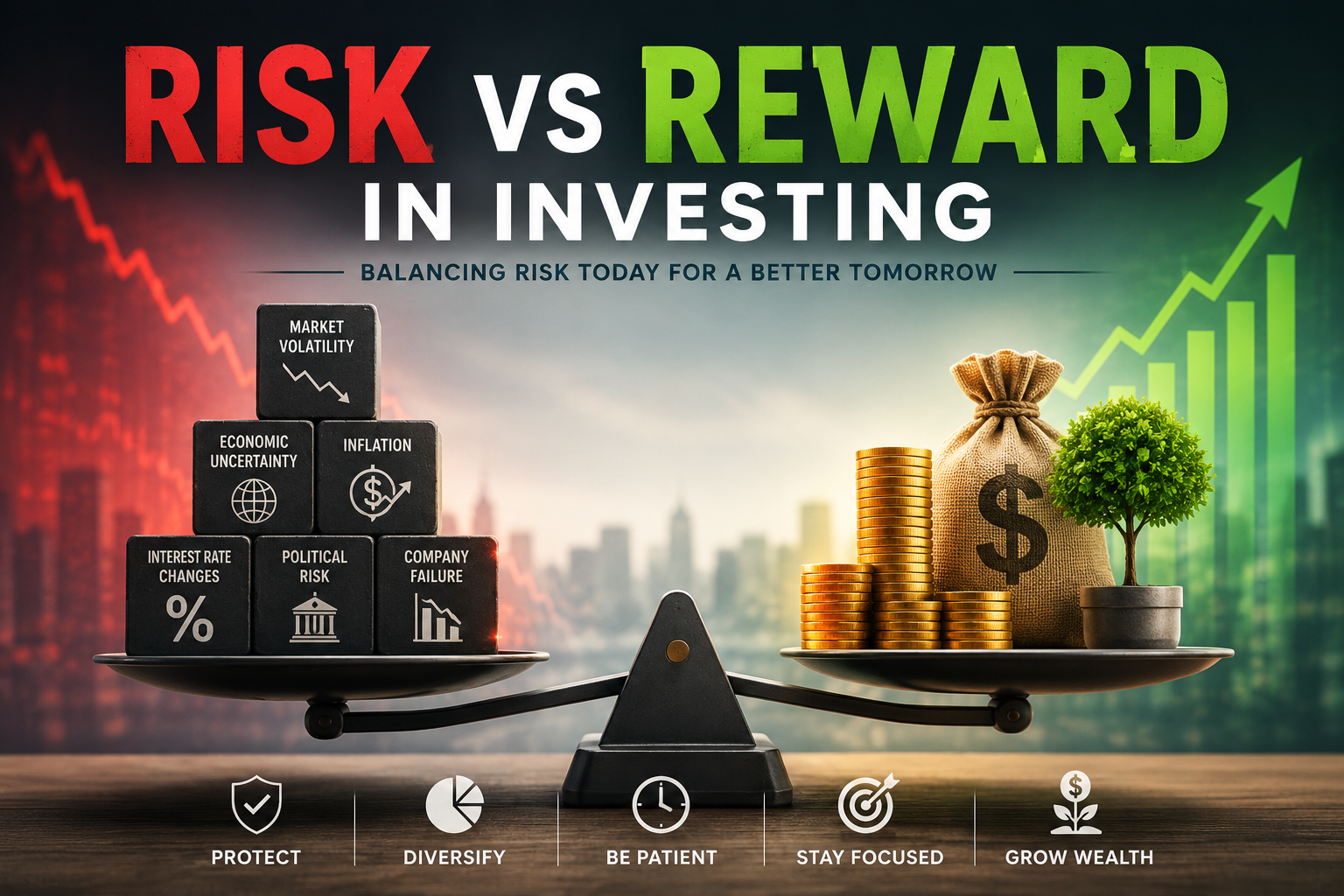
Risk vs Reward in Investing
Risk vs Reward in Investing is one of the most important concepts to understand before investing in stocks, bonds, exchange-traded funds (ETFs), real estate, or retirement accounts. It explains the relationship between the potential money you could earn and the possibility of losing some or all of your investment.
For investors in the United States, United Kingdom, Canada, and Australia, understanding this relationship can help when choosing investments for retirement, building long-term wealth, or saving for major financial goals. Investment accounts such as 401(k)s and IRAs in the US, ISAs and pensions in the UK, RRSPs and TFSAs in Canada, and superannuation accounts in Australia have different rules, but they all involve investment decisions where risk matters.
Readers who are new to investing can explore our guide to getting started with investing to understand the fundamentals before choosing investments.
Some investments offer relatively stable returns but limited growth. Others provide greater growth potential but can experience substantial losses. The objective is not to find an investment that promises the highest return. It is to choose an appropriate level of risk for your goals, financial circumstances, and investment timeframe.
This guide explains investment risk and reward in simple language, examines documented historical case studies, and explores practical strategies for making informed investment decisions.
Before choosing an investment, it is important to understand its potential returns, possible losses, liquidity, and costs. Investor.gov’s introduction to investing provides an overview of investment basics, risk management, and long-term wealth building.
What Is Risk vs Reward in Investing?
Risk vs reward in investing describes the relationship between the potential return of an investment and the uncertainty surrounding that return.
Investment risk is the possibility that actual results will differ from expectations, including losing money. Investment reward is the potential financial benefit, such as capital appreciation, dividends, interest, or rental income.
For example, imagine buying a share for $100. If its price increases to $120, you have an unrealized gain of $20 before fees and taxes. If the share price falls to $70, you have an unrealized loss of $30.
Neither outcome is guaranteed when you buy the share.
The US Securities and Exchange Commission’s investor education resource, Investor.gov, explains that investments can lose value and that potential returns must be considered alongside risk, fees, liquidity, and diversification.
What Does Investment Risk Mean?
Investment risk is uncertainty about financial outcomes. It includes the possibility of losing your original capital, earning less than expected, or failing to achieve a financial goal.
For example, an investor who places money needed for a house deposit in a volatile stock fund may have to sell at a loss if the market declines shortly before the purchase.
Risk is not limited to price fluctuations. It also includes inflation reducing purchasing power, borrowers defaulting on debt, and investments becoming difficult to sell when money is needed.
What Does Investment Reward Mean?
Investment reward is the financial benefit an investment may generate.
There are several common forms of investment reward:
- Capital appreciation: An increase in an asset’s market value.
- Dividends: Payments a company distributes to shareholders.
- Interest income: Money earned from deposits or debt investments.
- Rental income: Payments received from tenants.
- Total return: The combined effect of price changes and income, accounting for reinvestment where applicable.
Suppose you purchase shares for $1,000 and receive $40 in dividends while their market value rises to $1,080. Your total gain is $120 before fees and taxes, equivalent to a 12% return on your initial investment, assuming no other cash flows.
However, a potential reward is not a guaranteed reward. A company can reduce dividends, share prices can decline, and borrowers can miss interest payments. Understanding how returns accumulate over time is also important when building long-term wealth.
Why the Risk-Return Tradeoff Matters
The risk-return tradeoff is the principle that investments with greater uncertainty often need to offer higher potential returns to attract investors.
For example, investors may accept lower expected returns from short-term government securities because their credit risk is relatively low. Investors purchasing shares in an unprofitable startup may require substantial potential upside because the company could fail.
However, higher risk does not guarantee higher returns. An investor can take substantial risks and still lose money.
Consider three hypothetical investment choices:
| Investment | Potential outcome | Main concern |
|---|---|---|
| Insured savings deposit, within applicable limits | Relatively predictable interest | Inflation and limits on coverage |
| Diversified stock index fund | Long-term growth potential | Market declines and volatility |
| Speculative startup | Potentially large gain | Business failure and loss of capital |
These investments serve different purposes. A savings deposit may be appropriate for an emergency fund, a diversified stock fund may suit a long-term retirement goal, and a startup investment may be unsuitable for someone who cannot afford a loss.
The right investment is not necessarily the one with the highest possible return. It is the one whose risks are reasonable in relation to the financial goal.
The Main Types of Investment Risk
Understanding the different forms of risk helps investors identify what could go wrong and decide how to manage it.
Market Risk
Market risk is the possibility that an investment loses value because of broader market conditions. Recessions, geopolitical conflicts, changing interest rates, and investor sentiment can all influence market prices.
For example, a diversified stock ETF may hold hundreds of companies, but it can still decline sharply during a broad market sell-off. Diversification helps reduce the impact of individual company failures; it cannot eliminate market-wide losses.
Inflation Risk
Inflation risk is the possibility that rising prices reduce the purchasing power of your money.
Suppose your savings earn 2% annually while inflation averages 4%. Your account balance increases in nominal terms, but your purchasing power declines.
The approximate real return is:
Real return ≈ nominal return − inflation rate.
In this example, the approximate real return is −2%. The exact calculation gives a real return of about −1.92%.
This is why holding cash can be appropriate for short-term needs but potentially inadequate as the only strategy for funding goals several decades away.
Interest Rate and Credit Risk
Interest rate risk is the possibility that changes in market interest rates affect an investment’s value. Existing fixed-rate bonds generally fall in market price when comparable market yields rise.
For example, a bond paying a fixed 3% coupon becomes less attractive when newly issued bonds with similar risk offer higher yields. Its market price may need to decline to compensate a new buyer.
Credit risk is the possibility that a borrower fails to pay interest or repay principal. Corporate bonds generally expose investors to more company-specific default risk than comparable government securities issued by financially stable governments.
High-yield bonds offer potentially higher income partly because their issuers have greater perceived credit risk.
Liquidity, Currency, and Business Risk
Liquidity risk occurs when an investment cannot be sold quickly at a reasonable price. Property is often less liquid than exchange-traded shares because selling it may take weeks or months and involve substantial costs.
Currency risk affects investments denominated in foreign currencies. A Canadian investor holding US shares could see their Canadian-dollar returns reduced if the US dollar weakens against the Canadian dollar.
Business risk arises from company-specific problems, such as weak management, product failures, rising costs, fraud, or competition. Diversifying across companies and industries can reduce the effect of an individual business failing.
Systematic and Unsystematic Risk
Systematic risk affects the wider financial market. Examples include a severe recession or a sudden increase in economy-wide borrowing costs.
Unsystematic risk relates to a specific company or a relatively narrow industry. A failed product launch, accounting scandal, or loss of a major customer may cause a particular company’s share price to fall.
Diversification can substantially reduce unsystematic risk, but it cannot eliminate every form of systematic risk.
How Risk and Reward Differ Across Investments
Different asset classes have different return patterns, income sources, and risks. For a wider introduction to shares, market movements, and investing terminology, read our guide to stock market investing.
Stocks and ETFs
Stocks represent ownership in a company. Investors may earn returns through share-price appreciation and dividends, but prices can fall because of business problems or market conditions.
ETFs pool investor money to hold a collection of assets. A broadly diversified index ETF can reduce dependence on individual companies, although it remains exposed to the risks of the market it tracks.
A technology-sector ETF, for example, may contain dozens of companies but still be heavily exposed to one industry. Owning multiple funds does not automatically create diversification if their underlying holdings overlap.
To compare fund structures and understand how diversified funds work, read our guide to ETFs and index funds.
Bonds and Cash Investments
Bonds are debt instruments through which investors lend money to governments, companies, or other issuers. Their risks include interest rate changes, default, and inflation.
Cash deposits and certain short-term government securities typically have lower price volatility than stocks. However, safety depends on the issuer, product structure, deposit protection rules, and currency.
For US investors, FDIC insurance applies to eligible deposits at insured banks within coverage limits; it does not protect stock market investments. UK, Canadian, and Australian investors should check their respective deposit-protection arrangements.
Real Estate and Cryptocurrency
Real estate can generate rental income and potential appreciation, but investors face maintenance costs, vacancies, taxes, borrowing costs, and illiquidity. Property purchased with a mortgage also exposes the owner to leverage risk.
Cryptocurrencies can experience extreme price movements. Their risks include speculative pricing, custody failures, fraud, changing regulation, and the possible failure of trading platforms or individual projects.
Neither real estate nor cryptocurrency should be considered automatically safe or profitable. Their suitability depends on valuation, financial circumstances, diversification, and the investor’s ability to absorb losses.
Real-World Case Studies: Lessons About Risk and Reward
Historical events demonstrate that risk is not just a theoretical concept. It can affect retirement savings, business valuations, and the financial security of households. For additional context on financial events and market developments, browse our market guides.
Case Study 1: The 2008 Global Financial Crisis
The global financial crisis illustrates how risks can spread across markets.
In the years leading up to the crisis, US housing activity and mortgage lending expanded. Some lenders issued mortgages to borrowers with weak repayment capacity, while financial institutions created and traded complex mortgage-related securities. When housing prices fell and mortgage defaults increased, losses spread through financial institutions and markets.
The crisis culminated in severe financial stress in 2008 and a deep global recession.
The S&P 500 experienced a peak-to-trough decline of approximately 57% between October 2007 and March 2009, measured using closing price levels. An investor with $10,000 invested at the peak would have seen the value fall to roughly $4,300 at the trough, ignoring dividends, fees, and any subsequent transactions.
That decline illustrates an important point: a diversified stock portfolio can still suffer a severe loss when the overall market collapses.
Lesson: Diversification is important, but investors also need an appropriate time horizon, manageable debt, and enough liquid savings to avoid selling long-term investments during a financial emergency.
Case Study 2: The COVID-19 Market Crash in 2020
In February and March 2020, uncertainty surrounding the COVID-19 pandemic triggered an exceptionally rapid global market sell-off.
The S&P 500 fell approximately 34% from its February 2020 closing high to its March 2020 closing low. It subsequently recovered and reached a new closing high in August 2020.
Consider an illustrative investment of $10,000 tracking the index. A decline of 34% would reduce its value to approximately $6,600. A subsequent rise of about 51.5% from that lower value would be needed to return to $10,000.
This example shows why percentage losses and gains are asymmetric. A 34% loss requires more than a 34% gain to recover fully.
Investors who sold at the bottom could have locked in losses and missed part of the subsequent recovery. However, remaining invested is not always appropriate for every individual: someone needing money immediately may have a legitimate reason to reduce exposure before a crisis.
Lesson: Build an investment plan around your financial needs rather than assuming you can predict when markets will fall or recover.
Case Study 3: Enron and Company-Specific Risk
Enron, once a prominent US energy company, collapsed in 2001 after accounting fraud and serious corporate governance failures came to light. The bankruptcy caused substantial losses for investors and affected employees whose retirement savings were heavily exposed to company stock.
The case illustrates why a well-known brand or impressive reported financial performance does not guarantee a sound investment.
An employee holding a large amount of employer stock may face two related risks: their employment income and their investment portfolio both depend on the same company.
If the business fails, the employee may lose both a job and a substantial portion of their savings at the same time.
Lesson: Avoid allowing one company to dominate your financial future. Diversifying investments away from an employer’s stock can reduce this concentration risk.
Investors considering private companies or early-stage businesses should carefully assess the possibility of losing their entire investment. The SEC’s explanation of diversifying investment risk discusses how investors can spread exposure across different businesses, industries, and asset classes.
Case Study 4: The Dot-Com Bubble
During the late 1990s, enthusiasm for internet businesses drove valuations of many technology companies to extraordinary levels. Investors frequently focused on user growth and future potential without adequately considering profitability, cash flow, or reasonable valuation.
The Nasdaq Composite peaked in March 2000 before suffering a prolonged collapse. It ultimately lost roughly 78% of its peak value by its October 2002 low.
Some internet companies failed, while other businesses survived and later became successful. The key distinction was not simply whether a company operated online, but whether its business model and valuation could support a sustainable investment return.
Lesson: A promising technology or business does not automatically make its stock a good purchase at any price. Valuation and financial strength matter alongside growth potential.
How to Measure Investment Risk
Investors and financial analysts use several tools to understand risk. No single measure captures every possible loss.
Volatility and Standard Deviation
Volatility describes how much an investment’s price or returns fluctuate. Standard deviation is a statistical measure of how widely returns vary around their average.
A fund with higher historical standard deviation has generally experienced greater variation in returns. However, standard deviation does not tell you exactly how much an investment could lose in a future crash.
It also treats upward and downward fluctuations as deviations, even though investors may view them differently.
Beta
Beta measures how sensitive an investment’s returns have historically been relative to a chosen market benchmark.
- Beta of approximately 1: historically similar sensitivity to the benchmark.
- Beta greater than 1: historically greater sensitivity.
- Beta below 1: historically lower sensitivity.
Beta is not a guarantee of future behaviour. A low-beta stock can still suffer a large company-specific loss.
Risk Premium
The risk premium is the additional return investors expect for accepting risk compared with an appropriate lower-risk benchmark.
For example, if an investor expects a diversified stock portfolio to return 7% annually and a comparable lower-risk benchmark offers 3%, the expected difference is 4 percentage points.
These are illustrative assumptions, not a forecast. Actual returns may be lower or negative, and the appropriate benchmark depends on the investment and currency.
The Sharpe Ratio
The Sharpe ratio compares an investment’s excess return over a chosen risk-free rate with its return volatility.
A higher Sharpe ratio generally indicates more historical excess return per unit of volatility over the period measured. However, results depend on the selected time period, benchmark rate, and data quality.
It should not be used alone to determine whether an investment is suitable.
How to Manage Risk Without Abandoning Growth
Risk management does not mean avoiding every investment that can decline. It means structuring a portfolio so that potential losses are consistent with your financial capacity and goals.
1. Diversify Across Investments
Spread investments across companies, industries, countries, and asset classes where appropriate. For a broader framework for balancing investments and managing portfolio exposure, explore our portfolio strategy guide.
A broad index fund may provide exposure to many companies through one holding. Bonds and cash investments may serve different purposes from stocks, depending on their characteristics and the investor’s goals.
The SEC’s guide to asset allocation and diversification explains how diversification and allocation can help manage portfolio risk.
Remember that diversification cannot guarantee profits or prevent all losses.
2. Match Asset Allocation to Your Goals
Asset allocation is the distribution of a portfolio among assets such as stocks, bonds, and cash.
Someone investing for retirement decades away may be able to accept more short-term market volatility than someone who needs the same money for a home deposit next year.
A hypothetical portfolio holding 60% stocks and 40% bonds may suit one investor but be unsuitable for another. The correct allocation depends on the goal, time horizon, income stability, liabilities, and willingness and ability to tolerate losses.
3. Invest Regularly and Avoid Emotional Decisions
Dollar-cost averaging means investing a fixed amount at regular intervals regardless of market prices. It can help create a consistent investing habit and reduce reliance on choosing a single entry point.
However, it does not guarantee a profit or prevent losses. If markets rise steadily, investing a lump sum earlier may outperform gradual investing.
Investors should also avoid buying assets simply because prices have risen rapidly or selling diversified long-term investments solely because of short-term fear.
4. Maintain Emergency Savings
An emergency fund helps cover unexpected expenses such as medical bills, urgent repairs, or temporary unemployment.
Without accessible savings, an investor may be forced to sell investments during a downturn. Keeping emergency funds separate from long-term investments can reduce that pressure.
The appropriate amount depends on household expenses, job security, insurance, and other financial obligations. Emergency savings are one part of a broader financial plan; our personal finance guide covers other foundations of managing money.
5. Rebalance Your Portfolio
Rebalancing means bringing a portfolio back toward its intended asset allocation after market movements change the relative weights.
Suppose your target allocation is 60% stocks and 40% bonds. If stock prices rise substantially, stocks might eventually represent 75% of the portfolio. Rebalancing could involve selling some stocks or directing new contributions toward bonds.
Rebalancing helps maintain a chosen risk level, although transaction costs, taxes, and account rules should be considered.
6. Understand Fees, Leverage, and Liquidity
Investment fees reduce the amount of money that remains invested and compounds over time. Compare fund expense ratios, brokerage fees, transaction costs, and other charges.
Leverage means borrowing money to increase an investment position. It magnifies gains when markets move favourably but can magnify losses and trigger forced selling when markets move against the investor.
Liquidity matters as well. Do not assume that an asset can always be sold immediately at its quoted value.
How to Match Risk to Your Financial Goals
Your investment strategy should reflect three important factors: risk tolerance, risk capacity, and time horizon.
Risk tolerance is how comfortable you feel with uncertainty and potential losses.
Risk capacity is how much financial loss you can realistically absorb without jeopardizing essential expenses or important goals.
Time horizon is how long you expect to keep the money invested before needing it.
Investors planning for later life can also explore our guide to retirement investing when evaluating long-term financial goals.
These factors are related but not identical. An investor may feel comfortable with market volatility but lack the financial capacity to withstand a large loss.
A practical framework is to separate money according to its purpose:
- Short-term goals: Prioritize liquidity and capital stability for money needed soon.
- Medium-term goals: Balance growth potential with the risk of a market decline before the money is needed.
- Long-term goals: Consider diversified growth investments if your circumstances allow you to withstand substantial temporary losses.
Age alone does not determine the appropriate portfolio. A 30-year-old saving for a home purchase next year may need a different strategy from a 60-year-old with a long retirement horizon and a reliable pension.
Common Investment Mistakes
Investors can increase risk unnecessarily through avoidable decisions.
Chasing high returns: An investment advertised as offering extraordinary returns may carry hidden risks or be fraudulent. Always investigate the business model, fees, liquidity, and potential losses.
Concentrating too heavily: Investing most of your money in one stock, sector, or speculative asset makes your financial outcome dependent on a narrow set of events.
Confusing past performance with guarantees: Historical returns can provide context but cannot guarantee future performance.
Ignoring inflation and fees: A positive nominal return does not necessarily mean purchasing power increased after inflation, expenses, and taxes.
Taking inappropriate risks: Money needed for essential expenses should not generally be exposed to the same volatility as money invested for a distant goal.
Selling without a plan: Panic selling may lock in losses, while refusing to review a fundamentally deteriorating investment can also be costly. Decisions should follow an investment plan and a reasoned assessment of the facts.
Frequently Asked Questions About Risk vs Reward in Investing
1. What is risk vs reward in investing?
Risk vs reward in investing describes the relationship between an investment’s potential return and the possibility of losing money or receiving a disappointing outcome. Investors evaluate both before deciding whether an investment suits their goals.
2. Does higher investment risk always produce higher returns?
No. Higher-risk investments may offer higher potential returns, but they can also perform poorly or lose most or all of their value. Greater risk is not a guarantee of greater reward.
3. What is an example of risk versus reward?
A savings deposit may provide relatively predictable interest, while a stock fund may offer greater long-term growth potential alongside substantial price fluctuations. The appropriate choice depends on when the money is needed and how much loss the investor can withstand.
4. Which investments generally carry higher risk?
Speculative startups, concentrated stock positions, leveraged investments, and many cryptocurrencies can carry substantial risks. The level of risk varies by asset, valuation, financing, market conditions, and investor circumstances.
5. How can beginners reduce investment risk?
Beginners can learn about investments before buying, diversify their portfolios, keep emergency savings, compare fees, avoid excessive borrowing, and choose investments that match their goals and time horizons.
6. Is an index fund risk-free?
No. An index fund can fall significantly when its underlying market declines. Broad-market index funds can reduce company-specific concentration, but they do not eliminate market risk, inflation risk, or the possibility of loss.
7. How does diversification reduce risk?
Diversification spreads investments across assets that may respond differently to economic and market conditions. This can reduce the impact of an individual investment performing badly, although correlated investments may decline together during a broad market crisis.
8. How does inflation affect investment rewards?
Inflation reduces purchasing power. If an investment earns less than the rate of inflation, its real return is negative, even if its account balance increases. Investors should evaluate returns after inflation as well as fees and taxes.
9. Should investors take more risk when they are young?
Some younger investors have a longer time horizon that allows them to tolerate more market volatility. However, age alone does not determine suitable risk. Financial obligations, emergency savings, investment goals, income stability, and personal circumstances also matter.
10. What is the most important rule for managing risk and reward?
Understand what you are investing in, identify how much you could lose, diversify appropriately, and ensure the investment fits your financial goal and time horizon. Never assume that a high advertised return is guaranteed or that you can afford a loss simply because an investment has performed well in the past.
Final Thoughts on Risk vs Reward in Investing
Risk vs reward in investing is about making informed trade-offs rather than chasing the highest possible return. Every investment involves uncertainty, but understanding that uncertainty can help you make more deliberate financial decisions.
The 2008 financial crisis, the COVID-19 market crash, Enron’s collapse, and the dot-com bubble demonstrate different ways investors can lose money: broad market declines, sudden economic shocks, company failures, and excessive valuations.
A sensible investment process begins with clear financial goals. It then considers risk tolerance, risk capacity, time horizon, diversification, costs, liquidity, and the possibility of permanent loss.
For long-term investors, the objective is not to eliminate all risk or predict every market movement. It is to take risks that are understandable and appropriate, avoid unnecessary concentration, and maintain a strategy that can withstand difficult market conditions.
Financial disclaimer: This article is for educational purposes only and does not constitute individualized financial, investment, legal, or tax advice. Investments can lose value. Research each investment carefully and consider consulting a qualified financial professional before making decisions.