Introduction: Why Global Diversification Matters
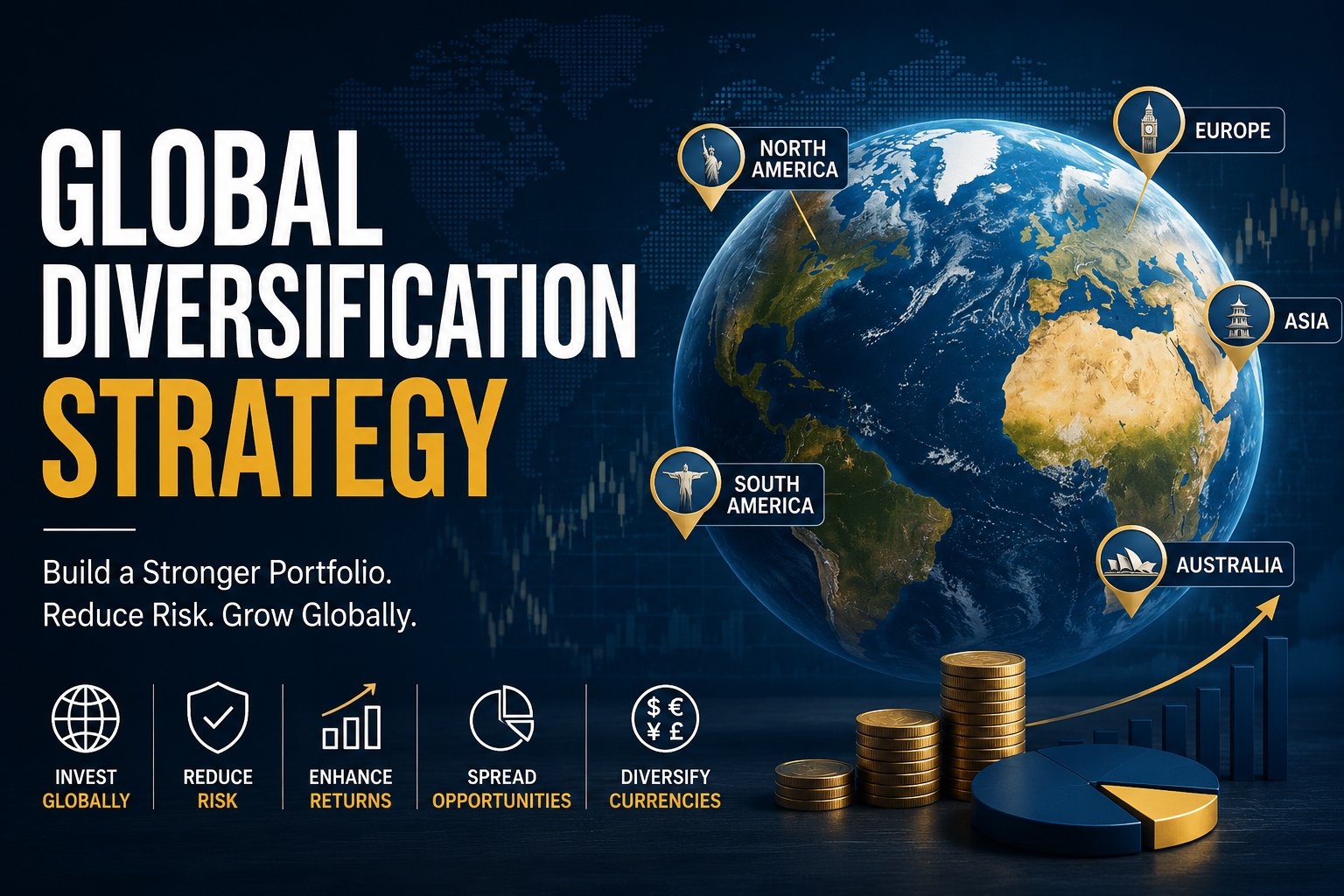
A Global Diversification Strategy helps investors spread their investments across different countries, regions, industries, currencies, and asset classes instead of relying on a single stock market. For long-term investors in the United States, United Kingdom, Canada, and Australia, this approach can reduce dependence on domestic market conditions and create access to a wider range of investment opportunities.
Consider an American investor whose portfolio consists almost entirely of US technology stocks. Even if the investor owns shares in 20 different companies, the portfolio may remain vulnerable to a technology-sector downturn. Similarly, a Canadian investor concentrated in domestic banks and energy companies may face significant losses if financial conditions deteriorate or commodity prices fall.
Global diversification addresses this concentration problem by combining investments that do not necessarily respond to economic events in the same way.
However, international investing does not guarantee higher returns or prevent losses. Global markets can decline simultaneously, and foreign investments introduce additional risks, including currency fluctuations, political instability, taxation, and higher transaction costs.
The objective is not to predict which country will outperform next year. It is to build an investment portfolio that can withstand different economic environments over time.
What Is Global Diversification?
Global diversification is the practice of spreading investments across multiple countries and international markets. It is a specific form of geographic diversification, which is itself one component of a broader investment diversification strategy.
A globally diversified portfolio might include:
- US equities representing American businesses and industries.
- European equities providing exposure to European companies.
- Japanese equities offering exposure to Japanese businesses.
- Emerging-market investments covering selected developing economies.
- International bonds providing exposure to foreign government and corporate debt.
- Global real estate investment trusts (REITs) offering exposure to listed property businesses.
A portfolio does not need to hold every asset class or invest in every country to qualify as globally diversified. Its design should reflect the investor’s goals, time horizon, financial circumstances, risk tolerance, and existing investments.
The US Securities and Exchange Commission’s Investor.gov explains that international investing can help investors spread risk across foreign companies and markets, while also warning about the additional costs and information challenges associated with overseas investments. Read its guide to international investing.
Understanding Diversification
Diversification means spreading money across investments so that the outcome does not depend excessively on one company, sector, asset class, or market.
For example, owning several companies from different industries can reduce company-specific risk. Adding bonds may change the portfolio’s exposure to stock market movements. Investing internationally can reduce dependence on a single country’s market.
These approaches complement each other, but they are not interchangeable.
Global Diversification vs. Diversification
| Feature | Diversification | Global diversification |
|---|---|---|
| Main meaning | Spreading risk across investments | Spreading investments across countries and regions |
| Scope | Companies, sectors, assets, and geography | International markets and geographic exposure |
| Main risk addressed | Concentration in a company, sector, or asset | Excessive dependence on one country or region |
| Example | US stocks, bonds, and REITs | US, European, Japanese, and emerging-market stocks |
| Main limitation | Investments may still share common risks | International markets may fall together |
A portfolio can be diversified within one country without being globally diversified. A more comprehensive portfolio may combine both approaches.
Why Global Diversification Matters
The world economy contains different industries, demographic trends, monetary policies, consumer markets, and business cycles. These differences create investment opportunities, but they also create risks.
1. Reduce Country-Specific Concentration Risk
Country-specific risk refers to the possibility that events affecting one nation will damage investments concentrated there. Examples include a recession, banking crisis, regulatory change, political disruption, or a sharp currency depreciation.
International holdings can reduce the proportion of a portfolio exposed to these events. They cannot eliminate the risk, particularly when countries are economically interconnected.
2. Access More Investment Opportunities
Investing exclusively in a domestic market can limit exposure to businesses and industries that are more prominent elsewhere.
International markets provide access to different areas of technology, manufacturing, pharmaceuticals, consumer products, financial services, and natural resources.
Nevertheless, buying foreign shares simply because a country has a fast-growing economy is not sufficient. Company valuations, profitability, governance, and the price paid for an investment remain important.
3. Address Home-Country Bias
Home-country bias occurs when investors allocate a disproportionately large share of their investments to their own country’s companies because those businesses are familiar.
An Australian investor might own Australian banks and mining companies but have limited exposure to international technology and healthcare businesses. A British investor may favour UK-listed companies even though many global industries are better represented elsewhere.
Familiarity does not necessarily make an investment safer. Reviewing domestic and international allocations can help investors identify hidden concentration.
4. Diversify Economic and Industry Exposure
Countries have different industry compositions. The US has substantial technology exposure, Australia has significant materials and financial-sector exposure, and Japan has prominent industrial and automotive businesses.
These are broad market characteristics, not guarantees of future performance. Industry composition also changes over time.
A Global Diversification Strategy can help spread exposure across these economic structures instead of relying entirely on one country’s dominant sectors.
Developed Markets vs. Emerging Markets
International investments are often divided into developed markets and emerging markets.
Developed Markets
Developed markets generally have mature financial systems, established regulatory frameworks, and relatively deep capital markets. Examples commonly include the United States, Canada, the United Kingdom, Japan, Australia, and several European economies.
These markets can still experience recessions, political changes, market crashes, and currency movements. Developed-market status does not guarantee lower investment losses.
Emerging Markets
Emerging markets include economies such as India, Brazil, China, Indonesia, and Mexico, although index classifications can change.
These markets may offer exposure to expanding consumer markets, infrastructure development, industrialization, and changing demographics. They may also involve greater political, regulatory, liquidity, governance, and currency risks.
Economic growth and stock market returns are not identical. A country’s GDP can grow rapidly without its listed equities delivering superior returns to investors, particularly if valuations are high or shareholders receive only a limited share of economic gains.
A balanced approach considers both the potential benefits and the risks rather than assuming emerging markets will automatically outperform developed markets.
Correlation and Global Diversification
Correlation measures how the returns of two investments move relative to each other over a specified period.
Correlation is commonly represented by a number between -1 and +1.
- Positive correlation: Two investments tend to move in the same direction.
- Negative correlation: Two investments tend to move in opposite directions.
- Low or near-zero correlation: Their movements show a weaker linear relationship.
Combining assets with imperfect correlation may reduce overall portfolio volatility. However, correlations change over time and can rise during financial crises.
Understanding Portfolio Risk
A portfolio’s risk depends on more than the number of holdings. It also depends on each holding’s weight, volatility, and relationship with the other investments.
For two assets, a simplified portfolio variance formula is:
[
\sigma_p^2=w_1^2\sigma_1^2+w_2^2\sigma_2^2+2w_1w_2\rho_{12}\sigma_1\sigma_2
]
Where:
- (\sigma_p^2) = portfolio variance, a measure of return variability.
- (w_1,w_2) = proportions invested in the two assets.
- (\sigma_1,\sigma_2) = standard deviations of their returns.
- (\rho_{12}) = correlation between their returns.
The correlation term explains why combining investments can affect total portfolio risk. When the assets are not perfectly correlated, portfolio volatility may be lower than it would be for a comparable concentration in one asset.
This formula is a simplified model, not a prediction of future returns or a guarantee that international holdings will protect a portfolio.
Modern Portfolio Theory and Global Investing
Modern Portfolio Theory (MPT), associated with economist Harry Markowitz, provides a framework for understanding how investors can combine assets to balance expected returns and risk.
One concept from MPT is the efficient frontier. It represents portfolios that offer the highest expected return for a given level of risk under specified assumptions, or the lowest risk for a given expected return.
Global assets may help improve portfolio efficiency when their returns, risks, and correlations complement existing holdings. The outcome depends on the selected assets, their costs, the investor’s assumptions, and actual market behaviour.
Investors should not treat mathematical models as exact forecasts. Historical relationships can change, and estimates of expected returns and correlations are uncertain. To understand how asset allocation, risk management, and diversification work together, explore our portfolio strategy guides.
International Stocks, Bonds, and ETFs
A global portfolio can contain different types of securities. The right combination depends on the purpose each investment serves.
International Stocks
International stocks are shares in companies outside the investor’s home market. They provide ownership exposure to foreign businesses and may offer different industry, company-size, and valuation characteristics.
Investors should assess corporate governance, financial reporting, trading liquidity, taxation, and the legal rights associated with foreign securities.
International Bonds
International bonds are debt securities issued by foreign governments, public agencies, or corporations. They can provide interest income and diversify some sources of risk.
However, bonds carry interest-rate risk, credit risk, and potentially currency risk. Foreign-currency bonds can lose value when the issuer’s currency weakens against the investor’s home currency.
Global ETFs and Index Funds
Exchange-traded funds (ETFs) and index funds allow investors to hold baskets of securities through a single investment. Depending on the fund, an investor may gain exposure to developed markets, emerging markets, or a broad selection of countries.
Before buying a fund, review its benchmark, country and sector weights, expense ratio, tracking difference, trading spread, currency exposure, domicile, tax treatment, and distribution policy.
A fund labelled “global” may exclude the investor’s home market, or it may hold a large share of its assets in a small number of countries. Read the factsheet rather than relying on the name.
Investors who want to compare fund structures, index-tracking approaches, and investment costs can explore our guide to ETF and index fund investing. Investors can also review the MSCI ACWI Index, which covers large- and mid-cap stocks across developed and emerging markets and provides a useful benchmark for understanding broad global equity exposure. However, an index’s coverage and performance do not guarantee the same results for an individual investor.
To understand how actively managed funds compare with their benchmarks, explore the S&P Dow Jones Indices SPIVA research, which publishes scorecards comparing active fund performance with relevant market indices across several regions.
Currency Risk Explained
Currency risk is the possibility that exchange-rate movements will increase or reduce the value of an international investment when measured in the investor’s home currency.
Suppose a US investor buys European shares. The shares rise by 8% in euros, but the euro falls by 5% against the US dollar over the same period.
The dollar return is approximately:
[
(1+0.08)(1-0.05)-1=2.6%
]
The investor earns approximately 2.6% in dollars before fees and taxes, rather than the 8% local-market return.
The reverse can also happen: a stronger foreign currency can increase the home-currency return.
Currency hedging uses financial instruments to reduce some exchange-rate exposure. Hedging introduces its own costs and limitations and does not remove investment risk. Whether hedging is useful depends on the investor’s currency, time horizon, asset type, and purpose for holding the investment.
Example of a Globally Diversified Portfolio
Consider a hypothetical investor with a $100,000 portfolio and a balanced allocation:
| Asset category | Allocation | Illustrative amount |
|---|---|---|
| US equities | 40% | $40,000 |
| Developed international equities | 25% | $25,000 |
| Emerging-market equities | 10% | $10,000 |
| Global bonds | 20% | $20,000 |
| Listed real estate and alternatives | 5% | $5,000 |
| Total | 100% | $100,000 |
This is an educational illustration, not a universally suitable portfolio. The actual risk depends on the holdings within each category, the bond quality and duration, currency exposure, fees, and how much equity risk the investor can tolerate.
A portfolio containing 75% equities may experience substantial losses during a global stock-market downturn. Investors with short time horizons or limited capacity for losses may need a different allocation. Choosing international investments is only one part of portfolio construction.
Our guide to asset allocation strategies explains how investors can divide investments among asset classes according to their objectives and risk tolerance.
Illustrative Allocation Chart
The following chart shows the hypothetical portfolio’s starting weights, not actual market performance or a recommended allocation for every investor.
| Asset category | Weight |
|---|---|
| US equities | 40% |
| Developed international equities | 25% |
| Emerging-market equities | 10% |
| Global bonds | 20% |
| Listed real estate and alternatives | 5% |
Real Case Study 1: Japan’s Asset-Price Bubble and the Lost Decades
Japan’s late-1980s asset-price boom demonstrates the risks of relying too heavily on one market after a period of exceptional performance.
Japanese share and property prices rose rapidly during the bubble period. The stock market peaked in late 1989, and the subsequent collapse damaged household wealth, corporate balance sheets, and financial institutions. Japan then experienced an extended period of weak growth and deflationary pressure.
The International Monetary Fund discusses the causes and consequences of this period in its historical analysis, Japan’s Lost Decade: Policies for Economic Revival.
What Investors Can Learn
Investors concentrated in Japanese equities and property near the peak faced serious losses. Investors with meaningful exposure to other countries would have avoided making their entire financial future dependent on Japan’s market recovery.
That does not prove that every internationally diversified portfolio would have performed well. Foreign markets have experienced their own crashes, and results depend on purchase dates, asset allocation, currencies, and rebalancing.
Practical lesson: Avoid assuming that a country or sector that performed exceptionally well in the past will remain the best-performing investment indefinitely.
Real Case Study 2: The 2008 Global Financial Crisis
The 2008 financial crisis began with severe stress in housing and financial markets and developed into a worldwide economic shock. After Lehman Brothers filed for bankruptcy in September 2008, financial-market stress intensified and capital flows to many emerging economies weakened.
The World Bank documents how the crisis affected emerging-market financing and how international capital markets experienced widespread disruption. See its research on the decade after the global recession. The World Bank’s historical research on capital flows to developing countries during the global financial crisis documents the sharp reduction in private capital flows in 2008, illustrating how financial stress can spread across international markets.
What Investors Can Learn
Geographic diversification did not prevent losses during this crisis. International stock markets fell sharply, demonstrating that countries can become highly interconnected when investors reduce risk and sell assets across markets.
Nevertheless, diversification can still reduce dependence on one company, industry, or national market over a full investment cycle. High-quality bonds, cash reserves, and a suitable asset allocation may serve different purposes from international equities.
Practical lesson: Global diversification is a way to manage concentration, not a guarantee against worldwide market crashes.
Real Case Study 3: COVID-19 and Different Market Recoveries
The COVID-19 shock in 2020 disrupted travel, hospitality, supply chains, employment, and consumer spending across many countries. Equity markets fell sharply during the initial panic, but the subsequent recovery differed across industries and periods.
Technology and some online businesses benefited from shifts towards remote work and digital services, while airlines, hotels, and other travel-related companies faced severe disruption. Later market performance was also influenced by fiscal support, monetary policy, inflation, and changing interest rates.
What Investors Can Learn
A diversified portfolio may include businesses with different revenue sources and economic sensitivities. However, owning international stocks does not automatically provide protection if those companies face the same global shock.
Investors should distinguish between diversification by country and diversification by underlying economic exposure. A company listed in Europe may generate most of its revenue in the United States, for example.
Practical lesson: Assess what businesses actually do and where they earn revenue, not just the exchange on which their shares trade.
Advantages of Global Diversification
1. Broader Investment Opportunities
International markets expand the range of businesses, industries, and securities available to investors.
2. Reduced Dependence on One Market
A portfolio with international exposure is less reliant on a single national stock market’s performance, although global shocks can still affect all holdings.
3. Wider Sector Exposure
International markets may provide exposure to industries that have smaller weights in the investor’s domestic index.
4. Multiple Sources of Returns
Returns can come from earnings growth, dividends, interest, changes in valuations, and currency movements. These sources do not always move together.
5. More Flexible Long-Term Planning
A global allocation can be adapted to retirement goals, changing cash-flow needs, and the investor’s preferred level of risk.
These benefits depend on implementation. Poorly selected funds, excessive fees, overlapping holdings, or unsuitable asset allocation can weaken the outcome.
Risks of Global Diversification
International investments introduce additional considerations that investors should understand before investing.
Currency Risk
Exchange-rate movements may increase or reduce returns in the investor’s home currency.
Political and Regulatory Risk
Changes in laws, taxation, capital controls, sanctions, or foreign-investment rules can affect securities and the ability to trade them.
Liquidity Risk
Some markets have lower trading volumes and wider bid-ask spreads, which can make buying or selling more expensive.
Information and Governance Risk
Reporting standards, disclosure practices, shareholder protections, and access to reliable information differ between markets.
Tax and Cost Risk
Foreign withholding taxes, local taxes, fund expenses, brokerage charges, and currency-conversion fees may reduce net returns.
Global Market Risk
During severe crises, correlations between equity markets may rise. International diversification does not eliminate broad equity-market risk.
The Investor.gov international investing guide provides additional information about these considerations.
How Much International Exposure Should Investors Have?
There is no single international allocation that is suitable for every investor. The appropriate amount depends on the home market, existing pension and retirement accounts, time horizon, investment objectives, tax circumstances, and tolerance for volatility.
A useful starting point is to examine the global stock-market exposure already present in existing funds. A broad global fund may already hold US and international equities, while adding separate regional funds can unintentionally overweight particular countries.
Investors should also consider whether their employment, property, pension, and future spending are concentrated in the same economy. Their financial exposure may be more domestic than their investment account alone suggests.
Considerations for US Investors
US investors may already have significant domestic equity exposure through broad-market funds and retirement accounts. International equities can provide additional geographic and sector diversification, but should be assessed alongside costs and tax considerations.
Considerations for Canadian Investors
Canada’s listed equity market has meaningful exposure to financials, energy, and materials. International holdings can broaden industry exposure, while foreign currency movements and account-specific tax treatment deserve attention.
Considerations for UK Investors
UK investors may hold domestic dividend-paying companies alongside international funds. The choice of fund domicile, account type, withholding taxes, and currency exposure can affect net returns.
Considerations for Australian Investors
Australian portfolios can have substantial exposure to financials, materials, and domestic economic conditions. International funds may broaden exposure to other sectors, but investors should consider the effect of foreign currencies on returns.
For readers in all four countries, account rules and taxation differ. Consult relevant official tax guidance or a qualified professional when needed.
How to Build a Global Diversification Strategy
Step 1: Define Your Investment Goals
Decide whether the portfolio is intended for retirement, long-term wealth accumulation, education, or another objective. The goal determines the required time horizon and how much risk may be appropriate. Before selecting investments, review the SEC’s guidance on asset allocation and diversification, which explains how investment mix, time horizon, and risk tolerance influence portfolio construction.
Step 2: Review Your Current Portfolio
List your existing funds, shares, bonds, retirement accounts, and other investments. Identify overlapping holdings and excessive exposure to a single country, sector, or company.
Step 3: Select a Geographic Allocation
Decide how to divide equity exposure between the home market, developed international markets, and emerging markets. Base the allocation on your circumstances and investment plan rather than recent performance rankings.
Step 4: Choose Appropriate Funds
Compare broad-market index funds and ETFs using their underlying index, diversification, expense ratio, tracking difference, liquidity, domicile, tax treatment, and currency policy.
Step 5: Consider Bonds and Other Assets
Stocks provide growth potential but can experience substantial declines. Bonds and cash may serve income, liquidity, and stability objectives, depending on their characteristics. Real estate and other alternatives also carry distinct risks.
Step 6: Automate Contributions Where Appropriate
Regular investing can help maintain discipline and reduce the temptation to make every investment decision based on short-term headlines. It does not guarantee a profit or prevent losses.
Step 7: Rebalance Periodically
Rebalancing restores a portfolio to its intended allocation after market movements cause weights to drift. Investors can use a scheduled review or predetermined allocation thresholds.
Consider transaction costs and tax consequences before selling investments. Rebalancing can also be achieved, where practical, by directing new contributions towards underweighted holdings.
Step 8: Review Costs and Risks
Monitor expense ratios, brokerage fees, currency-conversion charges, taxes, liquidity, and concentration. Review the investment plan when your goals or financial circumstances change rather than reacting to every market fluctuation.
For additional guidance, explore The AJ Times’ portfolio strategy resources and retirement investing guides.
Conservative and Aggressive Portfolio Examples
The following illustrations demonstrate how allocations can differ according to an investor’s risk preference. They are not individualized recommendations.
| Asset category | Conservative illustration | Aggressive illustration |
|---|---|---|
| Domestic equities | 20% | 40% |
| Developed international equities | 15% | 30% |
| Emerging-market equities | 5% | 20% |
| Bonds | 50% | 5% |
| Cash | 10% | 5% |
| Total | 100% | 100% |
The conservative illustration holds more bonds and cash, while the aggressive illustration has greater equity exposure. The aggressive portfolio may experience larger losses during equity-market declines. The conservative portfolio can still lose money, particularly if bond prices fall, inflation erodes purchasing power, or interest-rate and credit risks rise.
The right allocation is the one that matches the investor’s needs and can be maintained through difficult market conditions.
Rebalancing a Global Portfolio
Rebalancing means restoring investments to their planned weights after their relative values change.
Suppose a portfolio starts with 60% equities and 40% bonds. After a strong equity-market rally, the allocation becomes 70% equities and 30% bonds. The portfolio now carries more equity exposure than originally intended.
An investor might rebalance by selling some equities and buying bonds, or by directing new contributions towards bonds. The decision should account for taxes, fees, and the original investment plan.
Rebalancing does not guarantee higher returns. Its primary purpose is to keep portfolio risk aligned with the intended allocation and provide a disciplined framework for managing drift.
Behavioral Finance and Global Investing
Investor psychology can undermine even a carefully designed portfolio.
Familiarity bias encourages investors to favour companies or countries they know. Recency bias encourages them to assume recent market winners will continue to outperform. Herd behaviour leads investors to follow popular trades, while fear can cause them to sell during downturns.
A written investment policy, diversified holdings, planned contributions, and scheduled reviews can help reduce emotional decision-making. Discipline does not eliminate risk, but it can prevent unnecessary portfolio changes driven by short-term market noise.
Common Global Diversification Mistakes
Owning Too Many Overlapping Funds
Several ETFs may hold many of the same large companies. More funds do not automatically mean more diversification.
Chasing Recent Winners
Buying a country or sector after exceptional performance may expose investors to elevated valuations and disappointment if returns normalize.
Ignoring Fees and Taxes
Small recurring costs can compound over long periods. Compare total costs and understand the tax treatment of foreign dividends and gains.
Assuming International Means Safe
Foreign markets can be volatile, politically uncertain, or highly correlated with the home market during a crisis.
Failing to Rebalance
Allowing allocations to drift may cause a portfolio to become riskier or more concentrated than intended.
Confusing Economic Growth with Investment Returns
Rapid GDP growth does not automatically translate into strong shareholder returns. Valuations, corporate profitability, dilution, governance, and currency movements matter.
Frequently Asked Questions About Global Diversification
1. What is a Global Diversification Strategy?
A Global Diversification Strategy spreads investments across countries and regions to reduce dependence on a single national market and access a broader range of businesses and economic conditions.
2. Is global diversification better than domestic diversification?
They serve different purposes. Domestic diversification can reduce company and sector concentration within one country, while global diversification adds international exposure. Combining both may improve geographic breadth, but the outcome depends on asset selection and costs.
3. How many countries should a portfolio include?
There is no fixed number. A broad international index fund can provide exposure to many countries through one holding. The quality and breadth of exposure matter more than simply counting countries.
4. Do international ETFs reduce investment risk?
They may reduce country-specific concentration risk, but they do not eliminate equity-market, currency, political, or liquidity risk. International markets can decline together during global crises.
5. What is the difference between global and international funds?
Fund terminology varies by provider. A global fund may include the investor’s home market, while an international fund often excludes it. Always review the benchmark and actual holdings.
6. Are emerging markets necessary for global diversification?
No. Emerging markets can provide additional geographic exposure and growth opportunities, but they also carry distinct risks. An investor may choose a developed-market allocation or a broad global fund depending on their objectives.
7. Can currency changes affect my investment returns?
Yes. When a foreign investment is converted into the investor’s home currency, exchange-rate movements affect the final return. Currency-hedged funds seek to reduce some of this exposure but have costs and limitations.
8. How often should I rebalance my portfolio?
Some investors review allocations annually; others use predetermined thresholds. The appropriate schedule depends on the investment plan, taxes, transaction costs, and how much the allocation has drifted.
9. Does global diversification guarantee better returns?
No. It can reduce certain concentration risks and expand investment opportunities, but it cannot guarantee profits or outperform a domestic portfolio over every period.
10. Can beginners use global diversification?
Yes. Beginners can learn about broad-market index funds and ETFs, review costs and risks, and build an allocation suited to their goals. They should understand the fund’s holdings and tax implications before investing.
11. Is a global ETF enough to diversify an entire portfolio?
Not necessarily. A global equity ETF may provide broad stock-market exposure but may not include bonds, cash, or other assets needed for the investor’s objectives. Some global funds also have significant country or company concentration.
12. What is the biggest mistake in global investing?
Assuming that international holdings automatically make a portfolio safe. Investors still need to assess valuations, fund overlap, currency exposure, costs, liquidity, and the overall balance between risk and return.
Final Thoughts: Building a Stronger Global Portfolio
Global diversification is a long-term risk-management approach, not a promise of higher returns. It helps investors reduce excessive dependence on a single country, access international markets, and build portfolios that reflect the diversity of the global economy.
The Japanese asset-price collapse, the 2008 global financial crisis, and the COVID-19 market shock illustrate an important principle: market leadership changes, and different economic environments create different investment outcomes. They also demonstrate that geographic diversification cannot prevent every market decline.
For investors in the United States, United Kingdom, Canada, and Australia, a thoughtful approach combines domestic and international exposure with suitable asset allocation, cost awareness, periodic rebalancing, and realistic expectations.
Global diversification is one component of a broader wealth-building plan. Read our wealth-building guides for more on long-term investing principles and disciplined financial planning.”
The goal is not to identify the next winning country. It is to create an investment plan that remains appropriate across a range of possible futures.
Disclaimer: This article is for educational and informational purposes only. It does not provide personalized financial, investment, legal, or tax advice. Investments can lose value, including the original capital invested. Consider your circumstances and consult an appropriately qualified professional when necessary.