Stocks vs ETFs vs Mutual Funds: What’s Best for Long-Term Wealth? (Complete 2026 Guide)
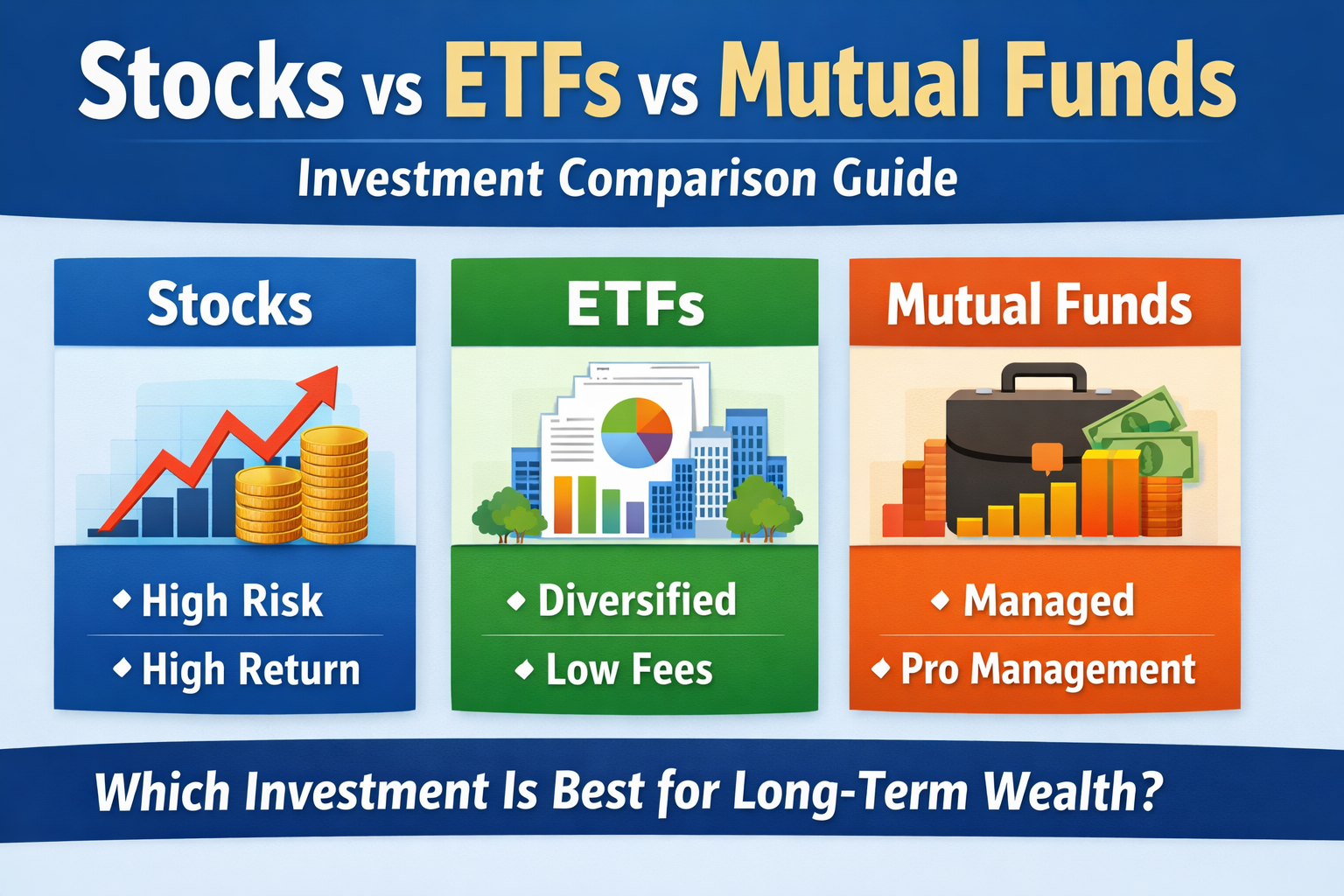
Understanding stocks vs ETFs vs mutual funds is essential for building long-term wealth and choosing the right investment strategy. Each investment option offers different levels of diversification, risk, and potential returns.
Building long-term wealth is one of the most important financial goals for individuals worldwide. Whether someone wants to retire comfortably, achieve financial independence, or simply grow savings faster than inflation, investing becomes essential.
However, beginners entering the investing world often face one major question:
Should I invest in stocks, ETFs, or mutual funds?
These three investment options dominate the modern financial system. They allow individuals to participate in the growth of businesses, economies, and financial markets.
Some investors prefer picking individual companies, hoping to outperform the market. Others prefer diversified funds that spread money across hundreds or thousands of companies.
Legendary investor Warren Buffett has famously recommended that most investors should buy low-cost index funds instead of individual stocks, because diversification reduces risk.
In this detailed guide you will learn:
- The definition and meaning of stocks, ETFs, and mutual funds
- Key financial terms explained in simple language
- Advantages and disadvantages of each investment
- Real-world investing case studies
- Comparison charts and tables
- Which investment strategy is best for long-term wealth creation
Understanding the Basics of Investing
Before comparing stocks, ETFs, and mutual funds, it is essential to understand what investing actually means. Educational platforms like Understanding the Basics of Investing provide detailed explanations of investing concepts for beginners.
What Is Investing?
Investing is the process of allocating money into assets with the expectation that their value will increase over time.
The purpose of investing is to grow wealth and beat inflation.
Common Investment Assets
Investors typically place money into:
| Asset Type | Description |
|---|---|
| Stocks | Ownership shares in companies |
| Bonds | Loans to governments or corporations |
| ETFs | Funds holding many assets |
| Mutual Funds | Professionally managed pooled investments |
| Real Estate | Property investments |
| Commodities | Gold, oil, agricultural goods |
What Is a Return?
A return is the profit generated from an investment.
Returns are usually expressed as percentages.
Example
If you invest $1,000 and the investment grows to $1,100:
Return = $100 profit
Return percentage =
$100 ÷ $1,000 = 10% return
Two Main Types of Investment Returns
1. Capital Appreciation
Capital appreciation occurs when the price of an asset increases.
Example:
Buy stock at $100
Sell stock at $150
Profit = $50
2. Income Returns
Some investments generate income.
Examples include:
- Dividends from stocks
- Interest from bonds
- Distributions from funds
What Are Stocks?
Definition of a Stock
A stock represents partial ownership in a company.
When you buy shares of a company, you become a shareholder, meaning you own a small piece of that business.
Example:
Buying shares of Apple Inc. means you own part of Apple.
Key Terms in Stock Investing
Share
A share is a unit of ownership in a company.
Companies issue shares to raise capital.
Market Capitalization
Market capitalization (market cap) measures the total value of a company.
Formula:
Market Cap = Share Price × Total Shares
Dividend
A dividend is a portion of company profits distributed to shareholders.
Example:
If a company pays:
Dividend = $3 per share
And you own 100 shares:
Dividend income = $300
Example of How Stock Investing Works
Imagine an investor buying shares of Amazon.
Investment details:
Shares purchased = 10
Price per share = $100
Total investment = $1,000
If the stock rises to $150:
Portfolio value = $1,500
Profit = $500
Advantages of Investing in Stocks
High Return Potential
Stocks historically deliver higher long-term returns than most asset classes.
For example, the S&P 500 index has returned about 10% annually over long periods.
Ownership in Growing Businesses
Stock investors benefit from company growth.
If a company expands globally and increases profits, the stock price usually increases.
Dividend Income
Many companies pay regular dividends.
Dividend investing can generate passive income streams.
Disadvantages of Stocks
Higher Risk
Individual companies can fail. Regulatory bodies such as the Higher Risk help protect investors and ensure transparency in financial markets.
Example:
Energy company Enron collapsed in 2001 due to accounting fraud, wiping out billions in investor wealth.
Requires Research
Stock investors must analyze:
- earnings reports
- industry trends
- competition
- financial statements
Stock investors must analyze earnings reports, industry trends, and valuation metrics before investing. Before investing in stocks, it is important to understand valuation metrics.
Price Volatility
Stock prices fluctuate daily based on:
- economic news
- interest rates
- earnings reports
- investor sentiment
Case Study: The Power of Stock Investing
A famous example is early investment in Amazon.
Investor example:
Investment in 2010 = $10,000
Amazon grew rapidly due to:
- e-commerce dominance
- cloud computing expansion
- global market growth
By 2024, that investment could be worth over $150,000.
However, identifying such winning companies in advance is extremely difficult.
What Are ETFs?
Definition
ETF stands for Exchange-Traded Fund.
An ETF is a basket of investments bundled into a single fund that trades on a stock exchange.
Instead of buying individual stocks, investors can buy a single ETF that contains many companies.
Example:
The SPDR S&P 500 ETF Trust (SPY) tracks the performance of the S&P 500.
How ETFs Work
An ETF may hold hundreds or thousands of investments.
Example:
An S&P 500 ETF holds shares of companies like:
- Apple Inc.
- Microsoft
- Amazon
- NVIDIA
When investors buy the ETF, they indirectly own a portion of all these companies.
Key ETF Terms Explained
Index
An index measures the performance of a group of investments.
Examples include:
- S&P 500
- NASDAQ‑100
ETFs often track these indexes.
Expense Ratio
The expense ratio is the annual fee charged by a fund. According to expense ratio , low-cost index funds have historically helped investors achieve better long-term results than many actively managed funds.
Example:
Expense ratio = 0.05%
Investment = $10,000
Annual cost = $5
Low fees significantly improve long-term returns.
Advantages of ETFs
Diversification
Diversification means spreading investments across many assets. Many ETFs follow passive investing strategies by tracking market indexes instead of trying to beat the market. Many investors prefer passive investing strategies.
This reduces risk.
Example:
Instead of investing in one company, an ETF may hold 500 companies.
Lower Costs
Many ETFs have extremely low fees.
Funds offered by Vanguard Group often charge less than 0.1% annually.
Liquidity
ETFs trade on stock exchanges, meaning they can be bought and sold anytime during market hours.
Disadvantages of ETFs
Market Risk
ETFs follow the market.
If the overall market declines, ETFs also decline.
Limited Outperformance
Most ETFs track indexes rather than attempting to beat the market.
Case Study: ETF Investing
Consider an investor named Sarah.
She invests $500 every month into the Vanguard Total Stock Market ETF (VTI).
Assuming an average return of 9% annually.
Investment Results
| Years | Total Invested | Portfolio Value |
|---|---|---|
| 10 | $60,000 | ~$95,000 |
| 20 | $120,000 | ~$320,000 |
| 25 | $150,000 | ~$500,000 |
This demonstrates the power of compound investing.
What Are Mutual Funds?
Definition
A mutual fund is an investment vehicle where money from many investors is pooled together and managed by professional fund managers.
These managers decide:
- which stocks to buy
- when to sell
- how to allocate capital
One of the largest asset managers globally is BlackRock.
How Mutual Funds Work
Example:
10,000 investors contribute money to a mutual fund.
Total capital = $100 million.
Professional managers invest the money into stocks, bonds, or other assets.
Each investor owns units of the fund.
Types of Mutual Funds
| Type | Description |
|---|---|
| Equity Funds | Invest mainly in stocks |
| Bond Funds | Invest in government or corporate bonds |
| Balanced Funds | Mix of stocks and bonds |
| Index Funds | Track market indexes |
Advantages of Mutual Funds
Professional Management
Experts research markets and manage investments.
Diversification
Mutual funds often hold dozens or hundreds of assets.
Automatic Portfolio Management
Fund managers rebalance portfolios regularly.
Disadvantages of Mutual Funds
Higher Fees
Many mutual funds charge:
- management fees
- distribution fees
- administrative costs
Fees may exceed 1% annually.
Limited Trading Flexibility
Mutual funds trade only once per day after markets close.
Potential Underperformance
Research shows many actively managed funds fail to beat market indexes.
Case Study: Mutual Fund Fees Impact
Investor John invests:
Initial investment = $10,000
Fund return = 8%
Expense ratio = 1.5%
Net return = 6.5%
Over 30 years:
| Investment Type | Portfolio Value |
|---|---|
| Active Mutual Fund | ~$66,000 |
| Low-Cost ETF | ~$100,000 |
Fees dramatically reduce long-term returns.
Stocks vs ETFs vs Mutual Funds: Key Differences
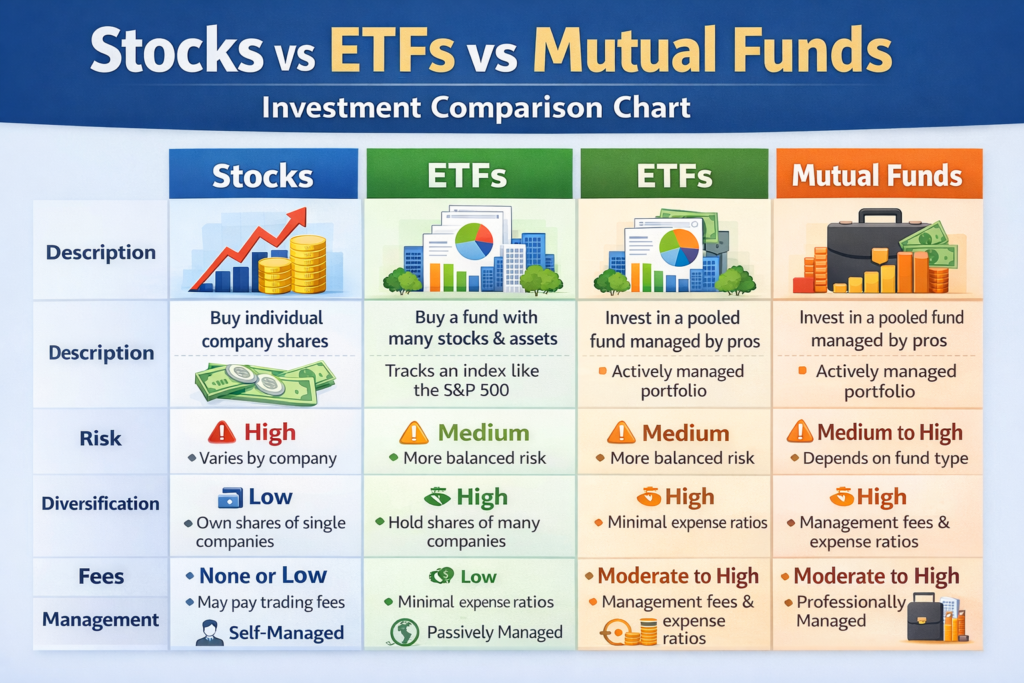
When comparing stocks vs ETFs vs mutual funds, it is important to understand how they differ in terms of diversification, risk, cost, and management style. The table below highlights the key differences between these three popular investment options.
Stocks vs ETFs vs Mutual Funds (Comparison Table)
| Feature | Stocks | ETFs | Mutual Funds |
|---|---|---|---|
| Ownership | Individual company | Basket of assets | Basket of assets |
| Diversification | Low | High | High |
| Management | Self-directed | Passive | Active |
| Fees | Low | Very Low | Higher |
| Trading | Real-time | Real-time | End of day |
| Risk | High | Moderate | Moderate |
This stocks vs ETFs vs mutual funds comparison helps investors quickly understand which investment option aligns best with their financial goals.
Investors often compare ETFs with index funds when building long-term portfolios. Investors often compare ETFs with index funds when building portfolios. See our detailed guide on Index Funds vs ETFs.
Stocks vs ETFs vs Mutual Funds: Which Investment Is Better?
When comparing stocks vs ETFs vs mutual funds, the best investment depends on your financial goals, risk tolerance, and experience level. Stocks offer higher return potential but come with higher risk, while ETFs provide diversification and lower costs. Mutual funds are ideal for investors who prefer professional management and a hands-off approach.
Understanding stocks vs ETFs vs mutual funds helps investors build a balanced portfolio for long-term wealth creation.
Real-Life Case Study – Stocks vs ETFs vs Mutual Funds Over 20 Years
To better understand stocks vs ETFs vs mutual funds, let’s look at a real-world style example comparing three investors over a 20-year period.
Scenario
In 2005, three investors each invested $10,000, but chose different strategies:
| Investor | Strategy Used |
|---|---|
| Alex | Individual Stocks |
| Ben | ETF (S&P 500 Index Fund) |
| Chris | Actively Managed Mutual Fund |
Investment Approach
Alex (Stocks Investor)
- Invested in a few individual companies like Apple and Amazon
- High risk, high reward strategy
- Required active research and monitoring
Ben (ETF Investor)
- Invested in a low-cost index ETF tracking the S&P 500
- Diversified across 500+ companies
- Passive long-term strategy
Chris (Mutual Fund Investor)
- Invested in an actively managed mutual fund
- Paid ~1.5% annual fees
- Relied on professional fund managers
Results After 20 Years (2005–2025)
| Investment Type | Portfolio Value |
|---|---|
| Stocks | ~$75,000 |
| ETFs | ~$60,000 |
| Mutual Funds | ~$52,000 |
Analysis of Results
This stocks vs ETFs vs mutual funds case study highlights key differences:
1️⃣ Stocks – Highest Returns but Highest Risk
Alex achieved the highest returns, mainly due to investing in high-growth companies.
However, this required:
- Strong research skills
- Emotional discipline
- Ability to handle market volatility
👉 Not all stock investors achieve these results.
2️⃣ ETFs – Best Risk-Adjusted Returns
Ben’s ETF investment delivered consistent and reliable growth.
Key advantages:
- Broad diversification
- Very low fees
- Minimal effort required
👉 This aligns with recommendations from experts like Warren Buffett, who suggests most investors choose low-cost index funds.
3️⃣ Mutual Funds – Lower Returns Due to Fees
Chris’s mutual fund underperformed mainly because of:
- Higher expense ratios
- Active management costs
- Difficulty beating the market
According to Vanguard Group, higher fees significantly reduce long-term returns.
Key Takeaway
This example clearly shows:
- Stocks can outperform but come with higher risk
- ETFs provide the best balance of growth, cost, and simplicity
- Mutual funds may underperform due to fees
👉 For most investors, understanding stocks vs ETFs vs mutual funds helps in choosing a strategy that balances risk and long-term wealth creation.
👉 This real-world comparison further explains how stocks vs ETFs vs mutual funds perform over time, helping investors choose the right strategy.
Long-Term Growth Comparison – Stocks vs ETFs vs Mutual Funds
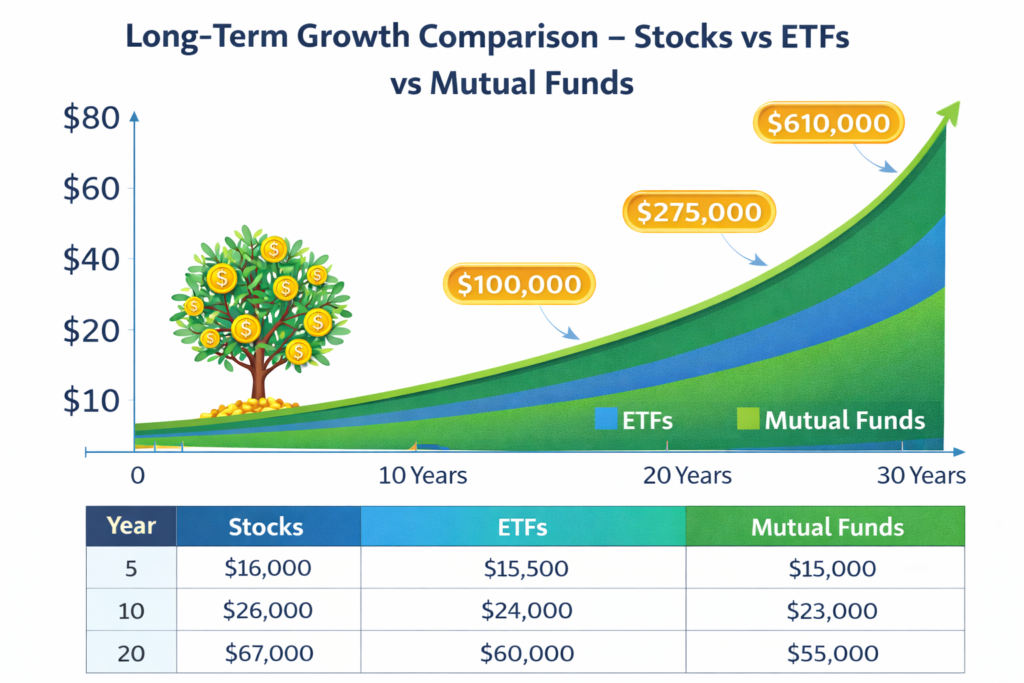
This stocks vs ETFs vs mutual funds growth chart shows how different investment strategies perform over time.
Example:
This chart compares the long-term growth potential of stocks vs ETFs vs mutual funds. While individual stocks may deliver higher returns, they also come with higher volatility. ETFs provide more stable and diversified growth, while mutual funds offer professionally managed portfolios with slightly higher fees.
Now add your data table:
| Year | Stocks | ETFs | Mutual Funds |
|---|---|---|---|
| 5 | $16,000 | $15,500 | $15,000 |
| 10 | $26,000 | $24,000 | $23,000 |
| 20 | $67,000 | $60,000 | $55,000 |
Risk Comparison Chart
| Investment | Risk Level | Reason |
|---|---|---|
| Stocks | High | Single company risk |
| ETFs | Moderate | Diversified holdings |
| Mutual Funds | Moderate | Managed portfolios |
Long-Term Wealth Building Principles
Successful investors typically follow three key principles.
Diversification
Never put all money into one investment.
Diversification spreads risk across multiple assets.
Long Time Horizon
Wealth creation through investing usually takes 10–30 years.
Compounding
Compounding means earning returns on previous returns.
Example:
$10,000 invested at 8% for 30 years becomes approximately $100,000.
Portfolio Strategy Used by Many Investors
Example allocation:
| Asset Type | Allocation |
|---|---|
| ETFs | 70% |
| Individual Stocks | 20% |
| Bonds or Mutual Funds | 10% |
This strategy balances growth and stability.
Example Portfolio for $50,000
| Investment | Amount |
|---|---|
| S&P 500 ETF | $25,000 |
| International ETF | $10,000 |
| Technology Stocks | $10,000 |
| Bond Fund | $5,000 |
Common Investing Mistakes
Trying to Time the Market
Predicting short-term market movements is extremely difficult.
Overtrading
Frequent trading increases transaction costs.
Ignoring Fees
Even small annual fees compound significantly.
The Power of Compounding
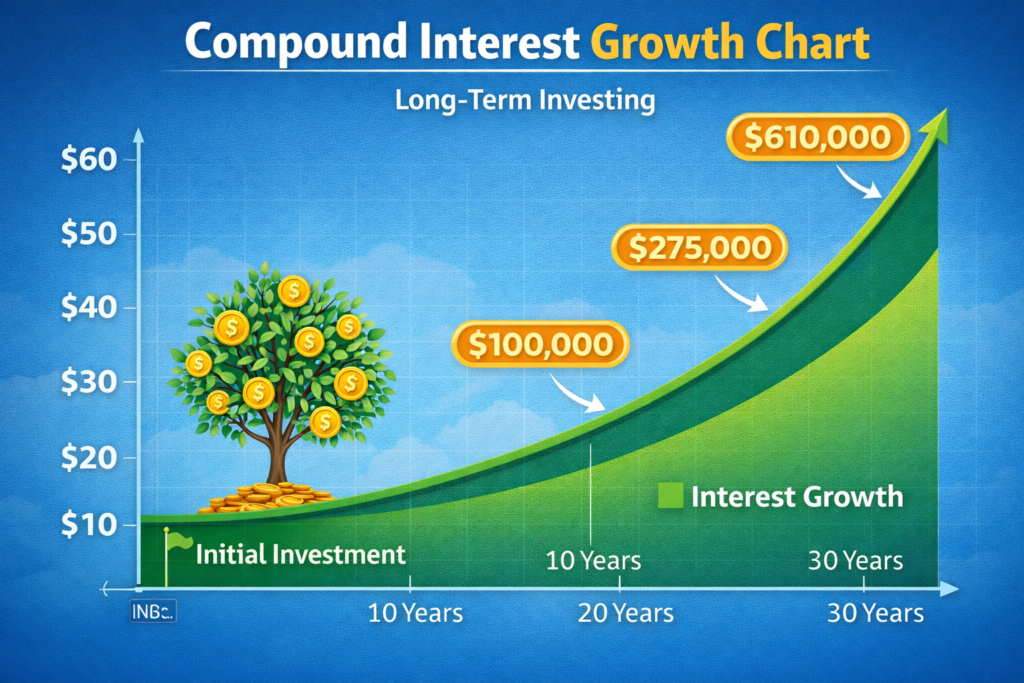
Compound Interest Growth Chart for Long-Term Investing
Example Scenario
Monthly investment: $500
Average annual return: 8%
Investment period: 30 years
| Years | Total Money Invested | Portfolio Value (8% return) |
|---|---|---|
| 5 | $30,000 | ~$36,700 |
| 10 | $60,000 | ~$91,500 |
| 15 | $90,000 | ~$174,000 |
| 20 | $120,000 | ~$295,000 |
| 25 | $150,000 | ~$476,000 |
| 30 | $180,000 | ~$745,000 |
Real-World Example
Legendary investor Warren Buffett built most of his wealth through long-term compounding.
Although he started investing as a teenager, the majority of his net worth accumulated after age 50, demonstrating how powerful compounding becomes over decades.
Why This Chart Is Important for Investors
Compound interest works because:
1️⃣ Investments earn returns
2️⃣ Returns are reinvested
3️⃣ New returns grow on previous returns
This creates exponential growth over long periods.
For example:
$10,000 invested at 8% for 30 years grows to approximately $100,000.
Invest $500 per month with an 8% annual return.
After 30 years:
Total invested = $180,000
Portfolio value ≈ $745,000
This demonstrates why starting early is critical.
Final Verdict: Which Investment Is Best?
The best choice depends on the investor’s experience and goals. When comparing stocks vs ETFs vs mutual funds, the best option depends on your goals, risk tolerance, and experience level.
Stocks
Best for investors who:
- enjoy researching companies
- want higher potential returns
- accept higher risk
ETFs
Best for investors who:
- want diversification
- prefer low fees
- want simple investing strategies
Mutual Funds
Best for investors who:
- want professional management
- invest through retirement accounts
- prefer hands-off investing
Frequently Asked Questions (FAQ)
Conclusion
Stocks, ETFs, and mutual funds are three of the most popular ways to invest in financial markets. This stocks vs ETFs vs mutual funds comparison helps investors choose the right strategy based on risk and return.
- Stocks offer high growth potential but require research and risk tolerance.
- ETFs provide diversification, low fees, and simplicity.
- Mutual funds offer professional management but often have higher costs.
For most long-term investors, a portfolio centered around low-cost ETFs with selective stock investments provides the best balance of growth, diversification, and risk management.
The most important investing principles remain simple:
- start investing early
- invest consistently
- stay disciplined for the long term.