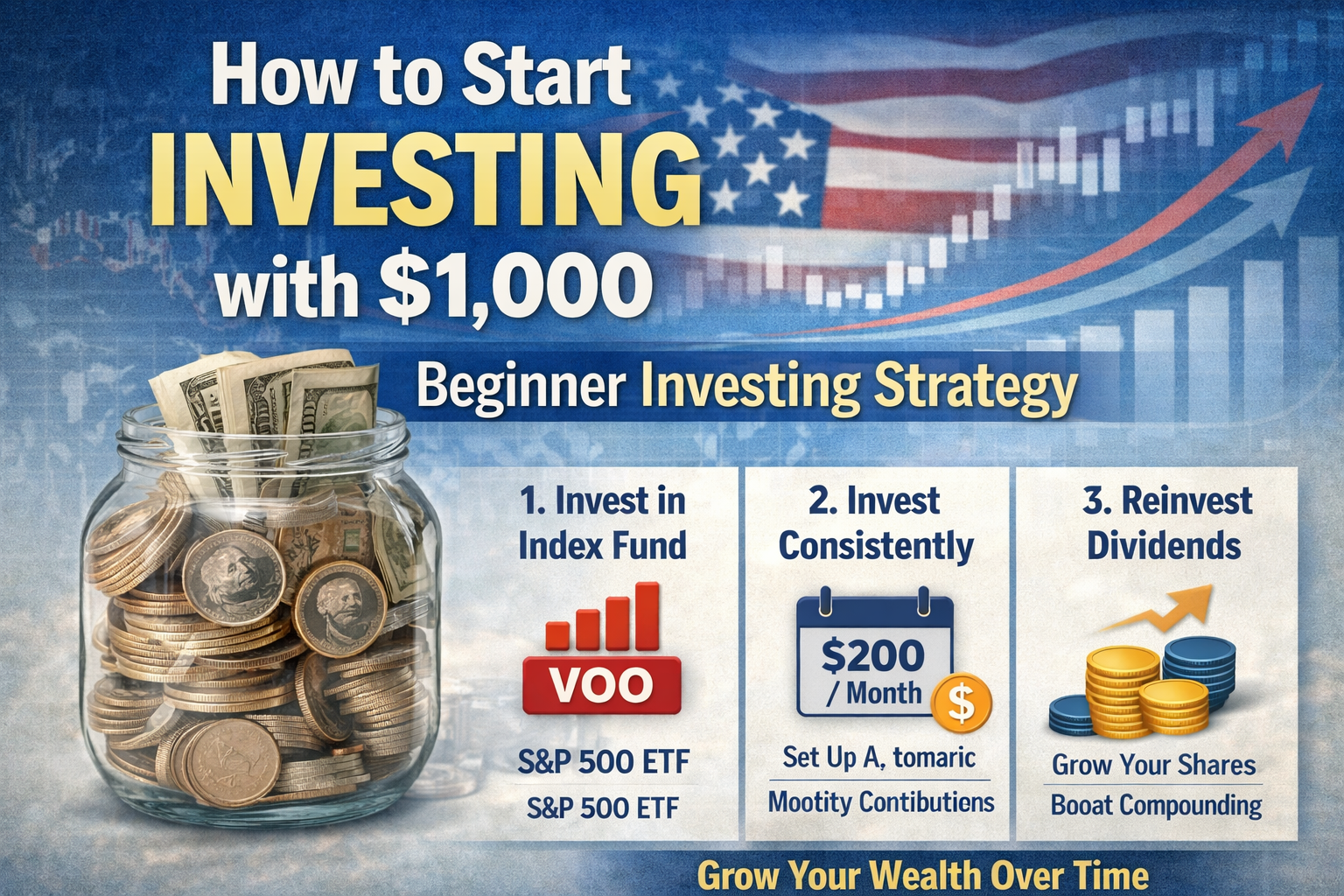
How to Start Investing with $1,000 (Step-by-Step Plan)
Back to: Start Investing Guide
Starting with $1,000 may seem small, but history proves small investments can grow significantly over time through compounding and disciplined investing.
Many successful investors began with small amounts. The key is not the initial amount but consistency and strategy.
Most people delay investing for years — but starting with just $1,000 today can be the difference between retiring rich or struggling financially.
Consider this simple example:
| Scenario | Investment Strategy | Result After 30 Years (8% Return) |
|---|---|---|
| One-time investment | $1,000 invested once | ~$10,000 |
| Monthly contribution | $1,000 + $200/month | ~$300,000 |
| Increasing contributions | $1,000 + $300/month | ~$700,000+ |
This example highlights the power of long-term investing.
This guide explains:
- What investing really means
- Important financial terms
- Step-by-step beginner strategy
- Case studies of real investing behavior
- Practical investment options
💡 Quick Answer:
To start investing with $1,000:
- Build an emergency fund
- Pay off high-interest debt
- Open a brokerage account
- Invest in an S&P 500 ETF
- Invest consistently every month
- Reinvest dividends
- Stay invested long-term
1. What Does “Investing” Actually Mean?
Before investing your first dollar, it’s important to understand the definition of investing.
Definition of Investing
Investing means:
Allocating money into assets with the expectation that those assets will produce income or increase in value over time.
This definition contains several key financial terms.
Key Investing Terms Explained
Asset
An asset is something that has economic value and can generate income or appreciate over time.
Examples of assets include:
| Asset Type | Description |
|---|---|
| Stocks | Ownership shares in companies |
| Bonds | Loans to governments or corporations |
| Real estate | Property that can produce rental income |
| ETFs | Funds that track market indexes |
| Mutual funds | Pooled investment funds |
For example, when you buy shares of Apple Inc., you own a small portion of the company.
If Apple grows and becomes more profitable, the value of your shares may increase.
Income
Investment income refers to money generated by an asset.
Examples include:
- Dividends from stocks
- Interest from bonds
- Rental income from property
For example:
Many companies pay dividends, meaning they distribute part of their profits to shareholders.
Appreciation
Appreciation means the increase in value of an asset over time.
Example:
If you buy a stock for $100 and its price rises to $150:
| Metric | Value |
|---|---|
| Purchase price | $100 |
| Current price | $150 |
| Appreciation | $50 |
| Return | 50% |
Return
Return refers to the total profit generated by an investment.
Return includes two components:
- Price appreciation
- Income (dividends or interest)
Formula:
Return = Capital Gain + Income
2. Step One: Build a Financial Foundation Before Investing
Before investing your $1,000, you must ensure your financial foundation is stable.
Three important elements must exist before investing.
Emergency Fund
An emergency fund is cash reserved for unexpected expenses.
Examples include:
- Job loss
- Medical emergencies
- Car repairs
- Home repairs
Financial experts recommend saving:
3–6 months of living expenses
Example:
| Monthly Expenses | Emergency Fund Target |
|---|---|
| $2,000 | $6,000–$12,000 |
| $3,000 | $9,000–$18,000 |
Emergency funds are typically kept in high-yield savings accounts.
High-Interest Debt
If you have debt with high interest rates, paying it off is usually better than investing.
Example:
| Scenario | Interest Rate |
|---|---|
| Credit card debt | 20–25% |
| Average stock market return | ~8–10% |
Because debt interest is higher, paying it off produces a guaranteed return.
Case Study: Rahul’s Investment Decision
Rahul had:
- $1,000 savings
- $5,000 credit card debt at 22%
He invested his $1,000 in the stock market instead of paying down debt.
| Item | Value |
|---|---|
| Investment return | 8% |
| Debt interest | 22% |
Result:
Rahul lost money because his debt grew faster than his investment.
Lesson:
Always eliminate high-interest debt before investing.
3. Step Two: Understand Risk and Return
Investing involves balancing risk and return.
What is Risk?
Risk refers to the possibility of losing money.
Different investments have different levels of risk.
What is Return?
Return is the profit earned from an investment.
Investments with higher potential returns usually carry higher risk.
Risk vs Return Comparison
| Investment | Risk Level | Average Return |
|---|---|---|
| Savings account | Very low | 1–3% |
| Bonds | Low | 3–5% |
| Index funds | Medium | 7–10% |
| Individual stocks | High | 10%+ potential |
| Cryptocurrency | Very high | Extremely volatile |
Historical Example
The S&P 500 represents 500 large U.S. companies. The S&P 500 represents 500 large U.S. companies and is widely used as a benchmark for long-term investing.
Historically:
| Period | Average Annual Return |
|---|---|
| 1926–2023 | ~10% (based on long-term U.S. stock market data — learn more about historical returns) |
| Inflation adjusted | ~7% |
However, returns vary year to year.
Example:
| Year | Market Return |
|---|---|
| 2008 | −37% |
| 2013 | +32% |
This fluctuation is called volatility.
4. Step Three: Choose the Right Investment Account
Investing requires an account where assets can be purchased and stored.
The most common option is a brokerage account.
What is a Brokerage Account?
A brokerage account is a financial account that allows investors to buy and sell securities (learn how brokerage accounts work).
Securities include:
- Stocks
- ETFs
- Mutual funds
- Bonds
Brokerage firms act as intermediaries between investors and financial markets.
Major Investment Platforms
Popular platforms include:
- Vanguard
- Fidelity Investments
- Charles Schwab
These firms offer:
- Commission-free trades
- Research tools
- Automated investing
Account Type Comparison
| Account Type | Purpose |
|---|---|
| Brokerage account | Flexible investing |
| 401(k) | Employer retirement plan |
| IRA | Individual retirement account |
5. Step Four: Choose Your Investment Strategy
Beginners should focus on simple diversified strategies.
Three popular strategies exist.
Strategy 1: Invest in an S&P 500 Index Fund
The S&P 500 is one of the most widely followed stock indexes.
It includes companies such as:
- Apple Inc.
- Microsoft Corporation
- Amazon.com, Inc.
What Is an Index Fund?
As discussed earlier, an index fund is designed to track a market index, offering diversification and low-cost investing for beginners.
Benefits of Index Funds
| Benefit | Explanation |
|---|---|
| Diversification | Reduces risk across many companies |
| Low cost | Lower management fees |
| Simplicity | Easy for beginners |
Case Study: Sarah’s Index Fund Strategy
Sarah invested:
- $1,000 initial investment
- $200 per month
Average return: 8%
Result after 30 years:
| Investment | Value |
|---|---|
| Total contributions | $73,000 |
| Final value | ~$300,000 |
Sarah never tried to predict the market.
Her strategy relied on consistency and compounding.
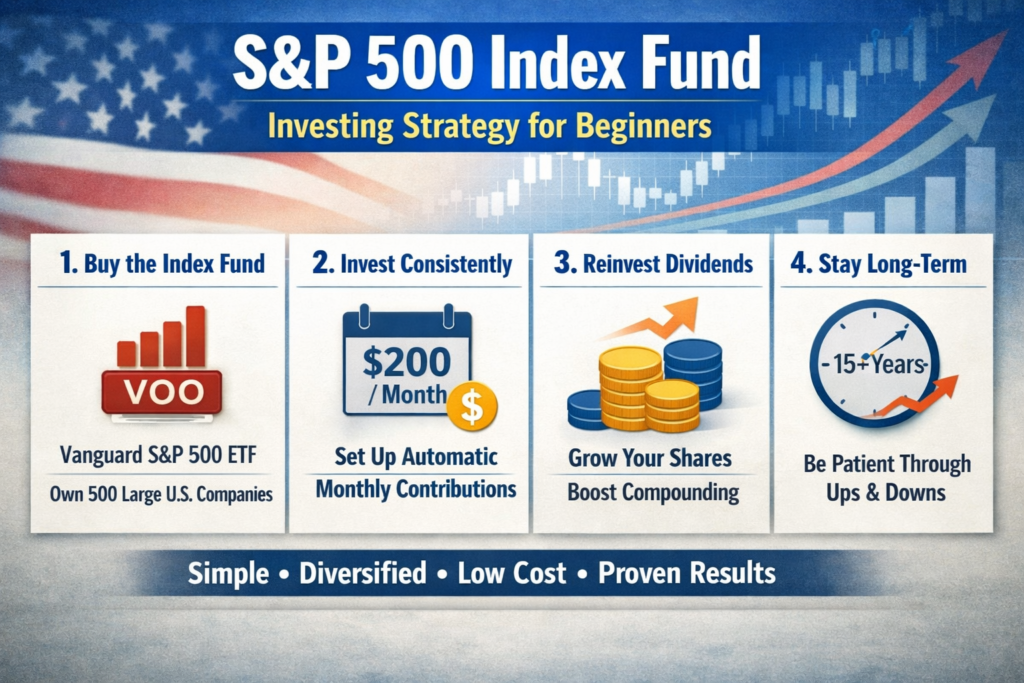
Many professional investors, including Warren Buffett, have recommended low-cost index funds as the best option for most people.
This guide explains:
- What the S&P 500 is
- How S&P 500 index funds work
- Why they are popular for beginners
- Step-by-step strategy to invest
- Real examples and case studies
What Is the S&P 500?
As explained earlier, the S&P 500 tracks 500 of the largest publicly traded companies and is widely used as a benchmark for long-term investing.
What Is an S&P 500 Index Fund?
An index fund is a type of investment fund designed to replicate the performance of a market index.
An S&P 500 index fund simply buys the same companies included in the S&P 500.
Instead of purchasing 500 individual stocks, you can buy one fund that holds them all.
Popular examples include:
- Vanguard S&P 500 ETF
- SPDR S&P 500 ETF Trust
- iShares Core S&P 500 ETF
When you invest in one of these funds, you automatically gain exposure to hundreds of major companies.
Why Beginners Should Consider S&P 500 Index Funds
Index funds are popular because they offer several advantages.
1 Diversification
Diversification means spreading investments across multiple companies or assets.
Instead of owning one company, you own 500 companies simultaneously.
This reduces the risk of losing money if one company performs poorly.
Example:
| Investment | Risk Level |
|---|---|
| Single stock | High |
| S&P 500 index fund | Moderate |
2 Low Fees
Index funds usually have very low management fees.
For example:
| Fund | Expense Ratio |
|---|---|
| VOO | ~0.03% |
| SPY | ~0.09% |
| IVV | ~0.03% |
Lower fees mean more of your money stays invested and compounds over time.
3 Strong Historical Performance
Historically, the S&P 500 has delivered an average return of about 8–10% per year over long periods.
Example growth:
| Investment | Value After 30 Years (8%) |
|---|---|
| $1,000 | ~$10,000 |
| $1,000 + $200/month | ~$300,000 |
This is why many financial advisors recommend long-term index investing.
S&P 500 Index Fund Strategy for Beginners
This strategy builds on the earlier concept of investing consistently in diversified index funds to maximize long-term returns.
This strategy reduces the risk of buying at market highs.
Example Portfolio for Beginners
A simple beginner portfolio might look like this:
| Investment | Allocation |
|---|---|
| S&P 500 Index Fund | 80% |
| Bond ETF | 20% |
This combination balances growth and stability.
Case Study: Long-Term Index Investing
Imagine two investors.
Investor A
- Invests $1,000 once
- No additional investments
After 30 years at 8%:
~$10,000
Investor B
- Starts with $1,000
- Adds $200 per month
After 30 years:
~$300,000
Comparison
| Investor | Contributions | Final Value |
|---|---|---|
| Investor A | $1,000 | $10,000 |
| Investor B | $73,000 | $300,000 |
Consistency dramatically improves investment outcomes.
Risks of S&P 500 Investing
Even diversified funds have risks.
Market Volatility
Stock markets rise and fall.
During the Global Financial Crisis, the S&P 500 dropped about 37%.
However, markets eventually recovered.
Short-Term Losses
In the short term, stock prices fluctuate significantly.
Example yearly returns:
| Year | Return |
|---|---|
| 2008 | −37% |
| 2009 | +26% |
| 2013 | +32% |
This is why investors should focus on long-term horizons.
How Long Should You Hold an S&P 500 Investment?
Experts recommend a minimum investment horizon of 5–10 years.
Ideal investing horizon:
| Time Horizon | Strategy |
|---|---|
| 1–3 years | Avoid stocks |
| 5–10 years | Moderate allocation |
| 20+ years | Growth-focused |
Longer horizons reduce risk.
Psychological Discipline
Investing success depends heavily on investor behavior.
Successful investors:
- avoid panic selling
- ignore short-term market noise
- focus on long-term growth
Investors like Warren Buffett emphasize patience and long-term ownership.
Final Beginner Strategy
A simple beginner strategy could follow these steps:
1 Open a brokerage account
2 Buy an S&P 500 ETF
3 Invest consistently each month
4 Reinvest dividends
5 Hold investments for decades
This approach minimizes complexity and maximizes long-term growth potential.
Final Thoughts
The S&P 500 represents some of the most successful companies in the global economy.
By investing in an S&P 500 index fund, beginners gain:
- diversification
- low costs
- strong historical returns
Over time, consistent investing combined with compound growth can transform even small investments into substantial wealth.
Starting early, staying disciplined, and maintaining a long-term perspective are the keys to successful investing.
Strategy 2: Total Market ETF
Example:
Vanguard Total Stock Market ETF
Unlike the S&P 500, this ETF includes:
- Large companies
- Medium companies
- Small companies
Comparison: S&P 500 vs Total Market ETF
| Feature | S&P 500 | Total Market |
|---|---|---|
| Companies included | 500 | 4,000+ |
| Company size | Large | All sizes |
| Diversification | High | Very high |
Total market ETFs provide broader diversification.
Strategy 3: Balanced Portfolio (Stocks + Bonds)
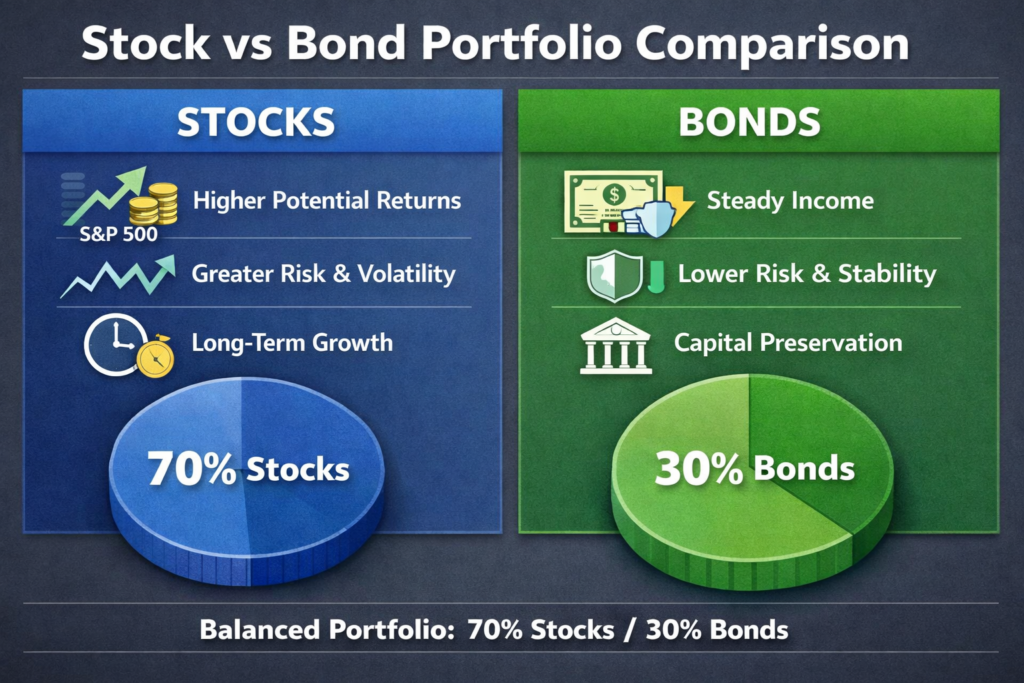
Some investors prefer combining stocks and bonds.
Example allocation:
| Asset | Allocation |
|---|---|
| Stocks | 70% |
| Bonds | 30% |
What Are Bonds?
A bond is a loan made by investors to governments or companies.
When you buy a bond:
- You lend money
- The borrower pays interest
Stocks vs Bonds Comparison
| Feature | Stocks | Bonds |
|---|---|---|
| Ownership | Yes | No |
| Income | Dividends | Interest |
| Risk | Higher | Lower |
| Growth potential | Higher | Lower |
The chart above shows the recent price movement of the SPDR S&P 500 ETF Trust, one of the most popular funds used by beginners to invest in the S&P 500.
Now let’s look at a Stock vs Bond Portfolio Comparison Chart concept and how investors typically compare them.
Stock vs Bond Portfolio Comparison (Beginner Guide)
1. What Is a Stock Portfolio?
A stock portfolio is a collection of shares in companies. Stocks represent ownership in a company, meaning investors benefit from company growth and profits.
For example, the S&P 500 includes 500 of the largest companies in the United States, representing industries like technology, healthcare, finance, and consumer goods.
Investors often buy index funds tracking this index through ETFs such as:
- SPDR S&P 500 ETF Trust
- Vanguard S&P 500 ETF
- iShares Core S&P 500 ETF
These funds allow investors to buy hundreds of companies in one investment.
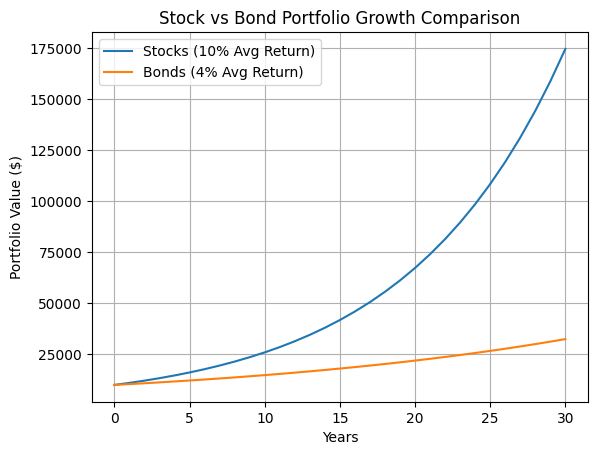
Example of Stock Portfolio Growth
Suppose an investor puts $1,000 into an S&P 500 index fund and earns an average 10% annual return.
After 20 years:
| Year | Portfolio Value |
|---|---|
| 0 | $1,000 |
| 5 | $1,610 |
| 10 | $2,594 |
| 15 | $4,177 |
| 20 | $6,727 |
This growth happens because of compound interest, where returns generate additional returns.
2. What Is a Bond Portfolio?
A bond portfolio contains investments in bonds. Bonds are essentially loans to governments or companies.
When you buy a bond:
- You lend money to the issuer.
- The issuer pays interest.
- The principal is returned at maturity.
Example bond investments:
- Government bonds
- Corporate bonds
- Bond ETFs
Popular bond ETFs include:
- Vanguard Total Bond Market ETF
- iShares Core U.S. Aggregate Bond ETF
Bonds are usually less volatile but provide lower returns than stocks.
3. Stock vs Bond Performance Comparison
Historically:
| Asset Type | Average Return | Risk Level |
|---|---|---|
| Stocks | 8–10% annually | High |
| Bonds | 3–5% annually | Low |
Research shows that stocks have historically produced higher long-term returns, while bonds provide stability and income.
4. Example Portfolio Comparison Chart
Imagine three portfolios starting with $10,000 for 20 years.
100% Stocks Portfolio
Assume 10% annual return
Value after 20 years:
$67,275
100% Bonds Portfolio
Assume 4% annual return
Value after 20 years:
$21,911
Balanced Portfolio (60% Stocks / 40% Bonds)
Assume 7% return
Value after 20 years:
$38,697
Visual Comparison
Portfolio Growth After 20 Years

Stocks (10%)          ███████████████████████████ $67,275
Balanced (7%)         ███████████████             $38,697
Bonds (4%)            ███████                     $21,911
5. Why Investors Combine Stocks and Bonds
Most investors don’t choose only stocks or only bonds. Instead, they build diversified portfolios.
Diversification means spreading investments across different asset classes to reduce risk.
For example:
| Portfolio | Stocks | Bonds |
|---|---|---|
| Aggressive | 90% | 10% |
| Moderate | 60% | 40% |
| Conservative | 40% | 60% |
6. Real-World Case Study
Case Study 1: Young Investor (Age 25)
Investment strategy:
- 90% stocks
- 10% bonds
Reason:
Young investors have long time horizons and can tolerate market volatility.
Example:
Investing in Vanguard S&P 500 ETF for growth.
Case Study 2: Retirement Investor (Age 60)
Portfolio:
- 40% stocks
- 60% bonds
Reason:
Older investors focus on income and capital preservation.
Example:
Combining SPDR S&P 500 ETF Trust with Vanguard Total Bond Market ETF.
7. Risk Comparison
| Factor | Stocks | Bonds |
|---|---|---|
| Volatility | High | Low |
| Return Potential | High | Moderate |
| Income | Dividends | Interest |
| Inflation Protection | Good | Moderate |
Stocks tend to outperform during economic growth, while bonds perform better during economic downturns.
8. Beginner Portfolio Strategy
A simple beginner strategy:
Step 1
Buy an S&P 500 index fund
Example:
- Vanguard S&P 500 ETF
Step 2
Add bond exposure
Example:
- Vanguard Total Bond Market ETF
Step 3
Rebalance yearly
Example portfolio:
| Asset | Allocation |
|---|---|
| S&P 500 ETF | 70% |
| Bond ETF | 30% |
9. Key Lessons for Beginners
- Stocks grow wealth faster
- Bonds reduce portfolio risk
- Diversification improves stability
- Long-term investing beats market timing
This philosophy is supported by investors like Warren Buffett, who often recommends low-cost S&P 500 index funds for most investors.
✅ Simple rule for beginners
Young investors → More stocks
Older investors → More bonds
If you want, I can also create 3 powerful investment charts that finance blogs use for SEO:
1️⃣ $1000 invested in S&P 500 for 30 years chart
2️⃣ Stock vs Bond volatility chart
3️⃣ 60/40 portfolio performance chart
These charts make articles rank higher on Google and keep readers engaged. 📈
6. Step Five: Understand Compounding (How Money Grows When You Start Investing with $1000)
Compounding is one of the most powerful concepts in finance. How to Start Investing with $1000: Compound Interest Chart
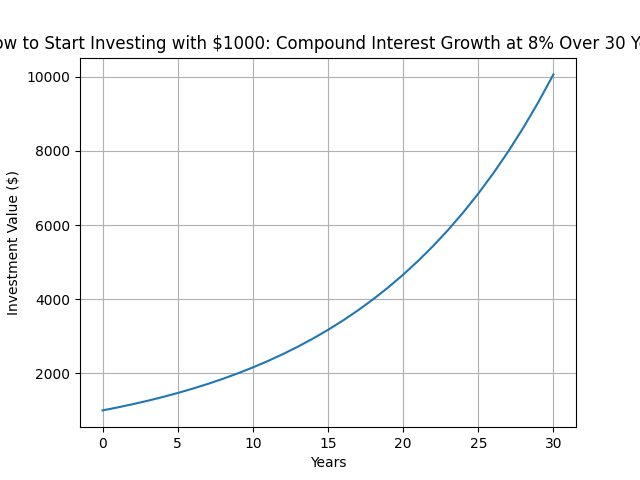
The chart above shows how compound interest works when you start investing with $1,000 and earn an average 8% annual return. Over time, the investment grows exponentially because each year you earn returns not only on your original investment but also on previous gains.
This is why long-term investing strategies used by investors like Warren Buffett emphasize patience and time in the market.
Compounding means earning returns on previous returns.
Compounding Example
| Year | Investment Value |
|---|---|
| Start | $1,000 |
| Year 1 | $1,080 |
| Year 5 | $1,469 |
| Year 10 | $2,159 |
| Year 30 | ~$10,000 |
Small growth accumulates over long periods.
7. Step Six: Common Beginner Investing Mistakes to Avoid
New investors often make mistakes.
Understanding these mistakes can protect your wealth.
Mistake 1: Stock Picking
Buying individual companies such as:
- Tesla, Inc.
- NVIDIA Corporation
These companies may grow significantly.
But individual stocks can also decline dramatically.
Diversification reduces this risk.
Mistake 2: Market Timing
Market timing means attempting to predict market highs and lows.
Research shows most professional investors fail at this consistently.
Example:
Missing the 10 best market days in a decade can drastically reduce returns.
Mistake 3: Emotional Investing
Fear and greed often cause poor decisions.
During market crashes many investors panic and sell.
8. Historical Example: The 2008 Financial Crisis
The Global Financial Crisis caused global markets to collapse. The official economic analysis caused global markets to collapse.
Stock markets fell dramatically.
The S&P 500 dropped about 37% in 2008.
However, investors who stayed invested experienced recovery.
Long-Term Market Recovery
| Year | Market Performance |
|---|---|
| 2008 | −37% |
| 2009 | +26% |
| 2013 | +32% |
Lesson:
Time in the market beats timing the market.
9. Step Seven: Reinvest Dividends
A dividend is a portion of a company’s profit distributed to shareholders.
Example:
If a company pays a $2 dividend per share:
| Shares Owned | Dividend Earned |
|---|---|
| 10 shares | $20 |
| 100 shares | $200 |
If dividends are reinvested:
- You buy more shares
- Those shares generate more dividends
This accelerates compounding.
10. Step Eight: Automate Your Investing
Automation removes emotional decisions.
Set up:
- Monthly transfers
- Automatic ETF purchases
Benefits of Automation
| Benefit | Explanation |
|---|---|
| Consistency | Regular investments |
| Discipline | Removes emotional decisions |
| Dollar-cost averaging | Reduces timing risk |
Case Study: Two Investors
Investor A
- $1,000 invested once
- No additional contributions
Result after 30 years:
~$10,000
Investor B
- $1,000 start
- $200 monthly investment
Result after 30 years:
~$300,000
Comparison
| Investor | Contributions | Final Value |
|---|---|---|
| Investor A | $1,000 | $10,000 |
| Investor B | $73,000 | $300,000 |
Consistency produced dramatically higher wealth.
Should Beginners Buy Individual Stocks?
With small portfolios, concentration risk is high.
Example:
If $1,000 is invested into a single stock and it falls 50%:
Investment becomes $500.
Index funds spread risk across many companies.
Recommended Beginner Portfolio
| Asset | Allocation |
|---|---|
| S&P 500 ETF | 70% |
| Total Market ETF | 20% |
| Bonds | 10% |
This provides diversification and growth potential.
How Long Should You Invest?
Investing works best over long time horizons.
| Time Horizon | Strategy |
|---|---|
| 1–3 years | Avoid stocks |
| 5–10 years | Balanced portfolio |
| 20+ years | Growth portfolio |
Longer investment horizons reduce risk.
The Psychology of Successful Investing
Successful investing is largely behavioral.
Investors must avoid emotional reactions to market fluctuations.
Example: Warren Buffett (read his investment philosophy )
One of the most successful investors in history is Warren Buffett.
His strategy focuses on:
- Long-term investing
- Buying quality companies
- Avoiding speculation
Buffett emphasizes patience and discipline.
Expected Wealth Outcomes
Consider this long-term scenario:
| Monthly Investment | Years | Final Value (8%) |
|---|---|---|
| $200 | 30 | ~$300,000 |
| $300 | 35 | ~$750,000 |
| $500 | 40 | ~$1.5M |
These outcomes illustrate the power of long-term investing.
Final Step-by-Step Investing Plan
Step-by-step beginner strategy:
- Pay off high-interest debt
- Build an emergency fund
- Open a brokerage account
- Invest in index funds
- Reinvest dividends
- Automate monthly investments
- Stay invested during market volatility
- Increase contributions over time
The Reality of Starting With $1,000
A single $1,000 investment will not make you rich immediately.
However, when combined with:
- time
- consistent investing
- compound returns
It can grow into substantial wealth.
Frequently Asked Questions (FAQ)
Conclusion
Investing is not speculation or gambling. It is the systematic ownership of productive assets. Every dollar invested represents a small piece of economic activity.
Over time, those assets generate income and grow in value. Start small. Start early. Stay disciplined.
That is the foundation of long-term wealth building.
Starting with $1,000 may seem small, but consistent investing and compounding can turn it into significant wealth over time.
By focusing on diversified investments like S&P 500 index funds, avoiding common mistakes, and staying disciplined, beginners can build a strong financial future. If you’re wondering how to start investing with $1000, the key is consistency, patience, and long-term thinking.
Back to: Start Investing Guide
Index Funds vs ETFs: Which Is Better for Long-Term Investors? (2026 Guide)