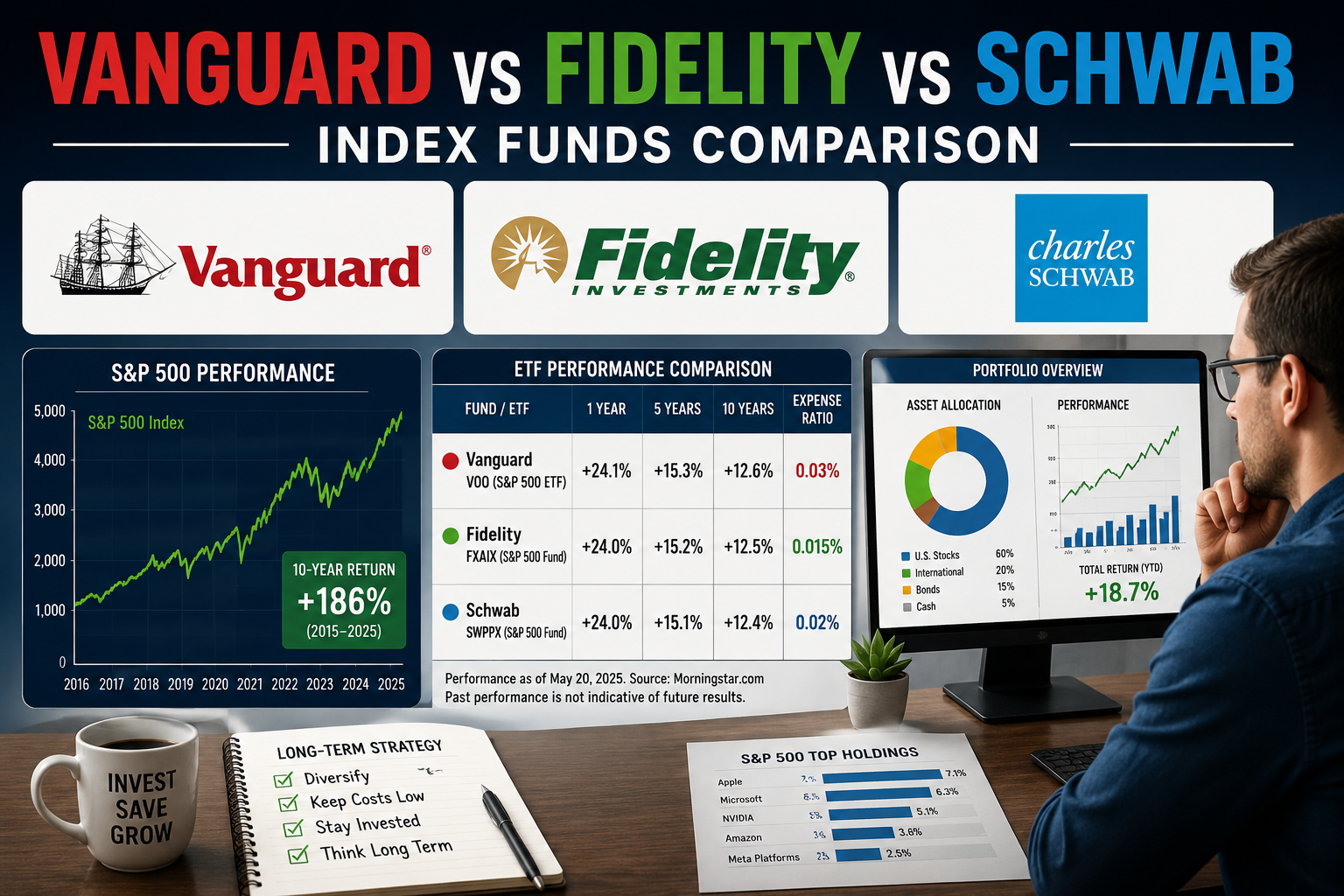
Introduction Vanguard vs Fidelity vs Schwab Index Funds
Vanguard vs Fidelity vs Schwab Index Funds is one of the most common comparisons among investors looking for low-cost, diversified, and long-term investment options. Understanding the differences between these three industry leaders can help you choose the right index fund strategy for building wealth. This guide explains Vanguard vs Fidelity vs Schwab Index Funds in detail, including fees, performance, diversification, and investment strategies.
Index fund investing has transformed how ordinary people build wealth. Instead of trying to “beat the market” by picking individual stocks, investors can simply buy the entire market through low-cost index funds.
Three companies dominate this world:
- Vanguard
- Fidelity Investments
- Charles Schwab
These firms collectively manage trillions of dollars and are considered the “Big Three” of passive investing.
But investors constantly ask:
- Which company offers the best index funds?
- Which has the lowest fees?
- Which platform is best for beginners?
- Which funds perform better long term?
- Does Vanguard still dominate?
- Are Fidelity’s ZERO funds truly better?
- Is Schwab underrated?
This guide explains everything in detail with terminology, examples, calculations, case studies, portfolio comparisons, and real-world investing scenarios.
What Is an Index Fund?
An index fund is an investment fund designed to track a market index. Index funds are designed to mirror the performance of a specific benchmark rather than relying on fund managers to select individual stocks. Because of their low costs, broad diversification, and long-term growth potential, index funds have become one of the most popular investment choices for both beginners and experienced investors.
A market index is simply a collection of stocks representing part of the market. Market indexes serve as performance benchmarks that help investors evaluate how different parts of the financial market are performing over time. Well-known indexes such as the S&P 500, Total Stock Market Index, and Nasdaq-100 represent different segments of the market and are widely tracked by index funds and ETFs.
Examples:
| Index | What It Tracks |
|---|---|
| S&P 500 | Largest 500 U.S. companies |
| Total Stock Market | Entire U.S. stock market |
| Nasdaq-100 | Large technology-focused companies |
| International Index | Stocks outside the U.S. |
Instead of researching hundreds of companies individually, you buy one fund that owns all of them.
Example:
If you invest in the Vanguard S&P 500 fund, you indirectly own companies like:
- Apple
- Microsoft
- Amazon
- Nvidia
- Meta
This creates:
- Diversification
- Lower risk
- Simplicity
- Long-term growth potential
What Is Passive Investing?
Passive investing means:
“Accept market returns instead of trying to outperform the market.” Passive investing focuses on minimizing costs, reducing unnecessary trading, and allowing investments to grow steadily over the long term. This strategy has gained widespread popularity because many actively managed funds struggle to consistently outperform broad market indexes after accounting for fees and expenses.
This philosophy became famous because of:
- John C. Bogle
- Warren Buffett
Passive investing usually wins because:
- Most active fund managers underperform long term
- Fees destroy compounding
- Emotional investing causes mistakes
Low-cost index funds solve these problems.
Understanding Important Terms
Before comparing Vanguard, Fidelity, and Schwab, you must understand investing terminology.
1. Expense Ratio
An expense ratio is the annual fee charged by a fund. Although expense ratios may seem small, they can significantly affect your long-term investment returns through the power of compounding over decades. Investors generally prefer funds with lower expense ratios because more of their money remains invested and continues to grow.
Example:
If a fund has a 0.03% expense ratio:
- $10,000 investment = $3 yearly fee
- $100,000 investment = $30 yearly fee
Lower expense ratios are generally better.
Major index funds now charge between:
- 0.00%
- 0.03%
The fee war between Vanguard, Fidelity, and Schwab dramatically reduced investing costs.
2. ETF
ETF = Exchange-Traded Fund.
ETFs trade like stocks during market hours. ETFs are popular among both beginner and experienced investors because they provide instant diversification, transparency, and relatively low operating costs. Most ETFs also track well-known market indexes, making them an efficient way to invest in broad market segments without selecting individual stocks.
Examples:
- VOO
- VTI
- SCHB
Benefits:
- Tax efficiency
- Easy trading
- No minimum investment
3. Mutual Fund
Mutual funds trade once daily after markets close. Mutual funds are commonly used in retirement accounts because they support automatic contributions and long-term investing strategies. Unlike ETFs, all investors buying or selling a mutual fund on the same day receive the same closing net asset value (NAV).
Examples:
- FXAIX
- SWPPX
- VFIAX
Benefits:
- Automatic investing
- Fractional purchases
- Retirement account friendly
4. Diversification
Diversification means spreading investments across many companies. A well-diversified portfolio can help reduce the impact of poor performance from any single company, industry, or geographic region. While diversification cannot eliminate market risk entirely, it is one of the most effective ways to manage investment risk over the long term.
Instead of owning one stock:
- You own hundreds or thousands.
This reduces risk.
5. Tracking Error
Tracking error measures how accurately a fund follows its index. Smaller tracking error = better index replication. A consistently low tracking error indicates that a fund is closely matching the performance of its benchmark index, which is a key objective of passive investing. Investors often compare tracking error alongside expense ratios to evaluate how efficiently an index fund delivers returns relative to its underlying index.
Even if two funds track the same index, small differences may exist because of:
- Fees
- Rebalancing timing
- Fund management techniques
The History of the Big Three
Vanguard
Vanguard pioneered index investing. Vanguard manages trillions of dollars in assets and is widely recognized for offering low-cost index funds and ETFs that support long-term wealth creation. Its investor-owned structure aligns the company’s interests with those of its clients, helping keep costs low and investment products highly competitive. Founded by John Bogle, Vanguard launched the first retail index fund in 1976.
Core philosophy:
- Low fees
- Long-term investing
- Investor-first structure
Vanguard became synonymous with passive investing.
Fidelity
Fidelity Investments focused on innovation and customer experience. Fidelity has become one of the world’s largest investment companies by combining advanced technology, comprehensive research tools, and competitive investment products. Its commission-free trading, fractional share investing, and ZERO expense ratio funds have made it especially attractive to modern investors.
Fidelity later entered the index fund war aggressively by launching:
- ZERO expense ratio funds
This disrupted the industry.
Schwab
Charles Schwab built its reputation through: Charles Schwab has grown into one of the largest brokerage firms by providing affordable investing solutions, comprehensive financial services, and an easy-to-use investment platform. In addition to index funds, Schwab offers banking, retirement planning, and wealth management services, making it a comprehensive choice for many long-term investors.
- Discount brokerage services
- Simplicity
- Low-cost investing
Schwab became especially popular among beginner investors and retirees.
Core Index Funds Comparison
Comparison Table Image
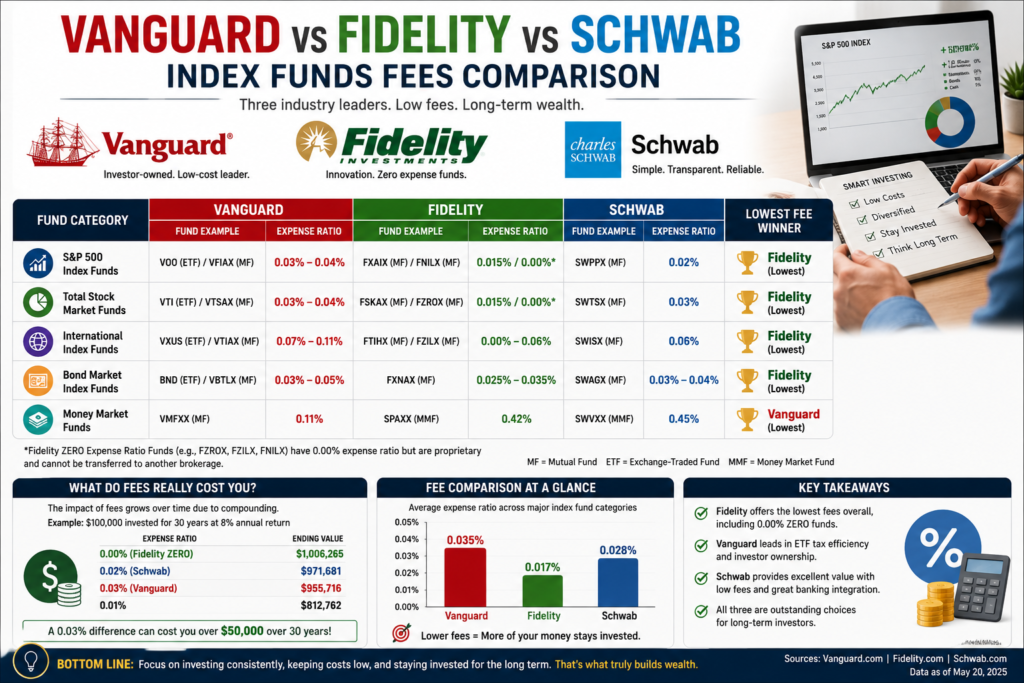
Vanguard vs Fidelity vs Schwab Index Funds offer investors a wide range of low-cost index funds covering the S&P 500, the total U.S. stock market, international markets, and bond markets, making them suitable for nearly every long-term investment strategy.
Here are the most important index funds offered by each company.
| Category | Vanguard | Fidelity | Schwab |
|---|---|---|---|
| S&P 500 | VOO / VFIAX | FXAIX / FNILX | SWPPX |
| Total Market | VTI / VTSAX | FSKAX / FZROX | SWTSX |
| International | VXUS / VTIAX | FTIHX / FZILX | SWISX |
| Bond Market | BND / VBTLX | FXNAX | SWAGX |
Expense Ratio Comparison
Expense Ratio Chart
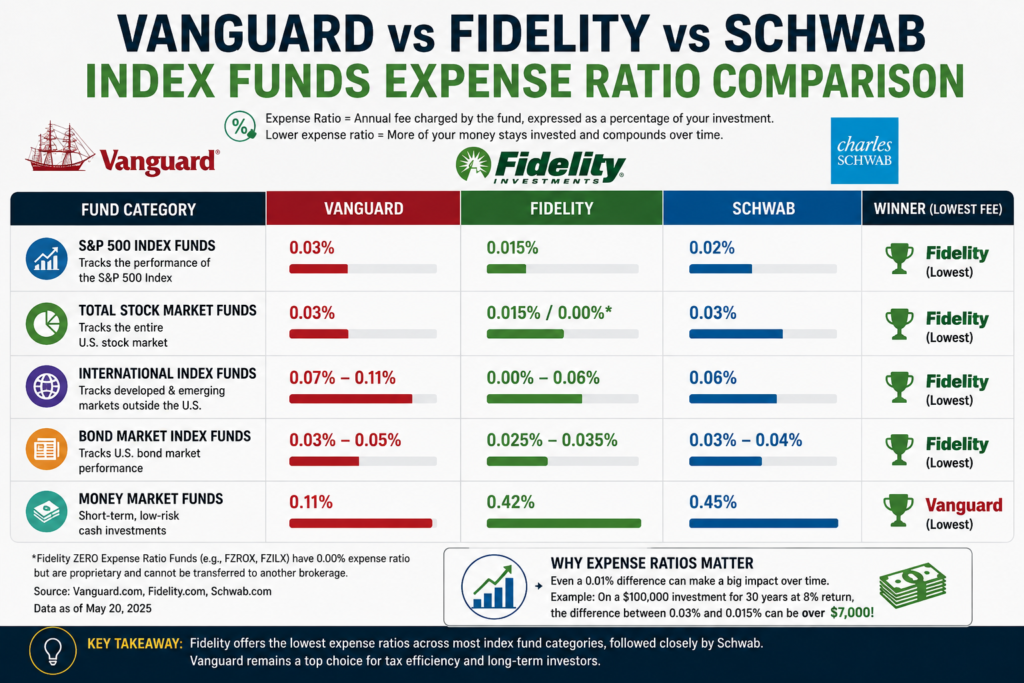
One of the biggest differences between Vanguard vs Fidelity vs Schwab Index Funds is their expense ratios, although all three providers are known for keeping investment costs extremely low.
Expense ratio differences appear tiny, but over decades they compound significantly.
| Fund Type | Vanguard | Fidelity | Schwab |
|---|---|---|---|
| S&P 500 | 0.03–0.04% | 0.015% or 0.00% | 0.02% |
| Total Market | 0.03–0.04% | 0.015% or 0.00% | 0.03% |
| International | 0.07–0.11% | 0.00–0.06% | 0.06% |
Understanding Fidelity ZERO Funds
When comparing Vanguard vs Fidelity vs Schwab Index Funds, Fidelity stands out by offering its unique ZERO expense ratio index funds, which have no annual management fees.
Fidelity introduced revolutionary funds:
- FZROX
- FZILX
- FNILX
These have:
- 0.00% expense ratios
- No minimum investments
Sounds unbeatable, right? Not entirely.
Important limitation:
Fidelity ZERO funds cannot be transferred to another brokerage.
This means:
If you later leave Fidelity:
- You may need to sell the fund
- Potentially trigger taxes in taxable accounts
This is one of the biggest criticisms of Fidelity ZERO funds.
Why Vanguard Still Dominates
Despite increasing competition, Vanguard vs Fidelity vs Schwab Index Funds comparisons often highlight Vanguard’s leadership in passive investing, investor trust, and long-term wealth building.
Even though Fidelity and Schwab often have lower fees, Vanguard remains extremely popular.
Reasons:
1. Brand Trust
Vanguard is associated with:
- Simplicity
- Discipline
- Long-term investing
Decades of consistent performance and a strong commitment to low-cost investing have earned Vanguard the trust of millions of individual and institutional investors worldwide. Its emphasis on investor education and disciplined investing has made the Vanguard brand synonymous with long-term wealth creation.
2. ETF Tax Efficiency
Vanguard ETFs are highly tax efficient.
This matters especially in:
- Taxable brokerage accounts
Tax-efficient ETFs can reduce taxable capital gains distributions, allowing investors to keep more of their investment returns over time. This advantage becomes increasingly valuable for long-term investors holding assets in taxable brokerage accounts.
3. Massive Fund Size
Large asset size improves:
- Liquidity
- Trading spreads
- Stability
Large funds also benefit from economies of scale, enabling fund providers to spread operating costs across more investors and maintain low expense ratios. In addition, larger asset bases often attract higher trading volumes, which can improve pricing efficiency for investors.
4. Investor Ownership Structure
Vanguard is unique because:
The funds own Vanguard.
This reduces pressure to maximize corporate profits. Instead of focusing on generating profits for outside shareholders, Vanguard prioritizes delivering greater value to its fund investors. This unique ownership model supports its long-term mission of offering low-cost investment solutions and improving investor outcomes.
Why Fidelity Is Extremely Popular
Among Vanguard vs Fidelity vs Schwab Index Funds, Fidelity has become increasingly popular because of its innovative ZERO expense ratio funds, modern technology platform, and beginner-friendly investment experience.
Fidelity excels in several areas.
1. ZERO Expense Funds
The biggest advantage.
For long-term investors, every basis point matters.
Example:
$1 million invested:
- 0.03% fee = $300 annually
- 0.00% fee = $0
Over decades this compounds significantly. Eliminating management fees allows investors to retain a greater share of their portfolio returns, especially over long investment horizons. Although expense ratios are important, investors should also consider diversification, fund structure, and transferability when evaluating ZERO expense ratio funds.(VanguardVsFidelity.com)
2. Better User Experience
Many investors believe Fidelity offers:
- Better apps
- Better customer support
- Better website experience
Fidelity continues to invest in digital tools, educational resources, and intuitive portfolio management features that simplify investing for users of all experience levels. Its mobile app and online dashboard make it easy to monitor investments, research funds, and manage retirement accounts.
3. No Minimums
Historically:
- Vanguard mutual funds required $3,000 minimums
- Fidelity often required $0
This made Fidelity beginner-friendly. Removing minimum investment requirements lowers the barrier to entry for new investors and encourages consistent investing regardless of account size. This flexibility is especially beneficial for students, young professionals, and investors following a dollar-cost averaging strategy.
Why Schwab Is Underrated
Although it receives less attention, Vanguard vs Fidelity vs Schwab Index Funds comparisons frequently show that Schwab offers competitive fees, excellent customer service, and integrated banking features.
Schwab often receives less attention, but remains excellent.
Advantages:
1. Low Fees
Schwab’s S&P 500 fund:
- SWPPX = 0.02%
This is cheaper than Vanguard. Low investment costs help investors keep a larger portion of their returns, which can significantly increase portfolio value over several decades. Even small differences in annual fees may have a meaningful impact when combined with long-term compounding.
2. Great Banking Integration
Schwab combines:
- Brokerage
- Banking
- Checking accounts
- International ATM benefits
This appeals to travelers and retirees. Combining banking and investing services within a single platform makes managing finances more convenient and efficient. Schwab’s integrated financial ecosystem is particularly attractive to investors seeking seamless cash management alongside their investment portfolio.
3. Simple Platform
Schwab is known for:
- Clean UI
- Ease of use
- Strong support
The platform is designed to make investing straightforward with intuitive navigation, comprehensive research tools, and easy account management features. Whether you’re a beginner opening your first brokerage account or an experienced investor managing multiple portfolios, Schwab provides a user-friendly experience.
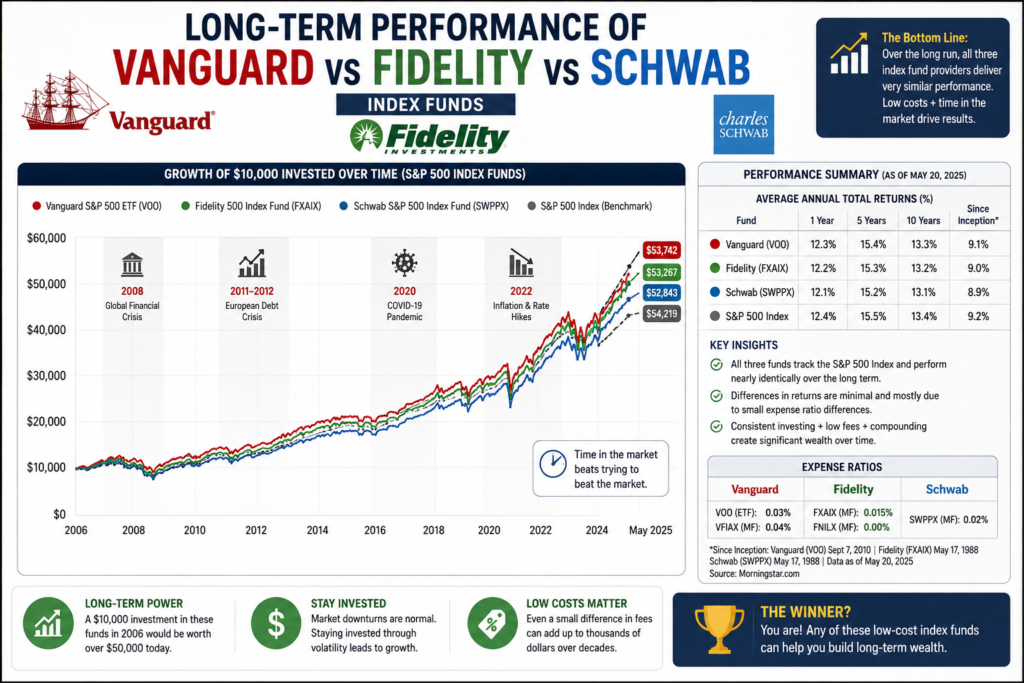
Are Returns Actually Different?
This is the most misunderstood topic.
Most investors think:
Lower fees = dramatically higher returns.
Reality:
The differences are usually tiny.
Example:
If three funds all track the S&P 500:
- Vanguard
- Fidelity
- Schwab
Their annual returns may differ by:
- 0.01%
- 0.05%
Practically identical.
Experts consistently note that convenience matters more than microscopic fee differences.
Case Study: $10,000 Investment Over 30 Years
Assume:
- 10% annual return
- Different expense ratios
Vanguard (0.03%)
Final value ≈ $171,000
Schwab (0.02%)
Final value ≈ $172,500
Fidelity ZERO (0.00%)
Final value ≈ $174,000
Difference:
- Noticeable
- But not life-changing
The real wealth driver is:
- Time in market
- Contribution consistency
Not tiny fee differences.
Case Study: Beginner Investor
Sarah — Age 22
Salary:
- $45,000 yearly
She wants:
- Simple investing
- Automatic deposits
- Roth IRA investing
Best choice?
Fidelity
Why?
- No minimums
- Easy app
- ZERO funds
- Beginner friendly
Possible portfolio:
- 70% FZROX
- 30% FZILX
Case Study: High-Net-Worth Investor
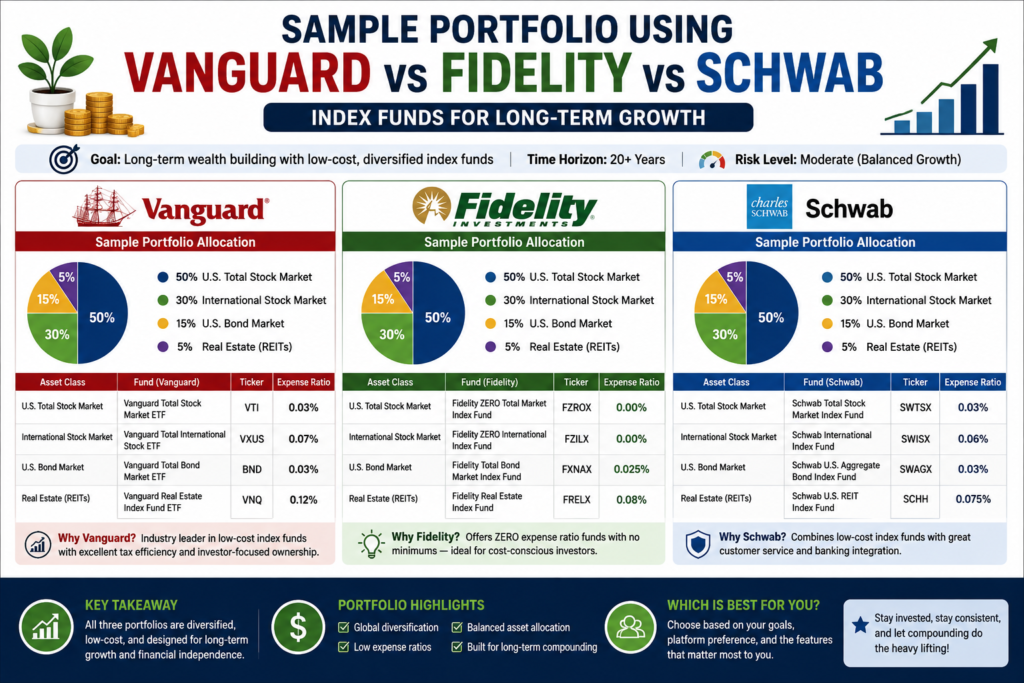
Portfolio Allocation Illustration
Michael — Age 45
Portfolio:
- $1.5 million
Goals:
- Tax efficiency
- Long-term wealth preservation
Best choice?
Vanguard ETFs
Why?
- Excellent ETF structure
- Strong tax efficiency
- Massive liquidity
Portfolio:
- VTI
- VXUS
- BND
Case Study: Retiree
Linda — Age 67
Needs:
- Simplicity
- Banking access
- Customer support
Best choice?
Schwab
Why?
- Banking integration
- Easy withdrawals
- Strong service
Portfolio:
- SWPPX
- SCHZ
- SCHF
ETF vs Mutual Fund
Understanding the differences between ETFs and mutual funds is essential when evaluating Vanguard vs Fidelity vs Schwab Index Funds, since all three providers offer both investment options.
This is another important comparison.
| Feature | ETF | Mutual Fund |
|---|---|---|
| Trading | All day | Once daily |
| Tax Efficiency | Higher | Lower |
| Minimums | Usually none | Sometimes required |
| Automatic Investing | Harder | Easier |
| Best For | Taxable accounts | Retirement accounts |
Best S&P 500 Funds
Vanguard
- VOO
- VFIAX
Expense ratio:
- 0.03–0.04%
Fidelity
- FXAIX
- FNILX
Expense ratio:
- 0.015%
- 0.00%
Schwab
- SWPPX
- 0.02%
Best Total Market Funds
Investors comparing Vanguard vs Fidelity vs Schwab Index Funds often start with total market index funds because they provide broad diversification across thousands of U.S. companies.
Vanguard
- VTI
- VTSAX
Tracks entire U.S. market.
Fidelity
- FSKAX
- FZROX
Very low fees.
Schwab
- SWTSX
Simple and inexpensive.
International Funds Comparison
International diversification means investing outside the U.S.
This reduces:
- Country concentration risk
Examples include:
- Europe
- Japan
- Emerging markets
Important distinction:
Some Schwab international funds exclude emerging markets.
This matters because:
Emerging markets can increase diversification.
Bond Index Funds
Bond funds reduce portfolio volatility.
Popular choices:
| Company | Bond Fund |
|---|---|
| Vanguard | BND |
| Fidelity | FXNAX |
| Schwab | SWAGX |
Tax Efficiency Explained
Tax efficiency is another important factor when comparing Vanguard vs Fidelity vs Schwab Index Funds, especially for investors using taxable brokerage accounts. Tax efficiency means minimizing taxable events.
ETFs generally outperform mutual funds in taxable accounts because of:
- “In-kind creation/redemption” mechanisms
This reduces capital gains distributions.
Vanguard is especially famous for ETF tax efficiency.
Psychological Advantage of Index Funds
Index investing also improves investor behavior.
Why?
Because investors stop:
- Chasing hot stocks
- Timing the market
- Panic selling
This often improves long-term returns more than fund selection itself.
What Most Experts Recommend
Many experts recommend:
- Broad diversification
- Low costs
- Long holding periods
Typical “three-fund portfolio”:
- U.S. total market
- International market
- Bond market
Popular examples include:
- VTI
- VXUS
- BND
Common Beginner Mistakes
1. Overthinking Expense Ratios
Investors obsess over:
- 0.02%
- 0.03%
- 0.04%
Reality:
Saving rate matters far more.
2. Chasing Performance
Past performance does not guarantee future results.
3. Lack of Diversification
Owning only tech stocks increases risk.
4. Trading Too Frequently
Frequent trading hurts long-term compounding.
Which Is Best for Retirement Accounts?
Choosing between Vanguard vs Fidelity vs Schwab Index Funds depends on your retirement goals, preferred account type, investment strategy, and long-term financial objectives.
Best for 401(k)
Usually determined by employer plan options.
Best for IRA
All three are excellent.
However:
| Goal | Best Choice |
|---|---|
| Lowest fees | Fidelity |
| Tax efficiency | Vanguard |
| Banking simplicity | Schwab |
Reddit Community Consensus
Across investing communities, a common opinion emerges:
“All three are excellent.”
Many experienced investors believe:
- Starting early matters more
- Consistency matters more
- Savings rate matters more
Than choosing between Vanguard, Fidelity, or Schwab.
Long-Term Compounding Example
Performance Timeline
Suppose:
- You invest $500 monthly
- For 35 years
- At 10% annual return
Final portfolio: ≈ $1.9 million
This demonstrates why:
- Time
- Consistency
- Discipline
Matter dramatically more than tiny fee differences.
Vanguard vs Fidelity vs Schwab Final Comparison
This Vanguard vs Fidelity vs Schwab Index Funds comparison summarizes the key differences in fees, performance, investment options, customer experience, and overall suitability for different types of investors.
| Feature | Vanguard | Fidelity | Schwab |
|---|---|---|---|
| Reputation | Legendary | Innovative | Reliable |
| Best Known For | Index investing | ZERO fees | Simplicity |
| Lowest Fees | Very low | Lowest | Very low |
| Best ETFs | Excellent | Very good | Very good |
| Tax Efficiency | Excellent | Good | Good |
| App Experience | Average | Excellent | Excellent |
| Banking Features | Limited | Moderate | Excellent |
| Beginner Friendly | Good | Excellent | Excellent |
| Transferability | Excellent | ZERO funds limited | Excellent |
Who Should Choose Vanguard?
Best for:
- Long-term investors
- Taxable accounts
- ETF investors
- Boglehead philosophy followers
Who Should Choose Fidelity?
Best for:
- Beginners
- Young investors
- Small accounts
- Investors wanting ZERO fees
Who Should Choose Schwab?
Best for:
- Retirees
- Travelers
- Banking integration
- Simplicity-focused investors
FAQs About Vanguard vs Fidelity vs Schwab Index Funds
Which is better: Vanguard, Fidelity, or Schwab?
There is no single best provider for every investor. Vanguard is known for its investor-first philosophy and tax-efficient ETFs, Fidelity stands out for its ZERO expense ratio funds and beginner-friendly platform, while Schwab offers competitive fees, integrated banking services, and an easy-to-use investing experience. The right choice depends on your financial goals, investment strategy, and preferred account features.
Which provider offers the lowest fees among Vanguard vs Fidelity vs Schwab Index Funds?
Fidelity generally offers the lowest fees through its ZERO expense ratio index funds. However, Vanguard and Schwab also provide extremely low-cost index funds with expense ratios that remain highly competitive, making all three excellent choices for long-term investors.
Are Vanguard vs Fidelity vs Schwab Index Funds suitable for beginners?
Yes. All three providers offer diversified index funds, educational resources, and user-friendly investment platforms that are ideal for beginners. Fidelity is often recommended for new investors because of its no-minimum investment requirements and intuitive mobile app, while Vanguard and Schwab are also excellent options for building long-term wealth.
Which is best for retirement investing: Vanguard vs Fidelity vs Schwab Index Funds?
All three companies offer high-quality index funds suitable for retirement accounts such as IRAs and 401(k)s. Vanguard is often preferred for long-term passive investing, Fidelity is attractive because of its low-cost funds and retirement planning tools, and Schwab provides excellent customer service and integrated financial solutions.
How do Vanguard vs Fidelity vs Schwab Index Funds compare in performance?
Because these providers track similar market indexes, their long-term investment performance is usually very similar. Small differences in returns are generally caused by expense ratios, tracking error, and fund management practices rather than major differences in investment strategy.
Can I transfer Vanguard vs Fidelity vs Schwab Index Funds to another brokerage?
Most Vanguard and Schwab ETFs can be transferred between brokerage firms without significant issues. However, Fidelity’s proprietary ZERO mutual funds generally cannot be transferred in kind to another brokerage and may need to be sold before transferring, which could have tax implications in taxable accounts.
Are Fidelity ZERO funds worth it?
Fidelity ZERO funds are an excellent option for long-term investors seeking the lowest possible investment costs. However, investors should also consider factors such as fund portability, diversification, and brokerage flexibility before choosing these proprietary funds.
Is Vanguard better for ETFs?
Vanguard is widely regarded as one of the best ETF providers because of its low expense ratios, broad diversification, tax-efficient fund structure, and long history of passive investing. Its ETFs are particularly popular among long-term investors using taxable brokerage accounts.
Are index funds safer than individual stocks?
Index funds generally carry lower risk than investing in individual stocks because they spread investments across hundreds or even thousands of companies. Although index funds are still subject to overall market risk, diversification helps reduce the impact of poor performance from any single company or sector.
Index Funds for Beginners
Final Verdict
After comparing Vanguard vs Fidelity vs Schwab Index Funds, it is clear that each provider offers outstanding low-cost index funds designed to help investors achieve long-term financial growth through diversified investing.
The truth is:
Vanguard, Fidelity, and Schwab are all outstanding.
The differences are much smaller than most people think.
The most important factors for wealth building are:
- Starting early
- Investing consistently
- Staying invested
- Avoiding emotional decisions
- Keeping costs low
Even though Fidelity technically offers the lowest expense ratios, Vanguard still dominates in brand trust and ETF efficiency, while Schwab provides one of the best all-around investing ecosystems.
For most investors:
- Vanguard = classic long-term investing
- Fidelity = lowest cost and best beginner experience
- Schwab = simplicity and banking convenience
Any of the three can help investors build substantial long-term wealth through disciplined index investing.
3-Fund Portfolio Strategy: Simple Proven Way to Build $1M Wealth (2026 Guide)