Introduction
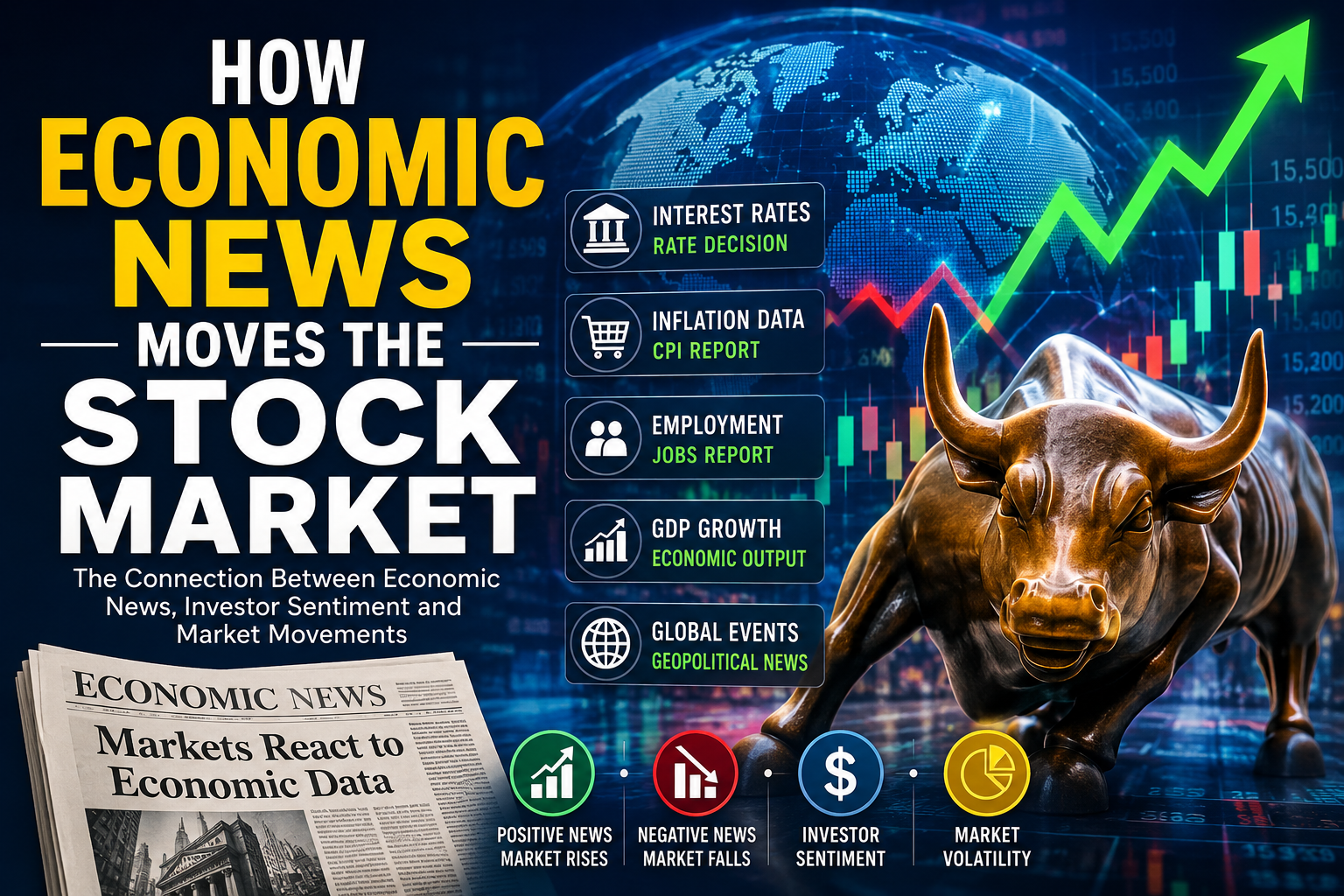
How Economic News Moves the Stock Market is one of the most important concepts every investor must understand. Economic reports such as inflation data, GDP growth, employment figures, and central bank announcements influence investor sentiment, corporate earnings expectations, and stock valuations. Understanding how economic news moves the stock market helps investors make smarter decisions during both bull and bear markets.
For investors in Tier 1 countries such as the United States, Canada, the United Kingdom, Germany, France, Australia, Japan, and other developed economies, understanding economic news is not optional—it is essential.
The stock market is often described as a “forward-looking mechanism.” This means investors are constantly trying to predict what the economy, corporate profits, consumer spending, inflation, and interest rates will look like in the future. Economic news provides clues about that future.
New to understanding financial markets? Start with our Market Guides pillar page, where you’ll learn about market cycles, economic indicators, inflation, interest rates, recessions, and investing strategies before diving deeper into how economic news moves the stock market.
If you’re new to investing, start with our ETF and Index Fund Investing Guide to understand how diversified investments respond to economic news and changing market conditions.
Economic news moves the stock market by influencing investor expectations about inflation, interest rates, GDP growth, employment, corporate earnings, and future economic conditions. Positive or negative economic reports can quickly change market sentiment and stock prices.
What Is Economic News?
Economic news refers to information that describes the current condition and future direction of an economy. Investors can access official economic statistics, including GDP, consumer spending, and business investment, through the U.S. Bureau of Economic Analysis (BEA), one of the primary sources for U.S. economic data.
This information is released by:
- Government agencies
- Central banks
- Financial institutions
- Research organizations
- International economic bodies
Economic news helps investors answer critical questions:
- Is the economy growing?
- Are consumers spending money?
- Are businesses expanding?
- Is inflation under control?
- Will interest rates rise or fall?
- Is a recession approaching?
Since stock prices reflect expectations about future company profits, any information affecting those profits can influence stock prices.
Understanding the Stock Market
Before understanding how economic news moves markets, investors must understand what a stock market actually represents.
A stock market is not simply a collection of stock prices.
It is a marketplace where investors buy ownership shares of companies.
When investors purchase stock, they are buying a small ownership stake in a business.
Examples include:
- Apple
- Microsoft
- Amazon
- NVIDIA
The value of these companies depends largely on expected future earnings.
If investors believe future earnings will increase, stock prices usually rise.
If investors believe earnings will decline, stock prices usually fall.
Economic news changes these expectations.
Market declines can also create opportunities. Read How to Invest During a Market Crash to learn practical strategies for volatile markets.
Why Economic News Matters
Consider a simple example.
Imagine a company selling luxury cars.
If economic news shows:
- Rising employment
- Strong wage growth
- Increasing consumer confidence
Consumers are more likely to buy expensive vehicles.
Investors anticipate higher profits.
The stock rises.
Now imagine economic news shows:
- Rising unemployment
- Falling wages
- Economic slowdown
Consumers delay purchases.
Expected profits decline.
The stock falls.
This basic principle applies across nearly every publicly traded company.
The Concept of Market Expectations
One of the most misunderstood concepts in investing is expectations.
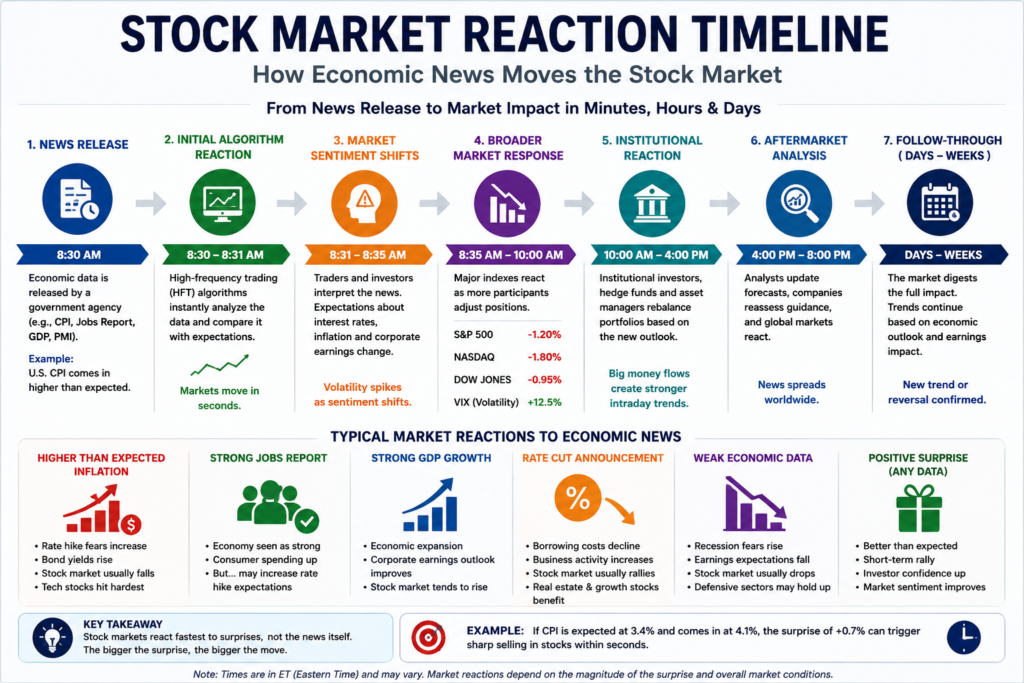
Markets rarely react to news itself.
Markets react to whether news is better or worse than expected.
For example:
Expected inflation: 3%
Actual inflation: 2.5%
Even though inflation exists, markets may rally because inflation was lower than expected.
Conversely:
Expected inflation: 3%
Actual inflation: 4%
Markets may decline because inflation was higher than anticipated.
This concept explains many seemingly irrational market movements.
Inflation: The Most Watched Economic Indicator
What Is Inflation?
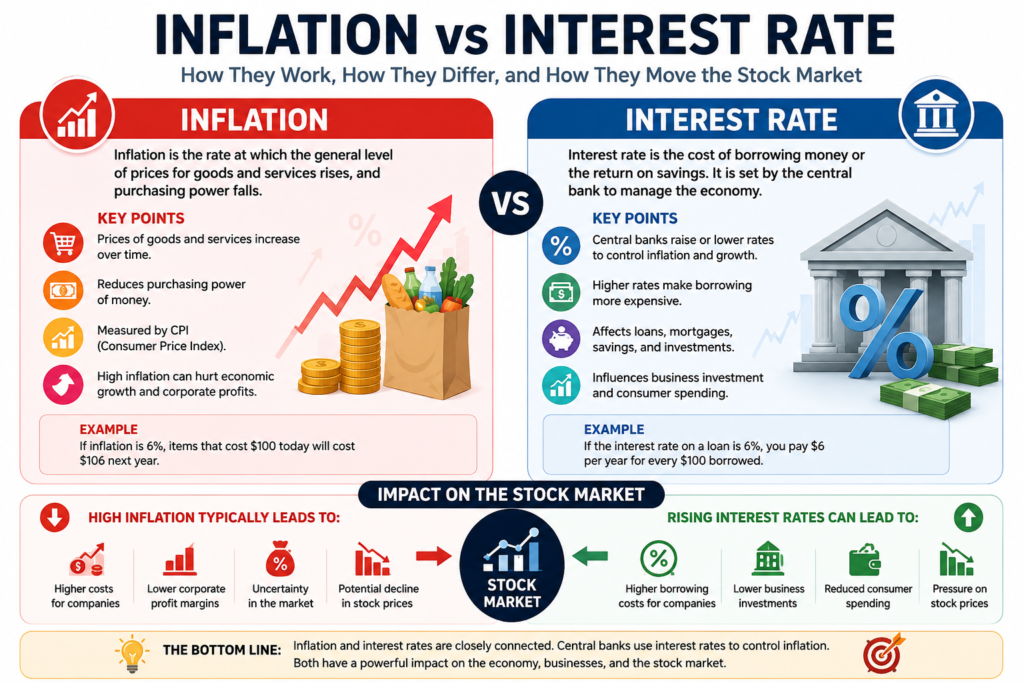
Inflation is the rate at which prices increase over time.
If a basket of goods costs:
- $100 today
- $105 next year
Inflation equals 5%.
Inflation reduces purchasing power.
Consumers can buy fewer goods with the same amount of money.
Why Inflation Matters
Inflation impacts:
- Consumer spending
- Business costs
- Interest rates
- Corporate profits
When inflation rises:
- Raw materials become more expensive
- Labor costs increase
- Transportation costs rise
Companies face pressure on profit margins.
Consumer Price Index (CPI)
The Consumer Price Index measures changes in prices paid by consumers.
It includes:
- Housing
- Food
- Energy
- Transportation
- Healthcare
- Education
Investors closely monitor CPI reports because they influence central bank decisions. The U.S. Bureau of Labor Statistics (BLS) publishes the official Consumer Price Index (CPI), providing monthly inflation data that investors use to evaluate price trends and potential interest rate changes.
Inflation Example
Suppose inflation rises from 2% to 8%.
Consumers spend more on necessities:
- Food
- Fuel
- Utilities
Less money remains for discretionary purchases.
Companies selling luxury products may experience declining sales.
Investors anticipate weaker earnings.
Stock prices often fall.
Investors looking to protect their portfolios during rising prices should also read our Inflation-Resistant Investment Strategies guide.
Central Banks and Interest Rates: The Market’s Most Powerful Force
What Are Interest Rates?
Interest rates represent the cost of borrowing money.
Central banks control benchmark interest rates.
Major central banks include:
- Federal Reserve
- European Central Bank
- Bank of England
- Bank of Japan
To learn more about monetary policy and its influence on financial markets, read our How Central Banks Control Stock Markets guide.
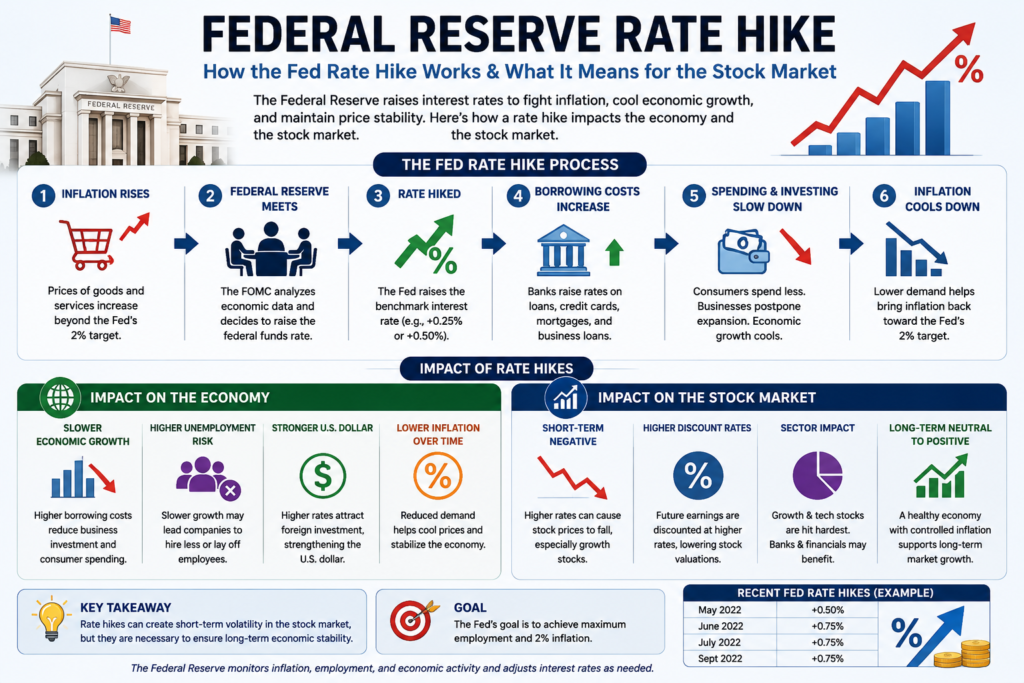
Why Rates Affect Stocks
Higher rates mean:
- More expensive mortgages
- More expensive business loans
- Reduced spending
- Lower investment activity
Economic growth slows.
Corporate earnings decline.
Stock prices often fall.
Rate Hike Example
Suppose a company borrows $1 billion.
Interest rate: 3%
Annual interest expense: $30 million
Now rates rise to 7%.
Annual interest expense: $70 million
Profit falls by $40 million.
Investors revalue the company.
Stock price declines.
For official interest rate announcements, policy statements, and economic projections, investors regularly follow updates published by the Federal Reserve.
Gross Domestic Product (GDP)
Definition
GDP stands for Gross Domestic Product.
GDP measures the total value of all goods and services produced within a country.
GDP acts as a scorecard for economic activity.
GDP Components
GDP consists of:
Consumer Spending
Household purchases. Consumer spending includes everyday expenses such as food, housing, healthcare, transportation, entertainment, and retail shopping. Since it accounts for a large share of GDP in many Tier 1 countries, strong consumer spending often signals a healthy economy and supports higher corporate earnings.
Business Investment
Corporate spending on equipment and expansion. Business investment includes spending on machinery, technology, factories, research, and new business projects. Higher investment usually reflects business confidence and contributes to long-term economic growth and job creation.
Government Spending
Public infrastructure and services. Government spending covers investments in roads, bridges, education, healthcare, defense, and public services. Increased government expenditure can stimulate economic activity, especially during periods of slow growth or recession.
Net Exports
Exports minus imports. Net exports measure the difference between a country’s exports and imports of goods and services. A positive trade balance can strengthen economic growth, while a negative balance may reduce GDP growth depending on overall economic conditions.
Economic growth moves through predictable phases. Learn more in our Market Cycles Explained: Expansion vs. Recession Guide.
GDP and Stocks
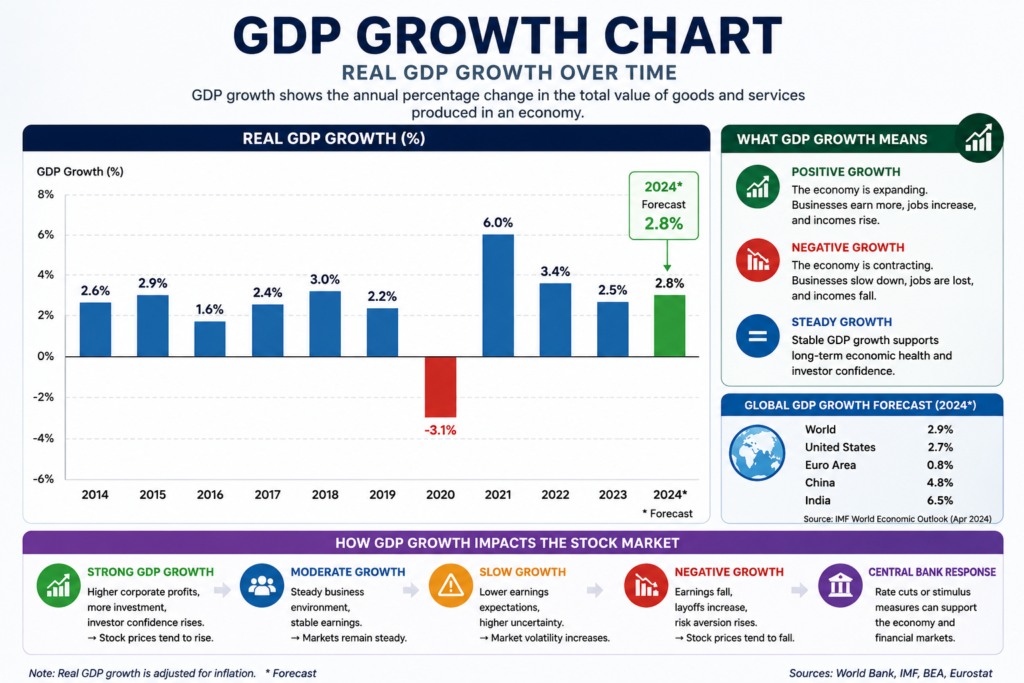
Strong GDP growth generally indicates:
- Higher employment
- Increased spending
- Better business conditions
These factors support corporate earnings growth. Investors also compare GDP trends across developed economies using research and economic outlook reports published by the Organisation for Economic Co-operation and Development (OECD).
Employment Data
Employment reports are among the most important economic releases.
Why?
Because employed people spend money.
Consumer spending drives much of economic growth.
Unemployment Rate
The unemployment rate measures the percentage of people actively seeking work but unable to find jobs.
Lower unemployment generally indicates economic strength.
Higher unemployment signals weakness.
Non-Farm Payrolls (NFP)
The U.S. Non-Farm Payroll report measures monthly job creation.
It excludes:
- Farm workers
- Military personnel
- Certain government employees
Investors watch this report closely.
Employment Example
Imagine economists expect:
200,000 new jobs
Actual result:
350,000 new jobs
The economy appears stronger than expected.
However, investors may fear inflation.
Markets sometimes decline despite strong employment.
This demonstrates how economic interpretation matters.
Consumer Confidence
Consumer confidence measures optimism about:
- Employment
- Income
- Financial conditions
Confident consumers spend more.
Spending boosts business revenue.
Higher revenue often leads to higher stock prices.
Strong consumer confidence often indicates a healthy economy, encouraging businesses to expand, hire more employees, and invest in future growth. Investors closely monitor consumer confidence reports because rising confidence can signal stronger corporate earnings and positive stock market performance.
Retail Sales
Retail sales measure consumer purchases.
This includes:
- Clothing
- Electronics
- Furniture
- Vehicles
Strong retail sales suggest healthy consumers.
Weak sales may signal slowing economic growth.
Manufacturing Data
Manufacturing remains an important economic indicator.
Factories produce:
- Cars
- Machinery
- Electronics
- Industrial equipment
Strong manufacturing activity indicates economic expansion.
Purchasing Managers Index (PMI)
PMI surveys business managers regarding:
- Production
- Employment
- Orders
- Inventories
PMI Above 50: Economic expansion.
PMI Below 50: Economic contraction.
Markets react quickly to PMI surprises.
Corporate Earnings and Economic News
Economic conditions directly affect company earnings.
Strong economy:
- More customers
- Higher sales
- Greater profits
Weak economy:
- Reduced spending
- Lower revenue
- Falling profits
Since stock prices ultimately reflect earnings expectations, economic news influences stock valuations.
The Psychology Behind Market Reactions
Markets are driven not only by economics but also by psychology.
Investor emotions often amplify economic news.
Fear
Fear emerges during:
- Recessions
- Financial crises
- High inflation
- Geopolitical uncertainty
Fear causes investors to sell aggressively.
Greed
Greed appears during:
- Bull markets
- Economic booms
- Strong earnings growth
Investors chase rising stocks.
Prices can exceed intrinsic value.
Herd Behavior
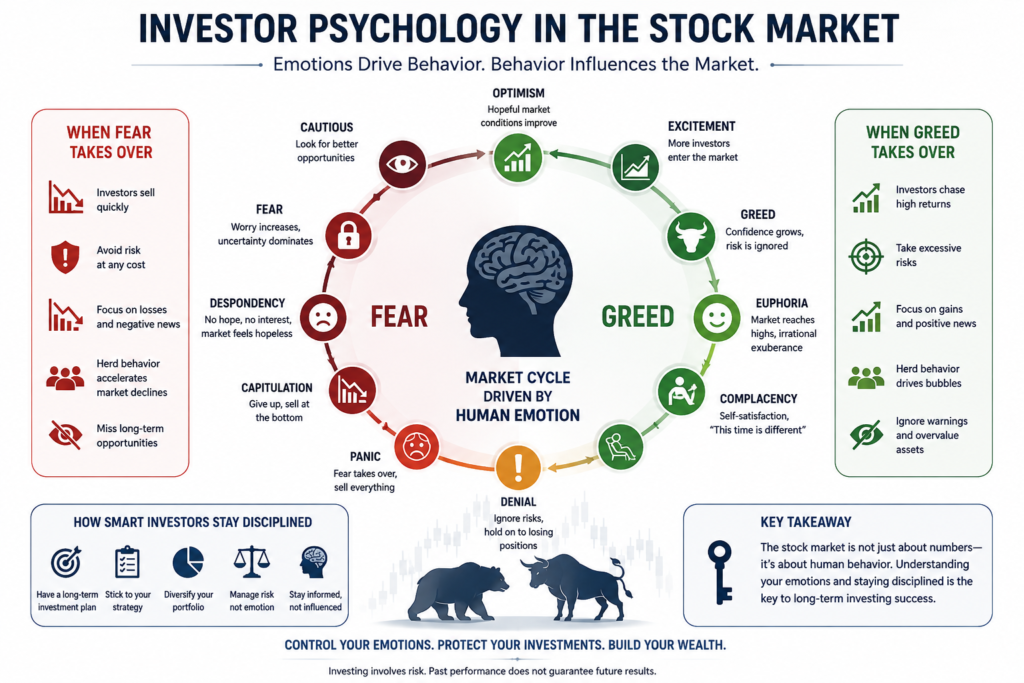
Many investors follow the crowd.
When others buy, they buy.
When others sell, they sell.
This behavior magnifies market moves.
Case Study: The Global Financial Crisis (2008)
The 2008 crisis provides a perfect example of economic news affecting markets.
Economic Signals
- Rising mortgage defaults
- Bank failures
- Credit market stress
Investors feared a global recession.
Market Reaction
Major stock indexes collapsed.
Financial stocks lost enormous value.
Consumer confidence plummeted.
Government Response
Central banks reduced interest rates.
Governments introduced stimulus programs.
Markets eventually recovered.
This case demonstrates how economic news influences investor expectations.
The International Monetary Fund (IMF) provides detailed reports on financial crises, global economic stability, and recovery policies, making it a valuable resource for understanding long-term market impacts.
Case Study: COVID-19 Market Crash (2020)
In early 2020:
Economic news included:
- Lockdowns
- Travel restrictions
- Business closures
Investors anticipated severe economic damage.
Markets crashed rapidly.
Recovery
Central banks responded with:
- Interest rate cuts
- Quantitative easing
- Emergency lending programs
Investors anticipated recovery.
Markets rebounded before the economy fully recovered.
This illustrates how markets focus on future expectations rather than present conditions.
Case Study: Inflation Shock (2022)
Following pandemic stimulus measures:
Inflation surged globally.
Investors feared aggressive central bank tightening.
Technology stocks suffered significant declines.
Growth stocks were particularly affected because future earnings became less valuable when discounted at higher interest rates.
Understanding Market Sectors
Different sectors react differently to economic news.
Technology
Technology stocks are highly sensitive to interest rates.
Examples include:
- Microsoft
- Apple
- NVIDIA
Higher rates often hurt technology valuations.
Financial Sector
Banks frequently benefit from rising rates.
Examples:
- JPMorgan Chase
- Goldman Sachs
Higher rates can increase lending profitability.
Consumer Discretionary
These companies depend heavily on consumer spending.
Examples:
- Amazon
- Nike
Economic weakness often impacts these stocks.
Utilities
Utilities are generally defensive.
Demand remains relatively stable during recessions.
They often outperform during economic uncertainty.
Bond Markets and Stock Markets
Economic news affects bonds first.
Bond investors closely monitor:
- Inflation
- Interest rates
- Growth expectations
Changes in bond yields often influence stock prices.
Rising bond yields frequently pressure equities.
The Yield Curve
The yield curve compares short-term and long-term interest rates.
A normal yield curve suggests healthy growth.
An inverted yield curve often signals recession risk.
Historically, inverted yield curves have preceded many economic downturns.
Quantitative Easing (QE)
Quantitative easing occurs when central banks purchase financial assets.
Objectives include:
- Lowering interest rates
- Increasing liquidity
- Supporting economic growth
QE generally benefits stocks by increasing available capital.
Quantitative Tightening (QT)
QT is the opposite of QE.
Central banks reduce liquidity.
Less liquidity often creates headwinds for stocks.
Currency Markets and Stocks
Economic news also affects currencies.
Strong economic data may strengthen a country’s currency.
Currency fluctuations impact multinational companies because overseas earnings must be converted back into domestic currency.
Recessions and Stock Markets
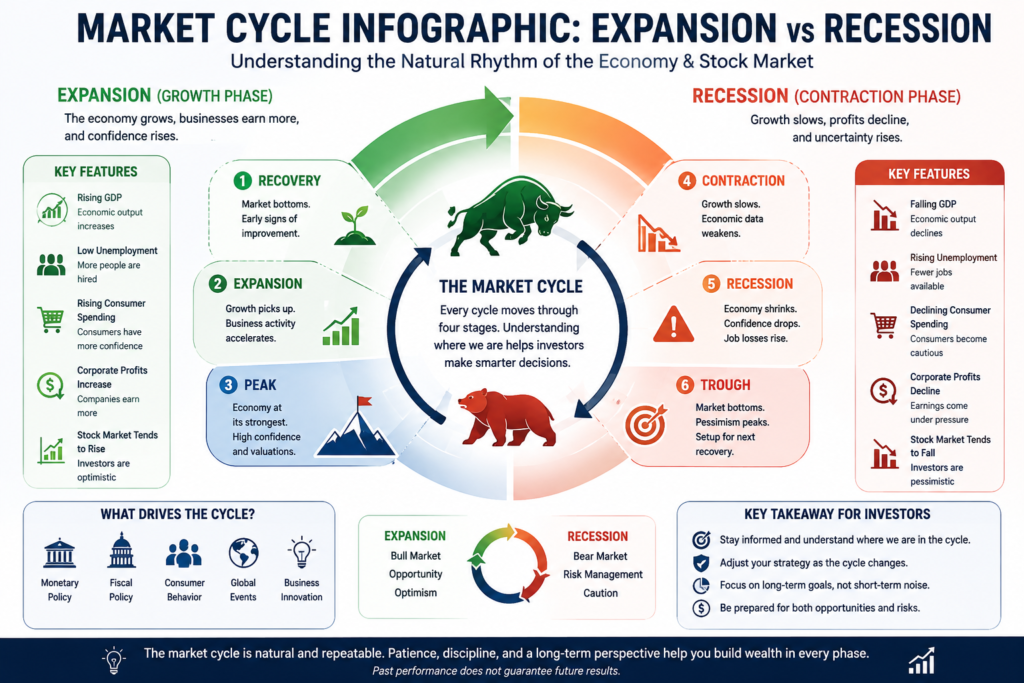
A recession is a significant decline in economic activity.
Common recession indicators:
- Rising unemployment
- Falling GDP
- Reduced spending
Stock markets often decline before recessions officially begin because investors anticipate future weakness.
Investors can also review global economic forecasts, recession analysis, and development reports from the World Bank to better understand worldwide economic trends.
Why Markets Sometimes Ignore Bad News
Sometimes markets rise despite negative economic news.
Why?
Because markets focus on future improvement.
If investors believe conditions will improve later, stocks may rise even while current data remains weak.
This phenomenon often confuses new investors.
How Professional Investors Analyze Economic News
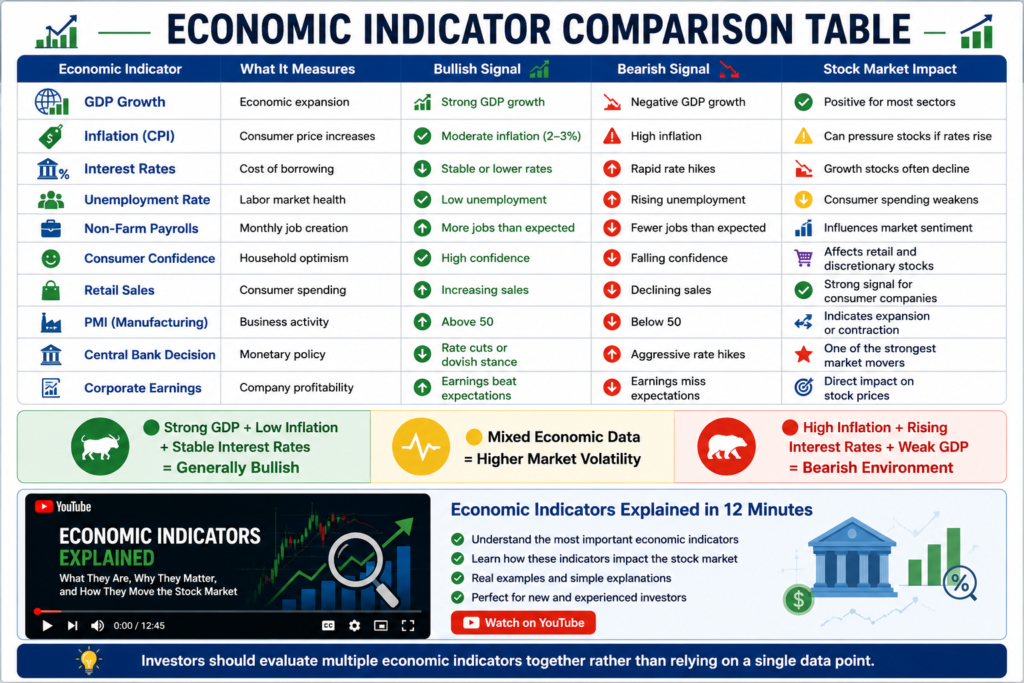
Institutional investors evaluate:
- Economic data
- Market expectations
- Central bank reactions
- Earnings impact
- Valuation changes
Rather than reacting emotionally, professionals analyze how new information changes future cash flows and risk.
Key Lessons for Investors
- Stock markets react to expectations, not just economic news.
- Inflation and interest rates are among the biggest market drivers.
- GDP, employment, and consumer spending indicate economic health.
- Strong economic news can sometimes lower stock prices if investors expect higher interest rates.
- Analyze multiple economic indicators instead of relying on a single report.
- Maintain a long-term investment strategy rather than reacting emotionally to short-term market volatility.
Continue learning with our Market Guides pillar page for comprehensive resources on economic indicators, central banks, inflation, recessions, and long-term investing strategies.
Frequently Asked Questions (FAQs)
1. How does economic news affect the stock market?
Economic news changes investor expectations about growth, inflation, interest rates, and company earnings, causing stock prices to rise or fall.
2. Which economic indicator has the biggest impact on stocks?
Interest rate decisions and inflation data are among the most influential indicators because they directly affect borrowing costs and corporate valuations.
3. Why do stock markets react before the economy changes?
Stock markets are forward-looking and price in future expectations rather than current economic conditions.
4. What is the relationship between inflation and stock prices?
Moderate inflation can support economic growth, while high inflation may reduce profits and lead to lower stock prices through higher interest rates.
5. How do interest rate hikes impact investors?
Higher interest rates increase borrowing costs, reduce consumer spending, and often put pressure on growth-oriented stocks.
6. What is GDP, and why is it important for investors?
Gross Domestic Product (GDP) measures a country’s economic output and helps investors evaluate overall economic health and growth potential.
7. Why are employment reports important for the stock market?
Employment reports show labor market strength, influencing consumer spending, business confidence, and future corporate earnings.
8. Can good economic news cause the stock market to fall?
Yes. If strong economic data increases expectations of higher interest rates, investors may sell stocks despite positive news.
9. What sectors benefit most from strong economic growth?
Technology, consumer discretionary, industrial, and financial sectors often perform well when economic activity expands.
10. How can investors prepare for major economic announcements?
Investors should diversify their portfolios, follow an economic calendar, and avoid making emotional decisions based on short-term volatility.
11. What is investor sentiment, and why does it matter?
Investor sentiment reflects overall market confidence or fear and can amplify stock price movements beyond fundamental data.
12. How can beginners use economic news to make better investment decisions?
Beginners should focus on long-term trends, understand key economic indicators, and avoid reacting to every headline or short-term market move.
Conclusion
Understanding how economic news moves the stock market helps investors make informed decisions instead of reacting emotionally to headlines. Key indicators such as inflation, interest rates, GDP growth, employment data, and central bank policies all influence investor confidence, corporate earnings, and overall market performance.
Rather than focusing on a single economic report, successful investors analyze multiple indicators together and maintain a long-term perspective. By understanding the relationship between economic news and market movements, you can better manage risk, identify investment opportunities, and build a stronger portfolio in any market environment.
Related Articles
If you found this guide helpful, continue learning with these investing resources:
- How Central Banks Control Stock Markets
- Inflation-Resistant Investment Strategies
- Market Cycles Explained: Expansion vs. Recession Guide
- How to Invest During a Market Crash
- Bear Market Investing Strategies
- Bull Market Investing Strategies
- Recession Investing Strategies
- Portfolio Diversification Guide
- ETF and Index Fund Investing Guide
- Wealth Building Through Long-Term Investing
References
- U.S. Bureau of Labor Statistics (BLS) – Consumer Price Index (CPI)
- U.S. Bureau of Economic Analysis (BEA) – Gross Domestic Product (GDP)
- Federal Reserve – Monetary Policy and Interest Rates
- International Monetary Fund (IMF) – World Economic Outlook
- World Bank – Global Economic Prospects
- Organisation for Economic Co-operation and Development (OECD) – Economic Outlook