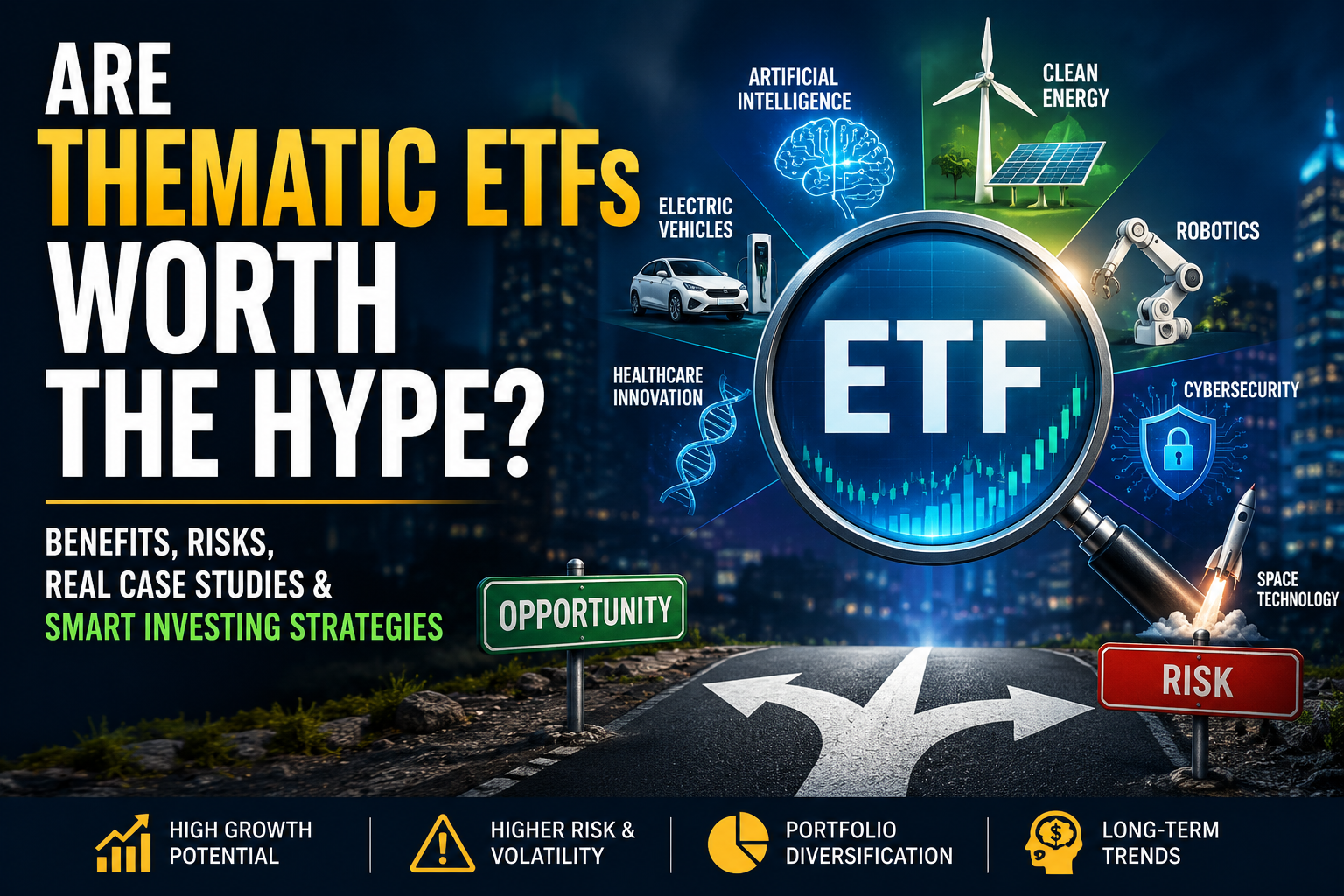
Are Thematic ETFs Worth the Hype in 2026?
Thematic ETFs have become one of the fastest-growing investment products in modern financial markets. Investors are increasingly using thematic ETFs to gain exposure to long-term trends such as artificial intelligence, robotics, cybersecurity, clean energy, electric vehicles, and space technology.
But are thematic ETFs worth the hype? While some thematic ETFs have delivered exceptional returns by capitalizing on powerful economic and technological trends, others have struggled due to high valuations, market volatility, and investor speculation.
In this complete 2026 guide, you’ll learn how thematic ETFs work, their benefits and risks, real-world case studies, performance patterns, and whether they deserve a place in your investment portfolio. In recent years, one of the biggest trends has been Thematic ETFs.
You may have seen headlines like:
- “Invest in Artificial Intelligence”
- “Own the Future of Robotics”
- “Clean Energy Is the Next Big Boom”
- “Cybersecurity Stocks Could Explode”
- “Space Exploration ETFs Are the Future”
These investment products are called Thematic ETFs.
Some investors believe thematic ETFs can generate massive long-term returns by investing early in powerful global trends. Others argue they are overhyped, risky, expensive, and often disappoint investors after the initial excitement fades.
So the big question is:
Are Thematic ETFs Really Worth the Hype?
The answer is not simple.
Some thematic ETFs have created enormous wealth. Others have collapsed after attracting billions of dollars from excited investors.
To understand whether thematic ETFs deserve a place in your portfolio, you must understand:
- What thematic ETFs are
- How they work
- Why investors love them
- Their hidden risks
- Real-world examples
- Historical case studies
- Psychological traps
- Performance patterns
- Portfolio strategies
- Who should and should not invest in them
This guide explains everything from beginner to advanced level in simple language with detailed examples and case studies.
What Is an ETF?
Before understanding thematic ETFs, we first need to understand the meaning of an ETF.
ETF stands for:
Exchange-Traded Fund
An ETF is an investment fund that trades on a stock exchange like a normal stock.
Instead of buying shares of one company, an ETF allows investors to buy many companies together in a single investment.
For example:
A U.S. stock market ETF may hold:
- Apple
- Microsoft
- Amazon
- Nvidia
- Meta
When you buy one ETF share, you indirectly own tiny portions of all these companies.
This creates:
- Diversification
- Lower risk
- Simplicity
- Lower costs
- Easy investing
ETFs have become one of the most popular investment tools in countries like:
- United States
- Canada
- United Kingdom
- Australia
because they make investing easier for ordinary people.
What Is a Thematic ETF?
A thematic ETF invests in companies connected to a specific long-term trend, idea, innovation, or economic transformation.
Instead of focusing on sectors like banking or healthcare, thematic ETFs focus on “themes.”
Examples of themes include:
- Artificial Intelligence
- Robotics
- Electric Vehicles
- Blockchain
- Cybersecurity
- Clean Energy
- Genomics
- Space Technology
- Cloud Computing
- Aging Population
- Video Gaming
- Metaverse
- Autonomous Vehicles
The idea behind thematic investing is simple:
“Invest in the future before everyone else.”
If the trend grows massively over the next decade, companies connected to that trend could experience enormous growth.
That growth may increase the value of the ETF.
Difference Between Sector ETFs and Thematic ETFs
Many beginners confuse sector ETFs with thematic ETFs.
But they are different.
| Feature | Sector ETF | Thematic ETF |
|---|---|---|
| Focus | Industry sector | Specific trend/theme |
| Example | Technology ETF | Artificial Intelligence ETF |
| Diversification | Broader | Narrower |
| Risk | Moderate | Higher |
| Investment Style | Traditional | Trend-based |
| Holdings | Large established firms | Often emerging firms |
Example:
A technology ETF may include:
- Apple
- Microsoft
- Oracle
- Cisco
An AI thematic ETF may specifically focus on:
- AI chipmakers
- Machine learning companies
- robotics firms
- data infrastructure businesses
This makes thematic ETFs more specialized.
Why Thematic ETFs Became So Popular
Thematic ETFs exploded in popularity during the 2020–2025 period.
Several major factors contributed to this growth.
1. Technology Revolution
Modern technologies are changing the global economy rapidly.
Examples include:
- Artificial Intelligence
- Electric vehicles
- Renewable energy
- Cloud computing
- Robotics
- Biotechnology
Investors wanted exposure to these future industries.
Thematic ETFs offered an easy way to participate.
2. Social Media Investing Boom
Platforms like:
- YouTube
- TikTok
- X (Twitter)
made investing trends spread rapidly.
Influencers promoted futuristic investing ideas aggressively.
Terms like:
- “Next Tesla”
- “AI Revolution”
- “Future of Humanity”
- “10X Opportunity”
created excitement.
Many retail investors entered thematic ETFs without fully understanding risks.
3. Fear of Missing Out (FOMO)
FOMO means:
Fear Of Missing Out
When investors see others making money quickly, they fear being left behind.
For example:
When electric vehicle stocks surged during 2020–2021, investors rushed into EV-themed ETFs hoping for huge profits.
This emotional investing behavior pushed thematic ETF assets to record highs.
4. Younger Investors Prefer Innovation
Younger investors often prefer exciting growth stories instead of traditional boring investments.
Many millennials and Gen Z investors like themes such as:
- AI
- Space exploration
- Renewable energy
- Gaming
- Crypto technology
Thematic ETFs match these interests.
5. Easy Access Through Brokerage Apps
Modern investing apps made ETF investing extremely easy.
Investors can buy thematic ETFs instantly using apps from companies like:
- Robinhood
- Fidelity Investments
- Charles Schwab
- Vanguard
This increased participation dramatically.
How Thematic ETFs Work
A thematic ETF manager creates rules to select companies connected to a specific trend.
For example:
Artificial Intelligence ETF
May include companies involved in:
- AI chips
- AI software
- machine learning
- cloud infrastructure
- robotics
Examples:
- Nvidia
- AMD
- Palantir
- C3.ai
Clean Energy ETF
May include:
- Solar companies
- Wind power firms
- Battery manufacturers
- Hydrogen companies
Active vs Passive Thematic ETFs
Thematic ETFs may be:
Passive ETFs
These follow an index.
The ETF automatically tracks predefined rules.
Lower fees.
Active ETFs
Professional managers actively choose stocks.
Higher fees.
Potentially higher risk.
Expense Ratios in Thematic ETFs
One important term is:
Expense Ratio
This is the annual fee charged by the ETF provider.
Example:
If an ETF has a 0.75% expense ratio:
You pay ₹750 annually for every ₹100,000 invested.
Thematic ETFs usually have:
- Higher research costs
- More active management
- Specialized portfolios
Therefore, their expense ratios are often higher than broad index ETFs.
Why Investors Love Thematic ETFs
Now let’s examine why investors become excited about thematic investing.
1. Exposure to Future Growth
The biggest attraction is growth potential.
Investors believe themes like AI or clean energy may dominate future economies.
Early investment could produce massive wealth.
Example:
Early investors in semiconductor companies benefited enormously from the AI boom.
2. High Return Potential
Some thematic ETFs outperform traditional indexes during growth cycles.
For example:
During the 2020 tech rally:
- AI
- cloud computing
- EV
- digital payments
performed exceptionally well.
This attracted even more investors.
3. Story-Driven Investing
Humans naturally connect with stories.
“The world will become electric.”
“AI will replace human jobs.”
“Cybersecurity demand will explode.”
These narratives emotionally attract investors.
Traditional index investing feels boring in comparison.
4. Portfolio Customization
Investors can align portfolios with beliefs and interests.
Example:
An investor passionate about renewable energy may invest in clean-energy ETFs.
A gamer may invest in gaming ETFs.
5. Potential for Long-Term Megatrends
Some themes are genuinely powerful.
Examples include:
- Aging population
- Digital transformation
- Artificial intelligence
- Cloud computing
These trends may continue for decades.
The Biggest Risks of Thematic ETFs
Despite excitement, thematic ETFs contain major risks many investors ignore.
Understanding these risks is critical.
1. Hype Risk
Many thematic ETFs become popular after the theme already surged.
This creates a dangerous cycle:
- Trend becomes popular
- Stocks rise sharply
- Media attention increases
- ETF launches
- Retail investors rush in
- Bubble forms
- Prices collapse
Investors often buy near the peak.
Case Study: Clean Energy ETF Boom and Crash
One famous example involved clean energy ETFs.
During 2020:
- renewable energy stocks surged
- governments promoted green energy
- investors expected explosive growth
Clean-energy ETFs attracted massive money inflows.
But many companies became overvalued.
By 2021–2022:
- interest rates increased
- growth stocks fell
- valuations collapsed
Some clean-energy ETFs lost over 50% from highs.
This showed how hype can create unsustainable valuations.
2. Concentration Risk
Many thematic ETFs hold a small number of companies.
This creates concentration risk.
If a few major holdings perform poorly, the ETF suffers heavily.
Example:
An AI ETF may depend heavily on Nvidia performance.
If Nvidia declines sharply, the ETF may struggle.
3. Lack of Profitability
Many companies inside thematic ETFs are young and unprofitable.
Some generate:
- little revenue
- negative cash flow
- uncertain business models
This increases investment risk significantly.
4. Valuation Risk
Valuation means how expensive a stock is relative to earnings or sales.
Popular thematic ETFs often trade at very high valuations.
When expectations become unrealistic, prices can collapse.
5. Theme May Fail Entirely
Not every exciting theme succeeds.
History contains many failed investment trends.
Examples:
- 3D printing hype
- cannabis investing boom
- metaverse excitement
- certain blockchain projects
A popular story does not guarantee investment success.
6. Timing Risk
The theme may eventually succeed…
…but investors can still lose money.
Why?
Because stock prices may already reflect future optimism.
Example:
A company may grow successfully over 10 years while its stock still underperforms due to excessive initial valuation.
7. Economic Sensitivity
Thematic ETFs often behave like high-growth investments.
High-growth stocks suffer when:
- interest rates rise
- inflation increases
- economic uncertainty grows
This makes thematic ETFs volatile.
Understanding Volatility
Volatility
means rapid price movement.
A highly volatile ETF may rise or fall sharply within short periods.
Example:
A thematic ETF may:
- gain 40% in one year
- lose 35% next year
This emotional roller coaster is difficult for many investors.
Case Study: ARK Innovation ETF
One of the most famous thematic investing stories involves the:
ARK Invest Innovation ETF
The fund focused on disruptive innovation themes:
- genomics
- AI
- fintech
- autonomous vehicles
During 2020:
The ETF produced spectacular returns.
Media coverage exploded.
Retail investors poured billions into the fund.
But problems emerged:
- valuations became extremely high
- many holdings were unprofitable
- rising interest rates hurt growth stocks
The ETF later experienced massive declines.
Important lesson:
Even revolutionary themes can become dangerous when valuations become excessive.
The Psychology Behind Thematic ETF Investing
Psychology plays a huge role in thematic investing.
Narrative Bias
Humans love compelling stories.
A futuristic investment story can feel emotionally convincing.
But strong narratives sometimes distract investors from fundamentals.
Recency Bias
Investors often assume recent winners will continue winning forever.
Example:
If AI stocks rise strongly for 2 years, investors may assume the trend will continue endlessly.
History shows this is often false.
Herd Mentality
People feel safer following crowds.
If millions buy a thematic ETF, new investors assume it must be good.
But crowd behavior can create bubbles.
Confirmation Bias
Investors search for information supporting their beliefs while ignoring warning signs.
Example:
An investor bullish on EVs may ignore concerns about:
- competition
- margins
- valuations
- slowing demand
Are Thematic ETFs Better Than Index Funds?
This is one of the most important questions.
Broad index funds remain the foundation of long-term investing for most investors.
Examples include:
- S&P 500 index funds
- Total market ETFs
- Global index ETFs
These offer:
- broad diversification
- lower costs
- lower risk
- stable long-term performance
Why Index Funds Often Win
Many thematic ETFs eventually underperform broad market indexes.
Reasons include:
- higher fees
- excessive hype
- concentration risk
- poor timing
- overvaluation
Broad indexes naturally include successful future companies anyway.
Example:
The S&P 500 already includes major AI companies like:
- Nvidia
- Microsoft
- Amazon
- Meta
So investors may already gain AI exposure without buying specialized thematic ETFs.
Historical Evidence
History shows broad market investing consistently outperforms many speculative strategies over long periods.
This does not mean thematic ETFs always fail.
But it shows:
Thematic investing should usually complement—not replace—core diversified investing.
Types of Popular Thematic ETFs
Let’s examine major thematic categories.
1. Artificial Intelligence ETFs
Focus areas:
- AI chips
- machine learning
- automation
- robotics
Potential advantages:
- massive future demand
- productivity revolution
- enterprise adoption
Risks:
- overvaluation
- intense competition
- regulatory uncertainty
2. Clean Energy ETFs
Focus areas:
- solar
- wind
- batteries
- hydrogen
Advantages:
- global sustainability push
- government incentives
Risks:
- policy dependency
- commodity price exposure
- cyclical demand
3. Cybersecurity ETFs
Focus areas:
- digital security
- cloud protection
- threat detection
Advantages:
- rising cyber threats
- recurring enterprise demand
Risks:
- tech valuation cycles
- competition
4. Robotics and Automation ETFs
Focus areas:
- industrial robotics
- factory automation
- AI systems
Advantages:
- labor shortages
- productivity demand
Risks:
- economic slowdown impacts
5. Blockchain and Crypto ETFs
Focus areas:
- blockchain infrastructure
- crypto-related companies
- digital asset platforms
Advantages:
- financial innovation
Risks:
- extreme volatility
- regulation uncertainty
When Thematic ETFs Make Sense
Thematic ETFs may be useful under certain conditions.
1. Small Satellite Allocation
Many professionals use thematic ETFs as:
Satellite Investments
This means:
Core portfolio = broad index funds
Small portion = thematic opportunities
Example:
| Portfolio | Allocation |
|---|---|
| S&P 500 ETF | 60% |
| International ETF | 20% |
| Bond ETF | 10% |
| AI Thematic ETF | 5% |
| Cybersecurity ETF | 5% |
This limits damage if the theme underperforms.
2. Long-Term Time Horizon
Thematic investing requires patience.
Some themes take years or decades to mature.
Short-term speculation is extremely risky.
3. High Risk Tolerance
Investors must emotionally handle volatility.
If a 40% decline causes panic selling, thematic ETFs may not be suitable.
4. Strong Research Understanding
Investors should understand:
- industry dynamics
- valuations
- business models
- competition
- economic sensitivity
Blindly following hype is dangerous.
When Thematic ETFs Are Dangerous
1. Chasing Performance
Buying after huge rallies is risky.
History shows investors often buy high and sell low.
2. Over-Concentration
Putting most savings into one theme is dangerous.
Example:
Investing entire retirement savings into AI ETFs creates huge concentration risk.
3. Emotional Investing
Many investors panic during volatility.
This leads to:
- buying high
- selling low
- permanent losses
4. Ignoring Valuations
Even amazing companies can become terrible investments if bought at unrealistic prices.
Case Study: Dot-Com Bubble
The late 1990s internet boom offers a major lesson.
Investors believed the internet would transform the world.
They were correct.
But many internet stocks became massively overvalued.
When the bubble burst:
- numerous companies collapsed
- investors lost fortunes
Important lesson:
A powerful theme does not guarantee good investment returns.
Timing and valuation matter enormously.
Thematic ETF Performance Cycles
Thematic ETFs often follow predictable cycles.
Stage 1: Innovation Emerges
New technology or trend appears.
Very few investors pay attention.
Stage 2: Early Adoption
Growth accelerates.
Institutional investors begin investing.
Stage 3: Media Excitement
Financial media promotes the trend heavily.
Retail investors enter rapidly.
Stage 4: Speculative Mania
Prices disconnect from reality.
Valuations become extreme.
Stage 5: Collapse
Reality fails to meet expectations.
Prices fall sharply.
Stage 6: Survivors Emerge
Strong companies survive.
Weak firms disappear.
Long-term winners eventually dominate.
Smart Strategies for Investing in Thematic ETFs
If investors decide to use thematic ETFs, certain strategies may reduce risk.
1. Limit Portfolio Exposure
Most professionals recommend small allocations.
Usually:
- 5%
- 10%
- maximum 15%
depending on risk tolerance.
2. Focus on Durable Themes
Better themes usually involve:
- long-term economic shifts
- real demand
- strong business adoption
Examples:
- AI
- cybersecurity
- cloud infrastructure
Less durable themes often rely mainly on hype.
3. Avoid FOMO Investing
Do not buy simply because prices recently surged.
4. Study ETF Holdings
Some thematic ETFs are poorly constructed.
Always examine:
- top holdings
- diversification
- expense ratio
- methodology
5. Rebalance Regularly
If a thematic ETF grows too large, rebalance.
Example:
If AI allocation rises from 5% to 15%, consider trimming exposure.
6. Understand Macroeconomic Conditions
Growth-oriented themes depend heavily on:
- interest rates
- liquidity
- economic growth
This affects performance significantly.
Active vs Passive Debate in Thematic ETFs
An important debate exists between:
- active management
- passive management
Active Thematic ETFs
Managers select stocks based on research.
Potential advantages:
- flexibility
- tactical decisions
- early opportunities
Risks:
- higher fees
- manager mistakes
- inconsistent performance
Passive Thematic ETFs
Track predefined indexes.
Advantages:
- lower fees
- transparency
- simplicity
Risks:
- rigid methodology
- slower adaptation
The Role of Innovation in Investing
One important truth:
Innovation does create enormous wealth.
Companies like:
- Apple
- Amazon
- Nvidia
- Tesla
changed industries dramatically.
Investors who identified these trends early earned exceptional returns.
But another truth also matters:
Not all innovation investments succeed.
Many early competitors disappear.
This makes thematic investing difficult.
Should Beginners Buy Thematic ETFs?
For most beginners:
Broad diversified index investing is usually the better starting point.
Why?
Because beginners often:
- underestimate volatility
- chase hype
- panic during declines
- overconcentrate portfolios
Thematic ETFs are generally better suited as supplementary investments.
Thematic ETFs vs Individual Stocks
Some investors prefer thematic ETFs over individual stocks because ETFs provide diversification within the theme.
Example:
Instead of buying only one AI stock, investors own multiple companies.
This reduces company-specific risk.
However:
theme-specific risk still remains.
How Institutions Use Thematic Investing
Large institutional investors sometimes use thematic investing strategically.
Examples:
- pension funds
- hedge funds
- wealth managers
They may invest in long-term themes to capture structural economic shifts.
But institutions usually:
- diversify widely
- control risk carefully
- avoid emotional investing
Retail investors often lack this discipline.
Future of Thematic ETFs
Thematic ETFs will likely continue growing.
Why?
Because global innovation continues accelerating.
Future themes may include:
- quantum computing
- biotechnology
- AI infrastructure
- climate adaptation
- advanced robotics
- space economy
However, competition among ETF providers may also increase.
Some funds will succeed.
Others may disappear.
Key Questions Before Buying a Thematic ETF
Before investing, ask:
- Is this theme truly durable?
- Are valuations reasonable?
- Is the ETF diversified?
- What are the expense ratios?
- How volatile is the ETF?
- Can I tolerate major declines?
- Am I investing based on research or hype?
- Does this fit my long-term plan?
These questions can prevent costly mistakes.
Final Verdict: Are Thematic ETFs Worth the Hype?
The answer depends on how investors use them.
Thematic ETFs can be powerful tools when used carefully.
They offer:
- exposure to innovation
- future growth opportunities
- portfolio customization
- potential high returns
But they also carry significant risks:
- hype cycles
- volatility
- concentration
- overvaluation
- speculative behavior
For most investors:
Thematic ETFs should complement a diversified core portfolio—not replace it.
The smartest approach is usually:
- Build a strong foundation using broad index funds
- Add small thematic exposure selectively
- Stay diversified
- Avoid emotional investing
- Focus on long-term investing discipline
Thematic investing works best when investors balance excitement with realism.
Because in investing:
The future may be exciting…
…but hype alone does not create wealth.