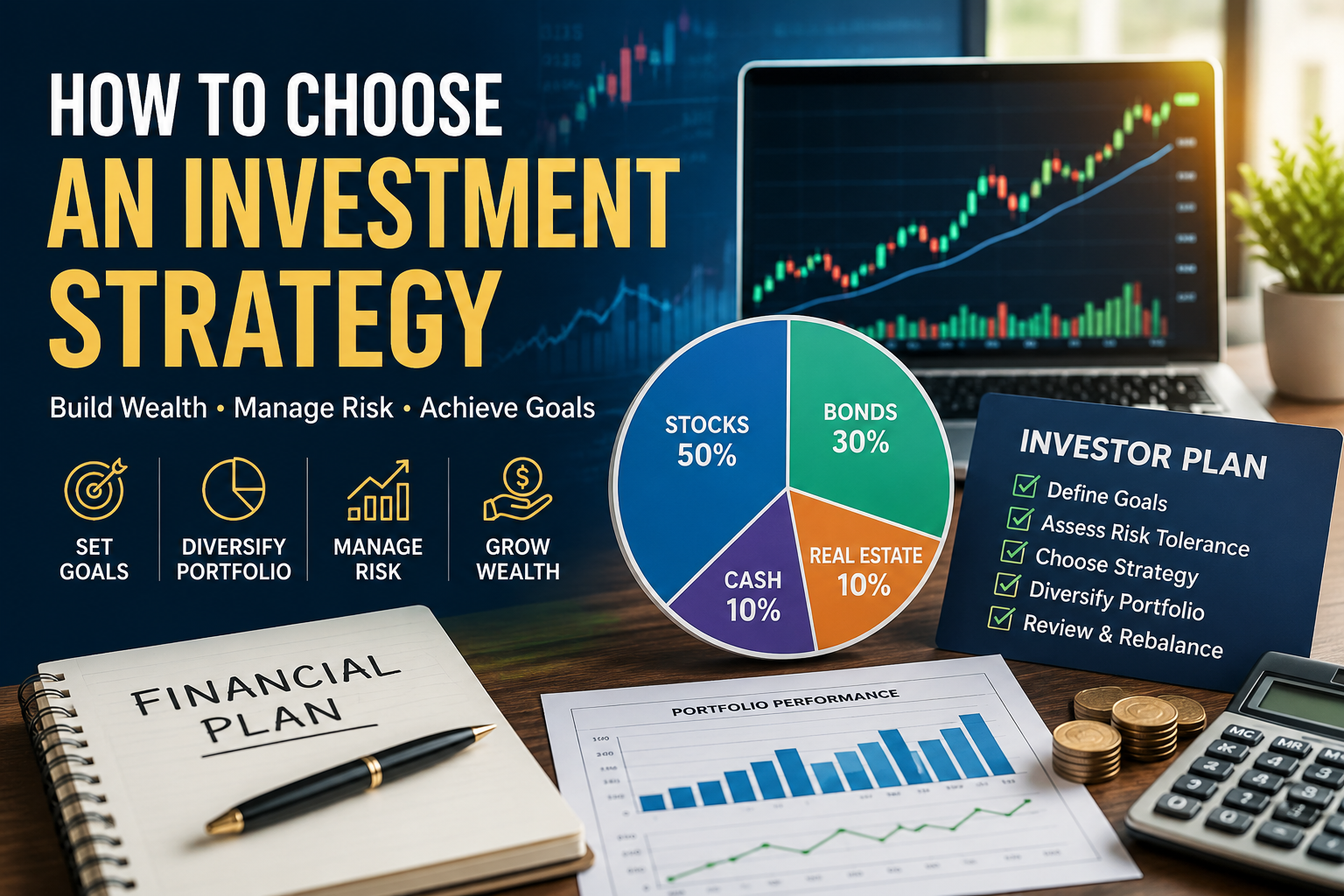
Introduction: How to Choose an Investment Strategy
How to choose an investment strategy is one of the most important financial decisions you can make when building long-term wealth. Whether you live in the United States, the United Kingdom, Canada, or Australia, the right approach can help you prepare for retirement, save for a home, generate investment income, and protect your purchasing power against inflation.
However, no single investment strategy works for everyone. A strategy suitable for a 25-year-old professional with a stable income may be inappropriate for someone approaching retirement or saving for a house deposit within three years.
The key is to understand your financial goals, risk tolerance, investment time horizon, tax situation, and ability to remain disciplined during market volatility. If you are new to investing, start with our guide to start investing before choosing investments for your portfolio.
This guide explains how to choose an investment strategy, compares popular investing approaches, and examines real-world investor case studies, practical calculations, and common mistakes.
This article is for educational purposes only and does not provide individualized financial advice.
What Is an Investment Strategy?
An investment strategy is a structured plan that determines how you invest your money to achieve specific financial objectives.
It establishes which assets you buy, how much risk you accept, how long you invest, how you manage costs, and when you review your portfolio.
For example, an investor saving for retirement in 25 years might choose diversified stock and bond funds. Someone saving for a house deposit in two years might prioritize accessible savings and lower-volatility investments.
A good strategy connects your financial goals with appropriate investments instead of relying on market predictions or short-term trends.
Why Choosing the Right Strategy Matters
Without a plan, investors may chase popular stocks, panic during market declines, trade too frequently, or invest money they need for immediate expenses.
A clear strategy can help you:
- Set realistic financial targets.
- Match investment risk to your time horizon.
- Diversify across investments and markets.
- Control fees and unnecessary trading.
- Make decisions consistently during uncertain markets.
The objective is not to find an investment that always rises. It is to develop a sustainable approach that gives you a reasonable chance of reaching your goals without taking risks you cannot afford.
Step 1: Define Your Financial Goals
Before comparing investment products, identify what your money needs to accomplish.
A financial goal should include a target amount, a deadline, and a clear purpose.
For example, saving $50,000 for a house deposit in five years is more useful than simply saying you want to become wealthy. The specific target helps determine how much you must save and how much investment risk may be appropriate.
Common Financial Goals
Retirement
Retirement investing involves building assets that can support living expenses after employment income decreases or stops.
Investors may use employer-sponsored retirement plans, individual retirement accounts, or pension arrangements, depending on their country.
- United States: 401(k), Roth IRA, and Traditional IRA.
- United Kingdom: Stocks and Shares ISA, and Self-Invested Personal Pension (SIPP).
- Canada: Tax-Free Savings Account (TFSA) and Registered Retirement Savings Plan (RRSP).
- Australia: Superannuation accounts.
Australian investors can use ASIC Moneysmart for independent educational information about investing, managing financial risk, and planning for retirement. Australians considering superannuation or other retirement options should check the rules and features that apply to their circumstances.
These accounts have different contribution rules, tax treatments, and withdrawal conditions. Check current local rules before choosing an account.
Buying a House
Money needed within a few years generally should not depend heavily on stock market performance.
For example, a couple saving for a home deposit in three years could consider insured or appropriately protected bank deposits, high-interest savings accounts, or short-term government securities, subject to local rules and product risks.
The priority is having the money available when the purchase occurs, rather than pursuing the highest possible return.
Wealth Creation and Passive Income
Long-term wealth creation may involve diversified equity funds, bonds, property investments, or a combination of assets.
Passive income means receiving cash flows without directly exchanging time for each payment. Examples include interest, dividends, and rental income. However, these sources are not guaranteed, and property ownership or dividend investing can involve substantial costs and risks.
Step 2: Understand Risk Tolerance
Risk tolerance is your willingness and ability to accept investment losses in pursuit of potential returns.
These are two different considerations. You may feel comfortable with risk emotionally but lack the financial capacity to withstand a large loss because you have debts, dependents, or an upcoming expense.
Before selecting an investment strategy, consider both.
Conservative Investor
A conservative investor prioritizes capital preservation and lower volatility.
Potential holdings include cash deposits, short-term government securities, high-quality bonds, and a smaller allocation to diversified equities.
The advantage is that lower-volatility assets may help reduce fluctuations in portfolio value. The disadvantage is that returns may not keep pace with inflation over long periods.
Even conservative investments carry risks, including inflation, interest-rate risk, credit risk, and the possibility of losing purchasing power.
Aggressive Investor
An aggressive investor accepts substantial price fluctuations in pursuit of higher long-term growth.
The portfolio might emphasize equities, including diversified domestic and international stock funds. Some investors also hold small allocations to individual growth stocks or other speculative assets.
Higher potential returns do not mean guaranteed superior performance. A concentrated portfolio can suffer severe losses, and recovery may take years.
Case Study: Matching Risk to Financial Needs
Consider two hypothetical investors.
Linda is 67 and expects to withdraw money from her portfolio to support retirement expenses. James is 28, has stable employment, maintains an emergency fund, and is investing for retirement several decades away.
Linda may prioritize reliable liquidity and a diversified mix of income-producing and growth assets. James may be able to tolerate a larger allocation to equities because he has more time to recover from downturns.
Neither age nor personality determines the correct allocation by itself. Income stability, other assets, health, liabilities, and individual goals also matter.
For a useful introduction, consult the U.S. government’s Investor.gov guide to asset allocation and diversification.
Step 3: Determine Your Investment Time Horizon
Your investment time horizon is the period between investing money and needing to use it.
This is one of the most important factors when deciding how to choose an investment strategy. To compare approaches for different holding periods, read our guide to long-term vs short-term investing.
Short-Term Horizon
A short-term goal generally falls within the next three years.
Examples include paying university fees, purchasing a vehicle, or funding a planned home purchase.
Capital preservation and liquidity usually matter more than aggressive growth. Cash savings and short-duration instruments may be appropriate, depending on their terms, protections, and risks.
Medium-Term Horizon
A medium-term goal may be three to ten years away.
A balanced approach may be suitable for some investors, but the appropriate mix depends on the exact deadline and the consequences of a market decline.
For instance, someone planning to use their entire portfolio for a home purchase in four years should not automatically assume that a stock-heavy ETF portfolio is appropriate.
Long-Term Horizon
Long-term goals generally extend beyond ten years, such as retirement or financial independence.
Diversified equity funds may play a significant role because they offer exposure to business growth over time. Bonds and cash can help manage volatility and future spending requirements.
Long-term investing does not eliminate losses. It simply provides more time for a portfolio to potentially recover from market downturns.
Compound Growth
Compounding occurs when investment earnings remain invested and potentially generate additional earnings.
For example, $10,000 growing at an assumed annual return of 6% would become approximately $17,908 after ten years, before taxes, fees, and inflation, if returns were compounded annually and remained constant.
Actual market returns fluctuate, and investments can lose value. The example illustrates the mathematics of compounding rather than predicting future performance.
Step 4: Learn the Main Types of Investment Strategies
Different investing strategies emphasize different sources of potential return, levels of involvement, and risks. If you are considering a diversified, rules-based approach, learn more about ETFs and index funds.
1. Buy-and-Hold Strategy
Buy-and-hold investing involves purchasing investments and retaining them for an extended period, provided they continue to fit your financial plan.
Investors may use diversified index funds, individual stocks, or a combination of assets.
Advantages: Less frequent trading, potentially lower transaction costs, and less temptation to react to daily market news.
Risks: Holding an unsuitable or deteriorating investment indefinitely can be harmful. Buy-and-hold should not mean ignoring portfolio quality or changing financial needs.
2. Value Investing
Value investing involves estimating a company’s underlying economic worth and comparing that estimate with its market price.
Important terms include:
- Intrinsic value: An estimate of what a business is worth based on its expected future economic benefits.
- Margin of safety: The difference between estimated intrinsic value and purchase price, intended to provide a buffer against estimation errors.
- P/E ratio: Share price divided by earnings per share.
- Free cash flow: Cash generated after operating expenses and capital expenditure, subject to the definition used.
Suppose a stock trades at $50 per share and an investor estimates its intrinsic value at $65. The apparent discount is $15 per share, or about 23% of the estimated value.
However, intrinsic value is an estimate, not an observable fact. If the company’s future earnings disappoint, its actual worth may be much lower than expected.
3. Growth Investing
Growth investing focuses on businesses expected to increase revenue, earnings, or cash flow significantly.
Potential areas include cloud computing, healthcare innovation, artificial intelligence, and digital infrastructure.
A growing business is not automatically a good investment. If investors pay an excessively high price, future returns can disappoint even when the company performs well operationally.
Examine valuation, competition, profitability, debt, and the sustainability of growth before investing.
4. Dividend Investing
Dividend investing focuses on companies or funds that distribute part of their income to shareholders.
Dividend yield measures annual dividends per share relative to the current share price.
For example, a stock priced at $100 that pays $3 annually has a dividend yield of 3%.
Dividends can provide income or be reinvested to purchase additional shares. However, companies can reduce or suspend payments, and a high yield may reflect a falling share price or deteriorating business conditions.
Total return includes both changes in investment value and income received.
5. Index Investing
Index investing involves purchasing a fund designed to track a market index, such as the S&P 500 or a broad global equity benchmark.
An exchange-traded fund (ETF) is a fund whose shares trade on an exchange. Some ETFs track indexes, while others follow active or specialized strategies.
Index investing can offer broad diversification, transparent rules, and relatively low costs. However, an index fund can still decline sharply when the underlying market falls. A narrowly focused index may not provide adequate diversification.
Real-World Evidence: Active Versus Passive Investing
S&P Dow Jones Indices’ SPIVA U.S. Year-End 2025 report found that 79% of active U.S. large-cap equity funds underperformed the S&P 500 during 2025. Its longer-term comparisons also showed substantial underperformance among active funds. These findings illustrate the difficulty of outperforming a benchmark consistently; they do not prove that every active manager will underperform or that an index will always perform better.
Read the SPIVA U.S. Year-End 2025 report for the methodology and full results.
6. Income Investing
Income investing emphasizes cash flows from assets such as bonds, dividend-paying shares, and real estate investment trusts (REITs).
A REIT is a company or trust that owns or finances income-producing real estate, subject to the rules of its jurisdiction.
Income investing may suit people who need portfolio cash flow, but income should not be confused with safety. Bond prices can fall, borrowers can default, dividends can be cut, and property income can fluctuate.
7. Dollar-Cost Averaging
Dollar-cost averaging means investing a fixed amount at regular intervals regardless of short-term price movements.
For example, investing $300 each month into a diversified fund creates a repeatable saving habit.
When prices are lower, the same contribution purchases more units. When prices are higher, it purchases fewer units.
This method can reduce the pressure to choose a perfect entry point, but it does not guarantee profits or prevent losses. If you already have a lump sum available, delaying investment may also reduce expected returns in markets that rise over time. The appropriate choice depends on your financial circumstances and tolerance for losses.
See Vanguard’s discussion of lump-sum investing and dollar-cost averaging.
Step 5: Understand Asset Allocation
Asset allocation is the distribution of a portfolio across categories such as stocks, bonds, cash, and real estate. For a practical discussion of how allocation may change with age and financial goals, read our guide to portfolio allocation by age.
A hypothetical balanced portfolio might allocate 60% to diversified equities, 30% to bonds, and 10% to cash. This is an illustration, not a recommended allocation for every investor.
Your allocation should reflect the goal’s time horizon, your financial capacity for losses, and the level of volatility you can tolerate.
Why Diversification Matters
Diversification means spreading investments across different securities, industries, countries, or asset classes.
Suppose an investor places their entire portfolio in one technology stock. A company-specific problem could cause a severe loss.
A diversified portfolio holding domestic and international shares, bonds, and cash reduces dependence on a single company or market segment.
However, diversification cannot eliminate market risk. Investments can fall together during periods of financial stress, and owning several funds with similar holdings may create the illusion of diversification.
Step 6: Consider Tax Efficiency
Tax efficiency means structuring investments and accounts in a way that complies with applicable tax rules while avoiding unnecessary tax costs.
The rules vary significantly by country.
- United States: Employer-sponsored 401(k) plans and individual retirement accounts may offer tax advantages subject to eligibility and withdrawal rules.
- United Kingdom: ISAs and pensions have different tax treatments and contribution conditions.
- Canada: TFSAs and RRSPs have distinct contribution, withdrawal, and tax rules.
- Australia: Superannuation has specific contribution, preservation, and withdrawal requirements.
Capital gains, dividends, interest, foreign withholding taxes, and fund distributions may be taxed differently.
UK investors should check the regulatory status of financial firms and review relevant consumer warnings before using an investment service. The Financial Conduct Authority’s consumer guidance provides information to help consumers make informed financial decisions and identify potential risks.
Do not assume that holding an investment longer always reduces tax. For example, the United States distinguishes certain short-term and long-term capital gains, while other jurisdictions apply different systems.
Review official tax guidance for your country or consult a qualified tax professional.
Step 7: Understand Market Conditions
Economic conditions influence investment performance, but predicting them consistently is difficult.
Bull Market
A bull market describes a sustained period of rising asset prices. Investors may become more optimistic, and some growth-oriented investments may perform strongly.
The risk is assuming that recent gains will continue indefinitely.
Bear Market
A bear market generally refers to a decline of at least 20% from a recent market peak in a widely followed market index, although definitions can vary.
Investors may experience fear and pressure to sell. A diversified portfolio and a written plan can help prevent emotional decisions.
Recession
A recession is a significant decline in economic activity. It can affect employment, company profits, borrowing costs, and consumer spending.
Different industries respond differently, and no asset allocation guarantees protection during a recession.
Inflation
Inflation is a sustained increase in the general price level, which reduces the purchasing power of money.
If a portfolio earns 4% in a year while inflation is 3%, its approximate real return before taxes and fees is around 1%.
Investors should consider whether their long-term strategy has a reasonable chance of meeting future spending needs after inflation.
Step 8: Match Strategy With Personality
Your ability to follow a strategy matters as much as the strategy’s theoretical merits.
Some investors feel comfortable holding stocks through a 20% decline. Others may sell under similar circumstances, even when their original goals have not changed.
A strategy that causes you to abandon your plan during every market downturn may be too aggressive for your circumstances. To better understand the trade-off between potential gains and possible losses, explore our guide to risk vs reward in investing.
Case Study: Emotional Versus Disciplined Investing
Consider two hypothetical investors who each start with $10,000.
During a market decline, Tom becomes frightened and sells his investments. Sophia follows a previously established plan and continues her scheduled contributions because her emergency savings, income, and long-term goal remain intact.
If the market subsequently recovers, Tom may miss part of the rebound, while Sophia may benefit from buying additional units at lower prices.
However, a recovery is not guaranteed, and continued investing is appropriate only when the underlying investments remain suitable and the money is not needed for essential expenses.
The lesson is not to ignore risk. It is to establish rules before emotions take control.
Step 9: Choose Active or Passive Investing
Passive Investing
Passive investing aims to track a market index or follow a systematic investment approach rather than consistently predict short-term market movements.
Potential benefits include lower fees, less frequent trading, and straightforward portfolio management.
A passive fund still requires evaluation of its holdings, costs, tracking difference, liquidity, and suitability.
Active Investing
Active investing attempts to outperform a benchmark through security selection, market timing, or other decisions.
It requires research, time, discipline, and an understanding of valuation and risk. Fees and trading costs can reduce returns.
Neither method guarantees success. Compare an active strategy with an appropriate benchmark after fees and taxes rather than judging it solely by its headline return.
Step 10: Rebalance Your Portfolio
Rebalancing means bringing a portfolio back toward its intended asset allocation after market movements cause its proportions to change.
Suppose a $10,000 portfolio initially contains 70% stocks and 30% bonds.
After market movements, the portfolio contains $8,500 in stocks and $1,500 in bonds, totaling $10,000. Its new allocation is 85% stocks and 15% bonds.
If the investor still wants a 70/30 allocation, they could sell some stocks and purchase bonds, or direct new contributions toward bonds.
Rebalancing helps maintain the chosen risk level. It does not guarantee higher returns, and selling assets may trigger taxes or transaction costs.
Investors often review allocations annually or when they move beyond predetermined percentage bands. The best approach depends on account rules, fees, and personal circumstances.
Real-World Investment Case Studies
Warren Buffett and Long-Term Value Investing
Warren Buffett’s investing career demonstrates the importance of evaluating business economics, management, valuation, and long-term capital allocation.
His approach through Berkshire Hathaway has involved owning businesses and shares in companies with characteristics he considers attractive, rather than relying solely on short-term market forecasts.
Buffett has also repeatedly emphasized the benefits of low-cost index funds for many ordinary investors who lack the time or expertise to evaluate individual businesses.
Practical lesson: You do not need to copy Buffett’s individual stock selections. Instead, consider the principles of patience, understanding what you own, managing costs, and avoiding investments you cannot evaluate.
Historical success does not guarantee that the same approach will produce similar future results.
John Bogle and Low-Cost Index Investing
John Bogle, founder of Vanguard, helped popularize low-cost index fund investing.
His work emphasized that investment costs matter because fees reduce the amount of return that remains for investors. Broad-market index funds also allow investors to participate in market returns without having to identify every winning company.
Practical lesson: Before choosing between two similar funds, compare expense ratios, tracking performance, diversification, taxes, and trading costs. A lower fee is valuable, although it does not make an unsuitable fund appropriate.
A Practical Retirement Investing Example
Consider Maya, age 35, who wants to retire at 65. She has a stable income, maintains emergency savings, and contributes $400 per month to a diversified investment portfolio.
If her investments earned a hypothetical 6% annual return compounded monthly, with contributions made at the end of each month, she would accumulate approximately $402,000 after 30 years, excluding starting capital, taxes, fees, and inflation.
The outcome would differ if actual returns were higher or lower, contributions changed, or withdrawals occurred.
Practical lesson: Regular saving can make a substantial contribution to long-term wealth, but a projection is not a guarantee. Maya should review whether her contribution level, portfolio risk, and retirement target remain realistic over time.
Common Investment Mistakes
- Chasing hot stocks: Recent gains do not guarantee future performance.
- Ignoring diversification: Concentrated holdings expose you to company-specific risks.
- Panic selling: Emotional decisions can undermine long-term plans.
- Ignoring fees: Small annual charges can compound into meaningful costs.
- Trying to time the market: Repeatedly predicting short-term price movements is difficult.
- Investing emergency money: Essential savings should remain accessible when needed.
- Confusing yield with safety: A high dividend or interest rate can reflect elevated risk.
- Following someone else’s portfolio blindly: Another investor may have different goals, tax circumstances, and loss capacity.
Because ongoing fund fees can reduce the amount you accumulate over time, learn how expense ratios impact long-term returns.
Example Investment Strategies by Age
Age can help frame investment decisions, but it should never be the only factor.
| Life stage | Potential priority |
|---|---|
| 20s | Building savings habits and long-term growth |
| 30s | Balancing retirement, housing, and family goals |
| 40s | Reviewing progress and managing competing expenses |
| 50s | Assessing retirement readiness and future withdrawals |
| 60+ | Planning income, liquidity, and portfolio longevity |
A 60-year-old with a secure pension and substantial assets may tolerate more equity risk than a 35-year-old who needs their portfolio for a home purchase in two years.
Choose based on your circumstances rather than an age-based rule alone.
Modern Trends Influencing Investment Strategies
Artificial Intelligence Investing
AI-related businesses have attracted interest because of potential applications in software, semiconductors, healthcare, and productivity.
However, strong demand for a technology does not automatically make every company in that industry a good investment. Valuation, competition, capital expenditure, regulation, and profitability remain important.
ESG Investing
Environmental, social, and governance (ESG) investing considers factors such as environmental impact, employee practices, and corporate oversight.
ESG funds vary considerably in their screening methods and holdings. Investors should examine the methodology, costs, diversification, and whether the fund aligns with their objectives.
Robo-Advisors
Robo-advisors use automated processes to help users construct and manage portfolios, often using diversified funds.
They may simplify investing and rebalancing, but services differ in fees, investment choices, tax features, and access to human advice. Check the provider’s regulatory status and terms before committing money.
How to Choose an Investment Strategy: A Practical Checklist
Before investing, ask yourself:
- What is the exact financial goal?
- When will I need the money?
- Do I have emergency savings and manageable debt?
- How much loss could I afford financially?
- How much volatility could I tolerate emotionally?
- Is the portfolio diversified across appropriate assets?
- Have I compared fees, taxes, and account restrictions?
- Do I understand the investments I am buying?
- When will I review and rebalance the portfolio?
- Can I continue following this plan during a market decline?
If you cannot answer these questions, spend time improving your financial plan before increasing investment risk.
Frequently Asked Questions
1. What is the best investment strategy for beginners?
A simple, diversified approach using low-cost funds may suit many beginners with long-term goals. Start by understanding your financial needs, emergency savings, investment horizon, and risk tolerance. No strategy guarantees profits.
2. How much money do I need to start investing?
The minimum depends on the account, brokerage, and investment product. Some platforms allow small recurring contributions or fractional shares. Before investing, account for essential expenses, expensive debt, and emergency savings.
3. Is long-term investing safer than short-term trading?
Long-term investing can reduce reliance on short-term market timing, but it does not eliminate the risk of losing money. Diversification, reasonable costs, and a suitable allocation are also important.
4. Should I invest in individual stocks or index funds?
Individual stocks allow company-specific investment decisions but carry concentration risk and require research. Broad index funds offer exposure to many securities, although their diversification depends on the index tracked.
5. What is the difference between asset allocation and diversification?
Asset allocation determines how much of a portfolio is held in asset classes such as stocks, bonds, and cash. Diversification spreads investments within and across those categories to reduce dependence on individual holdings.
6. How often should I review my investment strategy?
Review it periodically, such as annually, and when major financial circumstances change. You do not need to change investments every time markets move. Rebalance according to a predetermined policy rather than short-term predictions.
7. Can I change my investment strategy later?
Yes. Your goals, income, time horizon, and responsibilities may change. Adjustments should reflect those changes rather than simply chasing whichever asset performed best recently.
8. Is dividend investing better than growth investing?
Neither is universally better. Dividend investing emphasizes distributions, while growth investing emphasizes potential increases in business value. Compare total return, valuation, risk, diversification, and your need for current income.
9. How do investment fees affect long-term wealth?
Fees reduce the return retained by investors. Because costs recur, even modest differences can accumulate over time. Compare expense ratios alongside other charges and investment quality.
10. How can I protect my investments during a market crash?
You cannot eliminate market risk. Maintaining appropriate diversification, avoiding excessive leverage, keeping emergency savings, and investing according to a realistic time horizon may help. Do not assume every market decline will recover quickly.
Final Thoughts
Learning how to choose an investment strategy starts with understanding what your money needs to accomplish and how much risk you can reasonably accept.
A useful strategy combines clear goals, an appropriate time horizon, diversification, cost awareness, tax planning, and consistent review. It should be practical enough to follow through changing economic conditions rather than dependent on perfect market predictions.
For many long-term investors, diversified low-cost funds and regular contributions provide a straightforward starting point. Others may need a different mix because of retirement income requirements, shorter deadlines, tax circumstances, or specialized financial goals.
The most effective strategy is not necessarily the one promising the highest return. It is the one that fits your circumstances, manages risk sensibly, and helps you remain disciplined over time.
Financial Disclaimer: The AJ Times provides educational financial content, not personalized investment, legal, or tax advice. Investments can lose value. Consider consulting a qualified professional about decisions that materially affect your financial future.