Long-Term Investing vs Swing Trading: Which Is Better?
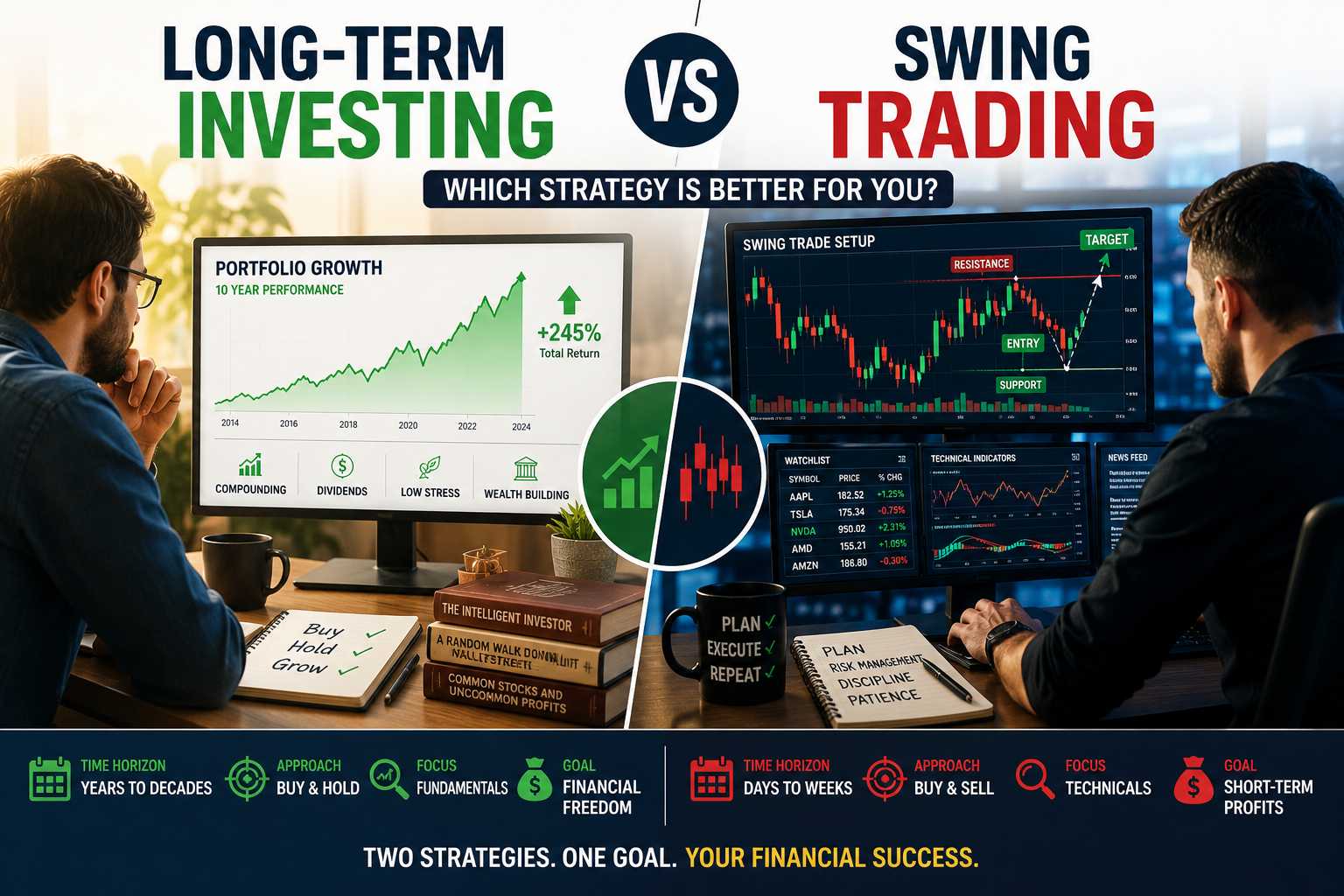
Long-Term Investing vs Swing Trading is one of the most important decisions every investor faces. While long-term investing focuses on building wealth through compounding over many years, swing trading aims to profit from short-term market movements over days or weeks. Choosing the right investing strategy depends on your financial goals, risk tolerance, investment timeline, and willingness to actively manage your investments.
Financial markets offer many ways to build wealth, but two of the most popular strategies are Long-Term Investing and Swing Trading. Both approaches aim to generate profits from stocks, ETFs, cryptocurrencies, commodities, or other financial assets. However, the philosophy, risk, psychology, time commitment, and expected outcomes are very different. Whether you’re new to stock market investing or already building a diversified portfolio, understanding these two approaches can help you make more informed investment decisions.
Many beginners ask:
- Should I hold investments for years?
- Is short-term trading more profitable?
- Which strategy creates more wealth?
- Which approach is safer?
- Can ordinary people succeed with swing trading?
- Why do famous investors recommend long-term investing?
The answer depends on your:
- Financial goals
- Risk tolerance
- Time availability
- Emotional discipline
- Knowledge level
- Income stability
This guide explains every important concept in detail, including:
- Definitions
- Terminology
- Strategies
- Risk management
- Psychological factors
- Tax implications
- Real-world examples
- Historical case studies
- Mathematical comparisons
- Pros and cons
- Who should choose which strategy
Understanding Long-Term Investing
What Is Long-Term Investing?
Long-term investing means buying assets and holding them for many years, often:
- 5 years
- 10 years
- 20 years
- Or even decades
The investor believes that over time, quality assets increase in value because businesses grow, economies expand, and profits compound.
The core idea is simple:
Time in the market is more important than timing the market. This philosophy is often referred to as buy and hold investing, where investors purchase quality assets and remain invested through different market cycles instead of frequently buying and selling.
Long-term investors usually buy:
- Stocks
- Index funds
- ETFs
- Mutual funds
- Bonds
- Real estate investment trusts (REITs)
Successful stock investing focuses on owning high-quality businesses that can grow earnings and shareholder value over many years.
If you’re new to investing, our What Is Investing guide explains the fundamentals, common investment types, and how beginners can build a strong financial foundation.
Many investors combine long-term investing with passive investing by regularly investing in diversified index funds and ETFs while minimizing trading activity.
Core Philosophy of Long-Term Investing
Long-term investing is based on several important principles:
1. Compounding
Compounding means earning returns on previous returns.
Example 1 :
Suppose you invest $10,000 with 10% annual returns.
Year 1:
- $10,000 → $11,000
Year 2:
- $11,000 → $12,100
Year 10:
- About $25,937
Year 20:
- About $67,275
The money grows exponentially over time.
This is why famous investors like Warren Buffett emphasize patience.
Compound Interest Formula
A = P × (1 + r/n)^(nt)
Where:
- (A) = final amount
- (P) = principal investment
- (r) = annual interest rate
- (n) = number of compounding periods
- (t) = number of years
To learn how compounding accelerates wealth over decades, read our detailed Compound Interest Explained guide.
2. Business Ownership Mentality
Long-term investors think like business owners.
When buying shares of companies like Apple or Microsoft, investors are buying ownership in real businesses.
They focus on:
- Revenue growth
- Profit margins
- Competitive advantages
- Brand strength
- Innovation
- Management quality
3. Market Growth Over Time
Historically, stock markets trend upward over long periods despite crashes and recessions.
For example:
- The S&P 500 has historically produced around 8–10% annual average returns over long periods.
Even after:
- Financial crises
- Wars
- Inflation
- Pandemics
markets eventually recovered.
What Is Swing Trading?
Swing trading is a short- to medium-term trading strategy where traders attempt to profit from price movements occurring over:
- A few days
- Several weeks
- Occasionally months
Unlike passive investing, swing trading is a form of active trading that requires frequent market analysis, timely decision-making, and continuous monitoring of price movements. Swing traders do not usually hold positions for many years.
Instead, they aim to capture “swings” in market momentum.
Core Philosophy of Swing Trading
Swing traders focus on:
- Market psychology
- Technical analysis
- Price momentum
- Short-term trends
- Entry and exit timing
Rather than asking:
“Will this company dominate in 20 years?”
They ask:
“Can this stock move 10% in the next 2 weeks?”
Common Swing Trading Tools
Swing traders use:
- Candlestick charts
- Moving averages
- RSI (Relative Strength Index)
- MACD
- Support and resistance levels
- Volume indicators
- Fibonacci retracements
Moving Average Formula
Moving Average (MA) = (P₁ + P₂ + P₃ + … + Pₙ) ÷ n
Where:
- (MA) = moving average
- (P) = asset prices
- (n) = number of periods
Moving averages help traders identify the overall direction of a price trend by smoothing out short-term price fluctuations. They are one of the most widely used tools in technical analysis for spotting potential buy and sell opportunities.
Example: Calculating a 5-Day Moving Average
Suppose a stock has the following closing prices over five days:
| Day | Closing Price |
|---|---|
| Day 1 | $100 |
| Day 2 | $102 |
| Day 3 | $101 |
| Day 4 | $104 |
| Day 5 | $103 |
The 5-day Moving Average is:
MA = (100 + 102 + 101 + 104 + 103) ÷ 5
MA = 510 ÷ 5
MA = $102
This means the stock’s average closing price over the last five trading days is $102.
To learn more about reading charts, trends, and technical indicators, read our Stock Market Basics guide.
Swing traders often use moving averages alongside other technical analysis indicators, such as the Relative Strength Index (RSI), MACD, and support and resistance levels, to confirm market trends and improve trading decisions.
Key Difference Between Long-Term Investing and Swing Trading
| Factor | Long-Term Investing | Swing Trading |
|---|---|---|
| Time Horizon | Years/Decades | Days/Weeks |
| Goal | Wealth building | Short-term profits |
| Analysis Type | Fundamental | Technical |
| Stress Level | Lower | Higher |
| Trading Frequency | Low | High |
| Tax Efficiency | Better | Worse |
| Emotional Pressure | Lower | Very High |
| Time Requirement | Minimal | Significant |
| Compounding Potential | Excellent | Depends on skill |
| Risk of Overtrading | Low | High |
Understanding Fundamental Analysis
Long-term investors rely heavily on fundamental analysis.
This means evaluating the real value of a company.
Key factors include:
- Revenue
- Earnings
- Debt
- Cash flow
- Market share
- Industry position
Example:
If NVIDIA continues dominating AI chips, investors may expect long-term growth.
Understanding Technical Analysis
Swing traders use technical analysis.
This involves studying:
- Charts
- Historical price patterns
- Trading volume
- Momentum indicators
The assumption:
Price action reflects all available information.
RSI Formula
RSI = 100 – \frac{100}{1 + RS}
Where:
- (RS) = average gain ÷ average loss
RSI helps traders identify:
- Overbought conditions
- Oversold conditions
Case Study 1: Long-Term Investor
Scenario
Imagine Sarah invested:
- $20,000
- Into the S&P 500
- In 2005
- And held through:
- 2008 financial crisis
- COVID crash
- Inflation shocks
Assume average annual return:
- 9%
After 20 years:
Her portfolio becomes approximately:
- $112,000+
Without frequent trading.
What Helped Sarah Succeed?
1. Patience
She ignored panic headlines.
2. Discipline
She continued investing during crashes.
3. Compounding
Returns generated additional returns.
4. Low Costs
Few transaction fees.
5. Tax Efficiency
Less taxable activity.
Case Study 2: Swing Trader
Scenario
David begins swing trading with:
- $20,000
- Trading technology stocks
- Holding positions for 5–15 days
Average trade:
- 5% gain target
- 3% stop loss
Suppose:
- 55% winning trades
- 45% losing trades
Potential outcome:
- Profitable but highly volatile
However:
- Emotional mistakes
- Overtrading
- Market gaps
- News shocks
can quickly destroy profits.
Why Swing Trading Looks Attractive
Many beginners prefer swing trading because:
- Faster profits seem exciting
- Social media promotes trading success
- Quick money appears possible
- Trading feels active and rewarding
Videos showing:
- “Turned $1,000 into $50,000”
create unrealistic expectations.
But most traders underestimate:
- Risk
- Emotional difficulty
- Losses
- Time commitment
The Psychology Difference
Long-Term Investing Psychology
Requires:
- Patience
- Emotional control
- Long-term thinking
Investors must tolerate:
- Market crashes
- Temporary losses
- Economic recessions
without panic selling.
Swing Trading Psychology
Requires:
- Fast decision-making
- Emotional discipline
- Stress management
- Acceptance of frequent losses
Strong trading psychology helps traders manage emotions such as fear, greed, overconfidence, and panic, allowing them to follow a disciplined trading plan. Swing traders face:
- Fear
- Greed
- FOMO (Fear of Missing Out)
- Revenge trading
every week.
What Is Revenge Trading?
Revenge trading occurs when traders:
- Lose money
- Become emotional
- Enter impulsive trades
- Try to recover losses quickly
This often leads to even larger losses.
Time Commitment Comparison
Long-Term Investing
Typical time required:
- Few hours monthly
Activities:
- Portfolio review
- Rebalancing
- Research
Ideal for:
- Busy professionals
- Students
- Business owners
Swing Trading
Typical time required:
- Several hours daily
Activities:
- Chart analysis
- Monitoring markets
- Setting stop losses
- Reviewing news
- Managing positions
Swing trading resembles a part-time job.
Risk Comparison
Long-Term Investing Risks
- Market crashes
- Inflation
- Poor company selection
- Economic recessions
However, diversified investors usually recover over long periods.
Swing Trading Risks
Additional risks include:
- Overnight gaps
- Sudden volatility
- Emotional errors
- Leverage losses
- Overtrading
- High transaction costs
High market volatility can create profitable trading opportunities, but it also increases the likelihood of rapid price swings and unexpected losses. Effective risk management, including stop-loss orders, proper position sizing, and diversification, is essential for protecting capital regardless of the investment strategy.
Understanding Leverage
Leverage means borrowing money to increase position size.
Example:
- Trader has $10,000
- Uses 5x leverage
- Controls $50,000 position
If stock rises 5%:
- Profit = $2,500
If stock falls 5%:
- Loss = $2,500
Leverage magnifies both gains and losses.
Many beginner traders lose money because of excessive leverage.
Risk-Reward Ratio
Swing traders use risk-reward calculations.
Example:
- Risk = $100
- Target profit = $300
Risk-reward ratio:
- 1:3
Risk Reward Formula
Risk\ Reward\ Ratio = \frac{Potential\ Loss}{Potential\ Profit}
Good traders seek higher reward relative to risk.
Tax Differences
Taxes can dramatically affect long-term returns. Taxes on capital gains vary depending on how long an investment is held, making tax planning an important consideration when comparing long-term investing with swing trading.
Long-Term Investing Taxes
Long-term capital gains taxes are often lower in many countries.
Benefits:
- Fewer taxable events
- Lower rates
- Better compounding
Swing Trading Taxes
Swing traders may face:
- Higher short-term capital gains taxes
- Frequent taxable transactions
This reduces net profitability.
Transaction Costs
Long-Term Investors
Costs are usually low because:
- Few trades occur annually
Swing Traders
Frequent costs include:
- Brokerage fees
- Spread costs
- Slippage
- Taxes
Over hundreds of trades, these costs accumulate significantly.
Understanding Slippage
Slippage occurs when:
- Trade executes at a worse price than expected
This is common during:
- High volatility
- Low liquidity
- Breaking news
Real Historical Example: Long-Term Investing
Amazon
An investor who bought Amazon shares in the early 2000s and held for decades experienced enormous wealth creation.
Despite:
- Dot-com crash
- Recessions
- Market volatility
long-term holders benefited from:
- E-commerce growth
- Cloud computing
- Global expansion
Real Historical Example: Swing Trading Failure
During meme-stock mania in 2021, many traders aggressively traded companies like:
- GameStop
Some traders made huge profits.
Others:
- Bought near the top
- Used leverage
- Panicked during crashes
Many lost substantial money.
This demonstrates how swing trading can produce:
- Large gains
- Large losses
very quickly.
Diversification
What Is Diversification?
Diversification means spreading investments across multiple assets. Proper diversification spreads investments across different asset classes, sectors, and geographic regions to reduce overall portfolio risk.
Purpose:
- Reduce risk
Example:
- Stocks
- Bonds
- International ETFs
- Real estate
- Commodities
Why Diversification Helps Investors
If one sector crashes:
- Others may remain stable
Example:
- Technology falls
- Healthcare rises
Diversification reduces portfolio volatility. Effective portfolio management involves regularly reviewing asset allocation, investment performance, and risk exposure to keep investments aligned with long-term financial goals.
Building a diversified portfolio is essential for reducing investment risk. Our Portfolio Diversification guide explains practical diversification strategies.
Swing Traders and Diversification
Swing traders usually hold:
- Concentrated positions
This increases:
- Potential returns
- Potential losses
Income Generation
Long-Term Investing
Can create:
- Dividend income
- Retirement wealth
- Passive income streams
Example:
Dividend-paying companies:
- Coca-Cola
- Johnson & Johnson
Swing Trading
Produces:
- Active income
Profits depend on:
- Constant performance
- Ongoing market participation
If trader stops trading:
- Income stops
Market Efficiency
Financial markets are highly competitive.
Swing traders compete against:
- Hedge funds
- Institutions
- Algorithms
- Professional traders
This makes consistent short-term profits difficult.
Why Most Traders Fail
Research consistently shows many active traders underperform the market.
Reasons include:
- Emotional decisions
- Poor risk management
- Overconfidence
- Excessive leverage
- Lack of strategy
- High costs
Why Long-Term Investors Often Win
Long-term investors benefit from:
- Economic growth
- Corporate earnings growth
- Compounding
- Lower costs
- Patience
Time becomes their advantage.
Volatility Explained
Volatility means:
- Speed and magnitude of price changes
High volatility:
- Bigger price swings
Low volatility:
- More stable movement
Swing traders often seek high volatility.
Long-term investors usually tolerate volatility while focusing on long-term growth.
Example of Volatility
A stock moving:
- 8% daily
is more volatile than one moving:
- 1% daily
High volatility creates:
- Opportunity
- Risk
Bull Markets vs Bear Markets
Bull Market
A period where prices generally rise.
Characteristics:
- Optimism
- Economic growth
- Strong investor confidence
Bear Market
A period where prices fall significantly.
Characteristics:
- Fear
- Economic weakness
- Pessimism
Long-term investors often buy during bear markets.
Swing traders may:
- Trade both upward and downward moves
Dollar-Cost Averaging (DCA)
Long-term investors frequently use DCA.
This means:
- Investing fixed amounts regularly
Example:
- $500 every month
Benefits:
- Reduces timing risk
- Encourages discipline
If you’re investing regularly, our Dollar Cost Averaging guide shows how consistent investing can reduce the impact of market volatility.
DCA Formula
Average\ Cost = \frac{Total\ Investment}{Total\ Shares\ Purchased}
Example of DCA
Suppose:
Month 1:
- Stock price = $100
- Buy 5 shares
Month 2:
- Price = $50
- Buy 10 shares
Month 3:
- Price = $25
- Buy 20 shares
Average purchase cost decreases automatically.
Which Strategy Is Better for Beginners?
Long-Term Investing Is Usually Better for Beginners
Reasons:
1. Lower Emotional Pressure
Less daily stress.
2. Simpler Strategy
No constant chart monitoring.
3. Better Historical Success Rates
Passive investing often outperforms active trading.
4. Lower Time Commitment
Ideal for people with jobs or studies.
5. Compounding Advantage
Time helps build wealth.
When Swing Trading May Be Appropriate
Swing trading may suit people who:
- Enjoy market analysis
- Can handle stress
- Have strong discipline
- Accept frequent losses
- Understand risk management
- Have sufficient time
It should usually begin with:
- Small capital
- Practice accounts
- Strict rules
Hybrid Approach
Some investors combine both strategies.
Example:
Core Portfolio
- 80%
- Long-term investments
A well-balanced investment portfolio often combines long-term holdings with a smaller allocation for active trading, depending on an investor’s goals and risk tolerance.
Trading Portfolio
- 20%
- Swing trading
This approach balances:
- Stability
- Growth
- Active opportunities
Famous Investors vs Traders
Famous Long-Term Investors
- Warren Buffett
- Charlie Munger
- Peter Lynch
These investors became wealthy through:
- Patience
- Compounding
- Business ownership
Famous Traders
Some successful traders exist, but trading success is harder to sustain consistently.
Professional traders often:
- Use teams
- Advanced systems
- Algorithms
- Institutional data access
Retail traders face disadvantages.
Mathematical Comparison Over 20 Years
Scenario A: Long-Term Investing
- Initial investment = $20,000
- Annual return = 10%
- 20 years
Future value:
genui{“math_block_widget_always_prefetch_v2”:{“content”:”FV = PV(1+r)^n”}}
Approximate result:
- $134,550
without frequent activity.
Scenario B: Swing Trading
Possible outcomes vary dramatically:
Best Case
- Exceptional profits
Average Case
- Moderate profits
Worst Case
- Large losses
Swing trading outcomes depend heavily on:
- Skill
- Discipline
- Psychology
- Market conditions
Emotional Cost
One overlooked factor is emotional health.
Long-Term Investors
Often experience:
- Lower stress
- Better sleep
- More predictable planning
Swing Traders
May experience:
- Anxiety
- Obsession with charts
- Emotional exhaustion
- Burnout
especially during volatile markets.
Technology and Modern Markets
Modern markets include:
- High-frequency trading algorithms
- AI systems
- Institutional trading desks
This makes short-term trading increasingly competitive.
Long-term investors are less affected by this competition.
Importance of Financial Goals
The “better” strategy depends on goals. Successful financial planning aligns your investing strategy with long-term objectives such as retirement, wealth creation, education funding, and financial independence.
Goal: Retirement Wealth
Long-term investing is generally superior.
Goal: Active Trading Career
Swing trading may fit better.
Goal: Passive Income
Long-term dividend investing is usually better.
Goal: Fast Excitement
Swing trading attracts many people, but excitement often increases risk.
Common Beginner Mistakes
Long-Term Investing Mistakes
- Panic selling
- Lack of diversification
- Chasing hype stocks
- Ignoring fees
Swing Trading Mistakes
- Overtrading
- No stop losses
- Emotional decisions
- Excess leverage
- Poor position sizing
Position Sizing
Position sizing means determining:
- How much capital to risk per trade
Professional traders rarely risk:
- More than 1–2% of capital per trade
Position Size Formula
Position\ Size = \frac{Account\ Risk}{Trade\ Risk}
This helps manage losses.
Economic Cycles and Strategy Performance
Long-Term Investing
Works well across:
- Multiple economic cycles
because economies tend to grow long term.
Swing Trading
Performance depends heavily on:
- Volatility
- Liquidity
- Market trends
Some market conditions are difficult for traders.
Inflation and Wealth Preservation
Long-term investing helps combat inflation.
Cash loses purchasing power over time.
Investments in:
- Stocks
- ETFs
- Real estate
historically outpace inflation.
Inflation Formula
Real\ Return = Nominal\ Return – Inflation\ Rate
Final Comparison
| Category | Long-Term Investing | Swing Trading |
|---|---|---|
| Wealth Building | Excellent | Variable |
| Stress | Lower | Higher |
| Time Needed | Low | High |
| Skill Requirement | Moderate | Very High |
| Tax Efficiency | Better | Worse |
| Emotional Difficulty | Moderate | Extreme |
| Historical Success Rate | Higher | Lower |
| Suitable for Most People | Yes | Usually No |
| Passive Income Potential | Strong | Weak |
| Lifestyle Flexibility | Better | Worse |
Final Verdict: Which Is Better?
For most ordinary people:
Long-Term Investing is usually the better choice.
Why?
Because it offers:
- Simplicity
- Lower stress
- Strong historical performance
- Tax efficiency
- Compounding power
- Better long-term wealth creation
It aligns well with:
- Retirement goals
- Financial independence
- Passive investing
Does That Mean Swing Trading Is Bad?
No.
Swing trading can work for disciplined individuals with:
- Education
- Risk management
- Emotional control
- Consistent strategy
But it is significantly harder than social media often suggests.
Best Practical Approach
For many people, the ideal strategy is:
1. Build Long-Term Investments First
Focus on:
- Index funds
- ETFs
- Diversification
- Retirement accounts
2. Use Small Capital for Trading
If interested in swing trading:
- Start small
- Practice carefully
- Learn risk management
Never risk money needed for:
- Rent
- Emergency savings
- Essential expenses
If your goal is long-term wealth creation, don’t miss our complete guide to Financial Independence, where you’ll learn how investing, saving, and smart financial planning work together.
Conclusion
Long-term investing and swing trading are fundamentally different paths.
Long-term investing focuses on:
- Patience
- Ownership
- Compounding
- Wealth preservation
Swing trading focuses on:
- Timing
- Momentum
- Technical analysis
- Short-term opportunities
Both can generate profits, but they require different personalities, skills, and lifestyles.
History consistently shows that disciplined long-term investors often outperform most active traders over long periods because they harness the extraordinary power of:
- Compounding
- Patience
- Economic growth
- Lower costs
- Emotional stability
For most people seeking financial security, retirement wealth, and sustainable growth, long-term investing remains the more reliable and practical strategy.
How to Analyze a Stock Before Buying: 10 Powerful & Proven Steps (2026 Guide)