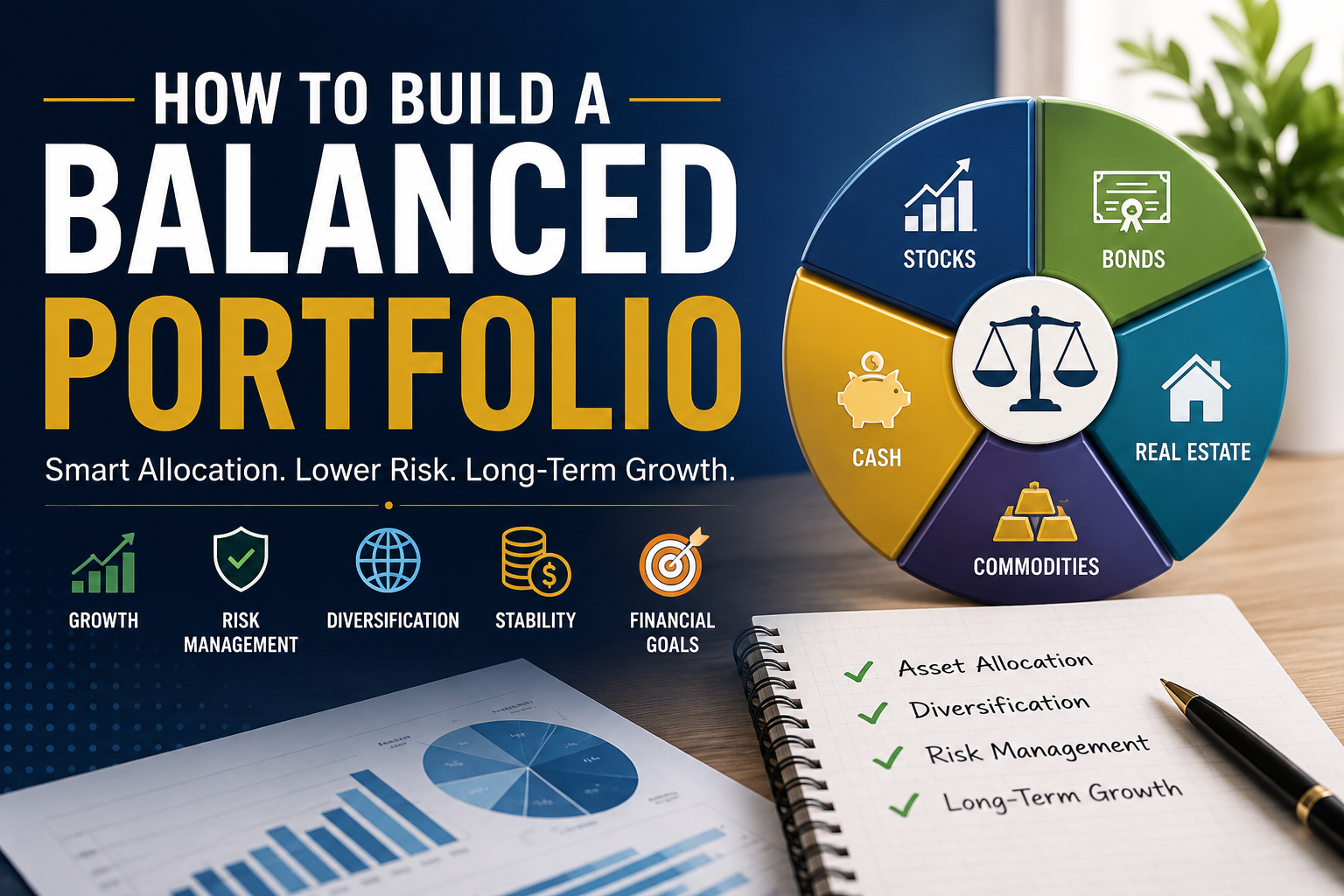
How to Build a Balanced Portfolio
How to Build a Balanced Portfolio is one of the most important skills every investor can learn. A balanced portfolio helps investors reduce risk, improve diversification, manage volatility, and build long-term wealth through disciplined asset allocation. Whether someone lives in the United States, United Kingdom, Canada, or Australia, the same question eventually appears:
“How do I grow wealth without taking unnecessary risk?”
A balanced portfolio attempts to answer that question.
It combines different asset classes, industries, investment styles, and risk levels into one investment strategy. The goal is not to maximize returns at all costs. The goal is to create a portfolio that can survive market crashes, inflation, recessions, interest-rate changes, and economic uncertainty while still growing steadily over time.
Many beginners think investing means buying a few popular stocks. In reality, successful investing is usually about allocation, diversification, risk management, patience, and consistency.
This guide explains everything in detail:
- What a balanced portfolio means
- Core investment terms
- Asset allocation
- Stocks vs bonds
- Diversification strategies
- Risk tolerance
- Portfolio construction
- Rebalancing
- Tax efficiency
- Retirement investing
- Real-world examples
- Case studies from Tier-1 countries
- Common mistakes to avoid
What Is a Balanced Portfolio?
A balanced portfolio is an investment portfolio that spreads money across multiple asset classes to balance:
- Growth
- Stability
- Income
- Risk protection
The purpose is to avoid depending too heavily on one investment.
For example:
If 100% of someone’s money is invested in technology stocks and the tech sector crashes, the portfolio may lose massive value.
But if investments are spread across:
- Stocks
- Bonds
- Real estate
- International markets
- Cash equivalents
- Commodities
then losses in one area may be reduced by gains or stability in another area.
This concept is called diversification.
Understanding the Word “Portfolio”
A portfolio is simply the collection of investments owned by an investor.
A portfolio may include:
- Individual stocks
- Bonds
- ETFs
- Mutual funds
- Real estate investments
- Cash
- Commodities like gold
- Cryptocurrency (optional/high risk)
Example:
John from United States owns:
- 50% U.S. index funds
- 20% international stocks
- 20% bonds
- 10% cash
That combination is his portfolio.
Why Balance Matters
Many investors focus only on returns.
Professional investors focus on:
- Risk-adjusted returns
- Drawdowns
- Volatility
- Long-term survival
A balanced portfolio reduces the chances of catastrophic losses.
Example
Imagine two investors during the 2008 Financial Crisis.
Investor A
- 100% invested in bank stocks
Portfolio decline:
-70%
Investor B
Balanced allocation:
- 50% stocks
- 30% bonds
- 10% gold
- 10% cash
Portfolio decline:
-18%
Investor B recovered much faster because diversification reduced damage.
Core Investment Terms Explained
1. Asset Allocation
Asset allocation means dividing investments among asset categories.
Main asset classes include:
- Stocks
- Bonds
- Cash
- Real estate
- Commodities
Asset allocation is considered one of the biggest drivers of long-term returns.
2. Diversification
Diversification means spreading investments across multiple assets to reduce risk.
Instead of owning one company, investors own many.
Example:
Bad diversification:
- 10 technology stocks
Good diversification:
- U.S. stocks
- International stocks
- Bonds
- Real estate
- Healthcare
- Utilities
- Energy
3. Risk Tolerance
Risk tolerance means how much volatility an investor can emotionally and financially handle.
Aggressive investors
Accept:
- Large fluctuations
- Higher short-term losses
- Higher long-term growth potential
Conservative investors
Prefer:
- Stability
- Income
- Lower volatility
Types of Investments in a Balanced Portfolio
1. Stocks
Stocks represent ownership in companies.
Examples include shares of:
- Apple
- Microsoft
- NVIDIA
Stocks generally provide:
- Capital appreciation
- Dividend income
- Inflation protection
But they also carry:
- Market risk
- Volatility
- Economic sensitivity
Growth Stocks
Growth companies reinvest profits to expand.
Characteristics:
- Higher valuation
- Faster growth
- Higher volatility
Example:
Technology companies during AI expansion.
Value Stocks
Value stocks trade below perceived intrinsic value.
Characteristics:
- Lower valuations
- More stable cash flow
- Often pay dividends
Examples:
Banks, utilities, consumer staples.
2. Bonds
Bonds are loans made to governments or corporations.
Investors receive:
- Interest payments
- Principal repayment at maturity
Bonds are usually less volatile than stocks.
Government Bonds
Issued by governments like:
- U.S. Treasury
- UK Gilts
- Canadian Government Bonds
They are considered relatively safer.
Corporate Bonds
Issued by companies.
Higher risk than government bonds but often provide higher yields.
3. Cash and Cash Equivalents
Cash includes:
- Savings accounts
- Money market funds
- Treasury bills
Cash provides:
- Liquidity
- Emergency stability
- Protection during market crashes
But cash loses purchasing power during inflation.
4. Real Estate
Real estate can provide:
- Rental income
- Appreciation
- Inflation protection
Investors often use:
- REITs (Real Estate Investment Trusts)
instead of directly owning property.
5. Commodities
Commodities include:
- Gold
- Oil
- Silver
- Agricultural products
Gold is often used as:
- Inflation hedge
- Crisis protection asset
The Classic Balanced Portfolio
One of the most famous balanced strategies is:
The 60/40 Portfolio
- 60% stocks
- 40% bonds
Historically, this portfolio provided:
- Growth from stocks
- Stability from bonds
Although modern markets have changed, the 60/40 strategy remains widely used.
Example of a Modern Balanced Portfolio
| Asset Type | Allocation |
|---|---|
| U.S. Stocks | 35% |
| International Stocks | 20% |
| Bonds | 25% |
| Real Estate | 10% |
| Gold | 5% |
| Cash | 5% |
This portfolio attempts to balance:
- Growth
- Stability
- Inflation protection
- Global exposure
Understanding Correlation
Correlation measures how investments move relative to one another.
Positive Correlation
Assets move together.
Example:
Many tech stocks.
Negative Correlation
Assets move opposite each other.
Example:
Stocks and government bonds during recessions.
Balanced portfolios use low-correlation assets to reduce volatility.
How Age Affects Portfolio Allocation
A person’s age strongly influences risk tolerance.
Young Investors (20s–30s)
Advantages:
- Long investment horizon
- Ability to recover from crashes
Common allocation:
- 80–90% stocks
- 10–20% bonds
Middle-Aged Investors (40s–50s)
Focus shifts toward:
- Wealth preservation
- Retirement planning
Typical allocation:
- 60–70% stocks
- 30–40% bonds
Retirees (60+)
Focus becomes:
- Income
- Capital preservation
- Reduced volatility
Common allocation:
- 40–50% stocks
- 50–60% bonds/cash
The Role of ETFs in Balanced Portfolios
ETFs (Exchange-Traded Funds) make diversification easier.
An ETF is a fund traded on an exchange that holds multiple assets.
Examples:
- S&P 500 ETFs
- Bond ETFs
- International ETFs
Benefits:
- Low cost
- Instant diversification
- Liquidity
- Simplicity
Index Investing
Index investing means tracking a market index instead of picking individual stocks.
Example indexes:
- S&P 500
- FTSE 100
- TSX Composite
- ASX 200
Many experts believe low-cost index investing outperforms most active managers over long periods.
Dollar-Cost Averaging
Dollar-cost averaging means investing fixed amounts regularly regardless of market conditions.
Example:
Investing $500 monthly into an ETF.
Benefits:
- Reduces emotional investing
- Smooths purchase prices
- Encourages discipline
Rebalancing a Portfolio
Over time, allocations change because assets grow at different rates.
Example:
Initial allocation:
- 60% stocks
- 40% bonds
After a bull market:
- 75% stocks
- 25% bonds
Risk increases.
Rebalancing restores original targets.
Example of Rebalancing
Suppose:
Stocks grew significantly.
Investor sells some stocks and buys bonds to return to:
- 60/40 allocation
Benefits:
- Controls risk
- Locks in gains
- Maintains strategy discipline
Emotional Investing: The Biggest Threat
Many investors fail because of emotions.
Common emotional mistakes:
- Panic selling
- Chasing hot stocks
- Market timing
- Fear during crashes
- Greed during bubbles
Balanced portfolios reduce emotional stress because volatility is lower.
Case Study: The Dot-Com Bubble
During the late 1990s:
Technology stocks soared.
Many investors became concentrated in tech.
Then the crash occurred.
The NASDAQ Composite lost around 78% from peak to bottom.
Investor Comparison
Investor A
- 100% tech stocks
Result:
Massive losses and long recovery.
Investor B
Balanced allocation:
- U.S. stocks
- International stocks
- Bonds
- Real estate
Result:
Much smaller decline.
Diversification preserved wealth.
Case Study: The 2008 Financial Crisis
The 2008 crisis was caused by:
- Housing bubble collapse
- Banking failures
- Excessive leverage
Major institutions suffered severe losses.
Examples:
- Lehman Brothers collapsed
- Bear Stearns failed
Balanced Portfolio Impact
Aggressive Portfolio
100% stocks:
Large drawdowns.
Balanced Portfolio
60/40 mix:
Smaller decline and faster recovery.
This crisis reinforced the importance of:
- Asset allocation
- Bonds
- Liquidity
- Risk management
Inflation and Portfolio Construction
Inflation reduces purchasing power.
If inflation is 5%, money effectively buys less over time.
Balanced portfolios fight inflation using:
- Stocks
- Real estate
- Commodities
- Inflation-protected securities
International Diversification
Many investors focus only on their home country.
But global diversification matters.
Why?
- Economies grow differently
- Currency diversification helps
- Political risks vary
Example:
If the U.S. market underperforms, international markets may perform better.
Tax-Efficient Investing
Taxes can reduce investment returns significantly.
Tier-1 countries offer tax-advantaged accounts.
United States
Common retirement accounts:
- 401(k)
- Roth IRA
- Traditional IRA
These accounts provide:
- Tax deferral
- Tax-free growth
- Employer matching
United Kingdom
Popular accounts:
- ISA (Individual Savings Account)
- SIPP (Self-Invested Personal Pension)
Benefits:
- Tax-free investing
- Retirement advantages
Canada
Common accounts:
- TFSA
- RRSP
Benefits:
- Tax shelters
- Retirement savings incentives
Australia
Popular accounts:
- Superannuation funds
These provide:
- Tax advantages
- Retirement investing structure
The Importance of Emergency Funds
Before building a portfolio, investors should establish emergency savings.
Common recommendation:
- 3–6 months of expenses
This prevents forced selling during emergencies.
Portfolio Allocation Examples
Conservative Portfolio
| Asset | Allocation |
|---|---|
| Bonds | 50% |
| Stocks | 30% |
| Cash | 10% |
| Real Estate | 10% |
Suitable for:
- Retirees
- Low-risk investors
Moderate Portfolio
| Asset | Allocation |
|---|---|
| Stocks | 60% |
| Bonds | 30% |
| Real Estate | 5% |
| Gold/Cash | 5% |
Suitable for:
- Long-term investors
- Balanced growth seekers
Aggressive Portfolio
| Asset | Allocation |
|---|---|
| Stocks | 85% |
| Bonds | 10% |
| Alternatives | 5% |
Suitable for:
- Younger investors
- High-risk tolerance
Understanding Volatility
Volatility measures how much prices fluctuate.
High volatility:
- Large price swings
Low volatility:
- Stable movement
Balanced portfolios aim to reduce unnecessary volatility.
Understanding Drawdowns
A drawdown is the decline from a portfolio peak to a trough.
Example:
Portfolio:
$100,000 → $70,000
Drawdown:
30%
Smaller drawdowns improve long-term recovery potential.
Why Compounding Matters
Compounding means earning returns on previous returns.
Albert Einstein allegedly called compound interest:
“The eighth wonder of the world.”
Example:
$10,000 invested at 8% annually.
genui{“math_block_widget_always_prefetch_v2”:{“content”:”A=P\left(1+r\right)^t”}}
After:
- 10 years ≈ $21,589
- 20 years ≈ $46,610
- 30 years ≈ $100,627
Time is one of the most powerful investment tools.
Case Study: Two Investors
Sarah
Started investing at age 25:
- $500 monthly
- 8% annual return
Mike
Started at age 35:
- $500 monthly
- Same return
By retirement:
Sarah accumulated dramatically more wealth because of compounding.
Sequence of Returns Risk
This risk affects retirees.
Poor market returns early in retirement can damage portfolios permanently.
Balanced portfolios help reduce this risk by:
- Lowering volatility
- Including bonds
- Preserving liquidity
Common Portfolio Mistakes
1. Lack of Diversification
Owning only:
- Tech stocks
- One country
- One sector
creates concentration risk.
2. Overtrading
Frequent trading increases:
- Taxes
- Fees
- Emotional mistakes
3. Chasing Performance
Investors often buy assets after massive rallies.
This usually leads to poor timing.
4. Ignoring Fees
High fees reduce compounding.
Even a 1% annual fee can cost hundreds of thousands over decades.
5. No Rebalancing
Without rebalancing:
- Risk levels drift
- Portfolios become unstable
Active vs Passive Investing
Active Investing
Managers attempt to beat the market.
Higher:
- Fees
- Trading activity
Passive Investing
Tracks market indexes.
Benefits:
- Lower cost
- Simplicity
- Historically strong performance
Many balanced portfolios use passive investing.
Behavioral Finance and Psychology
Investing success is often psychological.
Common biases:
- Overconfidence
- Fear of missing out (FOMO)
- Loss aversion
- Herd mentality
Balanced portfolios reduce emotional pressure.
The Role of Financial Advisors
Some investors prefer professional guidance.
Advisors help with:
- Asset allocation
- Tax planning
- Retirement planning
- Estate planning
- Behavioral coaching
However, fees should be evaluated carefully.
Example Balanced Portfolio for a 30-Year-Old Investor
| Investment | Allocation |
|---|---|
| U.S. Equity ETF | 40% |
| International ETF | 20% |
| Bond ETF | 20% |
| REIT ETF | 10% |
| Gold ETF | 5% |
| Cash | 5% |
Goal:
- Long-term growth
- Moderate volatility
- Inflation protection
Example Balanced Portfolio for a Retiree
| Investment | Allocation |
|---|---|
| Dividend Stocks | 30% |
| Bonds | 40% |
| Cash | 15% |
| REITs | 10% |
| Gold | 5% |
Goal:
- Income
- Stability
- Lower volatility
Should Cryptocurrency Be Included?
Cryptocurrency remains highly volatile.
Some investors allocate:
- 1–5%
for speculative exposure.
However, excessive crypto exposure can destroy portfolio balance.
The Importance of Patience
Successful investing usually appears boring.
Long-term investors succeed because they:
- Stay disciplined
- Avoid panic
- Continue investing
- Rebalance periodically
Building a Portfolio Step-by-Step
Step 1: Define Financial Goals
Examples:
- Retirement
- Buying a home
- Wealth creation
- Passive income
Step 2: Determine Risk Tolerance
Questions:
- Can you handle market crashes?
- What is your time horizon?
- How stable is your income?
Step 3: Choose Asset Allocation
Decide percentages for:
- Stocks
- Bonds
- Cash
- Alternatives
Step 4: Select Investments
Examples:
- ETFs
- Index funds
- Bonds
- REITs
Step 5: Automate Contributions
Automatic investing creates consistency.
Step 6: Rebalance Periodically
Common frequency:
- Every 6–12 months
Step 7: Stay Invested
Long-term discipline matters more than predicting markets.
Example: Balanced Portfolio During a Recession
During recessions:
- Stocks may decline
- Bonds often stabilize portfolios
- Cash provides flexibility
Investors with balanced allocations are less likely to panic sell.
Real-World Example: Pension Funds
Large pension funds globally use diversified balanced strategies.
Examples include pension systems in:
- Canada
- Australia
- Netherlands
These institutions diversify across:
- Equities
- Bonds
- Infrastructure
- Real estate
- Private equity
Why?
Because long-term survival matters more than chasing maximum returns.
Balanced Portfolios and Retirement
Retirement investing requires:
- Growth
- Income
- Inflation protection
- Longevity planning
Balanced portfolios attempt to support withdrawals while maintaining sustainability.
Final Thoughts
A balanced portfolio is not about finding the “perfect” investment.
It is about creating a durable system that can survive:
- Bull markets
- Bear markets
- Inflation
- Recessions
- Economic shocks
The most successful investors are usually not those who chase the hottest trends.
They are the investors who:
- Diversify intelligently
- Control risk
- Invest consistently
- Rebalance regularly
- Remain patient for decades
In Tier-1 countries like the United States, United Kingdom, Canada, and Australia, balanced portfolio strategies remain central to retirement planning, wealth management, pension systems, and institutional investing.
The core principle is timeless:
“Do not put all your eggs in one basket.”
A balanced portfolio transforms investing from speculation into a structured long-term wealth-building strategy.