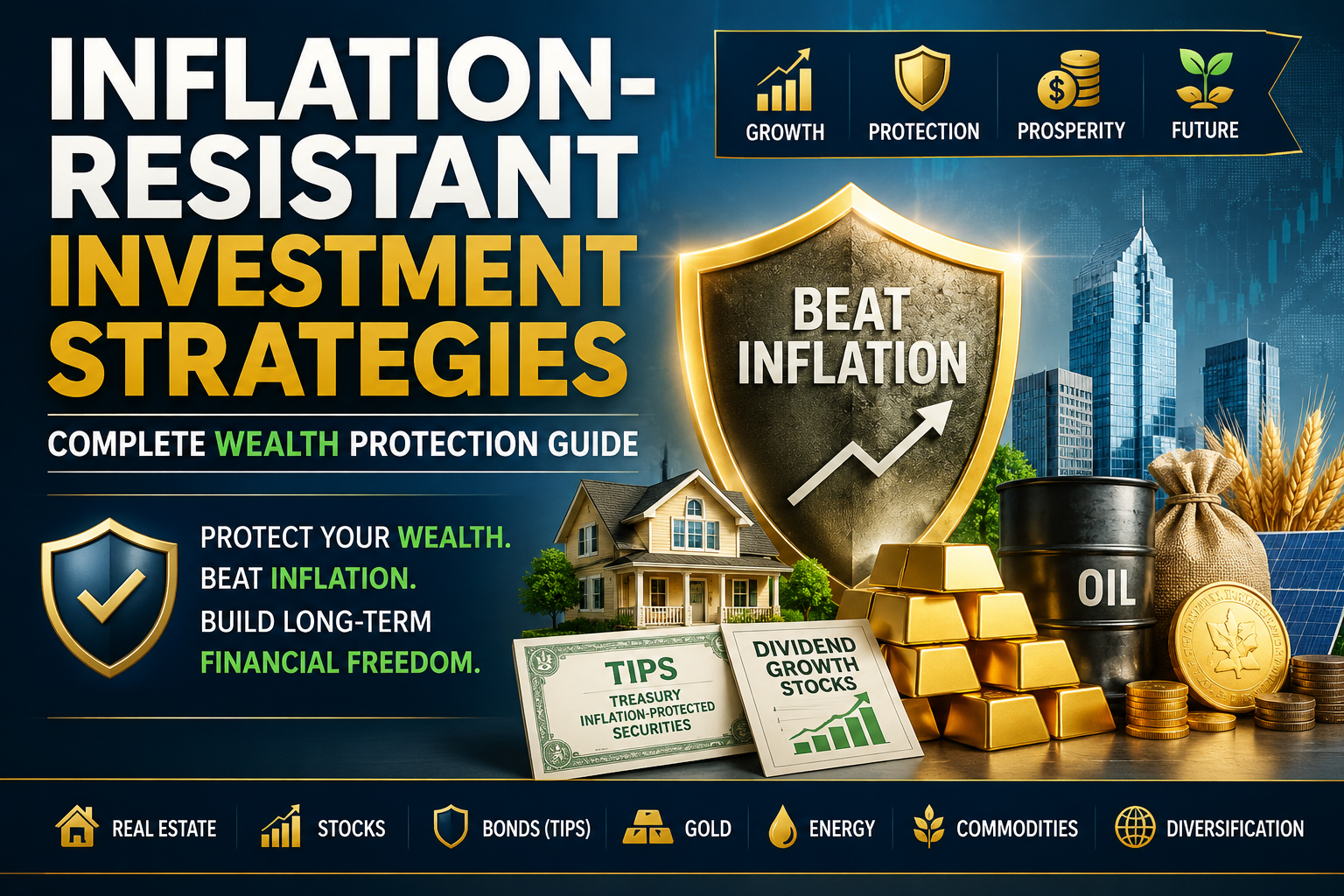
Inflation-Resistant Investment Strategies: The Complete Guide to Protecting and Growing Wealth During Inflation
Introduction
Inflation-Resistant Investment Strategies are essential for investors who want to protect purchasing power, preserve wealth, and generate long-term returns during periods of rising inflation. While many people focus on stock market crashes, recessions, or interest rate changes, inflation silently reduces the value of money every single day.
Imagine having $100,000 in savings. If inflation averages 5% annually, the purchasing power of that money will decline significantly over time. Although the account balance remains $100,000, the amount of goods and services it can purchase decreases every year.
This is why successful investors in Tier-1 countries such as the United States, Canada, the United Kingdom, Australia, Germany, France, Switzerland, and Singapore focus on inflation-resistant investment strategies.
Inflation-resistant investing is not simply about making money. It is about preserving purchasing power, maintaining financial independence, and ensuring long-term wealth creation.
This guide explains inflation in detail, explores the best inflation-resistant investments, discusses real-world case studies, and provides practical strategies used by professional investors to protect wealth during inflationary periods.
Understanding Inflation
What Is Inflation?
Inflation is the rate at which the general level of prices for goods and services rises over time.
As prices rise, each unit of currency buys fewer goods and services than before.
Example
Suppose a loaf of bread costs:
- $2 in 2020
- $2.20 in 2021
- $2.40 in 2022
The increase in prices reflects inflation.
The same concept applies to:
- Housing
- Healthcare
- Transportation
- Education
- Food
- Energy
- Insurance
When inflation rises across the economy, the purchasing power of money falls.
Key Inflation Terms Every Investor Must Understand
Purchasing Power
Purchasing power refers to the amount of goods and services that money can buy.
Example
If $100 buys:
- 10 products today
- 8 products next year
Your purchasing power has declined.
Consumer Price Index (CPI)
The Consumer Price Index is one of the most widely used inflation measurements.
It tracks changes in the prices of a basket of consumer goods and services.
The CPI basket typically includes:
- Food
- Housing
- Transportation
- Medical care
- Education
- Entertainment
Central banks closely monitor CPI when making monetary policy decisions.
Producer Price Index (PPI)
The Producer Price Index measures inflation from the perspective of manufacturers and producers.
When PPI rises significantly, companies often pass higher costs to consumers, resulting in higher CPI inflation later.
Core Inflation
Core inflation excludes volatile categories such as:
- Food
- Energy
Economists use core inflation to identify long-term inflation trends.
Why Inflation Is Dangerous for Investors
Inflation impacts nearly every asset class.
Cash Loses Value
Many people believe cash is safe.
However, cash can become one of the riskiest assets during inflation.
Example
Suppose:
- Savings account earns 2%
- Inflation rate is 6%
Real return:
2% − 6% = -4%
Your wealth declines despite earning interest.
Bond Values Fall
Traditional bonds often struggle during periods of rising inflation because future interest payments become less valuable.
Higher Living Costs
Inflation affects:
- Groceries
- Fuel
- Utilities
- Rent
- Healthcare
Investors must generate returns exceeding inflation to maintain their standard of living.
Historical Inflation Case Study: The United States in the 1970s
The 1970s remain one of the most studied inflationary periods in modern financial history.
Causes
Several factors contributed:
- Oil embargoes
- Supply shocks
- Government spending
- Monetary expansion
Inflation exceeded 13%.
Impact
Many investors holding cash experienced substantial purchasing power losses.
However, certain assets performed exceptionally well:
- Gold
- Energy stocks
- Real estate
- Commodities
The lesson remains relevant today:
Assets tied to real economic value generally perform better than cash during inflation.
Strategy 1: Invest in Stocks With Pricing Power
What Is Pricing Power?
Pricing power is a company’s ability to raise prices without losing customers.
Businesses with strong brands often possess significant pricing power.
Examples include:
- Apple
- Microsoft
- Coca-Cola
Customers continue buying their products even when prices increase.
Why Pricing Power Matters
During inflation:
- Input costs rise
- Labor costs rise
- Transportation costs rise
Companies with pricing power pass those costs to consumers.
As a result:
- Revenue rises
- Profits remain stable
- Stock prices often recover faster
Case Study: Coca-Cola During Inflationary Periods
For decades, Coca-Cola has consistently raised product prices while maintaining customer demand.
Even when sugar, transportation, and labor costs increased, the company maintained profitability.
This demonstrates why strong brands can be effective inflation hedges.
Strategy 2: Dividend Growth Investing
What Is a Dividend?
A dividend is a payment made by a company to shareholders from profits.
Dividend Yield
Dividend Yield = Annual Dividend ÷ Stock Price
Example:
- Annual dividend = $5
- Share price = $100
Dividend yield = 5%
Why Dividend Growth Matters
The key is not just receiving dividends.
The key is receiving increasing dividends.
If a company raises dividends annually:
- Income grows
- Purchasing power improves
- Inflation impact decreases
Dividend Aristocrats
Dividend Aristocrats are companies that have increased dividends for at least 25 consecutive years.
Examples include:
- Procter & Gamble
- Johnson & Johnson
- PepsiCo
These companies have survived multiple inflation cycles.
Strategy 3: Real Estate Investing
Real estate has historically been one of the most effective inflation-resistant assets.
Why Real Estate Performs Well During Inflation
Property Values Rise
Construction costs increase because of:
- Labor
- Materials
- Land scarcity
This often pushes property prices higher.
Rental Income Increases
Landlords frequently adjust rents upward.
As inflation rises:
- Apartment rents rise
- Commercial rents rise
- Property income rises
Real Estate Example
Suppose an investor owns a rental property generating:
$2,000 per month
Inflation increases.
Rent rises to:
$2,300 per month
The investor’s income adjusts with inflation.
Case Study: U.S. Housing Market (2020–2022)
Following the pandemic:
- Interest rates remained low initially
- Housing demand surged
- Construction supply remained constrained
Property values increased dramatically across many cities.
Investors holding real estate benefited from:
- Appreciation
- Higher rents
- Equity growth
Strategy 4: Real Estate Investment Trusts (REITs)
What Is a REIT?
A Real Estate Investment Trust is a company that owns income-producing real estate.
Examples include:
- Apartments
- Warehouses
- Shopping centers
- Data centers
- Healthcare facilities
Advantages of REITs
Investors receive:
- Diversification
- Dividend income
- Professional management
- Liquidity
Unlike physical real estate, REITs trade like stocks.
Strategy 5: Treasury Inflation-Protected Securities (TIPS)
What Are TIPS?
TIPS are government bonds designed specifically to protect investors from inflation.
In the United States, the principal value adjusts according to inflation.
How TIPS Work
Suppose:
Investment = $10,000
Inflation = 5%
Adjusted principal:
$10,500
Future interest payments are based on the larger principal amount.
Benefits
- Government-backed
- Inflation-adjusted
- Lower risk
Strategy 6: Commodity Investing
What Are Commodities?
Commodities are raw materials used throughout the economy.
Examples include:
- Oil
- Natural gas
- Gold
- Silver
- Copper
- Wheat
- Corn
Why Commodities Benefit During Inflation
Inflation often begins with rising commodity prices.
When oil rises:
- Transportation costs rise
- Manufacturing costs rise
- Consumer prices rise
Commodity investors can benefit from these trends.
Gold as an Inflation Hedge
Gold has been used as a store of value for thousands of years.
Why Investors Buy Gold
Gold offers:
- Scarcity
- Durability
- Global acceptance
- Independence from corporate earnings
Historical Case Study
Between the early 1970s and early 1980s:
- Inflation surged
- Gold prices increased dramatically
Many investors used gold to preserve purchasing power.
Strategy 7: Energy Investments
Energy is often one of the strongest-performing sectors during inflation.
Why Energy Benefits
Oil and gas are essential economic inputs.
Higher energy prices generally translate into:
- Higher revenues
- Larger profits for producers
Examples
Major energy companies often benefit during inflationary periods because energy prices rise faster than overall inflation.
Strategy 8: Infrastructure Investments
Infrastructure includes:
- Airports
- Toll roads
- Utilities
- Pipelines
- Communication towers
Inflation Protection Features
Many infrastructure contracts include inflation-linked pricing clauses.
This allows operators to increase fees as inflation rises.
Example
A toll road operator may increase toll charges annually according to inflation metrics.
Revenue rises alongside inflation.
Strategy 9: International Diversification
Inflation affects countries differently.
Why Diversify Globally?
Different countries experience different:
- Interest rates
- Economic growth rates
- Inflation levels
- Currency movements
Investing internationally reduces concentration risk.
Example
An investor may allocate capital among:
- U.S. stocks
- European stocks
- Australian equities
- Canadian energy companies
This diversification can reduce inflation-related risks.
Strategy 10: Index Funds and ETFs
What Is an Index Fund?
An index fund tracks a market index.
Examples:
- S&P 500
- FTSE 100
- DAX
Why Index Funds Help
Benefits include:
- Diversification
- Low fees
- Long-term growth
- Inflation-beating potential
Historically, broad stock markets have outperformed inflation over long periods.
Strategy 11: Value Stocks During Inflation
What Are Value Stocks?
Value stocks trade below their estimated intrinsic value.
Examples often include:
- Financial institutions
- Energy companies
- Industrial businesses
Why They Perform Better
During inflation:
- Investors prefer current earnings
- Future earnings become less valuable due to higher discount rates
Value stocks often outperform growth stocks in inflationary environments.
Strategy 12: Business Ownership
Owning businesses can be one of the best inflation hedges.
Why Businesses Resist Inflation
Businesses can:
- Raise prices
- Improve efficiency
- Expand operations
- Enter new markets
Unlike cash, businesses adapt.
Strategy 13: Inflation-Aware Portfolio Allocation
A balanced inflation-resistant portfolio might include:
40% Equities
Focus on:
- Dividend growers
- Quality companies
- Global exposure
20% Real Estate
Include:
- REITs
- Rental properties
10% Commodities
Include:
- Gold
- Energy exposure
15% Inflation-Protected Bonds
Include:
- TIPS
- Inflation-linked securities
10% International Investments
Diversify geographically.
5% Cash
Maintain liquidity for opportunities.
Common Mistakes During Inflation
Holding Excess Cash
Cash steadily loses purchasing power.
Chasing Short-Term Trends
Many investors buy assets only after prices surge.
Disciplined investing generally performs better.
Ignoring Diversification
No asset class performs best in every inflation cycle.
Diversification remains critical.
Panic Selling
Inflation creates uncertainty.
Selling quality investments during market volatility often damages long-term returns.
Lessons From the 2021–2023 Global Inflation Surge
Following the COVID-19 pandemic:
- Supply chains were disrupted
- Government stimulus increased demand
- Energy prices surged
Inflation reached multi-decade highs across:
- United States
- United Kingdom
- Canada
- Europe
- Australia
Investors who held diversified portfolios including:
- Stocks
- Real estate
- commodities
- energy exposure
generally fared better than those holding large cash balances.
Final Thoughts
Inflation is often called the “silent wealth destroyer” because it gradually erodes purchasing power without investors noticing its full impact. For investors in Tier-1 economies, protecting wealth from inflation is not optional—it is essential for long-term financial success.
The most effective inflation-resistant investment strategies include:
- Stocks with strong pricing power
- Dividend growth investing
- Real estate and REITs
- Inflation-protected bonds
- Commodities and gold
- Infrastructure assets
- International diversification
- Broad-market index funds
- Business ownership
History repeatedly shows that investors who own productive assets generally outperform inflation over long periods. While no investment is perfect, a diversified portfolio built around inflation-resistant assets can help preserve purchasing power, generate growing income, and build sustainable wealth through changing economic cycles.
This approach has worked through the inflationary periods of the 1970s, the commodity boom of the 2000s, and the global inflation surge of 2021–2023, making it one of the most reliable foundations for long-term wealth building in developed economies.