The Role of Bonds in a Portfolio
Introduction
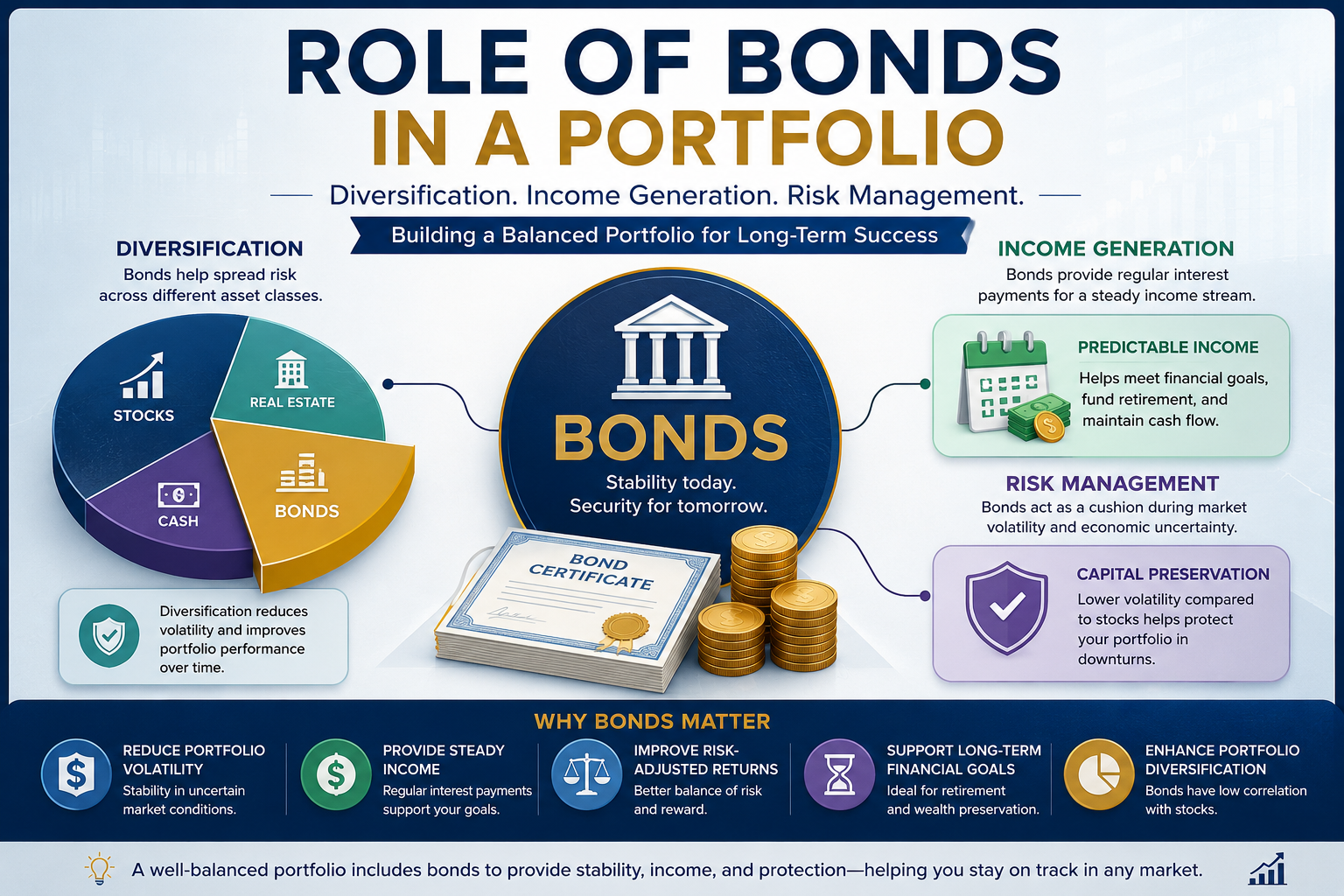
The Role of Bonds in a Portfolio is one of the most important concepts in modern investing. Bonds help investors generate income, reduce risk, preserve capital, and create a balanced investment strategy that can withstand different market conditions.
When most people think about investing, they immediately think about stocks. Stocks receive most of the media attention because they can generate high returns, create millionaires, and move dramatically during market booms and crashes. However, professional investors, retirement planners, pension funds, insurance companies, and wealthy families rarely build portfolios using stocks alone. Instead, they combine stocks with another major asset class: bonds.
Bonds play a critical role in portfolio construction because they help investors manage risk, preserve capital, generate stable income, and reduce overall volatility. In countries such as the United States, United Kingdom, Canada, and Australia, bonds are foundational components of retirement portfolios, pension systems, institutional investing, and wealth management strategies.
Understanding bonds is essential for anyone who wants to build long-term wealth while controlling financial risk. During economic crises, stock market crashes, recessions, and periods of uncertainty, bonds often act as stabilizers within an investment portfolio.
This article explains the role of bonds in a portfolio in detail, including:
- What bonds are
- How bonds work
- Types of bonds
- Benefits and risks of bonds
- Bond terminology
- Bond allocation strategies
- Bonds vs stocks
- How bonds reduce portfolio risk
- Interest rates and bond prices
- Real-world case studies
- Retirement portfolio examples
- Modern portfolio theory and bonds
- Mistakes investors make with bonds
- Bond investing strategies for Tier-1 countries
What Is a Bond?
A bond is a fixed-income investment where an investor lends money to a government, corporation, or institution in exchange for regular interest payments and repayment of the principal at maturity.
In simple terms:
- You lend money
- The issuer pays interest
- You receive your original investment back later
A bond is essentially a loan.
Simple Example of a Bond
Suppose the U.S. government issues a 10-year bond with:
- Face value: $1,000
- Interest rate: 5%
- Maturity: 10 years
If you buy this bond:
- You lend $1,000
- You receive $50 annually
- After 10 years, you get your $1,000 back
The annual interest payment is called the coupon payment.
Why Governments and Companies Issue Bonds
Organizations issue bonds to raise money.
Governments use bonds for:
- Infrastructure
- Defense
- Healthcare
- Public services
- Debt refinancing
Companies issue bonds for:
- Expansion
- Research
- Acquisitions
- Operations
- Debt management
Instead of borrowing from banks, issuers borrow from investors.
Important Bond Terms Explained
1. Face Value (Par Value)
The original amount of the bond.
Usually:
- $1,000 in the U.S.
- £100 in the UK
- CAD 1,000 in Canada
- AUD 1,000 in Australia
2. Coupon Rate
The annual interest paid by the bond.
Example:
A 4% coupon on a $1,000 bond pays $40 yearly.
3. Yield
Yield measures the return investors earn from a bond.
Different yields include:
- Current yield
- Yield to maturity
- Real yield
Yield is one of the most important concepts in bond investing.
4. Maturity
The date when the bond issuer repays the principal.
Examples:
- 2-year bond
- 10-year bond
- 30-year bond
5. Credit Rating
A measure of the issuer’s financial strength.
Major rating agencies include:
- Moody’s
- S&P Global
- Fitch Ratings
Higher ratings usually mean lower risk.
Types of Bonds
1. Government Bonds
Issued by national governments.
Examples include:
- U.S. Treasury Bonds
- UK Gilts
- Canadian Government Bonds
- Australian Government Bonds
Government bonds are usually considered safer than corporate bonds.
2. Corporate Bonds
Issued by companies.
Examples:
- Technology companies
- Banks
- Utility companies
Corporate bonds usually offer higher yields because they carry more risk.
3. Municipal Bonds
Issued by local governments or municipalities.
Common in the United States.
Used to fund:
- Schools
- Roads
- Hospitals
- Infrastructure
Many municipal bonds offer tax advantages.
4. High-Yield Bonds
Also called junk bonds.
These bonds:
- Offer higher interest
- Carry higher default risk
Used by:
- Risk-tolerant investors
- Income-focused portfolios
5. Inflation-Protected Bonds
These bonds adjust with inflation.
Examples:
- TIPS in the U.S.
- Inflation-linked gilts in the UK
They help protect purchasing power.
Why Bonds Matter in a Portfolio
The primary role of bonds is not maximizing returns.
The primary roles are:
- Capital preservation
- Income generation
- Risk reduction
- Portfolio diversification
- Stability during stock crashes
Bonds and Portfolio Diversification
Diversification means spreading investments across different asset classes.
A diversified portfolio may include:
- Stocks
- Bonds
- Real estate
- Cash
- Commodities
Bonds often move differently from stocks.
This lower correlation helps stabilize portfolios.
Understanding Correlation
Correlation measures how assets move relative to one another.
- Positive correlation = move together
- Negative correlation = move opposite
- Low correlation = move independently
Historically, high-quality bonds often had low or negative correlation with stocks during market stress.
How Bonds Reduce Portfolio Volatility
Volatility means how much investments fluctuate in value.
Stocks:
- Higher volatility
- Higher growth potential
Bonds:
- Lower volatility
- More stable returns
Adding bonds reduces large portfolio swings.
Example: Stock-Only Portfolio vs Balanced Portfolio
Portfolio A
- 100% stocks
Portfolio B
- 60% stocks
- 40% bonds
During a stock market crash:
- Portfolio A may decline 40%
- Portfolio B may decline 20%–25%
The balanced portfolio experiences smaller losses.
The Psychological Benefit of Bonds
One overlooked benefit of bonds is behavioral stability.
During bear markets:
- Many investors panic
- They sell stocks at losses
- Emotional decisions destroy long-term wealth
Bonds help investors stay calm because:
- Portfolio declines are smaller
- Income continues
- Stability improves confidence
This psychological advantage is extremely important.
Bonds as an Income Source
Bonds generate predictable cash flow.
This is valuable for:
- Retirees
- Pension funds
- Conservative investors
- Income-focused portfolios
Unlike stocks, which may cut dividends, many bonds provide contractual interest payments.
Bonds in Retirement Portfolios
Retirement investing focuses on:
- Income stability
- Risk management
- Capital preservation
As investors age, bonds become increasingly important.
The Traditional 60/40 Portfolio
The classic retirement portfolio is:
- 60% stocks
- 40% bonds
This strategy became popular because it balanced:
- Growth
- Income
- Risk reduction
Historically, the 60/40 portfolio performed well during many economic cycles.
Case Study: 2008 Financial Crisis
What Happened?
The 2008 crisis caused:
- Massive stock declines
- Bank failures
- Housing market collapse
The severely impacted investors worldwide.
Stock Market Performance
The S&P 500 fell approximately 37% in 2008.
Many investors panicked.
Bond Performance
High-quality U.S. Treasury bonds performed relatively well because investors sought safety.
Portfolios containing bonds:
- Experienced smaller losses
- Recovered faster
- Maintained liquidity
This demonstrated bonds’ defensive role.
Bonds During Recessions
During recessions:
- Businesses slow down
- Unemployment rises
- Stock earnings decline
Central banks often reduce interest rates to stimulate the economy.
Lower rates can increase bond prices, especially for high-quality bonds.
Understanding Interest Rates and Bonds
Interest rates are one of the most important drivers of bond prices.
Key Rule
When interest rates rise:
- Bond prices fall
When interest rates fall:
- Bond prices rise
This inverse relationship is fundamental to bond investing.
Why Bond Prices Fall When Rates Rise
Suppose:
- You own a 3% bond
- New bonds now pay 5%
Your bond becomes less attractive.
To compete:
- Your bond’s price falls
This adjusts the yield upward.
Duration Explained
Duration measures bond sensitivity to interest rate changes.
Long-duration bonds:
- More sensitive to rates
- Higher volatility
Short-duration bonds:
- Less sensitive
- More stable
Example of Duration Risk
Short-Term Bond
- 2-year maturity
- Smaller price swings
Long-Term Bond
- 30-year maturity
- Larger price swings
Long-term bonds can decline sharply when rates rise.
Case Study: 2022 Bond Market Decline
In 2022:
- Inflation surged
- Central banks aggressively raised rates
Both stocks and bonds declined simultaneously.
This challenged the belief that bonds always protect portfolios.
However:
- Bonds still provided income
- Future yields improved
- Long-term diversification benefits remained relevant
Inflation and Bonds
Inflation reduces purchasing power.
If inflation exceeds bond yields:
- Real returns become negative
Example:
- Bond yield = 3%
- Inflation = 5%
- Real return = -2%
This is inflation risk.
Inflation-Protected Securities
Governments created inflation-linked bonds to address this issue.
Examples:
- TIPS (Treasury Inflation-Protected Securities)
- Inflation-indexed bonds
These securities adjust principal values with inflation.
Bonds vs Stocks
| Feature | Bonds | Stocks |
|---|---|---|
| Ownership | Loan | Ownership stake |
| Income | Fixed interest | Dividends |
| Volatility | Lower | Higher |
| Growth Potential | Lower | Higher |
| Priority in Bankruptcy | Higher | Lower |
| Stability | More stable | More volatile |
Risk Types in Bond Investing
1. Interest Rate Risk
Bond prices fall when rates rise.
2. Credit Risk
Issuer may default.
Higher in:
- Corporate bonds
- High-yield bonds
Lower in:
- Government bonds
3. Inflation Risk
Inflation reduces real returns.
4. Reinvestment Risk
Future interest payments may be reinvested at lower rates.
5. Liquidity Risk
Some bonds are difficult to sell quickly.
Bond Ratings Explained
Investment-grade bonds:
- Lower default risk
- Lower yields
Junk bonds:
- Higher default risk
- Higher yields
Ratings categories:
- AAA
- AA
- A
- BBB
- BB
- B
- CCC
BBB and above are generally investment grade.
Investment Grade vs High Yield
Investment Grade Bonds
Suitable for:
- Conservative investors
- Retirees
- Stability-focused portfolios
High-Yield Bonds
Suitable for:
- Aggressive investors
- Higher income strategies
But they behave more like stocks during crises.
Bond Funds vs Individual Bonds
Individual Bonds
Advantages:
- Predictable maturity
- Known cash flow
Disadvantages:
- Less diversification
- More complex
Bond Funds
Advantages:
- Diversification
- Professional management
- Easy access
Disadvantages:
- No fixed maturity date
ETFs and Bond Investing
Bond ETFs became extremely popular.
Major providers include:
- Vanguard
- BlackRock
- State Street Global Advisors
Bond ETFs provide:
- Liquidity
- Diversification
- Low fees
Case Study: Retiree Portfolio
Investor Profile
Name: Sarah
Age: 67
Country: United States
Goal: Retirement income
Portfolio Allocation
- 45% stocks
- 50% bonds
- 5% cash
Why Bonds Matter Here
Sarah depends on her portfolio for living expenses.
Bonds provide:
- Predictable income
- Lower volatility
- Stability during market downturns
Without bonds, retirement withdrawals during crashes could permanently damage her portfolio.
Sequence of Returns Risk
This risk occurs when:
- Retirees withdraw money
- Markets decline early in retirement
Poor early returns can significantly reduce portfolio longevity.
Bonds help reduce this risk.
Bond Ladder Strategy
A bond ladder involves buying bonds with different maturities.
Example:
- 1-year bond
- 3-year bond
- 5-year bond
- 10-year bond
Benefits:
- Reduced reinvestment risk
- Regular cash flow
- Interest rate management
The Role of Bonds for Young Investors
Young investors often focus heavily on stocks.
However, bonds can still help:
- Reduce volatility
- Improve diversification
- Provide stability
Some younger investors use:
- 10%–20% bond allocations
Others prefer nearly all-stock portfolios.
Age-Based Bond Allocation
Traditional rule:
Bond percentage = your age
Example:
- Age 40 = 40% bonds
- Age 60 = 60% bonds
Modern investors sometimes use lower bond allocations because:
- People live longer
- Inflation risk increased
- Interest rates vary
Modern Portfolio Theory and Bonds
Harry Markowitz developed Modern Portfolio Theory (MPT).
Core idea:
- Investors should maximize return for a given level of risk.
Bonds improve portfolio efficiency because they:
- Reduce volatility
- Improve diversification
- Stabilize returns
Efficient Frontier
The efficient frontier represents portfolios offering:
- Maximum expected return
- For a specific risk level
Bonds help optimize portfolio positioning.
Case Study: Balanced Investor
Investor
Michael, age 45, Canada
Portfolio
- 70% global stocks
- 25% government bonds
- 5% cash
During Market Decline
Stocks fall 30%.
Government bonds rise 8%.
Overall portfolio loss becomes much smaller than a stock-only portfolio.
Michael avoids panic selling and stays invested.
Bonds and Central Banks
Central banks strongly influence bond markets.
Examples include:
- Federal Reserve
- Bank of England
- Bank of Canada
- Reserve Bank of Australia
Their interest rate policies directly affect bond yields and prices.
Quantitative Easing and Bonds
After the 2008 crisis, central banks used quantitative easing (QE).
This involved:
- Buying government bonds
- Lowering long-term interest rates
- Supporting economic growth
QE significantly influenced global bond markets.
International Bonds
Investors can also buy foreign bonds.
Benefits:
- Geographic diversification
- Currency exposure
- Different interest rate cycles
Risks:
- Currency fluctuations
- Political risk
- Foreign economic instability
Municipal Bonds and Taxes
In the U.S., municipal bonds often provide tax-free income.
This is attractive for:
- High-income earners
- Wealth preservation strategies
Tax-equivalent yield becomes important when comparing investments.
Bond Allocation by Risk Profile
Conservative Investor
- 70% bonds
- 25% stocks
- 5% cash
Goal:
- Capital preservation
Moderate Investor
- 40% bonds
- 55% stocks
- 5% cash
Goal:
- Balanced growth and stability
Aggressive Investor
- 10% bonds
- 85% stocks
- 5% alternatives
Goal:
- Maximum long-term growth
Common Mistakes Investors Make with Bonds
1. Ignoring Inflation
Low yields may not beat inflation.
2. Chasing Yield
Higher yield often means higher risk.
3. Overconcentration
Owning too many long-term bonds can increase rate risk.
4. Not Diversifying
Holding only one bond issuer increases credit risk.
5. Panic Selling
Bond prices fluctuate too.
Investors should understand bond behavior before investing.
How Wealthy Investors Use Bonds
High-net-worth investors often use bonds for:
- Capital preservation
- Income generation
- Tax planning
- Risk balancing
- Liquidity management
Institutional investors frequently maintain significant bond allocations.
Pension Funds and Bonds
Pension funds rely heavily on bonds because they need:
- Stable income
- Predictable liabilities
- Lower volatility
Many pension systems in Tier-1 countries allocate large percentages to bonds.
Bonds During Economic Uncertainty
When uncertainty rises:
- Investors seek safety
- Demand for government bonds often increases
This phenomenon is called a flight to safety.
Are Bonds Still Relevant Today?
Some investors argue:
- Stocks outperform bonds long term
- Rising rates hurt bond prices
- Inflation reduces real returns
However, bonds remain relevant because they:
- Reduce risk
- Provide income
- Improve diversification
- Stabilize retirement portfolios
The role of bonds is not to outperform stocks.
The role is to create balance.
Example Portfolio Comparisons
Portfolio 1 — 100% Stocks
Expected:
- Higher growth
- Larger crashes
- Greater emotional stress
Portfolio 2 — 80/20
Expected:
- Strong growth
- Some stability
Portfolio 3 — 60/40
Expected:
- Balanced performance
- Moderate volatility
Portfolio 4 — 40/60
Expected:
- Lower growth
- Higher stability
- Stronger income focus
The Future of Bond Investing
Future bond investing may be influenced by:
- Higher interest rates
- Persistent inflation
- Aging populations
- Government debt levels
- Central bank policies
Technology and ETFs are also transforming access to bond markets.
Key Lessons About Bonds
Bonds Are Not Designed for Maximum Growth
Their primary purpose is:
- Stability
- Income
- Diversification
Bonds Help Investors Stay Invested
Reducing emotional panic can improve long-term outcomes.
Bonds Reduce Portfolio Risk
Balanced portfolios often experience smaller drawdowns.
Bonds Are Critical for Retirement Planning
Income and capital preservation become increasingly important with age.
Bond Allocation Depends on Personal Goals
There is no universal perfect allocation.
Factors include:
- Age
- Risk tolerance
- Income needs
- Time horizon
- Financial goals
Final Thoughts
Bonds are one of the foundational building blocks of intelligent portfolio construction. While they may appear less exciting than stocks, their role is incredibly important in managing risk, generating reliable income, protecting capital, and improving long-term investing discipline.
For investors in the United States, United Kingdom, Canada, and Australia, bonds remain essential components of retirement accounts, pension funds, balanced portfolios, and wealth preservation strategies.
A well-designed portfolio is not built solely for maximum returns. It is built for survivability across economic cycles, recessions, inflationary periods, market crashes, and changing financial conditions.
Stocks provide growth.
Bonds provide stability.
Together, they create balance — and balance is often the key to long-term investing success.