What Are Stock Buybacks?
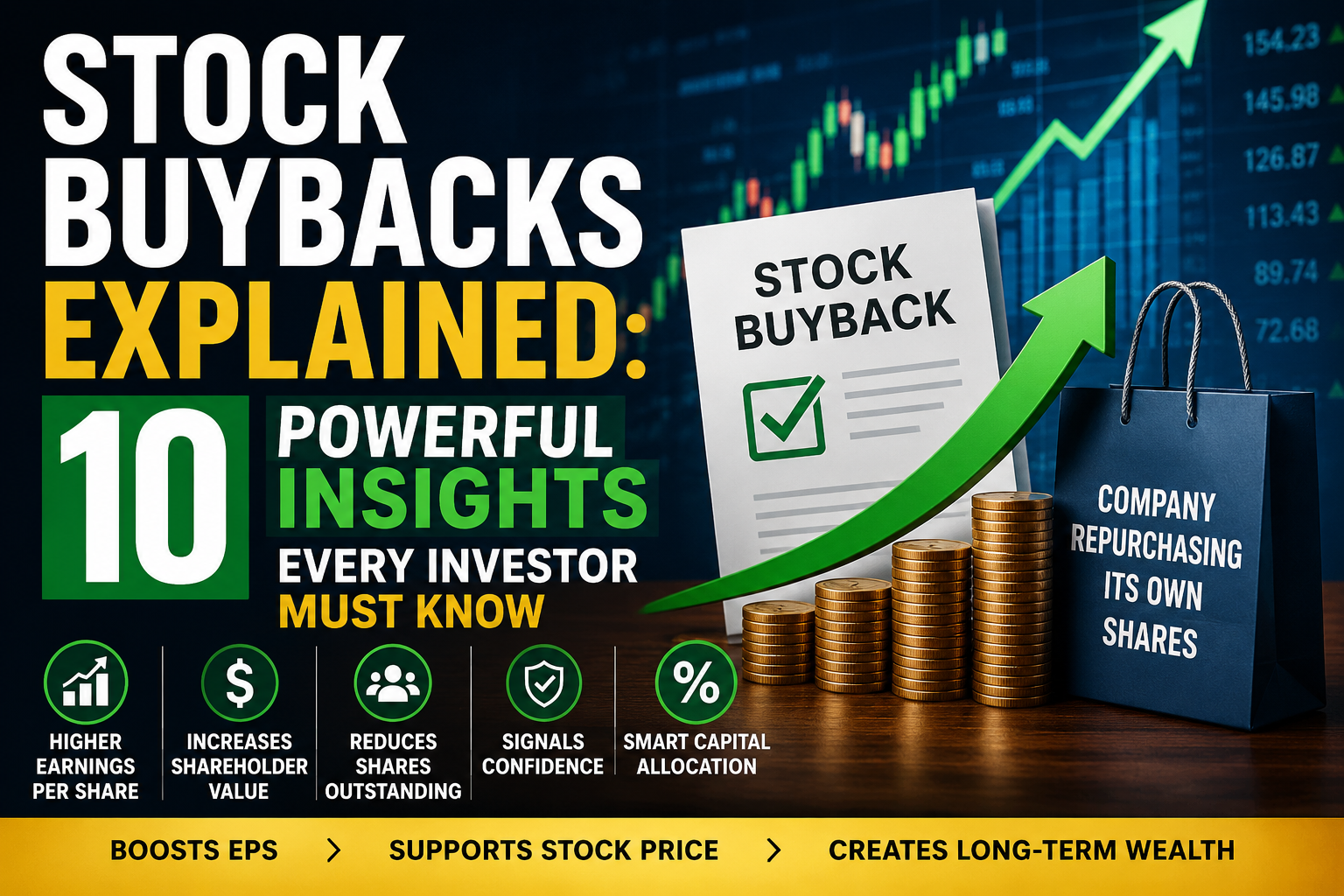
Stock Buybacks Explained is one of the most important concepts in modern investing and corporate finance. Stock buybacks occur when a company repurchases its own shares from the stock market, reducing total outstanding shares and increasing ownership value for remaining shareholders.
For investors in Tier-1 countries like the United States, United Kingdom, Canada, and Australia, stock buybacks play a major role in wealth creation, ETF performance, pension funds, and long-term compounding strategies.
Stocks buybacks, also called share repurchases, are one of the most important concepts in modern investing and corporate finance. In simple terms, a stock buyback happens when a company purchases its own shares from the stock market. After buying those shares, the company usually cancels them or keeps them as treasury stock, reducing the total number of shares available to investors.
A buyback can:
- Increase earnings per share (EPS)
- Improve stock price performance
- Return capital to shareholders
- Signal management confidence
- Reduce dilution from employee stock options
However, buybacks can also be controversial because some companies use them poorly, especially when they borrow money to repurchase shares or prioritize buybacks over innovation and employee investment.
This guide explains stock buybacks in depth with:
- Definitions and financial terms
- Step-by-step explanations
- Real-world examples
- Case studies
- Advantages and disadvantages
- Impact on investors
- Historical events
- Buybacks in Tier-1 economies
Understanding Stocks First
Before understanding buybacks, you must understand what a stock is.
A stock represents ownership in a company.
When you buy one share of a company, you become a partial owner of that business.
For example:
- If a company has 1 million shares outstanding
- And you own 10,000 shares
- You own 1% of the company
Companies issue shares to raise capital for:
- Expansion
- Research
- Hiring employees
- Building factories
- Paying debt
Public companies trade on stock exchanges such as:
- New York Stock Exchange
- NASDAQ
- London Stock Exchange
- Toronto Stock Exchange
- Australian Securities Exchange
What Is a Stock Buyback?
A stock buyback occurs when a company buys back its own shares from investors.
The company uses:
- Cash reserves
- Profits
- Or borrowed money
to purchase shares from the open market.
After repurchasing shares:
- Total outstanding shares decline
- Existing shareholders own a larger percentage of the company
- Financial ratios often improve
Simple Example of a Buyback
Imagine a company called ABC Corp.
Before Buyback
- Total profit = $100 million
- Shares outstanding = 100 million shares
Earnings per share:
EPS=\frac{100\text{ million}}{100\text{ million}}=1
EPS = $1 per share.
Now ABC Corp buys back 20 million shares.
After Buyback
- Profit remains = $100 million
- Shares outstanding = 80 million
New EPS:
EPS=\frac{100\text{ million}}{80\text{ million}}=1.25
EPS rises from $1 to $1.25 even though total profit did not change.
This is one reason investors often like buybacks.
Key Terms Explained
1. Shares Outstanding
This means the total number of shares currently owned by investors.
If a company reduces shares outstanding through buybacks:
- Ownership concentration increases
- EPS rises
2. Treasury Shares
Shares repurchased by the company but not cancelled are called treasury shares.
These shares:
- Do not receive dividends
- Do not vote
- Are not counted in EPS calculations
3. Earnings Per Share (EPS)
EPS measures company profit allocated to each share.
Formula:
EPS=\frac{Net\ Income}{Shares\ Outstanding}
Higher EPS often attracts investors because it suggests stronger profitability per share.
4. Capital Allocation
Capital allocation means how management uses company money.
Management can:
- Invest in growth
- Pay dividends
- Acquire businesses
- Reduce debt
- Buy back shares
Great capital allocation often creates long-term shareholder wealth.
Why Companies Do Stock Buybacks
Companies buy back stock for several reasons.
1. Returning Cash to Shareholders
A buyback is an alternative to dividends.
Instead of paying cash directly:
- The company reduces share count
- Investors benefit through higher stock value
This method is often tax-efficient in countries like the United States.
2. Management Thinks Stock Is Undervalued
Executives may believe the stock price is too low.
If management believes:
- Intrinsic value = $200
- Current market price = $140
buying shares at $140 may create value for remaining shareholders.
This is similar to purchasing an asset below its real worth.
3. Increasing EPS
As shown earlier:
- Lower share count
- Higher EPS
Higher EPS may improve:
- Investor sentiment
- Analyst ratings
- Stock valuation multiples
4. Offsetting Employee Stock Compensation
Technology companies often issue stock options to employees.
Over time, this increases share count and dilutes investors.
Buybacks help offset dilution.
Major companies using this strategy include:
- Apple
- Microsoft
- Alphabet
- Meta Platforms
5. Improving Financial Ratios
Buybacks can improve:
- EPS
- Return on Equity (ROE)
- Return on Assets (ROA)
These metrics influence institutional investors and Wall Street analysts.
How Stock Buybacks Work
There are several methods companies use.
1. Open Market Buybacks
This is the most common method.
The company purchases shares gradually from the stock exchange, just like ordinary investors.
Advantages:
- Flexible
- Easy to execute
- Lower regulatory complexity
2. Tender Offer
The company offers shareholders:
- A fixed price
- Usually above market price
Investors can choose whether to sell.
Example:
- Market price = $50
- Company offers = $60
This encourages shareholders to tender shares.
3. Dutch Auction
Shareholders specify the price at which they are willing to sell.
The company selects the lowest price that allows enough shares to be repurchased.
4. Private Negotiated Buyback
A company buys shares directly from a large investor or institution.
Buybacks vs Dividends
Both methods return value to shareholders, but they work differently.
| Feature | Buybacks | Dividends |
|---|---|---|
| Cash paid directly? | No | Yes |
| Tax efficient? | Often yes | Sometimes less efficient |
| Flexible? | Yes | Less flexible |
| Reduces shares? | Yes | No |
| Signals confidence? | Often | Stable income signal |
Why Investors Prefer Buybacks in Tier-1 Countries
In countries like the United States, capital gains taxes can be lower than dividend taxes for some investors.
Therefore:
- Buybacks may create better after-tax returns
- Long-term investors benefit from appreciation
Large pension funds and retirement accounts also benefit from share price appreciation.
The Psychology Behind Buybacks
Buybacks often signal:
- Confidence from management
- Strong cash flow
- Business stability
If executives spend billions buying shares, investors may assume:
- Management believes the company is undervalued
- Future earnings may remain strong
This can boost market confidence.
Case Study: Apple’s Massive Buyback Program
One of the most famous buyback programs comes from Apple.
Background
Apple generated enormous profits from:
- iPhone sales
- Services
- Hardware ecosystem
The company accumulated hundreds of billions in cash reserves.
Instead of keeping all the cash idle, Apple:
- Paid dividends
- Repurchased shares aggressively
Apple’s Buyback Impact
Apple spent hundreds of billions on buybacks over multiple years.
Effects included:
- Reduced share count dramatically
- Increased EPS
- Supported stock price growth
- Improved shareholder returns
Even when revenue growth slowed temporarily, EPS often continued rising because fewer shares existed.
This made Apple one of the most shareholder-friendly companies in the world.
Example Calculation
Suppose:
- Net income = $100 billion
- Shares outstanding = 20 billion
EPS:
EPS=\frac{100}{20}=5
After buybacks reduce shares to 16 billion:
EPS=\frac{100}{16}=6.25
EPS rises 25% without increasing profit.
Case Study: IBM Buyback Criticism
IBM provides an example of controversial buybacks.
For years, IBM used enormous amounts of cash for share repurchases.
Critics argued:
- Too much money went to buybacks
- Too little invested in innovation
- Competitive position weakened
Eventually:
- Revenue growth slowed
- Stock performance disappointed investors
This shows buybacks are not always beneficial.
Case Study: Boeing During Crisis
Boeing faced criticism after major buybacks before financial difficulties.
Before crises:
- Boeing spent heavily repurchasing shares
Later:
- The company needed financial support
- Critics argued money should have strengthened the balance sheet
This became a major public debate in the United States.
Advantages of Stock Buybacks
1. Increases Shareholder Ownership
Fewer shares mean remaining shareholders own a larger portion of the business.
2. Improves EPS
As share count falls:
- EPS rises
- Valuation metrics improve
3. Tax Efficiency
In many Tier-1 countries:
- Capital gains taxes may be lower
- Investors control when they sell
This creates flexibility.
4. Signals Management Confidence
A buyback may indicate management believes:
- Stock price is attractive
- Future growth prospects remain strong
5. Flexible Capital Return
Unlike dividends:
- Buybacks can start or stop anytime
Companies avoid the pressure of maintaining permanent dividend increases.
Disadvantages of Stock Buybacks
1. Artificial EPS Growth
Buybacks can increase EPS even without business improvement.
This may:
- Mislead investors
- Hide weak revenue growth
2. Poor Timing
Some companies buy back shares at extremely high prices.
If stock later falls:
- Shareholder value gets destroyed
Good buybacks depend heavily on valuation discipline.
3. Increased Debt
Some corporations borrow money for buybacks.
This can:
- Increase financial risk
- Weaken balance sheets
Especially dangerous during recessions.
4. Less Investment in Innovation
Critics argue some companies prioritize:
- Short-term stock price
instead of: - Research
- Employee development
- Long-term expansion
5. Executive Compensation Concerns
Many executives receive stock-based compensation tied to:
- EPS targets
- Stock price performance
Critics say buybacks can artificially boost these metrics.
How Buybacks Affect Stock Prices
Buybacks often support prices through:
1. Reduced Supply
Fewer shares available can increase scarcity.
Basic supply-demand economics suggests:
- Lower supply
- Higher prices
2. Improved Financial Metrics
Higher EPS can justify higher valuations.
3. Investor Sentiment
Buyback announcements may create bullish market psychology.
Market Reactions to Buyback Announcements
Stocks often rise after buyback announcements because investors interpret them as:
- Positive management outlook
- Strong cash generation
- Undervaluation signal
However, long-term success depends on:
- Business fundamentals
- Timing
- Financial discipline
Buybacks During Market Crashes
Some companies make excellent buybacks during recessions.
Example:
- Purchasing shares during market panic
- Buying undervalued stock cheaply
This can create enormous shareholder value later.
Warren Buffett’s View on Buybacks
Warren Buffett supports buybacks under specific conditions.
He believes buybacks are beneficial when:
- Company has excess cash
- Business remains strong
- Shares trade below intrinsic value
However, Buffett criticizes overpriced buybacks.
Berkshire Hathaway Example
Berkshire Hathaway historically avoided buybacks unless shares were undervalued.
This disciplined approach reflects value-investing principles.
Buybacks and Dilution
What Is Dilution?
Dilution occurs when companies issue more shares.
This reduces ownership percentage of existing shareholders.
Common causes:
- Employee stock options
- Convertible securities
- Secondary offerings
Buybacks can neutralize dilution.
Technology Sector and Buybacks
Major tech firms frequently repurchase shares because they:
- Generate massive free cash flow
- Issue stock compensation
- Have limited need for physical assets
Examples:
- Apple
- Microsoft
- Alphabet
Banking Sector Buybacks
Banks often use buybacks after stress tests.
Examples include:
- JPMorgan Chase
- Goldman Sachs
- Bank of America
Regulators monitor:
- Capital reserves
- Financial stability
before approving large buybacks.
Buybacks During COVID-19
During the COVID-19 crisis:
- Many governments restricted buybacks
- Especially in banking and airline sectors
Reason:
- Preserve liquidity
- Protect employment
- Strengthen financial systems
This highlighted political concerns surrounding buybacks.
Political Debate Around Buybacks
Critics claim buybacks:
- Enrich executives
- Favor Wall Street
- Increase inequality
Supporters argue:
- Shareholders own the company
- Efficient capital allocation matters
- Investors benefit broadly through retirement accounts
This debate remains active in the United States and Europe.
SEC Regulations on Buybacks
In the United States, buybacks are regulated by the:
- U.S. Securities and Exchange Commission
Companies must follow:
- Disclosure rules
- Timing restrictions
- Anti-manipulation laws
How Investors Analyze Buybacks
Investors should examine:
1. Buyback Price
Was the stock undervalued or overpriced?
2. Funding Source
Did the company use:
- Excess cash?
or - Debt?
3. Business Quality
Is the core business still strong?
4. Long-Term Growth
Did management sacrifice future investment?
5. Share Count Trend
Look at:
- Shares outstanding over years
Consistent reductions may indicate shareholder-friendly management.
Metrics Investors Should Watch
Share Count Reduction
Lower shares over time can signal effective buybacks.
Free Cash Flow
Strong free cash flow supports sustainable buybacks.
Debt-to-Equity Ratio
High debt-funded buybacks increase risk.
Return on Invested Capital (ROIC)
This measures capital efficiency.
Example of a Smart Buyback
Imagine:
- Stock trades at $40
- Intrinsic value estimated at $70
- Company has strong cash reserves
- Minimal debt
Buying shares here may create major long-term value.
Example of a Bad Buyback
Imagine:
- Stock trades at record highs
- Company revenue declining
- Debt rising rapidly
Repurchasing shares may destroy shareholder value.
Buybacks vs Growth Investment
A mature company with limited expansion opportunities may prefer buybacks.
A fast-growing company may benefit more from:
- Research
- Expansion
- Acquisitions
The correct choice depends on:
- Industry
- Growth stage
- Competitive landscape
Buybacks in Retirement Investing
In Tier-1 countries, retirement systems heavily invest in stocks.
Examples include:
- 401(k) plans in the United States
- Pension funds in Canada
- Superannuation funds in Australia
Buybacks indirectly benefit millions of retirees through higher corporate earnings per share and stock appreciation.
Historical Growth of Buybacks
Buybacks became extremely popular in the late 20th century.
Especially after regulatory changes in the United States during the 1980s.
Since then:
- Trillions of dollars have been spent on repurchases
Large-cap American companies remain the biggest buyers.
Are Buybacks Good or Bad?
The answer depends on execution.
Buybacks Are Good When:
- Shares are undervalued
- Business fundamentals are strong
- Company has excess cash
- Debt levels remain healthy
Buybacks Are Bad When:
- Shares are overpriced
- Debt becomes excessive
- Innovation suffers
- Executives manipulate metrics
Practical Investor Lessons
1. Don’t Judge Buybacks Alone
A buyback announcement is not automatically bullish.
Study:
- Financial statements
- Debt levels
- Valuation
2. Focus on Capital Allocation
Great management teams allocate capital wisely.
Poor capital allocation destroys shareholder wealth.
3. Watch Long-Term Trends
A decade of disciplined buybacks can create enormous shareholder returns.
4. Understand Incentives
Executive compensation structures matter.
Final Thoughts
Stock buybacks are one of the most powerful and controversial tools in corporate finance. A buyback reduces the number of outstanding shares by allowing a company to repurchase its own stock from the market. This often increases earnings per share, boosts shareholder ownership, and supports stock prices.
For investors in advanced economies such as the United States, United Kingdom, Canada, and Australia, buybacks are deeply connected to retirement investing, ETF performance, pension funds, and long-term wealth creation.
However, buybacks are not automatically good. Their success depends on:
- Company valuation
- Financial strength
- Management discipline
- Long-term strategy
The best buybacks occur when financially strong companies repurchase undervalued shares while continuing to invest in future growth. The worst buybacks happen when companies borrow heavily, ignore innovation, and repurchase overpriced stock merely to inflate short-term metrics.
Understanding stock buybacks helps investors evaluate:
- Corporate management quality
- Capital allocation decisions
- Long-term shareholder value creation
For modern investors, mastering this concept is essential for analyzing companies, understanding market behavior, and building long-term investment success.