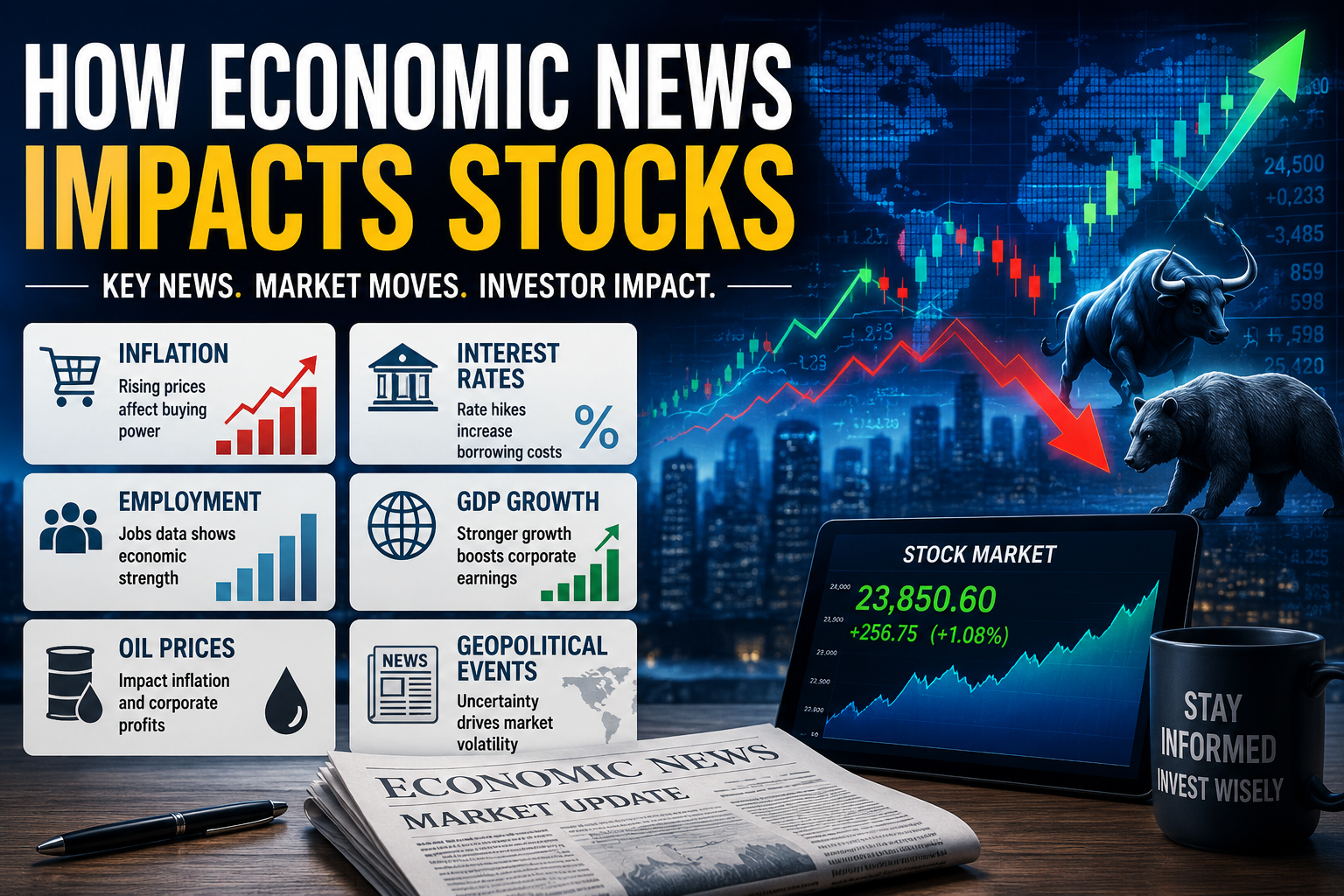
Introduction: How Economic News Impacts Stocks
How Economic News Impacts Stocks is an essential concept for anyone who wants to understand financial markets and make informed investment decisions. Stock prices respond to economic reports, inflation figures, interest rate decisions, employment data, government policies, and unexpected global events. These developments influence what investors expect companies to earn in the future and how much they are willing to pay for shares today.
For investors in the United States, United Kingdom, Canada, and Australia, understanding economic news is particularly important because these markets are connected through international trade, global investment flows, commodity prices, and central bank policies.
Investors comparing economic conditions across countries can also consult World Bank Data for indicators covering economic growth, inflation, trade, and other aspects of national and global development.
However, good economic news does not always make stock prices rise, and bad news does not always make them fall. Markets respond to the difference between what investors expected and what actually happened, as well as the likely consequences for corporate profits, inflation, and interest rates.
This comprehensive guide explains the major economic indicators, their effects on different industries, and real historical case studies that demonstrate how economic news influences stock prices.
Understanding how economic news impacts stocks starts with connecting each announcement to investor expectations, corporate earnings, interest rates, and stock valuations. This approach helps investors distinguish meaningful changes in the economic outlook from headlines that may have little lasting effect.
What Is Economic News?
Economic news includes announcements, statistics, government decisions, and significant events that reveal information about the financial condition of a country or the global economy.
Examples include inflation reports, employment statistics, gross domestic product (GDP) growth, central bank announcements, retail sales, housing data, oil prices, and international trade policies.
Economic news matters because it helps investors estimate whether businesses are likely to grow, maintain their profits, or experience financial difficulties.
For example, if consumer spending increases, retailers may sell more products. If borrowing costs rise sharply, companies may postpone expansion plans. Both developments can change investors’ expectations and influence stock prices.
Important Economic Terms Every Investor Should Understand
- Economic indicator: A statistic that helps measure economic conditions, such as inflation or unemployment.
- Market expectation: What investors collectively anticipate before new information becomes available.
- Economic surprise: The difference between an announced economic result and the result investors expected.
- Corporate earnings: The profits a company generates after accounting for its expenses.
- Market volatility: The degree to which stock prices fluctuate over a period.
- Investor sentiment: The overall attitude of investors toward the market, ranging from optimism to pessimism.
- Market valuation: The price investors are willing to pay for a company’s earnings, assets, or expected growth.
Understanding these terms helps investors interpret economic headlines instead of reacting to them emotionally.
Why Does Economic News Move Stock Prices?
Stock prices reflect expectations about future cash flows, business risks, and the return investors require for holding an investment.
Economic news affects all three.
First, stronger economic activity can increase sales and earnings. Second, changes in interest rates can alter the value of future profits. Third, uncertainty can cause investors to demand a higher return for accepting risk.
Consider a hypothetical publicly traded retailer whose shares trade at $100. Investors expect its annual earnings to grow by 10%. A new economic report reveals that consumer spending is weakening, making the forecast less convincing. Investors may reduce their earnings expectations and decide that $100 is no longer an attractive price.
The shares could decline even if the company is still profitable.
The reverse can also happen. If economic conditions turn out better than expected, investors may increase their earnings forecasts and pay more for the same business. This explains how economic news impacts stocks even when a company has not released new financial results. Investors can change their estimates of future revenue, profits, and risk as soon as new economic information changes their expectations.
How Expectations Influence Market Reactions
Suppose economists forecast annual inflation of 3%.
- If inflation comes in at 2.5%, investors may view the result positively because price pressures are easing.
- If inflation comes in at 3%, the result may produce a limited reaction because it matches expectations.
- If inflation comes in at 3.8%, investors may worry that interest rates will remain higher for longer.
These are illustrative figures, not predictions of actual market returns. The real reaction depends on the details of the report, previous data revisions, central bank guidance, and what investors have already priced in.
The essential principle is that markets respond to new information relative to expectations, not simply whether a headline sounds good or bad.
How Economic News Impacts Stocks Through Inflation
Inflation is the rate at which the general price level of goods and services rises over time. When inflation increases, money loses purchasing power because the same amount buys fewer goods and services.
Two widely followed US inflation indicators are the Consumer Price Index (CPI) and Producer Price Index (PPI).
The CPI measures changes in prices paid by consumers for a basket of goods and services. The PPI measures prices received by domestic producers for their output, depending on the specific index.
Official US inflation data is published by the Bureau of Labor Statistics, which provides detailed information about the Consumer Price Index (CPI) and changes in consumer prices.
Why Rising Inflation Can Hurt Stocks
High or unexpectedly persistent inflation can affect stocks through several channels.
Higher business costs: Companies may pay more for energy, transport, materials, wages, and rent.
Lower consumer purchasing power: Households may have less money available for non-essential purchases.
Higher interest rates: Central banks may raise policy rates or maintain restrictive conditions to bring inflation under control.
Lower profit margins: Businesses that cannot pass higher costs to customers may earn less profit from each sale.
For example, an airline facing higher jet fuel costs may see its expenses increase. If competition prevents it from raising ticket prices sufficiently, its profit margins may shrink.
However, inflation does not affect every company equally. Businesses with strong pricing power, low debt, or products that remain in demand may cope better than highly leveraged companies with limited pricing flexibility.
Inflation therefore illustrates how economic news impacts stocks through both company costs and monetary policy. Investors should consider whether price pressures are easing, whether profit margins are changing, and how the latest data may influence central-bank decisions.
Can Falling Inflation Make Stocks Rise?
Yes, but the context matters.
Falling inflation can support stock prices if it reduces pressure on interest rates without causing a severe economic slowdown. However, if inflation falls because demand is collapsing and unemployment is rising, investors may become concerned about falling earnings.
This distinction is important: investors want sustainable economic growth with manageable inflation, rather than simply the lowest possible inflation figure.
How Interest Rates Affect Stock Prices
Interest rates represent the cost of borrowing money and, in some circumstances, the return available on cash and interest-bearing investments.
Central banks influence short-term interest rates through monetary policy. Examples include the Federal Reserve in the US, the Bank of England in the UK, the Bank of In the United States, the Bureau of Economic Analysis publishes GDP estimates. Other countries have their own official statistical agencies., and the Reserve Bank of Australia.
Why Higher Interest Rates Can Pressure Stocks
Higher interest rates can influence companies and investors in several ways:
- Businesses may pay more to finance operations and expansion.
- Households may face higher mortgage, credit card, and other borrowing costs.
- Consumers may reduce discretionary spending.
- Bonds and cash-like investments may become more attractive relative to risky stocks.
- The estimated present value of future corporate cash flows may decline.
The fifth point is particularly important for growth stocks.
A discounted cash flow model estimates the value of a business by converting expected future cash flows into today’s money. A higher discount rate generally reduces the present value of those future cash flows, all else being equal.
For example, a company expected to generate most of its profits many years from now may be more sensitive to changing discount rates than a mature business producing substantial cash today.
Nevertheless, higher rates do not automatically make every stock fall. Some banks may benefit from improved lending margins, while other financial institutions may suffer from rising deposit costs, credit losses, or falling bond values.
The interest-rate channel is a key part of how economic news impacts stocks because policy expectations can change the cost of borrowing and the value investors assign to future profits. The effect depends on the size of the change, the market’s prior expectations, and each company’s financial position.
Real Case Study: The Federal Reserve’s 2022 Rate Hikes
In 2022, the Federal Reserve tightened monetary policy in response to elevated inflation and a strong labour market. Its target range for the federal funds rate increased from 0–0.25% at the beginning of the year to 4.25–4.50% in December.
The policy shift affected financial markets because investors had to reassess borrowing costs, future economic growth, and company valuations.
Technology and other growth-oriented shares faced pressure as higher discount rates reduced the present value of expected future profits. At the same time, investors considered the possibility that tighter financial conditions would slow consumer spending and business investment.
Lesson for investors: Follow not only the announced rate decision but also the central bank’s explanation of future policy. A rate increase that is smaller than expected can sometimes support stocks, while a rate hold accompanied by unexpectedly hawkish guidance can disappoint investors.
How GDP Growth and Recession News Affect Stocks
Gross domestic product, commonly called GDP, measures the value of final goods and services produced within an economy during a particular period.
GDP growth helps investors assess whether economic activity is expanding or contracting.
In the United States, the Bureau of Economic Analysis publishes GDP estimates. Other countries have their own official statistical agencies. For UK investors, the Office for National Statistics (ONS) publishes official data on GDP, inflation, employment, and other economic indicators that can help explain changes in the British economy and stock market. In Canada, Statistics Canada provides official economic data, including GDP, labour-market conditions, consumer prices, and retail activity, helping investors assess economic growth and its potential effects on Canadian businesses. Australian investors can consult the Australian Bureau of Statistics (ABS) for official GDP, employment, inflation, and household-spending data that can inform their understanding of economic conditions and potential stock market risks.
Strong GDP Growth and Corporate Earnings
When economic growth strengthens, businesses may benefit from rising demand, higher sales, improved capacity utilisation, and increased investment.
Industries such as industrial manufacturing, travel, hospitality, and consumer discretionary retail may benefit when growth translates into stronger demand.
However, very rapid growth can also create inflationary pressure. If investors believe the central bank will respond with higher interest rates, the stock market may react negatively despite the stronger GDP report.
Weak GDP Growth and Recession Risks
A recession generally involves a broad and sustained decline in economic activity, although the official definition and dating process vary by country.
Investors monitor weakening GDP, employment, industrial production, retail sales, and business confidence for signs of economic deterioration.
When a recession becomes more likely, investors may lower their estimates for company revenue and earnings. Highly indebted companies can be especially vulnerable if cash flows weaken while financing costs remain high.
For further reading, explore The AJ Times’ Stock Market and Portfolio Strategy pillar pages.
How Employment Reports Influence the Stock Market
Employment reports provide information about job creation, unemployment, working hours, and wage growth. In the United States, investors can track official employment and unemployment statistics from the Bureau of Labor Statistics, including monthly job growth, the unemployment rate, and wage trends that can influence consumer spending and expectations for interest rates.
In the United States, the monthly Employment Situation report includes nonfarm payrolls and the unemployment rate. Investors also examine wage growth because wages influence household spending and business costs.
Why Strong Jobs Data Can Be Positive or Negative
Strong employment can support the economy by giving more households an income and increasing spending capacity.
But if wage growth and labour demand remain unusually strong while inflation is elevated, investors may worry that interest rates will stay higher for longer.
Weak employment data can have the opposite dual effect. It may raise fears about declining consumer demand, yet it can also increase expectations of future interest-rate cuts.
For that reason, employment data should be considered alongside inflation, productivity, hours worked, and central bank policy.
How Consumer Spending and Retail Sales Affect Stocks
Consumer spending is the money households spend on goods and services. Retail sales provide a useful, though incomplete, indication of demand for merchandise.
When consumers have secure jobs, rising disposable income, and confidence about the future, they may spend more on clothing, electronics, restaurants, travel, and home improvements.
Companies can benefit through higher sales volumes and improved earnings, provided costs do not rise faster than revenue.
When borrowing costs increase or households become concerned about employment, consumers may reduce non-essential purchases. Retailers may respond with discounts, reducing profit margins.
Real-World Example: Discount Retailers During Economic Pressure
During periods of financial pressure, some shoppers trade down from premium products to lower-cost alternatives. Discount retailers may gain customers even as the wider retail sector struggles.
But a retailer is not guaranteed to benefit: higher labour expenses, supply-chain costs, inventory mistakes, or aggressive competition can still reduce profits.
Investor takeaway: Compare company sales growth, comparable-store sales, inventory levels, and profit margins rather than relying solely on a headline about consumer spending.
How Housing Market News Affects Stocks
Housing is connected to construction, banking, building materials, home furnishings, and household wealth.
Important indicators include home sales, housing starts, building permits, mortgage rates, and house-price trends.
When mortgage rates rise, monthly repayments on new loans generally become more expensive. That can reduce housing affordability and weaken demand for new homes.
Homebuilders may face fewer orders, while banks may experience slower mortgage growth. Home-improvement retailers and furniture businesses can also be affected when homeowners postpone purchases.
Conversely, improving affordability and stronger housing demand may support these industries.
Investors should also distinguish between housing prices and housing activity. Prices can remain elevated even while transaction volumes fall, so no single housing indicator tells the whole story.
How Oil Prices and Other Commodities Affect Stocks
Commodities are raw materials or primary goods traded in markets. Examples include crude oil, natural gas, copper, gold, wheat, and other agricultural products.
Commodity prices influence businesses through production costs, consumer prices, revenue, and global trade.
Rising Oil Prices: Winners and Losers
When oil prices rise because of supply disruptions or geopolitical tensions, the effects can differ by industry.
- Energy producers: May receive higher prices for oil and gas, increasing revenue if production costs and other factors remain favourable.
- Airlines: May face higher fuel expenses.
- Transport and logistics: May experience increased operating costs.
- Consumers: May have less disposable income after paying more for fuel.
- Manufacturers: May face higher energy and shipping costs.
A fall in oil prices can ease cost pressures for energy-intensive businesses, but it may also indicate weakening global demand.
The reason behind the price change matters as much as the direction.
How Geopolitical News and Government Policies Move Stocks
Geopolitical news includes wars, sanctions, trade disputes, diplomatic tensions, and political instability. Government policy news includes budgets, taxes, spending plans, tariffs, and regulation.
These developments can affect supply chains, international trade, business costs, and investor confidence.
For example, new tariffs may protect some domestic producers while increasing input costs for businesses that import raw materials or finished products.
Similarly, sanctions affecting a major commodity exporter may disrupt supply and increase prices for industries that depend on that commodity. For a broader international perspective, the International Monetary Fund (IMF) publishes global economic analysis and forecasts that can help investors understand how trade disruptions, financial conditions, and changes in economic growth may affect different countries.
Markets can also react to uncertainty before the full economic consequences become clear. Investors may reduce exposure to riskier assets, increase cash holdings, or shift toward sectors perceived as more defensive.
However, geopolitical events do not always produce prolonged market declines. If the economic impact is limited or the event was already anticipated, markets may stabilise quickly.
How Bond Yields and Currency Movements Affect Stocks
Bond Yields and Stock Valuations
A bond yield is the return implied by a bond’s price and cash flows. Government bond yields are closely watched because they influence borrowing costs and provide a reference point for valuing other assets.
When government bond yields rise, stocks may face competition from bonds offering higher yields. Higher yields can also increase the discount rate used in equity valuation models.
The relationship is not automatic: yields can rise because growth expectations improve, which may support some companies’ earnings, or because inflation and policy risks increase, which may pressure valuations.
To compare historical trends, investors can use Federal Reserve Economic Data (FRED) to explore time series for interest rates, Treasury yields, inflation, unemployment, and other economic measures.
Currency Movements and Multinational Companies
Exchange rates affect companies that import, export, manufacture abroad, or earn revenue in multiple currencies.
A stronger US dollar can reduce the dollar value of overseas earnings when multinational companies convert those earnings into US dollars. It can also make US exports more expensive for foreign customers.
A weaker currency may help exporters but increase the domestic cost of imported goods and materials.
Investors should examine a company’s geographic revenue mix, currency hedging, and cost structure before deciding whether a currency move is positive or negative.
Real Case Study: The 2008 Global Financial Crisis
The Global Financial Crisis of 2007–2009 demonstrates how economic news, banking stress, and collapsing confidence can combine to drive a severe stock market decline.
What Happened During the Crisis?
In the years before the crisis, housing credit expanded and many borrowers took out mortgages they struggled to repay. Financial institutions held mortgage-related assets that became less valuable as defaults and foreclosures increased.
As housing prices fell, investors became increasingly concerned about the solvency of financial institutions and the reliability of credit markets.
Lehman Brothers filed for bankruptcy in September 2008. Financial stress spread as lenders became more reluctant to provide credit and investors questioned the stability of the banking system.
The crisis had consequences far beyond housing. Companies found financing harder to obtain, households lost wealth, consumer demand weakened, and unemployment rose.
What Happened to Stocks?
According to Federal Reserve History, the S&P 500 fell approximately 57% from its October 2007 peak to its March 2009 trough. US home prices also fell substantially during the crisis.
Banks and other financial companies faced direct losses, while businesses in other sectors were affected by declining spending and tighter credit.
The Federal Reserve cut interest rates and introduced measures to support financial market functioning. The US government also established the Troubled Asset Relief Program (TARP) to help stabilise the financial system.
Lessons for Investors
This crisis illustrates three important principles:
- Economic problems can spread from one industry to the wider market through lending and confidence.
- Diversification can reduce concentration risk but cannot eliminate losses during a broad market decline.
- A low share price is not automatically a bargain if a company has excessive debt, weak cash flow, or a serious risk of insolvency.
Investors should therefore assess financial strength and liquidity, not merely how far a stock has fallen.
Real Case Study: The COVID-19 Market Crash and Recovery
The COVID-19 pandemic provides another example of how unexpected economic news can cause a rapid market repricing.
The Initial Market Shock
In early 2020, the spread of COVID-19 led governments to impose restrictions that disrupted travel, hospitality, retail, manufacturing, and other activities.
Investors faced extraordinary uncertainty about how long restrictions would last and how much corporate earnings would decline.
US and international stock markets experienced sharp falls. Airlines, cruise operators, and travel-related companies faced particularly difficult conditions because their businesses depended on movement and consumer confidence.
The Federal Reserve cut its policy rate close to zero and introduced emergency measures to support market functioning and credit availability.
Why Markets Recovered While Risks Remained
Markets subsequently rebounded as investors assessed policy support, vaccine developments, reopening prospects, and expectations for future business activity.
Technology businesses also benefited from increased demand for certain remote-working, cloud, and digital services, although individual companies experienced very different results.
The recovery did not mean that every company recovered equally or that investors who bought at any price earned positive returns.
Lesson: Stock prices reflect expectations about future conditions. A market can rise while current economic data remains weak if investors believe the outlook is improving. It can also fall during a strong economy if future risks increase.
Real Case Study: The 2022 Inflation and Interest Rate Shock
The 2022 market environment shows how several types of economic news can interact.
Following the pandemic disruption, inflation increased amid strong demand, supply constraints, and higher food and energy prices. Russia’s invasion of Ukraine added further pressure to energy and commodity markets.
The Federal Reserve responded by raising interest rates. Its December 2022 statement highlighted elevated inflation and the economic effects of Russia’s war against Ukraine.
Federal Reserve issues FOMC statement
Investors had to reconsider three questions:
- Would inflation decline quickly enough to permit easier monetary policy?
- Would higher interest rates reduce consumer spending and company earnings?
- Were stock valuations too high relative to the new interest-rate environment?
These questions affected growth stocks, bond prices, housing-sensitive businesses, and companies exposed to energy costs.
The lesson is not that every interest-rate increase causes a market crash. Rather, the combination of policy changes, earnings expectations, starting valuations, and investor positioning determines the actual market response.
How Economic News Impacts Different Stock Market Sectors
Economic news does not affect every industry equally. Investors often compare sectors to understand where earnings may prove resilient or vulnerable.
| Sector | Economic news that matters | Possible impact |
|---|---|---|
| Technology | Interest rates, business investment, demand for digital services | Higher discount rates can pressure valuations; stronger demand can support earnings |
| Banking | Interest rates, credit quality, loan growth, yield curve | Lending margins may improve or deteriorate; recession can increase loan losses |
| Healthcare | Regulation, healthcare spending, drug approvals, demographics | Demand may be resilient, but policy and company-specific risks remain |
| Consumer staples | Food prices, wages, household budgets | Demand may be steadier, but input costs can reduce margins |
| Consumer discretionary | Employment, wages, consumer confidence, credit costs | Often sensitive to changes in household spending |
| Energy | Oil and gas prices, supply disruptions, production costs | Higher commodity prices can help producers but hurt energy consumers |
| Industrials | Manufacturing activity, infrastructure spending, trade | Stronger investment may help; weak orders may hurt |
| Real estate | Interest rates, rents, credit conditions, property values | Financing costs and property demand can affect valuations and cash flows |
This is a general framework, not a reliable prediction for every stock. Company debt, management, valuation, competitive advantages, and business models can outweigh sector-wide trends.
How to Analyse Economic News Before Making an Investment Decision
Investors can use a repeatable process to interpret economic reports without trading on every headline.
Step 1: Identify the Economic Indicator
Determine whether the news concerns inflation, employment, GDP, interest rates, consumer spending, or another variable.
Understand what the indicator measures, when it was collected, and whether it is preliminary or revised.
Step 2: Compare the Result With Expectations
A report can look positive in isolation but disappoint relative to forecasts.
Compare the actual result with consensus estimates, the previous reading, and any revisions. Avoid assuming that a single number tells the entire story.
Step 3: Consider the Central Bank’s Likely Response
Ask whether the news makes interest-rate increases, cuts, or an extended period of unchanged rates more likely.
This is particularly important when inflation and employment data are changing at the same time.
Step 4: Assess the Impact on Corporate Earnings
Identify which businesses could experience changes in revenue, costs, financing expenses, or demand.
For example, higher oil prices may support an oil producer’s revenue but increase fuel costs for an airline. When assessing how economic news impacts stocks, avoid treating an economic indicator as a direct buy or sell signal. First identify the businesses most exposed to the change, then evaluate whether their likely earnings and risks differ materially from what investors already expect.
Step 5: Check Valuation and Financial Strength
A high-quality company can still be a poor investment at an excessive price. Examine valuation measures, debt, cash flow, profit margins, and the assumptions already reflected in the share price.
Step 6: Match the Decision to Your Time Horizon
Short-term traders may focus on immediate market reactions. Long-term investors generally need to consider whether the news changes the underlying business outlook or their investment plan.
Avoid buying or selling solely because a headline is dramatic.
Leading and Lagging Economic Indicators
Economic indicators are often grouped according to when they tend to provide information about the economic cycle.
Leading indicators may signal changes before they become evident in broader economic statistics. Examples include new manufacturing orders, building permits, and some measures of business confidence.
Coincident indicators move broadly alongside current economic activity. Examples include measures of industrial production and real personal income.
Lagging indicators often confirm trends after they have developed. Unemployment duration and certain credit-loss measures can help reveal the consequences of an earlier slowdown.
These classifications are useful, but no indicator predicts the future with certainty. Data can be revised, relationships can change, and unexpected events can overwhelm previous signals. Readers who want to explore these concepts further can consult Investopedia’s guide to economic indicators, which provides additional background on the statistics used to assess economic conditions.
Investors should combine several indicators rather than relying on a single forecast.
Short-Term Market Reactions vs Long-Term Investment Performance
Economic news can affect stocks over different time horizons.
Short-Term Effects
Immediately after a major announcement, stock prices may move sharply because traders revise expectations, adjust positions, or respond to changes in bond yields and currency markets.
This short-term movement can be amplified when market liquidity is limited or many investors hold similar positions.
Long-Term Effects
Over longer periods, stock returns depend heavily on the cash businesses generate, the growth of those cash flows, the price paid for them, and the risks investors bear.
An economic report may change the outlook temporarily without materially altering a company’s long-term competitive position. In other cases, a prolonged change in interest rates, regulation, demographics, or technology can permanently alter its prospects.
For long-term investors, the key question is not simply whether the market fell after the latest report. It is whether the news changed the expected long-term value of the investment.
Explore related guides on ETFs and Index Funds, Wealth Building, and Retirement Investing to understand how diversification and time horizon influence investment decisions.
Common Mistakes Investors Make When Reading Economic News
1. Assuming Good News Always Pushes Stocks Higher
Good news may already be priced in. It can also increase concerns about inflation or interest rates.
2. Panic Selling During Market Volatility
Selling after a sharp decline may turn a temporary paper loss into a realised loss. However, holding a fundamentally impaired investment is not always the right decision either.
3. Ignoring Company-Specific Information
A company can fall despite favourable economic data if it reports disappointing earnings, loses a major customer, or faces regulatory problems.
4. Treating Every Market Forecast as Certain
Economic forecasts are estimates, not guarantees. Analysts can disagree, and data may be revised.
5. Overtrading on Headlines
Frequent trading can increase transaction costs, taxes, and the risk of making decisions based on incomplete information.
6. Confusing Correlation With Causation
Two events happening at the same time does not prove that one caused the other. Interest rates, earnings expectations, valuations, and global events may all contribute to a market move.
How Long-Term Investors Can Respond to Economic Uncertainty
Long-term investors can prepare for economic uncertainty by building a portfolio suited to their goals, time horizon, and tolerance for losses.
Useful principles include:
- Diversification: Spread exposure across suitable investments rather than relying on one company, sector, or country.
- Risk management: Understand how much loss your portfolio could experience and whether you may need cash during a downturn.
- Regular review: Reassess whether your investments still fit your financial goals when meaningful circumstances change.
- Valuation discipline: Avoid paying any price simply because a company appears popular or has strong recent growth.
- A consistent plan: Establish clear investment rules rather than changing strategy after every headline.
Diversification does not guarantee profits or prevent losses. It is a way to manage concentration risk, not a promise that a portfolio will remain positive in every market environment.
Final Thoughts: Understanding How Economic News Impacts Stocks
How Economic News Impacts Stocks becomes easier to understand when investors connect economic indicators with business earnings, interest rates, valuations, and expectations.
Inflation can change central bank policy. Employment data can reveal the strength of consumer demand. GDP figures can indicate whether economic activity is expanding or slowing. Commodity prices, government policies, and geopolitical events can alter costs and investment risks across industries.
Historical events such as the 2008 financial crisis, the 2020 pandemic shock, and the 2022 inflation-driven policy tightening demonstrate that markets respond to changing expectations rather than headlines alone.
For investors in the United States, United Kingdom, Canada, and Australia, a disciplined approach means checking reliable sources, comparing actual data with expectations, evaluating company fundamentals, and keeping short-term volatility separate from long-term investment goals.
Ultimately, how economic news impacts stocks depends on the interaction between new information, market expectations, company fundamentals, and valuation. Investors who consider all four factors are less likely to mistake a dramatic headline for a complete investment analysis.
The most important principle is simple: understand what changed, why it matters, and whether it meaningfully changes the value or risk of an investment before acting.
This article is for educational purposes only and does not constitute personalised financial advice or a recommendation to buy or sell any security.
Frequently Asked Questions About How Economic News Impacts Stocks
1. How does economic news impact stock prices?
Economic news changes investors’ expectations about corporate earnings, interest rates, inflation, and economic growth. Positive news may lift prices when it improves the outlook, while disappointing news may trigger declines. The reaction depends on what investors expected before the announcement.
2. Which economic indicators have the greatest impact on stocks?
Major indicators include inflation (CPI and PPI), GDP growth, employment reports, retail sales, central bank interest rate decisions, and bond yields. Their importance varies with economic conditions. Inflation and interest rates often attract particular attention when monetary policy is a major market concern.
3. Why do stocks sometimes fall after good economic news?
Strong economic data may increase concerns about persistent inflation or higher interest rates. Investors may also have expected an even better result. Consequently, good news can lead to lower stock prices if it changes the outlook for valuations or monetary policy unfavourably.
4. How does inflation affect stock market performance?
High inflation can increase operating costs, reduce consumers’ purchasing power, and encourage central banks to maintain higher interest rates. These pressures may reduce corporate profit margins and stock valuations. However, the effects vary by industry, pricing power, debt levels, and the cause of inflation.
5. Do interest rate cuts always make stocks rise?
No. Rate cuts can support valuations by reducing borrowing costs, but they may also signal that policymakers are worried about economic weakness. Stocks may rise if cuts improve financial conditions without seriously damaging earnings, or fall if investors expect a recession.
6. How does unemployment data affect the stock market?
Employment data helps investors assess consumer income, spending, wage pressures, and economic momentum. Strong job creation may support business revenue, but it can also increase inflation concerns. Weak employment may raise recession fears while increasing expectations of interest rate cuts.
7. What happened to stocks during the 2008 financial crisis?
The financial crisis involved falling house prices, mortgage losses, banking stress, and a severe contraction in credit. The S&P 500 fell approximately 57% between its October 2007 peak and March 2009 trough. The episode demonstrated how financial-system problems can spread across the wider economy.
8. How can beginners follow economic news effectively?
Beginners can follow official statistical agencies and central bank announcements, compare reported figures with forecasts, and assess how the news affects corporate earnings and interest rates. They should avoid making investment decisions based solely on sensational headlines or short-term market movements.
9. Is economic news more important for traders or long-term investors?
Economic news can matter to both, but its use differs. Short-term traders may focus on immediate price reactions and volatility. Long-term investors generally focus on whether new information materially changes business fundamentals, valuation, risk, or their overall investment plan.
10. Where can investors find reliable economic news?
Investors can consult official sources such as the US Bureau of Labor Statistics, the Federal Reserve, the UK Office for National Statistics, the Bank of England, Statistics Canada, and the Australian Bureau of Statistics. These sources publish original economic data and policy announcements.
11. Can geopolitical news cause a stock market crash?
Yes, severe geopolitical events can contribute to a major market decline if they disrupt energy supplies, international trade, financial stability, or investor confidence. However, not every conflict leads to a prolonged crash. The outcome depends on the event’s scale, duration, economic consequences, and what markets had already anticipated.
12. Should investors sell stocks before an important economic announcement?
Not automatically. Selling before a report is an attempt to anticipate an uncertain market reaction and can result in missed gains or unnecessary costs. Investors should instead consider their time horizon, diversification, cash requirements, and risk tolerance before changing their portfolio.
Sources and reference
- Inflation data: US Bureau of Labor Statistics — Consumer Price Index
- US monetary policy: Federal Reserve — Monetary Policy
- GDP and economic growth: US Bureau of Economic Analysis
- Financial crisis history: Federal Reserve History — The Great Recession
- Central bank policy during the 2022 inflation period: Federal Reserve — Responses to Post-COVID High Inflation
- UK economic statistics: Office for National Statistics
- Canadian economic statistics: Statistics Canada
- Australian economic statistics: Australian Bureau of Statistics