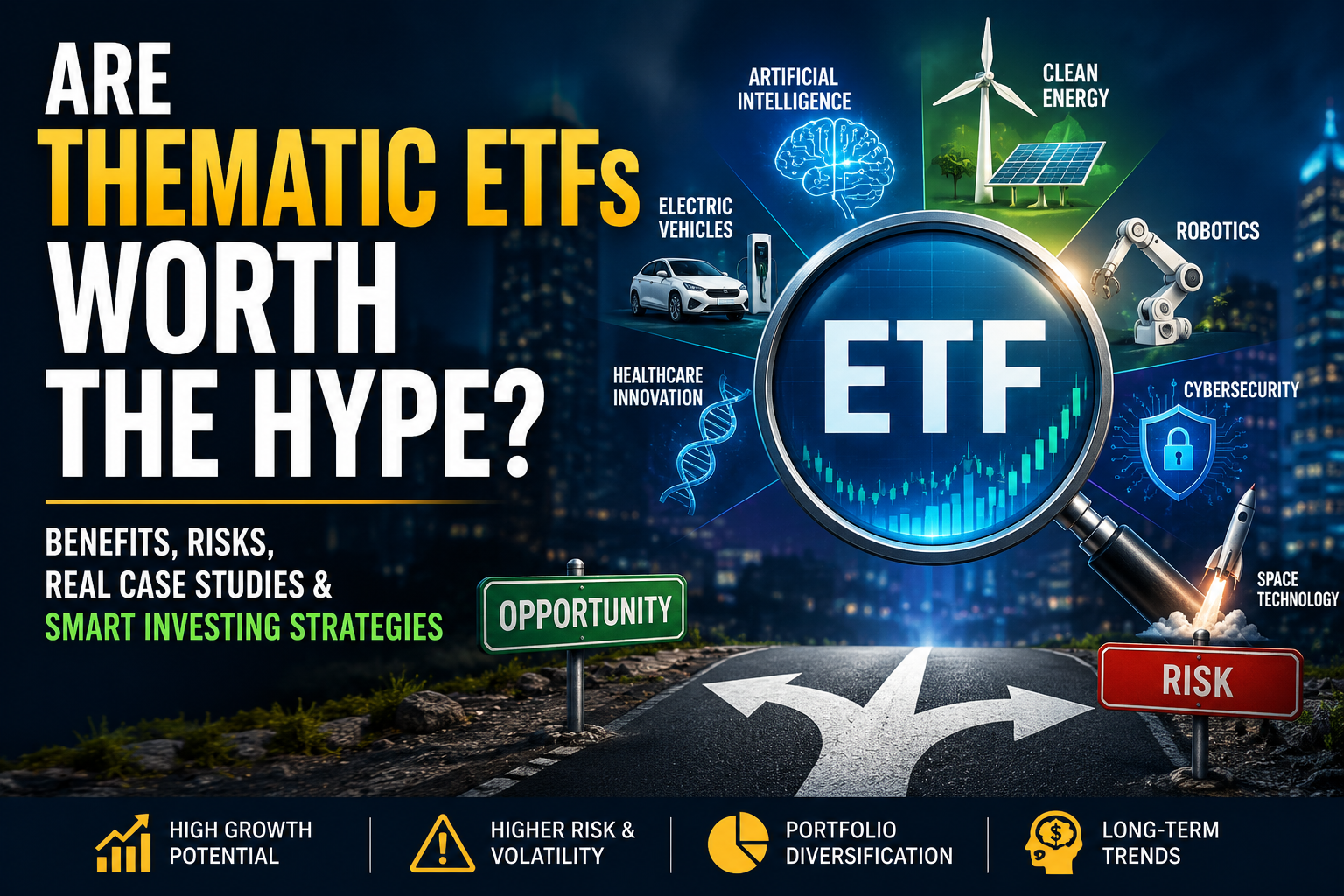
Introduction: Are Thematic ETFs Worth the Hype?
Are Thematic ETFs Worth the Hype? This is an important question for investors who want to profit from powerful trends such as artificial intelligence (AI), clean energy, robotics, cybersecurity, electric vehicles, and biotechnology. Thematic ETFs offer a convenient way to invest in these industries through a single exchange-traded fund, but their popularity does not guarantee superior returns.
Some thematic funds have benefited from major technological developments, while others have suffered substantial losses after investors paid too much for future growth. Research from Morningstar has repeatedly highlighted the difficulty of choosing thematic funds that survive and outperform diversified global equities. Its 2024 research found that more than two-thirds of thematic funds underperformed its global equity benchmark over the period examined. Read Morningstar’s thematic fund research.
In this guide, we examine how thematic ETFs work, their benefits and disadvantages, real investment case studies, historical performance, hidden costs, and practical strategies for evaluating them. You will also learn why a promising investment theme can be successful while the ETF tracking it disappoints investors.
What Is a Thematic ETF?
A thematic ETF is an exchange-traded fund that invests in companies associated with a particular economic, technological, demographic, or social trend.
For an overview of how exchange-traded funds work and the risks investors should understand, consult the SEC’s investor education resources on ETFs.
An exchange-traded fund, or ETF, is an investment fund whose shares trade on a stock exchange. Depending on its structure, an ETF may hold stocks, bonds, commodities, or other assets.
Unlike a broad-market ETF, which aims to represent a large portion of the stock market, a thematic ETF concentrates on a specific idea.
Examples include:
- Artificial intelligence and machine learning.
- Renewable energy and battery technology.
- Cybersecurity and digital infrastructure.
- Robotics and industrial automation.
- Biotechnology and genomic research.
- Electric vehicles and autonomous driving.
- Space exploration and satellite communications.
For example, an AI-focused ETF might invest in semiconductor manufacturers, cloud-computing businesses, data-centre infrastructure providers, and software companies developing AI applications.
Buying an ETF gives an investor exposure to several businesses without having to purchase each stock separately. However, the fund’s actual holdings depend on its investment mandate and selection methodology.
Important distinction: Owning a thematic ETF does not mean investing directly in the technology itself. You are buying securities issued by companies that the fund considers connected to that theme.
Are Thematic ETFs Worth the Hype for Long-Term Investors?
Thematic ETFs can be useful for investors who understand the underlying industry, accept concentrated risk, and want a limited allocation to a specific investment opportunity.
However, they are not automatically better investments than traditional index funds.
Consider three different questions:
- Will the theme grow? Will demand for AI, renewable energy, or cybersecurity increase over time?
- Will the companies profit? Can businesses in that industry turn demand into sustainable earnings and cash flow?
- Will the ETF deliver attractive returns? Are the fund’s holdings reasonably valued, appropriately diversified within the theme, and inexpensive enough to justify ownership?
These questions have different answers.
Choosing an appropriate investment approach is just as important as selecting a fund. Read our guide to choosing an investment strategy to explore how different approaches can fit different financial goals.
For instance, artificial intelligence can become more widely used while some AI companies fail commercially. Even successful companies can deliver disappointing stock returns if investors initially pay excessively high prices.
Therefore, the real question is not simply whether a trend is exciting. It is whether the ETF offers an attractive investment at its current price.
How Do Thematic ETFs Work?
Thematic ETFs typically follow an index or use an active investment strategy.
1. Passive Thematic ETFs
A passive thematic ETF follows an index designed around a particular theme.
The index provider establishes eligibility rules, selects qualifying companies, and determines how their weights are calculated. The ETF then attempts to track that index, before fees and tracking differences.
For example, a clean-energy index might include businesses involved in solar power, wind power, energy storage, and renewable-energy equipment.
The fund’s holdings may change when the index is reviewed or when companies no longer meet its rules.
2. Active Thematic ETFs
An actively managed thematic ETF allows portfolio managers to select investments according to their research and outlook.
Managers may evaluate:
- Revenue growth.
- Profit margins.
- Competitive advantages.
- Research and development spending.
- Valuation.
- Management quality.
- Future demand.
Active management provides flexibility, but it does not guarantee better results. Manager decisions can be wrong, and fees may be higher.
3. Understanding Expense Ratios
An expense ratio is the annual operating cost of a fund expressed as a percentage of its assets.
Suppose you invest $10,000 in an ETF with an annual expense ratio of 0.75%. Its annualized fund expense would be approximately $75 on a constant $10,000 balance, before considering changes in investment value.
A comparable ETF charging 0.10% would cost approximately $10 on the same balance.
The $65 difference may appear small, but expenses can compound over many years. Actual costs vary with the fund’s value, and investors may also pay brokerage commissions, spreads, taxes, or currency-conversion charges.
Before investing, compare the expense ratio with those of similar thematic funds and broad-market alternatives.
Why Are Thematic ETFs So Popular?
1. Exposure to Emerging Technologies
Investors often want exposure to industries that could reshape the global economy.
AI, automation, cybersecurity, and renewable energy may create new markets and transform existing businesses. A thematic ETF provides a relatively simple way to invest in companies associated with these developments.
However, technological importance and investment attractiveness are not identical. An industry can grow rapidly without every company in it becoming profitable.
2. Convenience and Diversification
Buying individual stocks requires researching each business separately. A thematic ETF can spread an investment across multiple companies in one transaction.
This can reduce the risk associated with a single company’s failure.
Nevertheless, diversification within a theme is not the same as broad portfolio diversification. Ten AI-related stocks may still respond similarly to changes in technology valuations, interest rates, or AI spending.
3. The Fear of Missing Out
Fear of missing out (FOMO) is the anxiety that other investors are making money from an opportunity you might miss.
When an investment theme receives intense media attention, investors may buy without carefully examining valuations, holdings, or potential losses.
This behaviour can be especially dangerous when fund inflows accelerate after a strong performance period.
4. Easy Access Through Brokerage Platforms
Online brokerage platforms have made ETFs accessible to many individual investors. Investors can compare fund documents, place trades, and monitor holdings from a single account.
Accessibility is useful, but it should not replace research. A simple purchase process does not make an investment simple to evaluate.
Seven Major Risks of Thematic ETFs
1. Hype and Performance-Chasing Risk
A thematic ETF may become popular only after the companies associated with its theme have already experienced substantial price increases.
The cycle often looks like this:
- A new technology gains attention.
- Related stocks rise.
- Media coverage increases.
- ETF providers launch or promote thematic products.
- Investors buy after strong returns.
- Expectations become difficult to meet.
- Prices decline when enthusiasm weakens.
This pattern does not occur in every theme, but it illustrates why buying a popular investment after a major rally can be risky.
2. Concentration Risk
Concentration risk occurs when a portfolio depends heavily on a small number of investments or related businesses.
An AI ETF may have substantial exposure to semiconductor manufacturers. A clean-energy ETF may depend heavily on renewable-energy equipment companies.
If these holdings decline together, the ETF can experience a significant loss.
Read the fund’s latest holdings report rather than assuming that a thematic label guarantees broad diversification.
3. Valuation Risk
Valuation describes the price investors pay relative to a company’s financial performance, assets, earnings, or expected future cash flows.
A business can be excellent but still be a poor investment if its share price assumes unrealistically strong growth.
For example, suppose a company’s earnings rise by 20% but investors had expected earnings to rise by 40%. Its stock could fall despite reporting higher earnings.
The market reacts to results relative to expectations, not just to whether a company is growing. To understand why stock prices can fall even when a business reports higher earnings, read our guide to how earnings reports affect stock prices.
4. Unprofitable Companies
Some thematic ETFs invest in early-stage or rapidly expanding businesses that have not established consistent profits.
Such companies may need additional financing, face competitive pressure, or struggle to turn sales into cash.
If borrowing becomes expensive or investors become less willing to finance speculative businesses, their share prices may fall sharply.
5. High Fees and Fund Closures
Specialized research and portfolio construction can make thematic funds more expensive than broad index funds.
Some thematic ETFs also attract insufficient assets to remain commercially viable. A provider may close or liquidate a fund, potentially requiring investors to reinvest elsewhere and consider tax consequences.
Fund closure is not necessarily evidence of fraud or poor management, but it creates inconvenience and can disrupt a long-term investment plan.
6. Interest-Rate Sensitivity
Growth-oriented companies often derive a significant portion of their estimated value from profits expected far into the future.
When interest rates rise, those future cash flows become less valuable in present-value calculations, all else being equal. Higher financing costs may also affect businesses that rely on borrowing.
Consequently, some thematic ETFs experience substantial declines when interest rates rise or market conditions become less supportive of growth stocks.
Interest rates are only one factor affecting equity valuations. See our guide to how economic news impacts stocks for more on how economic developments can influence market prices.
7. The Theme May Not Produce Shareholder Profits
A successful industry can still contain many unsuccessful investments.
Competition can reduce prices and profit margins. Governments may change regulations or subsidies. Technology can become outdated, and customers may adopt new products more slowly than expected.
The key distinction is between industry growth and shareholder returns. Investors need businesses that convert opportunities into sustainable financial results at a price that leaves room for attractive returns.
Real Case Study 1: ARK Innovation ETF and the Risks of Disruptive Growth
The ARK Innovation ETF (ARKK), managed by ARK Invest, became a prominent example of thematic investing during the technology-driven market rally of 2020.
The fund invests in businesses associated with disruptive innovation, with exposure that can include technologies, digital services, and other growth-oriented industries.
What happened?
ARKK experienced exceptional popularity after strong performance in 2020. Morningstar reported that the fund’s assets increased from approximately $3.2 billion at the beginning of 2020 to $34.4 billion at the end of that year. Assets reached approximately $51.35 billion at the end of February 2021.
The fund subsequently faced significant pressure as high-growth stocks declined. Morningstar reported that ARKK fell 23.5% in 2021 and 66.9% in 2022. Read Morningstar’s ARKK analysis.
What can investors learn?
First, past performance can attract investors just before conditions change. Second, a concentrated portfolio can be particularly sensitive to valuation shifts. Third, buying a fund after an exceptional rally does not guarantee that the next period will be profitable.
This case does not prove that disruptive innovation is unimportant. It demonstrates that investors must assess prices, risk, and portfolio construction alongside a compelling investment thesis.
Real Case Study 2: iShares Global Clean Energy ETF
The iShares Global Clean Energy ETF (ICLN) offers exposure to companies involved in the clean-energy industry.
The long-term investment argument for clean energy includes electricity demand, renewable-energy deployment, technological improvements, and changes in energy policy.
Nevertheless, the ETF’s historical performance shows that an attractive industry outlook does not prevent substantial market losses.
According to BlackRock’s published performance figures, ICLN returned approximately 140.24% in 2020. It then returned approximately -24.07% in 2021, -5.61% in 2022, -20.53% in 2023, and -26.07% in 2024. The figures are historical calendar-year returns for the share class reported in the cited fact sheet. Review the official iShares fund information.
Why did this matter?
Clean-energy businesses can face manufacturing costs, supply-chain problems, competition, financing constraints, and policy uncertainty. Higher interest rates can also make capital-intensive projects more expensive.
The lesson is not that clean energy will fail. It is that a growing market does not guarantee strong returns for every company or ETF associated with it.
Investors should examine the fund’s current holdings, geographic exposure, valuation, and costs rather than relying on the popularity of renewable energy alone.
Real Case Study 3: The Dot-Com Bubble
The dot-com bubble of the late 1990s and early 2000s provides a broader lesson about investing in technological change.
The internet transformed communication, commerce, advertising, and business operations. However, during the boom, some internet-related companies reached valuations that were difficult to justify using their financial results.
When investor expectations reversed, many technology stocks suffered severe losses, and numerous companies failed.
The underlying technology remained transformative. The investment outcomes were much less uniform.
What does this teach thematic ETF investors?
An investor can correctly identify a major technological shift and still choose an unsuccessful investment.
The dot-com experience highlights three important principles:
- Strong narratives do not eliminate valuation risk.
- Early-stage businesses need viable business models, not just promising ideas.
- Diversification and disciplined pricing matter even when a technology has enormous potential.
The same principles apply when evaluating modern themes such as AI, robotics, and biotechnology.
Real Case Study 4: Thematic Fund Performance and Investor Timing
Morningstar’s research on thematic funds has also examined the difference between a fund’s reported returns and the returns investors actually experience.
Its analysis of 111 US thematic ETFs that launched before May 2019 and survived through April 2022 found that 71% underperformed the Vanguard Total Stock Market ETF over the period studied. The average investor return was 11.4 percentage points below the average fund’s total return in the sample.
These findings concern a specific historical sample, not every thematic ETF or every investment period. Read Morningstar’s analysis of investor timing.
Why can investor returns be worse?
Imagine an ETF rises sharply, attracting large inflows. Investors buy after the rally. The ETF subsequently falls, and some investors sell in panic.
Even if the fund later recovers, those who purchased at high prices and sold during a downturn may experience poor outcomes.
This is known as performance-chasing behaviour. It can turn an investment with a reasonable long-term thesis into a disappointing personal experience.
Thematic ETFs vs Broad Index Funds
Broad-market index funds invest across many companies and industries. Thematic ETFs concentrate on businesses associated with a specific trend.
| Feature | Thematic ETFs | Broad Index Funds |
|---|---|---|
| Investment focus | Specific trend | Broad market or market segment |
| Diversification | Often more concentrated | Usually broader |
| Potential volatility | Can be high | Depends on the index |
| Fees | Often higher | Often lower |
| Main challenge | Selecting the right theme and valuation | Accepting market-wide risk |
| Typical portfolio role | Optional satellite holding | Potential core holding |
Broad index funds are not risk-free. They can fall substantially during market downturns, and a market-capitalization-weighted index can also be concentrated in its largest companies.
However, broad diversification reduces dependence on the success of one specific theme.
For many long-term investors, a low-cost diversified fund is a more practical starting point than building a portfolio around several fashionable investment themes. Investors comparing fund structures can also review Vanguard’s ETF investment resources to learn more about ETF investing and diversified funds.
How to Evaluate a Thematic ETF Before Investing
1. Understand the Investment Thesis
Ask what economic or technological change could drive demand. Identify who pays for the product, what problem it solves, and why companies in the industry may earn sustainable profits.
Avoid investing solely because a trend sounds futuristic.
2. Examine the Holdings
Read the fund’s fact sheet and portfolio disclosure.
Check the largest holdings, the percentage invested in each company, geographic exposure, sector overlap, and the number of securities. Also examine whether companies genuinely derive meaningful revenue from the stated theme.
Geographic exposure can affect currency risk, regulation, and market concentration. Learn more in our guide to how to invest in international stocks.
Two ETFs with similar names may have very different portfolios. Before choosing a fund, compare its holdings, investment objective, and index methodology using reliable ETF research and education resources.
3. Compare Fees and Trading Costs
Review the expense ratio, bid-ask spread, brokerage charges, and any applicable taxes or currency-conversion costs.
A low expense ratio does not guarantee good performance, but excessive costs create an additional hurdle for investors.
Check the issuer’s official fund documents for current expenses, holdings, and performance information. For example, see the iShares Global Clean Energy ETF’s official fund page.
4. Review Performance Over Different Periods
Examine returns over several market environments rather than focusing only on the most recent rally.
Compare the ETF with an appropriate benchmark and consider how much risk it took to generate its returns.
Remember that past performance does not predict future results.
5. Assess Fund Size and Structure
Review assets under management, trading liquidity, fund age, closure history where relevant, and the provider’s methodology.
A smaller fund is not automatically bad, but limited assets and trading activity may create additional practical risks.
6. Consider Your Existing Portfolio
An ETF can appear diversified while duplicating stocks you already own through broad-market funds.
For example, if your existing portfolio already has substantial exposure to major semiconductor and technology companies, adding an AI ETF may increase concentration instead of creating meaningful diversification.
A Practical Example: Adding a Thematic ETF to a Portfolio
Consider an investor with a hypothetical $20,000 investment portfolio.
The investor decides to allocate 5%, or $1,000, to an AI thematic ETF while keeping the remaining $19,000 in a diversified portfolio.
If the AI ETF falls by 40% and all other holdings remain unchanged, the loss on the AI allocation would be $400, equivalent to 2% of the original portfolio.
If the same investor instead puts 50% of the portfolio into the ETF, the same decline would produce a $4,000 loss, equivalent to 20% of the original portfolio.
These are hypothetical calculations, not forecasts. Actual portfolio losses depend on how all investments perform and how their returns interact.
The example illustrates why position size matters. A small thematic allocation can limit the direct effect of a theme-specific decline, although it cannot eliminate broader market risk.
When Are Thematic ETFs Worth the Hype?
Thematic ETFs may be appropriate when an investor:
- Has established a diversified core portfolio.
- Understands the businesses and risks behind the theme.
- Can tolerate substantial volatility and potential losses.
- Has a sufficiently long investment horizon.
- Has compared costs, holdings, and valuations.
- Can follow a consistent allocation and rebalancing plan.
Investors should consider thematic funds as part of a wider financial plan rather than as a shortcut to wealth. Learn more in our guide to building wealth through investing.
They may be unsuitable when an investor needs the money soon, is investing emergency savings, has high-interest debt that should be addressed first, or is buying mainly because of social-media excitement.
There is no universally correct thematic allocation. The appropriate amount depends on financial goals, risk capacity, investment knowledge, and the rest of the portfolio.
How to Invest in Thematic ETFs More Responsibly
1. Build a Core Portfolio First
A core portfolio may use diversified stock and bond funds appropriate to an investor’s goals and risk tolerance. Thematic ETFs can be considered only after this foundation is established.
Before deciding how much to allocate to a thematic ETF, read our guide to portfolio allocation by age to understand how investment goals, time horizon, and risk tolerance can influence portfolio construction.
2. Set an Allocation Limit
Decide in advance how much of the portfolio may be allocated to any single theme. A 5% allocation is an illustrative starting point for considering risk, not a universal recommendation.
Avoid increasing the allocation simply because prices have risen.
3. Invest According to a Plan
Some investors use regular contributions to reduce the temptation to time the market. Regular investing does not guarantee profits or prevent losses, but it can encourage discipline.
4. Rebalance When Necessary
Rebalancing means returning a portfolio to its intended allocation. If a theme grows beyond its target weight, an investor may reduce it to manage concentration.
Consider transaction costs, taxes, and the overall financial plan before making changes.
5. Review the Investment Thesis
Check whether the original assumptions remain valid. Evaluate changes in competition, profitability, regulation, valuations, and fund holdings.
Do not hold an investment simply because you hope it will recover, and do not sell automatically because of a short-term decline.
The Future of Thematic ETFs in 2026 and Beyond
Potential investment themes include AI infrastructure, cybersecurity, advanced robotics, biotechnology, climate adaptation, and quantum computing.
However, emerging technologies frequently evolve faster than investment narratives. New competitors can displace established firms, business models can change, and profitable opportunities may be captured by companies that are not included in a particular ETF.
Investors should also consider whether a theme is already represented in their existing holdings. Many broad-market funds own major companies involved in AI, cloud computing, healthcare, and renewable energy.
Before buying a specialized fund, determine whether it adds a distinct exposure or simply increases the weight of investments you already own.
Frequently Asked Questions About Thematic ETFs
1. Are thematic ETFs worth the hype?
They can be useful for investors seeking targeted exposure to a specific trend, but their popularity does not guarantee superior returns. High valuations, concentration, fees, and poor timing can undermine performance.
2. Are thematic ETFs riskier than index funds?
They can be. Thematic ETFs often concentrate on related companies and industries, while broad index funds typically spread exposure across more businesses. Actual risk depends on each fund’s holdings and methodology.
3. Can thematic ETFs outperform the S&P 500?
Yes, some thematic ETFs outperform the S&P 500 during particular periods. Others underperform substantially. Results depend on valuation, holdings, market conditions, fees, and the measurement period.
4. How much should I invest in thematic ETFs?
There is no universally suitable percentage. Some investors use a small satellite allocation after building a diversified core portfolio. The appropriate amount depends on risk tolerance, financial goals, and existing exposures.
5. Are AI thematic ETFs a good investment in 2026?
AI-related businesses may benefit from continued adoption, but valuations, competition, infrastructure spending, and the distribution of industry profits matter. Evaluate each fund’s holdings and costs rather than relying on the AI label alone.
6. What is the difference between thematic ETFs and sector ETFs?
Sector ETFs generally focus on an industry classification, such as healthcare or technology. Thematic ETFs focus on a trend that may span multiple industries, such as AI or clean energy.
7. Do thematic ETFs pay dividends?
Some do. Dividends depend on the income generated by their underlying holdings and the fund’s distribution policy. Growth-oriented thematic ETFs may pay little income or no regular distribution.
8. Can a thematic ETF close?
Yes. A provider may liquidate a fund if it is no longer commercially viable or for other operational reasons. Investors should read the fund’s closure and liquidation notices and understand the possible tax consequences.
9. Are thematic ETFs suitable for beginners?
Beginners may find them easy to purchase but difficult to evaluate. A diversified, low-cost core portfolio is often a more straightforward starting point. Thematic investments require additional research and tolerance for concentrated risk.
10. What should I check before buying a thematic ETF?
Review its investment objective, holdings, concentration, expense ratio, benchmark, valuation exposure, trading liquidity, fund size, and performance history. Confirm that it fits your financial plan.
11. Can thematic ETFs lose all their value?
An ETF holding several companies is generally less exposed to the failure of a single company than a single-stock investment. Nevertheless, a highly concentrated fund can lose most of its value if its underlying holdings collapse. Investors should not assume their capital is protected.
12. Is it better to buy individual stocks or thematic ETFs?
An ETF can reduce company-specific risk by spreading exposure across multiple holdings. Individual stocks offer more direct control but expose investors to the fortunes of particular businesses. Neither approach guarantees better returns.
Final Verdict: Are Thematic ETFs Worth the Hype?
Thematic ETFs offer a convenient way to participate in economic and technological trends, but they are not shortcuts to wealth.
Real-world examples from ARK Innovation, clean energy funds, and the dot-com bubble show that compelling investment stories can coexist with disappointing returns. The timing of purchases, prices paid, fund construction, and investor behaviour can all influence the final outcome.
For many long-term investors, the more disciplined approach is to establish a diversified core portfolio, research thematic funds carefully, control position sizes, and avoid chasing recent performance.
The bottom line: A promising theme may transform the world, but the best investment is not necessarily the fund with the most exciting story. It is the investment whose risks, costs, valuation, and role in your portfolio you genuinely understand.
Financial disclaimer: This article is for educational and informational purposes only. It is not personalized financial, investment, tax, or legal advice. Investments can lose value, including the original amount invested. Research each fund and consider consulting a qualified financial professional before making investment decisions.