Introduction: Why the PE Ratio Explained Is One of the Most Famous Investing Metrics
In the world of investing, PE Ratio Explained is one of the most searched financial concepts among beginners and professional investors. Understanding the PE Ratio Explained properly can help investors evaluate whether a stock is expensive, undervalued, or fairly priced. One of the most widely used and widely misunderstood metrics is the Price-to-Earnings ratio, commonly known as the PE Ratio.
If you have ever searched for a company on financial websites like Yahoo Finance, Morningstar, or Bloomberg, you probably noticed a number labeled P/E next to the stock price. Investors frequently use this number to determine whether a stock is cheap, expensive, or fairly valued.
However, the reality is more nuanced.
Many beginners assume a low P/E means a stock is cheap and a high P/E means a stock is expensive. While that can sometimes be true, it is often misleading. Some of the best companies in history have always traded at high PE ratios, while many struggling businesses appear “cheap” with extremely low PE ratios.
Understanding when the PE ratio matters and when it doesn’t is critical for making intelligent investment decisions.
This guide will explain:
- What the PE ratio explained actually means
- How the formula works
- The types of PE ratios investors use
- How to interpret P/E ratios in different industries
- When the PE ratio is useful
- When the PE ratio becomes misleading
- Real-world case studies from major global companies
By the end of this article, you will know how professional investors actually use the P/E ratio.
Why the PE Ratio Matters for Investors
The PE Ratio (Price-to-Earnings Ratio) is one of the most widely used metrics in stock market analysis. Investors use the PE Ratio to evaluate whether a stock is expensive or cheap relative to its earnings. By comparing the PE Ratio across companies and industries, investors can better understand market expectations and potential growth opportunities.
Because the price-to-earnings ratio connects stock price with company profits, it provides a quick snapshot of how the market values a company’s earnings power.
What Is the PE Ratio in Stock Market Investing?
The P/E Ratio (Price-to-Earnings Ratio) is one of the most widely used valuation metrics in stock market investing. Investors use the price-to-earnings ratio to determine whether a stock is overvalued, undervalued, or fairly priced. Understanding how the P/E Ratio works can help investors make better long-term investment decisions and compare companies across different industries.
PE Ratio Explained: What the Price-to-Earnings Ratio Means
The P/E Ratio (Price-to-Earnings Ratio) is one of the most widely used metrics in stock market investing. It measures how much investors are willing to pay for each dollar of a company’s earnings.
In simple terms, the P/E Ratio connects a company’s stock price with its profits, helping investors evaluate whether a stock may be overvalued, undervalued, or fairly priced.
For example, if a company has a PE Ratio of 20, investors are paying $20 for every $1 of earnings the company generates. This metric is widely used by analysts and institutional investors when evaluating companies in major indexes such as the S&P 500.
Because the P/E Ratio reflects both market expectations and company profitability, it has become one of the most important tools in modern stock valuation.
1. PE Ratio Explained: Meaning, Formula and Example
The Price-to-Earnings (PE) ratio measures how much investors are willing to pay for $1 of a company’s earnings.
In simple terms:
P/E Ratio = Price investors pay ÷ Profit the company generates
It answers a simple question:
How expensive is this company’s stock compared to its profits?
Example
Imagine a company with:
- Stock price: $100
- Earnings per share (EPS): $5
The P/E ratio would be:
P/E = 100 ÷ 5 = 20
This means investors are paying $20 for every $1 of earnings the company produces.
Interpretation
A P/E Ratio of 20 means:
Investors are willing to pay $20 for every $1 of earnings the company generates.
Real-World P/E Ratio Example: Microsoft
The simple $100 stock-price example above shows how the P/E formula works. We can also apply the same calculation to a real publicly traded company using a specific share price and a reported earnings figure.
Microsoft P/E Calculation
For fiscal 2026, Microsoft reported:
- Fiscal year ended: June 30, 2026
- Revenue: $331.8 billion
- Net income: $133.7 billion
- GAAP diluted EPS: $17.95
- Fiscal 2025 diluted EPS: $13.64
Microsoft’s fiscal 2026 results provide the underlying financial figures. Microsoft fiscal 2026 results
To illustrate the calculation, use Microsoft’s September 16, 2026 closing share price of $490.30 together with its reported fiscal 2026 GAAP diluted EPS of $17.95.
The calculation is:
P/E = Share Price ÷ EPS
P/E = $490.30 ÷ $17.95
P/E ≈ 27.31×
Therefore, using this specific share price and fiscal 2026 GAAP diluted EPS, the calculated P/E multiple is approximately 27.3×.
This is a dated calculation, not a statement that Microsoft’s P/E remains 27.3×. The share price changes continuously, and the P/E can change when the company’s earnings or the earnings period used in the calculation changes.
P/E Ratio Formula (Price-to-Earnings Ratio Explained)
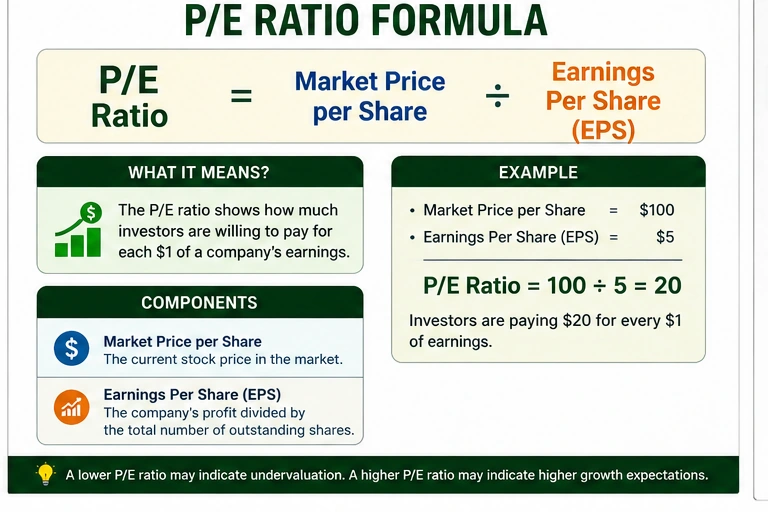
The Price-to-Earnings Ratio (earnings multiple) is one of the most important valuation metrics investors use to evaluate whether a stock is expensive, cheap, or fairly valued. To understand the broader process of stock valuation, investors should also consider growth, profitability, debt, cash flow, and other valuation metrics rather than relying on the P/E ratio alone.
It shows how much investors are willing to pay for $1 of a company’s earnings.
P/E Ratio Formula
The formula for calculating the P/E Ratio is:
P/E Ratio = Market Price per Share ÷ Earnings per Share (EPS)
Components of the Formula
1. Market Price per Share
This is the current trading price of the stock in the market.
Example:
- Stock price = $100
The price changes throughout the trading day as investors buy and sell shares.
2. Earnings Per Share (EPS)
Earnings Per Share (EPS) represents how much profit a company earns per share. Investors can also learn more about [Earnings Per Share (EPS)] and how it is calculated in our detailed guide.
EPS Formula:
Example:
- Net profit = $10 billion
- Total shares = 5 billion
So the company earns $2 per share.
Example: P/E Ratio Calculation
Assume a company has:
- Stock Price = $100
- Earnings Per Share (EPS) = $5
Now calculate the P/E Ratio.
Interpretation
A P/E Ratio of 20 means:
Investors are willing to pay $20 for every $1 of earnings the company generates.
Simple Interpretation of the P/E Ratio
| P/E Ratio | Meaning |
|---|---|
| Below 10 | Possibly undervalued or struggling company |
| 10 – 20 | Fair valuation |
| 20 – 30 | Growth expectations |
| 30+ | High-growth company or speculative valuation |
However, the interpretation depends on:
- industry
- growth rate
- economic conditions
- interest rates
Why Investors Use the P/E Ratio in Stock Market Investing
Investors use the earnings multiple to:
• Compare companies in the same industry
• Identify undervalued stocks
• Evaluate growth expectations
• Understand market valuation
For example:
Two companies in the same industry:
| Company | Stock Price | EPS | P/E |
|---|---|---|---|
| Company A | $100 | $5 | 20 |
| Company B | $100 | $10 | 10 |
Company B has a lower earnings multiple, which may indicate the stock is cheaper relative to its earnings.
Key Takeaway
The earnings multiple (Price-to-Earnings Ratio) is calculated by dividing a company’s stock price by its earnings per share (EPS). It helps investors understand how much they are paying for a company’s profits and is one of the most widely used metrics in stock market investing.
The PE Ratio (Price-to-Earnings Ratio) measures how much investors pay for $1 of a company’s earnings. It is calculated as Stock Price ÷ Earnings Per Share (EPS).
P/E Ratio Explained (Video Guide)
Watch this simple explanation of how the PE Ratio works in stock valuation and how investors use it to evaluate stocks.
This short video explains:
• What the Price-to-Earnings Ratio means
• How to calculate the earnings multiple
• How investors use the metric to value stocks
Videos improve understanding and make financial concepts easier to learn for beginner investors.
2. PE Ratio Explained: How to Calculate the P/E Ratio Formula
The standard formula is:
P/E Ratio = Market Price per Share ÷ Earnings per Share (EPS)
Let’s break this down.
Market Price Per Share
This is the current stock price in the market.
Example:
- Apple stock price: $200
- Microsoft stock price: $400
The market price constantly changes because investors buy and sell shares throughout the day.
Earnings Per Share (EPS)
EPS represents how much profit the company generates per share of stock.
Formula:
EPS = Net Profit ÷ Total Shares Outstanding
Example:
If a company earns $10 billion in profit and has 5 billion shares, then:
EPS = 10B ÷ 5B = $2 per share
Example Calculation
Company A:
- Share price = $50
- EPS = $2
P/E = 50 ÷ 2 = 25
This means investors are willing to pay 25 times the company’s annual profit.
3. Why Investors Use the P/E Ratio
To fully understand PE Ratio Explained, investors must know why this metric is widely used in stock market valuation. The concept of PE Ratio Explained helps investors compare company earnings with stock price. The P/E ratio helps investors answer several important questions:
1. Is a stock expensive?
A higher P/E might suggest investors expect future growth.
2. Is a stock undervalued?
A lower P/E might indicate a stock is cheap relative to earnings.
3. How does this company compare to competitors?
Investors often compare P/E ratios within the same industry.
4. Is the overall market expensive?
The P/E ratio can also be used to evaluate stock indexes such as the S&P 500. Investors interested in broader index investing can learn more in our guide to S&P 500 and Index Funds or Index Funds & ETFs.
Investors should also review a company’s financial information and understand the risks involved before making an investment decision. Investor.gov provides educational resources for individual investors.
4. Types of PE Ratios Investors Use
There is not just one P/E ratio. Professional investors use several variations.
1. Trailing P/E (Historical P/E)
Trailing P/E uses past earnings, usually from the last 12 months.
Formula:
Trailing P/E = Current Price ÷ Earnings from Last 12 Months
Advantages:
- Based on real financial data
- Reliable historical information
Disadvantages:
- Does not consider future growth
Real-World Case Study: Apple – Why TTM Earnings Matter
Apple provides a useful real-world example of why investors should distinguish between quarterly EPS and trailing twelve-month (TTM) EPS when calculating a P/E ratio.
Apple reported its fiscal 2026 third-quarter results for the quarter ended June 27, 2026. The company reported:
- Quarterly revenue: $109.4 billion
- Diluted EPS: $2.02
- Year-over-year diluted EPS growth: 29%
Apple’s official results report these figures for the June 2026 quarter. Apple fiscal 2026 Q3 results
Why You Should Not Use One Quarter’s EPS as TTM EPS
A common mistake is to take Apple’s share price and divide it by the $2.02 quarterly EPS and then call the result the company’s trailing P/E ratio.
That would not be a standard trailing P/E calculation because $2.02 represents only one quarter of earnings, not the company’s earnings over the most recent twelve months.
For a trailing P/E calculation, investors generally use earnings covering the most recent twelve-month period.
Therefore:
Quarterly EPS ≠ TTM EPS
For example, suppose a stock trades at $300 and reports quarterly EPS of $2.
Using the quarterly EPS:
$300 ÷ $2 = 150×
That calculation produces a multiple of 150× based on one quarter’s EPS, but it should not automatically be described as the stock’s trailing P/E ratio.
A proper trailing P/E calculation requires the appropriate TTM EPS figure.
Why This Matters When Reading Financial Websites
Financial websites may display P/E ratios using different earnings periods or methodologies. Investors should therefore check whether the reported P/E uses:
- Trailing twelve-month EPS
- Forward EPS estimates
- GAAP earnings
- Adjusted earnings
- Another earnings definition
Apple’s example demonstrates an important rule:
Always identify the earnings period and earnings definition before calculating or comparing a P/E ratio.
This prevents investors from accidentally comparing a P/E calculated from quarterly earnings with a P/E calculated from twelve-month or forward earnings.
2. Forward P/E
Forward P/E uses expected future earnings.
Formula:
Forward P/E = Current Price ÷ Expected Future EPS
Analysts estimate future earnings using:
- Revenue growth projections
- Economic conditions
- Industry trends
Example:
Stock price = $100
Expected EPS next year = $10
Forward P/E = 10
Forward P/E helps investors determine whether a stock may become cheaper as earnings grow.
3. Shiller P/E (CAPE Ratio)
Another advanced version is the Cyclically Adjusted Price-to-Earnings ratio (CAPE) developed by economist Robert Shiller. i.e. The CAPE ratio was developed by Nobel Prize–winning economist Robert Shiller to evaluate long-term stock market valuations. Historical CAPE data and methodology are available through Robert Shiller’s Yale data resources.
Instead of using one year of earnings, it averages 10 years of inflation-adjusted earnings.
Purpose:
- Remove short-term economic cycles
- Measure long-term market valuation
This metric is often used to compare long-term market valuation levels across different periods.
For additional information about publicly traded companies and the financial information investors can review, see the U.S. Securities and Exchange Commission (SEC) investor resources.
5. What Is a Good PE Ratio for Stocks?
There is no universal number that defines a good P/E ratio.
However, historically:
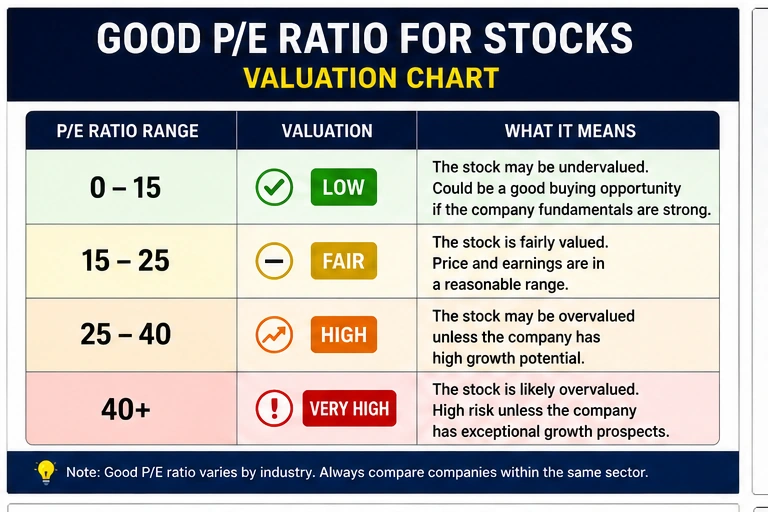
| P/E Ratio | Interpretation |
|---|---|
| Below 10 | Possibly undervalued or struggling company |
| 10–20 | Fair valuation |
| 20–30 | Growth expectations |
| 30+ | High growth or speculative |
But context is extremely important.
When discussing PE Ratio Explained, one of the most common questions investors ask is: What is considered a good P/E ratio?
For example:
- Technology companies often trade at high P/E ratios
- Utility companies usually have low P/E ratios
Good P/E Ratio for Stocks (Valuation Chart)
What Is a Good P/E Ratio?
There is no universal P/E ratio that can be classified as “good” for every company.
A P/E ratio should be interpreted in context, including:
- the company’s expected earnings growth
- profitability and margins
- industry characteristics
- business cyclicality
- interest rates
- balance-sheet strength
- the earnings definition used in the calculation
- the valuation of comparable companies
- the company’s own historical valuation
For example, a P/E of 30 can represent very different valuation expectations for a rapidly growing technology company and a mature company with slow or declining earnings.
Likewise, a P/E below 10 does not automatically mean a stock is undervalued. A low multiple can reflect declining earnings, cyclical peak profits, financial risk, or weaker future growth expectations.
Instead of asking:
“Is a P/E of 15 good?”
investors should ask:
“Why is the company trading at this P/E, and how does that multiple compare with its earnings outlook and relevant peers?”
This approach provides more useful information than applying a universal P/E range to every company.
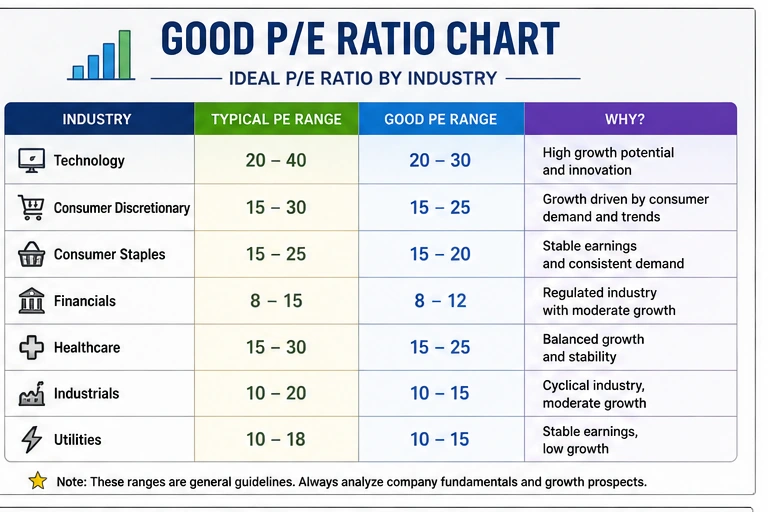
Sector-Based P/E Ratio Comparison
Different industries have different typical P/E ratios.
| Sector | Typical P/E Ratio |
|---|---|
| Technology | 25 – 40+ |
| Consumer Staples | 15 – 25 |
| Utilities | 10 – 20 |
| Banking & Financials | 8 – 15 |
This is why investors compare companies within the same industry rather than across completely different sectors.
Quick Rule Investors Use
Many professional investors use this simple rule:
For example:
If the market average P/E is around 15–20, then:
- Fast-growing companies can justify P/E of 25–40
- Stable companies often trade around P/E of 15–20
- Very slow growth companies may trade around P/E of 8–12
6. Why High P/E Stocks Can Reflect High Growth Expectations
A high P/E ratio can reflect strong expectations for future earnings growth, but a high multiple does not automatically mean that a stock will deliver strong returns. Investors need to examine the earnings growth that supports the valuation and the risks that could affect future results.
Case Study: NVIDIA – P/E and Rapid Earnings Growth
NVIDIA provides a useful real-world example of why a high-growth company should not be evaluated using its P/E ratio alone.
For fiscal 2026, NVIDIA reported:
- Revenue: $215.938 billion
- Net income: $120.067 billion
- GAAP diluted EPS: $4.90
- Fiscal 2025 GAAP diluted EPS: $2.94
NVIDIA reported that fiscal 2026 GAAP diluted EPS increased 67% year over year, while revenue increased 65%. NVIDIA fiscal 2026 results
The EPS growth can be calculated as:
($4.90 − $2.94) ÷ $2.94 × 100 ≈ 66.7%
This closely matches NVIDIA’s reported 67% year-over-year increase.
The example illustrates why investors should examine both:
- the price investors are paying for earnings, and
- the rate at which earnings are changing.
A company with rapidly increasing earnings may have a different valuation context from a mature company with flat or declining earnings.
However, strong historical earnings growth does not automatically justify any particular P/E multiple. Investors still need to consider future earnings expectations, competition, profit margins, capital requirements, valuation, and business risks.
What the NVIDIA Example Shows
NVIDIA demonstrates an important limitation of looking at a P/E ratio in isolation.
A P/E multiple represents the relationship between a company’s market price and its earnings. Earnings growth helps provide context for that multiple, but historical growth is not the same as guaranteed future growth.
Therefore, investors evaluating a high-P/E company should consider:
- Historical earnings growth — How quickly have earnings actually grown?
- Expected future growth — What do analysts or management expect going forward?
- Profit margins — Is growth accompanied by sustainable profitability?
- Competitive position — Can the company maintain its market position?
- Valuation — What price is the market already assigning to those expectations?
- Business risks — What could cause future earnings to fall short of expectations?
NVIDIA’s reported fiscal 2026 results provide a real example of why earnings growth is an important part of P/E analysis, while also showing why investors should not treat a high P/E or high historical growth rate as a standalone investment signal.
7. Why Low P/E Stocks Can Be Dangerous
Another important part of PE Ratio Explained is understanding why low P/E stocks can sometimes be dangerous. Low P/E ratios sometimes signal serious business problems.
This phenomenon is called a value trap.
A value trap occurs when a stock appears cheap but earnings are declining.
Example
Company B:
- Price = $20
- EPS = $4
- P/E = 5
This looks extremely cheap.
However, if profits collapse next year to $1, the real P/E becomes 20.
Investors who relied only on the current P/E ratio may be misled.
8. Industry Differences in P/E Ratio Valuations
In the context of PE Ratio Explained, industry differences play a major role in stock valuation. P/E ratios vary dramatically across industries.
Comparing companies from different sectors often leads to incorrect conclusions.
Technology Sector
Tech companies often have higher P/E ratios because investors expect rapid growth.
Typical P/E: 25 – 40+
Consumer Staples
Companies selling everyday goods like food or household products typically have stable growth.
Typical P/E: 15 – 25
Utilities
Utility companies grow slowly but provide stable income.
Typical P/E: 10 – 20
Banking
Banks are often valued based on price-to-book ratio, but P/E ratios still matter.
Typical P/E: 8 – 15
9. How Interest Rates Affect the P/E Ratio
Interest rates also affect PE Ratio Explained, because valuation multiples change when borrowing costs rise. Interest rates strongly influence stock valuations.
When interest rates are low, investors are willing to pay higher P/E ratios.
Why?
Because bonds and savings accounts produce very little return.
Interest rates can affect equity valuations through several channels, including changes in discount rates, financing costs, bond yields, and investor expectations. The relationship between interest rates and P/E ratios is not mechanical, however, because earnings expectations and economic conditions can change at the same time.
This relationship is one reason why the stock market often struggles during aggressive central bank tightening cycles.
10. When the P/E Ratio Actually Matters for Investors
Understanding when the PE Ratio Explained concept actually matters can significantly improve investment decision-making. The P/E ratio becomes especially useful in certain situations.
1. Comparing Companies in the Same Industry
If growth rates are similar, Company B might be undervalued.
2. Evaluating Mature Companies
Companies with stable profits often follow predictable valuation ranges.
Example:
Large consumer brands or telecom companies.
3. Market Valuation Analysis
Investors frequently analyze the P/E ratio of the entire stock market.
When the overall market P/E becomes extremely high, it may signal overvaluation.
11. When the P/E Ratio Does NOT Matter
There are situations where the P/E ratio is almost useless.
1. High-Growth Companies
Fast-growing businesses reinvest profits into expansion.
Earnings may appear small relative to future potential.
Example sectors:
- Artificial intelligence
- Cloud computing
- Biotechnology
2. Companies With Negative Earnings
If a company has negative profits, the P/E ratio cannot be calculated.
This is common in:
- Startups
- Early-stage tech firms
- Research-heavy industries
3. Cyclical Businesses
Some industries experience huge profit swings during economic cycles.
Examples:
- Airlines
- Energy
- Shipping
- Commodities
In these industries, earnings fluctuate dramatically, making the P/E ratio unreliable.
12. P/E Ratio vs Other Valuation Metrics
Although PE Ratio Explained is one of the most popular valuation tools, professional investors also compare it with other metrics. Professional investors rarely rely on just one metric. Investors should also learn how to read financial statements before analyzing stocks.
Other important valuation tools include:
P/E Ratio vs Price-to-Sales vs EV/EBITDA (Comparison Guide)
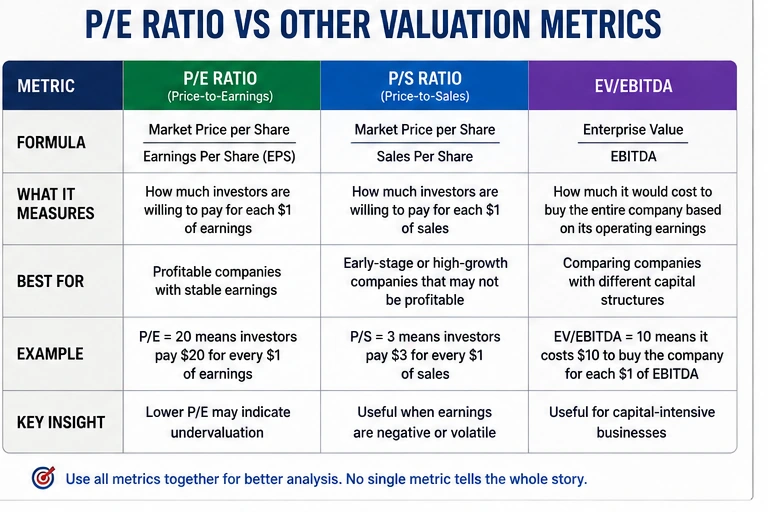
Investors use several valuation metrics to determine whether a stock is undervalued, fairly valued, or overpriced. Before comparing valuation multiples, investors should understand the company’s underlying financial performance. Our guide on How to Read Financial Statements explains how to examine revenue, earnings, assets, liabilities, cash flow, and other important financial information. The three most widely used metrics are:
- P/E Ratio (Price-to-Earnings)
- Price-to-Sales (P/S Ratio)
- EV/EBITDA
Each metric evaluates a company from a different financial perspective, and professional investors often use them together rather than relying on only one.
Quick Comparison Table
| Metric | Formula | What It Measures | Best Used For |
|---|---|---|---|
| P/E Ratio | Price per Share ÷ Earnings per Share | How much investors pay for $1 of profit | Mature profitable companies |
| Price-to-Sales | Market Cap ÷ Revenue | How much investors pay for $1 of revenue | High-growth or unprofitable companies |
| EV/EBITDA | Enterprise Value ÷ EBITDA | Total company value relative to operating profit | Comparing companies with different debt levels |
1. P/E Ratio (Price-to-Earnings Ratio)
The P/E Ratio measures how much investors are willing to pay for each dollar of a company’s earnings. The P/E ratio, or price-to-earnings ratio, measures a company’s share price relative to its earnings per share (EPS). It tells investors how much the market is paying for each $1 of earnings. A higher P/E may reflect stronger growth expectations, while a lower P/E may indicate lower growth expectations or potential undervaluation.
Formula
P/E = SharePrice ÷ EarningsPerShare
Example
Stock price = $100
EPS = $5
P/E=100÷5=20
Meaning investors pay $20 for every $1 of profit.
Best For
- profitable companies
- stable businesses
- long-term valuation comparison
Example companies often evaluated with P/E ratios include firms in the S&P 500 index.
2. Price-to-Sales Ratio (P/S Ratio)
The Price-to-Sales Ratio compares a company’s market value to its revenue.
This metric is useful when companies do not yet generate profits.
Formula
P/S = MarketCapitalization ÷ TotalRevenue
or
P/S = PriceperShare ÷ RevenueperShare
Example
Market Cap = $10 billion
Revenue = $2 billion
P/S = 10÷2 = 5
Investors are paying $5 for every $1 of revenue.
Best For
- startups
- technology companies
- high-growth businesses
Many high-growth firms on the NASDAQ historically trade with higher price-to-sales ratios.
3. EV/EBITDA
EV/EBITDA measures the value of a company including its debt and cash position.
EV/EBITDA measures a company’s enterprise value relative to its earnings before interest, taxes, depreciation, and amortization.
EV/EBITDA can be useful for comparing companies with different capital structures because enterprise value incorporates debt and cash, while EBITDA focuses on operating earnings before interest, taxes, depreciation, and amortization.
However, EV/EBITDA is not inherently more accurate than the P/E ratio. The two metrics measure different aspects of valuation, so investors should choose the metric that best fits the companies and industries being compared.
Formula
EV/EBITDA=EnterpriseValue÷EBITDA
Enterprise Value:EV=MarketCap+Debt−Cash
EBITDA stands for:
Earnings Before Interest, Taxes, Depreciation, and Amortization
Example
Market Cap = $10B
Debt = $3B
Cash = $1B
EBITDA = $2B
Best For
- comparing companies with different debt levels
- mergers and acquisitions
- capital-intensive industries
Investment banks such as Goldman Sachs frequently rely on EV/EBITDA in corporate valuation models.
When to Use Each Valuation Metric
| Situation | Best Metric |
|---|---|
| Company is profitable | P/E Ratio |
| Company has no profits | Price-to-Sales Ratio |
| Companies have different debt levels | EV/EBITDA |
| Comparing early-stage tech companies | Price-to-Sales |
| Comparing mature businesses | P/E Ratio |
Real-World Example
Imagine comparing three companies:
| Company | P/E | P/S | EV/EBITDA | Interpretation |
|---|---|---|---|---|
| Company A | 15 | 3 | 8 | Fair valuation |
| Company B | 40 | 12 | 25 | High growth expectations |
| Company C | 10 | 1 | 5 | Possibly undervalued |
Professional investors typically analyze multiple valuation metrics together to understand the full financial picture.
Key Takeaway
The P/E Ratio, Price-to-Sales Ratio, and EV/EBITDA each measure company valuation from different angles:
- P/E Ratio evaluates price relative to profits
- Price-to-Sales evaluates price relative to revenue
- EV/EBITDA evaluates enterprise value relative to EBITDA, a measure of earnings before interest, taxes, depreciation and amortization. EBITDA is not the same as operating cash flow.
Using all three together gives investors a more complete understanding of a company’s valuation.
13. Real-World P/E Ratio Case Studies
The P/E ratio becomes easier to understand when it is calculated using actual publicly reported company earnings rather than hypothetical companies. The following examples use published financial results and clearly dated market information.
Case Study 1: Microsoft Calculating P/E Using Reported Annual EPS
Microsoft provides a useful example of how investors can calculate a P/E ratio using a company’s reported earnings.
For fiscal 2026, Microsoft reported:
- Fiscal year ended: June 30, 2026
- Revenue: $331.8 billion
- Net income: $133.7 billion
- GAAP diluted EPS: $17.95
- Fiscal 2025 diluted EPS: $13.64
Microsoft reported that fiscal 2026 diluted GAAP EPS increased approximately 32% year over year. Microsoft’s fiscal 2026 results provide the underlying figures.
To illustrate the calculation, suppose an investor uses a Microsoft share price of $490.30 on September 16, 2026 together with the reported fiscal 2026 diluted EPS of $17.95.
The calculation is:
P/E = Share Price ÷ EPS
P/E = $490.30 ÷ $17.95
P/E ≈ 27.31
Therefore, on this specific calculation date and using fiscal 2026 GAAP diluted EPS, Microsoft’s price-to-earnings multiple was approximately 27.3×.
This is a dated calculation, not a statement that Microsoft’s P/E remains 27.3× today. The share price changes continuously, and a trailing P/E can also change as new earnings are reported.
What this example shows
Microsoft demonstrates why the date and earnings period should always be stated when presenting a P/E calculation.
“Using Microsoft’s September 16, 2026 closing share price of $490.30 and fiscal 2026 GAAP diluted EPS of $17.95, the calculated P/E is approximately 27.3×.”
Case Study 2: Apple – Why TTM Earnings Matter
Apple demonstrates why investors should distinguish between quarterly EPS and trailing twelve-month EPS when calculating a P/E ratio.
Apple reported fiscal 2026 third-quarter results for the quarter ended June 27, 2026. The company reported:
- Quarterly revenue: $109.4 billion
- Diluted EPS: $2.02
- Year-over-year diluted EPS growth: 29%
Apple’s official results report these figures for the June 2026 quarter. Apple fiscal 2026 Q3 results
A common mistake would be to take Apple’s share price and divide it by the $2.02 quarterly EPS and call the result the company’s P/E ratio.
That would not be a standard trailing P/E calculation because $2.02 represents one quarter, not twelve months of earnings.
For a trailing P/E calculation, investors generally use earnings covering the most recent twelve-month period.
Therefore:
Quarterly EPS ≠ TTM EPS
This distinction is important when comparing P/E figures reported by financial websites.
Why this matters
Suppose a stock trades at $300.
Using one quarter’s EPS of $2 would produce:
$300 ÷ $2 = 150×
But that does not mean the stock’s trailing P/E is 150×.
The calculation would need the appropriate twelve-month EPS figure.
Apple’s example therefore demonstrates an important rule:
Always identify whether the EPS figure is quarterly, annual, trailing twelve-month, GAAP, adjusted, or estimated before calculating a P/E ratio.
Case Study 3: NVIDIA – P/E and Rapid Earnings Growth
NVIDIA provides a useful example of why a high-growth company should not be evaluated using its P/E ratio alone.
For fiscal 2026, NVIDIA reported:
- Revenue: $215.938 billion
- Net income: $120.067 billion
- GAAP diluted EPS: $4.90
- Fiscal 2025 GAAP diluted EPS: $2.94
NVIDIA reported that fiscal 2026 GAAP diluted EPS increased 67% year over year, while revenue increased 65%. NVIDIA fiscal 2026 results
The EPS growth can be calculated as:
($4.90 − $2.94) ÷ $2.94 × 100 ≈ 66.7%
This closely matches NVIDIA’s reported 67% year-over-year increase.
The example illustrates why investors should examine both:
- the price investors are paying for earnings, and
- the rate at which earnings are changing.
A company with rapidly increasing earnings may have a different valuation context from a mature company with flat or declining earnings.
However, strong historical earnings growth does not automatically justify any particular P/E multiple. Investors still need to consider future earnings expectations, competition, margins, capital requirements, and business risks.
Case Study 4: The S&P 500 – P/E at the Index Level
The P/E ratio can also be used to study an entire stock-market index rather than a single company.
The S&P 500 measures the large-cap segment of the U.S. equity market and contains 500 constituent companies. S&P Dow Jones Indices states that the index is designed to represent the large-cap segment of the U.S. market. S&P U.S. Indices Methodology
When investors discuss the “S&P 500 P/E ratio,” it is important to ask:
- Is it trailing or forward?
- Are earnings GAAP or operating earnings?
- What date is being measured?
- How is the index-level multiple calculated?
- Which data provider is being used?
These questions matter because different methodologies can produce different valuation figures.
An index-level P/E should therefore not be presented simply as a universal number without identifying the methodology and measurement date.
Why the S&P 500 example matters
A company P/E answers:
How much is the market paying for this company’s earnings?
An index-level P/E provides a broader valuation measure for a group of companies.
This can be useful when comparing market valuation levels over time, provided the same methodology is used consistently.
Case Study 5: The Dot-Com Period – Why Historical P/E Data Needs Methodology
The dot-com period is frequently used when discussing extreme stock-market valuations.
However, historical P/E figures should not be presented as a single universal number.
Different historical datasets may use:
- reported earnings
- operating earnings
- trailing earnings
- forward earnings
- inflation-adjusted earnings
- different index definitions
- different measurement dates
Robert Shiller’s Yale data provides a long historical dataset containing stock prices, dividends, earnings and consumer-price data, and it also provides CAPE-related data. Robert Shiller’s Yale data
The historical data therefore provides a useful basis for studying long-term valuation levels, but the methodology behind the selected series should always be identified.
What the dot-com example teaches investors
The important lesson is not simply that “P/E was extremely high.”
The more useful lesson is:
Historical P/E comparisons are meaningful only when the measurement method, earnings definition, index, and time period are clearly identified.
This is especially important when comparing historical market valuations with current valuations.
What These Five Cases Show
The five examples demonstrate different uses and limitations of the P/E ratio:
| Case | What it demonstrates |
|---|---|
| Microsoft | How to calculate P/E using a dated share price and reported annual EPS |
| Apple | Why quarterly EPS should not be confused with TTM EPS |
| NVIDIA | Why earnings growth matters when interpreting valuation multiples |
| S&P 500 | How P/E can be applied to an entire market index |
| Dot-com period | Why historical P/E comparisons require consistent methodology |
The P/E ratio is therefore most useful when investors know exactly what price, earnings period, earnings definition, and methodology are being used.
14. The “PEG Ratio” – A Better Metric?
Some investors use the PEG ratio, which incorporates growth.
Formula:
PEG = P/E ÷ Earnings Growth Rate
Example:
P/E = 30
Growth rate = 30%
PEG = 1
Interpretation:
| PEG | Meaning |
|---|---|
| Below 1 | Possibly undervalued |
| Around 1 | Fair value |
| Above 2 | Expensive |
The PEG ratio helps investors compare growth companies more accurately.
How Investors Interpret the PEG Ratio
The PEG ratio can help investors compare a P/E multiple with an earnings-growth rate, but there is no universal PEG threshold that determines whether a stock is undervalued or overvalued.
The result depends on how the earnings-growth rate is measured, the forecast period, the quality of the earnings estimate, and the company’s business characteristics.
Investors should therefore treat PEG as a comparative valuation tool rather than a standalone buy-or-sell signal.
15. Historical Market Valuations
Historical P/E ratios vary depending on the methodology, earnings definition, measurement period, and data source. Historical valuation data for the S&P 500 can differ depending on whether the calculation uses reported earnings, operating earnings, trailing earnings, or forward earnings. Investors should therefore check the methodology used by the data provider, such as S&P Dow Jones Indices, rather than relying on a single historical average.
Why Historical P/E Comparisons Need Context
Historical P/E ratios can provide useful context when evaluating stock-market valuations, but investors should be careful when comparing figures from different periods.
P/E data can be calculated using different methodologies, including:
- Trailing earnings
- Forward earnings
- Operating earnings
- GAAP earnings
- Cyclically adjusted earnings
Historical averages can also vary depending on the time period, index methodology, and data source. Therefore, there is no single universal historical P/E average that applies to every analysis.
For a meaningful comparison, investors should identify the specific P/E measure, time period, index, and data source being used.
S&P 500 P/E: Why the Methodology Matters
The S&P 500 is a broad U.S. large-cap stock-market index. S&P Dow Jones Indices describes the index as measuring the large-cap segment of the U.S. equity market.
When investors discuss the S&P 500 P/E ratio, the number should always be considered together with its methodology and measurement date.
Important questions include:
- Is the P/E trailing or forward?
- Are the earnings based on GAAP or operating earnings?
- What date does the valuation represent?
- Which index methodology is being used?
- Which data provider calculated the P/E?
- Are the earnings figures reported, estimated, or cyclically adjusted?
These distinctions matter because different methodologies can produce different P/E figures for the same market and period.
For example, a trailing P/E uses historical earnings, while a forward P/E uses estimates of future earnings. A cyclically adjusted measure such as CAPE uses a longer period of inflation-adjusted earnings and therefore serves a different analytical purpose.
Investors should therefore avoid presenting an S&P 500 P/E as a universal number without specifying the earnings definition, calculation method, data source, and measurement date.
Why the S&P 500 Example Matters
A company-level P/E answers a relatively narrow question:
How much is the market paying for this company’s earnings?
An index-level P/E provides a broader valuation measure for a group of companies.
This makes the S&P 500 P/E useful when studying broad market valuation, but comparisons over time are most meaningful when the same methodology is used consistently.
For example, comparing a current trailing GAAP P/E with a historical forward operating P/E can create a misleading comparison because the two figures are measuring different things.
Therefore, before comparing the current S&P 500 valuation with a historical benchmark, investors should identify:
Index + P/E methodology + earnings definition + measurement date + data source.
This approach provides more meaningful historical context than relying on a single headline P/E number.
Dot-Com Bubble (2000)
During the dot-com bubble, valuations of many technology and internet companies reached exceptionally high levels. However, historical P/E figures from this period can vary substantially depending on the companies included and the earnings methodology used.
Rather than describing the peak simply as a P/E ratio “above 40,” investors should use a clearly defined historical dataset and specify whether the figure represents trailing, forward, operating, GAAP, or another P/E measure.
Post-Pandemic Market Boom
In the early 2020s, massive stimulus and low interest rates contributed to higher stock-market valuations. Stock-market valuations also changed significantly during the post-pandemic period as interest rates, earnings expectations, economic conditions, and monetary policy changed.
When evaluating this period, investors should compare P/E ratios using a consistent methodology rather than comparing an unspecified current P/E with an unspecified historical average.
Key P/E Ratio Statistics Investors Should Know (2026)
Understanding historical valuation data helps investors interpret whether the market is expensive or cheap relative to a specific historical benchmark.
| Statistic | How to Interpret It |
|---|---|
| Historical S&P 500 P/E | Depends on the earnings methodology and period selected |
| Trailing P/E | Based on historical earnings |
| Forward P/E | Based on estimated future earnings |
| CAPE ratio | Uses a longer-term, inflation-adjusted earnings measure |
| Historical valuation comparison | Should use a consistent data source and methodology |
Historical P/E statistics should always be interpreted alongside the methodology used to calculate them. Before comparing today’s valuation with historical levels, investors should verify the data source, earnings definition, time period, and whether the calculation uses trailing, forward, operating, GAAP, or cyclically adjusted earnings.
For investors, comparing today’s price-to-earnings multiple with a clearly defined historical benchmark can provide useful context when evaluating whether current market valuations appear relatively high or low.
16. How Professional Investors Use P/E Ratios
Professional investors apply PE Ratio Explained within a broader financial analysis framework. Institutional investors rarely rely on the price-to-earnings multiple alone. Valuation analysis generally requires consideration of multiple financial and business factors. Investors can refer to educational resources from the CFA Institute for additional information on equity valuation and financial analysis.
Instead, they combine it with:
- Revenue growth
- Profit margins
- Cash flow
- Debt levels
- Competitive advantages
The P/E ratio acts as one tool in a larger analytical framework.
17. Common P/E Ratio Mistakes Beginner Investors Make
Even after learning PE Ratio Explained, many beginner investors still make common mistakes when applying the metric. Many new investors misuse this metric.
Mistake 1: Comparing Different Industries
Tech companies and banks should not be compared using P/E.
Mistake 2: Ignoring Growth
High P/E stocks may actually be cheap if earnings grow quickly.
Mistake 3: Ignoring Debt
A company with heavy debt may appear cheap but carry serious risk.
Mistake 4: Using Only One Metric
Successful investors analyze multiple financial ratios together.
18. A Simple Framework for Using the P/E Ratio
After learning PE Ratio Explained, investors need a simple framework to apply it effectively. When evaluating a stock, ask:
- What is the company’s price-to-earnings ratio?
- How does it compare with industry averages?
- What is the expected earnings growth?
- Is the company’s profit stable or cyclical?
- Are interest rates affecting market valuations?
Using this framework prevents simplistic conclusions.
Related Valuation Terms Investors Should Know
When evaluating stocks, investors rarely rely on just one valuation metric. The price-to-earnings ratio is often used alongside other financial indicators to understand the full financial picture of a company.
Some commonly used metrics include:
• earnings per share (EPS)
• price-to-sales ratio (P/S)
• enterprise value to EBITDA (EV/EBITDA)
• price-to-book ratio (P/B)
• PEG ratio (price-earnings-to-growth)
Professional investors frequently analyze these metrics together when evaluating companies in major indexes like the S&P 500.
Using multiple valuation metrics helps investors avoid misleading signals that can occur when relying on a single indicator.
Frequently Asked Questions About the P/E Ratio
Related Investing Strategy
Valuation is only one part of building a long-term portfolio. Investors should also consider diversification, asset allocation, risk tolerance, and investment time horizon. Learn more in our guide to Diversified Portfolio.
Conclusion: The PE Ratio Explained Is Powerful but Limited
PE Ratio Explained shows how the market values a company’s earnings relative to its stock price. Understanding PE Ratio Explained helps investors evaluate stock valuations more intelligently. While the PE Ratio Explained concept is simple, applying it correctly requires context about growth, industry trends, and macroeconomic conditions. The Price-to-Earnings ratio remains one of the most widely used valuation tools in finance.
It provides a quick way to understand how the market values a company relative to its profits.
However, the P/E ratio should never be used in isolation.
A low price-to-earnings multiple does not automatically mean a stock is a bargain, and a high P/E ratio does not necessarily indicate overvaluation.
The true value of the P/E ratio emerges when it is combined with deeper analysis of:
- Growth potential
- industry trends
- competitive advantages
- macroeconomic conditions
For long-term investors, the P/E ratio is best viewed as a starting point, not the final answer.
When used correctly, it can help investors identify opportunities, avoid value traps, and build a more intelligent investment strategy in the complex global financial markets of today.
Sources and References
- U.S. Securities and Exchange Commission — Investor.gov — P/E Ratio
- FINRA — Evaluating Stocks
- S&P Dow Jones Indices — S&P 500 methodology
- Yale / Robert Shiller — historical valuation data
- Company annual reports / SEC filings for individual company examples
Financial Disclaimer
This article is for educational and informational purposes only and should not be considered financial, investment, tax, or legal advice. Investing involves risk, including the possible loss of principal. P/E ratios and other valuation metrics are analytical tools and should not be used alone to make investment decisions. Always conduct your own research and consider consulting a qualified financial professional before making investment decisions.