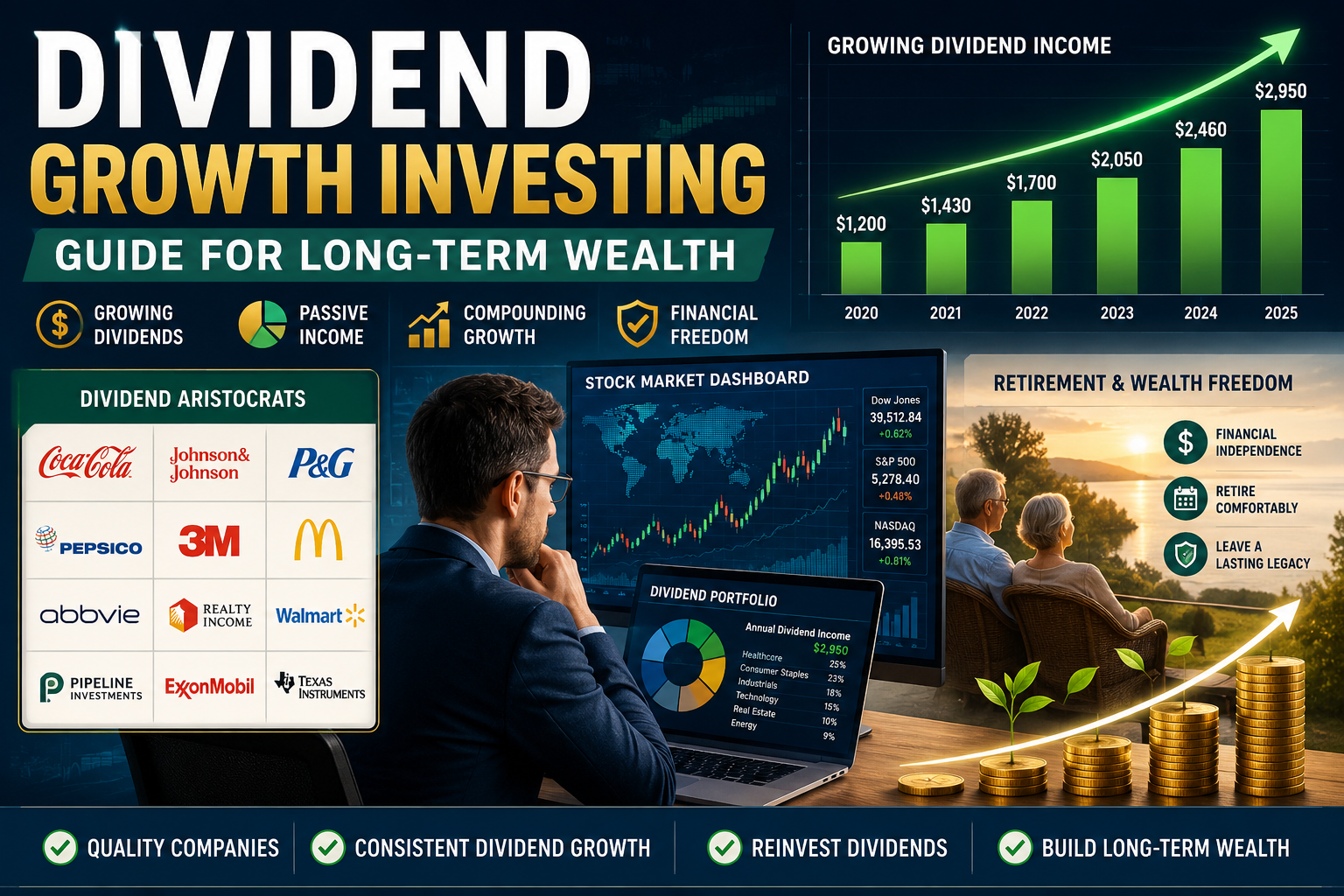
Introduction: What Is Dividend Growth Investing?
Dividend Growth Investing is a long-term investment strategy focused on buying shares of financially strong companies that pay dividends and have the potential to increase those payments over time. Investors aim to combine rising income with potential capital appreciation instead of relying exclusively on short-term price movements.
A dividend is a payment distributed to eligible shareholders, while capital appreciation means an increase in the market value of an investment. When a company grows its profits and cash flow, it may have greater capacity to raise dividends, although increases are never guaranteed.
For investors in the United States, United Kingdom, Canada, and Australia, Dividend Growth Investing can be part of a retirement or wealth-building plan. However, stock prices can fall, dividends can be reduced, and even established businesses can face financial difficulties.
The central principle is to purchase quality businesses at reasonable valuations, evaluate dividend sustainability, diversify investments, and allow time for compounding to work.
1. Understanding Dividend Growth Investing
Dividend Growth Investing combines three concepts: dividends, growth, and investing. Understanding each term helps investors distinguish a sustainable income strategy from simply buying stocks with high advertised yields.
What Is a Dividend?
A dividend is a distribution of company earnings or other distributable funds to shareholders, subject to corporate approval and applicable law. Companies commonly pay cash dividends quarterly, semiannually, or annually, depending on their policies and market practices.
For example, an investor holding 100 shares of a company paying $2 per share annually would receive $200 in annual dividends, assuming the payment remains unchanged and the investor qualifies for each distribution.
Dividends are not equivalent to interest on a bank deposit. A company’s board can change its dividend policy, and shareholders cannot assume that future payments will continue at the same rate.
What Does Dividend Growth Mean?
Dividend growth means an increase in the amount paid per share over time. If a company increases its annual dividend from $1.00 to $1.08, the dividend growth rate is 8%.
Growth may reflect rising earnings, stronger cash generation, or management’s decision to distribute more cash to shareholders. Investors should investigate the reason behind an increase because a company can temporarily raise its dividend even when its underlying business is weakening.
What Does Investing Mean?
Investing means committing money to an asset with the expectation of receiving future economic benefits. Purchasing ordinary shares makes an investor a partial owner of a business and exposes them to that business’s financial performance and market risks. For more information about stock ownership and investment risks, consult Investor.gov’s guide to stocks.
Investment returns may include dividends and capital appreciation. A company can pay dividends while its share price falls, so investors should evaluate total return rather than judging an investment exclusively by its income. Beginners should understand investment fundamentals, diversification, and risk before committing money. TheAJTimes.com’s start investing guide provides a useful next step for readers who are new to investing.
2. Essential Dividend Growth Investing Terms
Dividend Yield
Dividend yield measures annual dividend income relative to the current share price. It helps investors compare indicated income across stocks, but it does not measure the safety of a dividend or the quality of the business.
Formula:
Dividend yield = Annual dividend per share ÷ Current share price × 100
For example, a stock trading at $80 with an annual dividend of $2.40 has an indicated dividend yield of 3%. This is a calculation based on the stated dividend, not a guarantee of future income.
Dividend Growth Rate
The dividend growth rate measures the percentage change in dividend payments between two periods.
Formula:
Dividend growth rate = (New dividend − Previous dividend) ÷ Previous dividend × 100
If an annual dividend increases from $2.00 to $2.16, the growth rate is 8%. Reviewing several years of dividend history gives a more useful picture than examining a single increase.
Payout Ratio
The payout ratio measures the proportion of earnings distributed as dividends. A lower ratio can provide a financial cushion when profits decline, but the appropriate level depends on the industry and business model.
Formula:
Earnings payout ratio = Dividends per share ÷ Earnings per share × 100
If earnings per share are $5 and annual dividends per share are $2, the payout ratio is 40%. The company distributes 40% of its reported earnings and retains the remainder for other purposes.
This measure can be misleading when earnings are volatile or affected by unusual accounting items. Real estate investment trusts, for example, are often assessed using funds from operations and related measures rather than ordinary earnings alone.
Free Cash Flow and Dividend Coverage
Free cash flow is the cash remaining after a company pays operating expenses and capital expenditures. Capital expenditures are spending on long-term assets such as equipment, buildings, and infrastructure.
Dividend coverage describes how comfortably a company’s earnings or cash flow supports its distributions. A company reporting accounting profits but repeatedly borrowing to finance dividends may have a less sustainable policy than one generating sufficient cash internally.
Investors should compare cash flow with dividends while also considering debt repayments, working-capital requirements, pension obligations, and spending needed to maintain competitiveness.
Earnings Per Share and Balance Sheet
Earnings per share, or EPS, represents profit attributable to ordinary shareholders divided by the weighted average number of ordinary shares. Growing EPS can support dividend increases, although earnings growth does not automatically translate into higher distributions.
A balance sheet records assets, liabilities, and shareholders’ equity. Reviewing debt, cash reserves, interest costs, and upcoming repayments helps investors assess whether a company can maintain its dividend during difficult economic conditions.
3. How Dividend Growth Investing Works
The process begins with research. Investors identify businesses with understandable revenue sources, durable competitive advantages, and the financial capacity to maintain or increase shareholder distributions.
They then examine valuation. Even an excellent business can be a disappointing investment when purchased at an excessive price, because future returns depend partly on the price paid.
After purchasing shares, eligible investors receive declared dividends. They can reinvest the payments, hold the cash for future opportunities, or use the income to cover expenses.
The Role of a Dividend Reinvestment Plan
A Dividend Reinvestment Plan, commonly called a DRIP, allows dividend payments to purchase additional shares, subject to the broker’s and plan’s rules. Some brokers support fractional shares, while others may require investors to purchase whole shares.
Reinvestment can increase the number of shares held. If those shares continue to qualify for dividends, they can increase future income and create a compounding effect.
However, reinvesting dividends does not eliminate investment risk. Buying additional shares in an overvalued or deteriorating company can increase exposure to that business.
4. The Power of Dividend Compounding
Compounding occurs when investment returns remain invested and contribute to future returns. Over long periods, disciplined investing and reinvestment can form part of broader wealth-building strategies, although investment growth and dividend increases are never guaranteed. In dividend investing, compounding can involve reinvested distributions as well as growth in the dividend paid per share.
Suppose an investor owns $10,000 of shares with a starting dividend yield of 3%. The initial annual dividend income would be $300, assuming the yield is accurate at the starting point.
If the dividend per share then grows by 7% annually, the income associated with the original shares would increase as follows, provided the investor holds the same number of shares and the company follows that growth path.
| Year | Annual income from original shares |
|---|---|
| 1 | $300 |
| 5 | Approximately $393 |
| 10 | Approximately $590 |
| 15 | Approximately $827 |
| 20 | Approximately $1,161 |
| 25 | Approximately $1,628 |
These are mathematical illustrations, not actual company results or forecasts. They assume uninterrupted annual dividend growth of 7% and exclude taxes, fees, dividend cuts, and changes in the number of shares.
Reinvesting dividends could increase the share count further, but actual results depend on reinvestment prices and subsequent company performance. The share price and total portfolio value are not guaranteed to rise.
5. Real Company Case Studies in Dividend Growth Investing
Real company announcements help illustrate dividend policies. They do not prove that a stock is attractively valued or that its dividend will continue increasing indefinitely.
Case Study One – Coca-Cola
The Coca-Cola Company operates a global beverage business with brands distributed across more than 200 countries and territories. Brand recognition and a broad distribution network support its business, although consumer preferences, input costs, competition, and currency movements remain important risks.
On February 19, 2026, Coca-Cola announced its 64th consecutive annual dividend increase. Its quarterly dividend rose from $0.51 to $0.53 per share, equivalent to an indicated annual dividend of $2.12, compared with $2.04 in 2025.
Source: Coca-Cola’s official 2026 dividend announcement.
What investors can learn: A long history of dividend increases can demonstrate a sustained commitment to shareholder distributions. Investors must still examine sales, margins, cash flow, debt, valuation, and changing consumer preferences.
A strong brand does not eliminate business risk. Investors should evaluate whether future cash generation can support the dividend instead of assuming that historical increases will continue indefinitely.
Case Study Two – Johnson & Johnson
Johnson & Johnson operates in innovative medicine and medical technology. Its performance depends on research, product development, regulatory requirements, intellectual property, and demand for healthcare products.
On April 14, 2026, the company announced a 3.1% increase in its quarterly dividend, from $1.30 to $1.34 per share. This marked its 64th consecutive year of dividend increases.
Source: Johnson & Johnson’s official 2026 dividend announcement.
What investors can learn: A long dividend history is a starting point for research, not a guarantee of future safety. Healthcare investors should consider patent expirations, clinical trial outcomes, product safety, litigation, and regulatory decisions.
A 3.1% dividend increase may appeal to investors seeking consistency, but its value depends on inflation, taxes, valuation, and the investor’s objectives.
Case Study Three – Microsoft
Microsoft demonstrates how a technology company can combine shareholder distributions with investment in growth. Its business includes software, cloud computing, enterprise services, and artificial-intelligence infrastructure.
On September 15, 2026, Microsoft announced a quarterly dividend of $0.98 per share, an increase of $0.07, or approximately 8%, over the previous quarterly payment.
Source: Microsoft’s official September 2026 dividend announcement.
What investors can learn: Dividend growth is not limited to traditional consumer-goods companies. Profitable technology businesses may increase distributions while continuing to invest in research, data centres, and new products.
Nevertheless, investors should assess valuation, competition, capital expenditure, regulation, and the possibility that earnings growth may slow. A rapidly growing dividend does not automatically make a stock inexpensive or low-risk.
Comparing the Three Companies
Coca-Cola illustrates a long dividend record in consumer beverages, Johnson & Johnson represents healthcare, and Microsoft demonstrates that dividend growth can coexist with significant investment in technology.
Their business models and risks differ, so comparing them solely by dividend yield would be incomplete. A sound assessment considers financial strength, dividend growth, valuation, and the role each investment would play in a diversified portfolio.
6. Twelve Powerful Dividend Growth Investing Strategies
Strategy 1 – Prioritize Business Quality
Look for businesses with durable competitive advantages, understandable revenue sources, capable management, and products customers continue to need. Competitive advantages can arise from brand strength, intellectual property, customer loyalty, or high switching costs.
Support your assessment with evidence from financial statements. Review multi-year revenue, margins, cash flow, debt, and the company’s ability to adapt to competition.
Strategy 2 – Examine Dividend Sustainability
Review payout ratios, free cash flow, debt maturities, and dividend history. Ask whether the business could maintain its distributions during weaker earnings or higher borrowing costs.
A long history of increases can be reassuring, but it does not guarantee future payments. Cash generation is generally a more useful foundation than relying on reputation alone.
Strategy 3 – Avoid Chasing High Yields
An unusually high yield may indicate a falling share price, declining earnings, or concerns about a dividend cut. This is sometimes called a yield trap: an investment looks attractive because of its yield but may destroy value as the business weakens.
Investigate why the yield is high before buying. Compare the current payout with historical levels, cash-flow coverage, debt, and the company’s outlook.
Strategy 4 – Assess Dividend Growth and Valuation Together
A company growing its dividend rapidly may still be overvalued. A slower-growing business may offer reasonable potential returns when purchased at an attractive valuation.
Use conservative assumptions about earnings growth, dividend growth, and future valuation. Forecasts are estimates, not guarantees.
Strategy 5 – Diversify Across Sectors
Holding companies in several sectors can reduce dependence on one industry. Investors might research consumer staples, healthcare, technology, industrials, utilities, and financial services.
Diversification does not prevent losses, but it can reduce the impact of a single company’s problems. Review individual stock weights and overlapping holdings in funds to identify hidden concentration.
Strategy 6 – Reinvest Dividends When Appropriate
During the accumulation phase, reinvesting dividends can increase the number of shares held and potentially accelerate future income growth. Investors should compare automatic reinvestment with retaining cash for other opportunities.
Reinvestment should reflect the investor’s time horizon, tax circumstances, risk tolerance, and the valuation of the shares being purchased.
Strategy 7 – Track Cash Flow and Debt
Examine operating cash flow, capital expenditures, interest costs, and upcoming debt maturities. Businesses with significant refinancing needs may be vulnerable when interest rates rise or credit markets tighten.
A company can report positive net income while experiencing cash-flow pressure. Reading the cash-flow statement alongside the income statement and balance sheet gives a more complete view.
Strategy 8 – Review Dividend Announcements
Track declared dividend amounts, payment dates, changes to payout policy, and management commentary. Compare new announcements with financial performance rather than assuming that scheduled payments will always continue.
Use investor-relations websites and regulatory filings for primary information. News and screening tools can help identify changes, but important claims should be checked against original documents.
Strategy 9 – Consider Tax-Advantaged Accounts
Retirement accounts may offer tax advantages depending on the country, account type, eligibility, and withdrawal rules. US investors may compare eligible retirement accounts, while UK investors may review ISAs and pensions.
Tax treatment varies by residence, account, security, and income type. Consider foreign withholding taxes before choosing an account or international investment.
Strategy 10 – Rebalance Periodically
Rebalancing means returning a portfolio toward its intended allocation after market movements change the relative size of holdings. It can prevent one successful stock or sector from dominating the portfolio.
Rebalancing may involve directing new contributions toward underweighted areas or reducing an oversized position. Consider trading costs and tax consequences before selling.
Strategy 11 – Monitor Business Changes
Review a company when its fundamentals change materially. Warning signs include deteriorating cash flow, rising leverage, persistent market-share losses, or dividend increases that are no longer supported by operating performance.
Selling decisions should be based on the investment thesis and relevant evidence, not solely on a temporary decline in the share price.
Strategy 12 – Match the Strategy to Your Time Horizon
Investors with decades before retirement may focus on total returns and reinvestment. Investors who need income soon may place greater emphasis on cash flow, liquidity, and stability across their overall plan.
No single dividend strategy suits everyone. Emergency savings, debt costs, investment horizon, tax circumstances, and diversification should shape decisions.
7. Building a Diversified Dividend Growth Portfolio
A dividend portfolio should be designed around financial goals rather than a collection of famous companies. A dividend portfolio should be designed around financial goals rather than a collection of famous companies. Investors can use a structured portfolio strategy to determine their target allocation, risk tolerance, and investment objectives before selecting individual securities. Investors should decide how much risk they can tolerate and how much income they need before selecting individual securities.
An illustrative research framework might include consumer staples, healthcare, technology, financials, and diversified funds. These categories are not a recommendation to purchase any specific stock.
| Portfolio area | Research objective | Main risk to examine |
|---|---|---|
| Consumer staples | Durable demand and cash flow | Changing preferences and input costs |
| Healthcare | Product demand and innovation | Regulation, patents, and litigation |
| Technology | Cash generation and growth | Valuation and disruption |
| Financials | Earnings and capital strength | Credit losses and economic cycles |
| Diversified funds | Broader exposure | Market risk, fees, and concentration |
Investors should also consider whether a broad-market index fund may better meet their objectives than selecting individual dividend stocks. Understanding ETFs and index funds can help investors compare diversified funds with individual securities, including their costs, holdings, and investment objectives. Diversified funds can reduce company-specific risk, although they remain exposed to market declines and may not focus specifically on dividend growth.
Explore TheAJTimes.com’s Portfolio Strategy guide and ETFs and Index Funds guide for related topics.
8. A Worked Example: Estimating Dividend Income
Suppose an investor purchases $20,000 of shares at an initial dividend yield of 3%. The initial annual dividend income would be $600, assuming the stated yield is accurate and the dividend remains unchanged.
If the dividend per share increases by 6% annually for ten years, the dividend associated with the original shares would grow to approximately $1,075 annually before taxes, provided the investor holds the same number of shares and the company follows that growth path.
Formula:
Future annual dividend = Initial annual dividend × (1 + dividend growth rate)^number of years
Using the example:
$600 × (1.06)^10 ≈ $1,075
This is a hypothetical calculation, not a forecast for a specific company. It assumes ten uninterrupted annual increases and excludes reinvestment, taxes, fees, currency changes, and dividend cuts.
If dividends are reinvested, future income may be higher because the investor owns more shares. The actual outcome depends on reinvestment prices and investment performance.
Understand Yield on Cost
Yield on cost compares a holding’s current annual dividend per share with its original purchase price per share. If an investor bought a stock at $50 and its annual dividend later increased to $3, the yield on the original cost would be 6%.
This measure illustrates income growth relative to the original investment. It should not replace current yield, valuation, or total-return analysis when deciding whether to buy or hold a stock.
9. Dividend Growth Investing and Inflation
Inflation is the rate at which the general price level rises over time. It reduces purchasing power, meaning the same amount of money buys fewer goods and services as prices rise.
Dividend growth may help offset inflation if payments increase sufficiently. However, dividends do not always grow faster than inflation, and companies may freeze or cut distributions during difficult periods.
For example, if annual dividend income is $5,000 and dividends grow by 4%, annual income rises to $5,200 before taxes. If inflation is 3%, purchasing power has increased slightly, assuming the inflation measure reflects the investor’s spending.
Investors should consider real returns after inflation as well as taxes and fees. A growing nominal dividend does not automatically mean a growing standard of living.
10. Risks and Common Mistakes
Dividend Cuts and Suspensions
A company may reduce or eliminate its dividend if earnings deteriorate, cash becomes scarce, debt obligations rise, or management changes its capital-allocation priorities. Even a company with decades of increases can face financial difficulties.
Investors should not assume that past performance guarantees future payments. Review financial statements, dividend announcements, and the company’s ability to fund distributions during less favourable conditions.
Overconcentration
Owning many stocks does not necessarily create diversification if most holdings operate in the same sector or depend on the same economic factors. A portfolio heavily weighted toward banks, energy companies, or consumer staples may share common risks.
Review sector weights, individual company weights, geographical exposure, and overlapping holdings in exchange-traded funds.
Ignoring Total Return
Total return includes income received and changes in investment value, with reinvestment assumptions stated where applicable. A high dividend can be offset by a substantial decline in the share price.
Compare dividend strategies with suitable benchmarks over meaningful periods, and review stock market basics to understand how share prices, market movements, and investment risks can affect overall returns. Consider risk, taxes, fees, and portfolio objectives rather than judging success by income alone.
Treating Dividends as Guaranteed Income
Dividend payments depend on company decisions and applicable legal requirements. They are not equivalent to guaranteed interest or a government-insured deposit.
Retirees should maintain appropriate liquidity and consider a diversified withdrawal plan instead of relying entirely on dividends for every expense.
11. Dividend Growth Investing in the US, UK, Canada, and Australia
Investors in developed markets should account for differences in tax systems, account structures, currency exposure, and company reporting practices. A strategy that works well in one jurisdiction may produce different after-tax results in another.
United States
US investors can research company announcements and filings through investor-relations websites and the Securities and Exchange Commission. Tax treatment depends on whether dividends are qualified or nonqualified, the investor’s circumstances, and the account in which investments are held.
Review current guidance from the Internal Revenue Service rather than assuming every dividend receives the same tax rate.
United Kingdom
UK investors should consider current dividend tax rules, available allowances, and the treatment of investments held in ISAs and pensions. Tax rates and allowances can change, so calculations should use the rules applicable to the relevant tax year.
Consult HM Revenue & Customs’ dividend tax guidance for the latest applicable rules.
Canada
Canadian investors should distinguish between eligible and non-eligible dividends and understand how the dividend tax credit operates. Tax treatment can vary by province or territory and by the investor’s circumstances.
Foreign dividends may receive different treatment from eligible Canadian dividends, including potential withholding tax. Review the Canada Revenue Agency guidance before estimating after-tax income.
Australia
Australian investors may need to consider franked dividends and franking credits. A franking credit reflects company tax associated with a dividend and may affect an eligible shareholder’s tax calculation, subject to applicable rules.
Not every dividend is fully franked, and foreign dividends may have different treatment. Consult the Australian Taxation Office and relevant company disclosures.
12. Dividend Growth Investing for Retirement
Retirement planning requires a way to fund spending over many years. Dividend income can contribute to that plan, but investors should also consider cash savings, bonds, diversified funds, pensions, and other income sources.
A retiree spending $30,000 annually cannot assume that a $30,000 dividend target will remain stable forever. Taxes, inflation, company decisions, market valuations, and unexpected expenses can affect the amount available to spend.
A practical approach is to estimate essential and discretionary expenses, maintain liquid reserves, and diversify income sources. Investors should test their plans against dividend cuts, market declines, and periods of high inflation.
For more guidance on retirement income, withdrawals, and long-term planning, explore TheAJTimes.com’s retirement investing guide and Wealth Building guide.
Conclusion: Is Dividend Growth Investing Worth Considering?
Dividend Growth Investing can be a useful long-term strategy for investors who value growing income, business ownership, and disciplined portfolio management. Its key principles are straightforward: understand the business, assess dividend sustainability, pay attention to valuation, diversify, and review investments as circumstances change.
Company announcements from 2026 show that Coca-Cola and Johnson & Johnson continued their long records of dividend increases, while Microsoft demonstrated that a technology company can also raise its dividend. These examples illustrate corporate dividend policies, not guaranteed future returns.
Successful investing requires more than finding companies with rising payouts. Investors must evaluate risk, taxes, inflation, fees, and total return while maintaining a plan that fits their financial circumstances.
Dividend growth can support long-term wealth creation, but it works best as part of a researched, diversified investment plan rather than a promise of effortless or guaranteed passive income.
Frequently Asked Questions About Dividend Growth Investing
1. What Is Dividend Growth Investing?
Dividend Growth Investing focuses on owning companies that pay dividends and have the financial capacity to increase those payments over time. Investors often seek a combination of growing income and capital appreciation.
2. How Much Money Do I Need to Start Dividend Growth Investing?
The amount depends on your broker’s minimums, trading costs, share prices, and local regulations. Some brokers offer fractional shares, allowing smaller initial investments, but investors should first maintain emergency savings and manage expensive debt.
3. Is Dividend Growth Investing Suitable for Beginners?
It can suit beginners who are willing to learn about financial statements, diversification, valuation, and investment risk. A diversified fund may be easier to manage than selecting individual dividend stocks.
4. Are Dividend Payments Guaranteed?
No. A company’s board may change or suspend its dividend, subject to applicable laws and corporate requirements. Past dividend increases do not guarantee future distributions.
5. What Is a Good Dividend Yield?
There is no universally ideal yield. Investors should assess yield alongside business quality, payout coverage, growth prospects, valuation, and sector-specific risks.
6. Should I Reinvest My Dividends?
Reinvestment may be useful during the accumulation phase if it fits your plan and the investment remains attractive. Investors who need income for expenses may prefer to retain some or all dividends in cash.
7. What Is the Difference Between Dividend Growth and High-Yield Investing?
Dividend growth investing emphasizes a company’s ability to raise distributions over time. High-yield investing focuses more on the income currently offered relative to the share price. The approaches can overlap, but a high yield may indicate elevated risk.
8. Can Dividend Growth Investing Beat the Stock Market?
It can outperform or underperform a broad-market benchmark depending on valuations, company performance, sector exposure, fees, taxes, and the period measured. There is no guarantee that a dividend-focused portfolio will beat the market.
9. How Long Should I Hold Dividend Growth Stocks?
The holding period should reflect the investment thesis and financial goals. Long-term ownership can allow dividend growth and reinvestment to compound, but investors should reassess holdings when fundamentals or valuations change materially.
10. Can Dividend Growth Investing Help Fund Retirement?
It can contribute to retirement income, but dividends are uncertain and may be reduced. A retirement plan should account for inflation, taxes, diversification, liquidity, and the possibility of market losses.
11. What Is Yield on Cost?
Yield on cost compares the current annual dividend per share with the original purchase price per share. It can illustrate income growth relative to the original investment but does not indicate whether the stock is attractively valued today.
12. Are Dividend Stocks Safer Than Growth Stocks?
Not automatically. Dividend-paying companies can suffer substantial price declines, financial distress, and dividend cuts. Risk depends on the business, its financial position, valuation, and the investor’s overall portfolio.
13. How Are Dividends Taxed in Different Countries?
Tax treatment differs across the US, UK, Canada, and Australia. It may depend on account type, tax status, dividend classification, and foreign withholding taxes. Check the relevant tax authority’s current guidance.
14. Should I Choose Individual Stocks or Dividend ETFs?
Individual stocks allow company-level selection but create company-specific risk and require more research. Dividend exchange-traded funds provide exposure to multiple holdings, although fees, screening rules, concentration, and market risk still matter.
15. What Is the Biggest Mistake in Dividend Growth Investing?
One major mistake is chasing the highest yield without examining dividend sustainability. Other common errors include ignoring valuation, holding too few companies, overlooking taxes, and assuming dividends eliminate investment risk.
Educational disclaimer: This article is for general educational purposes only and does not provide individualized financial, investment, or tax advice. Investments can lose value, dividends may be reduced or suspended, and past performance does not guarantee future results. Consider your circumstances and consult a qualified professional when appropriate.