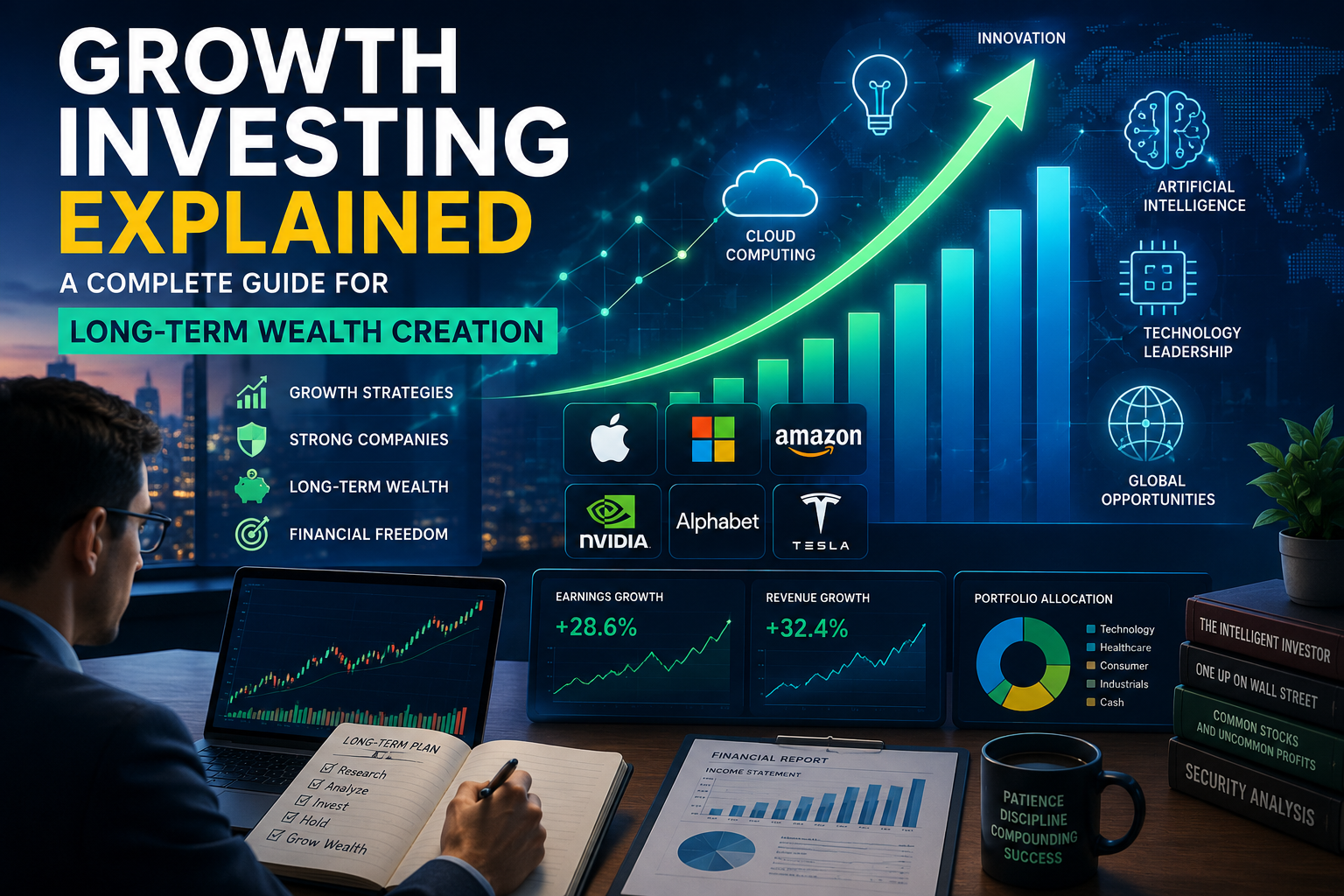
Growth Investing Explained: The Complete Guide to Building Long-Term Wealth Through High-Growth Companies
Introduction
Growth investing is one of the most popular and potentially rewarding investment strategies used by investors in developed economies such as the United States, Canada, the United Kingdom, Australia, Germany, Singapore, and other Tier-1 countries.
The strategy focuses on identifying companies that are expected to grow faster than the overall economy and faster than the average company in the stock market. Instead of looking for stocks that appear cheap today, growth investors look for businesses that can become significantly larger and more profitable in the future.
Many of the world’s greatest investment success stories have come from growth investing. Investors who recognized the potential of companies like Amazon.com Inc., Apple Inc., Microsoft Corporation, Alphabet Inc., and NVIDIA Corporation during their growth phases generated extraordinary returns over long periods.
Growth investing is not simply about buying technology stocks. It is about identifying businesses with strong competitive advantages, expanding markets, innovative products, talented leadership, and the ability to increase earnings for many years.
This guide explains every major concept, term, principle, and strategy associated with growth investing, along with real-world examples and case studies.
What Is Growth Investing?
Growth investing is an investment strategy that focuses on purchasing shares of companies expected to grow their revenues, earnings, cash flow, or market share at a rate significantly above average.
To understand growth investing, let’s break down the phrase into two parts.
Growth
Growth refers to an increase in a company’s business performance.
Examples include:
- Higher sales revenue
- More customers
- Greater profits
- Expanded product offerings
- New market penetration
- Increased market share
Investing
Investing means allocating capital today with the expectation of generating future returns.
When combined, growth investing means:
Investing in businesses that are expected to become much larger and more profitable in the future.
The goal is capital appreciation, which means increasing the value of your investment over time.
Understanding Capital Appreciation
Capital appreciation refers to the increase in the value of an asset.
Example:
Suppose an investor purchases a stock at $100 per share.
Five years later, the stock is worth $300.
The capital appreciation is:
$300 − $100 = $200
The investor generated a 200% gain.
Growth investors primarily focus on capital appreciation rather than dividend income.
Why Growth Investing Exists
The stock market rewards businesses that continuously increase profits.
Imagine two companies.
Company A
- Revenue growth: 2% annually
- Profit growth: 1% annually
Company B
- Revenue growth: 30% annually
- Profit growth: 25% annually
Which company is likely to attract more investors?
Most investors would choose Company B because future earnings are expected to be much larger.
As earnings grow, stock prices often follow.
This relationship forms the foundation of growth investing.
Key Terms Every Growth Investor Must Understand
Revenue
Revenue represents total money generated from sales before expenses.
Formula:
Revenue = Units Sold × Selling Price
Example:
A software company sells 100,000 subscriptions at $100 annually.
Revenue = $10 million
Revenue growth is often the first sign of a successful growth company.
Earnings
Earnings represent profits after expenses.
Also called:
- Net Income
- Bottom-Line Profit
Example:
Revenue: $100 million
Expenses: $80 million
Net Income = $20 million
Growth investors want earnings to grow consistently.
Earnings Per Share (EPS)
EPS measures profit allocated to each outstanding share.
Formula:
EPS = Net Income ÷ Shares Outstanding
Higher EPS generally indicates improving profitability.
Market Share
Market share measures a company’s percentage of total industry sales.
Example:
If the smartphone market generates $500 billion annually and a company generates $100 billion, its market share equals 20%.
Growth companies often increase market share by outperforming competitors.
Total Addressable Market (TAM)
TAM refers to the maximum revenue opportunity available.
Example:
The global cloud computing market may be worth trillions of dollars.
A company serving this market has enormous growth potential.
Growth investors prefer businesses with large TAMs.
Characteristics of Growth Stocks
Growth stocks often share several characteristics.
Strong Revenue Growth
Most growth companies increase revenue faster than industry averages.
Example:
- Industry growth: 5%
- Company growth: 25%
This indicates strong competitive positioning.
Innovation
Innovation means creating new products, technologies, or business models.
Examples:
- Artificial Intelligence
- Cloud Computing
- Electric Vehicles
- Biotechnology
- Robotics
Innovation often creates growth opportunities unavailable to traditional businesses.
Competitive Advantage
A competitive advantage is something that makes a company difficult to compete against.
Examples include:
- Brand power
- Technology leadership
- Network effects
- Patents
- Customer loyalty
Strong competitive advantages allow companies to maintain growth.
Scalability
Scalability means the ability to increase revenue without proportionally increasing costs.
Software companies provide excellent examples.
A software company may spend millions creating a product but can sell additional copies at very low cost.
This creates enormous profit potential.
The Power of Compounding
One of the most important concepts in growth investing is compounding.
Compounding occurs when growth builds upon previous growth.
Example:
Initial investment = $10,000
Annual return = 15%
Year 1:
$10,000 × 1.15 = $11,500
Year 2:
$11,500 × 1.15 = $13,225
Year 3:
$13,225 × 1.15 = $15,209
The growth accelerates because returns generate additional returns.
This is why long-term investors often become significantly wealthier than short-term traders.
Growth Investing vs Value Investing
Growth investing and value investing are often compared.
Growth Investing
Focuses on:
- Future potential
- Revenue expansion
- Earnings growth
- Market leadership
Investors willingly pay higher valuations.
Value Investing
Focuses on:
- Undervalued stocks
- Discounted prices
- Margin of safety
- Current fundamentals
Investors seek bargains.
Example
Growth Investor:
Buys a fast-growing AI company at a high valuation.
Value Investor:
Buys a mature industrial company trading below intrinsic value.
Both approaches can be successful when executed properly.
Case Study: Amazon
One of the greatest growth investing examples is Amazon.com Inc..
Early Years
Founded as an online bookstore.
Most investors focused on profits.
Amazon focused on growth.
The company reinvested heavily in:
- Warehouses
- Logistics
- Technology
- Customer acquisition
Investor Skepticism
For years, critics argued Amazon was overvalued.
The company often generated minimal profits.
Traditional valuation metrics appeared unattractive.
Long-Term Outcome
Amazon eventually expanded into:
- E-commerce
- Cloud computing
- Digital advertising
- Streaming
The creation of AWS transformed the business.
Investors who believed in Amazon’s growth story achieved extraordinary returns.
Lesson
Growth investors focus on future earning power rather than current profits.
Case Study: Apple
Apple Inc. demonstrates how innovation can fuel growth.
Initial Growth Phase
Apple was primarily a computer company.
Market share remained relatively small.
Product Innovation
The company introduced:
- iPod
- iPhone
- iPad
- Apple Watch
Each product expanded Apple’s ecosystem.
Ecosystem Advantage
Apple created interconnected products and services.
Customers became increasingly loyal.
This generated recurring revenue.
Long-Term Results
Apple evolved into one of the world’s most valuable companies.
Lesson
Sustainable innovation can drive decades of growth.
Case Study: NVIDIA
NVIDIA Corporation provides a modern example of growth investing.
Original Business
The company initially focused on gaming graphics processors.
New Opportunities
Management recognized emerging demand in:
- Artificial Intelligence
- Machine Learning
- Data Centers
- Autonomous Vehicles
Growth Explosion
As AI adoption accelerated globally, demand for NVIDIA chips surged.
Revenue and profits expanded dramatically.
Lesson
Growth investing often involves identifying major technological trends before they become mainstream.
How Growth Investors Evaluate Companies
Professional growth investors examine several factors.
Revenue Growth Rate
Example:
Year 1 Revenue: $1 billion
Year 2 Revenue: $1.3 billion
Growth Rate:
30%
Higher growth rates generally attract investors.
Profit Margins
Profit margin measures efficiency.
Formula:
Net Income ÷ Revenue
Companies with expanding margins often become more profitable over time.
Cash Flow
Cash flow measures actual money generated.
Strong cash flow helps companies:
- Expand operations
- Acquire competitors
- Invest in research
Management Quality
Leadership is critical.
Growth investors assess:
- Vision
- Execution ability
- Capital allocation
- Innovation mindset
Exceptional leaders often create exceptional businesses.
Industries Popular Among Growth Investors
Artificial Intelligence
AI is transforming industries worldwide.
Applications include:
- Healthcare
- Finance
- Manufacturing
- Education
Growth investors closely monitor AI-related companies.
Cloud Computing
Cloud services allow businesses to store and process data online.
Benefits include:
- Scalability
- Flexibility
- Lower costs
Demand continues growing globally.
Biotechnology
Biotech companies develop innovative medical treatments.
Successful breakthroughs can create enormous value.
However, risks remain high.
Renewable Energy
Governments worldwide support cleaner energy solutions.
Examples include:
- Solar power
- Wind power
- Energy storage
Long-term growth opportunities remain substantial.
Risks of Growth Investing
Growth investing offers high rewards but also significant risks.
Valuation Risk
Investors may overpay.
Even great companies can generate poor returns if purchased at excessive valuations.
Competition Risk
Successful industries attract competitors.
Increased competition can reduce profitability.
Technology Risk
Innovation changes rapidly.
Today’s market leader may become tomorrow’s loser.
Economic Risk
Economic slowdowns often reduce spending.
Growth companies may experience lower demand.
Interest Rate Risk
Higher interest rates can negatively impact growth stocks.
Future earnings become less valuable when discounted at higher rates.
Common Mistakes Growth Investors Make
Chasing Hype
Investing based solely on headlines is dangerous.
Always analyze fundamentals.
Ignoring Valuation
Great companies can still become overpriced.
Price matters.
Lack of Diversification
Concentrating investments in a single stock increases risk.
Diversification helps protect capital.
Emotional Decisions
Fear and greed often lead to poor outcomes.
Successful investors remain disciplined.
Growth Investing Strategy for Tier-1 Countries
Investors in the United States, Canada, the United Kingdom, Australia, and Europe often follow a structured process.
Step 1
Identify industries with strong future demand.
Step 2
Find companies with:
- Strong revenue growth
- Competitive advantages
- High-quality management
Step 3
Analyze financial statements.
Step 4
Assess valuation.
Step 5
Invest gradually.
Step 6
Monitor business performance.
Step 7
Hold for the long term.
The Psychology of Growth Investing
Investing success depends heavily on psychology.
Growth stocks can experience:
- 20% corrections
- 30% declines
- 50% crashes
Even strong companies face volatility.
Investors who panic often sell before recovery.
Patience is one of the most valuable investing skills.
Why Long-Term Thinking Matters
Consider two investors.
Investor A
Buys and sells frequently.
Investor B
Owns high-quality growth companies for 15 years.
Historically, long-term ownership of exceptional businesses has often produced superior results.
Time allows:
- Compounding
- Innovation
- Earnings growth
- Market expansion
to work in the investor’s favor.
Future of Growth Investing
Several trends may drive future growth opportunities:
- Artificial Intelligence
- Quantum Computing
- Robotics
- Autonomous Vehicles
- Biotechnology
- Renewable Energy
- Cybersecurity
- Space Technology
Investors who identify transformative trends early may benefit significantly.
Final Thoughts
Growth investing is the practice of investing in companies expected to grow faster than the broader market. It focuses on future potential rather than current valuation discounts. Successful growth investors seek businesses with strong revenue growth, competitive advantages, scalable business models, visionary leadership, and large market opportunities.
The remarkable success stories of companies such as Amazon.com Inc., Apple Inc., Microsoft Corporation, Alphabet Inc., and NVIDIA Corporation demonstrate the wealth-building power of growth investing when combined with patience, research, and long-term thinking.
For investors in Tier-1 countries, growth investing remains one of the most effective strategies for participating in innovation, economic expansion, and technological progress while building long-term wealth through the power of compounding.