Introduction
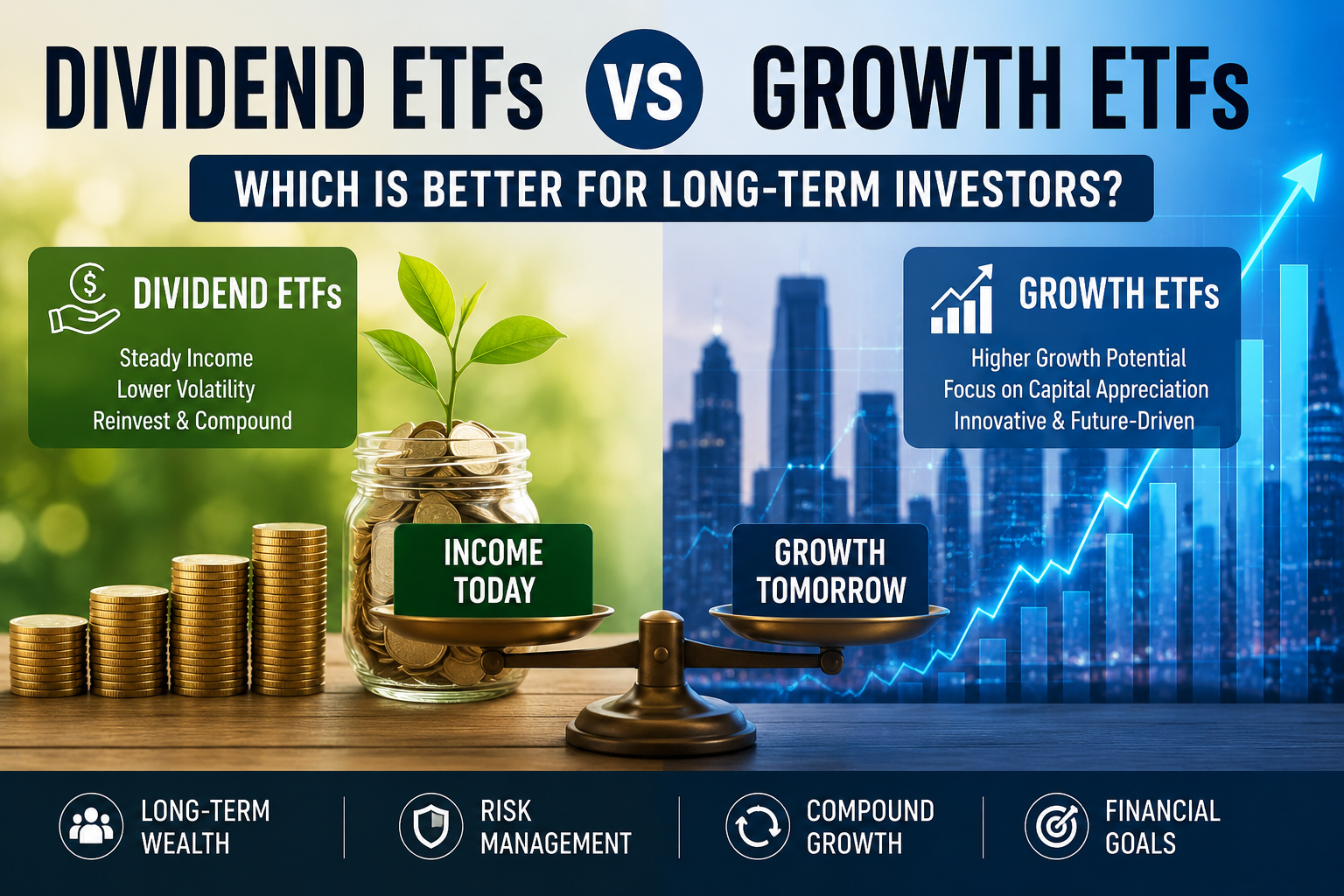
If you are building an investment portfolio, one of the biggest decisions you will face is whether to invest in dividend ETFs, growth ETFs, or a combination of both. At first glance, the difference may seem simple: one type pays cash income and the other focuses more on capital appreciation. But in reality, the choice between dividend ETFs vs growth ETFs affects your income, taxes, volatility, retirement planning, portfolio behavior during market crashes, and long-term wealth creation.
Understanding Dividend ETFs vs Growth ETFs is one of the most important decisions long-term investors will make. The choice between dividend ETFs and growth ETFs affects your portfolio’s income, long-term returns, and overall investment strategy.
If you’re new to investing, start with our Beginner’s Guide to Investing to understand core concepts before comparing dividend and growth ETFs.
For some investors, dividend ETFs feel safer because they own mature companies that pay regular dividends. For others, growth ETFs are more attractive because they aim to maximize long-term capital gains through fast-growing companies, often in technology, healthcare, communication services, and consumer sectors. Neither category is automatically “better.” The right answer depends on your age, income needs, tax situation, time horizon, risk tolerance, and investing goal.
By the end, you should understand not just what dividend ETFs and growth ETFs are, but when to use each one, how they behave in different markets, and how to combine them intelligently.
1) What Is an ETF?
ETF stands for Exchange-Traded Fund.
Let’s break that down word by word:
- Exchange = It trades on a stock exchange like a regular stock.
- Traded = You can buy or sell it during market hours.
- Fund = It is a basket of many investments pooled together.
So, instead of buying 100 individual stocks one by one, you can buy one ETF that already owns those stocks for you.
New to ETFs? Read our What Is an ETF? guide to learn how exchange-traded funds work, their advantages, and why they are popular among long-term investors. Before investing, it’s also worth reviewing ETF information and investor protection resources published by FINRA.
Key Takeaways
- ETFs are diversified.
- ETFs trade like stocks.
- ETFs have lower costs.
Expert Insight
“Costs matter because they compound over time. Keeping investment expenses low allows investors to retain more of their long-term returns.” — Vanguard
Example
If you buy a dividend ETF, you may instantly own shares of dozens or hundreds of dividend-paying companies. If you buy a growth ETF, you may instantly own a portfolio of fast-growing businesses such as software, semiconductor, or consumer platform companies.
Why ETFs are popular
ETFs are popular because they usually offer:
- Diversification – spread across many stocks
- Lower costs – many passive ETFs have very low expense ratios
- Liquidity – easy to buy and sell
- Transparency – holdings are often published daily or regularly
- Tax efficiency – often better than mutual funds in many jurisdictions
Still deciding between fund types? Compare ETFs vs Mutual Funds to understand their differences in structure, costs, and trading.
For official guidance on exchange-traded funds, investor risks, and investment basics, review the educational resources provided by the U.S. Securities and Exchange Commission.
Before comparing Dividend ETFs vs Growth ETFs, it’s important to understand how ETFs work and why they have become one of the most popular investment vehicles for long-term investors.
2) What Is a Dividend ETF?
A dividend ETF is an exchange-traded fund that invests primarily in companies that pay dividends to shareholders. Dividend ETFs are one side of the Dividend ETFs vs Growth ETFs comparison because they focus on income investing through companies that regularly distribute dividends.
What is a dividend?
A dividend is a portion of a company’s profits distributed to shareholders, usually in cash. For example, if a company earns strong profits and has more cash than it needs, it may return some of that money to investors as a dividend.
Simple example
Suppose you own a dividend ETF worth $10,000 and the ETF has a 3% annual dividend yield. That means you may receive about $300 per year in cash distributions, usually paid quarterly or monthly depending on the ETF.
What types of companies pay dividends?
Dividend ETFs often hold companies that are:
- Mature
- Profitable
- Cash-generating
- Less dependent on aggressive reinvestment
- Found in sectors like consumer staples, healthcare, financials, energy, industrials, utilities, and sometimes mega-cap technology
Important point
Not all dividend ETFs are the same. Some target:
- High dividend yield
- Dividend growth
- Dividend quality
- Dividend aristocrats
- Defensive dividend payers
That distinction matters because a 3.5% yield ETF can behave very differently from a 1.5% yield dividend-growth ETF. Many investors prefer dividend ETF investing because it combines diversification with recurring dividend income.
For a deeper explanation of dividend-focused strategies, explore our complete Dividend ETFs guide.
3) What Is a Growth ETF?
A growth ETF is an exchange-traded fund that focuses on companies expected to grow their revenue, earnings, cash flow, market share, or future value faster than the average company. Growth ETFs represent the other half of the Dividend ETFs vs Growth ETFs debate by focusing on companies expected to increase earnings and revenue over time.
What makes a stock a “growth” stock?
Growth companies usually:
- Reinvest profits back into expansion
- Spend heavily on R&D, hiring, product development, and acquisitions
- Often pay low dividends or no dividends
- Trade at higher valuations because investors expect strong future growth
Common sectors in growth ETFs
Growth ETFs often have large exposure to:
- Technology
- Semiconductors
- Cloud software
- Consumer internet/platform companies
- Communication services
- Healthcare innovation
- AI-related businesses
Growth ETF investing appeals to investors seeking long-term capital appreciation rather than immediate income.
Example
If a company can grow earnings 20% per year, investors may be willing to pay a higher price today because they expect the business to be much larger in the future. Growth ETFs bundle many such companies into one fund.
4) Dividend ETFs vs Growth ETFs: The Core Difference
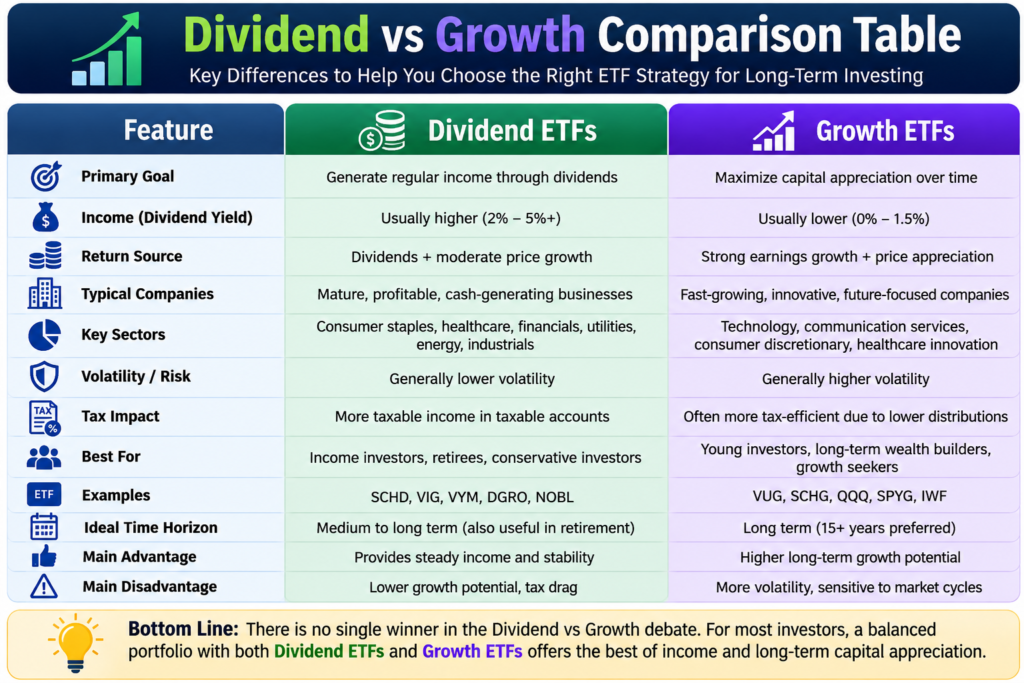
Dividend vs Growth Comparison Table
At the highest level:
Dividend ETFs
- Focus on income + stability + mature businesses
- Often emphasize cash distributions
- May hold value-oriented or quality companies
- Tend to be used by income investors, retirees, conservative investors, and total-return investors who like lower volatility
Growth ETFs
- Focus on capital appreciation
- Often emphasize future earnings expansion
- Usually pay lower yields
- Tend to be used by younger investors, long-term accumulators, and investors comfortable with volatility
The simplest way to think about it
- Dividend ETF: “I want my portfolio to produce cash flow and own financially strong businesses.”
- Growth ETF: “I want my portfolio to maximize long-term value by owning companies with higher expected growth.”
When comparing Dividend ETFs vs Growth ETFs, investors should focus on investment objectives rather than recent performance.
Dividend ETFs vs Growth ETFs differ mainly in how shareholder returns are generated.
Choosing between Dividend ETFs vs Growth ETFs depends on your financial goals, investment horizon, and tolerance for risk.
5) Key Investing Terms You Must Understand
Before comparing dividend ETFs vs growth ETFs, let’s define the most important terms.
Dividend Yield
The annual dividend paid divided by the ETF’s current price.
Formula:
Dividend Yield = Annual Dividend per Share / Price per Share
If an ETF pays $3 per year and trades at $100, its dividend yield is 3%.
Total Return
The most important performance measure for long-term investors.
Total Return = Price Return + Reinvested Dividends
This matters because a dividend ETF may look slower on price charts, but if dividends are reinvested, its total return can be much better than people expect.
Capital Appreciation
The increase in the value of an investment.
If you buy an ETF at $100 and it rises to $130, that is $30 of capital appreciation.
Expense Ratio
The annual fee charged by the ETF, expressed as a percentage of assets.
Example:
- 0.03% expense ratio = $3 per year on a $10,000 investment
- 0.20% expense ratio = $20 per year on a $10,000 investment
Volatility
How much an investment’s price moves up and down. Growth ETFs usually have higher volatility than broad dividend-quality ETFs.
Drawdown
The decline from a peak to a trough.
If an ETF falls from $100 to $70, that is a 30% drawdown.
Yield Trap / Dividend Trap
A stock or ETF may have a very high yield not because it is attractive, but because the underlying stock prices fell sharply due to business problems. A 9% yield can sometimes be a warning sign rather than an opportunity.
Valuation
How expensive a stock or ETF is relative to its fundamentals. Common valuation metrics include:
- P/E ratio = Price-to-Earnings
- P/S ratio = Price-to-Sales
- P/B ratio = Price-to-Book
- Free Cash Flow Yield
Growth ETFs often trade at higher valuations, which can amplify downside if expectations disappoint.
6) How Dividend ETFs Work
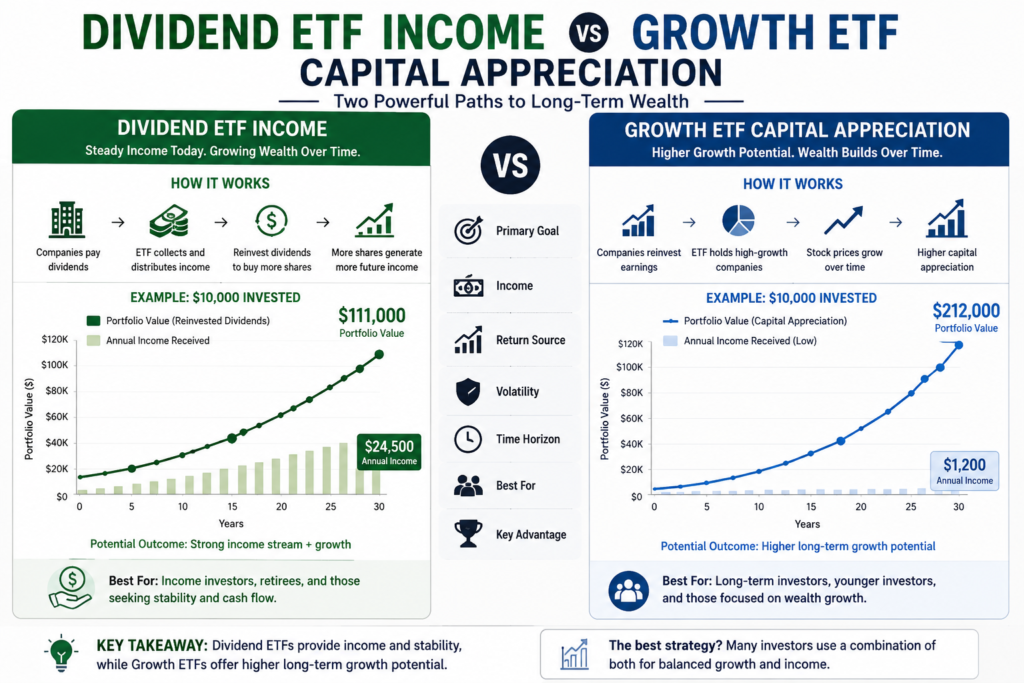
Dividend ETFs follow a set of rules, or an index methodology, to select dividend-paying stocks. The ETF collects the dividends from underlying companies and passes most of them through to shareholders.
How cash flows through a dividend ETF
- The ETF owns dividend-paying companies.
- Those companies pay dividends to the ETF.
- The ETF distributes that income to ETF shareholders.
- Investors can either:
- Take the cash
- Reinvest the dividend into more ETF shares
Why reinvestment matters
Reinvesting dividends is one of the most powerful compounding tools in investing. If you reinvest every distribution, you buy more shares, which then generate more future dividends.
This creates a compounding flywheel:
- More shares
- More dividends
- More reinvestment
- More future income and value
Long-term investors can also explore educational resources from Vanguard on dividend reinvestment, low-cost investing, and index fund strategies. Understanding how dividend ETF investing works makes it easier to compare Dividend ETFs vs Growth ETFs objectively.
7) How Growth ETFs Work
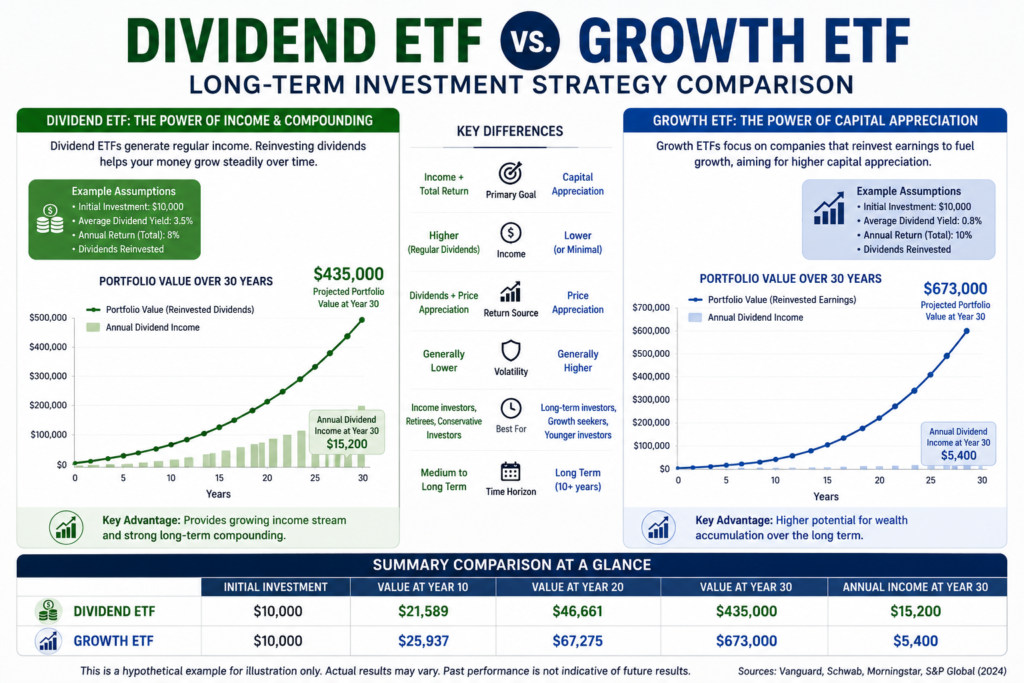
Growth ETFs usually own companies that retain earnings rather than distribute them. Instead of sending cash back to shareholders, those companies may use profits to:
- Build new products
- Enter new markets
- Buy other companies
- Hire talent
- Expand infrastructure
- Invest in AI, data centers, logistics, or healthcare pipelines
Why investors accept low yield
If a business can reinvest cash at a high rate of return, it may create more long-term value than simply paying that cash out as a dividend.
Example:
- Company A pays a 4% dividend
- Company B reinvests capital and compounds earnings at 18% annually
If Company B can sustain that growth, its stock price may appreciate much faster over time.
8) Dividend ETF Types
Not all dividend ETFs do the same thing. This is one of the most important concepts in this article.
A) High Dividend Yield ETFs
These prioritize current income.
Goal:
Generate a higher payout today.
Typical characteristics:
- Higher yields
- More exposure to financials, energy, utilities, telecom, REITs
- Can be more vulnerable to “yield traps”
Best for:
- Income-focused investors
- Retirees needing cash flow
- Investors who understand sector risk
B) Dividend Growth ETFs
These focus on companies that increase dividends over time, rather than simply paying the highest current yield.
Goal:
Lower yield today, but potentially stronger dividend growth and quality.
Best for:
- Long-term investors
- People who want both quality and income growth
- Investors who prefer a total-return mindset
C) Dividend Aristocrat ETFs
These invest in companies with long histories of increasing dividends, often 20–25+ consecutive years.
Appeal:
- Strong quality screen
- Shareholder-friendly culture
- Often resilient during downturns
D) Quality Dividend ETFs
These combine dividend screens with measures like:
- Return on equity
- Free cash flow
- Earnings stability
- Balance sheet strength
- Dividend sustainability
For a deeper explanation of dividend-focused strategies, explore our complete Dividend ETFs guide.
9) Growth ETF Types
A) Broad Large-Cap Growth ETFs
These track large-cap U.S. growth stocks and often include mega-cap technology leaders.
B) Nasdaq-Focused Growth ETFs
These tilt more heavily toward:
- Tech
- Semiconductors
- Internet platforms
- Non-financial growth names
These can be more concentrated and volatile.
C) Thematic or Innovation Growth ETFs
These may focus on:
- AI
- robotics
- biotech
- cloud
- cybersecurity
- clean energy
These can be exciting but often carry much higher risk than broad growth ETFs.
D) International Growth ETFs
These focus on growth stocks outside the U.S., useful for geographic diversification.
To better understand companies focused on long-term expansion, read our Growth Investing guide. For additional insights into growth investing and ETF selection, see the educational resources available from Charles Schwab.
10) Dividend ETFs vs Growth ETFs: Return Sources Explained
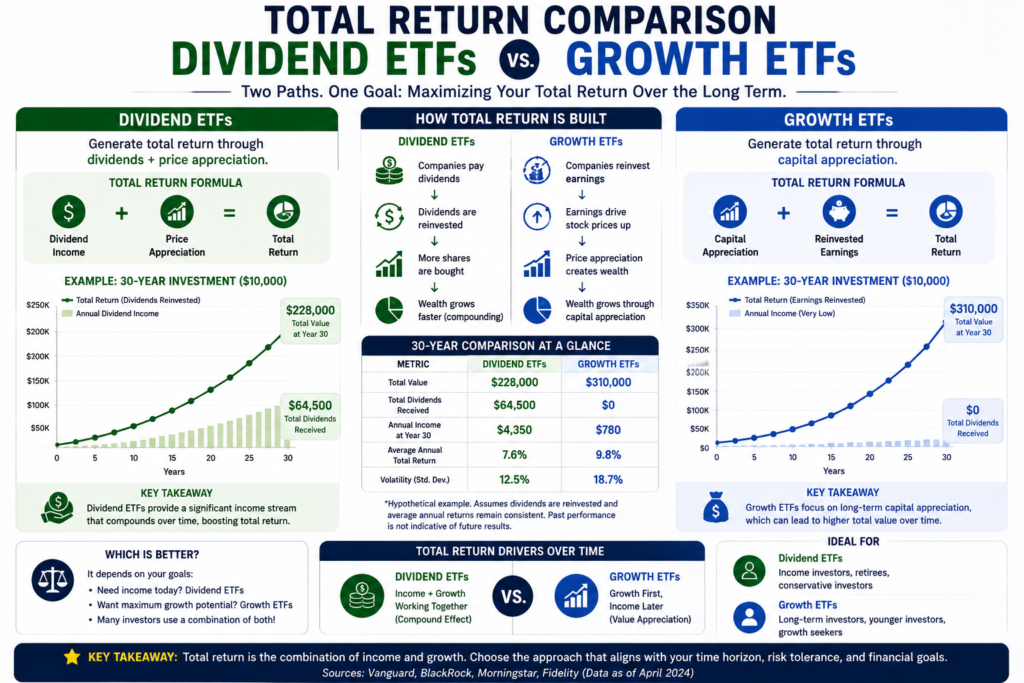
One of the biggest mistakes beginners make is thinking:
- Dividend ETFs make money from dividends
- Growth ETFs make money from price increases
That is incomplete.
Dividend ETF returns come from:
- Dividend income
- Share price appreciation
- Dividend reinvestment
Growth ETF returns come from:
- Earnings growth
- Valuation expansion
- Share price appreciation
- Sometimes a small dividend
So the real question is not “cash vs no cash.” The real question is:
Where will the majority of long-term return come from, and how stable is that return path likely to be?
Wondering how index funds compare? Read our Index Funds vs ETFs guide for a detailed comparison. Market research from BlackRock also highlights how dividends, capital appreciation, and asset allocation contribute to long-term portfolio performance.
The biggest difference between Dividend ETFs vs Growth ETFs lies in how total returns are generated.
Dividend ETFs produce returns through dividends and price appreciation, while growth ETFs rely primarily on capital appreciation.
Successful long-term ETF investing focuses on total return instead of only dividend yield.
11) Volatility, Drawdowns, and Risk
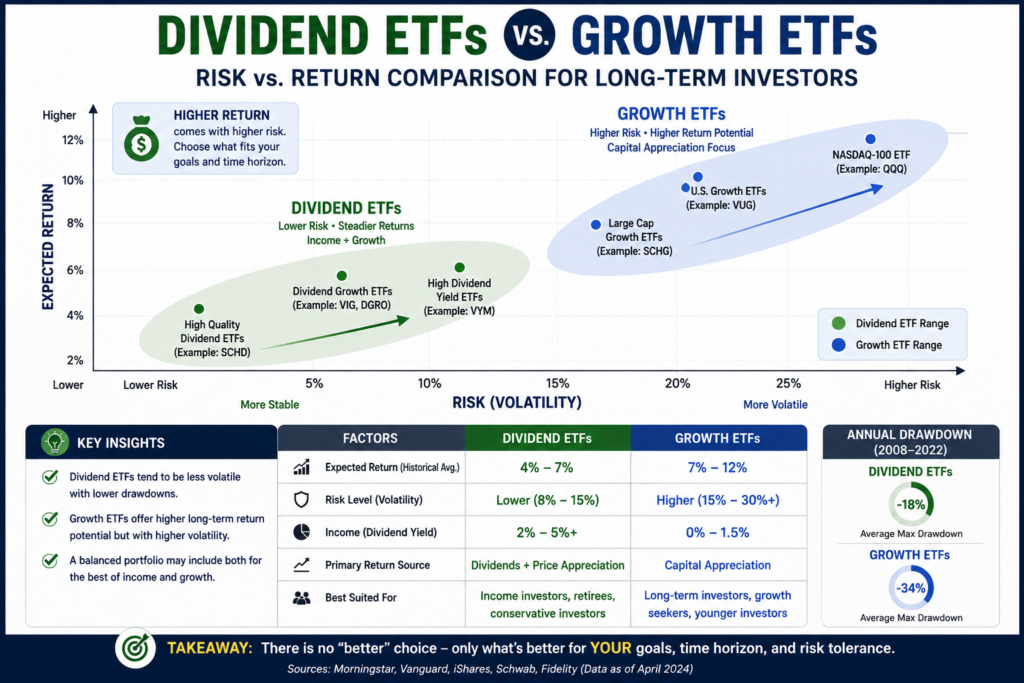
In many periods, growth ETFs can produce higher long-term returns than dividend ETFs. But those returns often come with:
- Higher volatility
- Bigger valuation risk
- More concentration in technology and communication services
- Sharper drawdowns during rate shocks or growth-stock selloffs
Dividend ETFs, especially dividend-growth or quality-dividend funds, often provide:
- Lower volatility
- More defensive sector exposure
- Better downside resilience in some bear markets
- More tangible cash flow
However, high-yield dividend ETFs can also be risky if they are overloaded with troubled sectors or companies. Investors seeking a deeper understanding of portfolio risk and valuation can review educational materials published by the CFA Institute.
12) Income vs Compounding
This is where investor goals matter. The Dividend ETFs vs Growth ETFs debate often comes down to choosing between immediate income investing and long-term capital appreciation.
If you need income today
Dividend ETFs are naturally more attractive because they distribute cash regularly. That cash can help fund:
- Retirement expenses
- Living expenses
- Passive income goals
- Psychological comfort during market downturns
If you do not need income today
Growth ETFs can be extremely compelling because you are allowing businesses to reinvest internally rather than taking cash out.
A useful rule of thumb
- Need cash flow now or within a few years? Dividend ETFs deserve a bigger role.
- Have 15–30 years and want maximum growth? Growth ETFs may deserve a larger role.
- Want balance? Blend both.
Many investors combine dividend ETF strategy with growth ETF strategy to enjoy both income and long-term wealth creation.
13) Taxes: Why ETF Type Matters in Taxable Accounts
Taxes are one of the most overlooked parts of the dividend ETFs vs growth ETFs debate. Tax treatment is another major consideration when evaluating Dividend ETFs vs Growth ETFs, especially in taxable investment accounts.
Why dividend ETFs can create tax drag
If you hold a dividend ETF in a taxable brokerage account, you may owe tax on dividends distributed each year, even if you reinvest them.
That means:
- You receive a dividend
- The government may tax it
- You have less capital left to compound
Why growth ETFs can be more tax-efficient
Growth ETFs often distribute less cash. If most of your return comes from unrealized capital gains, you may defer taxes until you actually sell the ETF.
Deferral can be powerful because:
- More money stays invested
- More money compounds over time
- Tax payment may be delayed for years or decades
Learn additional strategies in our Tax-Efficient Investing guide to help reduce investment taxes over time.
Important nuance
Tax treatment varies by country:
- U.S.: qualified dividends and long-term capital gains may be taxed differently than ordinary income
- UK: ISA/SIPP wrappers change the picture
- Canada: registered accounts vs taxable accounts matter
- Australia: franking credits can affect dividend attractiveness
So if you are comparing dividend ETFs vs growth ETFs, always evaluate them in the context of the account type:
- Taxable brokerage
- Retirement account
- pension wrapper
- tax-sheltered account
14) Valuation Risk: Why Growth Can Be Powerful but Dangerous
Growth ETFs are often full of excellent businesses. But excellent businesses can still be bad investments if you overpay.
Example
Suppose a great company grows earnings 20% per year, but investors are already pricing in perfection at 50x earnings. If growth slows to 12%, the stock can fall even if the business is still healthy.
This is a core risk in growth investing:
- Growth expectations are high
- Valuations are high
- Disappointment gets punished quickly
Dividend ETFs, especially value-tilted dividend ETFs, may carry less valuation risk because the underlying businesses are often priced more conservatively.
15) Dividend Traps: Why High Yield Is Not Always Good
A 7% or 8% yield can look irresistible. But sometimes that high yield is caused by a collapsing stock price.
Example of a dividend trap
A company pays a $4 annual dividend.
Its stock falls from $100 to $40 because earnings are weakening.
Now the yield looks like 10%.
Investors may think, “Amazing income opportunity.”
But if the company cuts the dividend to $1, the yield advantage disappears and the stock may fall further.
Signs of possible dividend danger
- Very high payout ratio
- Falling revenue
- Rising debt
- Cyclical industry stress
- Negative free cash flow
- Management defending dividend at all costs
This is why dividend quality matters more than raw yield.
16) How Interest Rates Affect Dividend ETFs and Growth ETFs
Interest rates are a major force in ETF performance.
Growth ETFs and rates
Growth stocks are often valued based on expected future cash flows. When rates rise:
- Future cash flows are discounted more heavily
- High-valuation growth stocks may fall
- Investors become less willing to pay premium multiples
This is why growth ETFs can struggle when rates rise sharply.
Dividend ETFs and rates
Dividend ETFs can react in different ways:
- High-yield, bond-like sectors such as utilities and REITs may weaken when rates rise because their income becomes less attractive relative to bonds.
- Dividend growth / quality dividend ETFs may hold up better if their companies have strong earnings and pricing power.
So “rates are bad for dividend ETFs” is too simplistic. The real answer depends on which kind of dividend ETF you own. Changes in monetary policy can significantly influence equity valuations. For official information on interest rates and monetary policy, refer to the Federal Reserve. Interest rate changes can significantly affect Dividend ETFs vs Growth ETFs because each investment style responds differently to economic conditions.
17) Sector Exposure Differences
Sector allocation is one of the hidden reasons dividend ETFs and growth ETFs behave differently.
Growth ETF sector bias often includes:
- Technology
- Communication services
- Consumer discretionary
- AI/semiconductor ecosystems
- software and platform businesses
Dividend ETF sector bias often includes:
- Financials
- Healthcare
- Consumer staples
- Industrials
- Energy
- Utilities
- telecom
- sometimes mega-cap tech if they also pay dividends
This matters because sector cycles can dominate ETF performance over long periods. Sector allocation is one reason Dividend ETFs vs Growth ETFs often perform differently during various market cycles.
Example
If mega-cap technology is leading the market, growth ETFs may dominate.
If value, income, energy, financials, or defensive sectors lead, dividend ETFs may perform better.
18) Performance Across Bull Markets and Bear Markets
There is no single “winner” in all environments.
When growth ETFs often outperform
- Falling interest-rate environments
- Innovation booms
- strong economic growth with low inflation
- periods when mega-cap tech dominates
- AI/semiconductor upcycles
- strong earnings expansion for growth companies
When dividend ETFs may outperform or hold up better
- Defensive markets
- sideways markets
- periods of value leadership
- periods when investors prioritize cash flow and quality
- some inflationary or uncertain environments
- retirement drawdown phases where income matters
19) Detailed Case Studies
Below are practical case studies showing how dividend ETFs and growth ETFs can serve different investors. This example demonstrates how Dividend ETFs vs Growth ETFs can produce different outcomes depending on an investor’s age and financial goals.
Case Study 1: The 28-Year-Old Software Engineer
Profile
- Age: 28
- Stable job
- High risk tolerance
- No need for portfolio income
- 30+ year time horizon
Goal
Maximize long-term wealth.
Better fit
A growth-heavy allocation may make sense because:
- no need for current income
- long runway for compounding
- ability to ride out volatility
- tax efficiency may be better in taxable accounts if dividend yield is low
Example allocation
- 70% broad market / growth ETF
- 20% international equity ETF
- 10% dividend growth ETF for balance
Lesson
A young investor does not need dividend income. But a small dividend allocation can still improve diversification and psychological discipline.
Case Study 2: The 42-Year-Old Couple Building College + Retirement Wealth
Profile
- Dual income household
- Wants growth but dislikes extreme volatility
- Has 15–20 years until retirement
- Wants a “sleep at night” portfolio
Problem
Pure growth feels too concentrated in tech. Pure dividend feels too conservative.
Solution
A blend can work well:
- 40% broad U.S. index
- 25% growth ETF
- 25% dividend growth ETF
- 10% international or bonds depending on risk profile
Why this works
- Growth ETF captures long-term upside
- Dividend growth ETF adds quality and cash flow
- overall portfolio becomes more balanced across sectors
Lesson
The dividend vs growth debate is often a false choice. Many investors are best served by using both.
Case Study 3: The 63-Year-Old Near-Retiree
Profile
- Retirement in 2 years
- Wants portfolio income
- Worried about sequence-of-returns risk
- Cannot tolerate a 40% drawdown right before retirement
Better fit
Dividend ETFs become more attractive because:
- they provide cash flow
- may reduce the need to sell shares during market downturns
- quality dividend funds often hold mature, profitable businesses
Example allocation
- 35% dividend ETF
- 20% dividend growth ETF
- 25% broad market ETF
- 20% bonds/cash equivalents
Lesson
As retirement approaches, cash flow and downside resilience become more important than maximizing upside.
Case Study 4: The FIRE Investor Seeking Passive Income
Profile
- Wants financial independence
- Plans to live partly from portfolio income
- Values predictable cash flow
Temptation
Load up on the highest-yield ETFs available.
Risk
Chasing yield can lead to:
- sector concentration
- dividend cuts
- weaker total returns
- tax drag
Smarter approach
Combine:
- dividend growth ETF
- high-quality dividend ETF
- broad market ETF
- maybe a modest bond allocation
Lesson
For FIRE investors, sustainable total return matters more than the headline yield.
Case Study 5: The Taxable-Account Professional in a High Tax Bracket
Profile
- Large taxable brokerage account
- High income
- no need for cash flow
- wants efficient compounding
Consideration
Dividend ETFs can create ongoing taxable distributions.
Better fit
Growth ETFs may be more tax-efficient because:
- lower yield
- fewer taxable distributions
- larger share of return deferred until sale
Lesson
If two ETFs have similar long-term expected returns, taxes can tilt the decision heavily toward the lower-yield option in a taxable account.
Case Study 6: The Retired Investor Who Hates Selling Shares
Profile
- Retired
- emotionally dislikes selling ETF units for income
- prefers “living off dividends”
Important reality
Dividends are not free money. When a company pays a dividend, cash leaves the company. But psychologically, many retirees prefer spending dividends over selling shares.
Sensible implementation
Use dividend ETFs for part of the portfolio, but don’t ignore:
- diversification
- inflation protection
- growth exposure
- bond ladder or cash reserve
Lesson
Behavior matters. A mathematically perfect strategy is useless if an investor cannot stick to it.
Case Study 7: The Investor Burned by a Tech Crash
Profile
- Heavy in growth ETFs
- saw 35–50% drawdowns during a tech selloff
- now wants a more balanced portfolio
Better approach
Instead of abandoning growth entirely:
- keep core growth exposure
- add dividend growth ETFs
- add broad market exposure
- reduce concentration risk
Lesson
Dividend ETFs can act as a stabilizer inside a portfolio, especially for investors who discover their true risk tolerance only after a market crash.
Case Study 8: The Long-Term Total Return Investor
Profile
- doesn’t need income now
- understands taxes
- wants best risk-adjusted return
- is comfortable using multiple ETFs
Strategy
Use dividend ETFs not for “income,” but for factor diversification:
- quality
- profitability
- lower volatility
- value tilt
Pair that with a growth ETF for upside.
Lesson
Dividend ETFs are not only for retirees. They can also be a strategic building block for long-term total-return portfolios.
20) How to Choose Between Dividend ETFs and Growth ETFs
Choosing between Dividend ETFs vs Growth ETFs requires evaluating your income needs, investment objectives, and risk tolerance. Ask yourself these 8 questions:
1. Do I need portfolio income now?
- Yes → dividend ETFs deserve a bigger role
- No → growth ETFs become more compelling
2. What is my time horizon?
- 20–30 years → more room for growth volatility
- 0–10 years → stability and income matter more
3. How do I react to market crashes?
If a 35% drawdown will make you panic-sell, a pure growth portfolio may be too aggressive.
4. Is this in a taxable account?
If yes, dividend-heavy strategies may create more tax drag.
5. Am I chasing yield?
If you only care about the highest yield, you may end up with weaker companies or concentrated sector bets.
6. Am I overexposed to technology already?
If your job, stock grants, and portfolio are all tech-heavy, dividend ETFs may help diversify.
7. Do I want current income or future income?
- Current income → higher-yield dividend ETF
- Future income growth → dividend growth ETF
- Maximum future wealth → growth ETF may play a larger role
8. Do I want simplicity?
A simple combination like:
- 1 broad market ETF
- 1 dividend ETF
- 1 growth ETF
can solve a lot of problems without overcomplication.
There is no universal winner in the Dividend ETFs vs Growth ETFs comparison because every investor has unique financial goals.
21) Model Portfolios by Investor Type
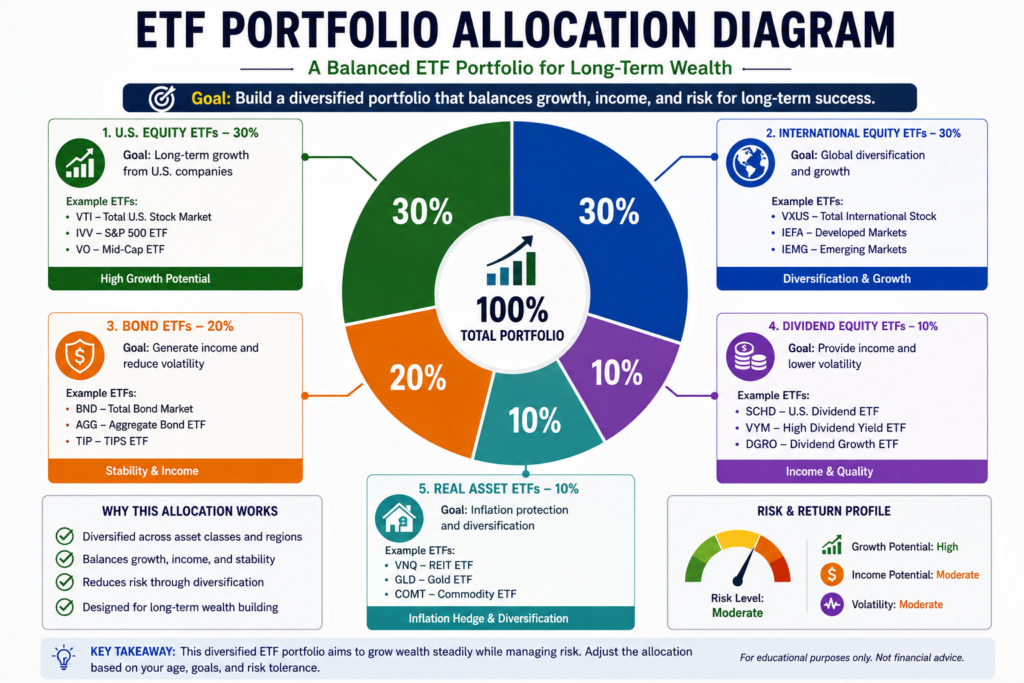
Before choosing a portfolio, review our Asset Allocation Guide to understand how different asset mixes affect risk and return. These model portfolios show how Dividend ETFs vs Growth ETFs can work together in a diversified investment strategy.
A) Young Accumulator Portfolio
- 60% broad U.S. market ETF
- 25% growth ETF
- 10% international ETF
- 5% dividend growth ETF
B) Balanced Wealth Builder Portfolio
- 40% broad market ETF
- 25% growth ETF
- 25% dividend growth ETF
- 10% international or bonds
C) Income + Growth Portfolio
- 30% dividend ETF
- 25% dividend growth ETF
- 25% broad market ETF
- 10% growth ETF
- 10% bonds
D) Near-Retirement Conservative Equity Portfolio
- 35% dividend ETF
- 20% dividend growth ETF
- 20% broad market ETF
- 10% growth ETF
- 15% bonds/cash
These are educational examples, not personal advice.
22) Common Mistakes Investors Make
One of the biggest mistakes investors make in the Dividend ETFs vs Growth ETFs debate is focusing only on dividend yield.
Mistake 1: Comparing only dividend yield
Yield alone tells you very little. A 4% yield with weak fundamentals can be worse than a 1.5% yield with strong dividend growth and total return.
Mistake 2: Ignoring total return
A lower-yield ETF may still produce much more wealth if it compounds faster.
Mistake 3: Assuming all dividend ETFs are “safe”
High yield can hide major business risk.
Mistake 4: Assuming growth always wins
Growth leadership can reverse, especially when valuations get stretched or rates rise.
Mistake 5: Overlapping ETFs without realizing it
Many investors own:
- S&P 500 ETF
- growth ETF
- dividend ETF
and end up with heavy overlap in mega-cap stocks.
Mistake 6: Using the wrong ETF in the wrong account
High-yield ETFs in taxable accounts can create avoidable tax drag.
Mistake 7: Letting psychology dictate a poor strategy
Some investors abandon growth after a crash or chase yield after reading social media posts about passive income. Long-term strategy should come first.
23) Best ETF Examples to Research
The right ETF depends on your market, tax location, and goals. Below are well-known U.S.-listed examples often used to study the category differences. The following ETFs illustrate how Dividend ETFs vs Growth ETFs differ in objectives, holdings, and expected returns.
Dividend ETF examples
- Vanguard Dividend Appreciation ETF (VIG) – dividend growth orientation
- Schwab U.S. Dividend Equity ETF (SCHD) – quality + yield + dividend focus
- Vanguard High Dividend Yield ETF (VYM) – broad high-dividend exposure
- iShares Core Dividend Growth ETF (DGRO) – dividend growth and quality
- ProShares S&P 500 Dividend Aristocrats ETF (NOBL) – dividend aristocrat strategy
Investors often compare dividend ETFs using independent research, portfolio analysis, and fund ratings from Morningstar.
Growth ETF examples
- Vanguard Growth ETF (VUG) – broad U.S. large-cap growth
- Schwab U.S. Large-Cap Growth ETF (SCHG) – low-cost large-cap growth
- Invesco QQQ / QQQM – Nasdaq-100 growth tilt
- SPDR Portfolio S&P 500 Growth ETF (SPYG) – S&P 500 growth exposure
- iShares Russell 1000 Growth ETF (IWF) – large-cap growth benchmark
The goal is not to buy what is popular. The goal is to understand:
- strategy
- index rules
- sector concentration
- yield
- expense ratio
- tax implications
- valuation exposure
Want to build a diversified ETF portfolio? Explore our complete ETF Investing Guide.
24) Dividend ETFs vs Growth ETFs for Retirement
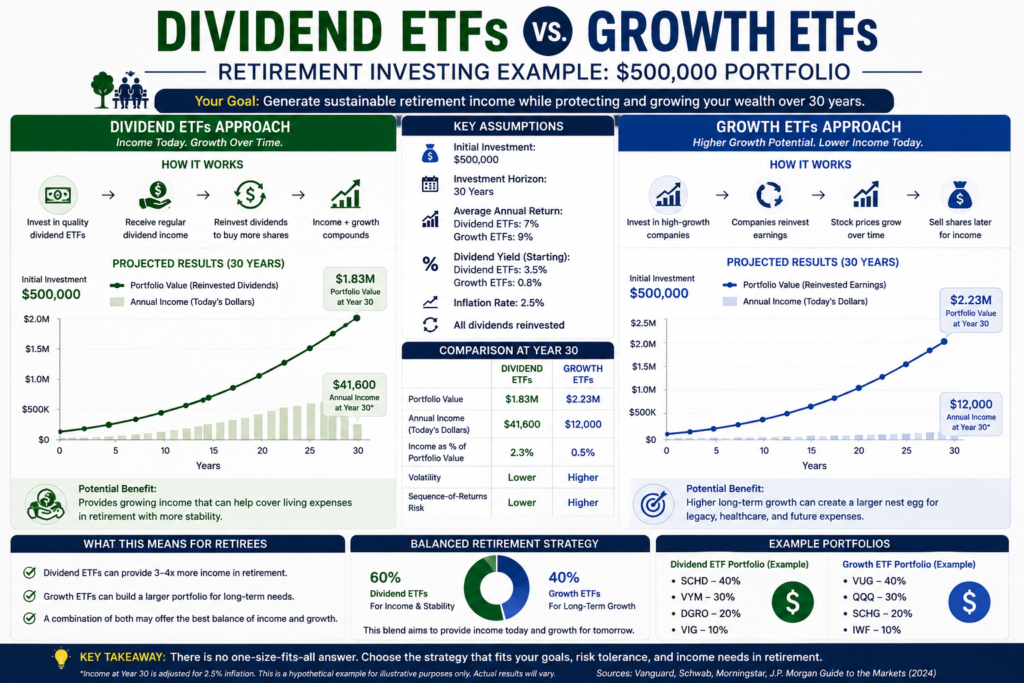
Retirement changes the equation because portfolio withdrawals become real. Dividend ETFs vs Growth ETFs become especially important when planning retirement income and portfolio withdrawals. For broader retirement planning strategies, read our Retirement Investing Guide.
Why dividend ETFs appeal in retirement
- predictable cash flow
- less need to sell shares for spending
- mature companies may feel safer
- easier mental accounting
But retirement portfolios still need growth
If retirement lasts 25–35 years, you still need:
- inflation protection
- earnings growth
- long-term capital appreciation
A retiree who owns only high-yield assets can accidentally build a portfolio that:
- grows too slowly
- becomes sector-heavy
- loses purchasing power after inflation
Practical retirement solution
A retirement portfolio often works best with:
- quality dividend ETFs
- some growth exposure
- broad market diversification
- bonds/cash for near-term spending
25) Dividend ETFs vs Growth ETFs for Young Investors
For younger investors, Dividend ETFs vs Growth ETFs is often a question of balancing future growth with long-term portfolio stability. Young investors often ask:
“If I don’t need income, should I avoid dividend ETFs entirely?”
Not necessarily.
Why growth often deserves a bigger weight when young
- longer time horizon
- no immediate need for cash flow
- greater ability to tolerate volatility
- stronger benefit from long-term compounding
Why some dividend exposure can still help
- quality factor exposure
- lower volatility
- sector diversification
- behavioral comfort during downturns
For many young investors, the issue is not “dividends or growth.”
It is how much of each.
26) Dividend ETFs vs Growth ETFs for FIRE and Passive Income
The FIRE movement often gravitates toward dividends because dividends feel like “portfolio salary.” That’s understandable but FIRE investors need to be careful. The Dividend ETFs vs Growth ETFs discussion is highly relevant for FIRE investors seeking passive income and financial independence.
Throughout this guide, we’ll compare Dividend ETFs vs Growth ETFs from every angle, including risk, income investing, capital appreciation, taxes, retirement planning, and long-term ETF investing.
If your goal is financial independence, our Passive Income Investing guide explores additional income-generating strategies.
What FIRE investors should remember
- Total return still matters most
- High yield is not always sustainable
- Tax efficiency matters a lot
- Inflation matters
- Selling a small number of shares is not inherently bad
A FIRE investor might reasonably use:
- broad index ETF
- dividend growth ETF
- modest high-yield allocation
- short-term bond/cash reserve
The best FIRE strategy is usually the one that balances:
- cash flow
- tax efficiency
- long-term growth
- emotional sustainability
27) Expert Takeaways
Here are the key principles experienced investors tend to agree on:
1. Dividends are not “free money”
A dividend is one way a company returns capital to shareholders. It is not a magical extra return layered on top of business value.
2. Total return matters more than yield
The right question is:
“What is the best after-tax, risk-adjusted, long-term return for my goal?”
3. Quality matters more than headline yield
A 3% yield from financially strong companies can be much better than a 7% yield from fragile ones.
4. Growth investing is powerful but valuation-sensitive
Great companies can still underperform if purchased at excessive valuations.
5. The best portfolio often blends styles
Many successful investors combine:
- broad market exposure
- growth exposure
- dividend growth exposure
28) Final Verdict: Dividend ETFs vs Growth ETFs —Which Is Better?
The answer depends on what “better” means for you. After comparing Dividend ETFs vs Growth ETFs in detail, it becomes clear that both investment styles have advantages depending on the investor’s objectives.
Dividend ETFs may be better if you:
- want current income
- are near retirement or already retired
- prefer mature, cash-generating companies
- want a lower-volatility equity sleeve
- value psychological comfort from regular cash flow
- want to reduce tech concentration
Growth ETFs may be better if you:
- have a long time horizon
- do not need income now
- want to maximize long-term capital appreciation
- can tolerate volatility
- care about tax efficiency in taxable accounts
- believe innovation-led earnings growth will continue to compound
The most practical conclusion
For many investors, the smartest answer is not dividend ETFs vs growth ETFs.
It is dividend ETFs plus growth ETFs in the right proportion.
A thoughtful portfolio can use:
- Growth ETFs for long-term upside
- Dividend growth ETFs for quality and income growth
- Broad market ETFs for core diversification
- Bonds/cash for stability if needed
Further Reading
If you’d like to continue your research using primary and industry-recognized sources, the following organizations provide valuable educational materials on ETFs, investing, market analysis, and portfolio management:
- U.S. Securities and Exchange Commission
- FINRA
- Morningstar
- Vanguard
- Charles Schwab
- BlackRock
- CFA Institute
- Federal Reserve
29) Frequently Asked Questions (FAQs)
1. Are dividend ETFs safer than growth ETFs?
Often, quality dividend ETFs are less volatile than aggressive growth ETFs, but they are not risk-free. High-yield dividend ETFs can still be risky if they hold weak companies or concentrated sectors.
2. Do growth ETFs pay dividends?
Yes, some do—but usually the yield is much lower because the underlying companies retain more earnings for growth.
3. Which is better for retirement: dividend ETFs or growth ETFs?
Retirees often benefit from dividend ETFs because of cash flow, but a retirement portfolio usually still needs some growth to fight inflation and support long-term withdrawals.
4. Which is better for a 25-year-old?
A 25-year-old with a long time horizon may lean more toward growth ETFs, but adding some dividend growth exposure can still improve diversification and discipline.
5. Can I own both dividend ETFs and growth ETFs?
Yes. In fact, many investors should. A blend can provide both upside potential and portfolio stability.
6. Are dividend ETFs better during recessions?
Sometimes they hold up better, especially quality dividend funds, but not always. High-yield sectors can also struggle in recessions if dividends are cut.
7. Are growth ETFs too risky?
Not necessarily. Broad large-cap growth ETFs are different from speculative thematic growth funds. Risk depends on valuation, concentration, and your own time horizon.
8. Is a higher dividend yield always better?
No. Very high yields can be a warning sign of deteriorating fundamentals or an unsustainable payout.
9. Are dividend ETFs tax-inefficient?
In taxable accounts, they can create more annual taxable income than low-yield growth ETFs. But the actual impact depends on your country, tax bracket, and account type.
10. What is the biggest mistake when comparing dividend ETFs vs growth ETFs?
Focusing only on yield or only on price charts instead of looking at total return, tax drag, risk, valuation, and fit with your personal goals.
Quick Summary
Diversification remains one of the most effective risk-management tools. Learn more in our Portfolio Diversification Guide. The Dividend ETFs vs Growth ETFs decision should always be based on your financial goals, risk tolerance, tax situation, and long-term investment plan rather than short-term market trends.
If you remember only five things from this guide, remember these:
- Dividend ETFs focus more on income, quality, and mature businesses.
- Growth ETFs focus more on future earnings expansion and capital appreciation.
- Total return matters more than yield alone.
- Taxes, account type, and time horizon can change which ETF style is best.
- For many investors, the best answer is a blend of dividend ETFs and growth ETFs, not an all-or-nothing choice.