Total Market Index Funds vs S&P 500: The Complete Beginner-to-Advanced Guide
If you are building a long-term investment portfolio, one of the most common questions you will face is this:
Should you invest in a Total Market Index Fund or an S&P 500 fund?
At first glance, the two seem almost identical. Both are low-cost index funds. Both are passive investment vehicles. Both hold large U.S. companies such as Apple, Microsoft, Amazon, Nvidia, Alphabet, Meta, Berkshire Hathaway, and other market leaders. Both are often recommended for retirement accounts, taxable brokerage accounts, and beginner portfolios.
So why does the distinction matter?
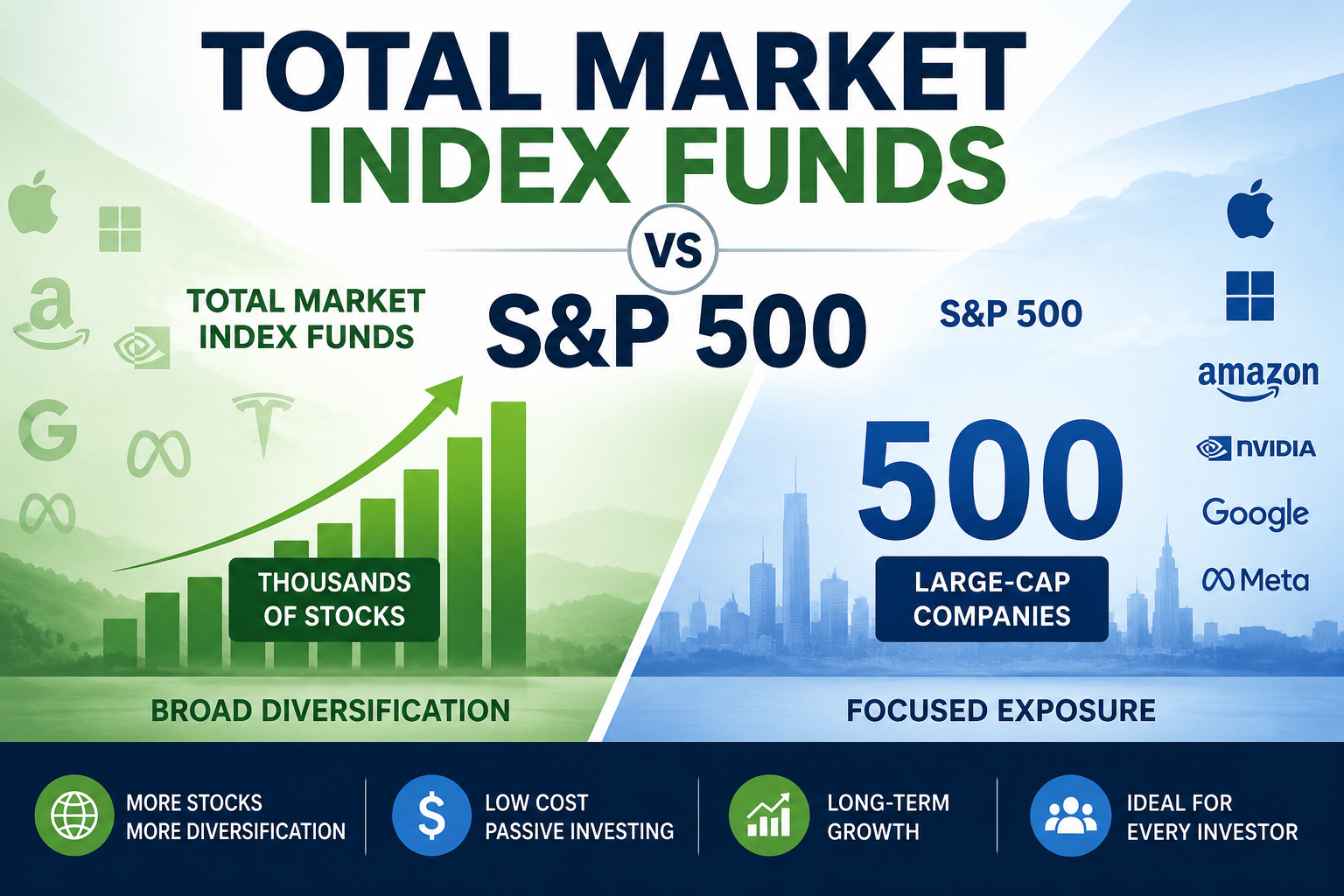
Because while these two investment approaches are similar, they are not the same. A Total Market Index Fund is designed to give you exposure to the entire investable U.S. stock market, including large-cap, mid-cap, and small-cap companies. An S&P 500 fund focuses on 500 leading large-cap U.S. companies, which collectively represent roughly 80% of available U.S. market capitalization.
That means the choice between the two is really a choice between:
- “Own the biggest 500 U.S. companies”
vs. - “Own almost the whole U.S. stock market in one fund.”
For many investors, the difference in returns over long periods may look surprisingly small. But the differences in diversification, small-cap exposure, index methodology, portfolio construction, and behavior during different market environments can still matter.
This guide explains Total Market Index Funds vs S&P 500 in plain English, then goes deeper into performance, risk, costs, case studies, and portfolio strategy so you can make a more informed decision.
1) What Is a Total Market Index Fund?
A Total Market Index Fund is an index fund that aims to track the performance of the entire stock market, or at least nearly all of the investable stock market within a country.
In the U.S. context, a total market fund typically holds:
- Large-cap stocks – giant companies like Apple, Microsoft, Amazon
- Mid-cap stocks – medium-sized companies that are established but smaller than mega-cap firms
- Small-cap stocks – smaller publicly listed companies with greater growth potential and often greater volatility
Simple definition
A Total Market Index Fund is a fund that tries to own almost every publicly traded stock in a market, weighted by size.
In practice, a U.S. total market fund might own thousands of stocks. For example, Vanguard Total Stock Market ETF (VTI) tracks the CRSP US Total Market Index and held 3,484 stocks as of May 31, 2026, according to Vanguard. It also carried a 0.03% expense ratio.
Why investors like total market funds
Investors often choose total market index funds because they offer:
- Broad diversification
- Low costs
- Simplicity
- Automatic exposure to different company sizes
- A “buy the market” philosophy rather than betting on a subset of the market
A total market fund is often considered one of the purest forms of passive investing because it says, in effect:
“I don’t know which part of the market will outperform next, so I’ll own almost all of it.”
2) What Is an S&P 500 Fund?
An S&P 500 fund is an index fund that tracks the S&P 500 Index, one of the most famous stock market indexes in the world.
The S&P 500 includes 500 leading U.S. companies and is widely used as a benchmark for the U.S. large-cap stock market. According to S&P Dow Jones Indices, the S&P 500 covers approximately 80% of available U.S. market capitalization.
Simple definition
An S&P 500 fund is a fund that invests in the 500 large U.S. companies included in the S&P 500 Index.
Examples include:
- Vanguard S&P 500 ETF (VOO)
- iShares Core S&P 500 ETF (IVV)
- SPDR S&P 500 ETF Trust (SPY)
- Fidelity 500 Index Fund (FXAIX)
Why investors like S&P 500 funds
Investors often choose S&P 500 funds because they offer:
- exposure to many of the biggest, most profitable U.S. companies
- long-term historical growth
- low fees
- strong liquidity
- simplicity
- a long track record as a benchmark for “the U.S. stock market”
For many people, buying an S&P 500 fund is shorthand for saying:
“I want broad exposure to American business, but I’m comfortable owning only the biggest companies.”
3) The Key Difference in One Sentence
Here is the simplest possible way to understand Total Market Index Funds vs S&P 500:
- A Total Market Index Fund owns large-, mid-, and small-cap U.S. stocks.
- An S&P 500 fund owns only the large-cap portion of the U.S. market—specifically the 500 companies in the S&P 500.
That’s the core difference.
Everything else—returns, diversification, volatility, concentration, and long-term portfolio fit—flows from that distinction.
4) Why the Two Often Perform So Similarly
One of the biggest surprises for new investors is this:
Total Market Index Funds and S&P 500 funds often perform very similarly over long periods.
Why?
Reason 1: The biggest companies dominate the market
Both types of funds are usually market-cap weighted. That means larger companies receive larger weights in the portfolio.
If Apple, Microsoft, Nvidia, Amazon, Alphabet, Meta, and other mega-cap firms make up a huge share of the U.S. stock market, they will also make up a huge share of a total market fund.
So even though a total market fund holds thousands of companies, a large portion of its value is still concentrated in the largest companies—many of the same companies that dominate the S&P 500.
Reason 2: The S&P 500 is already most of the market
The S&P 500 covers about 80% of U.S. market capitalization.
That means the “missing” 20% in a total market fund consists of:
- mid-cap companies
- small-cap companies
- micro-cap or smaller investable stocks depending on index methodology
That extra exposure matters for diversification, but it doesn’t completely change portfolio behavior because the largest companies still drive most of the market’s movement.
Reason 3: Total market funds are still top-heavy
For example, VTI may hold more than 3,000 stocks, but the largest holdings still account for a substantial share of assets because the fund is weighted by market capitalization, not equally weighted.
So if the largest 10–20 U.S. companies rally hard, both a total market fund and an S&P 500 fund will usually benefit significantly.
5) How Each Index Is Built
To compare Total Market Index Funds vs S&P 500 properly, you need to understand the indexes behind them.
6) How a Total Market Index Is Built
A U.S. total market fund may track a benchmark such as:
- CRSP US Total Market Index
- Dow Jones U.S. Total Stock Market Index
- Russell 3000
- S&P Total Market Index
Each provider has its own methodology, but the broad goal is similar: capture nearly all of the investable U.S. equity market.
For example, the CRSP US Total Market Index is designed to represent 100% of the U.S. investable equity market.
Typical features of a total market index
- thousands of stocks
- market-cap weighting
- inclusion of large, mid, small, and sometimes micro-cap companies
- periodic reconstitution and rebalancing
- low turnover relative to active funds
What “investable” means
The word investable matters.
An index provider doesn’t necessarily include every single listed company with equal treatment. Instead, it usually screens for factors like:
- liquidity
- free float
- listing standards
- share class eligibility
- market capitalization thresholds
- availability to investors
So “total market” doesn’t literally mean “every stock in existence.” It usually means the broad investable stock market.
7) How the S&P 500 Is Built
The S&P 500 is not simply “the 500 biggest U.S. stocks by size.” It is a curated large-cap index maintained by S&P Dow Jones Indices.
Key characteristics of the S&P 500
- roughly 500 large U.S. companies
- float-adjusted market-cap weighted
- committee-based inclusion process
- profitability and eligibility screens
- widely used as the benchmark for U.S. large-cap stocks
The S&P 500 is considered the leading gauge of large-cap U.S. equities and covers approximately 80% of available U.S. market capitalization.
Important nuance: the S&P 500 is not a pure “top 500 by size” list
A company usually must satisfy various criteria related to:
- market capitalization
- liquidity
- U.S. domicile and exchange listing
- public float
- profitability requirements
- financial viability
- index committee decisions
That matters because the S&P 500 is not merely “the biggest companies”; it is also a screened large-cap benchmark.
This can lead to small but meaningful differences versus a total market index, which is often more mechanical and broader.
8) Total Market Index Funds vs S&P 500: Side-by-Side Comparison
Quick comparison table
| Feature | Total Market Index Fund | S&P 500 Fund |
|---|---|---|
| What it tracks | Nearly the entire U.S. stock market | 500 large-cap U.S. companies |
| Number of holdings | Often 3,000+ | Around 500 |
| Company size exposure | Large-cap + mid-cap + small-cap | Mostly large-cap only |
| Diversification | Broader | Broad, but narrower than total market |
| Small-cap exposure | Yes | No direct small-cap exposure |
| Mid-cap exposure | Yes | No direct mid-cap exposure |
| Market coverage | Near-total investable market | ~80% of U.S. market cap |
| Typical cost | Very low | Very low |
| Similarity in returns | Often close to S&P 500 | Often close to total market |
| Best for | Investors wanting “own the whole market” exposure | Investors comfortable focusing on large-cap U.S. leaders |
9) Diversification: Which One Is More Diversified?
If your question is:
“Which fund is more diversified?”
the answer is straightforward:
A Total Market Index Fund is more diversified.
Why? Because it owns:
- the S&P 500-style large caps plus
- mid-cap stocks plus
- small-cap stocks
Example
A total market fund like VTI includes thousands of stocks and is designed to track the overall U.S. stock market. Vanguard states that VTI seeks to track the CRSP US Total Market Index and held 3,484 stocks as of May 31, 2026.
By contrast, an S&P 500 fund such as VOO holds the large-cap segment only.
But “more diversified” does not automatically mean “much better returns”
This is where investors often get confused.
A total market fund is more diversified by number of holdings and market-cap segment exposure, but because the U.S. market is so heavily dominated by large-cap firms, the return gap between the two can be modest for long stretches.
So the right conclusion is:
- Total market fund = more diversified
- S&P 500 fund = less diversified, but still broadly diversified among major U.S. companies
10) Returns: Which One Has Performed Better Historically?
This is usually the first thing investors want to know:
“Which has higher returns—Total Market Index Funds or S&P 500 funds?”
The honest answer is:
It depends on the time period.
Sometimes the S&P 500 outperforms because large-cap growth stocks dominate the market. At other times, the total market may pull ahead if mid-cap and small-cap stocks outperform.
Why return differences change over time
The relative performance depends on:
- whether large-cap stocks are leading the market
- whether small-cap stocks are in favor
- valuation differences
- economic cycles
- interest rates
- sector concentration
- momentum in mega-cap technology stocks
Recent example: large caps have dominated
In recent years, U.S. mega-cap stocks have had enormous influence on market returns. When large-cap technology and communication services names surge, S&P 500 funds can look especially strong.
At the same time, total market funds still hold those companies in large weights, so the performance gap often remains narrow rather than dramatic.
What the data generally shows
Historically, the long-term performance of total market and S&P 500 funds has often been very close, because:
- the S&P 500 represents most of the market’s capitalization, and
- both are market-cap weighted.
That said, the total market fund gives you an extra slice of mid/small caps, which may help in certain market cycles and may improve diversification even if it doesn’t always improve short-term returns.
11) A Practical Example: VTI vs VOO
One of the easiest ways to understand Total Market Index Funds vs S&P 500 is to compare two widely used ETFs:
- VTI = Vanguard Total Stock Market ETF
- VOO = Vanguard S&P 500 ETF
VTI at a glance
According to Vanguard, VTI:
- tracks the CRSP US Total Market Index
- held 3,484 stocks as of May 31, 2026
- had an expense ratio of 0.03%
- seeks exposure to large-, mid-, and small-cap U.S. equities
VOO at a glance
According to Vanguard, VOO:
- tracks the S&P 500
- had an expense ratio of 0.03%
- focuses on large-cap U.S. companies
What does this mean in practice?
If you buy VOO, you are effectively saying:
“I want the 500 large U.S. companies in the S&P 500.”
If you buy VTI, you are effectively saying:
“I want those large U.S. companies too, but I also want the rest of the U.S. market—mid caps and small caps—in one package.”
12) Market-Cap Weighting Explained
To understand why these funds behave so similarly, you need to understand market-cap weighting.
What is market capitalization?
Market capitalization (or market cap) is the total market value of a company’s equity.
Formula:
Market Cap = Share Price × Number of Shares Outstanding
If a company has:
- 1 billion shares outstanding
- share price of $100
then its market capitalization is $100 billion.
What is a market-cap weighted index?
A market-cap weighted index gives bigger companies a bigger weight.
That means:
- Apple affects the index much more than a tiny small-cap stock
- Microsoft matters more than a small regional bank
- Nvidia has a much larger influence than a small industrial company
Both total market funds and S&P 500 funds are generally cap-weighted, which is a major reason their returns often track closely.
13) Large-Cap, Mid-Cap, and Small-Cap Exposure
This is where the comparison gets more interesting.
Large-cap stocks
Large-cap companies are the giants of the market. They tend to be:
- mature
- profitable
- globally diversified
- heavily researched
- relatively more stable than small caps
Examples:
- Apple
- Microsoft
- Amazon
- Alphabet
- Meta
- Berkshire Hathaway
Mid-cap stocks
Mid-cap companies are usually in the “middle” stage of business size. They may be:
- more mature than small caps
- more nimble than mega-caps
- still growing faster than many large-cap firms
Mid-caps often sit in a “sweet spot” between growth potential and business maturity.
Small-cap stocks
Small-cap stocks are smaller public companies. They can offer:
- higher growth potential
- more sensitivity to economic cycles
- higher volatility
- more room for business expansion
- greater risk of underperformance in difficult environments
So what’s the portfolio difference?
S&P 500 fund
- mostly large-cap only
Total market fund
- large-cap + mid-cap + small-cap
That means a total market fund is a more complete representation of the domestic equity market.
14) Does Small-Cap Exposure Actually Matter?
This is one of the most important questions in the whole debate.
The case for small-cap exposure
Supporters of total market funds often argue that including small-cap stocks matters because:
- You own more of the economy
You are not limiting yourself to the biggest firms. - You reduce concentration in mega-caps
The S&P 500 can become heavily tilted toward the top 10 holdings when market leadership narrows. - You participate if smaller companies outperform
Small caps and mid caps do not always lag. There are periods when they lead. - You stay philosophically consistent with “buy the whole market” investing
Instead of trying to choose which size segment will win, you own all of them.
The case against overthinking small-cap exposure
Supporters of S&P 500 funds often respond:
- The S&P 500 already captures most of the market’s value.
- Small caps may be a relatively small slice of a total market fund anyway.
- Long-term return differences between total market and S&P 500 have often been modest.
- Simplicity matters more than optimization.
Both sides have a point.
15) Concentration Risk: Is the S&P 500 Too Top-Heavy?
A major criticism of the S&P 500 in recent years is concentration risk.
What is concentration risk?
Concentration risk means too much of a portfolio is tied to a small number of stocks, sectors, or themes.
For example, if a large share of your portfolio is effectively driven by a handful of mega-cap tech names, your returns become more dependent on those companies.
Why this matters in the S&P 500
Because the S&P 500 is market-cap weighted, when a few giant companies soar, they take up more of the index.
This can be great when those companies continue winning. But it also means:
- more dependence on large-cap growth
- more dependence on U.S. technology leaders
- more concentration in the top 10 holdings
Does a total market fund solve this completely?
Not completely.
A total market fund is also market-cap weighted, so it still has significant exposure to mega-caps. But it does at least add:
- mid-cap exposure
- small-cap exposure
- a wider set of sectors and business types
So a total market fund can slightly reduce concentration compared with a pure S&P 500 fund, even though it still remains heavily influenced by the biggest U.S. companies.
16) Fees, Costs, and Expense Ratios
One of the best things about both fund types is that they are often extremely cheap.
What is an expense ratio?
An expense ratio is the annual fee charged by a fund, expressed as a percentage of your invested assets.
If a fund has a 0.03% expense ratio, that means you pay $3 per year for every $10,000 invested.
Why low fees matter
Fees reduce returns. Even a small annual cost can compound into a large drag over decades.
Example:
- Portfolio value: $100,000
- Expense ratio: 0.03%
- Annual cost: about $30
Compare that with a high-fee active fund charging 1.00%:
- Annual cost: $1,000
That fee difference can become enormous over 20–30 years.
Current examples
Vanguard’s official pages show that both:
- VTI and
- VOO
carry 0.03% expense ratios as of 2026.
This means cost is often not the deciding factor between a total market fund and an S&P 500 fund—because both can be extremely inexpensive.
17) Tax Efficiency
For investors in taxable accounts, tax efficiency matters.
Why index funds are often tax-efficient
Broad index funds tend to be tax-efficient because they usually have:
- lower turnover than active funds
- fewer taxable distributions
- rules-based portfolio management
- lower need to constantly buy and sell based on manager opinion
Both total market index funds and S&P 500 funds are typically among the most tax-efficient equity fund choices available, especially in ETF form.
Which is more tax-efficient?
In practice, both are usually highly tax-efficient, and for many investors the difference is too small to drive the decision.
Your bigger tax variables are often:
- whether you’re using an ETF or mutual fund
- whether you’re holding in a taxable account or retirement account
- your dividend tax treatment
- your jurisdiction (U.S., U.K., Canada, Australia, etc.)
18) ETF vs Mutual Fund: Does It Matter?
Both total market and S&P 500 strategies can be accessed through:
- ETFs (Exchange-Traded Funds)
- mutual funds
ETF
An ETF trades on an exchange during market hours like a stock.
Pros
- intraday trading
- often tax-efficient
- low minimums if fractional investing is available
- easy portability across brokers
Mutual fund
A mutual fund is bought or sold at end-of-day net asset value (NAV).
Pros
- easy automatic investing
- simple recurring contributions
- psychologically helpful for long-term savers
- often ideal in retirement plans
Example pairs
Total market
- ETF: VTI
- Mutual fund: VTSAX
S&P 500
- ETF: VOO
- Mutual fund: VFIAX
In most cases, the bigger decision is not ETF vs mutual fund, but which market exposure you want.
19) Total Market Index Funds vs S&P 500 for Beginners
If you are brand new to investing, you might be wondering:
“Which one is simpler?”
The answer is: both are simple.
That’s part of their appeal.
A beginner can build a solid long-term equity portfolio with either:
- a total market index fund, or
- an S&P 500 index fund
So what should a beginner focus on?
Not on squeezing out a tiny theoretical edge.
Instead, focus on the things that matter most:
- Start investing early
- Contribute consistently
- Keep fees low
- Avoid panic selling
- Hold for decades
- Match your stock allocation to your risk tolerance
- Add international stocks and bonds if appropriate for your plan
In other words, the behavioral edge often matters more than the fund-selection edge between these two options.
20) Case Study #1: The New 25-Year-Old Investor
Profile
- Age: 25
- Time horizon: 30–40 years
- Goal: retirement wealth
- Risk tolerance: high
- Wants simplicity
Option A: S&P 500 fund only
The investor buys a low-cost S&P 500 ETF and contributes monthly.
Benefits
- simple
- low fee
- exposure to top U.S. companies
- easy to understand
Limitation
- no direct mid-cap/small-cap exposure
Option B: Total market fund only
The investor buys a low-cost total market ETF.
Benefits
- one-fund exposure to the whole U.S. market
- more diversification
- includes smaller companies automatically
Better fit?
For a young investor who wants the most complete one-fund U.S. stock exposure, the total market fund is often slightly more elegant because it captures the whole market rather than just large caps.
21) Case Study #2: The 40-Year-Old High Earner With a 401(k)
Profile
- Age: 40
- Stable income
- maxing retirement contributions
- wants low-maintenance investing
- 401(k) only offers an S&P 500 fund, not a total market fund
What should they do?
This is a classic real-world scenario.
Many employer retirement plans offer:
- an S&P 500 index fund
- maybe a bond fund
- maybe an international fund
- but not a total market fund
Solution
Using the S&P 500 fund is completely reasonable.
If the investor wants to approximate the total market more closely, they could pair it with:
- a mid-cap fund
- a small-cap fund
or a market completion fund, if available.
But if the plan options are limited and the S&P 500 fund is cheap, using it as the core U.S. equity holding is still a very strong choice.
Lesson
Sometimes the best fund is the best available fund.
22) Case Study #3: The Investor Worried About Mega-Cap Concentration
Profile
- Age: 33
- reads a lot of market news
- worried the U.S. market is dominated by a handful of giant tech companies
- wants broader exposure
Concern
“Am I taking too much risk if my portfolio is mostly the same mega-cap names?”
Best fit
A total market fund may feel more aligned with this investor’s concerns because it adds:
- mid-cap exposure
- small-cap exposure
- broader representation of U.S. listed companies
Will it completely eliminate mega-cap concentration? No.
But it can reduce the feeling that your portfolio is “just the Magnificent Seven plus friends.”
23) Case Study #4: The Investor Who Values Simplicity Above Everything
Profile
- Age: 50
- wants a “set it and forget it” U.S. stock allocation
- doesn’t want to think about market segments
- just wants something proven and low-cost
Best fit
An S&P 500 fund may be perfectly acceptable here.
Why?
Because for many investors, the S&P 500 is:
- familiar
- easy to understand
- broadly diversified across major U.S. businesses
- cheap
- easy to find in almost every brokerage and retirement plan
If the investor is comfortable with large-cap exposure and likely to stay invested because the product feels simple and familiar, that behavioral advantage matters.
24) Case Study #5: The “I Want to Own the Entire U.S. Market” Investor
Profile
- Age: 29
- follows Boglehead-style investing
- prefers rules over prediction
- wants maximum passive simplicity
Best fit
A Total Market Index Fund is almost tailor-made for this investor.
Why?
Because the philosophy is:
“I don’t want to decide whether large caps, mid caps, or small caps will win. I want the whole U.S. equity market in one fund.”
This is one of the strongest arguments in favor of total market investing.
25) Case Study #6: The Investor Building a Global Portfolio
Profile
- Age: 37
- already owns international stocks and bonds
- wants a U.S. allocation within a globally diversified portfolio
Which U.S. fund fits better?
Either can work, but the answer depends on portfolio design.
If they want the broadest U.S. slice:
Use a Total Market Index Fund
If they want to pair large caps with separate small-cap/value tilts:
Use an S&P 500 fund plus separate factor funds or completion funds
Lesson
The “best” choice sometimes depends on what the rest of the portfolio already contains.
26) Historical Performance: Why “Best” Depends on the Time Period
When comparing Total Market Index Funds vs S&P 500, investors often make one mistake:
They look at one chart, one 5-year period, or one recent bull market, and declare a winner.
That’s not enough.
Different market environments favor different parts of the market
Periods when S&P 500 may outperform
- mega-cap growth leads
- technology dominates
- investors prefer quality, scale, and profitability
- smaller companies struggle with high rates or weak credit conditions
Periods when total market may benefit more
- small caps recover strongly after recessions
- mid-caps outperform
- market leadership broadens beyond mega-cap stocks
- value or cyclical segments rebound
This is why your choice should be based less on “what won lately” and more on:
- diversification preference
- investment philosophy
- available fund options
- overall asset allocation
27) Why Most Investors Should Not Obsess Over the Difference
This may sound surprising after a long comparison article, but it’s true:
For many investors, the difference between a low-cost total market fund and a low-cost S&P 500 fund is smaller than the difference between:
- investing and not investing
- staying invested and panic selling
- paying 0.03% vs paying 1.00%
- saving 20% of income vs saving 5%
- owning a diversified portfolio vs stock-picking randomly
In other words:
Good
- low-cost total market fund
- low-cost S&P 500 fund
Often much worse
- expensive active funds
- speculative trading
- performance chasing
- trying to time the market
This is where the evidence around passive investing becomes powerful.
S&P Dow Jones Indices’ SPIVA research continues to show that a large share of active managers underperform their benchmarks over time. In the SPIVA U.S. Year-End 2025 report, 79% of active large-cap U.S. equity funds underperformed the S&P 500 in 2025.
That doesn’t mean active management never works. It does mean that low-cost indexing remains a very hard benchmark to beat.
28) Expert and Evidence-Based Takeaways
Below are several principles supported by index-fund research and long-term investing practice.
1. Low cost matters
The less you pay in fees, the more of the market’s return you keep.
2. Diversification matters
Owning more of the market reduces single-stock risk and makes your portfolio less dependent on one company or sector.
3. Behavior matters more than perfection
A slightly “better” fund is useless if you abandon it during a bear market.
4. Simplicity is a real advantage
A portfolio you can understand and stick with is often better than a theoretically perfect portfolio you constantly tinker with.
5. Passive investing is powerful because it removes ego from the process
Index investing says:
- I do not need to guess the next winner
- I do not need to predict which fund manager will outperform
- I do not need to trade constantly
- I can own the market cheaply and let compounding do the work
29) When a Total Market Index Fund Makes More Sense
A Total Market Index Fund may be the better choice if:
You want maximum U.S. stock diversification in one fund
You prefer owning large, mid, and small companies instead of only large caps.
You like the “own the whole market” philosophy
You don’t want to choose which size segment will outperform.
You’re building a minimalist portfolio
A total market fund can serve as the entire U.S. equity sleeve of a portfolio.
You care about avoiding unnecessary concentration in the biggest names
A total market fund still owns mega-caps, but it spreads your exposure more broadly.
You’re a long-term passive investor
If your goal is “buy the whole market and hold for decades,” a total market fund is a very natural fit.
30) When an S&P 500 Fund Makes More Sense
An S&P 500 fund may be the better choice if:
Your retirement plan only offers an S&P 500 index fund
This is common. If it’s low-cost, it’s still an excellent core holding.
You want a simple, familiar benchmark
Many investors know and trust the S&P 500.
You intentionally want large-cap U.S. exposure
Maybe you prefer large profitable businesses and don’t care about small-cap ownership.
You plan to add mid-cap and small-cap funds separately
Some investors like controlling those exposures independently rather than holding a single total market fund.
You already have a strategy built around S&P 500 exposure
For example, your taxable account, pension, or model portfolio may already be designed around large-cap U.S. indexing.
31) Can You Own Both a Total Market Fund and an S&P 500 Fund?
Yes—but in many cases, it’s redundant.
Why?
Because a total market fund already contains the S&P 500 companies.
If you own:
- VTI and
- VOO
you are overlapping heavily.
That doesn’t make it “wrong,” but it often doesn’t add much value either.
When owning both may make sense
You might hold both if:
- one is in a 401(k) and one is in a taxable account
- you are transitioning between strategies
- you intentionally want to overweight large caps while still keeping broad-market exposure
But for most investors, choosing one as the core U.S. stock fund is cleaner.
32) Common Mistakes Investors Make
Mistake 1: Chasing whichever one did better last year
Short-term performance is not a reliable reason to choose one long-term core holding over another.
Mistake 2: Thinking more holdings automatically means much higher returns
More diversification reduces concentration risk, but it doesn’t guarantee outperformance.
Mistake 3: Ignoring overall asset allocation
Choosing between total market and S&P 500 matters less than deciding:
- how much to put in stocks vs bonds
- whether to own international stocks
- whether your risk level matches your life stage
Mistake 4: Paying high fees for something that behaves like an index fund
If a costly active fund ends up hugging the index anyway, you may be paying more without gaining much.
Mistake 5: Building a portfolio you don’t understand
If your portfolio structure is too complicated, you may be more likely to abandon it when markets fall.
33) Portfolio Examples
Portfolio Example A: Ultra-Simple U.S. Equity Portfolio
- 100% Total Market Index Fund
Who it suits:
- long-term investor
- wants one-fund U.S. stock exposure
- values broad diversification
Portfolio Example B: Simple U.S. Large-Cap Portfolio
- 100% S&P 500 Fund
Who it suits:
- wants a classic, familiar benchmark
- comfortable with large-cap focus
- may be using a 401(k) with limited options
Portfolio Example C: Three-Fund Style Portfolio
- U.S. Total Market Fund
- International Total Market Fund
- Bond Market Fund
Who it suits:
- wants global diversification
- prefers a clean passive strategy
Portfolio Example D: S&P 500 Plus Completion Tilt
- S&P 500 Fund
- Extended Market / Mid-Cap / Small-Cap Fund
- International Fund
- Bond Fund
Who it suits:
- wants to customize exposure outside large caps
34) The Tier-1 Country Perspective: Why This Topic Matters So Much in the U.S., U.K., Canada, and Australia
For investors in Tier-1 countries, this debate matters because these markets generally offer:
- low-cost brokerages
- retirement investing accounts
- broad access to ETFs and index funds
- strong financial education ecosystems
- a large passive-investing culture
United States
The U.S. is the home market for the S&P 500 and many of the world’s largest index funds and ETFs. The debate between total market and S&P 500 is especially relevant because both are widely available in 401(k)s, IRAs, taxable brokerage accounts, and robo-advisor portfolios.
Canada
Canadian investors often face the same decision inside RRSPs, TFSAs, and taxable accounts—especially when choosing between U.S. equity ETFs that track either the S&P 500 or the total U.S. market.
United Kingdom
U.K. investors using ISAs or SIPPs may compare U.S. equity ETFs based on whether they want broad U.S. market exposure or simply a large-cap benchmark like the S&P 500.
Australia
Australian investors often use ETFs to access U.S. equities through superannuation or brokerage accounts, and the same question appears: broad U.S. total market exposure or S&P 500 exposure?
The answer in all these markets is broadly similar: both are strong options, but the best choice depends on how much breadth and simplicity you want in your U.S. equity allocation.
35) Statistics and Data Points Investors Should Know
Here are several useful facts that frame the discussion:
1. The S&P 500 covers about 80% of U.S. market capitalization
S&P Dow Jones Indices describes the S&P 500 as including 500 leading companies and covering approximately 80% of available market capitalization in the U.S.
2. Vanguard VTI held 3,484 stocks as of May 31, 2026
This highlights how much broader total market exposure can be compared with the S&P 500.
3. VTI and VOO both carry a 0.03% expense ratio
That makes both products exceptionally cheap and keeps the comparison focused on exposure, not cost.
4. The CRSP US Total Market Index is designed to represent 100% of the U.S. investable equity market
That’s a useful shorthand for understanding the mission of a total market benchmark.
5. Active managers still struggle to beat major benchmarks
The SPIVA U.S. Year-End 2025 report found that 79% of active large-cap U.S. equity funds underperformed the S&P 500 in 2025.
These statistics reinforce the core lesson:
broad, low-cost passive exposure remains an extremely powerful default strategy for long-term investors.
36) Frequently Asked Questions (FAQs)
FAQ 1: Is a Total Market Index Fund better than the S&P 500?
Not universally. A Total Market Index Fund is more diversified because it includes large-, mid-, and small-cap stocks, while an S&P 500 fund focuses on large-cap U.S. companies. If you want the broadest U.S. market exposure in one fund, total market is often the better fit. If you want a simple, low-cost large-cap core, the S&P 500 can still be an excellent choice.
FAQ 2: Why do Total Market Index Funds and S&P 500 funds perform so similarly?
Because both are usually market-cap weighted, and the largest companies dominate the market. Since the S&P 500 already represents about 80% of U.S. market capitalization, its performance often ends up very close to the total market over long periods.
FAQ 3: Which is riskier: Total Market or S&P 500?
A total market fund may be slightly more volatile in some periods because it includes smaller companies. However, the difference is often not dramatic because both are still heavily driven by large-cap stocks.
FAQ 4: Should beginners choose VTI or VOO?
Either can work.
Choose VTI if you want the broadest one-fund U.S. stock exposure.
Choose VOO if you prefer a classic S&P 500 benchmark and want maximum simplicity.
FAQ 5: Is the S&P 500 diversified enough?
Yes, for many investors it is still highly diversified relative to owning individual stocks. But it is less diversified than a total market fund because it excludes mid-cap and small-cap stocks.
FAQ 6: Do I need both a Total Market Fund and an S&P 500 fund?
Usually not. They overlap heavily. Most investors can pick one as the core U.S. stock holding and keep things simpler.
FAQ 7: Which is better for retirement investing?
Both can work very well in retirement accounts. The better question is whether the fund fits your broader plan, including:
- stock/bond allocation
- international diversification
- risk tolerance
- contribution discipline
FAQ 8: Does the S&P 500 include the best companies only?
Not exactly. It includes large U.S. companies that meet S&P’s eligibility rules and are selected within its index methodology. It is not simply “the best 500 stocks,” nor is it purely “the 500 biggest stocks.”
FAQ 9: Are total market funds more expensive?
Not necessarily. Many are just as cheap as S&P 500 funds. For example, both VTI and VOO are listed by Vanguard with 0.03% expense ratios.
FAQ 10: If returns are similar, why bother choosing a total market fund?
Because some investors value:
- broader diversification
- automatic mid/small-cap exposure
- a purer “buy the whole market” philosophy
even if recent return differences have been small.
37) Final Verdict: Total Market Index Funds vs S&P 500
So, which should you choose?
Choose a Total Market Index Fund if:
- you want the broadest possible U.S. stock exposure in one fund
- you like owning large-, mid-, and small-cap stocks together
- you prefer the “buy the whole market” philosophy
- you want slightly broader diversification and less dependence on only the biggest companies
Choose an S&P 500 fund if:
- you want a simple, low-cost large-cap U.S. core holding
- your retirement plan offers a great S&P 500 fund but not a total market fund
- you prefer a classic benchmark that’s easy to understand and widely available
- you are comfortable with a large-cap focus
The most practical conclusion
For most long-term investors, both are excellent core U.S. equity choices.
If you force a tiebreaker, the Total Market Index Fund arguably wins on portfolio completeness because it gives you the whole U.S. market rather than only the large-cap slice.
But the difference is not so large that an investor with a low-cost S&P 500 fund should feel they are making a poor decision. Far from it. A cheap S&P 500 fund is still one of the strongest building blocks in modern investing.
The better question is not:
“Which one is perfect?”
The better question is:
“Which one will I buy consistently, hold for decades, and stick with through bull markets and bear markets?”
If you can answer that question honestly, you are already thinking like a successful long-term investor.
Key Takeaway
Total Market Index Funds vs S&P 500 is ultimately a choice between broader market ownership and large-cap focus.
A total market fund gives you exposure to nearly the entire U.S. stock market, including large-, mid-, and small-cap stocks, while an S&P 500 fund concentrates on 500 leading large-cap U.S. companies that represent about 80% of the market.
Total market funds are more diversified, but because both approaches are market-cap weighted and dominated by the biggest companies, long-term returns are often similar.
For investors who want the most complete one-fund U.S. equity solution, a total market fund is often the cleaner choice. For investors who want a simple, proven, ultra-low-cost large-cap benchmark, the S&P 500 remains a superb option.