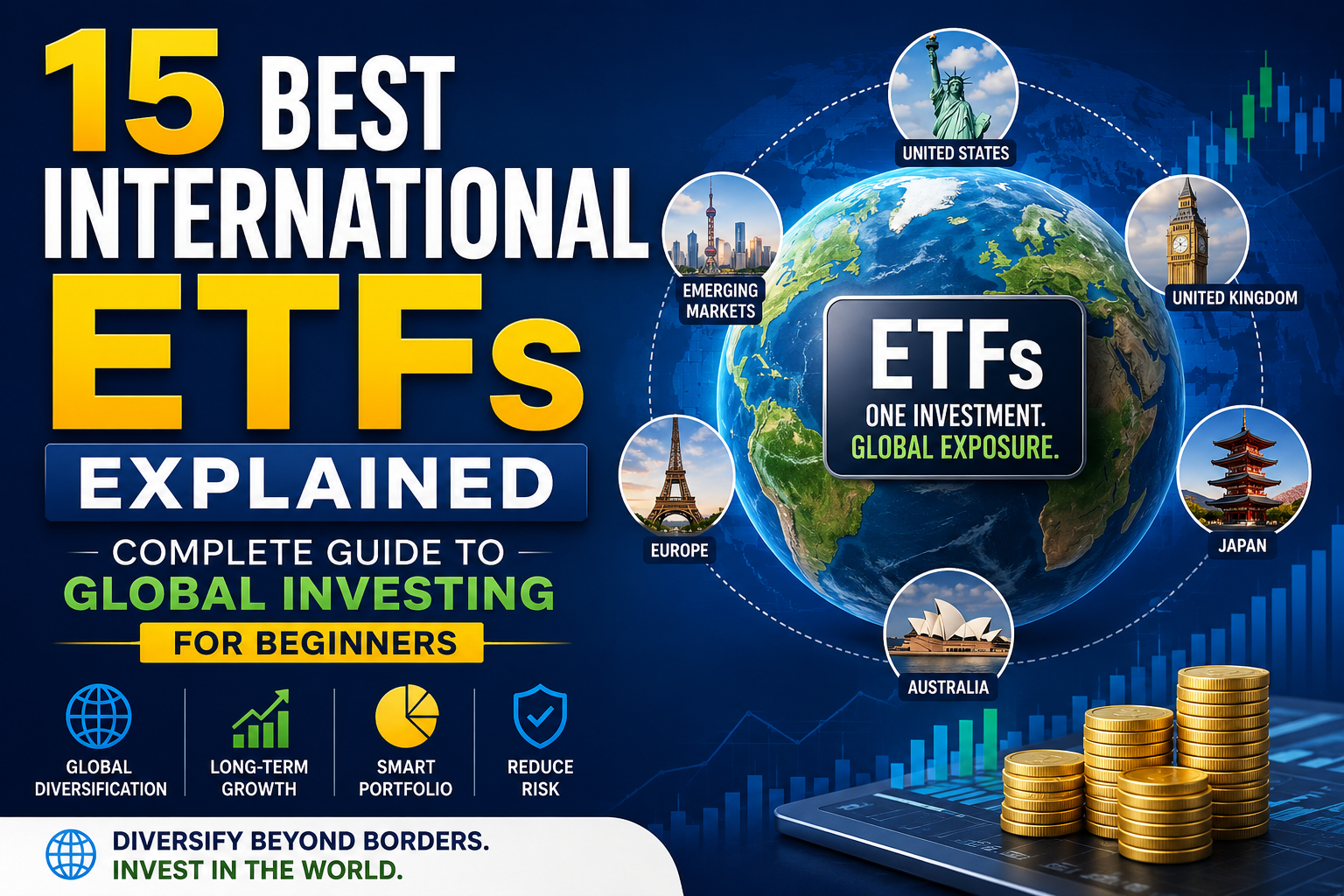
International ETFs Explained
If you’ve spent any time learning about investing, you’ve probably heard advice like “diversify your portfolio” or “don’t put all your eggs in one basket.” One of the most practical ways to do that today is through international ETFs.
An international ETF is a type of exchange-traded fund (ETF) that gives investors exposure to companies, bonds, or markets outside their home country. For a U.S. investor, that usually means investing in companies outside the United States. For a UK investor, it may mean exposure outside the UK. For a Canadian or Australian investor, it means gaining access to global markets rather than relying only on domestic stocks.
International ETFs matter because the global economy is much bigger than any one country. The United States is a dominant equity market, but it is still only part of the investable world. Europe, Japan, Canada, Australia, Taiwan, India, South Korea, and many emerging markets all contain major companies, sectors, and growth opportunities. By using international ETFs, investors can participate in those markets without having to buy individual foreign stocks one by one.
This guide explains what international ETFs are, how they work, why investors use them, what risks they carry, and how to choose the right international ETF for your portfolio. We’ll also cover developed-market ETFs, emerging-market ETFs, global ETFs, ex-U.S. ETFs, currency hedged ETFs, international bond ETFs, tax considerations, portfolio allocation examples, and real-world case studies.
Whether you are a complete beginner building your first portfolio or an intermediate investor trying to understand whether international diversification is worth it, this article will give you a complete roadmap.
What Is an International ETF?
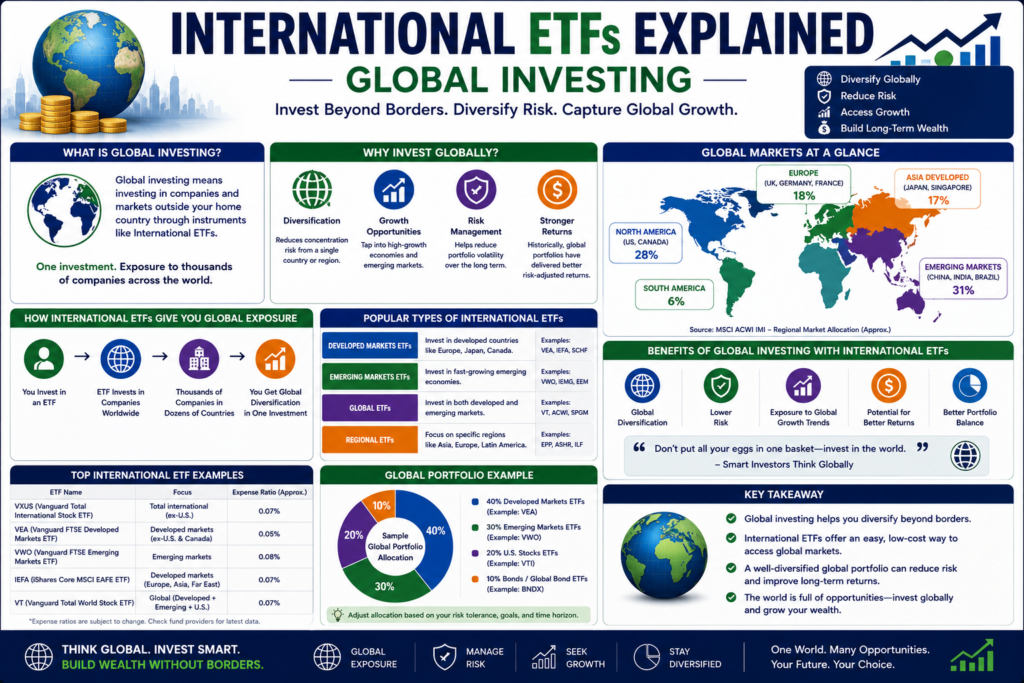
An international ETF is an exchange-traded fund that invests in assets outside the investor’s home market.
Let’s break that sentence down carefully:
- International = outside your domestic market or home country.
- ETF = a basket of investments that trades on a stock exchange like a stock.
- Invests in assets = may hold stocks, bonds, or other securities.
- Outside your home market = for a U.S. investor, this usually means non-U.S. investments; for a UK investor, it means non-UK investments.
So if you are a U.S. investor and you buy an international ETF, you might indirectly own small pieces of companies in:
- Japan
- the UK
- France
- Germany
- Switzerland
- Taiwan
- India
- South Korea
- Australia
- Brazil
- South Africa
- Mexico
- China
and many more.
Instead of researching and purchasing dozens or hundreds of foreign companies yourself, the ETF bundles them into one fund.
Simple definition
An international ETF lets you invest in foreign markets through one tradable fund. If you’re completely new to investing, start with our Start Investing Guide before building an international ETF portfolio.
What Does “ETF” Mean?
ETF stands for Exchange-Traded Fund.
To understand international ETFs, you first need to understand ETFs in general.
ETF = a basket of investments
Think of an ETF like a shopping basket filled with securities. Instead of buying one company’s stock, you buy one ETF share, and that ETF share gives you exposure to many holdings.
For example, one international ETF may hold:
- 3,000+ developed-market stocks
- 2,000+ emerging-market stocks
- companies across dozens of countries
- large-cap, mid-cap, and small-cap businesses
“Exchange-traded” means it trades like a stock
ETFs trade on stock exchanges during market hours. You can generally buy and sell them through a brokerage account the same way you buy a stock like Apple or Microsoft.
Why ETFs are popular
ETFs are popular because they often offer:
- diversification
- low cost
- transparency
- easy access
- tax efficiency in some jurisdictions
- intraday trading flexibility
That ETF wrapper becomes especially useful for international investing because buying foreign stocks directly can be complicated, expensive, and operationally difficult for ordinary investors.
What Does “International” Mean in Investing?
In investing, the word international usually means outside the investor’s domestic market.
But there are a few important versions of that idea.
A) International = non-domestic
If you live in the United States:
- U.S. stocks = domestic
- non-U.S. stocks = international
If you live in Canada:
- Canadian stocks = domestic
- non-Canadian stocks = international
If you live in Australia:
- Australian stocks = domestic
- non-Australian stocks = international
B) International does not always mean “global”
This is a common point of confusion.
- International ETF often means outside your home country
- Global ETF often means home country + international markets together
- Ex-U.S. ETF specifically means everything except the U.S.
So:
- a U.S. total stock market ETF is domestic
- an international ETF is non-U.S.
- a global ETF can include both U.S. and non-U.S. holdings
We’ll cover this distinction in more detail later because it matters when building a portfolio.
How International ETFs Work
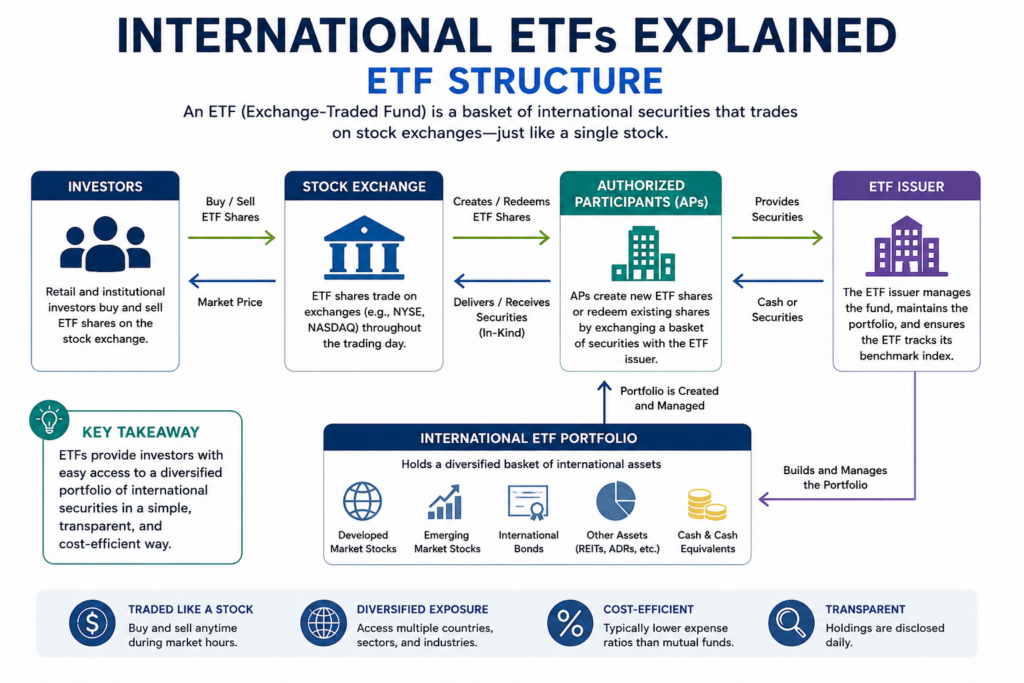
International ETFs work by pooling investor money and using it to buy a portfolio of foreign securities.
Step-by-step example
Imagine an ETF provider launches a “Total International Stock ETF.”
Step 1: The ETF chooses an index
The fund may track an index such as:
- MSCI ACWI ex USA IMI
- FTSE Global All Cap ex US
- MSCI EAFE
- MSCI Emerging Markets
- FTSE Developed ex North America
- or a custom international benchmark
Step 2: The index defines the holdings
That benchmark may include:
- large companies in Europe and Japan
- semiconductor companies in Taiwan and South Korea
- banks in Canada and Australia
- industrial companies in Germany
- consumer businesses in India and Mexico
- healthcare firms in Switzerland and Denmark
Step 3: The ETF buys the underlying securities
The ETF provider either fully replicates the index or samples it closely. The fund then owns those underlying foreign shares.
Step 4: Investors buy the ETF on an exchange
You buy the ETF through your brokerage account. You do not buy the underlying companies directly; you buy a share of the fund that owns them.
Step 5: Returns come from the underlying assets
Your return depends on:
- the performance of the underlying foreign stocks or bonds
- dividend distributions (if paid out)
- currency movements
- fees and tracking error
MSCI currently provides global, developed-market, emerging-market and other index classifications, making it highly relevant to your explanation of how ETF benchmarks work.
Why Investors Buy International ETFs
International ETFs are not just “extra diversification for the sake of diversification.” They solve several real portfolio problems.
Reason 1: Diversification beyond one country
No country outperforms forever. The U.S. has had long stretches of dominance, but other regions have had strong periods too. International ETFs reduce the risk of tying your entire financial future to one country’s market cycle.
Reason 2: Access to global growth
Many industries are global:
- semiconductor manufacturing
- luxury goods
- industrial automation
- pharmaceuticals
- mining and materials
- financial services
- renewable energy
- consumer brands
Some of the world’s most important companies are not listed in the U.S.
Reason 3: Exposure to different economic cycles
Countries do not all grow, contract, inflate, or cut interest rates at the same time. International exposure can give your portfolio access to different business cycles and policy environments.
Reason 4: Sector diversification
The U.S. stock market is heavily weighted toward technology and communications giants. Other countries may offer stronger exposure to:
- banks
- industrials
- materials
- exporters
- commodity producers
- luxury goods
- dividend-paying companies
Reason 5: Valuation diversification
Sometimes U.S. stocks are more expensive than international stocks on metrics like:
- price-to-earnings ratio (P/E)
- price-to-book ratio (P/B)
- dividend yield
- cyclically adjusted valuations
International ETFs can help investors avoid overconcentration in one expensive market.
Reason 6: Simplicity
Instead of opening foreign brokerage accounts or researching dozens of overseas firms, an international ETF provides instant global access in one trade.
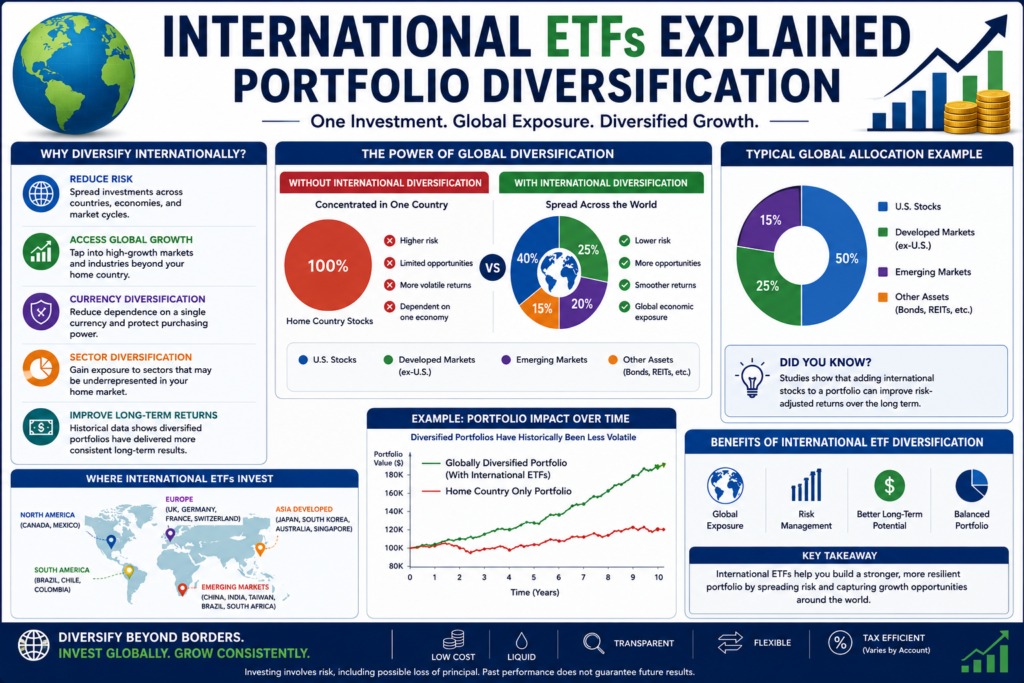
International ETFs can complement a broader portfolio strategy by spreading equity exposure across countries and economic cycles.
International ETFs vs U.S.-Only ETFs
Let’s compare a domestic U.S. ETF and an international ETF.
U.S.-Only ETF
A U.S.-only ETF might hold:
- Apple
- Microsoft
- Nvidia
- Amazon
- JPMorgan
- ExxonMobil
- Costco
International ETF
An international ETF might hold:
- Taiwan Semiconductor Manufacturing
- Nestlé
- ASML
- Samsung Electronics
- Toyota
- Novo Nordisk
- HSBC
- Roche
- SAP
- Sony
Main difference
A U.S.-only ETF concentrates on one country’s listed market. An international ETF spreads exposure across foreign markets.
Trade-off
- U.S.-only ETF: simpler, familiar, often very low cost
- International ETF: broader global diversification, but adds currency and geopolitical complexity
Neither is automatically “better.” The question is how much global exposure you want in your overall asset allocation.
Understanding how domestic and foreign markets fit together is an important part of learning about the stock market.
International ETFs vs Global ETFs
This distinction is one of the most important in ETF investing.
International ETF
Usually means non-domestic only.
For a U.S. investor, an international ETF excludes U.S. stocks.
Example concept:
- 100% non-U.S. stocks
- Europe, Japan, Canada, Australia, Taiwan, India, etc.
- no Apple, no Microsoft, no Amazon
Global ETF
A global ETF usually includes both domestic and international stocks.
For a U.S. investor, a global ETF might hold:
- 60% U.S.
- 40% international
That means one fund may include:
- Apple and Microsoft
- plus Nestlé and Toyota
- plus Taiwan Semiconductor and Samsung
- plus banks, industrials, and healthcare firms around the world
Why this matters
If you already own a U.S. total market ETF and then buy an international ETF, you are combining domestic + international yourself.
If you buy a single global ETF, the fund may already do that for you.
In short:
- International ETF = outside home country only
- Global ETF = home country + international together
Types of International ETFs
International ETFs are not one single category. There are many sub-types.
1. Broad international stock ETFs
These aim to hold a large slice of the non-domestic equity market. They may include developed and emerging markets.
2. Developed-market ETFs
These invest in countries considered economically mature and institutionally stable, such as:
- Japan
- UK
- Germany
- France
- Switzerland
- Australia
- Canada
- Netherlands
- Sweden
3. Emerging-market ETFs
These invest in faster-growing but often riskier economies such as:
- India
- Taiwan
- Brazil
- Mexico
- South Africa
- Indonesia
- Thailand
- Saudi Arabia
- parts of Latin America and Asia
4. Regional ETFs
Examples:
- Europe ETF
- Asia-Pacific ETF
- Latin America ETF
- Japan ETF
- China ETF
- India ETF
5. International dividend ETFs
These focus on foreign companies that pay dividends.
6. International bond ETFs
These hold foreign government or corporate bonds rather than stocks.
7. Currency-hedged international ETFs
These try to reduce the effect of exchange-rate movements.
8. International small-cap ETFs
These target smaller foreign companies rather than large multinationals.
9. International sector ETFs
Examples:
- international real estate ETF
- global infrastructure ETF
- international healthcare ETF
- foreign financials ETF
10. ESG or thematic international ETFs
These use environmental, social, governance, or theme-based filters across global markets.
Vanguard specifically distinguishes international ETFs, global/world ETFs, regional ETFs and developed-market ETFs. Before choosing an international ETF, it helps to understand the basic structure of ETFs and index funds.
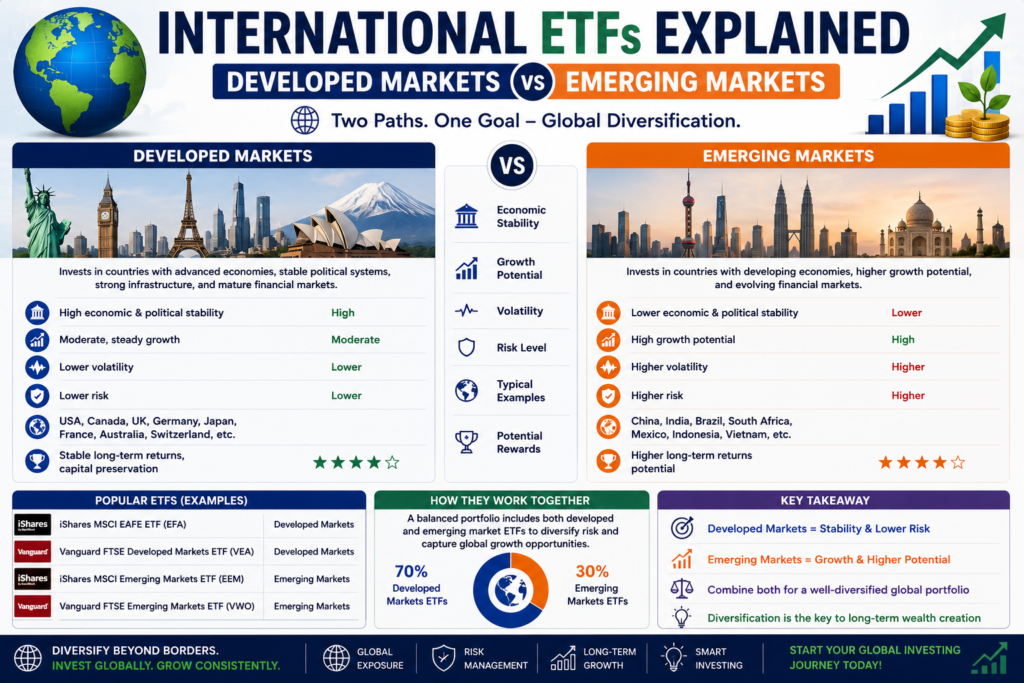
Developed Markets vs Emerging Markets
This is a foundational distinction in international investing.
Developed markets
Developed markets are generally countries with:
- more mature financial systems
- higher average income
- established legal institutions
- deeper capital markets
- stronger disclosure and governance standards
Examples commonly treated as developed:
- Japan
- UK
- Germany
- France
- Switzerland
- Australia
- Canada
- Netherlands
- Sweden
- Singapore
Emerging markets
Emerging markets are countries that are still developing economically and financially. They may offer higher growth potential, but often come with more volatility and risk.
Examples often included:
- India
- Brazil
- Mexico
- South Africa
- Indonesia
- Thailand
- Malaysia
- Taiwan
- China (depending on index methodology and market accessibility)
- Saudi Arabia
Why the distinction matters
Developed-market ETFs often provide:
- lower volatility than emerging markets
- more stable currencies and institutions
- established large multinational businesses
Emerging-market ETFs often provide:
- higher growth potential
- higher political and currency risk
- more cyclical swings
- sometimes lower valuations, sometimes higher uncertainty
A broad international ETF may combine both.
Ex-U.S. ETFs Explained
For U.S.-based investors, ex-U.S. ETF is a very common label.
“Ex” means “excluding”
So:
- ex-U.S. = everything except the United States
- ex-North America = everything except North America
- ex-Japan = everything except Japan
Why ex-U.S. matters
Many investors already own a U.S. stock ETF such as a total U.S. market fund or S&P 500 fund. They then use an ex-U.S. ETF to add international exposure without overlapping with their U.S. holdings.
Example
Portfolio A:
- 60% U.S. total stock market ETF
- 40% international ex-U.S. ETF
That gives broad global exposure while keeping the U.S. and international pieces separate.
This is especially useful because MSCI provides country membership and index classification resources.
International Stock ETFs vs International Bond ETFs
When people say “international ETF,” they often mean international stock ETF, but there are also international bond ETFs.
International stock ETFs
These invest in foreign companies and are generally used for:
- long-term growth
- global equity diversification
- exposure to foreign business profits
International bond ETFs
These invest in foreign bonds, which may include:
- foreign government bonds
- international corporate bonds
- sovereign debt
- inflation-linked foreign bonds
- developed-market bond indexes
- emerging-market debt
Key difference in portfolio role
- International stock ETF = growth-oriented equity allocation
- International bond ETF = income / defensive / fixed-income allocation
Bond ETFs also introduce additional decisions:
- hedged or unhedged currency exposure
- government vs corporate credit risk
- developed vs emerging debt risk
For most beginners building an equity-heavy portfolio, international stock ETFs are usually the first category they encounter.
Currency Risk in International ETFs
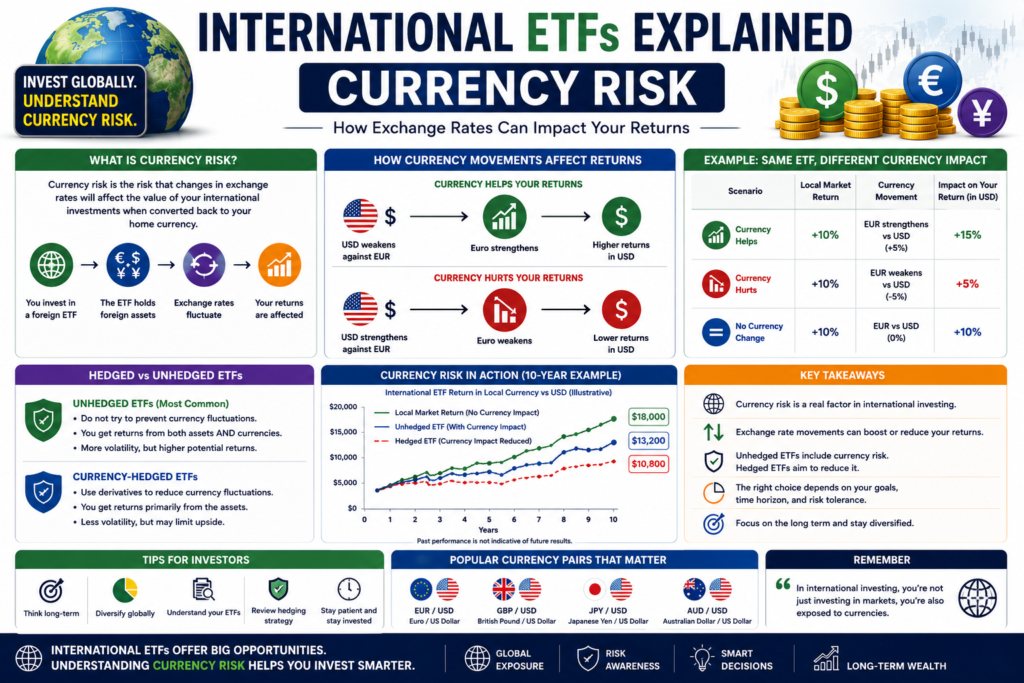
One of the most important concepts in international investing is currency risk.
What is currency risk?
When you invest internationally, you are exposed not only to the underlying foreign stock market but also to the movement of foreign currencies relative to your home currency.
Example
Suppose you are a U.S. investor and buy a European ETF. The companies inside the fund may earn profits in euros, Swiss francs, pounds, and other currencies.
If those stocks rise 10% in local currency but the euro falls sharply against the U.S. dollar, your return in dollars may be lower than expected.
Currency can help or hurt returns
Scenario A: Currency helps
- Japanese stocks rise 8%
- Japanese yen strengthens versus the U.S. dollar
- your U.S.-dollar return may end up higher than 8%
Scenario B: Currency hurts
- European stocks rise 8%
- euro weakens versus the U.S. dollar
- your U.S.-dollar return may be less than 8%, flat, or even negative in extreme cases
Why investors should care
Currency exposure is not always bad. It’s just another layer of risk and return. Over long periods, currency effects can either dampen or enhance results, depending on the cycle.
Hedged vs Unhedged International ETFs
This leads to the next major decision: currency hedged or unhedged?
Unhedged international ETF
This is the default structure for many broad international stock ETFs. It means the fund generally does not try to eliminate currency fluctuations.
Pros
- simpler
- often cheaper
- gives true foreign currency exposure
- may benefit if the home currency weakens
Cons
- returns can be more volatile in home-currency terms
- foreign currency weakness can reduce returns
Currency-hedged international ETF
A currency-hedged ETF tries to offset exchange-rate moves, usually through derivatives such as forward contracts.
Pros
- can reduce currency volatility
- lets investors focus more on stock-market performance rather than exchange rates
- may be useful when a home currency investor wants cleaner equity exposure
Cons
- higher complexity
- often slightly higher cost
- hedging may reduce upside when foreign currencies strengthen
- not guaranteed to hedge perfectly
Which is better?
There is no universal answer. It depends on:
- your time horizon
- your risk tolerance
- whether you want foreign-currency exposure
- whether you’re investing in stocks or bonds
Many long-term equity investors are comfortable with unhedged international stock ETFs. Many investors prefer hedged exposure for international bonds because currency swings can overwhelm bond yields.
Dividend Income From International ETFs
Many international ETFs pay dividends because many foreign companies distribute profits to shareholders.
How international ETF dividends work
If the companies inside the ETF pay dividends, the ETF may:
- collect those dividends
- deduct expenses
- distribute cash to shareholders, or
- reinvest depending on fund structure and jurisdiction
Why international ETFs can appeal to income investors
In some regions, companies historically have:
- higher dividend payout ratios
- more mature, cash-generative business models
- stronger representation in sectors like financials, telecoms, utilities, and energy
That means some international dividend ETFs may show higher yields than U.S. growth-heavy funds.
But yield is not everything
A higher dividend yield does not automatically mean a better investment. High-yield funds can be:
- concentrated in slower-growth sectors
- exposed to value traps
- more sensitive to rate cycles or economic weakness
Always look at:
- total return
- dividend sustainability
- country and sector concentration
- expense ratio
- tax treatment of foreign dividends
Costs and Expense Ratios
One of the biggest advantages of ETFs is cost efficiency, but international ETFs still vary in price.
What is an expense ratio?
The expense ratio is the annual fee charged by the fund, expressed as a percentage of assets.
Example
If an ETF has a 0.10% expense ratio:
- on $10,000 invested, annual fund cost is about $10
- on $100,000 invested, annual fund cost is about $100
Why costs matter
Costs reduce your return every year. A small difference can compound meaningfully over decades.
International ETFs may cost more than U.S. broad-market ETFs
Why?
- foreign trading and custody can be more complex
- emerging markets are costlier to access
- currency operations and index licensing add cost
- some niche funds lack scale
Real-world cost examples
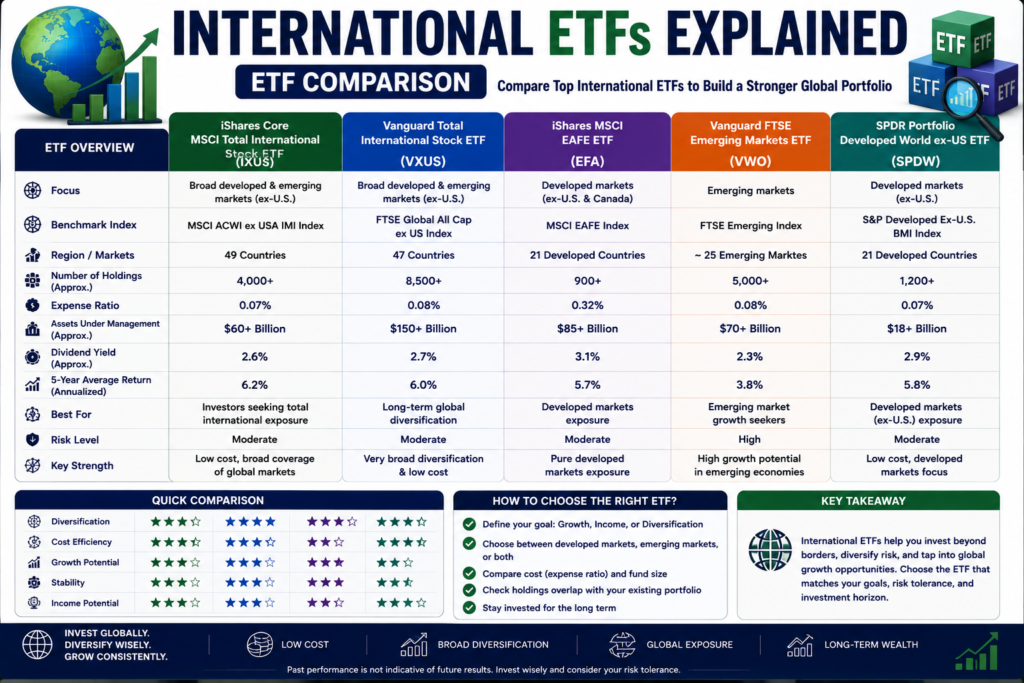
Large core international ETFs often remain inexpensive by historical standards. For example, the iShares Core MSCI Total International Stock ETF (IXUS) recently reported an expense ratio of 0.07% and held roughly $57–59 billion in net assets, while tracking a broad non-U.S. equity benchmark that includes both developed and emerging markets.
Similarly, broad-market international funds like Vanguard Total International Stock ETF (VXUS) are widely used because they combine broad diversification with low fees; third-party holdings data recently showed VXUS with roughly 8,800 holdings and about $149 billion in assets.
Cost rule for beginners
When comparing two very similar broad international index ETFs, lower cost is often a meaningful tie-breaker—assuming:
- the index exposure is comparable
- liquidity is solid
- the fund is reputable
- tracking quality is good
Taxes and Withholding Taxes
Taxes are one of the least exciting parts of investing, but they matter a lot with international ETFs.
What is foreign withholding tax?
Some countries withhold part of dividend payments before the money reaches the ETF or the investor. This is called withholding tax.
Example
A foreign company pays a dividend. The home country of that company may withhold a portion before the dividend reaches the fund.
Why this matters
Your gross dividend yield and your actual after-tax yield may differ.
Tax treatment depends on:
- your country of residence
- whether the ETF is U.S.-domiciled, Irish-domiciled, Canadian-domiciled, etc.
- whether you hold the ETF in a taxable account or tax-advantaged account
- treaty rules between countries
- whether your country offers foreign tax credits
Important note for Tier-1 readers
A U.S. investor, UK investor, Canadian investor, Australian investor, and EU investor can all face different tax outcomes even when buying similar international ETFs.
That means tax treatment should be confirmed with:
- the fund prospectus
- your broker’s tax reporting documents
- a qualified tax professional if the amounts are meaningful
Big takeaway
International ETFs can be tax-efficient, but the tax layer is more complex than purely domestic investing.
Political, Regulatory, and Market Risks
International diversification reduces one risk—home-country concentration—but adds others.
1. Political risk
Governments can change:
- tax laws
- capital controls
- trade policies
- corporate regulations
- foreign ownership rules
2. Regulatory risk
Disclosure standards, accounting rules, governance quality, and shareholder protections can vary by country.
3. Currency risk
As discussed, exchange-rate moves can affect returns.
4. Market structure risk
Some foreign markets are less liquid or less transparent than the U.S. market.
5. Emerging-market instability
Emerging markets may face:
- inflation shocks
- banking stress
- commodity dependence
- election volatility
- geopolitical disruptions
6. Concentration risk hidden inside “international”
Some broad international funds may still be heavily concentrated in a few countries or companies.
For example, international indexes today often have meaningful exposure to:
- Japan
- UK
- Canada
- France
- Switzerland
- Taiwan
- India
- South Korea
That’s diversified, but not equally spread across all countries.
Liquidity, Spreads, and ETF Structure
Not all ETFs are equally easy to trade.
Liquidity
Liquidity refers to how easily you can buy or sell an ETF without causing a large price move.
Signs of a more liquid ETF
- higher trading volume
- tighter bid-ask spread
- larger fund size / assets under management
- established issuer and active market makers
Bid-ask spread
The bid is what buyers are willing to pay.
The ask is what sellers are asking.
The difference is the spread.
Why spreads matter
If you buy at the ask and sell at the bid, you lose the spread cost. Thinly traded niche international ETFs may have wider spreads.
ETF size matters too
A large international ETF with billions in assets is often easier and cheaper to trade than a tiny niche country ETF with limited volume.
How to Evaluate an International ETF
When choosing an international ETF, use a checklist rather than chasing performance.
1. What does the ETF actually hold?
Ask:
- Does it include developed markets only?
- Does it include emerging markets too?
- Is it ex-U.S.?
- Is it global, not purely international?
- Is it large-cap only or all-cap?
2. What index does it track?
Examples:
- MSCI EAFE
- MSCI ACWI ex USA IMI
- FTSE All-World ex-US
- MSCI Emerging Markets
- FTSE Developed ex North America
Index methodology affects country weights, market-cap coverage, and stock inclusion rules.
3. How diversified is it?
Look at:
- number of holdings
- top 10 holdings concentration
- country weights
- sector weights
4. Expense ratio
Lower is generally better, all else equal.
5. Fund size and liquidity
Larger and more liquid funds often trade more efficiently.
6. Distribution policy
Does the ETF pay dividends? Quarterly? Semiannually? Is it accumulating or distributing in your jurisdiction?
7. Currency policy
Hedged or unhedged?
8. Tax structure and domicile
This can matter materially for non-U.S. investors.
9. Tracking quality
How closely does the ETF follow its benchmark after fees and operational costs?
10. Role in your portfolio
Is this:
- your entire international allocation?
- an emerging-market satellite?
- a developed-market complement?
- a dividend sleeve?
- a tactical regional bet?
FTSE Russell provides global and local equity benchmarks covering different market-cap and market-development categories. The ETF should also have a clear role within your overall asset allocation strategy.
Popular International ETF Categories
Let’s look at the main categories investors commonly use.
A) Total International Stock ETFs
These are the broadest “one-ticket” non-domestic equity funds. They usually include:
- developed markets
- emerging markets
- large-, mid-, and sometimes small-cap stocks
Who they’re for
Investors who want one simple ETF to cover most of the non-domestic stock market.
Example use
If you already own a U.S. total stock market ETF, you might pair it with a total international ETF to create a global stock allocation.
Real-world illustration
Funds like IXUS aim to track a broad non-U.S. index covering developed and emerging market equities across large-, mid-, and small-cap companies. BlackRock’s fund page describes IXUS as tracking the MSCI ACWI ex USA IMI Index, and recent data showed the fund with an expense ratio of 0.07% and tens of billions of dollars in assets.
B) Developed-Market ETFs
These funds focus on countries with more established economies and capital markets.
Typical countries
- Japan
- UK
- France
- Germany
- Switzerland
- Australia
- Canada
- Netherlands
- Sweden
Who they’re for
Investors who want foreign exposure but prefer to avoid some emerging-market volatility.
Main trade-off
You may get lower volatility than emerging markets, but you also miss some faster-growing economies.
C) Emerging-Market ETFs
These focus on countries with higher growth potential and higher risk.
Typical countries
- India
- Taiwan
- Brazil
- South Africa
- Mexico
- Indonesia
- Thailand
- Malaysia
- Saudi Arabia
Who they’re for
Investors who want a higher-growth, higher-volatility slice of their portfolio.
Main risk
Emerging markets can be hit hard by:
- dollar strength
- rising global rates
- political uncertainty
- commodity shocks
- capital outflows
Recent IMF commentary has highlighted how emerging economies can be vulnerable to financing shocks and rapid capital withdrawals during periods of global stress—one reason emerging-market ETFs should usually be viewed as a long-term allocation rather than a short-term trade.
D) Regional ETFs
These target a specific region.
Examples:
- Europe ETF
- Asia-Pacific ETF
- Latin America ETF
- Japan ETF
- India ETF
- China ETF
Who they’re for
Investors who have a specific regional thesis or want to overweight a geography.
Risk
Regional ETFs are less diversified than broad international funds.
E) International Dividend ETFs
These emphasize foreign dividend-paying companies.
Potential benefits
- higher income
- exposure to mature cash-generative firms
- diversification away from U.S. growth concentration
Risks
- value traps
- sector concentration
- dividend cuts during downturns
- tax drag from withholding taxes
F) International Small-Cap ETFs
These focus on smaller companies outside the investor’s home market.
Why use them?
Some investors believe small caps offer:
- higher long-term return potential
- greater diversification beyond mega-cap multinationals
- more exposure to domestic demand within foreign economies
Risks
- higher volatility
- lower liquidity
- more tracking complexity
G) Currency-Hedged International ETFs
These aim to reduce exchange-rate impact.
Good fit for:
- investors who dislike currency swings
- tactical allocations
- certain bond exposures
Less ideal for:
- investors who want pure global market exposure over very long horizons and don’t mind currency fluctuations
iShares specifically describes international ETFs as providing exposure to developed and emerging markets and offers broad, regional and country-specific products.
Case Studies: 7 Real-World Portfolio Examples
Below are practical case studies showing how international ETFs can fit different investor situations.
Case Study 1: The U.S. Beginner Who Owns Only the S&P 500
Profile
- Age: 28
- Lives in the U.S.
- Started investing with one S&P 500 ETF
- Has no international exposure
Problem
The investor thinks they are diversified because they own 500 large U.S. companies. But they are still concentrated in one country and heavily exposed to U.S. large-cap stocks.
Solution
They add a broad international ex-U.S. ETF to complement their U.S. fund.
New portfolio
- 70% U.S. broad market ETF
- 30% international ex-U.S. ETF
Result
The portfolio now includes:
- Europe
- Japan
- Canada
- Australia
- Taiwan
- India
- South Korea
- emerging markets
Lesson
An S&P 500 ETF is diversified within U.S. large caps, but not fully diversified globally.
Case Study 2: The “One-Fund Simplicity” Investor
Profile
- Age: 35
- Wants a very simple long-term portfolio
- Doesn’t want to rebalance multiple equity funds
Problem
They want global diversification but dislike managing separate U.S. and international weights.
Solution
Instead of holding separate domestic and international ETFs, they buy a single global stock ETF that includes both U.S. and international markets.
Lesson
Sometimes the best “international ETF decision” is deciding whether you want:
- a separate international sleeve, or
- a one-fund global solution
International investing is not only about which fund to buy, but also how you want to structure the portfolio.
Case Study 3: The Retiree Seeking Income Diversification
Profile
- Age: 64
- Already owns U.S. dividend ETFs and U.S. bond funds
- Wants more income diversification
Problem
Their income portfolio is heavily tied to U.S. companies and U.S. rates.
Solution
They add:
- a developed-market dividend ETF
- a modest international bond ETF allocation
Benefits
- broader source of dividend income
- less concentration in U.S. sectors
- more diversified cash-flow sources
Risk management
They keep the international slice moderate because income needs are immediate and currency volatility matters.
Lesson
International ETFs are not only for growth investors. They can also diversify income sources.
Case Study 4: The Investor Chasing Emerging Markets After a Rally
Profile
- Age: 31
- Sees headlines about strong returns in India and Taiwan
- Wants to put 100% of international allocation into emerging markets
Problem
They are confusing higher recent performance with appropriate portfolio construction.
Solution
Instead of putting everything into one high-volatility emerging-market ETF, they use:
- 80% broad total international ETF
- 20% emerging-market ETF satellite
Lesson
Emerging markets can be valuable, but they are usually better treated as part of a diversified international strategy rather than the entire international allocation.
Case Study 5: The UK Investor With Heavy Home Bias
Profile
- Age: 42
- Lives in the UK
- Owns mostly UK dividend stocks and FTSE funds
- Feels “international” is risky
Problem
The portfolio is overly tied to one domestic market and one style profile.
Solution
They add a broad ex-UK international ETF.
Why it helps
Now the portfolio gets exposure to:
- U.S. technology and healthcare leaders
- Japanese industrials
- European luxury and pharma firms
- Asian semiconductor giants
- global consumer brands
Lesson
Home bias feels comfortable, but comfort is not the same as diversification.
Case Study 6: The Long-Term FIRE Investor Using Global Market Weights
Profile
- Age: 29
- Saving aggressively for financial independence
- Wants a rules-based approach
Strategy
They decide to approximate the global stock market rather than make country predictions.
Portfolio example
- 60% U.S. total market ETF
- 40% total international ETF
This rough framework is often close to broad global market weights, though exact weights drift over time.
Why it works
- low-cost
- rules-based
- no need to forecast which country wins next
- globally diversified
Supporting context
Broad investor discussion often centers on market-cap-weight global allocations such as roughly 60/40 or 63/37 U.S./international, especially when pairing a U.S. total market fund with an ex-U.S. fund. Community discussions regularly use that framework as a neutral baseline rather than a performance prediction.
Case Study 7: The Investor Burned by Buying an International ETF for the Wrong Reason
Profile
- Age: 38
- Bought an international ETF because “U.S. stocks are too expensive”
- Expected immediate outperformance
Problem
They treated international exposure as a short-term valuation trade rather than a long-term diversification decision.
What happened
- international underperformed for 18 months
- currency swings reduced returns
- investor lost confidence and sold
What they should have done
Buy international ETFs for one of these reasons:
- long-term diversification
- global market exposure
- strategic asset allocation
- disciplined risk spreading
Not because of a 6-month or 12-month performance bet.
Lesson
International ETFs work best when they are part of a long-term plan, not a headline-driven trade.
How Much of Your Portfolio Should Be International?
This is one of the most common investing questions.
There is no universal perfect percentage. The right answer depends on:
- your home country
- your existing domestic exposure
- your risk tolerance
- your beliefs about global diversification
- taxes and account structure
- whether you want to track global market weights or maintain a home bias
Common approaches
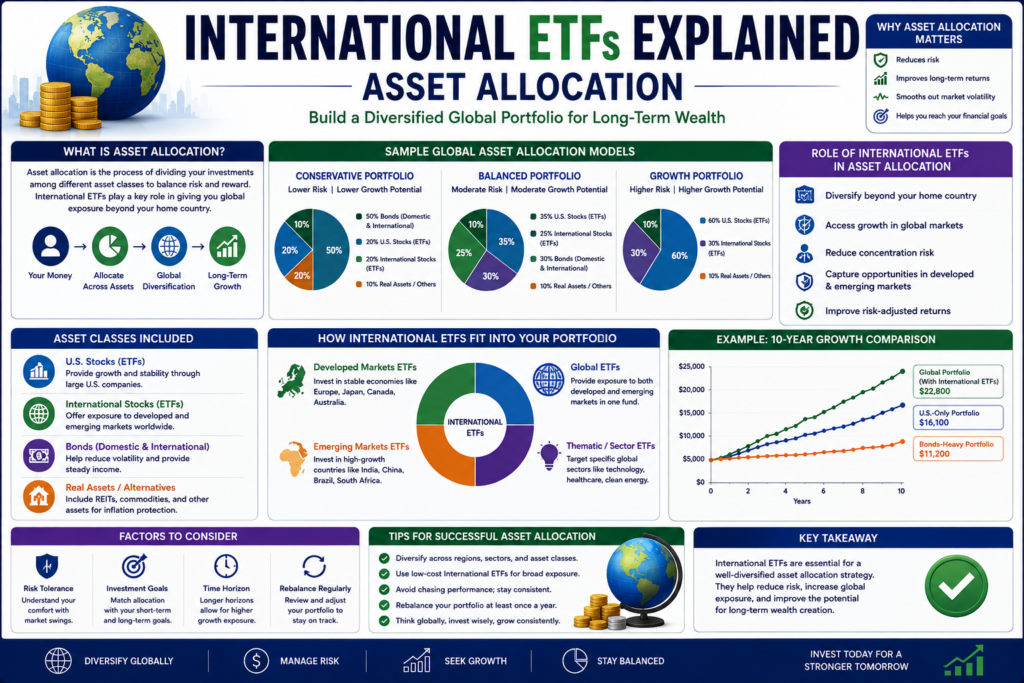
Approach 1: Global market weight
Some investors roughly mirror the world stock market by market capitalization. That often means a large U.S. allocation plus a substantial international allocation.
Approach 2: Moderate home bias
Some investors intentionally overweight their home country for familiarity, taxes, or spending-currency reasons.
Approach 3: Minimal international
Some investors hold only 10%–20% internationally because they prefer domestic dominance but still want some diversification.
Approach 4: Broad global diversification
Others hold 30%–45% internationally, especially if they want to avoid betting on one country.
Practical framework for beginners
Instead of asking “what is the best number,” ask:
- Do I want some international exposure or none?
- Do I want to approximate the global market or keep a domestic tilt?
- Can I stay invested through periods when international underperforms domestic stocks?
The best allocation is the one you can stick with consistently. International exposure should be considered as part of a broader wealth-building and asset-allocation strategy rather than as an isolated investment decision.
International ETF Portfolio Models for Beginners
These are not personalized financial recommendations—just examples of how investors often structure international exposure.
Model 1: Simple Two-Fund Equity Portfolio
- 60% domestic total stock market ETF
- 40% total international ETF
Good for:
- investors who want broad global diversification
- long-term passive investing
- a clean domestic/international split
Model 2: Domestic Tilt With International Diversification
- 75% domestic stock ETF
- 25% international ETF
Good for:
- investors who prefer a home-country tilt
- beginners who want international exposure without making it a huge allocation
Model 3: Three-Part Global Equity Mix
- 60% domestic total market ETF
- 25% developed-market ETF
- 15% emerging-market ETF
Good for:
- investors who want more control over international exposure
- people who want to tilt toward or away from emerging markets
Model 4: Global Core + Emerging Satellite
- 80% global all-world ETF
- 20% emerging-market ETF
Good for:
- investors who want a one-fund global base but a modest growth tilt
Model 5: Income-Oriented International Diversification
- 50% domestic dividend / broad market
- 20% international dividend ETF
- 20% domestic bonds
- 10% international bonds
Good for:
- investors prioritizing income diversification and portfolio balance
Common Mistakes Investors Make With International ETFs
Mistake 1: Thinking “international” means equally spread across every country
Most funds are weighted by market capitalization, so some countries dominate more than others.
Mistake 2: Buying a “global ETF” and an “international ETF” without understanding overlap
This can unintentionally overweight non-domestic markets.
Mistake 3: Chasing whichever region just outperformed
Today it might be India; tomorrow Europe; the year after that, the U.S. Performance chasing is a poor asset-allocation process.
Mistake 4: Ignoring currency risk
Currency can materially affect returns.
Mistake 5: Ignoring taxes
Withholding tax, fund domicile, and account type matter.
Mistake 6: Using a narrow country ETF as their entire international allocation
A single-country ETF is not the same as diversified international exposure.
Mistake 7: Focusing only on yield
High yield can come with concentration, value traps, or tax drag.
Mistake 8: Not checking what the ETF actually excludes
“International,” “world,” “all-world,” “global,” “ex-U.S.,” and “developed ex-U.S.” all mean different things.
Mistake 9: Overcomplicating the portfolio
Many investors would be fine with one broad international ETF instead of five overlapping regional funds.
Mistake 10: Selling international exposure after a few years of underperformance
Diversification only works if you maintain it through different cycles.
Statistics and Market Context: Why International ETFs Matter More Than Ever
The ETF industry itself has become enormous, which matters because it has made international diversification cheaper, easier, and more accessible.
According to ETFGI, assets invested in the global ETF industry reached a record $23.08 trillion at the end of May 2026, with 17,075 ETFs, 33,094 listings, and 1,014 providers across 85 exchanges in 66 countries. ETFGI also reported record year-to-date inflows of $1.07 trillion through May 2026.
That scale matters for ordinary investors because larger ETF ecosystems typically mean:
- more competition among fund providers
- lower fees on core funds
- more international choices
- better trading liquidity in flagship products
- easier access to markets that were once hard to reach
Recent market performance has also reminded investors why non-U.S. exposure matters. In 2025, developed markets outside the United States rose strongly, and some widely followed commentary highlighted that international stocks outperformed U.S. equities after a long stretch of U.S. dominance. For example, Kiplinger noted that Vanguard Total International Stock ETF (VXUS) gained more than 32% in 2025, while the iShares Core MSCI Emerging Markets ETF (IEMG) rose nearly 33%, helped by a weaker U.S. dollar and stronger foreign-market performance.
The lesson is not that international stocks always beat U.S. stocks—they don’t. The lesson is that leadership rotates, and global diversification exists precisely because investors do not know in advance which country or region will lead next.
The SEC reported in February 2026 that more than 3,600 ETFs held assets exceeding $10 trillion in the U.S. market.
Expert Principles Behind International ETF Investing
Rather than quoting one “guru,” it’s more useful to understand the core principles professionals and evidence-based investors tend to agree on:
Principle 1: Diversification is about uncertainty, not prediction
You buy international exposure because the future is uncertain—not because you know which country will win next.
Principle 2: Costs matter
If two broad funds give similar exposure, lower fees are generally better.
Principle 3: Asset allocation matters more than product excitement
A boring, diversified, low-cost international ETF is often more useful than a trendy niche country fund.
Principle 4: Simplicity beats complexity for most investors
Most people do not need 10 international ETFs. One broad international ETF or one global ETF is often enough.
Principle 5: Risk is multi-dimensional
International investing adds diversification, but also adds:
- currency risk
- geopolitical risk
- tax complexity
- varying governance standards
That’s why international ETFs should fit into a full portfolio plan—not be bought in isolation.
Frequently Asked Questions (FAQ)
1. What is an international ETF in simple words?
An international ETF is a fund you can buy on a stock exchange that invests in markets outside your home country.
2. Are international ETFs good for beginners?
Yes, broad international ETFs can be beginner-friendly because they provide instant diversification across many countries in one fund.
3. What’s the difference between an international ETF and a global ETF?
An international ETF usually excludes your home country. A global ETF usually includes both your home market and international markets.
4. Do international ETFs include emerging markets?
Some do and some don’t. Always check the fund’s benchmark and holdings.
5. Are international ETFs risky?
They carry stock-market risk plus extra layers such as currency risk, political risk, and foreign-market risk. Broad funds are generally less risky than narrow country funds.
6. Should I buy developed-market ETFs or emerging-market ETFs?
That depends on your goals. Developed-market ETFs are usually less volatile. Emerging-market ETFs may offer higher growth potential but higher risk.
7. Do international ETFs pay dividends?
Many do, because many foreign companies pay dividends. The amount and frequency vary by fund.
8. What is currency hedging in an international ETF?
Currency hedging is a strategy used by some ETFs to reduce the impact of exchange-rate fluctuations on investor returns.
9. Can I lose money in an international ETF even if foreign stocks go up?
Yes. If your home currency strengthens significantly against the currencies of the countries held in the ETF, your home-currency return can be reduced.
10. Is one international ETF enough?
For many investors, yes. A broad total international ETF can be enough for the international equity portion of a long-term portfolio.
11. Are international ETFs better than picking foreign stocks individually?
For most beginners and many long-term investors, broad international ETFs are simpler, cheaper, and more diversified than trying to pick individual foreign stocks.
12. How much international exposure should a portfolio have?
There is no single correct number. Many investors choose anywhere from 20% to 40% of equities internationally, while others follow global market weights more closely.
13. What does “ex-U.S.” mean?
It means the ETF excludes U.S. holdings.
14. Are international ETFs tax efficient?
They can be, but tax outcomes depend heavily on your country, account type, and the ETF’s domicile. Foreign withholding tax is an important factor.
15. Should I use a currency-hedged international ETF?
Possibly, but it depends on your goals. Many long-term stock investors are comfortable with unhedged exposure, while hedging is more common in international bond allocations.
Final Thoughts: Are International ETFs Worth It?
For many investors, yes—international ETFs are one of the simplest and most effective ways to build a more globally diversified portfolio.
They allow you to invest beyond your home market without having to:
- research dozens of foreign companies
- manage foreign brokerage accounts
- worry about buying stocks across multiple exchanges
- manually build exposure to dozens of countries and currencies
International ETFs can give you access to:
- developed economies like Japan, the UK, Germany, France, Switzerland, and Australia
- emerging economies like India, Brazil, and South Africa
- sectors underrepresented in your domestic market
- foreign dividend payers
- global growth outside a single country’s market cycle
But they are not magic. They come with real trade-offs:
- currency risk
- tax complexity
- geopolitical uncertainty
- periods of underperformance versus domestic markets
That is why the best way to use international ETFs is not as a short-term performance bet, but as part of a disciplined long-term asset allocation strategy.
If you want a practical rule of thumb, start here:
- Decide whether you want domestic-only or global diversification.
- If you want global diversification, decide whether you prefer:
- one global ETF, or
- a domestic ETF + an international ETF
- Choose a broad, low-cost, diversified fund
- Keep the allocation simple enough that you can stick with it during both good and bad market cycles
In the end, international ETFs are not really about predicting which country will outperform next year. They are about acknowledging a basic investing truth:
the future is global, uncertain, and bigger than any one market.
And for long-term investors, that is exactly why international ETFs deserve serious consideration.
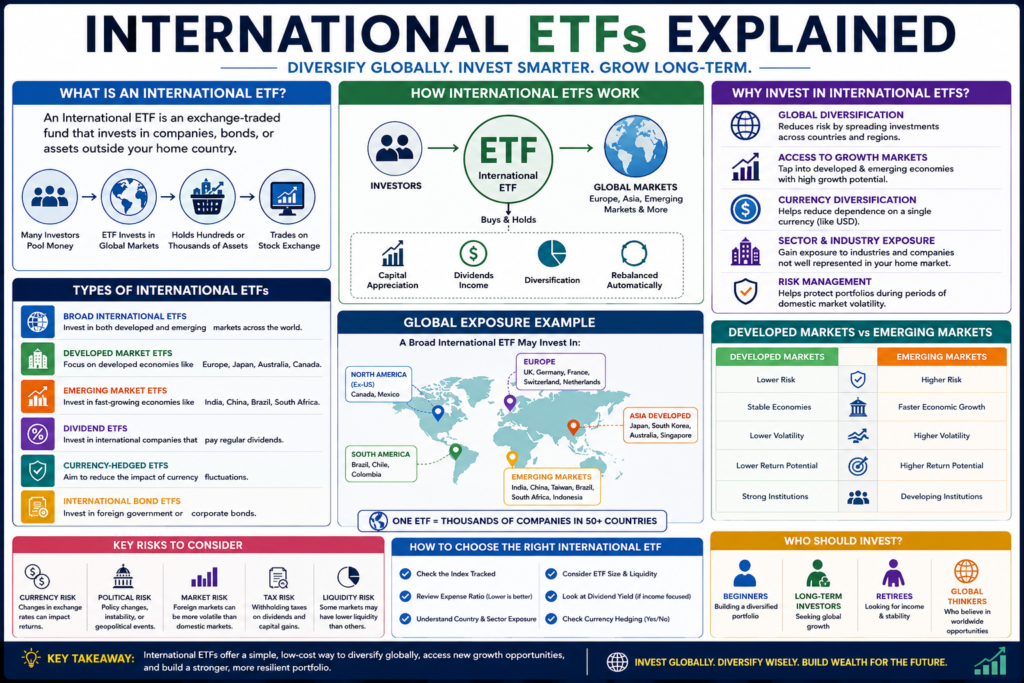
If you’re continuing your investing journey, explore our Start Investing Guide, ETF & Index Funds Guide, and Portfolio Strategy Guide.
Quick Summary
- International ETFs invest outside your home market.
- They help investors diversify across countries, currencies, sectors, and economic cycles.
- The main categories include broad international ETFs, developed-market ETFs, emerging-market ETFs, international dividend ETFs, and international bond ETFs.
- Key risks include currency risk, withholding tax, geopolitical risk, and foreign-market volatility.
- For many beginners, one broad total international ETF is enough for the international portion of a portfolio.
- International ETFs are most useful when used as part of a long-term diversified asset allocation plan, not as a short-term bet on one region.