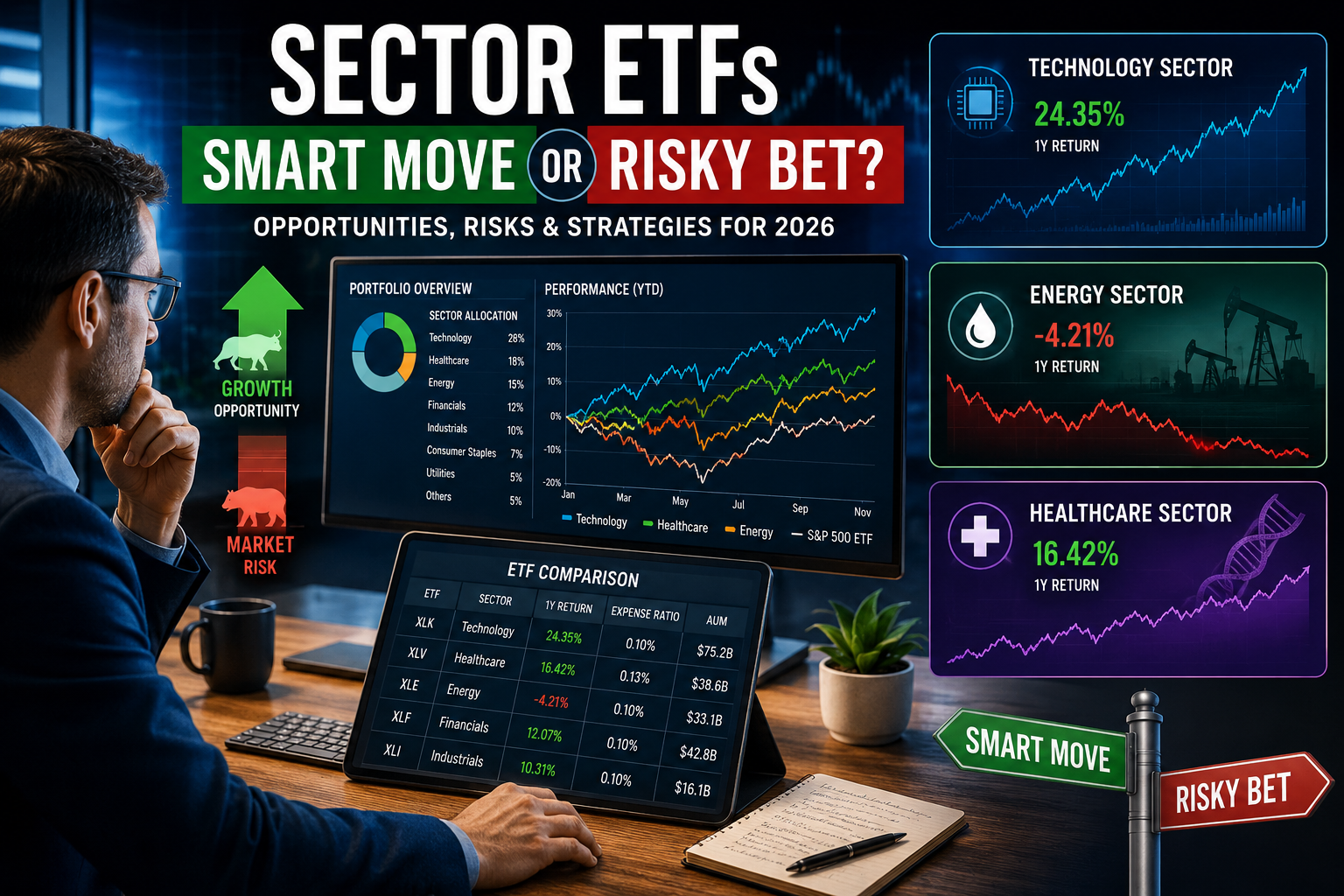
Introduction: Sector ETFs – Smart Move or Risky Bet?
Sector ETFs have become one of the most popular investment vehicles for investors seeking targeted exposure to specific industries. Whether you are interested in technology, healthcare, energy, or financial services, Sector ETFs allow you to invest in an entire industry through a single fund.
Investing has changed dramatically over the last two decades. In the past, investors mostly bought individual stocks like Apple, Microsoft, or Tesla and hoped those companies would grow. Today, many investors prefer a more diversified approach through Exchange-Traded Funds (ETFs).
One special category of ETFs has become extremely popular among both beginner and advanced investors: Sector ETFs.
But this raises a major question:
Are Sector ETFs a smart investing strategy that can outperform the market, or are they risky bets that expose investors to dangerous concentration risk?
The answer is more complicated than a simple “yes” or “no.”
Sector ETFs can create enormous wealth during economic booms, technological revolutions, or industry expansions. At the same time, they can also produce severe losses when a specific industry collapses.
This complete guide explains:
- What Sector ETFs are
- How they work
- Different types of sectors
- Advantages and disadvantages
- Real-world examples
- Historical case studies
- Risks investors ignore
- Smart strategies for using sector ETFs
- Whether they belong in your portfolio
What Is a Sector ETF?
A Sector ETF is an Exchange-Traded Fund that invests only in companies belonging to a specific sector of the economy.
What Is an ETF?
An ETF (Exchange-Traded Fund) is an investment fund traded on a stock exchange, similar to a stock.
Instead of buying one company, an ETF allows investors to buy a basket of investments. For a deeper explanation of ETF structures, diversification, and index-based investing, read our guide to ETFs and index funds.
For example:
- A stock = ownership in one company
- An ETF = ownership in many companies
A technology ETF may contain:
- Apple
- NVIDIA
- Amazon
- Meta
This creates diversification compared to buying only one stock.
To understand how ETFs fit into the broader market, see our guide to stock market investing. For a broader explanation of how ETFs work, diversification, fees, risks, and trading, see the SEC’s guide to ETFs.
What Is a Sector?
A sector is a group of companies operating in the same part of the economy. Think of sectors as categories of businesses.
Examples include:
| Sector | Type of Companies |
|---|---|
| Technology | Software, AI, chips |
| Healthcare | Pharma, hospitals |
| Energy | Oil, gas, renewable energy |
| Financials | Banks, insurance |
| Consumer Staples | Food and household products |
| Utilities | Electricity and water |
| Industrials | Manufacturing and aerospace |
What Is a Sector ETF?
A Sector ETF combines these ideas. Instead of investing in the whole market, it focuses only on one economic sector.
For example:
| ETF Type | What It Invests In |
|---|---|
| S&P 500 ETF | Entire large-cap U.S. market |
| Technology Sector ETF | Only technology companies |
| Energy Sector ETF | Oil and gas companies |
| Healthcare ETF | Medical and pharmaceutical companies |
Why Investors Love Sector ETFs
Sector ETFs became popular because they allow investors to make targeted bets on economic trends.
For example:
- If AI grows rapidly → technology ETFs may rise
- If oil prices surge → energy ETFs may rise
- If healthcare demand increases → healthcare ETFs may perform well
Sector ETFs allow investors to express an economic opinion without choosing individual stocks.
Major Sector Categories
Most U.S. markets use the Global Industry Classification Standard (GICS), which divides the economy into 11 major sectors.
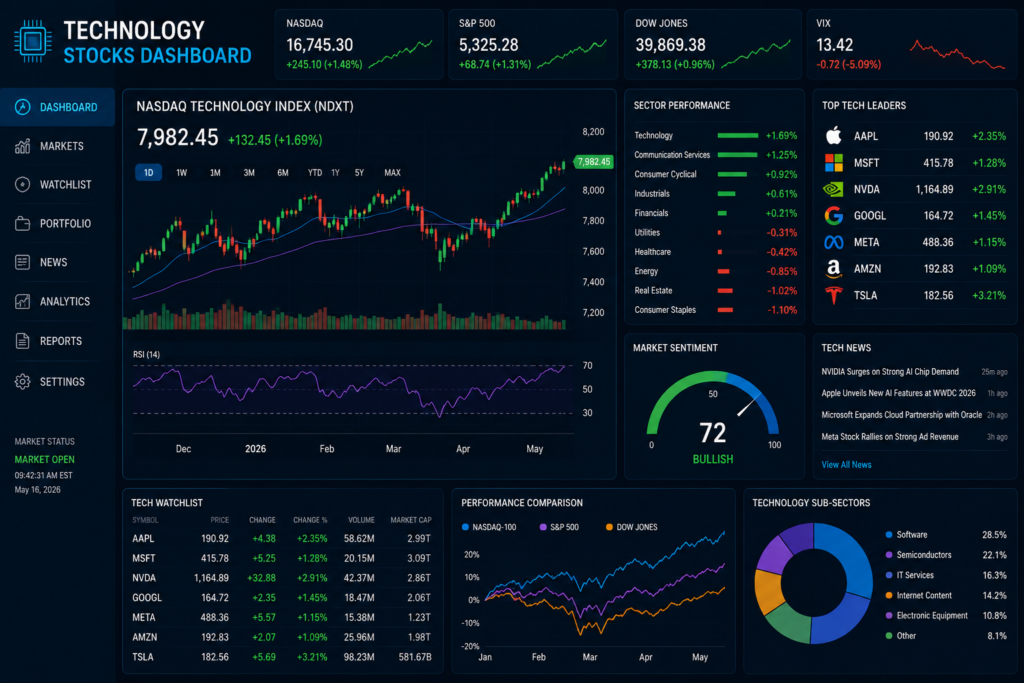
1. Technology Sector
Includes:
- Software companies
- Semiconductor manufacturers
- Cloud computing firms
- AI companies
Examples:
- Microsoft
- NVIDIA
- Adobe
Popular ETF examples:
- Technology Select Sector SPDR Fund
- Vanguard Information Technology ETF
Technology is usually considered a growth sector.
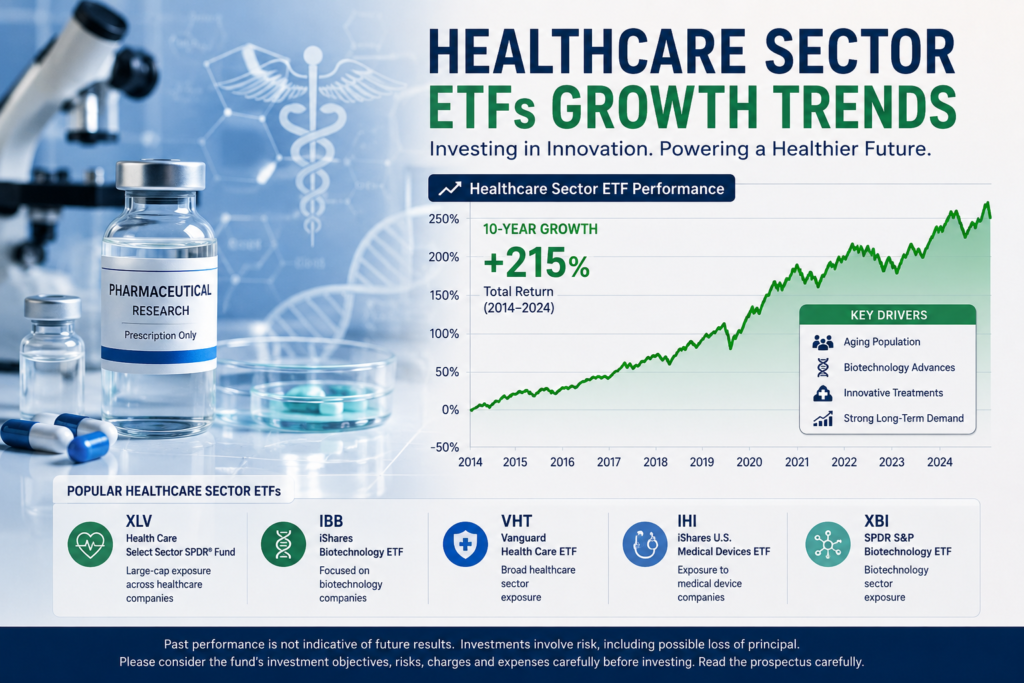
2. Healthcare Sector
Includes:
- Pharmaceutical companies
- Biotechnology firms
- Medical equipment makers
Examples:
- Johnson & Johnson
- Pfizer
- UnitedHealth Group
Healthcare is often considered defensive because people need medical care regardless of economic conditions.
3. Financial Sector
Includes:
- Banks
- Insurance companies
- Asset managers
Examples:
- JPMorgan Chase
- Goldman Sachs
Financials often perform well when:
- Interest rates rise
- Economy expands
- Lending increases
Financial-sector performance can be influenced by interest rates, lending activity, credit conditions, economic growth, and the shape of the yield curve.
4. Energy Sector
Includes:
- Oil companies
- Natural gas companies
- Energy infrastructure
Examples:
- ExxonMobil
- Chevron
Energy ETFs are heavily influenced by oil prices.
5. Consumer Discretionary Sector
Includes non-essential spending companies:
- Retail
- Travel
- Luxury goods
- Automobiles
Examples:
- Tesla
- Nike
- Amazon
These companies often perform best during strong economic periods.
6. Consumer Staples Sector
Includes essential products:
- Food
- Beverages
- Household products
Examples:
- Coca-Cola
- Procter & Gamble
These are considered defensive investments.
7. Industrials Sector
Includes:
- Aerospace
- Manufacturing
- Transportation
Examples:
- Boeing
- Caterpillar
8. Utilities Sector
Includes:
- Electricity providers
- Water companies
- Power infrastructure
Utilities are often stable and dividend-focused.
9. Real Estate Sector
Includes REITs (Real Estate Investment Trusts).
Examples:
- Commercial property owners
- Data center REITs
- Apartment REITs
10. Materials Sector
Includes:
- Mining companies
- Chemical manufacturers
- Metal producers
These are tied closely to global economic demand.
11. Communication Services Sector
Includes:
- Telecom companies
- Social media firms
- Streaming companies
Examples:
- Meta
- Netflix
Investors can also review an ETF provider’s current fund offerings, expense ratios, and sector-focused funds using the Vanguard ETF List.
How Sector ETFs Work
Sector ETFs usually track a sector index.
For example:
- A technology ETF tracks a technology index
- An energy ETF tracks energy companies
- A healthcare ETF tracks healthcare stocks
The ETF provider buys the underlying stocks and creates ETF shares for investors. For a practical industry explanation of ETF structures and sector exposure, see iShares’ guide to ETFs.
Passive vs Active Sector ETFs
Passive Sector ETFs
These follow indexes automatically.
Advantages:
- Lower fees
- Simpler strategy
- More transparency
Example:
A tech ETF tracking the Nasdaq technology index.
Active Sector ETFs
Fund managers actively select stocks.
Advantages:
- Potential to outperform
- Flexible management
Disadvantages:
- Higher fees
- Manager risk
Why Sector ETFs Can Be a Smart Move
Now let’s explore the advantages.
1. Targeted Exposure
Sector ETFs allow investors to focus on areas they believe will outperform.
Example:
An investor believes AI will dominate the future.
Instead of choosing individual AI stocks, they buy a technology ETF.
This reduces company-specific risk.
2. Diversification Within a Sector
Buying one stock is risky.
Example:
If you buy only Intel and it struggles, your investment suffers badly.
But a technology ETF spreads risk across many companies.
3. Easier Than Stock Picking
Choosing winning stocks is difficult.
Sector ETFs simplify investing.
Instead of researching 50 companies, investors buy one ETF.
4. Potential for High Returns
Certain sectors experience explosive growth.
Examples:
| Sector | Historical Boom |
|---|---|
| Technology | AI and cloud computing |
| Energy | Oil price surges |
| Healthcare | Pandemic demand |
| Communication | Internet expansion |
Sector ETFs can capture these megatrends.
5. Tactical Portfolio Management
Professional investors rotate between sectors depending on economic conditions.
This is called sector rotation.
Example:
| Economic Phase | Strong Sectors |
|---|---|
| Recession | Utilities, healthcare |
| Recovery | Industrials, financials |
| Expansion | Technology, consumer discretionary |
| Inflation | Energy, materials |
Sector ETFs make this strategy easy.
Understanding Sector Rotation
Sector rotation is based on the idea that different sectors perform differently during economic cycles.
For example:
During recessions:
- Consumers reduce spending
- Luxury businesses suffer
- Defensive sectors perform better
During growth periods:
- Technology expands
- Consumer spending rises
- Industrials grow
Professional investors constantly rotate capital. For additional explanations of market cycles and investing concepts, explore our market guides.
Case Study: Technology Sector Boom (2010–2021)
One of the greatest examples of sector ETF success was the technology boom.
Technology companies dominated global markets because of:
- Smartphones
- Cloud computing
- Artificial intelligence
- Digital advertising
- E-commerce
Major companies exploded in value:
| Company | Approximate Growth |
|---|---|
| Apple | Massive multi-trillion growth |
| Amazon | E-commerce dominance |
| Microsoft | Cloud computing leadership |
| NVIDIA | AI chip leadership |
Technology ETFs delivered enormous returns.
Investors who recognized long-term trends benefited greatly.
Case Study: Energy Sector Collapse (2014–2020)
Sector ETFs can also become dangerous.
The energy sector suffered major declines due to:
- Falling oil prices
- Oversupply
- Weak demand
- Pandemic shutdowns
Many energy companies lost huge value.
Energy ETFs underperformed badly during this period.
This demonstrates a critical truth:
Sector concentration increases risk.
Case Study: Healthcare During COVID-19
During the COVID-19 pandemic:
- Vaccine makers surged
- Medical demand exploded
- Biotech stocks rallied
Healthcare ETFs performed strongly because investors anticipated long-term healthcare spending growth.
The Biggest Risks of Sector ETFs
Now let’s discuss the dangers.
1. Concentration Risk
This is the largest risk.
A broad market ETF owns companies across all sectors.
A sector ETF focuses narrowly on one area.
If that sector struggles, the ETF may fall sharply.
Example:
- Technology crash in 2000
- Energy collapse in 2015
- Banking crisis in 2008
2. Volatility
Sector ETFs are often more volatile than diversified index funds.
Volatility means price swings.
Example:
A broad market ETF might fall 15%.
A concentrated sector ETF may fall 35%.
3. Timing Risk
Many investors buy sectors after massive rallies.
This creates performance chasing.
Example:
Buying technology ETFs during peak hype can lead to losses if valuations become excessive.
4. Economic Sensitivity
Some sectors depend heavily on economic conditions.
Examples:
| Sector | Sensitive To |
|---|---|
| Financials | Interest rates |
| Energy | Oil prices |
| Technology | Growth expectations |
| Real Estate | Borrowing costs |
Unexpected economic changes can hurt performance.
5. Regulatory Risk
Governments can heavily impact sectors.
Examples:
- Healthcare regulations
- Energy environmental rules
- Banking regulations
- Antitrust action against tech companies
6. Valuation Risk
Sometimes sectors become overpriced.
Investors may become overly optimistic.
This creates bubbles.
The Dot-Com Bubble: A Famous Warning
The late 1990s technology boom is one of history’s most important investing lessons.
Internet companies became extremely popular.
Technology stocks skyrocketed.
Many investors believed tech could only go higher.
Eventually:
- Valuations became irrational
- Profits were weak
- Speculation exploded
Then the bubble burst.
Technology-heavy investors suffered massive losses.
Some companies disappeared entirely.
This teaches a powerful lesson:
Even great sectors can become terrible investments at the wrong price.
Broad Market ETFs vs Sector ETFs
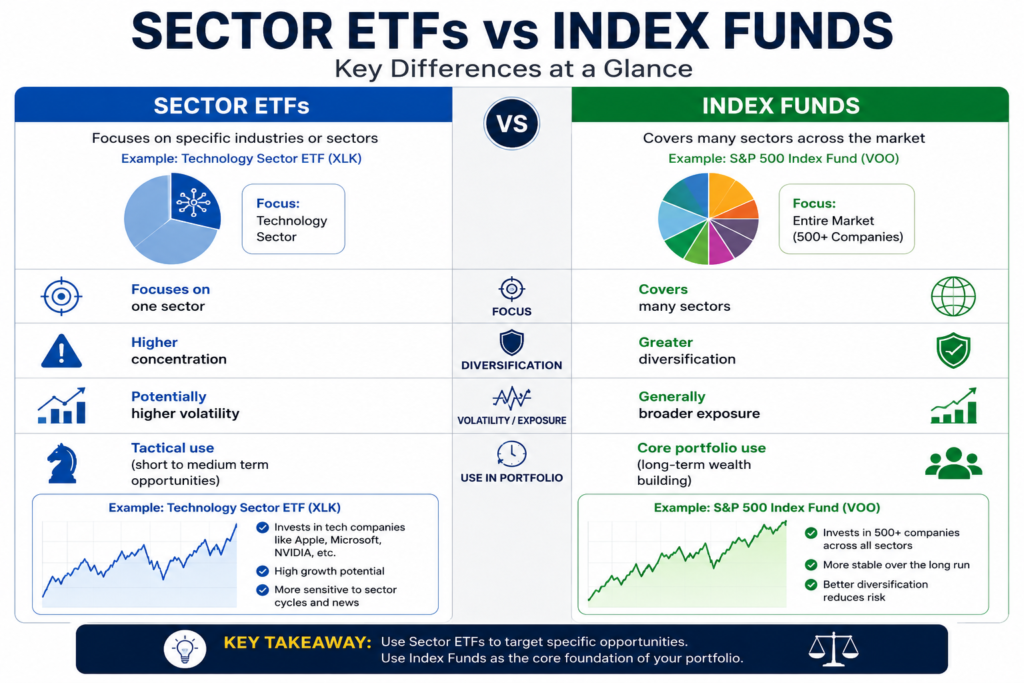
Broad Market ETF
Example:
S&P 500 ETF
Characteristics:
- Diversified
- Lower risk
- Long-term investing
- Stable exposure
If you’re comparing investment structures, see our guide to index funds vs ETFs for a deeper comparison.
Sector ETF
Characteristics:
- Concentrated exposure
- Higher risk
- Tactical investing
- Potentially higher returns
Investors researching individual ETFs can also use Morningstar ETF Research to review fund information and research data.
Which Is Better?
It depends on investor goals.
| Investor Type | Better Choice |
|---|---|
| Beginner | Broad market ETFs |
| Long-term retirement investor | Mostly broad index funds |
| Tactical investor | Sector ETFs |
| Aggressive growth investor | Select sector ETFs |
Smart Ways to Use Sector ETFs
Sector ETFs are most effective when used carefully.
Strategy 1: Satellite Investing
Many investors use a core-satellite strategy.
Example:
| Portfolio Part | Allocation |
|---|---|
| Broad market ETF | 80% |
| Sector ETFs | 20% |
This balances diversification with growth opportunities. A broader portfolio strategy can help investors determine how Sector ETFs fit alongside diversified investments and other asset classes.
Strategy 2: Long-Term Megatrends
Some sectors benefit from long-term structural changes.
Examples:
| Trend | Possible Sector |
|---|---|
| AI growth | Technology |
| Aging populations | Healthcare |
| Renewable energy | Clean energy |
| Data expansion | Communication services |
Investors considering these long-term trends can also explore our wealth-building strategy guide for a broader perspective on building wealth through investing.
Strategy 3: Economic Cycle Investing
Investors rotate sectors depending on macroeconomic conditions.
This requires more skill and monitoring.
Strategy 4: Defensive Positioning
During uncertainty, investors may shift into:
- Utilities
- Consumer staples
- Healthcare
These sectors are considered defensive because demand remains relatively stable.
What Are Defensive Sectors?
Defensive sectors usually perform better during recessions.
Why?
Because consumers still buy necessities:
- Food
- Electricity
- Healthcare
Even during economic downturns.
What Are Cyclical Sectors?
Cyclical sectors depend heavily on economic growth.
Examples:
- Travel
- Luxury goods
- Automobiles
- Industrials
These sectors may perform poorly during recessions.
Understanding Expense Ratios
Sector ETFs charge fees called expense ratios.
This fee is deducted annually.
Example:
| Expense Ratio | Cost on $10,000 |
|---|---|
| 0.10% | $10 per year |
| 0.50% | $50 per year |
Lower fees generally help long-term returns. Learn more about how ETF costs can affect long-term returns in our guide to ETF expense ratios. For additional information about ETF costs, trading,
and risks, see the SEC Investor Bulletin on ETFs.
Liquidity and Trading Volume
Good sector ETFs usually have:
- High trading volume
- Tight bid-ask spreads
- Large asset size
This improves trading efficiency.
Common Mistakes Investors Make
Mistake 1: Chasing Performance
Investors often buy sectors after strong rallies.
This can lead to buying at market tops.
Mistake 2: Ignoring Valuation
A great sector can still be overpriced.
Price matters.
Mistake 3: Overconcentration
Some investors put all money into one sector.
This creates huge risk.
Mistake 4: Emotional Investing
Fear and greed drive bad decisions.
Successful investors stay disciplined.
Sector ETFs and Retirement Investing
Should retirement investors use sector ETFs?
Possibly — but carefully.
A retirement portfolio usually prioritizes:
- Diversification
- Stability
- Long-term growth
Sector ETFs may work best as smaller additions rather than the portfolio core. For a broader approach to investing for retirement, see our guide to retirement investing.
International Sector ETFs
Sector ETFs are not limited to the United States.
Investors can buy international sector exposure.
Examples:
- European technology
- Asian semiconductors
- Emerging market banks
This increases diversification.
Are Thematic ETFs the Same as Sector ETFs?
Not exactly.
Sector ETFs
Focus on traditional economic sectors.
Example:
- Healthcare
- Technology
- Energy
Thematic ETFs
Focus on trends or themes.
Examples:
- Artificial intelligence
- Robotics
- Blockchain
- Clean energy
Thematic ETFs are usually even riskier.
Dividend Sector ETFs
Some sector ETFs focus on dividend income.
Examples:
- Utilities
- Energy pipelines
- Consumer staples
These may appeal to income-focused investors.
Growth vs Value Sector ETFs
Growth Sectors
Typically include:
- Technology
- Communication services
Characteristics:
- Higher growth potential
- Higher volatility
Value Sectors
Typically include:
- Financials
- Energy
- Industrials
Characteristics:
- Lower valuations
- Often more cyclical
Should Beginners Buy Sector ETFs?
Beginners should usually start with diversified broad-market ETFs.
Why?
Because sector ETFs require:
- Economic understanding
- Risk management
- Discipline
- Timing awareness
Beginners should also consider their broader personal finance situation, including financial goals, emergency savings, debt, and investment priorities.
Sector ETFs can still be useful in small allocations.
How Much Should You Allocate?
There is no universal answer.
General examples:
| Risk Level | Possible Sector ETF Allocation |
|---|---|
| Conservative | 5–10% |
| Moderate | 10–20% |
| Aggressive | 20–40% |
These percentages are for educational purposes only and are not universal recommendations. An appropriate Sector ETF allocation depends on an investor’s goals, time horizon, risk tolerance, and existing portfolio. Very high allocations increase concentration risk significantly.
Example Portfolio
The following portfolios demonstrate how Sector ETFs might be incorporated into different risk profiles. They are not personalized investment recommendations.
Conservative Investor
| Investment | Allocation |
|---|---|
| Broad market ETF | 85% |
| Healthcare ETF | 5% |
| Technology ETF | 10% |
Aggressive Investor
| Investment | Allocation |
|---|---|
| Broad market ETF | 50% |
| Technology ETF | 25% |
| Energy ETF | 10% |
| Healthcare ETF | 15% |
For more guidance on combining different investments, read our guide on how to build a diversified portfolio.
When Sector ETFs Work Best
Sector ETFs tend to work best when:
- A strong long-term trend exists
- Valuations are reasonable
- Economic conditions support the sector
- Investors remain diversified
When Sector ETFs Become Dangerous
They become dangerous when:
- Investors chase hype
- Valuations become extreme
- Portfolios become concentrated
- Risk management disappears
Final Verdict: Smart Move or Risky Bet?
The answer is:
Sector ETFs can be both.
They are smart tools when used strategically, carefully, and with diversification.
They become risky bets when investors:
- Concentrate too heavily
- Follow hype blindly
- Ignore valuations
- Attempt short-term speculation
For most investors, Sector ETFs work best as:
- Supplemental investments
- Tactical portfolio additions
- Controlled growth opportunities
Rather than replacing diversified core index investing.
Key Takeaways
- Sector ETFs invest in specific economic sectors.
- They provide targeted exposure and diversification within industries.
- Technology, healthcare, energy, and financials are popular sectors.
- Sector ETFs can outperform broad markets during strong sector trends.
- They also carry higher volatility and concentration risk.
- Economic cycles strongly affect sector performance.
- Broad market ETFs remain safer for most beginners.
- Sector ETFs are often best used as smaller portfolio additions.
Frequently Asked Questions About Sector ETFs
1. What are Sector ETFs?
Sector ETFs are exchange-traded funds that invest in companies within a specific economic sector, such as technology, healthcare, energy, or financials.
2. Are Sector ETFs risky?
Sector ETFs can have higher concentration risk because they focus on one sector, and their value can decline when that sector performs poorly.
3. Are Sector ETFs good for beginners?
Beginners may use Sector ETFs as a smaller part of a diversified portfolio rather than relying on them as their primary investment.
4. How much should I invest in Sector ETFs?
There is no universal allocation, as the appropriate amount depends on your goals, time horizon, risk tolerance, and existing portfolio.
5. What is the difference between a Sector ETF and a broad-market ETF?
A Sector ETF focuses on one economic sector, while a broad-market ETF provides exposure to companies across multiple sectors.
6. Can Sector ETFs outperform the market?
Yes, Sector ETFs can outperform broad-market investments when their underlying sector performs strongly, although past performance does not guarantee future results.
7. What are the most common types of Sector ETFs?
Common Sector ETFs focus on technology, healthcare, financials, energy, consumer discretionary, consumer staples, industrials, utilities, real estate, materials, and communication services.
8. How do Sector ETFs work?
Sector ETFs generally track an index or strategy designed to provide exposure to companies within a particular sector.
9. What are the benefits of Sector ETFs?
Sector ETFs provide targeted industry exposure, diversification among companies within a sector, and a simpler alternative to selecting individual stocks.
10. What is sector rotation?
Sector rotation is an investment strategy that shifts money between economic sectors based on changing economic conditions and market cycles.
11. Are Sector ETFs suitable for retirement portfolios?
Sector ETFs can be included in retirement portfolios, but diversification, risk tolerance, investment horizon, and overall asset allocation should be considered.
12. What are the biggest risks of Sector ETFs?
The biggest risks include concentration risk, volatility, timing risk, economic sensitivity, regulatory changes, and paying excessive valuations for popular sectors.
Conclusion
Sector ETFs are powerful investment tools.
They allow investors to participate in economic trends, technological revolutions, demographic changes, and global growth opportunities.
But power comes with responsibility.
A Sector ETF is not automatically safer simply because it contains many stocks. If all those stocks belong to the same struggling industry, losses can still be severe.
The most successful investors understand balance:
- Diversification
- Discipline
- Long-term thinking
- Risk management
- Proper allocation
Used wisely, Sector ETFs can enhance a portfolio and potentially improve returns.
Used recklessly, they can become speculative traps driven by hype and emotion.
The difference lies not in the ETF itself — but in how the investor uses it.
For more guidance on maintaining a long-term approach, see our guide to long-term investing.
Sources & References
- U.S. Securities and Exchange Commission — Investor.gov
- SEC Investor Bulletin — Exchange-Traded Funds
- Official ETF provider resources where individual funds are discussed
The SEC itself recommends investors review a fund’s available information, including its prospectus and shareholder report, before investing.
Disclaimer
Disclaimer: This article is for educational and informational purposes only and does not constitute personalized financial, investment, tax, or legal advice. Investing involves risk, including possible loss of principal. Consider your financial situation and consult a qualified financial professional before making investment decisions.
Stocks vs ETFs vs Mutual Funds: What’s Best for Long-Term Wealth? (Complete 2026 Guide)