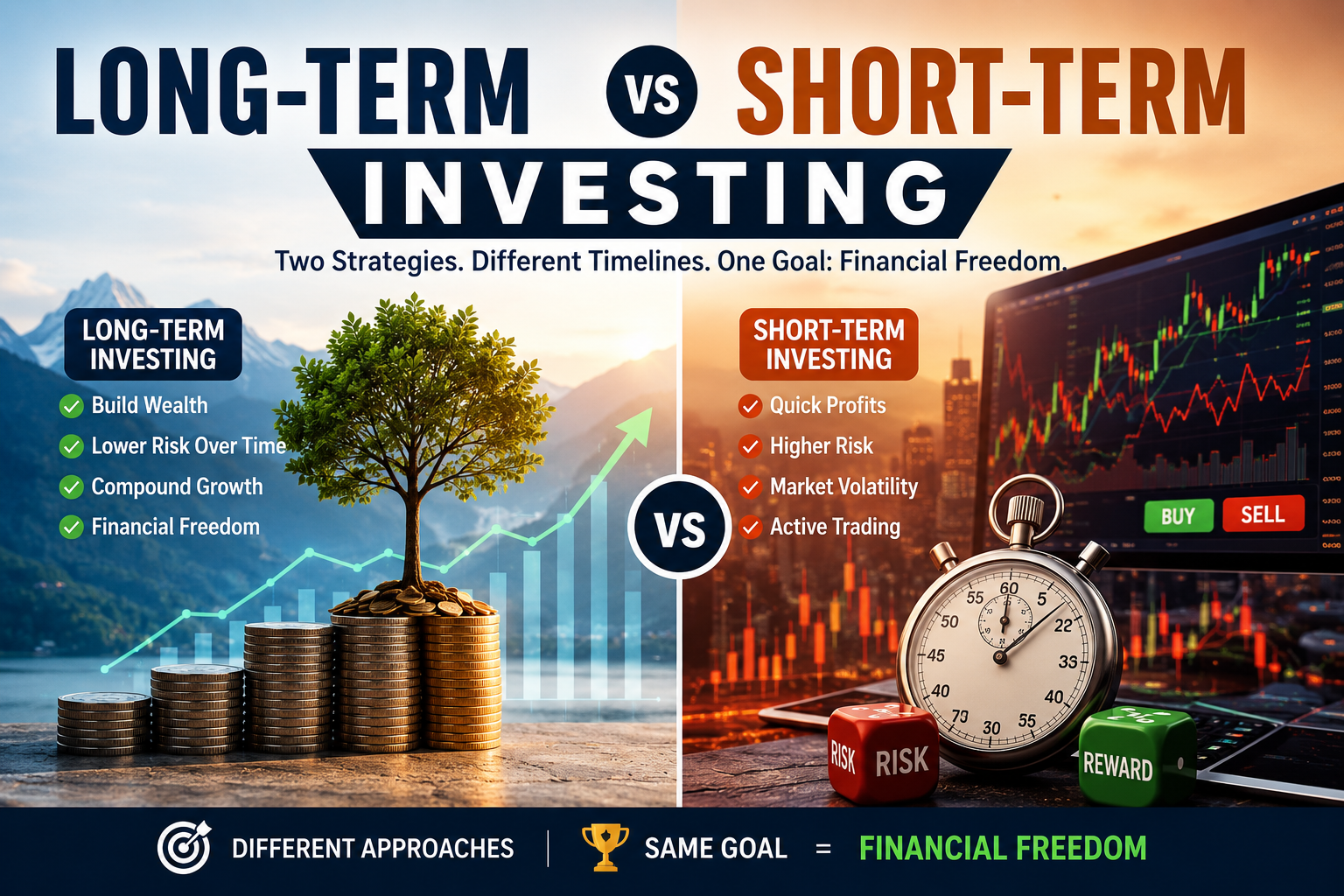
Long-Term vs Short-Term Investing
Long-Term vs Short-Term Investing is an important comparison for anyone who wants to build wealth, manage financial risk, and make informed decisions about money. Both strategies involve investing capital in the hope of earning a return, but they differ in holding period, investment objectives, risk management, costs, and the amount of time an investor must devote to research.
For investors in the United States, United Kingdom, Canada, and Australia, choosing an investment strategy also means considering local tax rules, retirement accounts, inflation, and personal financial goals.
Long-term investing generally focuses on growing wealth over several years or decades. Short-term investing focuses on opportunities over shorter periods, from days to months or a few years. Short-term trading is a more active approach that attempts to profit from price movements.
Neither strategy guarantees profits. A long investment horizon does not eliminate market risk, and a short holding period does not automatically make an investment safer.
This guide explains the essential terms, compares the two approaches, and examines documented market events alongside clearly labelled numerical illustrations.
What Is Investing?
Investing means committing money to an asset with the expectation of earning income, increasing its value, or achieving both outcomes.
Common investments include stocks, bonds, mutual funds, exchange-traded funds (ETFs), and real estate.
A stock represents an ownership interest in a company. Investors may earn returns through share-price appreciation and dividends, although share prices can fall and dividends can be reduced or discontinued.
A bond is a debt instrument through which an issuer borrows money and promises payments under specified terms. Bonds carry risks, including interest-rate risk, inflation risk, and the possibility that the issuer will fail to pay.
An ETF is an investment fund whose shares trade on an exchange. An ETF may hold hundreds of securities or focus on a narrow market segment. Not every ETF is diversified or low-risk.
Investment return measures the gain or loss on an investment over a specified period. Returns can include price changes, dividends, and interest, depending on the asset and the calculation method.
For example, an investment that costs $10,000 and later has a market value of $12,000 has an unrealised gain of $2,000, excluding distributions and costs. If the investor sells it at that value, the gain becomes realised for investment-record purposes, although the final taxable amount depends on the applicable tax rules.
For a broader introduction to the basics, read our guide to Investing for Beginners, which explains how to get started and understand common investment choices.
Understanding Investment Time Horizon
An investment time horizon is the length of time before an investor expects to need the money for a particular goal.
A short-term goal might involve saving for a house deposit within two years. A long-term goal might involve accumulating retirement savings over 30 years.
The appropriate investment depends partly on when the money will be needed and how much loss the investor could tolerate. The US Securities and Exchange Commission’s investor education website explains how time horizon, risk tolerance, and diversification affect asset allocation.
Reference: Investor.gov — Asset Allocation and Diversification.
There is no universal definition separating short-term from long-term investing. For this guide, short-term investing generally means holding investments for days to three years, while long-term investing means holding them for five years or longer. The period between three and five years can be treated as an intermediate horizon.
These are practical categories, not official rules. The correct timeframe depends on the financial goal and the asset involved.
What Is Short-Term Investing?
Short-term investing aims to generate returns over a relatively brief period. Some investors buy and sell securities actively, while others use short-term savings products to preserve money for an upcoming expense.
Short-term stock trading attempts to benefit from price movements influenced by company announcements, economic reports, interest rates, investor sentiment, and market volatility.
Market volatility describes the extent to which an asset’s price fluctuates. Greater volatility can create trading opportunities, but it can also increase the risk of sudden losses.
Types of Short-Term Investing
1. Day Trading
Day trading involves opening and closing a position during the same trading day. Traders may analyse price charts, trading volume, and market news to identify opportunities.
For example, a trader buys 100 shares at $50 each and sells them at $52. The gross gain is $200 before transaction costs, taxes, and any other charges. If the price falls instead, the trader may incur a loss.
Leverage, which means using borrowed funds or margin to increase market exposure, can magnify both gains and losses.
Day trading is not a dependable shortcut to wealth. It requires discipline, a tested process, risk controls, and the ability to absorb losses. The SEC provides a useful explanation of day trading and margin risks.
2. Swing Trading
Swing trading involves holding positions for several days or weeks to capture a potential price movement.
A trader might buy a share after researching a possible recovery and plan to sell if the price reaches a target. However, the expected movement may never occur. A disappointing earnings report or unexpected economic announcement can cause a price gap that exceeds the trader’s intended risk limit.
Swing trading requires a clear entry plan, an exit strategy, position sizing, and an understanding of trading costs.
3. Momentum Investing
Momentum investing seeks to benefit from an existing price trend. A momentum strategy may favour assets whose prices have been rising relative to other investments or their own past performance.
Momentum can persist, but it can also reverse abruptly. Investors who purchase an asset simply because its price has increased may buy near a temporary peak.
Momentum strategies should therefore use explicit risk limits rather than assuming that a rising price will continue rising.
4. Short-Term Bond Investing
Short-term bonds and cash-equivalent products may suit investors saving for near-term expenses.
Examples include Treasury bills, eligible money market funds, and bank certificates of deposit in the United States. Comparable products and government securities exist in other countries.
These products are not interchangeable. A bank deposit may qualify for deposit protection subject to local rules, while a money market fund is an investment and can carry risks. A bond fund’s market value can decline even when it holds relatively short-maturity bonds.
For money needed soon, capital preservation and access to cash may be more important than seeking the highest possible return.
Readers who want to understand how share prices and market movements work can explore our guide to Stock Market Investing.
What Is Long-Term Investing?
Long-term investing involves holding suitable investments for many years to pursue goals such as retirement, financial independence, or future family expenses.
The strategy often relies on owning diversified assets, making regular contributions, controlling costs, and avoiding unnecessary trading.
Long-term investors may hold stocks, bonds, index funds, ETFs, or a combination of investments suited to their circumstances.
A long holding period can give an investor more time to recover from market declines, but recovery is never guaranteed. Individual companies can fail, entire markets can underperform, and inflation can reduce the purchasing power of future wealth.
The Power of Compounding
Compounding occurs when investment returns remain invested and subsequently generate additional returns.
Suppose an investor places $10,000 into an investment that earns a hypothetical 8% annual return, compounded annually, for 30 years. The future value would be approximately $100,627 before fees, taxes, and inflation.
The calculation assumes a constant return, which real investments do not deliver. Actual returns fluctuate and may be negative in some years.
Compounding is powerful because returns can accumulate on both the original investment and earlier returns. Regular contributions can add another source of growth.
For more information, see Investor.gov’s introduction to investing, which explains compound growth, investing time horizons, and risk.
Compounding is one part of a broader financial plan; our Wealth Building guide explores other principles for growing wealth over time.
Types of Long-Term Investing
1. Buy-and-Hold Investing
Buy-and-hold investing involves purchasing investments and keeping them for an extended period, provided they remain appropriate for the investor’s goals.
It can reduce the number of trades and the temptation to react to every market headline. However, it does not mean holding every asset forever. Investors may need to sell when their goals change, a portfolio becomes unbalanced, or an investment’s underlying prospects deteriorate.
2. Index Investing
Index investing involves using a fund designed to track a market index. The S&P 500, for example, represents a selection of large US companies rather than the entire global stock market.
An index fund can provide exposure to many securities through a single holding. Its diversification depends on the index it follows, and it remains exposed to the risks of the underlying market.
Index funds can be used for long-term investing, but an index fund is not guaranteed to outperform every actively managed fund or produce positive returns over every period.
Learn more about fund structures, diversification, and index-tracking investments in our guide to ETFs and Index Funds.
3. Dividend Investing
Dividend investing focuses on shares of companies that distribute part of their earnings or other available funds to shareholders.
A dividend is a payment made to shareholders. Investors may spend the income or reinvest it to purchase additional shares.
Dividend payments are not guaranteed, and a high dividend yield can sometimes reflect a falling share price or concerns about the company’s financial position. Total return, rather than dividend yield alone, is a more complete way to evaluate performance.
4. Retirement Investing
Retirement investing involves building assets to support future living expenses.
Examples of relevant arrangements include 401(k) plans and individual retirement accounts in the United States, registered retirement savings plans (RRSPs) in Canada, individual savings accounts (ISAs) and pensions in the United Kingdom, and superannuation in Australia.
These arrangements have different contribution rules, tax treatments, withdrawal restrictions, and eligibility requirements. Investors should consult the relevant national tax authority and plan documentation rather than assume that the same rules apply in every country.
Key Differences Between Long-Term and Short-Term Investing
| Factor | Short-Term Investing | Long-Term Investing |
|---|---|---|
| Time horizon | Days to a few years | Usually five years or longer |
| Main objective | Short-period gains or capital preservation | Long-term growth or future income |
| Trading frequency | Often frequent for active traders | Usually less frequent |
| Research | May emphasise prices, news, and momentum | Often emphasises fundamentals, diversification, and goals |
| Costs | Can rise with frequent trading | Often lower when turnover is limited |
| Tax treatment | Depends on the country, asset, and activity | Depends on the country, account, asset, and holding period |
| Risk | Short-term price movements can be difficult to manage | Long horizons do not eliminate loss or inflation risk |
| Time commitment | Can be substantial for active trading | Often lower for a disciplined passive strategy |
| Compounding | Possible, but gains may be withdrawn or offset by losses | Reinvested returns may accumulate over time |
The key distinction is not that one strategy is always safe and the other is always risky. It is whether the strategy, asset selection, and timeframe fit the investor’s objectives.
Understanding Risk
Investment risk is the possibility that an investment will lose value, deliver lower returns than expected, or fail to meet a financial goal.
Risk tolerance refers to an investor’s willingness to accept losses. Risk capacity refers to the financial ability to withstand those losses without compromising essential goals. A person may be psychologically comfortable with volatility but lack the financial capacity to take substantial risks.
Market Volatility Explained
Share prices can rise and fall sharply over short periods. A diversified portfolio may reduce the impact of problems at a single company, but it cannot eliminate broad market risk.
Long-term investors should distinguish between temporary price declines and permanent impairment of an investment’s value. That distinction is not always clear in real time, so diversification and an appropriate asset allocation are important.
Historical Market Performance
Broad stock markets have produced positive long-run returns over many historical periods, but the result depends on the market, dates, currency, inflation adjustment, and whether dividends are included.
Historical averages are not forecasts. An investor may experience a major loss just before needing the money, even after holding an investment for many years.
A sound investment plan should therefore avoid relying on a single assumed annual return.
Taxes and Investing
Taxes affect the amount of investment return an investor ultimately keeps.
Short-Term Capital Gains
A capital gain is generally the profit realised when an asset is sold for more than its adjusted cost, subject to the relevant tax rules.
Some jurisdictions tax gains differently according to the holding period. Others consider the nature of the asset, account type, taxpayer circumstances, or whether trading amounts to a business.
Long-Term Capital Gains
Certain jurisdictions provide preferential tax treatment for qualifying long-term capital gains. However, these rules differ substantially.
In the United States, the distinction between short-term and long-term capital gains generally depends on whether a qualifying capital asset was held for one year or less or for more than one year. Other countries use different systems.
Do not assume that a long-term investment always receives a lower tax rate. Check current guidance from the IRS, HMRC, the Canada Revenue Agency, or the Australian Taxation Office as appropriate. For US investors, the U.S. Securities and Exchange Commission provides regulatory information and investor resources. For tax-specific rules, consult the relevant tax authority, such as the IRS, HMRC, Canada Revenue Agency, or Australian Taxation Office.
Emotional Psychology in Investing
Investing decisions are influenced by emotions as well as financial information.
Fear
Fear can lead an investor to sell during a downturn without reviewing whether the original investment plan remains appropriate.
Greed
Greed can encourage excessive risk-taking when markets are rising and recent profits appear easy to achieve.
FOMO (Fear of Missing Out)
FOMO occurs when investors buy an asset because they see other people reporting profits. It can encourage purchases without sufficient research or a clear exit plan.
A written investment plan, suitable diversification, and predetermined review intervals can help reduce impulsive decisions.
Case Study 1: Long-Term Investor
Consider a clearly labelled illustrative example.
Sarah begins investing at age 25. She contributes $500 at the end of each month to a diversified portfolio and continues until age 65.
Assume a hypothetical 7% effective annual return, with monthly compounding at the equivalent monthly rate. Under these assumptions, the portfolio could grow to approximately $1.2 million before fees, taxes, and inflation.
Sarah’s total contributions would be $240,000 over 40 years. The remainder of the projected balance would represent investment growth.
This is a mathematical illustration, not a documented individual’s result or a forecast. Actual market returns are variable, and a real portfolio could end with substantially more or less money.
The lesson is that starting early, contributing consistently, and allowing returns to compound can help build wealth over time.
Case Study 2: Short-Term Trader
Michael is a fictional Canadian trader who allocates $10,000 to a short-term trading account.
He makes several trades based on price trends and company announcements. Some trades produce profits, while others result in losses. Commissions, bid-ask spreads, and taxes reduce his final results.
If he makes a series of profitable trades, he may outperform a benchmark during that period. If a market reversal occurs, his account could lose value quickly.
This illustration does not establish that short-term traders generally lose or that long-term investors always win. It demonstrates why traders must measure results after all costs and compare them with an appropriate benchmark.
The important question is not whether a trader had one profitable trade, but whether the complete strategy produces satisfactory risk-adjusted returns over time.
Why Many Professionals Prefer Long-Term Investing
A long-term approach can be practical because it allows investors to focus on financial goals instead of predicting every daily price movement.
Lower turnover may reduce transaction costs and unnecessary taxable events. Diversification can reduce exposure to individual companies, and regular contributions can encourage discipline.
However, professionals use many strategies, including active trading, market-making, and short-term risk management. No single holding period is appropriate for every investor or institution.
Understanding Fundamental Analysis
Fundamental analysis examines an investment’s underlying economic or business characteristics.
For a company, it may involve:
- Revenue: money generated from selling products or services.
- Earnings: profit after relevant expenses.
- Debt: obligations the company must repay.
- Cash flow: cash generated and used by the business.
- Valuation: the price investors pay relative to measures such as earnings or cash flow.
- Competitive advantage: characteristics that may help a business defend its market position.
Fundamental analysis can support long-term decisions, although business performance and share prices can still disappoint.
Understanding Technical Analysis
Technical analysis studies price movements, trading volume, chart patterns, and indicators in an attempt to assess market behaviour.
Traders may use support levels, resistance levels, and momentum indicators to structure decisions. These tools do not guarantee the direction of future prices and can generate misleading signals.
Technical analysis should not replace risk controls or an understanding of the potential loss.
Liquidity Explained
Liquidity describes how easily an asset can be bought or sold without materially affecting its price.
Cash in an accessible bank account is generally more liquid than property. A heavily traded stock may be easier to sell quickly than an investment in a thinly traded security.
Investors should consider both market liquidity and withdrawal restrictions when selecting investments for near-term goals.
Diversification
Diversification means spreading money across different investments to reduce reliance on any single holding.
A diversified portfolio might include domestic and international equities, high-quality bonds, and cash reserves, depending on the investor’s needs.
Diversification does not guarantee a profit or prevent losses during a broad market decline. Funds that concentrate on one industry or theme may be less diversified than their names suggest.
See Investor.gov’s guide to diversification and asset allocation.
Inflation and Investing
Inflation is the general increase in prices over time. It reduces the purchasing power of money.
If prices rise by 3% per year, something that costs $100 today would cost approximately $134 after 10 years if that inflation rate continued.
Cash may be suitable for near-term needs, but its purchasing power can decline when interest earned is below inflation after taxes. Investments can potentially outpace inflation, but returns are uncertain and losses are possible.
Interest Rates and Investing
Central banks, including the US Federal Reserve and the Bank of England, influence financial conditions through monetary policy.
Higher interest rates can make borrowing more expensive and can affect company valuations. They may also increase yields available on newly issued bonds and savings products.
The actual market response depends on expectations, economic conditions, and what investors have already priced in. Interest-rate changes do not cause every stock or bond to move in the same direction.
Advantages of Long-Term Investing
1. Compound Growth
Reinvested returns can generate further returns, potentially increasing wealth over a long period.
2. Lower Stress
A clearly defined long-term plan may reduce the need to react to every market fluctuation.
3. Lower Costs
Fewer transactions can reduce commissions and trading-related costs, although fund management fees still matter.
4. Better Tax Efficiency
Longer holding periods may improve tax efficiency in some jurisdictions, but the benefit depends on local law and the type of account and asset.
5. Simplicity
A diversified portfolio of low-cost funds may require less daily attention than an active trading strategy.
Disadvantages of Long-Term Investing
1. Requires Patience
Building wealth often takes years. Long-term investing is not a solution for someone seeking a guaranteed quick profit.
2. Temporary Market Declines
A portfolio can lose substantial value during a downturn. Recovery may take years, and some investments never recover.
3. Opportunity Cost
Money committed to one investment cannot simultaneously be used for every other opportunity. Poor asset selection can leave a long-term investor behind a suitable benchmark.
Advantages of Short-Term Investing
1. Faster Profit Potential
A successful trade can generate a gain over a short period, although the possibility of quick losses is equally important.
2. Flexibility
Active traders can adjust positions as their market outlook or circumstances change.
3. Potential to Benefit From Falling Markets
Certain strategies, including properly managed short selling, can potentially profit when prices fall. These strategies can be complex and may expose investors to substantial or theoretically unlimited losses, depending on the position.
Disadvantages of Short-Term Investing
1. High Stress
Rapid price changes and frequent decisions can create emotional pressure.
2. High Risk
Unexpected news, poor timing, leverage, and concentrated positions can produce significant losses.
3. Taxes and Fees
Frequent trading can increase spreads, commissions, and tax complexity. The actual tax effect depends on local rules.
4. Requires Expertise
Active trading requires research, disciplined execution, record-keeping, and an honest assessment of performance after costs.
Risk Management
Risk management means identifying and controlling the risks that could prevent an investor from reaching a financial goal.
Useful practices include:
- Diversifying across suitable investments.
- Limiting the amount exposed to a single position.
- Maintaining emergency savings outside volatile investments.
- Understanding leverage before using it.
- Reviewing investments against a defined objective.
- Avoiding money needed for essential expenses in speculative trades.
Stop-loss orders may help manage certain risks, but they cannot guarantee an execution price during a rapid market move or a price gap. Investors can also consult FINRA’s investor education resources for additional information about investment risks, trading, and protecting themselves as investors.
Asset Allocation
Asset allocation is the distribution of a portfolio among asset classes such as stocks, bonds, and cash.
A hypothetical portfolio might hold 60% equities, 30% bonds, and 10% cash. This is an illustration, not a universal recommendation. The appropriate allocation depends on the investor’s goals, time horizon, financial capacity, and tolerance for losses.
Rebalancing means bringing the portfolio back toward its intended allocation after market movements change the proportions. To understand how different investments can work together, read our guide to Portfolio Strategy.
Dollar-Cost Averaging
Dollar-cost averaging involves investing a fixed amount at regular intervals regardless of short-term price movements.
For example, an investor might contribute $200 every month to an eligible investment fund.
When prices are lower, the fixed contribution buys more units; when prices are higher, it buys fewer. This approach can support regular investing, but it does not guarantee a profit or prevent losses.
Passive vs Active Investing
Passive Investing
Passive investing seeks to track a market index or follow a rules-based strategy, often through an index fund or ETF. Costs and tracking differences still affect performance.
Active Investing
Active investing involves selecting securities or adjusting positions in an attempt to achieve a particular result, such as outperforming a benchmark or managing a specific risk.
Active management can be long-term or short-term. The distinction between active and passive investing is different from the distinction between short-term and long-term investing.
ETFs and Mutual Funds
ETFs (Exchange-Traded Funds)
ETFs trade on exchanges and may track an index or follow an active strategy. Investors should review fees, holdings, liquidity, and the fund’s investment objective.
Mutual Funds
Mutual funds pool money from investors to purchase a portfolio of assets. They may be actively managed or index-tracking, and their fees and trading arrangements vary.
Neither structure is automatically safer. The assets held by the fund are central to understanding its risk.
Retirement Planning
Retirement planning usually involves setting a target, estimating future expenses, and investing according to a long-term plan. For more information about preparing financially for retirement, see our Retirement Investing guide.
Investors should account for inflation, expected retirement income, healthcare costs, taxes, and the possibility of living longer than expected.
The investment mix may need to change as retirement approaches. However, retirees may still need growth assets because retirement can last decades.
Wealth Building Example
Compare two hypothetical investors.
Investor A begins investing at age 25 and contributes $300 monthly for 40 years.
Investor B begins at age 35 and contributes $300 monthly for 30 years.
Assume both earn a hypothetical 7% effective annual return, with monthly contributions and equivalent monthly compounding. Investor A would accumulate approximately $790,000, while Investor B would accumulate approximately $366,000.
These estimates are rounded and exclude taxes, fees, and inflation. They are illustrations, not guaranteed outcomes.
The comparison shows how an earlier start can provide more time for compounding when contribution amounts and assumed returns are otherwise equal.
Market Crashes and Recovery
Market crashes demonstrate why investors need to prepare for volatility before it occurs.
The dot-com bust in the early 2000s, the 2008 global financial crisis, and the COVID-19 market shock in 2020 all affected asset prices and investor confidence.
Different markets and investments experienced different losses and recovery periods. A broad index’s recovery does not mean every company or portfolio recovered at the same time. For more explanations of financial markets and investing concepts, browse our Market Guides.
Case Study 3: The 2008 Financial Crisis
The 2008 financial crisis followed severe stress in housing and credit markets and spread through the global financial system.
The S&P 500 suffered a major decline during the crisis. Investors who needed cash during the downturn faced a different situation from investors who had a long horizon and could remain invested.
A disciplined long-term investor with a diversified portfolio and adequate emergency reserves could continue following a suitable plan, while someone who needed to sell shares to pay immediate expenses might have had little choice but to realise losses.
This is a historical lesson, not proof that every investor who holds through a crash will recover. Recovery depends on the investment, purchase price, time period, and subsequent returns.
When Short-Term Investing May Be Appropriate
Short-term strategies may be relevant when an investor understands the risks, has a defined strategy, can afford potential losses, and does not rely on speculative gains for essential expenses.
For money needed soon, the priority is usually liquidity and capital preservation rather than aggressive trading. A suitable savings account, deposit, or short-duration instrument may be more appropriate than volatile equities.
When Long-Term Investing May Be Appropriate
Long-term investing may suit retirement savings, future education costs, and wealth accumulation when the investor has time to withstand fluctuations.
The strategy should be diversified, cost-conscious, and aligned with a realistic financial goal. Long-term investing is not a reason to ignore a deteriorating investment or avoid reviewing a portfolio.
Hybrid Investing Strategies
Some investors maintain a core long-term portfolio and allocate a smaller, clearly limited amount to active opportunities.
For example, an investor might place most of their investment assets in diversified long-term holdings while using a separate small allocation for active trading.
An 80/20 split is sometimes used as an illustration, but it is not suitable for everyone. The appropriate proportions depend on personal circumstances, and the active allocation should not jeopardise essential goals.
Technology and Modern Investing
Digital brokerages, robo-advisers, fractional shares, and online research tools have made investing more accessible.
However, easier access can encourage overtrading. Investors should understand fees, product risks, platform protections, and the difference between educational content and personalised financial advice.
Common Mistakes in Short-Term Investing
Overtrading
Frequent trading can increase costs and lead to decisions driven by boredom or excitement rather than a sound process.
Emotional Decisions
Buying out of excitement or selling out of panic can undermine a strategy.
Ignoring Risk Management
Concentrating too much money in one position or using excessive leverage can expose a trader to losses that are difficult to recover from.
Common Mistakes in Long-Term Investing
Lack of Diversification
Relying on one company, sector, or country can create unnecessary concentration risk.
Panic Selling
Selling solely because prices fall can turn a temporary decline into a realised loss, although selling may be appropriate when an investment no longer suits the investor’s circumstances.
Unrealistic Expectations
Assuming that investments will deliver the same return every year can lead to poor planning. Actual returns vary and may be negative for extended periods.
Understanding Return on Investment (ROI)
Return on investment (ROI) measures the gain or loss relative to the original investment cost.
The basic formula is:
ROI = (Investment value − Investment cost) ÷ Investment cost × 100%
For example, an investment bought for $1,000 and sold for $1,200 produces a 20% gross ROI before costs and taxes.
ROI does not show how long the investment took to produce the return. Annualised return can be more useful when comparing investments held for different periods.
The Importance of Financial Goals
An investment strategy should follow the goal rather than the latest market trend. Setting investment goals also requires managing everyday money decisions, which we cover in our Personal Finance guide.
| Financial goal | General approach to consider |
|---|---|
| Emergency expenses | Accessible savings |
| Home deposit needed soon | Lower-volatility savings or suitable short-duration products |
| Retirement decades away | Diversified long-term portfolio |
| Long-term wealth accumulation | Regular investing and cost control |
| Active trading | A limited, risk-controlled strategy using money that can be lost |
These are general categories, not individual recommendations. The right choice depends on the investor’s country, tax situation, liquidity needs, and risk capacity.
Economic Cycles and Investing
Economic cycles include expansion, slowing growth, recession, and recovery. These phases can affect company profits, interest rates, employment, and market sentiment.
Short-term traders may attempt to respond to economic announcements. Long-term investors may focus on whether their portfolio remains suitable across different conditions.
Economic cycles are difficult to predict accurately, which is one reason investors should avoid building a financial plan around a single forecast.
Behavioral Finance
Behavioral finance studies how psychological tendencies affect financial decisions.
Common biases include:
- Confirmation bias: favouring information that supports an existing belief.
- Herd mentality: copying other investors without independent analysis.
- Loss aversion: feeling the pain of a loss more strongly than the pleasure of a comparable gain.
- Overconfidence: believing one’s predictions are more accurate than they really are.
Recognising these biases can help investors create more consistent decision-making rules.
The Role of Patience
Patience does not mean ignoring financial risks. It means giving a well-designed strategy sufficient time to work while continuing to monitor costs, diversification, and changing circumstances.
A long-term investor should periodically check whether the portfolio still matches the goal. A short-term trader should evaluate results across a meaningful sample of trades rather than judge a strategy from one win.
Final Comparison
| Feature | Long-Term Investing | Short-Term Investing |
|---|---|---|
| Primary focus | Future wealth and financial goals | Near-term opportunities or liquidity |
| Time commitment | Often lower for passive strategies | Often higher for active trading |
| Compounding | Can play a major role | Depends on returns, costs, and reinvestment |
| Risk | Market losses remain possible | Rapid losses and trading risks can be significant |
| Costs | May be lower with limited turnover | Can be higher with frequent trading |
| Best starting point | A clear goal and suitable diversified portfolio | A tested plan and strict risk limits |
Conclusion
Long-Term vs Short-Term Investing is not a contest with one winner for every person. The right approach depends on when the money is needed, how much risk the investor can bear, and whether the strategy supports the financial goal.
Long-term investing can provide time for compounding and reduce the need for frequent trading. Short-term investing can offer flexibility, but active trading demands discipline and can expose investors to substantial losses.
For many people building retirement savings or long-term wealth, a diversified, cost-conscious investment plan may be a practical starting point. Money needed soon generally deserves a more conservative approach than money that can remain invested for decades.
Successful investing is not about predicting every market movement. It is about setting realistic goals, understanding risk, controlling costs, and following a strategy that can withstand changing market conditions.
Financial education disclaimer: This article is for informational and educational purposes only. It does not constitute personalised financial, investment, or tax advice. Investment values can rise or fall, and investors may lose money. Tax rules vary by jurisdiction; consult official guidance or a qualified professional where appropriate.
Frequently Asked Questions
1. What is the main difference between long-term and short-term investing?
Long-term investing generally aims to build wealth over years or decades. Short-term investing seeks results over a shorter period, which may involve active trading or preserving money for a near-term goal.
2. Is long-term investing safer than short-term investing?
Not automatically. A longer horizon may give a diversified portfolio more time to recover from declines, but losses can persist. Short-term trading carries additional risks related to timing, costs, and rapid price movements.
3. How much money do I need to start long-term investing?
The minimum depends on the investment platform, fund, and country. Some platforms offer fractional shares or funds with relatively low minimums. Before investing, consider high-interest debt, emergency savings, fees, and your financial goals.
4. Can beginners use short-term investing strategies?
Beginners can learn about short-term strategies, but active trading is difficult and can result in substantial losses. It is sensible to understand market mechanics, practise with a simulated portfolio, and avoid using borrowed money or essential savings.
5. How does compound growth help long-term investors?
Compound growth allows returns to generate additional returns when they remain invested. Over time, this can contribute substantially to portfolio growth, although actual returns are variable and are reduced by applicable costs, taxes, and inflation.
6. Should I sell my investments when the stock market falls?
A market decline alone does not determine the right action. Review your time horizon, cash needs, diversification, and investment thesis. Selling may be appropriate if your circumstances or the investment’s prospects have changed, but panic-selling can undermine a suitable long-term plan.
7. Are ETFs suitable for long-term investing?
Some ETFs are useful for long-term portfolios because they offer convenient access to diversified holdings. However, ETFs vary widely. Check their underlying assets, concentration, fees, liquidity, and investment objectives before deciding whether they fit your plan.
8. Does long-term investing always pay less tax?
No. Tax treatment depends on the country, asset, account type, holding period, and individual circumstances. Some jurisdictions offer favourable treatment for certain long-term gains, but the rules are not universal.
9. Can I combine long-term investing with short-term trading?
Yes. Some investors keep a core portfolio for long-term goals and use a separate, limited allocation for active trading. The trading allocation should not endanger emergency reserves, retirement objectives, or other essential financial needs.
10. How often should I review my investment portfolio?
Review it periodically and when important circumstances change, such as a new financial goal, a change in income, or a major shift in asset allocation. Frequent checking is not necessarily helpful if it encourages impulsive decisions.