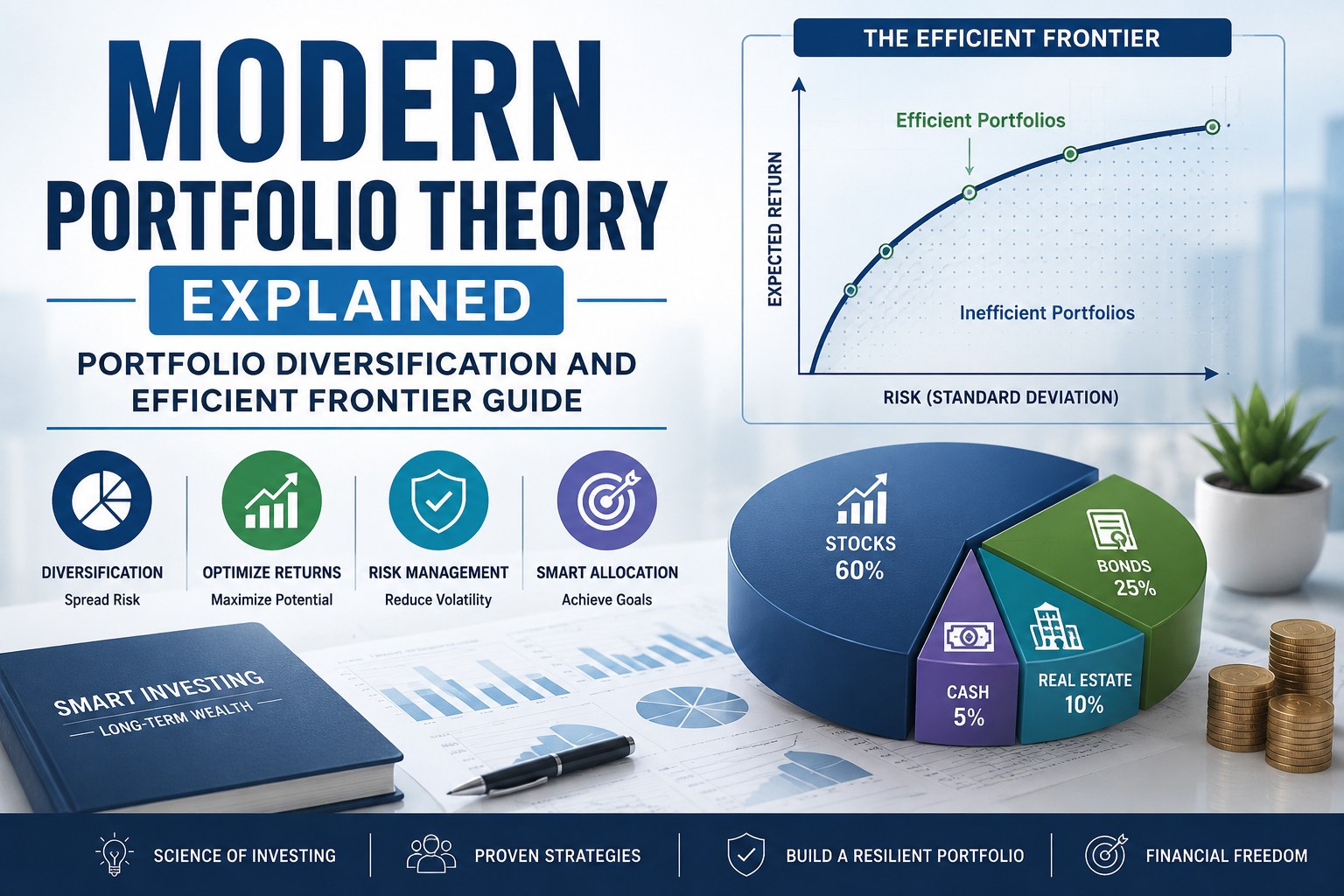
Modern Portfolio Theory Explained
Modern Portfolio Theory Explained is one of the most important concepts in modern investing and portfolio management. Developed by Harry Markowitz, this framework helps investors maximize returns while minimizing risk through diversification, asset allocation, and portfolio optimization.
Before MPT, many investors focused only on choosing the “best” investments. Markowitz showed that the real key to long-term investing success is not just picking good assets individually, but combining them intelligently.
Today, MPT is used by pension funds, hedge funds, financial advisors, robo-advisors, retirement planners, and individual investors across the United States, United Kingdom, Canada, Australia, and other developed economies.
This article explains Modern Portfolio Theory in detail, including:
- What MPT means
- Important investing terms
- Risk vs return
- Diversification
- Correlation
- Efficient Frontier
- Asset allocation
- Portfolio optimization
- Real-world examples
- Historical case studies
- Criticisms of MPT
- How investors use MPT today
What Is Modern Portfolio Theory?
Modern Portfolio Theory is an investment framework that helps investors maximize expected returns while minimizing risk through diversification.
The core idea is simple:
A portfolio should not be judged by individual investments alone. Instead, investors should evaluate how all investments work together.
For example:
- Owning only technology stocks may produce high returns, but also high volatility.
- Combining technology stocks with bonds, international stocks, and real estate may lower overall portfolio risk while maintaining attractive returns.
MPT teaches that:
- Risk is unavoidable
- Diversification reduces unnecessary risk
- Different assets behave differently
- Portfolio construction matters more than stock picking alone
Understanding the Basic Terms
Before understanding MPT deeply, investors must understand several key financial terms.
What Is a Portfolio?
A portfolio is the collection of investments owned by an investor.
A portfolio may contain:
- Stocks
- Bonds
- ETFs
- Mutual funds
- Real estate
- Commodities
- Cash
Example:
A retirement portfolio in the United States may include:
- 60% U.S. stock index funds
- 20% international stocks
- 15% bonds
- 5% REITs
That combination is called an asset allocation.
What Is Return?
Return refers to the profit or loss generated by an investment.
Formula:
\text{Return} = \frac{\text{Ending Value} – \text{Beginning Value}}{\text{Beginning Value}} \times 100
Example:
If an investor buys shares worth $10,000 and the portfolio grows to $11,000:
- Profit = $1,000
- Return = 10%
Returns can come from:
- Capital appreciation
- Dividends
- Interest income
What Is Risk?
Risk is the possibility that actual investment returns differ from expected returns.
In investing, risk often means volatility.
Volatility refers to how much prices fluctuate over time.
Example:
- A government bond may move very little
- A technology stock may rise or fall dramatically
Higher volatility usually means higher risk.
Risk vs Return Relationship
One of the foundations of MPT is the relationship between risk and return.
Generally:
- Higher potential returns require accepting higher risk
- Lower-risk investments usually provide lower returns
This is called the risk-return tradeoff.
Example:
| Investment | Expected Annual Return | Risk Level |
|---|---|---|
| Savings Account | 2% | Very Low |
| Government Bonds | 4% | Low |
| Index Funds | 8% | Moderate |
| Emerging Market Stocks | 12% | High |
MPT helps investors determine the best balance between risk and return.
What Is Diversification?
Diversification means spreading investments across multiple assets to reduce risk.
The phrase “don’t put all your eggs in one basket” perfectly describes diversification.
Instead of investing everything in one company or sector, investors spread money across:
- Industries
- Countries
- Asset classes
- Company sizes
Why Diversification Works
Different investments react differently to economic conditions.
Example:
- Technology stocks may perform well during economic growth
- Bonds may perform better during recessions
- Gold may rise during inflation fears
When one asset declines, another may rise or remain stable.
This reduces overall portfolio volatility.
Correlation: The Heart of MPT
Correlation is one of the most important concepts in Modern Portfolio Theory.
Correlation measures how two assets move relative to each other.
Correlation values range from:
| Correlation | Meaning |
|---|---|
| +1 | Move perfectly together |
| 0 | No relationship |
| -1 | Move opposite each other |
Examples of Correlation
Positive Correlation
Two technology companies may move together.
If one rises, the other often rises too.
Negative Correlation
Stocks and government bonds sometimes move in opposite directions.
When stock markets fall, investors may buy bonds for safety.
Low Correlation
Real estate and commodities may move independently from stocks.
This improves diversification.
Why Correlation Matters
MPT proves that portfolio risk depends not only on individual asset risk but also on how assets interact.
This was revolutionary.
Two risky assets combined together can sometimes create a safer portfolio if they are weakly correlated.
Standard Deviation Explained
MPT uses standard deviation to measure investment risk.
Standard deviation measures how widely returns vary from the average return.
- Low standard deviation = stable investment
- High standard deviation = volatile investment
Example:
| Investment | Average Return | Standard Deviation |
|---|---|---|
| Bond Fund | 4% | 3% |
| Stock Fund | 10% | 18% |
The stock fund experiences larger fluctuations.
Expected Return
Expected return is the anticipated future return of an investment or portfolio.
Formula:
E(R_p)=\sum_{i=1}^{n} w_i R_i
Where:
- (E(R_p)) = expected portfolio return
- (w_i) = weight of each asset
- (R_i) = expected return of each asset
Example of Expected Portfolio Return
Suppose a portfolio contains:
- 60% stocks with expected return of 10%
- 40% bonds with expected return of 4%
Expected return:
E(R_p)=0.60(10%)+0.40(4%)=7.6%
Expected portfolio return = 7.6%
The Efficient Frontier
The Efficient Frontier is the most famous concept in MPT.
It represents the set of portfolios offering:
- Maximum expected return for a given level of risk
- Minimum risk for a given level of return
Graphically, the Efficient Frontier appears as a curved line.
Portfolios below the frontier are inefficient because better risk-return combinations exist.
Efficient vs Inefficient Portfolios
Efficient Portfolio
- Generates higher returns for the same risk
- Or lower risk for the same return
Inefficient Portfolio
- Takes excessive risk
- Produces insufficient return
MPT encourages investors to remain on the Efficient Frontier.
The Optimal Portfolio
The optimal portfolio depends on investor preferences.
A young investor may accept higher risk for higher returns.
A retiree may prioritize stability and income.
MPT does not recommend one perfect portfolio for everyone.
Instead, it helps investors select the best portfolio for their goals and risk tolerance.
Asset Allocation
Asset allocation means dividing investments among asset categories.
This is one of the most important decisions in investing.
Common asset classes include:
- Stocks
- Bonds
- Cash
- Real estate
- Commodities
Research suggests that asset allocation determines most long-term portfolio performance.
Example Asset Allocations
Aggressive Growth Portfolio
| Asset | Allocation |
|---|---|
| Stocks | 90% |
| Bonds | 5% |
| Cash | 5% |
Suitable for:
- Younger investors
- Long investment horizons
Balanced Portfolio
| Asset | Allocation |
|---|---|
| Stocks | 60% |
| Bonds | 35% |
| Cash | 5% |
Suitable for:
- Moderate investors
- Retirement planning
Conservative Portfolio
| Asset | Allocation |
|---|---|
| Bonds | 60% |
| Stocks | 30% |
| Cash | 10% |
Suitable for:
- Retirees
- Low-risk investors
Real-World Example of Diversification
Imagine two investors during the 2008 Global Financial Crisis.
Investor A
Owned:
- 100% U.S. banking stocks
Result:
- Massive losses
- Extreme volatility
Investor B
Owned:
- U.S. stocks
- International stocks
- Government bonds
- Gold
- Cash
Result:
- Losses were smaller
- Recovery was faster
Diversification reduced damage.
This is a practical example of MPT.
Case Study: The 2008 Financial Crisis
The Global Financial Crisis tested Modern Portfolio Theory.
During the crisis:
- Stock markets crashed globally
- Banks collapsed
- Volatility surged
However:
- Government bonds performed relatively well
- Diversified portfolios declined less than concentrated portfolios
Example:
| Portfolio Type | Approximate 2008 Return |
|---|---|
| S&P 500 Only | -37% |
| 60/40 Portfolio | Around -20% |
| Bond-Heavy Portfolio | Smaller declines |
MPT did not eliminate losses, but diversification significantly reduced risk.
Case Study: The COVID-19 Market Crash
During the 2020 pandemic:
- Stocks fell sharply
- Bonds and defensive assets provided stability
- Technology stocks recovered faster
Diversified portfolios recovered more efficiently than concentrated portfolios.
This demonstrated the continuing relevance of MPT.
The Role of Bonds in MPT
Bonds are important because they usually have:
- Lower volatility
- Stable income
- Lower correlation with stocks
When stocks fall, bonds may stabilize portfolios.
This is why retirement portfolios often increase bond allocation with age.
International Diversification
MPT also encourages geographic diversification.
Investors in Tier-1 countries often allocate funds internationally.
Example:
A U.S. investor may own:
- U.S. stocks
- European stocks
- Japanese equities
- Emerging markets
Benefits include:
- Reduced country-specific risk
- Exposure to global growth
- Currency diversification
Systematic Risk vs Unsystematic Risk
MPT separates risk into two categories.
Systematic Risk
Systematic risk affects the entire market.
Examples:
- Recessions
- Inflation
- Interest rate hikes
- Wars
This risk cannot be eliminated completely.
Unsystematic Risk
Unsystematic risk affects individual companies or industries.
Examples:
- Management failures
- Product recalls
- Company scandals
Diversification can reduce unsystematic risk.
Beta Explained
Beta measures how sensitive an investment is relative to market movements.
| Beta | Meaning |
|---|---|
| 1.0 | Moves with the market |
| Above 1 | More volatile than market |
| Below 1 | Less volatile than market |
Example:
- Technology stocks may have beta above 1.3
- Utility companies may have beta below 0.7
Capital Asset Pricing Model (CAPM)
CAPM evolved from Modern Portfolio Theory.
It estimates expected investment returns based on market risk.
Formula:
E(R_i)=R_f+\beta_i(E(R_m)-R_f)
Where:
- (R_f) = risk-free rate
- (\beta_i) = beta
- (E(R_m)) = expected market return
CAPM remains widely used in finance.
The Risk-Free Rate
The risk-free rate refers to returns from investments considered extremely safe.
Examples:
- U.S. Treasury bills
- UK government gilts
- Canadian government bonds
These serve as benchmarks in portfolio construction.
Sharpe Ratio
The Sharpe Ratio measures risk-adjusted return.
Formula:
\text{Sharpe Ratio}=\frac{R_p-R_f}{\sigma_p}
Higher Sharpe Ratios indicate better risk-adjusted performance.
Example:
| Portfolio | Return | Risk | Sharpe Ratio |
|---|---|---|---|
| Portfolio A | 10% | 20% | Lower |
| Portfolio B | 8% | 10% | Higher |
Portfolio B may actually be superior because it achieved strong returns with much lower risk.
Behavioral Finance vs MPT
MPT assumes investors behave rationally.
However, behavioral finance argues that investors are emotional.
People often:
- Panic during crashes
- Become greedy during bubbles
- Overreact to news
This creates challenges for pure MPT assumptions.
Criticisms of Modern Portfolio Theory
Although influential, MPT has limitations.
1. Markets Are Not Perfectly Rational
Real investors make emotional decisions.
Fear and greed affect prices.
2. Correlations Change During Crises
During severe market crashes, many assets fall together.
Diversification may become less effective temporarily.
3. Historical Data Limitations
MPT relies heavily on historical returns and volatility.
Past performance does not guarantee future results.
4. Black Swan Events
Unexpected events can disrupt models.
Examples include:
- Pandemic shutdowns
- Financial crises
- Wars
These events may create extreme market behavior.
5. Overreliance on Volatility
MPT defines risk mainly as volatility.
But investors may define risk differently, such as:
- Inflation risk
- Longevity risk
- Loss of purchasing power
How Robo-Advisors Use MPT
Modern robo-advisors heavily rely on MPT principles.
Examples include:
These platforms:
- Assess investor risk tolerance
- Create diversified ETF portfolios
- Automatically rebalance allocations
This brings institutional-style investing to everyday investors.
Rebalancing Explained
Over time, portfolio allocations drift.
Example:
- Stocks rise sharply
- Bond allocation shrinks proportionally
Rebalancing restores original targets.
Example:
| Asset | Original | After Market Growth |
|---|---|---|
| Stocks | 60% | 72% |
| Bonds | 40% | 28% |
Investor may sell stocks and buy bonds to return to 60/40.
Dollar-Cost Averaging and MPT
Many long-term investors combine MPT with dollar-cost averaging.
This means investing fixed amounts regularly.
Benefits include:
- Reduced emotional investing
- Lower timing risk
- Consistent discipline
Example:
Investing $1,000 monthly into diversified ETFs.
Example of a Modern MPT Portfolio
A diversified portfolio for a 35-year-old professional in the United States might include:
| Asset Class | Allocation |
|---|---|
| U.S. Stocks | 45% |
| International Stocks | 20% |
| Bonds | 25% |
| REITs | 5% |
| Cash | 5% |
This structure balances:
- Growth
- Stability
- Income
- Diversification
MPT in Retirement Planning
Retirement investors use MPT extensively.
Typical strategies include:
- Younger investors → more stocks
- Older investors → more bonds
- Retirees → income-focused allocations
Target-date funds are based largely on MPT concepts.
Target-Date Funds
Target-date funds automatically adjust allocations over time.
Example:
A 2060 retirement fund may start aggressively with stocks.
As retirement approaches:
- Stock allocation decreases
- Bond allocation increases
This is called a glide path.
Example: Comparing Two Portfolios
Portfolio 1
- 100% tech stocks
- High return potential
- Extremely volatile
Portfolio 2
- Stocks
- Bonds
- International equities
- REITs
- Cash
Portfolio 2 may produce slightly lower peak returns but significantly lower long-term risk.
MPT generally favors Portfolio 2.
Long-Term Benefits of MPT
Modern Portfolio Theory helps investors:
- Reduce unnecessary risk
- Improve diversification
- Build disciplined portfolios
- Avoid emotional investing
- Focus on long-term strategy
- Achieve smoother returns
For retirement planning and wealth preservation, these principles are extremely valuable.
Who Should Use MPT?
MPT is useful for:
- Retirement investors
- High-income professionals
- Pension funds
- Endowments
- Financial advisors
- Long-term ETF investors
It is especially valuable for investors who prioritize consistency over speculation.
MPT vs Speculation
Modern Portfolio Theory emphasizes disciplined investing.
Speculation focuses on:
- Market timing
- Hot stocks
- Short-term trends
MPT focuses on:
- Risk management
- Diversification
- Long-term compounding
- Asset allocation
This difference is critical.
Practical Lessons from Modern Portfolio Theory
Here are the biggest lessons investors can learn from MPT:
1. Diversification Matters
Owning different assets reduces risk.
2. Asset Allocation Is Critical
Portfolio structure matters more than chasing hot stocks.
3. Risk and Return Are Connected
Higher returns usually require accepting more risk.
4. Emotional Investing Is Dangerous
Discipline improves long-term outcomes.
5. Long-Term Investing Wins
Patience and consistency outperform frequent trading for most investors.
Final Thoughts
Modern Portfolio Theory remains one of the foundations of modern investing. Even though markets evolve and critics point out limitations, the central ideas of diversification, asset allocation, and risk management continue to guide professional and individual investors worldwide.
The theory does not promise perfect returns or eliminate losses. Instead, it provides a structured framework for balancing risk and reward intelligently.
For investors in Tier-1 countries like the United States, United Kingdom, Canada, and Australia, MPT remains especially relevant because retirement systems increasingly depend on self-directed investing through:
- 401(k) plans
- IRAs
- ISAs
- Superannuation accounts
- Brokerage portfolios
Whether an investor manages millions of dollars or simply contributes monthly to index funds, the principles of Modern Portfolio Theory can help create more resilient, efficient, and sustainable portfolios over the long term.